



Abstract
Joiner and colleagues’ Interpersonal Theory of Suicide (IPTS), a prominent “desire-capability” model of suicide—based on the common-sense idea that people take their own lives because they want to, and can—is critiqued from a biological perspective. Tinbergen’s ethological “four questions” guide the analysis: evolution, survival value, ontogeny, and proximate causation, each addressing a different aspect of biological understanding. Problems for IPTS emerge with all four. As a parsimonious solution, the desire-capability hypothesis is reconceived as an ultimate, instead of proximate, mode of explanation. By this light, desire and capability for suicide combined in our species’ ancestral past, thus making suicide a recurrent survival threat, and driving the evolution of special-purpose defensive adaptations. This stance tallies with the pain-brain theory of the evolution of suicide, and with Joiner and colleagues’ own investigation into organismic anti-suicide defenses, which appears to conflict conceptually with IPTS. These defenses’ evolved algorithm may make suicide an intrinsically aleatory phenomenon, opaque to usefully accurate prediction. Positive implications for prevention and research are proposed.
Introduction
The Interpersonal Theory of Suicide (IPTS)1 is a prominent conceptual framework in suicide research, originated by Joiner (2005) and amended and addended by Joiner and his research team (e.g., Chu et al., 2017; Van Orden et al., 2010). IPTS was the forerunner of a genre of ideation-to-action (Klonsky et al., 2018) or desire-capability (Ribeiro et al., 2021) theories of suicide, sharing the common-sense notion that “people die by suicide because they want to, and can” (p. 211).
IPTS may itself be understood as an emerging family of ideas, several variants having been advanced. Early versions proposed three joint causal conditions for a lethal or near-lethal suicide attempt: perceived burdensomeness and thwarted belongingness, together inducing a desire for suicide; plus an acquired capability for lethal self-injury, which enables the desire to be enacted (e.g., Joiner et al., 2009; Van Orden et al., 2006). Perceived burdensomeness—originally “feeling a burden on loved ones and others” (Joiner, 2005, p. 65)—was later expanded to accommodate a “perception of self-burdensomeness” (Joiner et al., 2016, p. 246, emphasis added), whereby people feel they themselves would be better off dead, independently of feeling a burden on others. Acquired capability, originally held to arise from “particular kinds of experience” (Joiner, 2005, p. 46), was broadened to capability (i.e., without the “acquired”) in response to evidence of genetically inherited predisposition (Chu et al., 2017). An explicit fourth condition has been recently added: interpersonal hopelessness—a feeling that one’s perceived burdensomeness and thwarted belongingness are irremediable (Joiner et al., 2021). As to how the combined components logically relate to suicide, Joiner and colleagues have expressed ambiguous and apparently contradictory positions: (1) “necessary, but not sufficient” (Stellrecht et al., 2006, p. 211); (2) “necessary, and sufficient” (Smith et al., 2012, p. 60; Smith et al., 2008, p. 780; see also Joiner et al., 2009, p. 644); (3) “sufficient but not necessary” (Van Orden et al., 2010, p. 592; see also Van Orden et al., 2008, p. 80); and (4) neither necessary nor sufficient, inasmuch as “suicidal desire and the capability for suicide are hypothesized to be conditions that approach causal necessity and sufficiency” (Ribeiro et al., 2021, p. 218, emphasis added) or, probabilistically, suicide is “more likely” (Joiner et al., 2009, p. 644) under IPTS’s conditions. Empirical support for this latter “linchpin prediction” (p. 643) remains elusive (Chu et al., 2017; Ma et al., 2016; Ribeiro et al., 2021). Nonetheless, while acknowledging this and other problems, Joiner et al. (2021) assert that IPTS has “money in the bank” (p. 5) on account of the attention it has garnered and a claimed “continuing explanatory reach” (p. 4). General critiques from outside of IPTS’s authorship group are offered by Paniagua et al. (2010), Gunn (2014), and Hjelmeland and Knizek (2019).
This article presents a critical analysis of IPTS’s explanatory utility from an ethological stance, with three motives. First, ethology (“the biological study of behavior”; Tinbergen, 1963, p. 411) is conceptually pertinent to IPTS (“a universal theory of human suicidal behavior”; Joiner et al., 2021, p. 4), and may be a useful perspective (Goldney, 2000). Second, several claims have been made concerning IPTS’s biological, especially evolutionary, credentials (e.g., Chiurliza et al., 2017; Joiner, 2005; Ringer et al., 2021; Van Orden et al., 2010). Notably, a “sociobiological extension” of IPTS (Joiner et al., 2017) is said to serve “as a foundation for observing human suicidality through an evolutionary lens” (Chiurliza et al., 2017, p. 87). With few exceptions (e.g., Gorelik & Shackelford, 2017), these proposals have gone unexamined.
The third motive is that a comprehensive ethological approach may offer a new and constructive way to understand suicidal behavior. It answers an anticipatory call, made by Ribeiro et al. (2021) in the light of empirical findings that appear to refute the desire-capability hypothesis, that further refutation may “indicate a need to reevaluate how we conceptualize the causes of suicide” (p. 220). Advanced below is a redeployment of the desire-capability idea as an ultimate evolutionary mode of explanation, instead of a proximate mechanistic one. This reassignment connects with theoretical work on the evolution of suicide undertaken both outside of Joiner’s research group (Humphrey, 2018; Soper, 2018), and, as it will be argued, within (Rogers et al., 2018).
Tinbergen’s (1963) “four questions” structure this discussion. They address a behavior’s evolution (how has selection shaped the behavior over an evolutionary timescale?); survival value (what, if any, is the behavior’s fitness function?); ontogeny (how does the behavior mechanism change during development?); and mechanistic causation (what are its input stimuli, output patterns and intervening processes?). Widely accepted as framework for comprehensive understanding, these four modes of explanation are complimentary, together covering ultimate and proximate process and function (Bateson & Laland, 2013). The following four sections ask each question in turn, and suggest potentially useful insights. Novel inferences drawn from the desire-capability approach are then discussed, followed by concluding comments on the implications for suicide prevention and research.
Evolution
Tinbergen’s (1963) question of evolutionary history concerns “the elucidation of the course evolution must be assumed to have taken, and the unravelling of its dynamics” (p. 427). A formidable puzzle arises with suicide, “the act of deliberately killing oneself” (W.H.O., 2014, p. 12), because the behavior has almost certainly been under intense negative selective pressure, now and in the evolutionary past. It presents all three necessary and sufficient conditions—variability, heritability, and a differential effect on reproductive fitness (Darwin, 1859)—for natural selection to operate (Soper, 2018). The last of these, suicide’s impact on the propagation of genetic material across generations, is deleterious in the extreme (Gunn, Malo, & Soper, 2021). On this basis, offspring of the less suicidal would be expected to outbreed those of the more suicidal (if, indeed, there are any offspring), thereby pressing the behavior out of the population. Yet as Joiner and colleagues note, while showing “no clear evidence of evolutionary advantages” (original italics), suicide has “reliably carried with it devastating effects for...millennia” (Chiurliza et al., 2017, p. 84). So, how could the behavior have come about, and persisted?
Joiner and colleagues look for answers in sociobiology—in self-sacrificial, but genetically adaptive, defensive responses of sterile castes of honeybees, ants, and other “eusocial” species (Joiner, 2005; Joiner et al., 2016, 2017). These behaviors are explained straightforwardly by the principle of inclusive fitness, which recognizes that an organism’s genes can propagate not only directly from its own reproduction, but also indirectly via the reproduction of kin that carry copies of those genes (Hamilton, 1964). In colonies of bees, for example, where the direct reproduction is done by one queen, and almost all the other colony members are her sterile offspring—workers that reproduce not directly but by helping the queen to procreate—it may be genetically worthwhile for a worker to lethally sacrifice itself in the defense of the queen and colony. Inspired by this principle, deCatanzaro (1980, 1986) put forward a sociobiological burdensomeness hypothesis; that a hypothetical “suicide gene” might take hold in a human population if it caused individuals to remove themselves in scenarios where close kin could reproduce more successfully in their absence. Suicide might thereby be evolutionarily adaptive. This proposal has drawn interest from some quarters (e.g., Brown et al., 1999; Syme et al., 2016), but it faces considerable empirical and theoretical problems (Bering, 2018; Gunn et al., 2021; Lester, 2014; Soper, 2018). Among these, the burdensomeness hypothesis does not explain specifically suicide; even if someone were such a social liability as to require removal, genetically more logical solutions would take precedence. For example, instead of killing themselves, a burdensome individual would do better to simply wander away (Wright, 1994). The explanatory shortfall may betray a more fundamental disconnect: humans are surely not characterized by the extreme reproductive specialization and special familial configurations that drive genetically algorithmic self-sacrifice among sterile honeybees and the like. Suicide may be a categorically different phenomenon (Dawkins, 1976; Hamilton, 1980).
The burdensomeness hypothesis is thus open to scientific challenge—as, indeed, is the assumption that useful analogues for (human) suicide are to be found in the sociobiology of colonial insects. However, Joiner’s (2005) objection is expressly non-scientific. He discloses, poignantly,
I do not much like this adaptive view; my own dad died by suicide and the idea that he was an actual burden is offensive (p. 115).
On this evidence it is a psychological need, not biological science, that impels production of an alternative theory: the “sociobiological extension” of IPTS (Joiner et al., 2017). This duly serves the need, but at the expense of biological rigor. It does away with deCatanzaro’s (1980) premise of an inclusive (“actual burden”) fitness dynamic exerting a selective effect, and it offers instead three contentions: (a) that humans are arguably “eusocial”, comparable to honeybees and suchlike; on which basis, speculatively, (b) humans and honeybees etc alike may have evolved a “Self-Sacrifice Behavioral Module” (Joiner et al., 2016, p. 237), and (c), also speculatively, (human) suicide may arise as a non-adaptive “derangement of this behavioral suite” (p. 241) via an erroneous self-appraisal of burdensomeness. The argument rests on drawing “parallels” and “phenomenological similarities” (p. 239) between behaviors of sterile castes of eusocial species on one side, and (human) suicide on the other. In such vein, a worker bee is described as “willingly dying for its community” (Chiurliza et al., 2017, p. 84) and a suicidal human as having “a similar mindset” (Joiner et al., 2016, p. 241). Anthropomorphism notwithstanding, the new theory is an intriguing juxtaposition of ideas. Perhaps humans can be deemed loosely “eusocial” (a controversial matter; Gintis, 2012). Perhaps evolutionary convergence has occurred; it often happens that different species independently arrive at similar answers to similar adaptive problems (McGhee, 2011). And adaptations can certainly malfunction. But Joiner and colleagues’ cross-species comparisons do not in themselves constitute evolutionary explanation. Evolved psychological modules are special-purpose systems, tailored by natural selection “to solve specific adaptive problems that were recurrently encountered in the environment of evolutionary adaptiveness” (Öhman & Mineka, 2001, p. 484). It needs to be explained what specific fitness threat or opportunity in the human ancestral past would have induced the evolution of a supposed psychological module that outputs specifically suicide. No such pathway is set out.
To answer the question of suicide’s ultimate origin, an explicit account is required as to how natural selection would have caused this particular behavior to arise and endure. IPTS does not address this issue. Although the title of a review article by Joiner and colleagues adverts to “Evolutionary Processes in Suicide” (Chiurliza et al., 2017), none is provided in the article’s text, at least none in the normal paradigmatic sense of the evolutionary process—blind variation and selective retention (Bickhard & Campbell, 2003). It seems that, in this respect, many years after Joiner (2000, p. 1) called out a “theoretical vacuum” in suicidology, the vacuum remains.
Survival Value
The explanatory void regarding suicide’s evolution extends into Tinbergen’s (1963) related question of current utility; if, and if so, how, a behavior contributes to survival and reproductive success. Almost by definition, suicide has no survival value; but the question still demands an answer. As already noted, without some countervailing fitness upside, capacity for the behavior would remove itself along with the somas of suicides; but no such elimination appears to be underway. IPTS is not uniquely challenged to identify that upside. As deCatanzaro (1980) noted: “Any general theory of suicide must account for the biological anomaly that this behavior presents” (p. 272). And IPTS is not alone in eschewing the question; other prominent, supposedly comprehensive, desire-capability theories of suicide are equally inexplicit (e.g., Klonsky & May, 2015; O'Connor & Kirtley, 2018).
Nonetheless, the generic desire-capability idea—that suicide arises when motivation and capacity for the act come together—may be insightful, subject to an important change of perspective. It is better taken as an ultimate, instead of a proximate, mode of explanation. Suicide may be understood as a noxious by-product of evolutionary adaptations that generate the desire and capability: ‘pain’ and ‘brain’, respectively (Soper, 2018, 2019a, 2021). Pain is an ancient stimulus that enables an animal to navigate fitness hazards in its environment. Whether physical or emotional, pain is meant to be unbearable. It is precisely designed to motivate evasive action, to end or escape the aversive sensation. For the human animal, especially sensitive to psychological pain, or psychache, the desired outcome in suicide is not suicide per se, but the cessation of painful consciousness (Shneidman, 1996). The “brain” adaptation is the resourceful sapience of Homo sapiens. Human intelligence likely evolved as a powerful social tool, enabling the organism to read the minds of similarly smart conspecifics, and thereby compete for status, mates, and other resources in complex social settings (Humphrey, 1976). The human brain is so promiscuously imaginative that it can, and at times does, represent self-induced death as a way to obey pain’s demand for escape, thereby opening the door to this effective, but dysgenic, response to aversive affect (Murray & Kluckhohn, 1948). Given both motivation and means, suicide is not merely possible: it is expectable. If the desire (“pain”) and capability (“brain”) for suicide are combined, then suicide is the logical outcome—unless, importantly, some obstacle blocks the path (Soper, 2018).
By the light of this pain-and-brain model (Soper, 2018, 2019a, 2021)—henceforth “pain-brain” (Chatterjee & Rai, 2021)—discussed further in later sections, suicide emerges as a recurrent fitness threat in our species’ evolutionary environment. Returning to the question of suicide’s evolutionary history, the behavior can be presumed to have posed a danger ever since an ancestral population encephalized to the point at which intentional self-killing became an intellectually available option (Humphrey, 2018; Soper, 2018; Stengel, 1970). Concerning Tinbergen’s question of survival value, and to furnish an answer that IPTS does not, the fitness benefit that stops suicide from being eliminated by natural selection resides not in the behavior itself, but in the motivational (desire/“pain”) and cognitive (capability/“brain”) adaptations that incidentally produce it.
Ontogeny
Tinbergen’s (1963) question of ontogeny asks how a behavior develops over the course of the individual’s lifespan. Suicide first appears in adolescence, as illustrated in Figure 1. A categorical shift in prevalence takes place—from zero in early childhood, rocketing through the teen years, and plateauing in early adulthood. The rate fluctuates in later adulthood, but it never reverts to zero. Ontogenesis of suicide in adolescence: suicide rate by age, 0–30 years, USA, 1999–2019. Data source: C.D.C. (2021).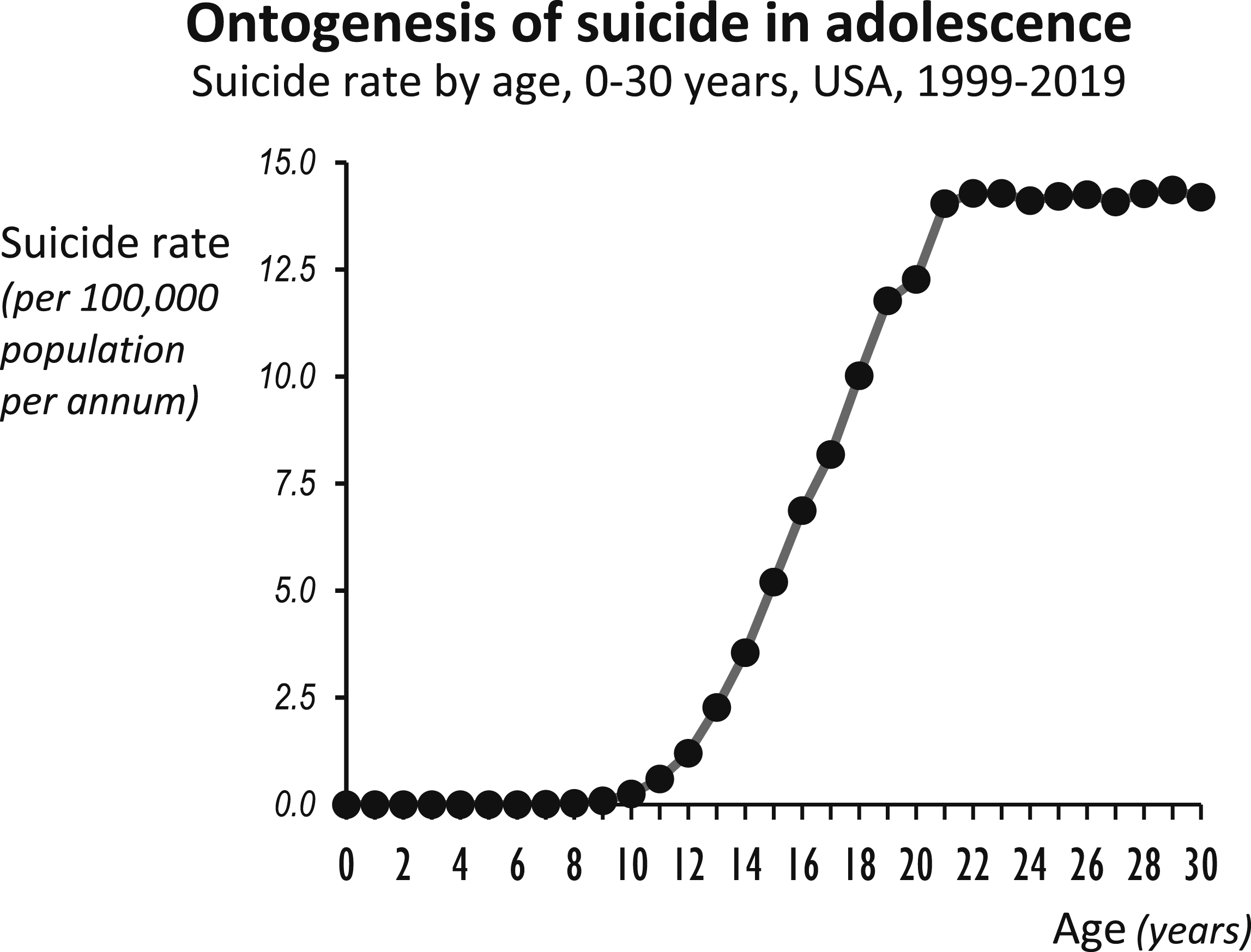
Regarding this remarkable transition, IPTS is mute. As Joiner et al. (2021) acknowledge, the theory does not preclude the very young from intentionally killing themselves, provided they meet its criteria. Yet it is hard to argue that the developmental discontinuity is explained by IPTS’s conditions, since these lack an obvious step change that would tally with the observed pattern. Bypassing the anomaly, Joiner et al. (2021) appear to deny that there is a discontinuity to explain; they allude to an “above-zero occurrence but relative rarity of suicidality in young children” (p. 4, emphasis added), leaving the zero occurrence and absolute rarity of suicide unaddressed. This is a doubtfully tenable position. It is true that preschoolers can sometimes talk and act in disconcerting, but non-lethal, ways that may fit researchers’ notions of “suicidality” (Luby et al., 2019); but this is not suicide. Very rarely around the world there are officially recorded suicides of young children, where the cause of death was registered as “intentional self-harm”, such as of two 5-year-olds in Italy (Pompili et al., 2012). But even with these outliers, Figure 1 represents a clear and ubiquitous human pattern (Borges et al., 2012).
In the absence of a better explanation, it seems likely that, on reaching a certain stage of cognitive maturation, children cross the same intellectual Rubicon that our species can be presumed to have crossed in the ancestral past—a threshold at which intentional self-killing suddenly becomes conceivable, and therefore enactable (Soper, 2018). For younger children, death generally, personal mortality, and the possibility of self-accomplished death in particular, are conceptual abstractions too complex to be meaningfully mentalized (Cuddy-Casey & Orvaschel, 1997; Soper, 2018). Beyond the intellectual threshold, in contrast, suicide presents an endemic hazard, with a more-or-less steady minority of humans acting on their suicidal thoughts. In this light, the capability for suicide is acquired, but not in the exceptional way envisaged by IPTS; capability is primarily a matter of cognitive access, which emerges spontaneously in the course of regular childhood development. Thus, contra IPTS, suicides in early adolescence are characterized not only by troubled interpersonal backgrounds, but by the youngsters’ precocity (Shaffer, 1974). Equally problematic for IPTS is an observation made by Baechler (1975/1979); that cognitive incompetence parsimoniously explains not only the virtual non-existence of suicide among young children, but also its extreme rarity among intellectually incapacitated adults (Tromans et al., 2020), and the apparent immunity of nonhuman animals (Preti, 2018; Soper, 2021).
In sum, the simplest explanation for suicide’s adolescent ontogenesis lies outside of IPTS. An ultimate reinterpretation of the desire-capability model—pain-brain theory (Soper, 2018, 2019a, 2021)—points to the crossing of an intellectual threshold, both ontogenetically and phylogenetically, after which suicide presents a cognitively accessible way for humans to relieve painful affect. It suggests, contrary to IPTS, that every normal human adult may be capable of suicide.
Causation
Tinbergen’s (1963) question of proximate causation boils down to “How does it work?” On this, again, IPTS is silent. Flow diagrams have been presented, many correlations reported, and much has been written (e.g., Van Orden et al., 2010), but it is nowhere stated explicitly by what mechanism the posited inputs are supposed to control the posited output. Proximate causation for suicide is claimed, but not explained.
Whether there is in fact a mechanistic link is open to reasonable doubt, not least because of two-way missing specificity (Soper, 2019b). In one direction, IPTS’s conditions are not specific to suicide; Joiner and colleagues conceive, for example, that a putative “capability remains protective for some people, including in the midst of suicidal crises, yet it may become a significant danger for others” (Chu et al., 2017, p. 1333). Nor, in the other direction, is suicide specific to IPTS; “[t]he theory does not propose that thwarted belongingness and perceived burdensomeness are the only paths to suicidal desire” (Van Orden et al., 2008, p. 80). Causal haziness may be inferred from Joiner and colleagues’ indecision, outlined in the introduction above, concerning the conditions’ number, definition, and logical function—perhaps sufficient, or necessary, or both, or neither. In Lakatosian terms (Lakatos, 1976), the question arises whether ad hoc amendments—such as “burdensomeness” extended to include “self-burdensomeness” (Joiner et al., 2016), or “acquired capability” extended to just “capability” (Chu et al., 2017)—in response to new and troublesome evidence, may be taken as progressive or degenerative for IPTS as a research program (Joiner et al., 2021). Empirically, non-specificity may be inferred from what are only modest-to-weak statistical associations between IPTS’s constructs, whether singly or in combinations, and various measures of suicidality (Chu et al., 2017; Large et al., 2021; Ma et al., 2016; Ribeiro et al., 2021). It is fair to conclude that suicide can occur in the absence of IPTS’s conditions, and many people who fulfill them find other solutions.
This failure to couple explanans to explanandum is not unique to IPTS. It follows a pattern in suicide research that Atkinson (1978) called out decades ago, then in the context of the sociological theorizing of the time: a characteristic feature of such works…is the failure to explain why suicide in particular, rather than some other course of action, is a likely consequence of the particular…condition posited as the independent variable (pp. 14–15).
The explanatory gap also reflects in a decades-long empirical failure to identify usefully accurate predictive markers (Soper, 2019b). Despite an exponential growth in research, with increasingly sophisticated techniques and larger-scale surveys, the result, in terms of predicting suicide at the level of the individual, remains a steadfast nil (Paris, 2021). IPTS’s constructs forecast suicidal behavior no less inaccurately than do hundreds of other correlates; that is, no better than chance (Carter et al., 2017; Franklin et al., 2017; Zortea et al., 2020). Incontrovertible disproof often being hard to secure, there may always be scope to call for more, and more rigorous, empirical testing of any suicide theory, IPTS included (e.g., Joiner et al., 2021; Ribeiro et al., 2021). But the history suggests little prospect of a change of fortune. More recent surveys achieve no better predictive success than older ones, and no basis has yet emerged even for narrowing the search space (Franklin et al., 2017). IPTS’s failure is outstanding perhaps only inasmuch as usefully accurate prediction—sensitivity and specificity—was what the theory was explicitly advanced to deliver (Joiner, 2005; Van Orden et al., 2008).
Desire-Capability as an Ultimate Explanation
In view of science’s longstanding inability to pin down proximal causation of suicide, as exemplified by IPTS, it may be time to study the possibility, indeed likelihood, that causation at this level may not be open to discovery (Soper, 2019b). The primary source of uncertainty increasingly looks to be not epistemic, but aleatory; more information does not help (Corke et al., 2021; Taylor et al., 2021). By analogy, before betting on a number in a game of roulette, one can make actuarial assessments of probabilities. Knowledge of the construction and tendencies of the ball and wheel might influence those calculations. Yet outcomes at the level of an individual spin will resist reliable prediction. Better data and finer methodology cannot, even in principle, overcome the behavior’s intrinsic non-predictability. Individual suicides may likewise be constitutionally opaque to usefully accurate prediction or proximal explanation (Lester, 2019a; Soper et al., 2022).
The desire-capability hypothesis—as an ultimate, not proximate, explanation—should lead us to expect this fundamental randomness. With the motivation and capability for suicide combining to create a recurring, lethal, fitness hazard since ancestral times, it is necessary to consider how natural selection would have responded. What defensive adaptations have arisen to deal with the threat? It is likely that humans are equipped with evolved psychological machinery that seeks to avoid deliberate self-destruction. Its biological algorithm, refined over an evolutionary timescale, will be attuned to identify and exploit any and every actionable marker of suicide risk that is detectable at the level of the organism. By responding to those markers, averting suicidal death as far as is practicable within a trade-off of opposing fitness costs, the module will exhaust the information’s predictive utility. Suicides can be understood as statistical residuals: they occur precisely because they are not preceded by usefully predictive cues (Soper, 2018, 2019b, 2021).
If this analysis is correct, Tinbergen’s question of proximate causation does not concern supposed mechanistic processes that produce suicide. These, if they exist at all, will be as inscrutable as the chaotic vagaries that cause a roulette ball to settle on one number instead of the next. The matter of mechanistic control primarily concerns the operation of evolved, special-purpose, protective devices.
Science has hardly begun to explore anti-suicide adaptations, or even to acknowledge that they may exist. Suicidology’s vision may be impaired in this regard by a prevailing but unfounded assumption; that protection is afforded by a “survival instinct” (Hames et al., 2012, p. 1), “instinct for self-preservation” (Joiner et al., 2017, p. 242) or similar turn of phrase—referring to a supposedly innate general-purpose drive that is imbued in all life forms and which suicide flouts. A “survival instinct” is explanatively empty (Chandler & Proulx, 2006), unevolvable (Soper, 2019b), and, being a saw of pre-Darwinian “folk” biology (Joiner, 2010), questionably germane to a 21st-century scientific enquiry. Yet it features as a foundational tenet of IPTS (Joiner, 2005; Joiner et al., 2009; Stanley et al., 2016) and is invoked matter-of-factly elsewhere (e.g., Bering, 2018, p. 112; Hooley et al., 2020, p. 101; Nishanth & Jha, 2021; Nock et al., 2019, p. 258; O’Connor, 2021, p. 80; Zalsman, 2021, p. IX).
Evolved protections against suicide should also not be confused with multitudinous special-purpose systems that seek to prevent fatal mishap, although the two domains are sometimes conflated (e.g., Klonsky, Dixon-Luinenburg, & May, 2021). It is worth dwelling on this point, because it is important and easily missed. Evolved mechanisms, deploying fear, pain, disgust, and other aversive stimuli, no doubt usually keep humans and other animals from inadvertently killing themselves. As Joiner and colleagues observe, “the body is generally not designed to cooperate with its own early demise” (2009, p. 636). Deliberate self-killing thus requires resourcefulness. But there are least four reasons to believe that evolution will not have left the task of suicide prevention to devices that were designed for other purposes.
The first is a theoretical point. Accidental and intentional self-destruction are categorically different classes of fitness threat, which, following an evolutionary principle of special design (Williams, 1996), call for categorically different responses. By analogy, a bridge or platform can be designed straightforwardly so as to forestall accidental falls; but creating barriers that cannot be removed, cut though, climbed around, or jumped from is an altogether different engineering challenge (Rezaeian, 2020). Likewise, a biological anti-misadventure system may, for example, make self-hanging difficult while one’s feet are on the ground, as Joiner relates from one attempter’s account: “every time I started to lose consciousness, I’d just stand up” (Joiner, 2005, p. 51). But the mechanism that impedes this method of self-strangulation will do little to save people who willfully hang themselves from a height. Suicide calls for a special preventative solution.
Second, empirically, occasional anecdotes circulate of nonhuman animals purportedly “committing suicide” (Pallardy, 2021), enough to suggest that physiological protections are not, in fact, too difficult to override. It is doubtful whether such deaths are really suicides—intended outcomes—but they do indicate that defenses against accidental self-destruction are not failsafe even for nonhumans. They would be even less failsafe for intellectually capable humans determined to exploit their weaknesses. The large number of humans who do take their own lives (703,000 annually, or 1.3% of deaths; W.H.O., 2021) suggests that this is indeed the case.
Third, evolution works opportunistically. The severity of suicide as a fitness threat sets up a strong impetus for blind variation and selective retention to exploit biologically available countermeasures. If opportunities existed to contain the risk of suicide, they will automatically have been found and seized, like frost finds cracks in a rock surface and prizes them open. Desire-capability as an evolutionary framework implies the existence of such opportunities, not in directly blocking multifarious self-destructive end behaviors, but in tactically moderating their common desire (“pain”) and capability (“brain”) precursors, especially at times of heightened risk. Organismic defenses will take the form of special-purpose evolved psychological mechanisms that make proximal use of suicide’s ultimate, evolutionary drivers (Soper, 2018, 2021).
Fourth, suicide has posed an adaptive problem over an evolutionary timescale, long enough for special-purpose defenses to evolve. Firearms, pesticides, and carbon monoxide are recent additions to the human repertoire of self-destruction; but not unfaceably painful methods, beyond the reach of physiological defenses to control, have always been available to those bent on taking their own lives—by hanging, arrow shot, jumping, drowning, naturally occurring toxins, and so on. Deliberate self-killing is reportedly widespread, seemingly ubiquitous, across pre-literate societies (Steinmetz, 1894; Zilboorg, 1936), suggesting that suicide has presented a special, recurring, and severe fitness threat throughout the ancestral history of our species.
All this points to evolved protections against suicide taking the form of custom-designed psychological devices. It is possible, therefore, to predict some of their features, based on what is known or can be inferred about the adaptive problem they arose to solve (Soper, 2018, 2021). For example, because anti-suicide defenses would bring no fitness benefit to any other species, they would not be selected; so, they will be found only in humans. Because they would serve no useful purpose before the developmental stage when suicide emerges, we should expect their earliest activation to be scheduled accordingly, in adolescence. They should be precipitated by protracted psychache, of whatever origin; and deactivate, albeit cautiously, following its relief. They will automatically, tactically, and sometimes drastically, disrupt motivational and intellectual faculties, usually enough to stop suicidal ideas from escalating into lethal actions. Soper (2018) advances a score of such predictable parameters.
As for how anti-suicide defenses reveal themselves, psychiatry has put forward several proposals. These deserve attention, not least because, although formulated apparently independently and over many decades, they follow a theme (Soper, 2018). The connecting thread is that some common forms of psychopathology—a prominent correlate of suicide—may not be, as is widely assumed, a simple causal driver (Mishara & Chagnon, 2011). Some psychiatric syndromes may be understood as the organism’s alternative to suicide, or suicide-prevention machinery in action, properly responding to—and often observed alongside—chronic, potentially suicidogenic, psychological distress. This may be the case for major depression (Hendin, 1975); compulsive substance use (Menninger, 1938); non-suicidal self-harm (Simpson, 1976); psychosis (Hundert, 1992); eating disorders (Himmelhoch, 1988); and possibly others (Himmelhoch, 1988; see also Himmelhoch & Ostow, 1986, for manic states). From an evolutionary psychological stance, Soper (2018, 2021) contends that pain-type (moderating the motivation for suicide) and brain-type (moderating the capability) devices would expectably manifest in such phenomena as part of an integrated system of front-line (positive psychological) and rearguard (psychopathological) defenses. He suggests that this shared functionality could parsimoniously explain the extreme comorbidity and many other, otherwise puzzling, cross-diagnostic features of “functional” psychiatric disorders (First & Pincus, 2009; Goldberg & Goodyer, 2005; Marshall, 2020). In the context of calls for a new paradigm in mental healthcare (Leichsenring et al., 2022), this confluence of ideas may indicate a useful new avenue for research.
Joiner and colleagues may be moving in a similar direction. In a series of articles they consider the possibility that depressive symptoms may be protective in blocking the path from suicidal thought to lethal action (Joiner & Stanley, 2016; Rogers et al., 2018; Stanley et al., 2018). As with the research group’s sociobiological speculations (Joiner et al., 2016), they look for cross-species parallels, in this case with pan-mammalian anti-predator defensive systems (Joiner & Stanley, 2016); but this breadth of vision may warrant narrowing. It has been argued in this section that anti-suicide adaptations will be like other evolved psychological modules—special-purpose devices. Joiner and colleagues’ approving citation of seminal evolutionary psychological literature (Öhman & Mineka, 2001; Tooby & Cosmides, 1990) suggests that, in principle, they would concur (Van Orden et al., 2010; Wingate et al., 2006). They may accept, then, that nonhuman adaptations may shed only limited light on what is a specifically human adaptive problem. Other disruptive inferences lie in wait. If the existence of special-purpose protective modules is accepted, then the notion of a general-purpose “survival instinct” becomes redundant. It is questionable whether there would also still be a need for an “acquired capability” for suicide, which was posited as a counterforce to the “survival instinct” (Joiner, 2005). It may also be recognized, as discussed above, that anti-suicide machinery, powered by an evolved algorithm, will have exploited available informational inputs to the extent that there should be no usefully predictive regularities left. Notwithstanding patterns detectable at a population level, suicide emerges as a largely aleatory phenomenon at the level of the individual (Soper, 2019b; Soper et al., 2022).
In sum, Joiner and colleagues’ own research into evolved psychological protections against suicide points toward desire-capability as an ultimate, not proximate, mode of explanation—diverging from, and undermining, IPTS’s core assumption of proximate causation.
Concluding Comments
Tinbergen (1963) posed four interconnected questions that can be asked of a behavior from an ethological perspective; those of evolution, survival value, ontogeny, and proximate causation. Together they form a framework for comprehensively understanding a behavior’s function and dynamics. Advanced as a “comprehensive theory of suicidal behavior” (Van Orden et al., 2010, p. 7), IPTS could be expected to generate robust answers for each. The above discussion finds that it does not. IPTS does not plausibly explain how the behavior would have arisen in the evolutionary past. It does not identify the countervailing survival value that stops suicide from being eliminated by natural selection. It fails to account for suicide’s adolescent ontogenesis. And as an account of mechanistic causation, or a tool for prediction, IPTS has proved no more useful, or no less useless, than other risk-factor-based models. By this light, contrary to Joiner’s et al.,’s (2021) assessment, IPTS does not possess “continuing explanatory reach” (p. 4).
Joiner and colleagues’ investigation into organismic defenses against suicide (e.g., Rogers et al., 2018), on the other hand, may be exploring more fertile ground. This line of enquiry is consistent with an understanding of suicide as an adaptive problem. It implies reinterpretation of the desire-capability hypothesis as an ultimate, not proximal, explanation; humans, as a species, acquired the desire and capability for self-accomplished death in the ancestral past, and have evolved to survive in the presence of this recurrent fitness threat. Pain-brain theory (Soper, 2018, 2019a, 2021), integrating Tinbergen’s four modes of understanding, may be useful in this regard. Pain-brain holds that suicide evolved as a noxious side-effect of human intelligence, which incidentally allows humans to mentalize self-induced death as an escape from pain. The behavior’s adolescent ontogeny reiterates an ancestral phylogenetic transition; a threshold of cognitive competence is crossed, beyond which suicide constitutes an endemic survival hazard. The behavior itself has no survival value; far from it. Survival value lies in the primary adaptations—pain, and mature human cognition—which, when combined, bring suicidality in their wake. Suicide risk is managed by evolved psychological machinery that responds to whatever actionable markers of danger are available to the organism, stops predictable suicides from occurring, and thereby exhausts those markers’ predictive utility. Thus, suicides that do happen are an aleatory residue, devoid of identifiable proximate causation.
This biologically coherent framework offers a much-needed reconceptualization of suicide and its causes. It may not find ready acceptance, not least because its prediction of individual-level randomness promises no easy solutions in suicide prevention. However, it is increasingly hard to ignore the possibility that a continued search for proximate linear causation in suicide (“suigiston”; Soper, 2019b) may be a misguided endeavor. There may be no mechanism, even in principle, by which supposedly “at risk” people can be picked out with useful accuracy.
This conclusion is not as bleak as may first appear. The pain-brain stance invites a paradigmatic change of perspective that could bring far-reaching benefits in mental healthcare (Soper et al., 2022). By relocating “fault” for suicide outside of the individual—as a universal “occupational hazard of being human” (Soper, 2019a, p. 468), as opposed to a personal derangement or dysfunction—the framework offers a way to de-sting the shame and stigma that accompany the phenomenon. By predicting suicide’s intrinsic non-predictability, it may assuage the guilt that often besets the bereaved (Ajdacic-Gross et al., 2019). It could help to move the focus of suicide prevention towards more productive strategies; away from interventions led by ineluctably inaccurate and arbitrary judgments of individual risk, towards means-restriction and other community-wide measures (Bryan, 2022; Soper et al., 2022). And it suggests, positively, that the human psych is precisely adapted to manage its own risk. The research effort in suicide prevention could fruitfully seek to understand, and co-operate with, the evolved special-purpose mechanisms that successfully keep nearly all of us, nearly always, safe from willful self-destruction.
Footnotes
Declaration of Conflicting Interests
The author(s) declared the following potential conflicts of interest with respect to the research, authorship, and/or publication of this article: The author receives book royalties.
Funding
The author(s) received no financial support for the research, authorship, and/or publication of this article.
