




Abstract
This qualitative study examined teachers’ experiences dealing with bereaved students following the death of a parent. The researchers conducted in-depth, semi-structured, face-to-face interviews with 25 teachers in Israeli schools who had counseled one of their students after the death of a parent. The interviews were recorded and transcribed and underwent content analysis. Analysis of the findings revealed that the teachers felt helpless, confused, overloaded emotionally and anxious when counseling students who had lost a parent. In addition, the teachers discussed the complex nature of their relationship with the remaining parent, ranging from a desire to support the family through avoidance for fear of hurting the parent to fears of being overwhelmed by the child’s problems. Many teachers mentioned their need for support from school officials.
Grief Among Children and Adolescents in the Wake of a Parent’s Death
The death of a parent is bewildering and disturbing for young children (Bergman et al., 2017). Approximately 5% of children in Western countries are liable to lose a parent before high school graduation (Ellis et al., 2013; Haine et al., 2008; National Center for School Crisis and Bereavement, 2010; Stroebe et al., 2007; Tamborini et al., 2011).
According to numerous studies, children and adolescents may have varied responses to the loss of a parent, among them sadness, shock, confusion, helplessness, self-blame, anger, regret, anxiety and loneliness (Andriessen, Mowll, et al., 2018; Balk, 2014). These children may try to conceal their emotions or be reluctant to share them (Andriessen, Hadzi-Pavlovic, et al., 2018). The loss of a parent upsets the family balance and undermines the basic support children require for their continued development. Grieving children tend to be preoccupied with thoughts and fantasies about how things would be if the parent were still alive (Biank & Werner-Lin, 2011). The death of a parent shatters children’s illusion that their parents are all powerful as well as their expectation that their parents will always be there to protect them. Indeed, the basic foundations of the child’s world are undermined and disappear, affecting the child’s future development (Flahault et al., 2018). The death of a parent also raises questions about the child’s relationship with the remaining parent, who often finds it difficult to cope with his/her own pain and bereavement and more so with the child’s pain. Thus the child becomes even more dependent upon the remaining parent, whose presence or absence becomes crucial. Indeed, the child is often faced with a double death: the physical death of one parent and the mental death of the other parent (Corr et al., 2018). Parents exert a major influence on a child’s sense of security, such that the death of a parent has a major impact on a child’s continued development (Bergman et al., 2017; Rosenberg, 2015).
Most children who have lost a parent are able to adapt to their loss over time without serious problems (Akerman & Statham, 2014; Feigelman et al., 2017). Nevertheless, bereaved children are at elevated risk of negative emotional outcomes, including the possibility of developing depression, anxiety, post-traumatic stress disorder, somatic complaints and behavioral problems (Akerman & Statham, 2014; Appel et al., 2019; Dowdney, 2008; Feigelman et al., 2017). Children who have lost a parent reported difficulties expressing sadness and grief, feeling isolated and different, experiencing problems at school and being afraid of losing the surviving parent (Appel et al., 2013, 2019; Berg et al., 2016; Dyregrov et al., 2015; Grenklo et al., 2013; Hamdan et al., 2013; Høeg et al., 2017; Rolls & Payne, 2007).
From the social perspective, research on the consequences of childhood trauma found that traumatized children may be self-protective and avoid intimate contact with others. Fearing that revealing their pain and distress will burden others, they become suspicious, stubbornly defend themselves and become unapproachable (Dopp & Cain, 2012). Moreover, children who underwent loss and trauma are preoccupied with conflicts at home and at school, have difficulty trusting others and fear betrayal in their interpersonal relationships (Cohen et al., 2012). A 2014 cohort study of 7,72,117 people in Sweden showed that those who had lost a parent as children were up to twice as likely to have failed elementary school as those who had not (Berg et al., 2014). Another cohort study of about one million students in Denmark reported that students who had lost a parent had lower achievements than those who had not. The parent’s gender, cause of death and child’s age at the time of the parent’s death did not change the results (Høeg et al., 2019). Bereaved adolescents are liable to take up risky behaviors such as smoking, drinking or fighting, particularly during the first years after the loss (Feigelman et al., 2017; Hamdan et al., 2012). Adolescents who lost a parent have higher long-term risks of psychiatric problems, attempted suicide and violent behavior (Berg et al., 2016; Jakobsen & Christiansen, 2011; Wilcox et al., 2010). Moreover, children who lost a parent may exhibit somatic symptoms, with their grief manifested in headaches, muscle aches, sleep disorders, nightmares, loss of appetite and impaired functioning of the immune system (Koehler, 2010). With respect to their education, traumatized children may exhibit cognitive problems, including dysfunctional thinking patterns, academic problems in school and attention deficit problems (Berg et al., 2014; Cohen et al., 2012).
How Teachers Cope While Counseling Students After the Death of a Parent
School plays a major role in a child’s life. School can serve as an important anchor point, facilitating adjustment during traumatic times when family members are having trouble being available and providing sufficient support (Abdelnoor & Hollins, 2004). The educational staff, and primarily the teacher, can help these bereaved children by providing support and responding to their needs (Lowton & Higginson, 2003). Educating children to normalize their grief is pivotal in helping them cope effectively and manage their feelings (Levkovich & Duvshan, 2020; Botha et al., 2009; Schreiber et al., 2017). Hence, teachers who are available for their students and sensitive to their needs can play a significant role in helping them adapt to their new reality (Lane et al., 2014). Yet despite the teachers’ empathy and their natural desire to help, many feel they lack the necessary skills and training to do so (Levkovich, & Duvshan, 2020).
During the course of any given school year, teachers are likely to encounter children who are grieving over the loss of a parent. Nevertheless, evidence points to deficiencies in teacher training, preparation and motivation in responding to such situations in the school environment (National Commission on Children and Disasters, 2009; Levkovich, & Duvshan, 2020). Some teachers may feel that neither their training nor their experience has sufficiently prepared them to support and counsel grieving students (Busu & Luchici, 2016; Lane et al., 2014).
The school setting is very important as a system of support and protection for grieving children. Sometimes the grieving family is less available, so that the children tend to express their sense of loss at school (Eppler, 2008; Gülay et al., 2016). Ongoing stability is crucial for children to develop personal resilience. Since the child’s home has undergone significant changes, the school plays an important role in providing a suitable response to the child’s needs. Indeed, school can serve as a stable and safe place for grieving children, thus bolstering their inner strength and resilience (Dyregrov et al., 2013; Hope & Hodge, 2006; Stylianou & Zembylas, 2018). A study conducted in Norway found that educators were aware of the needs of their students who were mourning the loss of a parent. These professionals did not consider mourning to be a transient event that children should or would easily forget and they were aware of the importance of showing empathy for these students. This attitude on the part of the professionals helped students cope better with their grief and develop personal resilience (Dyregrov, 2008).
Many children tend to experience short- or long-term difficulties upon returning to school after the loss of a parent (Lytje, 2018A). The teachers and the entire educational staff can support these children, respond to their needs and help them normalize their grieving so they do not feel different (Heath & Cole, 2012; Lohan, 2006). Teachers play a central role because they are personally acquainted with the students and available to meet their needs. As an adult who is closely acquainted with her grieving students, a teacher can offer a structured interpretation of the trauma to help these children cope (Busu & Luchici, 2016; Lane et al., 2014). Studies have indicated that teachers recognize grieving students’ need for support and see themselves as the one these students can turn to (Alisic, 2012; Kahn, 2013; Lane et al., 2014). Yet some teachers expressed a lack of confidence, uncertainty, fears and concerns about providing support to grieving students (Alisic, 2012; Kahn, 2013). They were afraid to say the wrong thing, felt they did not have sufficient knowledge about how to handle death and feared they were intruding on the student’s grief (Lane et al., 2014). Teachers encouraged students to seek additional support from school counselors, charitable organizations, priests and mental health services (Lane et al., 2014).
Alisic (2011) interviewed 17 teachers from the Netherlands regarding their perspectives on supporting traumatized children. She found that several teachers wondered where their responsibilities as teachers ended and those as social workers or psychologists began. Teachers also struggled to find a balance between the needs of individual children and those of the entire class. Papadatou et al. (2002) asked 1,810 teachers to complete a questionnaire regarding their perceptions and experiences while providing support to grieving students. Almost half the group (45%) claimed they avoided the topic of death because they felt frustrated and helpless and did not know how to respond to a bereaved child.
The above review highlights the difficulties encountered by educational staff members in general and by teachers in particular when counseling students who have lost a parent and underscores the major importance of school as a protective and supporting environment for these children and their families. In view of these factors, this study sought to provide a deeper understanding of the perspectives of teachers who counsel students after the loss of a parent, to make the teachers’ voices heard and to examine their experiences in coping with grieving students.
Methodology
This study used the qualitative-phenomenological approach that aims to understand people’s behaviors and experiences through observations and in-depth interviews (Creswell & Poth, 2018). The qualitative-phenomenological research approach is useful for studying sensitive topics that involve participants’ self-disclosure. The descriptive power of this approach can provide an in-depth understanding of the teachers’ perceptions regarding the support and counseling they provided to bereaved students. Such research is based on small samples that include a limited number of ‘information-rich’ informants, where depth is exchanged for representativeness (Brinkman & Kvale, 2015; Creswell & Poth, 2018; Frankfurt-Nachmias et al., 2015).
Participants
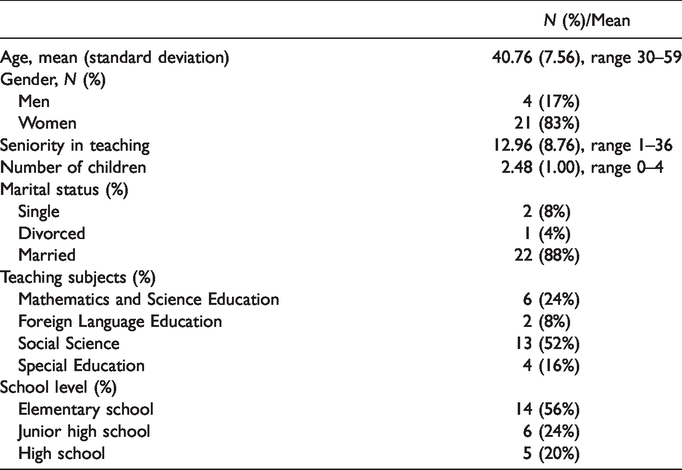
A total of 25 teachers aged 30–59 years were interviewed. The sample included 21 women and four men, reflecting the predominance of women in the teaching profession. We used purposeful sampling to obtain variability in the teachers’ experiences while providing support to bereaved students.
The inclusion criteria for the study were Hebrew speakers who work in the education system at the elementary through high school levels and have counseled a student who lost a parent during the last two years. The majority of respondents were married (n = 22, 88%), one was divorced (4%) and two were single (8%). They had an average of 12.96 years of teaching experience (range 1–36). About half were elementary school teachers (56%), one-quarter worked in junior high schools (24%) and a fifth taught in high schools (20%) (Table 1).
Research Procedure
The study was approved by the Ethics Committee at the principal investigator’s university. Data were collected via face-to-face structured personal interviews at the respondents' homes (Creswell & Poth, 2018). After receiving a brief explanation of the study and assurance of confidentiality, each participant signed a letter of consent to participate. Graduate students who had been specially trained by the researcher and given feedback on their interviewing style conducted the interviews. The interviews were conducted in Hebrew and lasted approximately one hour. Each interview was recorded and later transcribed verbatim. Data collection proceeded until theoretical saturation was reached (i.e., additional interviews yielded no new material for the analysis) (Brinkman & Kvale, 2015). The data were analyzed after all the interviews were completed. Identifying details were changed to preserve the participants’ confidentiality.
Research Instruments
The in-depth, semi-structured interviews were conducted based on an interview guide that included significant key areas but was flexible enough to allow for a dialogue to develop between interviewer and interviewee and for meaningful self-expression (Brinkman & Kvale, 2015). The interviewers encouraged participants to narrate their stories from a reflective perspective (Frankfurt-Nachmias et al., 2015). The interview guide covered several content categories, including coping with grief and bereavement, counseling families that have experienced loss, the school as a source of support for children who have lost a parent, and personal connections to the topic of loss. Sample questions include: How did you learn about the loss? Share your emotions, thoughts, and behavior at the time. What impact did the loss have on the student’s functioning? Tell me about your relationship with the student’s family after the loss? What are the school’s procedures in cases of the death of a parent? What support and guidance did you receive when working with the child and his/her family? For you, what is the most significant part of counseling a student who has lost a parent? How can you advise other teachers who must deal with such situations?
Data Analysis
Thematic content analysis entailed several phases. Transcripts were read and analyzed by the research team made up of the primary investigator and a research assistant. After reading all the interviews several times to achieve immersion and obtain a sense of the text as a whole, the team broke them down into smaller parts or units of meaning. The researchers read each interview transcript line by line, jotting down notes to capture and identify initial units of meaning emerging from the data and to allow subthemes to flow from the data. After the researchers considered variations of similarities, the parts were then gathered into clusters and the units of meaning were converted into abstractions using more scientific language. The researchers then reviewed and discussed the larger themes. Next, the researchers grouped the statements into units of meaning or themes represented by quotes that exemplified the participants’ experiences and perceptions. During the analysis, the researchers engaged in ongoing dialogue and sought agreement on their interpretation of the lived experience. The core themes that emerged from the data were reordered conceptually and placed back into context, facilitating the analysis and integration of large amounts of data and the generation of abstractions and interpretations. The researchers then examined these themes, looking for similarities, differences and connections among them.
Results
Analysis of the qualitative interviews yielded three main themes:
“I Don’t Know What to Say and I’m Afraid of Making Matters Worse”: How Teachers Cope With Students Who Lost a Parent
All the participating teachers felt they had played an important role in working with students who had lost a parent. While they believed it was crucial to respond to these students, they were not sure of the extent of their role. The teachers expressed difficult and complex feelings about their students’ loss and grief and admitted to feeling helpless in dealing with the situation, as well as surprised, shocked, frustrated and even insecure. They felt unsure of what to do and how to deal with such a situation. In addition, the teachers expressed concerns about getting hurt, being overwhelmed by the child’s troubles and longings, and being able to cope with difficult topics that might arise. It seems that the teachers’ feelings ranged from a desire to support and help their students air their emotions and speak openly to a sense of not knowing how to accomplish this. The teachers debated about how much they should talk to the students about their bereavement and loss, whether they should share their own personal losses and what was the right time for such talks. It was very hard, I did not know what to do, and in all my years of teaching this had never happened to me, that a girl from my class lost her mother … It’s a disaster … I do not know what to say and I’m afraid to make things worse. Maybe I’ll offend her, maybe I’ll cause her further harm. I’d rather not. The father wanted me to tell the children the bitter news together with him. I had no choice but to agree. I could not refuse him, but it was very difficult. I was broken inside. I am neither a counselor nor a psychologist. I’m always worried that maybe I’m not doing enough, maybe he needs more things from me that I cannot give him … I wonder whether what he’s going through is normal. And what do you do with the other kids who are exposed to all kinds of talk about death and cemeteries and the like. They should not have to be exposed to this.
On the one hand, the teachers expressed a desire to support and help the remaining parent and to acknowledge and make concessions for what the parent is going through. On the other hand, the teachers wanted to avoid burdening the surviving parent further and were worried about causing more harm. The teachers were concerned about being unable to reach the remaining parent or worried that the parent would not be open to sharing and discussion. Moreover, they felt they lacked the tools and knowledge to converse with the remaining parent and support the family. I know the father has a lot on his plate. He works very hard to raise the girls. I don’t need to add to his burden … I try talking to him about the good things, tell him that N. is mature, works well in class, is smart and responsible. But he always seems withdrawn to me and doesn’t let me in on what he is going through. I try to contact him periodically, to update him on the child’s situation, but he does not want to hear about what’s happening at school, claiming he is not interested. He seems to be busy merely surviving. He has to learn to raise his children, something he has not been involved with for many years.
“It’s as If a Tsunami Washed Over the Island and You Are the Only Survivor”: The Challenges Posed by the School Environment When Teachers Must Cope With Parental Death
The teachers reported that when a student at the school loses a parent, the entire educational staff becomes overwhelmed with confusion and emotional turmoil. In such cases, their own troubles are to some extent legitimized and their sense of loneliness dissipates. Some mentioned a sense of great chaos and lack of control. The teachers described their own troubles and confusion upon being informed that one of their students lost a parent. At the same time they spoke about coping with this situation together with the principal and the school’s counselling staff. They expressed relief that they did not have to cope with the situation alone and were thankful for all the support they received from the system. They felt relieved and more confident in working with the student when they were backed up by their superiors. When I met with her, she looked like an injured baby bird to me. It was heartbreaking to see her like that. I was lucky that I was not alone with her, that I insisted that the counselor accompany me because I just could not get a word out of my mouth … I just hugged her. So many times I said that the girl is lost, she needs help, and I do not know how to help her … But no one was impressed by this … The principal told me: ‘Do your best to include her.’ Does she really think it’s that simple? I don’t know where to start at all, yet it seems that everyone expects me to control the situation and to manage on my own. For the most part I act according to my feelings rather than following any systematic pattern. It’s not like I’m a professional or a psychologist and I know how to conduct myself professionally … I do what seems right to me and is appropriate for the girl. Yes, I speak with the counselor regularly. In general, our conversations are about the class, but if something about the girl comes up, then we talk about her. The counselor tells me I do not need to force her to say anything, just be there for her and acknowledge her difficulties. So, that’s what I try to do.
“I Take the Pain Home With Me and Can’t Find a Place for Myself”: Personal Consequences of Parental Loss on Teachers’ Lives
The participants dealt with their emotions by relying on their professional role and maintaining emotional distance. Some participants described an urge not to show their emotions and to be strong within their professional role. Yet not expressing emotions may be difficult and have a negative effect. All the participants expressed great pain, sorrow and despair that remained with them after school hours and infiltrated their personal lives. This pain was accompanied by many thoughts about the parent’s death and the student’s current condition. Some of the teachers indicated that this feeling continued to haunt them even months after the loss, making it difficult for them to return to normal. They were overwhelmed by parental concerns about the student and constantly thought about the student in different situations on a daily basis. In the interviews, the teachers raised concerns about their students who had lost a parent. They were distressed and fearful about the children’s fate and about how they would continue to function without the parent. It’s hard, very hard. I think about the girl all the time. I keep thinking about her when I’m at home as well. If there’s a TV show about families or small children who are with their mother or even when I’m cooking, I suddenly remember her … I wonder who cooks for her. I think I have already developed a kind of an armor … I try to keep myself separate from what is happening, to make room for my students and also to protect myself … If each of them left a mark on me, I would not survive in this profession… A lot of sadness, worry. I feel overwhelmed. I go home with the pain and find no place for myself. Sometimes I get scared, too, that this might happen to me or someone close to me … How do you live without a mother? I cannot imagine it. My mother is the closest person to me, God forbid, if something were to happen to her. I cannot think about it. Enough!
Discussion
This study examined teachers who had counseled students in their class after the death of a parent. These teachers felt they played an important role in helping these students. Nevertheless, they were insecure about their ability to provide support, debated over whether they should tell the students about their own personal losses, and wondered about the limits of their responsibilities. In addition, the teachers felt they did not have sufficient assistance, guidance, or support. They described the emotional effects of counseling students who lost a parent, reported that their concern for these students spilled over into their private lives, and raised concerns about their own personal losses.
In the current study, the teachers expressed a wide range of emotions, among them confusion, helplessness, fear, anxiety, anger, depression, guilt, and sorrow upon hearing of the loss of their students’ family members (Bușu & Luchici, 2016; Cohen et al., 2012). The teachers recognized that students who had lost a parent were in need of support and saw themselves in a position to provide that support. Nevertheless, they felt unqualified for this task and were afraid of making mistakes or causing harm. This finding is in line with previous studies showing that education personnel lack confidence and are not trained to deal with grief and loss (Alisic, 2011; Levkovich & Duvshan, 2020; Busu & Luchici, 2016; Case et al., 2020; Lane et al., 2014; Lowton & Higginson, 2003; Morell-Velasco et al., 2020). Among teachers who provided support to bereaved students, more than 90% reported they lacked confidence (Papadatou et al., 2002).
A special unit of the Israel Ministry of Education known by the acronym SHEFI (Educational Counseling Services) is devoted to preparing the education system to cope with various forms of student crises and emergencies. SHEFI employs 80 district counselors across Israel and has extensive resources for developing relevant intervention programs, including grief intervention (Ministry of Education, 2020). Nevertheless, only some of the teachers in the current study received support and guidance from the local school counselor and none of them received help from SHEFI. Clearly the teachers’ unfamiliarity with the topic of mourning and loss and their lack of outside support make it difficult for them to provide effective responses to bereaved students (;Levkovich, & Vigdor, 2020; Busu & Luchici, 2016; Lane et al., 2014). This may also explain the teachers’ sense of inadequacy and confusion. Without sufficient professional knowledge, these teachers feel they must navigate through a foreign land based only on their gut feelings or their personal beliefs (Hart & Garza, 2013). The teachers in the current study were concerned about the possibility of causing harm and were unsure when and how to talk to the bereaved student. Their perceptions of their job as teachers conflicted with their sense of obligation to help the bereaved student.
Previous studies found that many teachers are concerned about the change in their job definition when dealing with cases of parental death, including their increased workload resulting from the school’s expectation that they serve as case manager in helping these children (Alisic, 2012; Dyregrov, 2009; Lane et al., 2014). Coping with a student who has lost a parent raises questions regarding how to balance the pedagogic task of teaching with the need to meet the emotional and social needs of the grieving student and those of the other students in the class (Alisic, 2012; Ko et al., 2008; Lane et al., 2014). Teachers seek a clear definition of their roles and prefer to allocate the “emotional” aspects to those trained to do so (Papadatou et al., 2002). The interviewed teachers were suddenly expected to develop caregiving qualities they felt unsure about, to be inclusive, and indeed to take on the role of psychologist. These feelings may also result from a fundamental change in the “contract” between teacher and student. This change reflects a new social norm, according to which teachers must distance themselves from the traditional role of educator while adopting a more therapeutic role that emphasizes unconditional acceptance of the child along with setting goals according to the child’s own pace. In declaring that they are not counselors or psychologists, the teachers in effect are expressing their fears of this transition and their concerns that their feelings will be exploited. Such concerns also emerged in a previous study by Dyregrov (2009), which examined coping mechanisms among students who had lost a parent and among their teachers. The study showed that the students believed their teachers did not trust them and suspected they would “take advantage of the situation” and indeed a substantial number of teachers did think this way.
The teachers in the current study underscored the importance of communicating with the living parent. Yet they also pointed to the potential complexity inherent in talking about death and mourning. Family systems theory posits that a loss in the family affects all family members, including the surviving parent and the children (McCubbin and Figley, 1983). Such a loss can disrupt family communication, interrupt family routines, and shake up family role relationships. These challenges may affect children’s psychological progress during the grieving process (Chen & Panebianco, 2018).
In a survey of intervention programs for children who lost a parent, Bergman et al. (2017) found that combined help for the surviving parent and for the bereaved child increases the parent’s ability to help the child. When the intervention targeted the child but not the parent, it diminished the child’s symptoms of traumatic grief while at the same time reinforced the parent’s sense of being able to support the child (Kalantari et al., 2012). Thus, an integral part of helping children cope with their grief entails coping with the grief of the surviving parent as well.
The research findings show that teachers who support a child after the loss of a parent must cope with their own fears and anxieties about themselves and their families. They experience burnout accompanied by fatigue and exhaustion, particularly in the face of their professional duties. Avoidance and withdrawal are common responses among caregivers who are exposed to traumatic stories in the course of their work. The trauma reminds adults of their own prior traumatic experiences, thus arousing past feelings of helplessness, distress and emotional detachment (Busu & Luchici, 2016; Lane et al., 2014). Such feelings can be seen as an expression of “secondary traumatization” in which an individual who is not directly exposed to trauma develops secondary posttraumatic symptoms, among them avoidance of stimuli that are reminiscent of the traumatic event, invasive thoughts related to the trauma and ongoing physiological arousal that includes confusion, problems in concentration, and sleep disturbances (Cieslak et al., 2014). The findings indicate that providing teachers organized and systematic support in the area of bereavement and grief and helping them develop their inner resources can help resolve their emotional difficulties. For example, Lytje (2017) found that 81% of teachers who supported students after parental loss in the framework of a governmental program reported that the program gave them a sense of confidence in their everyday lives. Moreover, 65% reported that the program helped them significantly, to the point that they did not need any additional help or support. In a later study, Lytje (2018b) reported that 78% of teachers who used a structured protocol to help students cope with bereavement felt more confident in coping with loss and grief at school.
Furthermore, the literature makes practically no mention of possible grieving on the part of the teacher, who may have been previously acquainted with the parent that died. Disenfranchised grief, a term coined by Doka (1989), describes a loss that is unrecognized and not acknowledged, such that the mourner receives no support and has no religious or social mourning privileges. In addition to the difficulties involved in supporting a bereaved student, some of the teachers may also be grieving for the deceased parent. Yet this grief is neither acknowledged nor supported by the social environment, which does not see expressions of grief on the part of the teacher as legitimate (Levkovich & Duvshan 2020).
Study Limitations
Because this study focused on teachers' perceptions, it is not possible to draw firm conclusions regarding their actual behavior. This study used qualitative and phenomenological methodology to assess how 25 Israeli teachers coped while providing guidance and support to bereaved students in their classes. This method facilitated a deeper understanding of the interviewees’ experiences. Nevertheless, qualitative research is based upon a small sample of participants and therefore its results cannot be generalized to large populations.
Practical Implications
The findings of the current study indicate that teachers are insecure in coping with parental loss and do not know how to talk with bereaved students. Training programs are needed to educate teachers about loss and grief, their helping role and the long-term effects of loss on their students. For example, modern conceptualizations recognize the need to normalize grief and to maintain a relationship with the deceased after death (Klass et al., 2014). The two-level model of loss and bereavement (Rubin et al., 2012) includes conceptualizations of mourning for formulating working principles to support grieving students. According to this model, the grieving process moves simultaneously through two channels: The bio-psycho-social functioning channel places emphasis on the thoughts, feelings and behaviors elicited by the loss. It includes everyday functioning as well as the mourner’s attitude toward the concrete environment. The second channel comprises the emotional relations, thoughts and feelings about the deceased loved one. At this stage, the goal is to integrate the loss into the bereaved individual’s personal narrative to arrive at a point of acceptance. To this end, the adults surrounding the bereaved child must not exclude the child from the grieving process and must enable the child to move forward simultaneously through both channels.
The results of this study suggest that teachers themselves are in need of help after a student’s parent dies. The teachers acknowledged they were not trained to handle such situations and needed assistance in handling the students’ issues in the classroom. Additional professional development in the area of crisis response training would benefit teachers in dealing with grieving students, as would a guidebook outlining how to help these students. We recommend including such training in teacher education programs. Through such programs, prospective teachers can learn about the contingencies of grief among students as well as the guidelines determining the parameters of education and therapy. Finally, the SHEFI government program should provide training and support for teachers who must deal with bereaved students in their classrooms.
Conclusion
The current study sheds light on the experiences of teachers who have had to deal with bereaved students following the death of a parent. These teachers were confused, emotionally overloaded and anxious when counseling students after the loss of a parent. The results of this study highlight that teachers are inadequately trained to deal with grief or to talk with surviving parental caregivers.
Moreover, the teachers are at risk of developing existential fears regarding their own death or that of close family members. In coping with bereaved students, the teachers believe they need more help and support from school officials. Finally, even though the teachers in the study felt inadequate in helping bereaved students, our findings indicate that if teachers are given the proper training and guidance, they have the potential to play a valuable role in helping bereaved children.
Sample characteristics (N = 25).
Footnotes
Acknowledgments
The study was approved by the Ethics Committee of the principal investigator’s university.
Declaration of Conflicting Interests
The author(s) declared no potential conflicts of interest with respect to the research, authorship, and/or publication of this article.
Funding
The author(s) disclosed receipt of the following financial support for the research, authorship, and/or publication of this article: The study was funded by The MOFET Institute (IL).
