



Abstract
This study aims to investigate the phenomenon of suicide, which is a global health problem, by utilizing suicide notes. Our main concern in this article is to understand why a person leaves suicide notes before committing suicide; indeed, this question may shed light on particular personal characteristics of the note-leavers. 12 documents containing suicide notes, belonging to Turkish males, were obtained from Prosecutor office. By using an inductive and interpretative method, firstly, we conducted a semantic level analysis; and subsequently, we deeply analyzed the data by conducting latent level analyses from a Lacanian point of view. At the end of this cumulative process, we labelled the latent themes as ‘ambivalence of emotions’, ‘issues associated with separation’ and ‘issues associated with the Law’. Within the scope of those findings, a diagnostic discussion was provided. This discussion designated a picture of narcissism in addition to a psychotic structure, specifically paranoia.
Suicide is a very common phenomenon around the world; in fact, nearly 800.000 people die due to suicide per year according to the statistics of World Health Organization (2019). Thus, suicide can be evaluated as one of the most important global health problems. In order to investigate the completed form of this phenomenon, suicide notes have been used as tools throughout the years (McClelland et al., 2000; Olson, 2005; Olson et al., 2011; Scourfield et al., 2012; Shneidman, 1998). A suicide note is defined as a document in which a person manifests the intention to end his or her own life (Tumram & Ambade, 2016). The first estimated suicide note in ancient history was claimed to be written on a papyrus, in Egypt. Thomas (1980) deciphered the poems on this papyrus, and he claimed that they “reflect inner fantasy rather than external reality” (p. 285). He added that the owner of the note might have had depressive psychosis. Indeed, suicide notes have been evaluated as notable tools for investigating the act of suicide in terms of studying motivational purposes (Cynoweth, 1977; Ho et al., 1998) and communicational contents (McClelland et al., 2000). Moreover, Shneidman (1981) believed that suicide notes may provide key information about the act of suicide which may help researchers to understand the roots of this behavior even in the cases without a note or letter.
There exists, yet, another issue that signals the necessity to handle suicide notes from another angle, that is, “Why a person leaves notes or letters before committing suicide?” More specifically, while permanently leaving the society and the rules which govern that society, why does a person use words which are the basic units of a language that is also integrated in the societal rules? Our main question here is closely associated with the Lacanian Other. Although this term has been unfolded in various premises such as language, demand, desire, law, unconscious or jouissance (Fink, 1995), we will mainly use it as a signifier of the mOther’s tongue in this article. According to Fink’s interpretation (1995), the Other, which is also known as the big Other, can be explained as an “uninvited intruder” that reconstructs our wishes, but also allows us to communicate about our desires. Specifically, the Other is associated with language. Congruently, Fink (1995) states that Lacan’s phrase L’Autre du language can be translated as “the Other of the language,” “the Other as a language” or “the linguistic Other” (p. 5). Moreover, language is structurally unassimilable; in fact, words exist before we born and they continue to exist after we die.
In terms of Lacanian approach, language is closely linked with the symbolic order and the law. According to Lacan, the subject may get rid of the ambiguous structure of the words by the act of suicide (as cited in Evans, 2006). Concordantly, Zevnik (2016) states that suicide is a way to free one’s body from the tranny of the society; indeed, it is a repudiation of the morality and ethical standards defined by the society. On the other hand, the law, which is the basis for the symbolic order, forbids suicide. Thus, suicide may be evaluated as an act in which the subject abolishes his or her connections with the law, the language and the social bonds. In this sense, it can be claimed that an attempted suicide may have different roots from a completed suicide. In fact, the former implies an invitation or an appeal to the Other; whereas the latter induces a precise separation (Miller, 1985). Accordingly, Lacan associates suicide with his concept named as passage to the act (passage à l’acte) which is the subject’s detachment from the language and the symbolic network. This concept is also defined as “a dissolution of the social bond” (as cited in Evans, 2006, p. 140). Another concept of Lacan, which is named as acting out, stands for “a symbolic message addressed to the big Other” (Evans, 2006, p. 140). Soleim (2012) clarifies the difference between the acting out and passage to the act by claiming “while the latter is an attempt at separation, the former can be read as an appeal that reaffirms the attachment to the Other.” Therefore, an attempted suicide may be evaluated in the scope of acting out; whereas a completed suicide is an example for the passage to the act, in Lacanian terms. Nevertheless, leaving a suicide note before the act is an unfocused issue which needs to be addressed; since, the act of leaving a suicide note can be considered as the usage of language while getting out of it, or as reaffirming the bonds while dissolving them at the same time. Certainly, there is a symbolic message in a suicide note; indeed, it conveys a message directed to other people. It can be claimed that there is a one-way communication in the case of a suicide note because “the note-leaver sends a message but blocks the incoming message and does not receive a message, due to the nature of death” if the suicide is completed (Canbolat, 2018).
In this qualitative study, our aim is to deeply investigate the suicide notes which belong to males who completed suicide. We searched for the note-leavers’ positions in terms of the Other, from a Lacanian point of view. By following two main steps, we analyzed surface and latent meanings in the suicide notes.
Methods
One of the most important elements which differentiates qualitative method from quantitative method is about their separate logics associated with sampling. Indeed, due to their diverse epistemological backgrounds, the former focuses on the depth of data whereas the latter is based on statistical probability theory and thus focuses on randomization and generalizability (Carter & Little, 2007; Macnee & McCabe, 2008; Marshall, 1996; Patton, 2002; Trotter, 2012). More specifically, the target of the qualitative inquiry is to make a thick description and to handle a social phenomenon within its context by using a deeper perspective rather than focusing on generalizability (Hays & Singh, 2012). Within the scope of qualitative research, purposive sampling, which is also known as purposeful sampling, aims to pick the cases that are rich in terms of information (Macnee & McCabe, 2008; Patton, 2002; Yin, 2011). Thus, we used purposive sampling while gathering the data.
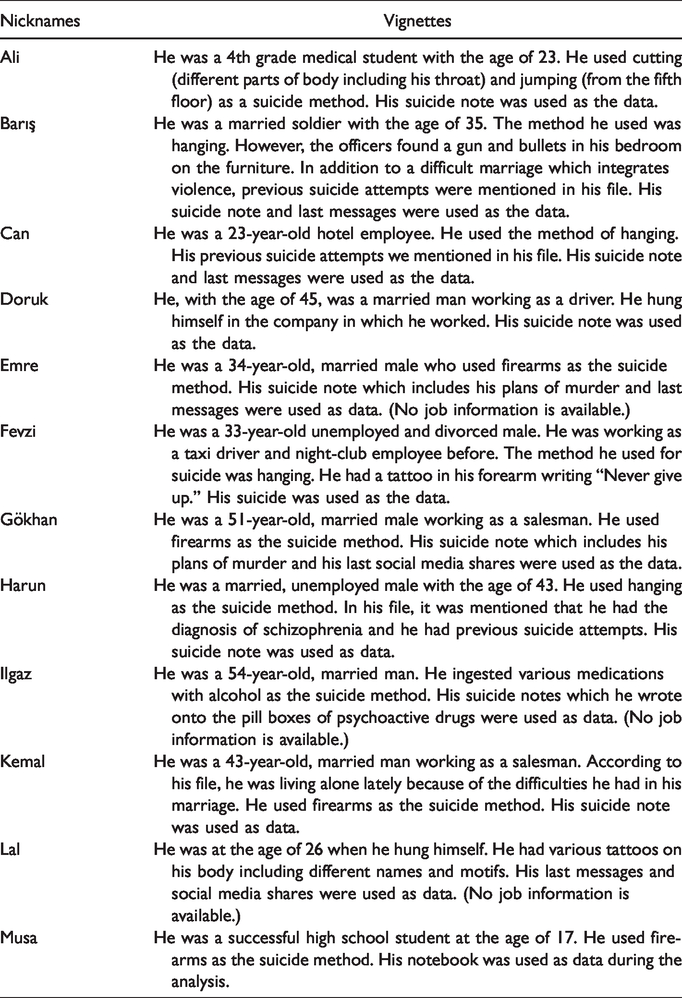
After taking all the required permissions from the ethical committee of our university and attorney general, we have acquired twelve files containing documents as the data corpus, from Ankara Public Prosecutor Office. Those documents were taken by contacting the prosecutors personally for the suicide cases which they worked on, and taking permission to make a search in the archived files. The files were containing suicide notes, last messages, social media shares, a notebook, statements of the eyewitnesses and the families, and the official reports such as autopsy reports and crime scene investigation reports. However, we have chosen the first four (suicide notes, last messages, social media shares, notebooks) as the data set, because we thought that those study units would provide the most relevant data which fit well with our research questions. Those documents belong to Turkish males who were aged between 17 and 54, and completed suicide between the years of 2010 and 2015. During the data selection, we decided to focus on males only because male and female dynamics may indicate difference within the Lacanian framework in terms of the signification of the phallus (i.e. having or being the phallus) and castration complex (Evans, 2006), and thus they may require to be handled separately. Therefore, we eliminated documents belonging to women. In addition, we tried to limit the suicide cases within a 5-year period because we aimed homogeneity in terms of current societal and cultural experiences of the cases. On the other hand, we tried to get maximum variation and diversity in terms of age and suicide methods used in order to enrich our data by using heterogeneity sampling. The methods which the cases used for suicide differentiated as can be seen in Table 1. The real names of the cases are concealed and nicknames are used in this table in order to provide anonymity. We paid attention to the saturation of the data while determining the number of the documents. Data saturation is defined as the spot where no new information is detected during the data analysis (Faulkner & Trotter, 2017). For this study, the data was sufficient to conduct an in depth analysis because the emerging themes started to repeat through the end of the analysis and did not yield discrete results, which means data saturation was provided.
Vignettes.
By using qualitative inquiry, we have conducted a two-legged analysis consecutively. Firstly, we have analyzed the documentary data by using a semantic level thematic analysis. At this level, we focused on the surface meanings of the data by using Braun and Clarke’s (2006) phases of thematic analysis. According to Coffey (2014), “it is entirely possible and appropriate to undertake a thematic analysis of a documentary data” (p. 370). It has been an iterative process which required us to go back and forth many times. After we determined the main categories and themes in the documents, we continued with a latent level analysis of the data by using those categories and the themes. In other words, at this second level, we have taken an interpretative approach to the primary level findings from a Lacanian stand point. While establishing our study onto those two legs, our aim was to provide a study which starts with a descriptive style, and continues with an interpretative way of analysis. According to Patton (2002), the analytic process which follows those two specific steps is the most ideal way of conducting an analysis.
Results
Findings of the Analysis-1
By conducting a primary (semantic) level analysis, we have determined four main categories; namely, emotions, perceptions, functions and phantasies. Those categories with their themes, sub-themes and extract examples are given in the Table 2.
Findings of the Semantic Level Analysis With the Extract Examples.
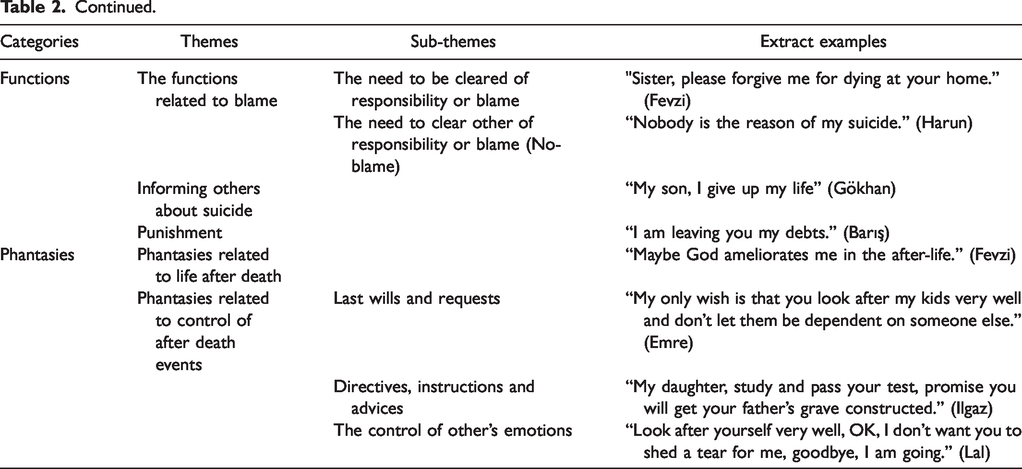
At this level of the analysis, the meanings of the words were focused on semantically. For example, we have coded the segments integrating affection, intimacy, compassion or fondness as love; or the segments which integrated a solution to the problem and getting rid of pain was coded as relief. Some of the extracts were overlapping at the beginning with a fluid structure in terms of their boundaries so we carefully and iteratively decided which extract should belong to which sub-theme, theme or category.
Findings of the Analysis-2
After having the data in a more organized way by using the semantic level analysis, we started to conduct a latent level analysis in order to have an in-depth understanding about the suicide notes. Thus, we iteratively searched for the underlying meanings of those themes and categories which were found in the first step. Especially, the sentences such as “I don’t know why I am writing this note but I am writing it.” (Can) or “Actually, I would write nothing on this paper and let everybody understand their own mistakes by indicating that it is not so easy to leave the world by a blank paper after all, but…” (Emre) attracted our attention in terms of our research question associated with the language use. We thought that the suicide notes may integrate messages addressed at the Other. Indeed, our main aim in this research was to investigate the note-leavers’ positions in terms of the Other, from a Lacanian point of view.
The results of the Analysis-2 indicated three latent themes. We labelled those themes as ‘ambivalence of emotions’, ‘issues associated with separation’ and ‘issues associated with the law’.
Ambivalence of Emotions
When we re-examined the extract examples about emotions from a psychoanalytical point of view, we realized that they may indicate ambivalence which is defined basically as love and hate at the same time. For example, Kemal wrote “My brothers, I love you all very much. Think about the fire that I am in now; I hug you with a many times more than this heat.” At the first glance, this segment was coded as love; however, the same segment may indicate hate or aggresivity when examined from a deeper level. Indeed, Kemal mentions “the fire” that he feels before committing suicide, and he adds that he wants to hug his beloved brothers with a heat many times more than he feels at the exact minute. Naturally, that kind of a fire would have burnt his brothers along with himself. From this point of view, aforementioned segment gave us the impression of hate besides love.
Another extract example from the suicide note of Gökhan indicates that he was planning to murder his wife and daughter before suicide. He wrote to his son: “When I am going I thought that the ones I love the most (my wife and my daughter) should not feel sorrow or suffer, so I said that three of us should go altogether while leaving the life.” Although this segment includes aggresivity due to the nature of the murder plan, Gökhan’s explanation also integrates “the ones I love the most.” Thus, we observed both love and hate as an indicator of ambivalence in his explanation.
Issues Associated With Separation
This latent theme has two sub-themes, namely; ‘investment for the eye of the Other’ and ‘illusion of omnipotence’. Those sub-themes were thought to be uniting under ‘issues associated with separation’ because both sub-themes indicated a refusal or denial in terms of separation.
Investment for the eye of the Other can be exemplified by the primary level findings such as blame related emotions, blame related functions or even by the theme named as informing others about suicide. We thought that the note-leavers might have had a concern about purification. In other words, by blaming themselves or the others, they might have a wish to be acquitted. For example, Emre wrote “Yet, everyone should realize their own mistakes and regret them. I am paying my dues with my death.” In addition, apologizing was a very common theme across the suicide notes (i.e. “I am very sorry.” – Doruk) which was thought to have the same function with the blame. Indeed, in both ways there may be a concern or care associated with how they look in the eyes of the others. Besides, the explanations about the reasons for suicide can be evaluated under this latent theme too, because the note-leavers may be bringing justification for their acts. For example, Harun stated “Who, as a father, would want to leave his three kids orphan? […] I tried as much as possible not to let you be deprived within the bounds of possibility.” On the other hand, when considered together with the ‘issues associated with law’ theme, we changed this sub-theme’s name as “the investment for the eye of the Other as an urge to escape from persecution anxiety,” which will be discussed in the following pages. In addition to this ‘wish to be purified’, another wish which is associated with ‘to be seen’ can be considered in terms of the theme informing others about suicide. In fact, that wish to be seen can also be interpreted as an investment to the eye of the Other. For example, Harun wrote “Let the people who I love and who love me know that I died.”
Illusion of omnipotence, on the other hand, was considered to be associated with the primary level findings such as ‘phantasies’ and ‘grandiose/perfect self-perception’. As an example to the former, we can mention the note-leaver’s urge to control after death events such as last wills or directives as well as the urge to control other’s emotions about the suicide. Besides, ‘phantasies associated with the life after death’ may also be discussed as a manner of illusion of omnipotence. Nevertheless, this latent theme was thought to be showing itself in its most clear form in the sentences about autopsy. For example, Barış stated, “I know it is a legal procedure; however, I am requesting not to have an autopsy.” We interpreted this type of sentences as a wish to remain as a whole or Gestalt after death. In addition, we thought that it may integrate an omnipotent stance towards the after death events in terms of control. Moreover, ‘grandiose/perfect self-perception’ was also thought to be associated with illusion of omnipotence. To illustrate, Lal shared this sentence in the social media before his act of suicide by using capital letters as shown: “I NEVER TRY HARD TO TAKE REVENGE… MY BIGGEST REVENGE IS BEING WITHOUT ME. EACH DAY YOU BEING WITHOUT ME IS YOUR PINING ANYWAY.” This sentence was thought to indicate an illusion of omnipotence with its limitless, almighty and powerful meaning as well as its configuration by capital letters.
Issues Associated With the Law
As aforementioned, ‘emotions related to blame’ and ‘functions related to blame’ themes were evaluated as a wish to be purified. Besides, the note-leaver’s positions in terms of the extracts in those themes were just like a judge because their sentences were resembling to an authority’s words which integrates a decision about a crime or guilt. For example, Doruk and Fevzi stated: “Nobody is responsible for my death.” This sentence was evaluated under the sub-theme named as ‘The need to clear other of responsibility or blame’, during the primary analysis. On the other hand, this judge position was thought to become omnipotent and very strong in some cases. To illustrate, Barış wrote “If you regret the things you did, give me your blessings. Pray to God because you won’t have a high position.” Another example from Emre’s suicide note is “Plant God in front of me, I will still kill myself.” Indeed, this position was thought to be a God-like position which brings the law.
In addition to this high and strong judge position, it was realized that there may be a perception of threat in the suicide notes. To illustrate, Musa wrote in different pages of his notebook “A stranger is watching” as if he was mentioning a persecutory look. Furthermore, sentences such as “I entrust my mother to you (Ilgaz)” gave us the impression of this perceived threat by the note-leavers.
Discussion
In this qualitative study, we followed two steps, the first of which was a primary level analysis, and the second of which was a Lacanian analysis. The former analysis aimed at the organization of the data whereas the latter brought a deeper and richer information associated with the suicide notes. In this part of the paper, we are going to discuss the findings from the Analysis-2 from a Lacanian point of view.
The first latent theme in this study was named as ‘ambivalence of emotions’. Freud (1913/2004) defined ambivalence as a term which integrates love and hostility at the same time towards an object in the cases of loss which is followed by an intensely affectionate bond. In Lacanian terms, on the other hand, ambivalence is known as hainamoration which means love-hate (Wolf, 2015). In addition to this word, Lacan used the word aggresivity with a different meaning from aggression; indeed, he used ‘aggresivity’ for the situations which integrates both love and violent acts, just like ambivalence (Evans, 2006). According to Lacan, aggresivity is a word which belongs to the mirror stage because this stage accommodates both love and hate. The baby who has a fragmented body image sees himself in the mirror and hates this specular image at the beginning due to its Gestalt structure. Lacan explains this period of life as the period of hostility and jealousy. When the baby realizes that this specular image belongs to himself, mirror stage comes to an end with identification and also alienation (Evans, 2006). Our theme in this study named as ‘ambivalence of emotions’ indicates parallel roots with Lacan’s ideas in terms of mirror stage; in fact, he places suicide to this stage by mentioning ‘narcissistic suicidal aggression (agression suicidaire narcissique)’which is a return of the mirror stage.
The second latent theme in this research was named as ‘issues associated with separation’. Considering our research question, this finding was thought to be parallel with the dilemma of reaffirming the bonds while dissolving them at the same time by a suicide note. Indeed, even though the note-leavers tried to bring an exact separation (due to the nature of death), they made a certain level of investment to the eye of the Other within their suicide notes according to this theme. Nevertheless, this investment was thought to be associated with persecution anxiety during the later stages of the analysis; therefore, it was renamed as ‘investment to the eye of the Other as an urge to escape from persecution anxiety’. The Other, here, stands for the symbolic Other. Congruently, while describing the mirror stage, Lacan attracts attention to the parent next to the baby holding him and telling that “This is you.” This parent not only facilitates the identification procedure but also brings about the ego ideal which stands for a transition to the language world, or symbolic in Lacanian terms (Evans, 2006). Fink (1997) states that if there is a lack of ego ideal, it leads to an unstable self-perception. Grandiose and weak self-perception themes which aroused during the primary level analysis can be evaluated as forms of that unstable self-perception. In addition, the latent sub-theme named as ‘illusion of omnipotence’ was thought to be parallel with the nature of this kind of self-perception. Besides, it can be explained within the Lacanian mirror stage too. Indeed, according to Lacan, the baby tries to take the movements of the specular image under control with an imaginary, delusional domination which can be evaluated as a form of omnipotent control. This imagination gives an “imaginary sense of mastery” to the baby (Evans, 2006, p. 118). This imaginary sense of omnipotence can be exemplified with the note-leaver’s denial of the death in their suicide notes. For example, Kemal wrote: “If you ever miss me, call out my name, I will hear you.” This sentence can be evaluated as a denial of death as well as an omnipotent sense of control in front of something uncontrollable, which is the death.
In terms of the last latent theme, which was named as ‘issues associated with the law’, the first point to discuss should be that the note-leavers might be taking the position of the Other by bringing the law. According to Lacan, the law can be defined as the main elements which guide social relations; in this sense, suicide can be considered as an act which is forbidden by the law (as cited in Evans, 2006). Lacan puts the law next to the Name of the Father (Nom du Père), which brings separation from the m(O)ther by castration (Fink, 1997). When we consider the note-leavers’ judge or God-like position and their illusions of omnipotence as well as their persecution anxiety, we might assume that they try to be excluded from castration. Indeed, castration requires a loss or acceptance of the limits (Boothby, 1991). On the other hand, the note-leavers take a position similar to a persecutor or a castrator because death can be evaluated as a limit to life, which can be interpreted as a form of castration (Harris, 2017). In this respect, we can claim that the note-leavers may be implementing the paternal function by the act of suicide. Both in perversion and psychosis, the central objective is to invoke the paternal function (Fink, 1997). Nevertheless, in the case of paranoia, the subject positions himself as the Other (Melman, 1994). Therefore, when we consider the note-leavers’ positions as the castrator, paranoia should be the focal point.
To conclude, this inductive and cumulative analysis procedure brought us to consider two main diagnoses; namely, narcissism and paranoia. The themes associated with ambivalence, illusion of omnipotence and the unstable perception of self and the others were considered to be associated with narcissism. Congruently, Lacan places narcissism to the mirror stage and mentions ‘narcissistic suicidal aggression’ in this period (Evans, 2006). Another important issue associated with the mirror stage is paranoia and a perception of the body-I (Tura, 2013). Indeed, the findings revealed a lack of ego-ideal, a perception of threat and anxiety of persecution. Furthermore, the note-leavers were considered to take a position similar to someone who castrate. Those findings brought us to the diagnosis of paranoia. Lacan (1975) states: “The discursive products characteristic of the register of paranoia usually blossom into literary productions.” In this sense, writing a suicide note becomes even more meaningful; indeed, we can interpret the suicide note as an urge of the note-leaver to gain control on the words and feel safer, because words belong to language which is a form of symbolic or law, with a potential to castrate. Thus, we can claim that a position similar to death might have been taken to the words by the note-leavers because both are the elements which belong to the symbolic in Lacanian terms.
The findings of this study can provide useful information for the clinical and health settings while conceptualizing the phenomenon of suicide. In case a repetition or cycle similar to those findings occurs in clinical area, the professionals can evaluate narcissism and paranoia as the diagnoses. Moreover, the findings of this study can contribute to understanding communication styles of the suicidal patients as well as their stance in terms of transference within the scope of psychoanalytical inquiries. The limitations, on the other hand, integrate lack of autobiographical information of the cases, which would bring a rich and in-depth view while investigation the act of suicide. Nevertheless, further studies may focus on anamneses of the patients who completed suicide. Moreover, interviews with the note-leaver’s families may provide rich information.
Footnotes
Declaration of Conflicting Interests
The author(s) declared no potential conflicts of interest with respect to the research, authorship, and/or publication of this article.
Funding
The author(s) received no financial support for the research, authorship, and/or publication of this article.
