




Abstract
Recent studies investigate grief among soldiers who experienced combat loss, but little research exists on the qualitative lived experience of such an event. In this study, semi-structured interviews were conducted with soldiers (n = 19) who lost a comrade (3–21 years ago) to delve into their bereavement process. The reflexive thematic analysis of soldiers’ accounts identified six main themes: (1) an unexpected and shattering experience; (2) emotional dissociation; (3) detachment from the outside world; (4) group formation; (5) accommodating the bereaved family; and (6) life-long impact. These themes were positioned on four distinct circles relating to the self and the surrounding social systems, indicating how soldiers’ grief unfolds and remains encapsulated and disenfranchised. The findings emphasize the value of peer support groups that should be facilitated and encouraged by official bodies—even years after—as part of providing social recognition.
Introduction
Experiencing loss and death are an unfortunate yet integral part of combat military service. While the significance of such loss for the bereaved family is both socially and officially recognized, it is often disregarded for all other affected groups such as unmarried life partners, siblings and friends (Harrington-LaMorie & McDevitt-Murphy, 2011). Accordingly, the present work attempts to vocalize the emotional lived experience of another affected group—the unit members of the fallen soldier.
Losing a comrade during combat is naturally an imminent source of stress (Pivar, 2004; Pivar & Field, 2004) and is considered traumatic due to its sudden and violent occurrence in combination with the typically young age of the involved soldiers (Barlé et al., 2017; Pivar, 2004; Pivar & Field, 2004; Rubin et al., 2020). Accordingly, studies have typically focused on soldiers’ trauma and post-traumatic symptoms in the aftermath of war (Hoge et al., 2004; Osório et al., 2018; Prigerson et al., 2001), while research on soldiers’ grief over a fallen comrade to whom soldiers were attached to (Currier & Holland, 2012; Papa et al., 2008) remain sparse.
In a typical course of mourning, the grieving person may experience various acute grief reactions, yearning and intrusive thoughts. Contemporary bereavement theories view mourning process as involving both the need to organize one’s life without the deceased’s physical presence and re-working the relationship with the deceased, as a means of adjustment to loss (e.g., Klass et al., 1996; Rubin et al., 2009; Stroebe & Schut, 2010). For most people over time, grief subsides and emotional equilibrium is achieved (Prigerson & Maciejewski, 2008). For others, such as combat veterans, this process bears complications especially under traumatic circumstances, resulting in complicated grief (CG). Namely, a prolonged combination of acute grief and post-traumatic stress symptoms (Killikelly & Maercker, 2017; Rubin et al., 2020; Shear et al., 2011).
Only recently a select handful of studies have demonstrated the impact of combat exposure, reporting high rates of significant losses and prevalence of CG among veterans and service members (e.g., Charney et al., 2018; Delaney et al., 2017; Simon et al., 2018; Toblin et al., 2012). Past literature has already linked CG to adverse physical and mental health and poor family relationships among both veterans (Currier & Holland, 2012; Toblin et al., 2012) and civilians (Barlé et al., 2017; Stroebe et al., 2007). Therefore, such quantitative findings necessitate a deeper qualitative understanding of combat bereavement and the psychological processes soldiers undergo in the aftermath of combat loss.
The loss of a unit’s member encompasses a relational loss that can produce a grief reaction similar to the loss of a family member (Lubens & Silver, 2019; Pivar & Field, 2004). Current literature has already acknowledged the strong relationships that are developed within a military unit and their importance as a source for social support, motivation, and a sense of security (Rubin et al., 2011). Unit cohesiveness emphasizes proximity among soldiers and with their commanders (Ben-Shalom et al., 2005; Papa et al., 2008), while unique shared experiences facilitate close attachment bonds (Davidovitz et al., 2007). However, loss during combat military service inherently includes several characteristics that may hinder soldiers’ ability to integrate the loss and may result in delayed response and complications in the grieving process.
Soldiers’ Bereavement Process and its Unique Characteristics
Literature points to several inhibiting factors that restrict soldiers' mourning processes in military bereavement, compared to civilian mourning. First, losses endanger the unit`s positive morale. Proclaimed dealing with grief and loss might afflict the military structure, the unit execution and the psychological earning of its members (Britt & Dickinson, 2006; Motowidlo & Borman, 1978). The military does not perform mourning rituals of the unit itself during active duty, but only participates in general ceremonies geared towards the bereaved families and the citizens (Witztum et al., 2001). Thus, altogether soldiers may internalize the covert message that the military does not approve of externalized grief in a military context, leading soldiers to suppress their feelings in order not to hurt company morale (Harrington-LaMorie & McDevitt-Murphy, 2011; Rubin et al., 2011).
A second, more practical reason is the inability to grieve while in battlefield and in need to keep the unit active. The limited coping resources of soldiers are channeled to cope with fear and threat, and not towards their own well-being (Neria & Litz, 2004). Such suppression of grief disconnects soldiers from the loss experience and can impede processing it later, outside the battlefield (Rubin et al., 2012; Stein, 2007; Widdison & Salisbury, 1990).
A third reason is related to soldiers’ sense of legitimacy to grieve. Whether due to a hierarchy of loss, a model that differs the levels of societal recognition of the right to grieve (Butler, 2016), or due to the need to protect them from emotional expression during battle, the attitude to their grief is minimal to non-existent. They do not get a place in ceremonies that recognize loss, like funeral or memorials (Doka, 2002; Neimeyer & Jordan, 2002). Importantly, most soldiers serving in battlefield are still male, who mourn in a more “instrumental” way (Doka & Martin, 2014). They display fewer outward signs of distress, evaluate their experiences cognitively rather than emotionally, express grief through anger and somatic expressions, value self-reliance, and use problem-solving activities to cope. This may worsen their disenfranchisement, in light of such gender difference (Doka & Martin, 2010).
The Present Study
To date, few quantitative studies on soldiers’ grief exist, focusing primarily on US combat soldiers and post-9/11 service members (e.g., Charney et al., 2018; Delaney et al., 2017; Lubens & Silver, 2019; Simon et al., 2018; Toblin et al., 2012). To the best of our knowledge, qualitative examinations rarely exist. By studying soldiers' bereavement process—particularly in their social context where losses occur—we can better understand how their loss and grief experience unfolds. This study was conducted in Israel, a country with mandatory military service for all genders at the age of 18, and where most male soldiers continue to partake in active reserve duty afterward. The danger of death is an unavoidable element of combat service. Moreover, unlike other forms and circumstances of death, military death is socially perceived as heroic and meaningful for the country and the protection of its people; thus, the bereaved family becomes part of that ethos. Such social context leaves soldiers’ grief internalized and stigmatized; it has also garnered minimal research attention (Rubin et al., 2011) despite its common occurrence. To this end, our aim was to study soliders’ subjective lived experiences of combat loss and the meaning they attirbute to these expriences, while finding common themes that are significant to their grieving process and relationships with surrounding social circles.
Method
Participants’ Sampling and Recruitment
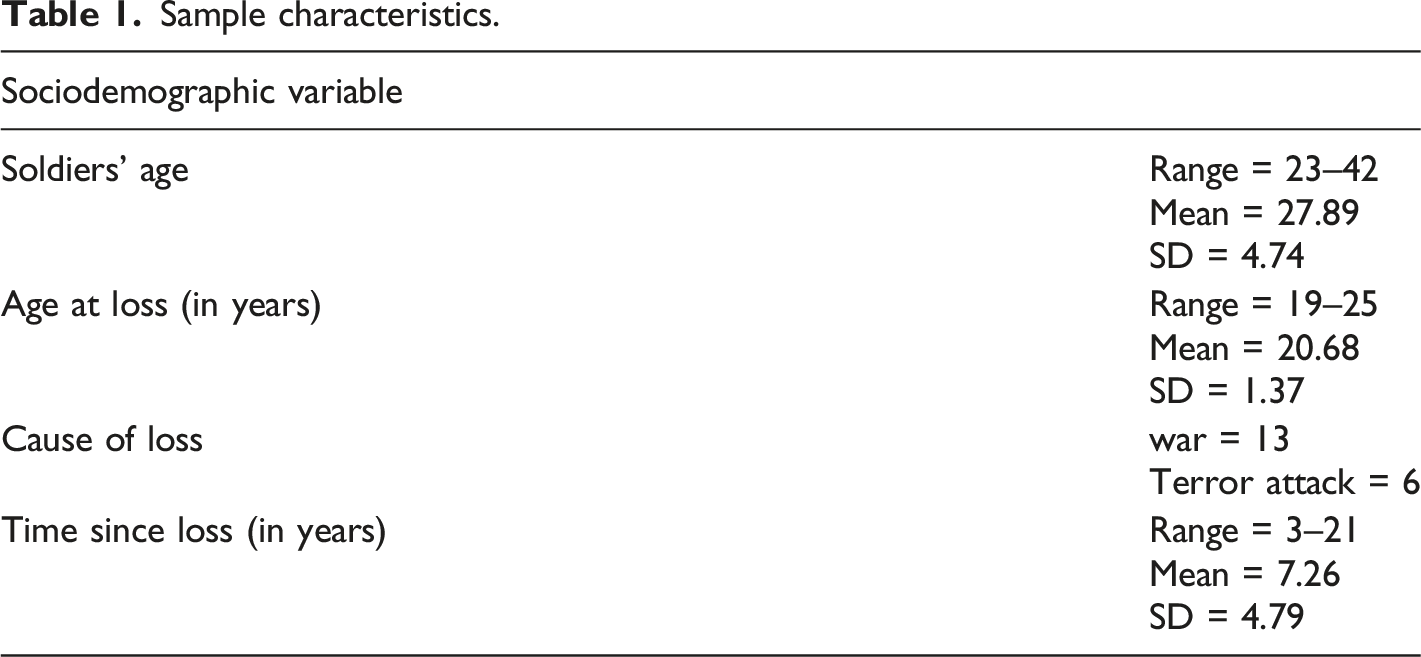
Soldiers’ accounts were collected as part of a larger research project conducted between 2017–2019 on soldiers’ loss and grief experiences during combat military service. Potential subjects were invited to participate through advertisements posted on social media forums, through personal approaches, and snowball sampling. Soldiers who expressed interest in being interviewed were contacted, their compatibility with the inclusion criterion was assessed, and (if they matched the criteria) an interview was set.
Sample characteristics.
Data Collection
The six semi-constructed interview questions.
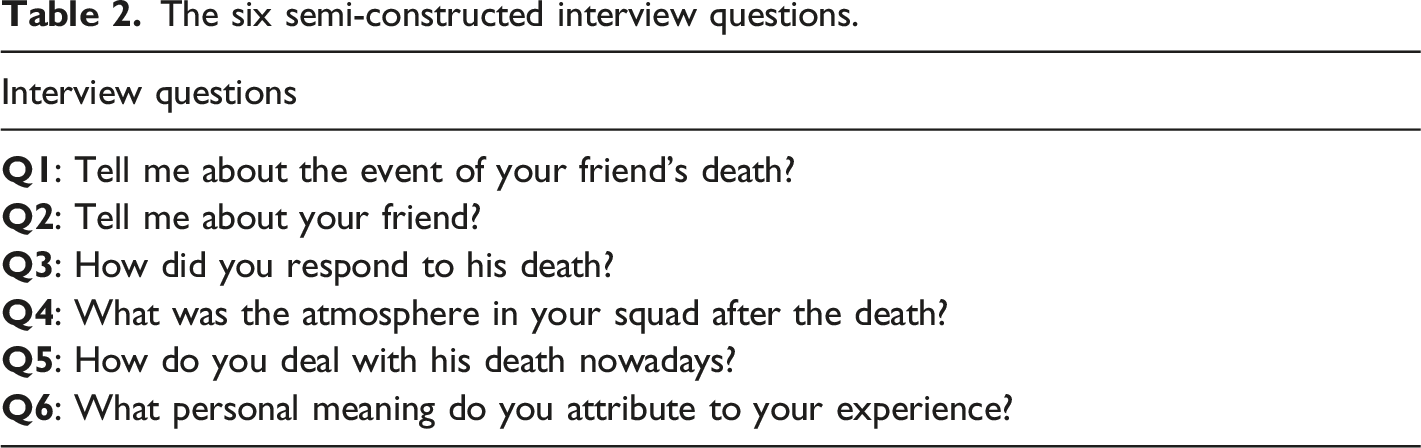
Our research team involved the first author, a faculty member at a rehabilitation psychology program for graduate students, a scholar and a practicing clinician in the field of grief and loss, and the second author, a graduate psychology student in the program. The interviews were conducted by a group of eight third-year psychology students who were involved in the project as part of their requirements for graduation. The first author provided professional training to the interview team and debriefed them thoroughly on the interview questions and guide, making sure they all adhered to a standardized protocol while providing empathy and a comfortable environment (see interview guide - Appendix 1). Each interview was taped and then transcribed by its own interviewer, who then handed over the raw data and the signed informed consent to the first author. The first author checked each interview for clarity and accuracy, de-identified relevant content and assigned a unique identifying code to each. Thus, the entire raw data and the file linking participant names with numbers were accessible only to the first author.
When no new information on soldiers' experiences emerged from new interviews, we felt that we had gathered sufficient information to begin our analysis. For the purpose of publication, soldiers’ texts were translated from Hebrew to English. The standard “forward-backward” procedure was applied by two psychology experts in the field proficient in both languages. After one of them translated the text to English, the other one translated the English version back into Hebrew (back translation) and the two Hebrew versions were compared.
Data Analysis
As qualitative studies of soldiers' perspectives are rare in this field, we aimed to gain a deeper understanding of their subjective experience and create a unified narrative through study of themes as patterns of shared meaning, where data in its entirety could be conveyed. Thus, Braun and Clarke’s (2019) method of reflexive thematic analysis (RTA) was used. RTA builds on Braun and Clarke (2006) framework and emphasizes the researcher’s subjectivity as an analytical-informative resource, as well as their reflexive engagement with theory, data, and interpretation (Braun & Clarke, 2021b). RTA was chosen also because it suited the study’s underlying paradigmatic and epistemological assumptions about meaningful knowledge and knowledge production (Carter & Little, 2007). The study’s focus on reporting an assumed reality evident in the data, seemed consistent with a critical realist epistemology (Fletcher, 2017), as well as inductive coding and theme development that reflect the explicit, semantic content of the data. As meaning and knowledge are regarded as situated and contextual (Braun & Clarke, 2021b), our immersion in the data and analysis also acknowledged the theoretical context of the research in the field of grief and loss, as well as our subjective view of this deeply rooted, highly situated phenomenon in the country and society. This allowed us to sculpt the knowledge produced (Braun & Clarke, 2021b; Ho et al., 2017). By giving priority to soliders’ voices and truth when examining their subjective “personal states,” the study did not seek to make claims about the social construction of the research topic. Rather, it acknowledged the socially constructed nature of the research topic (see also Byrne, 2021).
Braun and Clarke (2019, 2021b) recommend a six-phase, iterative approach to conducting RTA: 1) data familiarization and writing familiarization notes; 2) systematic data coding; 3) generating initial themes from coded and collated data; 4) developing and reviewing themes; 5) refining, defining and naming themes; and 6) writing the report. We followed each one of them.
The first step of our analysis was to immerse ourselves in the data. Both authors read all de-identified transcripts independently in one batch to become familiar with the data, noting initial observations and reactions while writing down preliminary ideas. In the second phase, we generated an initial set of semantic codes. Our analysis stayed close to the data, highlighting segments of the text (phrases, sentences or short paragraphs) that represented meaning units. Each of these organically involving meaning units (Braun & Clarke, 2021a) was given a shorthand label or "code” to describe its essence. These codes were written in the right-hand margin of the page. In the third phase, we integrated codes based on significant broader patterns of shared meaning. In each theme, a central organizing concept clustered several related and overlapping codes. At the fourth phase, we compared themes against the coded-data and the entire research data set to ensure they captured the full scope of soldiers’ accounts, told a convincing story and addressed the research question. The entire process was fluid, recursive and collaborative. We exchanged interpretations and reverted to the transcripts and coding iteratively, moving back and forth between stages of analysis. This process helped us clarify and rework themes when needed. The outcome reflected an integration of the data with our own subjective interpretation, prior skills, and psychology knowledge. Then, each theme was examined in detail, determining its scope and focus and refining its name accordingly, which is consistent with phase five. Finally, the writing phase weaved analytic rather than descriptive narrative and data extracts, as well as contextualization of the findings within existing literature. This was done while adhering to the standards of reporting qualitative research (O’Brien et al., 2014). We stayed reflexive throughout by keeping a track of the decisions made at each stage, during meetings, and in the final project summary. We attached sticky notes to the top of each interview`s first page to remind us of anything we should keep in mind for the respective interview. Furthermore, we kept a journal to record our assumptions and experiences so that we could acknowledge and discuss them regularly. Our coding agreements were also written. The second author served as the notetaker to ensure accurate documentation and representation of perspectives.
Ethics
The study was approved by the ethical committee of the The Academic College of Tel Aviv - Yaffo (protocol no. 2018-066). Verbal and written informed consent was obtained from all participants prior to enrollment. As the research dealt with a difficult, sensitive, and often painful topic, participating soldiers were informed in advance of the following details: (1) The purpose of this study, that is, to learn about their experiences as someone who lost a comrade during military service; (2) what their participation would entail; (3) that they may feel uncomfortable during the interview, given the sensitivity of the subject; and (4) their right to end the interview at any point in time, and without requiring an explanation for doing so. In case of potential post-interview emotional distress, participants were given the researcher’s contact details as well as the numbers of a non-profit mental health association. As mentioned above, each participant’s identity was kept anonymous and confidential, data was de-identified, and consent forms were kept separately from recordings and transcripts.
Results
Based on the results of our work, we were able to identify six core themes. These themes reflect the key features and processes integral to the loss of a unit member during combat military service and their impact on the soldiers’ mental health and ability to lead a normal life.
“All of a sudden, you get what war means”: An unexpected and shattering experience
The abruptness of this type of loss is a subject that rose across all interviews. Though being cognitively aware of this possibility and being trained to fight a war, the loss event was described as an unexpected-shattering experience. Soldiers narrated the rapid transition from a state of livelihood and vitality to the painful reality of loss using terms that indicated a striking contrast that was beyond their comprehension at the time. You get how stupid it is? You party [the night before] and a few hours later the man is gone. It's crazy… we got the boom only later, I'll tell you that. The shock. That it could even happen. [P1]
The comrade loss was also an “eye-opening” experience, regarding their own life-threat as it revealed the reality that soldiers operate in, always within close proximity to death. Soldiers’ accounts indicate an unbearable rupture in their assumptive world, understanding that they themselves are not “safe” and “invincible” and that even ordinary daily activities entail imminent danger. As one soldier shared: We couldn’t digest this, could not get that in such a routine activity we perform every day, we are so exposed and vulnerable… it’s the first time you get the meaning of being close to death… what you are really doing, what you are exposed to, what could have happened to you. [P17]
Having been present on the battlefield and seeing how “In one second, one moment, someone is gone,” [P6] left a profound sense of mortality and a horrifying near-death experience that has since remained untouched and indelible. One soldier said: “I was actually there, so that’s a corner that I'm not getting into [in the interview]. Easily, I could have been buried.” [P8]. Along with worrying about their physical survival, soldiers worried about their mental survival. They feared that the harsh and overwhelming experiences of war-related tragedy would haunt them and hinder their adjustment to civilian life afterward. As one soldier described it: His death broke us. It sent war straight to our faces. All of a sudden, you get what war means… there were nights that I really could not imagine coming out of it, I mean, even if I made it out alive, how am I gonna overcome what happened here […]. [P5]
“Everything is ice”: Emotional dissociation
As an immediate response, most soldiers acted emotionally disconnected. This seemed to have the practical value of survival, enabling them and their team to successfully fight the ongoing battle. Such dissociation was an automatic defense mechanism. One soldier explained: “In the beginning you don't think, there’s no emotion, everything is ice […] you don't have time to grasp or try to think what happened, why it happened, you don't ponder on it.” [P3]. Another soldier articulated how the circumstances of continuous war-related tasks required the focus on “doing” which hindered the processing of the loss: “In the beginning, you have to understand, there’s no place to think about it. There’s a task and another one follows, and you get a respite and then you think, but you can't think because you have to be focused.” [P1]. At times, lack of emotional disconnection was stemming also from an overwhelming multiple experienced losses. As a third soldier shared: “When I heard he died, I didn't have a response to it because on that day we lost four guys in our own unit […].” [P4]
For others, disconnecting emotions was a rather deliberate process of intentional “avoidance,” as they knew that reacting emotionally to the loss event might break them down and prevent them from keeping up with the “war rhythm.” As one soldier described: “I did not want to break apart, was afraid of what would happen if I’d allow myself to… can't even let myself go into what happened last night […] so I just disconnected, at least until the war will be over.” [P5]. In the attempts to “shut-down” extremely painful emotions, routine tasks and other mental preoccupations had a distracting and a “containing” value. Another soldier explained: Each one who dies is another toll and you feel pain and you can’t do anything… you disconnect head and heart, that’s it. Get back to your tank, you have to fight a war and there’s no way out […] music saved me. I would sit in the tank and sing songs to myself during battles, keeping myself busy and thinking about both things at the same time. [P7]
“No one else gets it”: Detachment from the outside world
After experiencing loss, soldiers felt that those who could understand what they had been through to share and process their experience are solely their own unit members. They drew a clear distinction between “inner” and “outer” circles, showing a strong preference to turn to each other for comfort and support rather than to refer to or approach other resources from perceived “outer” circles. As one soldier shared: Between us… we talked to each other a lot; we did not disguise. It’s very hard to explain it to people from the “outside,” but those from the “inside,” they understand what I feel like. [P8]
As the loss event occurred when soldiers were physically, geographically, and emotionally separated from the normal outside world, reaching out to their natural familial support system caused great emotional distress. Most soldiers linked the vivid nature and intensity of the experience with their family’s incapability of understanding them, conveying a sense of estrangement: “I did not share it with my family. I can't tell them, what, like, out of the blue. I could tell them a thousand things that happened to me. They wouldn't understand.” [P3] Soldiers also seemed to feel they needed to protect their own families from what they were experiencing to spare them of additional worry and stress, so they disclosed it briefly or did not disclose it at all: Did not tell my Mom, will not tell my mom. I don't think she can handle it so why would I? It's a bad idea. [P13] We were debating who lies to their parents and doesn't share details about what’s happening. They know I've been to the war, that I lost friends, but I did not give them details. [P15]
Keeping such an intense experience from their closest kin enhanced their sense of isolation and created a heavy emotional burden. Altogether, soldiers’ experiences remained encapsulated from the outer, “normal” (i.e., civilian) world.
In addition, part of the “outer” world concerned the encounter with mental health professionals. Accordingly, when offered mental support in the form of a psychologist or mental health counselor, they viewed this help as “so limited” and mostly burdensome. The intense and intimate emotional experience contradicted the distant formality that usually characterizes the interaction with professionals especially given the need to reiterate to them what happened only because “they have to.” As one soldier explained: “I felt relieved when we started talking about him [deceased soldier], I felt that at least we're going through this together. They got us psychologists and stuff, and we thought ‘get off our backs’ […]. We were all just broken people.” [P10] Being already emotionally drained, opening up to professionals was perceived as effortful, despite percolating emotions and a need for an outlet: “They told us: ‘if you want to, you can speak to the mental health officer.’ I didn't go. Didn't have the mental resources for that… when we came back I sat in the car and started sobbing. I cried hard for some time there.” [P16]
Preferring their own unit members’ seemed to also represent soldiers’ pre-attitudes towards mental health counselors and fear of stigma. Others were reluctant due to the dual-role that mental officers held as they were supposed to help them while at the same time constituting an official part of the military system. Some even felt that exposing their fragile mental state could harm them. As one soldier articulated: They brought us a mental-health officer afterwards. I'm sure some people wanted to say “listen, I am having a hard time,” but if someone actually said that, they could maybe even kick him out of the unit. [P18]
“The loss created a family”: Group formation
The shared experience of war and exposure to death and loss created extreme closeness and group formation in the unit. As one soldier shared: “So much has happened that it only seems natural the nucleus will tighten… We were all scared… you need them by your side with you.” [P6]. Soldiers described how this event enhanced their mutual commitment and responsibility. Under such extreme circumstances, their war-meaning and motivation changed. Rather than fighting for an abstract, general goal, they fight for the immediate, concrete goal of keeping each other alive. We were a team of 17, and only 4 of us didn't get hurt… you see your friend and tell yourself “I'm protecting him, no matter what.” I said that winning, for me, means that we all get back safe and sound. Of course there’s your family, and you protect your people [country citizens], but at the edge of it you do it to protect your friends. [P7]
Soldiers also preserved this closeness and brotherhood, through gatherings focused on the deceased (e.g., funerals and memorial services). They described how “The war created a family,” [P13], whereas keeping in touch with the unit members was almost a paradoxical consequence of the loss, tightening them up together forever. As one soldier explained: “When someone dies it means that from now on ‘till forever, the entire team gets together. It's an opportunity for us to catch up that without it, wouldn't have existed. And it's insane. Totally insane.” [P18]
Formal and informal gatherings in the memory of the lost comrade, also had and continue to have a therapeutic role in the lives of the unit members. Keeping in touch with each other provides a platform for them to “reminisce,” re-process and work through the loss further. There wasn't a conversation after we were discharged from the army that we did not mention it… we analyzed all these things even though we were done. It's still coming up; I think we'll keep discussing it for our entire lives. [P8]
Altogether, the experience of combat loss created a lifetime commitment among the unit members that has served as a protective shield, accompanying each of them later, in times of comfort and need. In addition, it enables a continued elaboration of their shared traumatic experience. Once in the civilian world, this group promotes a sense of belonging and allows them to sustain a concrete and symbolic connection to their lost unit member, to each other and to strong self-experiences that no one can truly relate to.
“I'm a reminder of what they’ve lost”: Accommodating the bereaved family
The bereaved family’s grief gets recognition from the state and the military system, and soldiers felt obliged to attend the Shiva-sitting [a week-long mourning-period in Judaism for first degree relatives] or memorials to satisfy both societal expectations and family wishes. They also recognize their role as the “last link” (last bond) between the family and their lost loved one: “We spoke with his family, they wanted to know who he was, how he was when he was around us.” [P4]. Some carried and continue to carry this obligation on, maintaining this continued bond for many years after: “We all came. Both units. …]. On memorial days we come every single time. To let them know we won't forget… you know that a year ago I flew back from Peru to a memorial? Couldn't leave them alone.” [P1]
Soldiers also discussed their discomfort and difficulty when accompanying the bereaved family in “their” hard time, due to the psychological complexity of the situation: “There’s tension, I think… they see us and it makes them remember and then they cry, and then it's a chain reaction.” [P18]. The contextual closeness to the family triggered spontaneous grief reactions and provided a temporary platform for letting down their guard. Yet most soldiers resisted expressing their emotions explicitly, knowing breaching their tough-shield could be costly. Unlike families who can immerse themselves in the grieving process, soldiers eventually return to their military duties, and are left to grieve alone: I came to the Shiva and cried every day. Crying in (wearing) my uniform, for sure […]. There were people who said it wasn’t mentally appropriate for them to start crying in front of others. When you enter this place [family house] it is very difficult not to cry, especially when the deceased is related to you. You cry at the funeral, it's hard not to cry, and then when it ends you're still in uniform with weapons and tears in your eyes. [P12]
Being confronted with the raw emotions of the bereaved family was often times debilitating as it also entailed heavy emotional limbo of trying to comfort and accommodate them emotionally while at the same time being a trigger and a living reminder of what they had lost: “It hurts, seeing them, especially when I have nothing to say or do that will make a change for them… I felt like I'm not helping the family, I felt like I'm the reminder of their loss. I wanted to swaddle them, but understood that I'm not the right man for it. My hug will only hurt them.” [P5]. Such an augmented tension when facing the family was even intensified given the survival guilt many soldiers carried. As one solider expressed: “I leaned on [name]’s leg and he was killed and I was not. This is the complication.” [P11]
This complexity created an additional burden, eliciting contemplations on self-disenfranchised grief. Soldiers undergo an inner conflict regarding their own legitimacy to grieve: “The ones that suffer the most are the family members. On the other hand though, I, myself, am accompanied by it every day.” [P8]. The struggle with finding a place for their own grief experience was intensified in situations where the death story and the families' after-death narratives do not align with soldiers’ own personal “real” narratives. As one soldier expressed: “Bereaved families tend to glorify the grief. His brother said to a news reporter something that really irritated me: ‘I'm sure my brother died smiling’, and I'm like: no brother, he was blasted by a grenade.” [P9]. Discords of this nature often resulted in feelings of isolation in grieving and estrangement from the outside world.
“Something that accompanies you every day”: Life-long impact
The loss became a life-altering event that shatters soldiers’ “assumptive world” and is difficult to integrate years after, as one soldier explained: “Even after many years you still cannot completely digest it. Until you get married and have children you do not fully understand things and their meaning. When it happens you are still a child yourself.” [P15]. Soldiers’ spoke of how the troubling experience taught them about life’s “temporality,” its “fragility,” and how life can change abruptly and unpredictably. Many attested that the loss experience was transformative and added another unique dimension to them feeling alienated and detached from their surroundings: You cannot live your entire life with all the experiences and with the same intensity and frequency because it is insane, it is not life. People who undergo such crises experience real trauma as a result of the war and loss of a close friend [...]. I came to a place where those who are not in this place ... those who did not experience it ... we can be in the same space but it is not the same life, the way of looking at life is completely different. [P6]
Many spoke about their enduring grief experience and longing for their lost unit member, especially around certain life milestones: “It's something that accompanies you every day. From the moment you think ‘what he would have to say about it’ and ‘why he is not here with me finishing one stage and beginning another one’.” [P7]. Regardless of the degree of closeness, soldiers described a continued bond with the deceased comrade, that is, how they maintain his psychological presence in their life nowadays despite his physical absence: “I was always a part of everyone and learned it from [deceased soldier`s name]. The acquaintance with him shapes me more and more day by day. […]. It always guides me. I always take on the responsibility [...] I am a leader in the form of his way.” [P2]
Years after, soldiers continue to strive to find meaning for their loss. Many described how the event impacted their view of life and shaped their resilience. Often, they demonstrate a benevolent coping with other life-events that appeared more ordinary in the face of a major life event (i.e., the combat loss). They commonly expressed “a sense of appreciation” for life while embracing a “thankful attitude” for the life they were able to live, in part thanks to their comrade’s sacrifice. Undoubtedly this whole period brings life into proportion. Life is short and can end in a second and nothing should be taken for granted. The entire situation matures you because you experience things that a 21-year-old child shouldn`t experience. In no sane world should I see the death of many people in front of my eyes. […]. It opened me up more. It grew maturity in a good way. It's more about how I see situations. As if I understand life better than I did before I got into it. [P3]
Others spoke about the struggle they had with meaning making in the face of their grief and loss. These struggles sometimes contradict the bereaved family`s meaning making and the heroic-aggrandizing value that combat loss receives in society especially in funerals and memorials. Soldiers expressed anger towards the military, questioning whether the death was indeed necessary. They felt that their private losses were enmeshed in the collective losses of war, while they were left to grieve and ponder what would have been if their friend would still be alive, experiancing milestones of adulthood. As one soldier shared: So many were killed there … maybe I’m really angry about this war too and that I really have no meaning to give [name]`s death. Even more angering is the thought that his death was part of the war, so like it’s okay, it’s normal, it’s natural. It’s wrong he’s not here. In no way is this OK. [P5]
Discussion
This study aims to find common themes among soldiers who lost a comrade in combat. The reflexive thematic analysis of the soldiers’ accounts reveals six overarching themes: (1) “an unexpected and shattering experience,” (2) “an emotional dissociation,” (3) “detachment from the outside world,” (4) “group formation,” (5) “accommodating the bereaved family,” and (6) “life-long impact.” Encompassing past and present experiences, these themes are positioned on four distinct relational-circles representing social systems: (a) “soldier,” (b) “military unit,” (c) “family,” (d) “society.” Figure 1 illustrates these circles and summarizes the soldiers’ experiences and relationships with these surrounding social systems. Soldiers’ experience and relationships with the self and the surrounding social circles.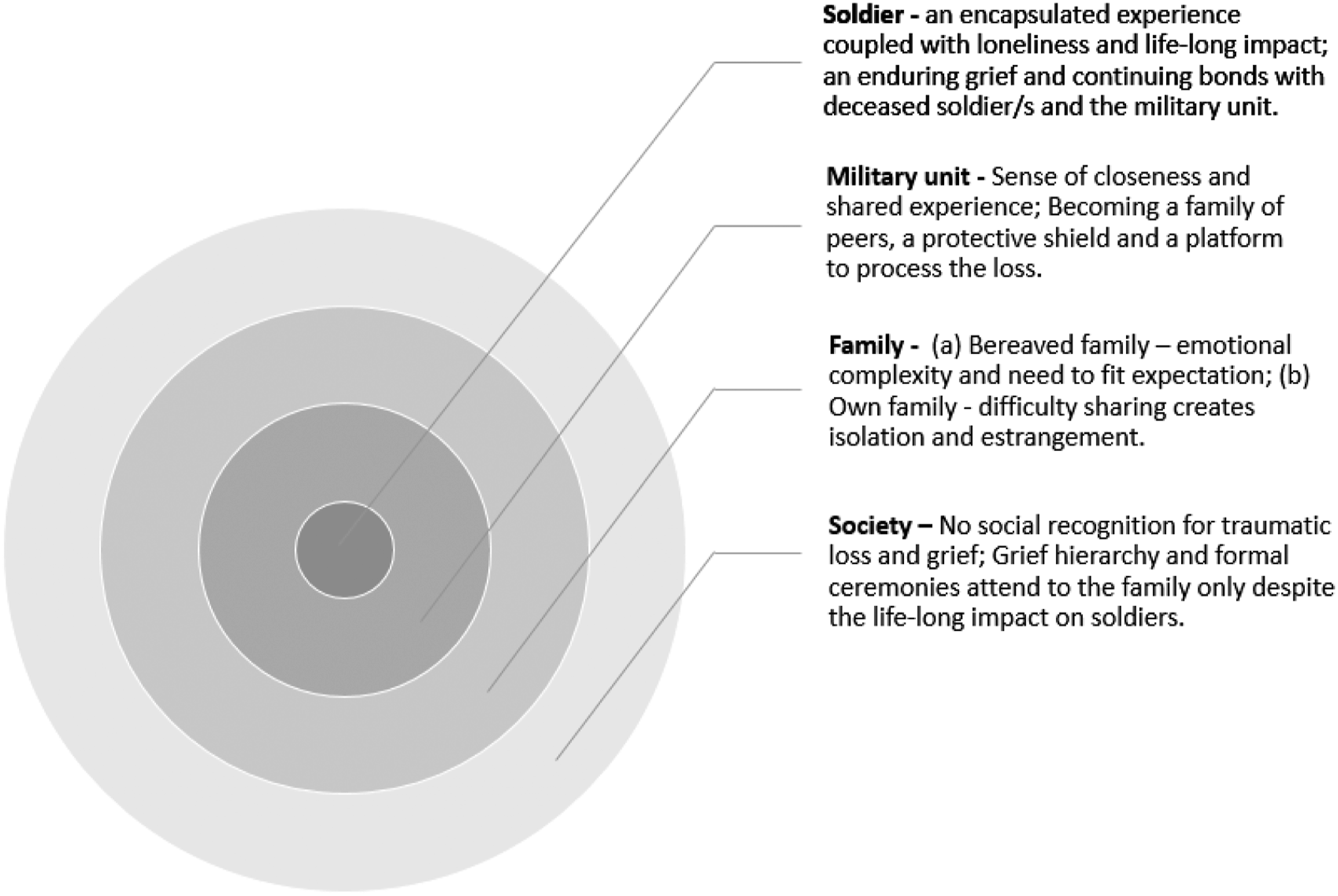
Figure 1 also highlights the internal and external processes common to the unique experience of combat soldiers. The complexity and external occurrences of facing their own family, the bereaved family, as well as society’s expectations and ethos alongside the internal occurrences of isolation and seeking comfort of their own, create a cycle that promotes encapsulation, estrangement, and loneliness in grieving. This cycle starts early on in the battlefield where soldiers are physically, geographically, and mentally isolated from their family and the outside world. These gaps seem to grow when soldiers gradually increase their overall interaction with the outside world. Lubens and Silver (2019) found that detachment from the civilian world may make it more difficult to cope with comrade death, while Delaney et al. (2017) considered separation from family and loved ones as a risk factor for complicated grief. Our study takes these notions further, shedding light on the psychological complexity soldiers experience with these surrounding social systems. Our findings also show that the soldier’s nuclear family is not a source of strength and support but an additional source of stress, while the bereaved family mainly evokes mixed feelings and the need to accommodate their domineering experience.
Along the same lines, our study further emphasizes and validates the significance of group ties within the combat unit (Lubens & Silver, 2019; Pivar & Field, 2004), especially under such distinct circumstances. The military unit as an entity is also known to mediate the relationship between the soldier, the military, and the state (Currier & Holland, 2012). Yet, our findings show that unit coherence is important not only for survival in dangerous situations, but also for sharing and grieving years after a loss (i.e., group formation). The unit serves as a protective shield that mediates the interface with the outside world (i.e., civilian world), reduces loneliness, and enables informal group bereavement rituals. In this way, the lasting bonds to the deceased soldier is also maintained (Klass & Steffen, 2018).
The results of this study also confirm the literature on the mechanisms that predispose soldiers to delayed grief complications (Pivar & Field, 2004; Prigerson et al., 2001; Rubin et al., 2011; Simon et al., 2018; Widdison & Salisbury, 1990), while further emphasizing the social aspects of their grief. For many soldiers, combat loss is their first encounter with death. Due to the young age of the soldiers and the violent nature of war, this experience becomes especially shattering and difficult to integrate (Seamon-Lahiff et al., 2021). Such aspects put them at risk for various psychological sequelae alongside guilt and other lasting difficult emotions (Simon et al., 2020). However, soldiers' grief goes unnoticed, as their loss experiences often fail to attract attention (Witztum et al., 2001), possibly also due to gender-social stereotypes (Doka & Martin, 2010, 2014). Such enfranchisement is exacerbated by the state ethos that the bereaved family becomes part of, that soldiers are supposed to be heroes, knowing their sacrifice is for a meaningful greater cause.
Overall, the way soldiers' isolated and silent grief unfolds throughout life—especially in social contexts—further emphasizes the impact of public discussion highlighting one nation’s grievance over others. Butler (2016) also stated this in her hierarchy of grief. Zehfuss (2009) argued the same hierarchy exists in different subgroups within the same group in a country. Accordingly, it seems valuable that soldiers will also be viewed as grievers and get more social recognition and better placement in the hierarchy. Practically, grief acknowledgment allows a grieving period and absence from work that are treated with understanding as well as rehabilitative and financial help (Doka, 2002). The recognition helps with the loneliness of the grievers, improves physical and mental health and allows personal growth (Hastings et al., 2007). Therefore, this research joins the body of literature that reflects the reality of populations other than the bereaved families.
Implications
Findings from the current study bear several implications to therapeutic interventions. Based on literature about disenfranchised loss, it is suggested that soldiers will be offered with an official interpersonal and group directed solutions primarily with their unit members. Such support groups will validate the experience, normalize grief within a supporting society, engage in therapeutic ceremonies that will legitimize their expressions, and construct personal meaning for the loss (Currier & Holland, 2012; Currier et al., 2008; Doka, 2002; Neimeyer, 2006). Although the military system offers soldiers short-term professional help around the time of the loss event, soldiers accounts show that during or around the time of battle, they are physically and mentally incapable to engage in such a process. Therefore, these tools seem to only be effective long-term (sometimes years after the loss) when a better mental receptiveness and attentive environment become attainable. Therefore, it is important that military systems will recognize and maintain a continued bond with bereaved soldiers to address their emotional and psychological needs long-term. Such mediation can help reduce anger, negative emotions, and a sense of alienation towards the system, especially among those who struggle with meaning making of the loss. Notably, there is a need for more research and knowledge on the ways families and communities respond to military personnel returning from combat deployments, and specifically how family resources affect their health (Lubens & Bruckner, 2018). Providing guidance and assistance also to these immediate surrounding circles is important for soldiers' reintegration.
Limitation and Future Research Directions
Few limitations should be considered with respect to this study. Firstly, soldiers volunteered and opted into the study. Therefore, we cannot determine whether such a sample may be skewed compared to those who did not volunteer to participate. Secondly, our sample consisted of males only, hence making it impossible to generalize our results and recommendations to both genders. Accordingly, it is suggested that future studies include samples of female combat soldiers to examine gender differences in psychological response to military bereavement. Studies may also explore differences between active soldiers, reserves, and veterans to trace the trajectory of bereavement and the development of CG overtime. The present study shows family and society’s recognition and approval, adhering to masculinity, and receiving military encouragement to grieve, as important factors in soldiers' psychological adaptation. Therefore, future research may quantitatively examine each of these factors' role in perpetuating soldiers' continued grief and traumatic symptoms to provide a more comprehensive picture.
Conclusion
In the current study, combat loss is highlighted as a traumatic life-altering experience that impacts soldiers long after they leave the military. Among countries such as the US and Israel, military reserve members and veterans make up a significant portion of the population. Therefore, finding support systems and solutions for them that go beyond less obvious signs of emotional distress and gender-social stereotypes is important and impactful. Our findings suggest that long-term encouragement by social circles to mourn publicly can be helpful as well as allowing soldiers to have their narrative be part of a nation ethos. In addition, since soldiers noted peer support as the most effective and necessary support option, it is essential that government entities organize groups that process combat-experiences to support grieving soldiers. Moreover, it seems important to also support the families of the returning soldiers, in order to enhance their ability to accommodate soldiers’ emotional needs. This may change the reality for many soldiers and veterans who served their country and had to grieve and cope with the loss on their own.
Footnotes
Declaration of Conflicting Interests
The author(s) declared no potential conflicts of interest with respect to the research, authorship, and/or publication of this article.
Funding
The author(s) received no financial support for the research, authorship, and/or publication of this article.
