



Abstract
The market for natural burial has increased for a variety of reasons including positions on environmental and sustainability issues, religious and spiritual considerations, and cost. While there is growing research on popular perceptions from potential consumers, very little is known about the industry actors, institutions, and structures that support natural burial practices. This study examines the knowledge, impressions, attitudes, and practices pertaining to natural burial among funeral directors through a multi-state, anonymous survey (n = 346). This study offers important contributions to the field of death studies, in that it helps to uncover funeral directors’ perspectives, contributes to an understanding of the social aspects of natural burial, and sets the stage for additional research on this topic. Further, the project examines natural burial through a sociological lens, with consideration of the implications for professionals.
Introduction
The options available for final disposition, along with the funeral industry and its practices, have evolved and changed throughout history, in keeping with advances in technology, historic events, and other societal influences. In early American society, the family of the deceased generally arranged short funerals, and burials took place without embalming, in simple wooden caskets (Earle, 2008). Thus, early burials were natural in the way we use the term today, allowing for internment of the body in a way that did not inhibit composition but rather allowed the body to be naturally recycled (Steward, 2018). During this time-period, death was part of the day-to-day reality of life and people were closely connected with dying and death processes.
The use of embalming, metal caskets, and other methods associated with what is generally considered the modern funeral and burial of today emerged out of the technological and scientific innovations of the Industrial Revolution, needs associated with the Civil War, the increased wealth in American society, and changing views toward death (Beard & Burger, 2017). Embalming was uncommon until the Civil War when deceased soldiers were preserved for transport from their places of death to their home communities. The public display of Abraham Lincoln’s embalmed body over a two-week train journey further popularized the practice (Harris, 2007). Metal caskets and burial vaults also appeared around this time, becoming recognized for their perceived ability to protect the deceased from the elements, create a more aesthetically pleasing death scene, protect against grave robbers, and help maintain the stability of cemetery grounds (Harris, 2007). These innovations sparked change in the funeral industry and, along with other societal and medical system changes, influenced American death culture. As the living were increasingly separated from dying and death, fear and denial took hold, and death and dying became taboo topics (Incorvaia, 2022).
Though these modern burial practices are now the norm, a variety of factors have returned attention to natural burials in recent years. Since the 1960s, increasing numbers of individuals and groups have advocated for change, as they view the ideas and practices associated with the modern death system to be environmentally damaging, overly professionalized, and too medicalized (MacMurray & Futrell, 2021). These advocates press for the use of more environmentally sensitive and humanistic approaches as alternatives to modern practices they believe to be problematic, limiting, and harmful (MacMurray & Futrell, 2021). Some use the term “natural burial” to more broadly refer to practices that do not inhibit body decomposition such as avoidance of embalming fluids, burial vaults, and non-biodegradable caskets. Others speak more specifically to “green burial” and “conservation burial,” both of which have intentional environmental components and implications. This is the conceptual approach utilized in this paper; “natural burial” is the guiding construct with an acknowledgement that the other terms overlap and are oftentimes used interchangeably.
According to Rumble et al. (2014), “a new ecological mentality is increasingly framing the management of the dead” (p. 243). Relatedly, an emerging era of death awareness and death-positive consciousness is resulting in a variety of initiatives to help people more openly talk about, prepare for, and view death as a natural part of life. This movement has also resulted in increased attention to natural burial options, as well as new forms of final disposition such as alkaline hydrolysis and human composting (Incorvavia, 2022). The founding of the Green Burial Council in 2005 further propelled these movements forward, establishing standards and a rating system for funeral homes, cemeteries, and products, as well as providing advocacy, education, and resources to professionals and the public.
Interestingly, while natural burial as a method of final disposition is not a new approach, it is now viewed by many an alternative method, one mainly used by environmentalists and some religious groups. Modern burial and cremation are the most common choices in today’s society, and our current death culture supports their use (National Funeral Directors Association, 2023). While natural burial is generally depicted as a return to simpler practices, it is not without debate and complexity (Stewart, 2018). For instance, Stewart’s definition is expansive, including other sub-types (e.g., green burial), but serves as a popular reference. Those in the funeral industry likely have a range of views on its use as they consider the business, financial, and practical implications for themselves and consumers of integrating it into their practices. Arnold et al. (2023) discuss such challenges with respect to alkaline hydrolysis as a newer innovation, writing that representing it “materially and discursively to the funeral professions and to the public eye in a way that positions the technologies as contributing to and drawing upon contemporary normative values is a vexing problem” (p. 15). Perhaps the same may be true of natural burial. Although it is an ancient practice, it is now viewed as strange, alternative, and not in keeping with societal norms. It goes against what many funeral directors have been taught and socialized into, what most Americans have experienced within their social networks, and how burial policies for most cemeteries have been established. But while modern funerals and burials continue to be the standard today, and cremation has become increasingly popular, natural burial practices have reemerged to share the landscape of options for final disposition.
The Literature Base on Natural Burial
A variety of guides aiming to assist people who want to plan natural burials, (e.g., Fornier, 2018; Herring, 2019), books containing personal narratives and perspectives, (e.g., Butz, 2009; Kelly, 2015) and books critiquing the funeral industry’s practices related to environmental and social responsibility exist (e.g. Doughty, 2017; Webster, 2016). While these sources provide a starting point for understanding the issues, challenges, and dynamics surrounding natural burial, very few empirical studies have been published.
Existing scholarly articles are mainly discussion-based, and they vary in terms of disciplinary focus. Some discuss natural burial from a land use perspective and as an option to address the space issues associated with the need to dispose of an increasing number of deceased due to population growth (Basmajian & Coutts, 2010; Coutts et al., 2018). Others connect various spiritual and religious dimensions with natural burial practices (Pike, 2023; Pryds, 2022; Stewart, 2012, 2014, 2018). Still others focus on natural burial from an environmental perspective, positing natural burial as a way to reduce our carbon footprint (Robinson, 2021; Stowe et al., 2001), calling attention to the pollution caused by cemeteries and crematoria (Franco, Georgin, Campo et al., 2022), and highlighting how such burial practices could be used to fund the conservation of threatened species (Holden & Madden, 2018). Kelly (2012), for example, argues that “American death care has positioned human death outside of the cycles of nature,” and encourages a “vision of human death that matters to and is part of nature” (p. 39). In short, the interest in natural burial is multifaceted.
Within the existing literature base few empirical studies have been conducted specifically on the topic of natural burial. One study gave voice to American older adult environmentalist perspectives, finding that their environmental activist identities carry through into their death care considerations, with green burials emerging as a theme (Stock & Dennis, 2023). One German-based study focused on cemetery spaces, contrasting consumer experiences of natural burial grounds with those of traditional cemetery spaces. The authors explored how the rules and regulations in place in various cemetery spaces may impact mourning practices and behaviors, and ultimately found that those who initially express positive views about natural burials frequently become disillusioned by their choice due to the lack of material symbols that serve to memorialize the deceased (Balonier et al., 2019). A recent study focused on stakeholder perceptions toward green burial in Zimbabwe, its implications for environmental sustainability, and the conflict between green burial and cultural beliefs (Muposhi et al., 2023). Recommendations for promoting and generating infrastructure around green burial were suggested.
Amidst this modest, multifaceted discussion, funeral director voices are relatively unheard. Though funeral directors are on the front lines of assisting people with decisions surrounding final disposition, no studies exist that examine their knowledge, impressions, attitudes, and practices pertaining to natural burial. Existing literature suggests that the funeral industry poses barriers to natural burial; is at fault for the resulting environmental, emotional, and social outcomes associated with the proliferation of modern burial practices; and needs to innovate and change to satisfy consumer demands and maintain profitability (Beard & Burger, 2017). The funeral industry has indeed integrated natural burial options into its offerings in recent years, though it is likely that a range of attitudes and levels of competence exist amidst funeral directors. Understanding funeral director perspectives is important since they may influence how natural burial is viewed within mainstream society.
Death System Hegemonies
Funeral directors are “core participants” in the American societal death system, which is comprised of a diverse array of people, places, times, objects, and symbols that characterize the strategies through which society’s members define, interpret, ritualize, and manage death (Kastenbaum, 1993; Kastenbaum & Moreman, 2018). In essence, a societal death system, inclusive of all its various components, facilitates peoples’ relationships with mortality (Kastenbaum, 1993, 2001). As part of this system, funeral directors guide people through the options available for final disposition of the deceased person’s body, including burial, cremation, and alternative methods. They present options, answer questions, and engage in planning with people who are often emotionally distraught and grieving. These discussions are often complex and include information about costs, legal processes, planning a service, and available products. Though a variety of factors influence families’ decisions regarding final disposition, funeral director knowledge, attitudes, impressions, and approaches regarding various options may influence whether and how they present them, and subsequently affect families’ decisions. Through their approaches in serving people in the pre-planning and after death planning phases, funeral directors are key players in shaping how people understand, manage, and make decisions surrounding death.
Funeral rites and rituals are viscerally important to any society and culture. The ascribed meaning, operational procedures, and institutional dynamics of any death system can say a lot about the people who use that system. Indeed, they serve as the “embodiment of sociocultural order but also as a culturally prescribed means to legitimize individuals’ actions and define their identity” (Tsuji, 2006, p. 391). In other words, the way society approaches, manages, and makes sense of death defines not only the culture writ large but the individual in it as well. Like any cultural system, approaches toward dealing with death vary over place and time.
That said, how flexible a social system is to change differs. For instance, in Japan, Tsuji found traditional mortuary rituals remain, despite “rapid social change” in other sectors of society (2006). Just like any social institution, death systems also carry cultural hegemonies, and the power dynamics that follow, which can build impenetrable scaffolding against change. Hegemony refers to a particular understanding of how power and control over beliefs and meaning in society are held together (i.e., ideological domination). Specifically, cultural hegemony refers to “cultural leadership,” or the coercion and consent of a populace through the intentional manipulation of common-sense assumptions made about social life as ‘natural’ or ‘the way things are’ (Gramsci, 1971). Maintaining the status quo through the normalization of perceived options, obligations, and beliefs is arguably an aspect of any social system. Indeed, this theoretical understanding can offer helpful insight into a variety of social market landscapes and belief-oriented collective actions, including the industry managing our death systems.
Some consideration has already been given to the hegemonic realities inherent in the funeral home industry. While this attention has largely focused on gender disparities in the profession (Donley, 2021; Pruitt, 2018), it provides a useful illustration of ‘hidden’ power dynamics perpetuated within the cultural mores and norms of the industry and regurgitated across wider society. Our study extends the same idea of hegemony to account for disparities in types of burial options offered to the public. As gatekeepers of information and options, funeral home professionals wield significant power in determining said practices. Ensuring individuals are given adequate, unbiased information about specific final disposition options for their loved ones or themselves, is vital and a standard mission within the industry. Beyond this democratic consideration, rising global populations have long pointed to serious concern for how we manage burial practices from an economic and environmental perspective.
As such, it is imperative to examine the realities of what professionals in the industry believe and support in their own practice and standards and how this may reveal what hegemonic dynamics that exist. By employing the concept of hegemony in this way, the detection of dissonance between industry practice and the market and cultural shifts playing out in society today can be disentangled and resolved, producing a death system more representative of the population and environment it attends. The data, analysis, and results from this study help facilitate this endeavor through an intentional discussion and implications for further work.
Data and Methods
Demographic Statistics.
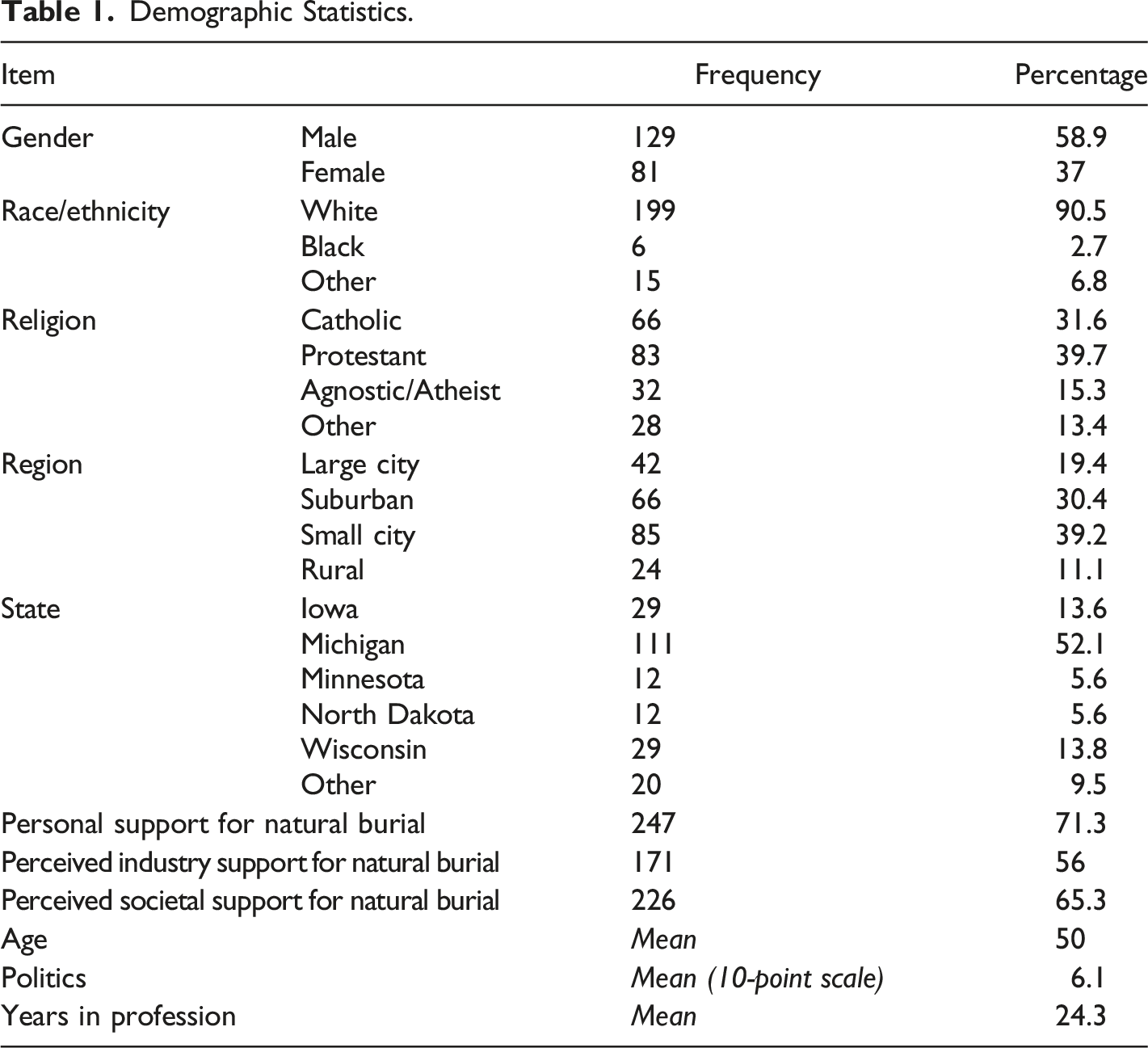
Further univariate and bivariate tests reveal the social and professional profile and extent of support for natural burial among funeral directors, perceived challenges, and understanding of industry standards and practices. Additionally, principal component analysis is administered on a battery of attitudinal items which affirm thematic clumping of factors. These composite scores provide deeper insight into the current disposition and positioning of funeral directors on the natural burial option.
Findings
Funeral Director Attitudes and Practices
Correlation Matrix of Attitude Toward Natural Burial and Demographic Items.

*p < .01, **p < .005, ***p < .001.
Natural Burial Items – Basic Percentages.
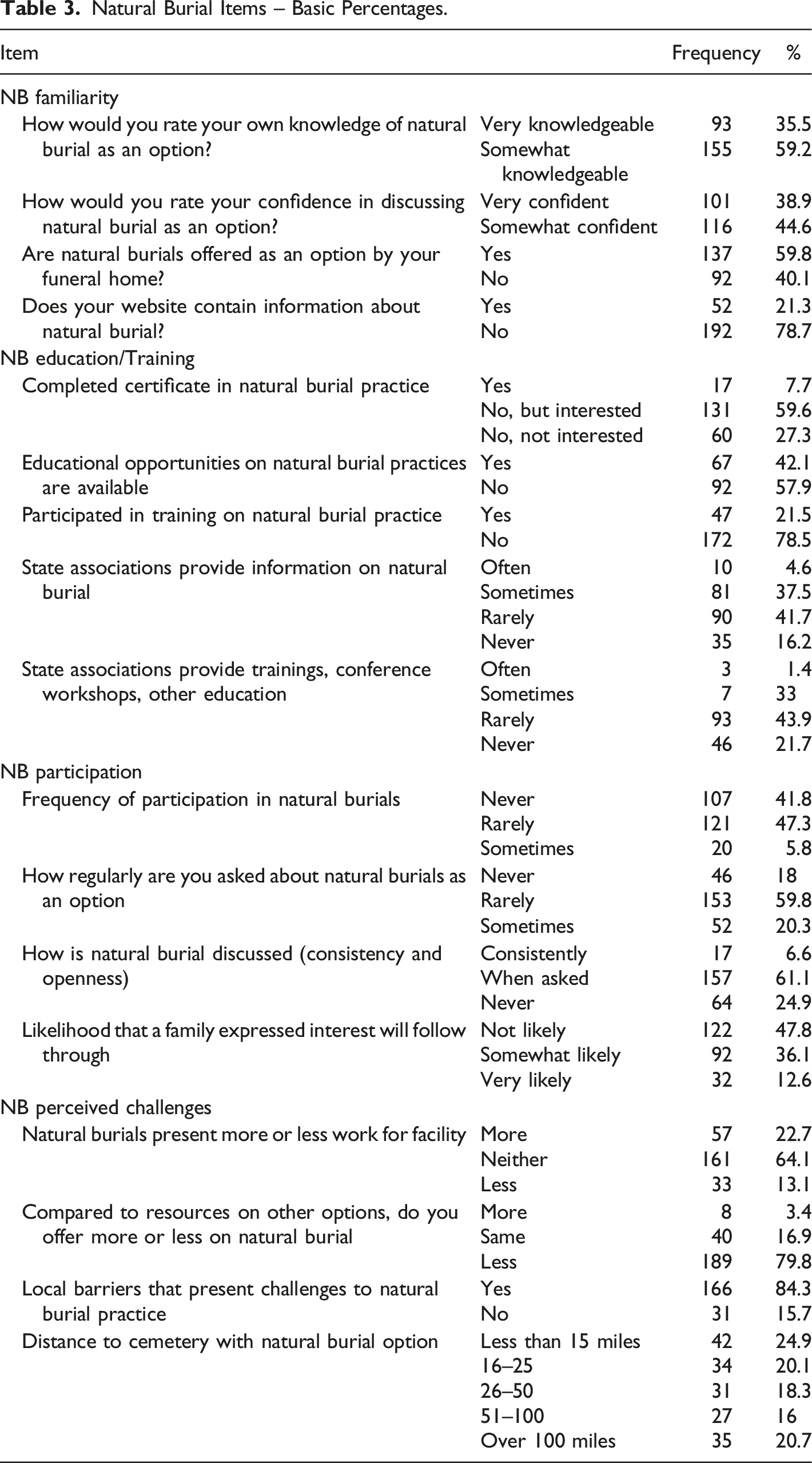
Basic percentages suggest funeral directors self-identify as supportive, knowledgeable, and offering natural burial options. However, funeral directors report not being proportionally trained or formally educated on the topic and methods. Additionally, funeral directors self-identify actual participation as rare or never happening and questions from clients as equally atypical. In fact, funeral directors disclose how little information about natural burials can be found on their facility website and that they only engage in conversations if prompted by the families themselves. Finally, funeral directors offer less resources on natural burial options (79%) and deem local barriers as a significant challenge (84%). This despite the reported reality that there appear reasonable options for accommodating cemeteries nearby (45% of respondents identified a natural burial cemetery 25 miles or closer). In short, funeral directors appear to present a bloated position of support on natural burial whereas levels of actual engagement with the public on natural burial options is uncommon.
A note on education and professional support reveals some added insight. Few (8%) are formally trained on the topic of natural burial, but a sizeable majority (60%) would be interested. Furthermore, funeral directors generally perceive state associations as rarely offering trainings and professional development opportunities on the topic. This could suggest if formal structures, like state associations, offered more opportunities to learn about natural burial practices, the actual participation and offerings of such options might increase. Further examination is required to determine what impact, if any, state associations might actually have.
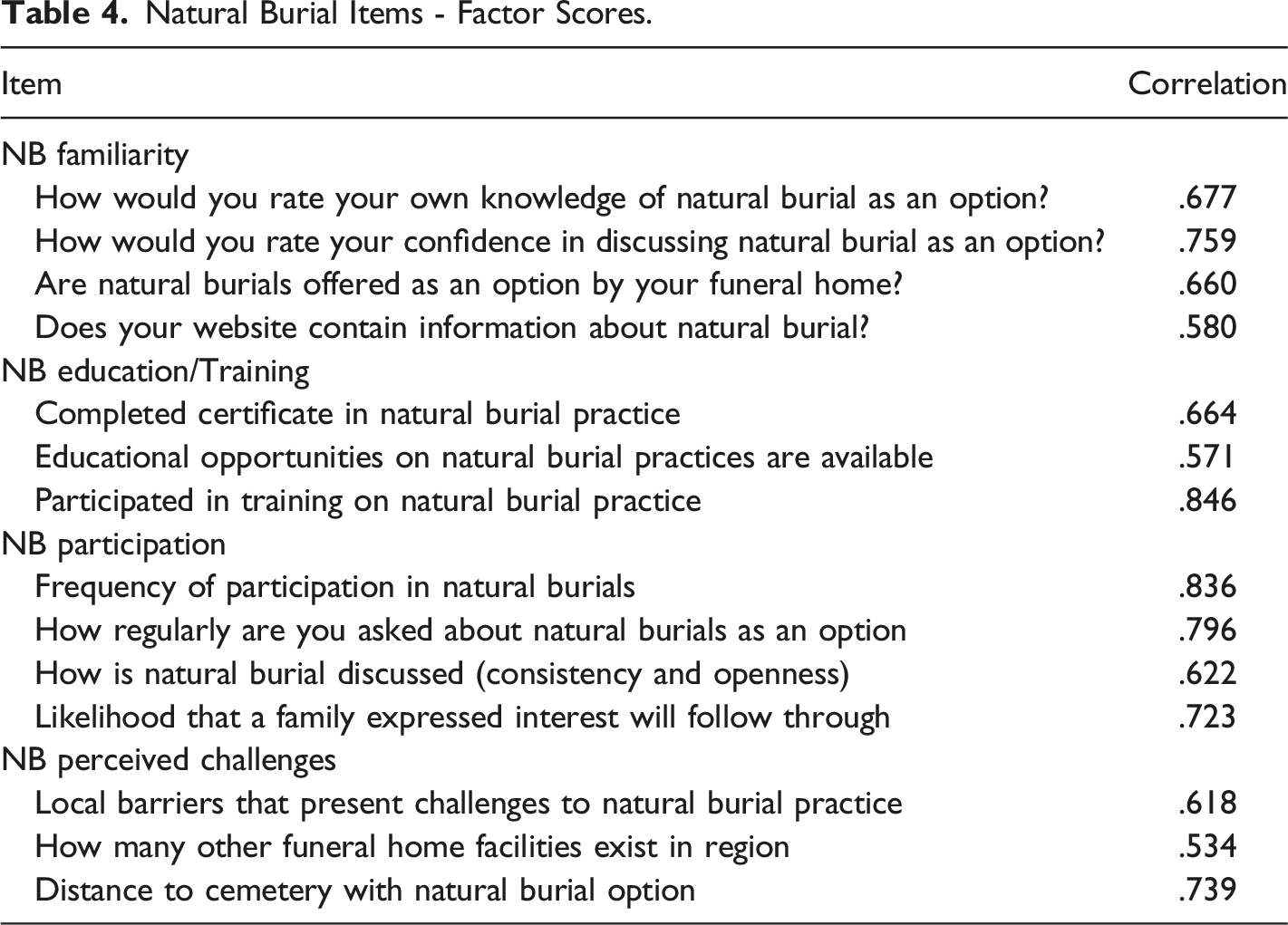
Factor Analysis of Attitudes toward Industry Practice and Standards
Natural Burial Items - Factor Scores.
Correlation Matrix With Natural Burial Factor Scores.
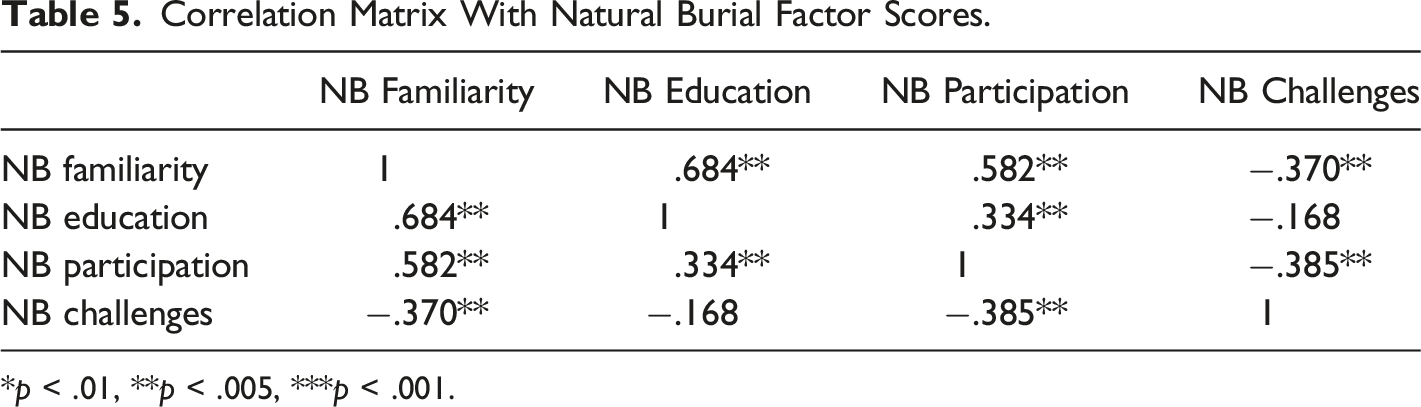
*p < .01, **p < .005, ***p < .001.
Correlation Matrix of NB Factors and Attitudes Toward Natural Burial Industry Practice.
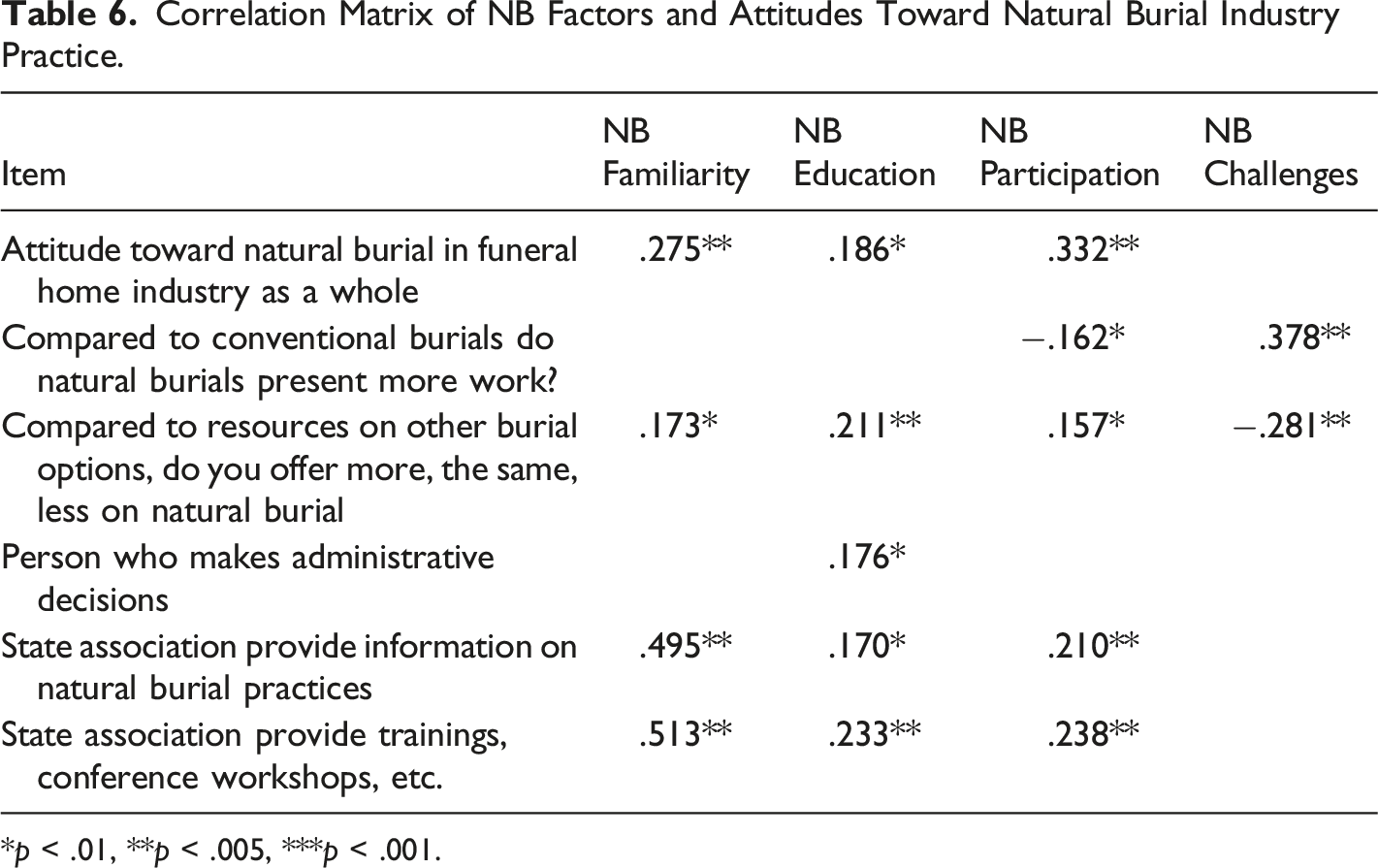
*p < .01, **p < .005, ***p < .001.
Participants were also asked what role their state professional association serves in providing information, education/training and other professional development opportunities on natural burial practices. For those who viewed state associations as providing support (e.g., information on natural burial, training and educational opportunities), there is greater likelihood of familiarity, education, and participation with natural burial practices. Perceived challenges to natural burial practices were not significantly related to attitudes toward state associations. In other words, funeral directors who saw state associations as a positive resource were more likely to engage in natural burial practices.
Discussion
Recent reports suggest growing interest in alternative burial methods as compared with modern approaches such as embalming, casket and cremation. In a 2018 survey, the National Funeral Directors Association found 54% of Americans would consider green burial and 72% of cemeteries reported an increase in demand (Vatomsky, 2018). The way people approach final disposition is clearly changing. Impact on the environment, cost of the current death system, and the realities of a growing global population may all contribute to the way people make decisions around death. As presented in this paper, the fact that cultural landscapes fluctuate over time and place is a well-documented expectation not unique to our attitudes and dispositions on death and dying. Whether the institutions that maintain support and services related to death practice also adapt to a changing landscape is critical to ensuring transparent and comprehensive social needs are being met.
To better understand the interaction between changing patterns in the general population and the death industry system, this study centered on the attitude and perceived role of funeral directors as an integral nexus point. Indeed, funeral directors serve as gatekeepers for many families making decisions for loved ones during particularly vulnerable moments in life. Assessing what type of options are offered, discussed, and supported – especially during a time when many American’s preferences are changing – is paramount.
To do this, an online survey instrument was disseminated across multiple midwestern states, inviting licensed funeral directors to share their positions on natural burial practices, options in their own facility, and general attitudes about the state of the industry. Though such self-reported survey data generally carry limitations, the anonymous nature of the survey offered some protection against issues of response bias. That said, future research might use additional methodologies to gain further insight into these topics, and research including a more nationally representative sample and others key players involved in the American death system may offer a more comprehensive picture.
Initially, most funeral directors (71.3%) in this study present positive dispositions around natural burial as an option for individuals and their families. However, the reality of an informed service offered and supportive of natural burial is much more complicated. Findings from the survey reveal two main conclusions. First, results depict an unbalanced concentration of support for natural burial practices. Funeral directors that are younger, liberal leaning, not particularly religious, environmentally minded, and newer to the industry were more likely to be supportive of natural burial practices. These demographics parallel the characteristics among the general population that care about environmental issues more broadly. The environmental aspect of natural burial options is important, signified by the results of this study but require additional research for deeper insight. For instance, just how the environmental dispositions relate, inform, or effect attitudes and practice regarding natural burial options among funeral directors could be examined even more.
Second, despite general individual support for natural burial practice, there is less perceived confidence among funeral directors that the industry and society writ large are just as accepting. Therein lie the first of two paradoxes. On the one hand, funeral directors depict a lack of interest in natural burial practice from client families, but rarely present or engage in such options with families to begin with. Additionally, funeral directors report designating fewer resources to this option and complain of local barriers, such as a lack of participating cemeteries, as a key hindrance when at the same time many report reasonable options for natural burial locations within a 25-mile radius. Indeed, funeral directors who already report participating in natural burial practice, do not see it as more work at all. The pause around local barriers and cemetery options is an important aspect that requires additional research to dig even deeper into the potential attitudes and understandings from funeral directors. For instance, further research might uncover the need for advocacy related to cemetery practices and other zoning issues.
A potential reason for the dissonance uncovered in these findings could be hegemonic. As detailed in this paper, a death system is not unlike any cultural system; each include particular power dynamics and ideological traditions. The modernist approach toward death and dying has long been established and maintained, making it difficult to imagine and adopt new approaches so quickly. But if perceptions are challenged with rational intent and justification, this might change. Indeed, while most funeral directors do not have formal training on the topic, a majority (60%) would be interested in the opportunity. Furthermore, state associations are perceived as currently underutilized sources for maintaining such training and development. This finding is critical for two reasons as the hegemonic qualities of the funeral home industry are considered. First, this finding presents evidence that in addition to other hidden power dynamic disparities already noted in the funeral home industry (Donley, 2021; Pruit, 2018) variability also exists regarding support and engagement with new options such as natural burial. However, this can change. The second conclusion highlights the shifts in attitude and practice within the industry as stirring, which, despite the already acknowledged inflexible nature of many death systems (Tsuji, 2006), illustrates the potential malleability of this social system.
The takeaway of this study is two-fold. First, the results suggest a disconnect between a growing national preference for natural burial options and an industry that purportedly supports them. Within the industry a series of paradoxes emerge, presenting a somewhat bloated support for natural burial that quickly falls flat with actual execution. Second, there are signs for optimism. A stronger role in education and training on natural burial from state associations could increase awareness, confidence, practice, and engagement. This study has already identified this correlation. These results offer a promising outlook that with increased exposure and information to natural burial options, the realities and challenges of implementation are seen as surmountable, which counters what some previous work has suggested (Balonier et al., 2019). Furthermore, state associations could serve a vital role to buttress a growing and informed profession that welcomes natural burial practices as an option. This too is encouraging, considering the uphill battle previous work has delivered on the barriers the funeral industry poses to natural burial (Beard & Burger, 2017).
Additionally, and more gradually, this will likely curve naturally with generational changes. Millennial and Gen Z cohorts are more environmentally conscious than other groups (Funk, 2021) and, as depicted in this study, younger funeral directors follow similar patterns. The question is whether waiting for generational changes is fast enough to meet actual market demand, rising environmental and population challenges, and cultural shifts around death and dying.
Footnotes
Declaration of Conflicting Interests
The author(s) declared no potential conflicts of interest with respect to the research, authorship, and/or publication of this article.
Funding
The author(s) received no financial support for the research, authorship, and/or publication of this article.
