



Abstract
This qualitative study explores the bereavement experiences of 12 surviving siblings in India, focusing on familial, societal, and cultural influences. Six themes emerged: “The Demanding Familial Role,” “Isolation That Accompanies the Grief,” “Damaging Impact of Society,” “Positive Role of Friends and Family,” “Support Systems,” and “Continuing Bonds.” Participants often felt the burden of supporting their parents, leading to personal grief suppression and isolation, exacerbated by societal stigmas. Conversely, empathetic friends, supportive extended family, and professional resources like therapy provided crucial coping mechanisms. Continuing bonds with the deceased offered comfort and connection. The study highlights the need for comprehensive support systems tailored to cultural and societal contexts. It emphasizes the importance of public awareness and education to foster a supportive response to bereavement. Further research with larger, more diverse samples is recommended.
Keywords
Sibling bereavement is the complex experience of losing a brother or a sister, profoundly impacting the psychological, emotional, and social well-being of the surviving siblings (Davies, 1991; Gillies et al., 2014; Rostila et al., 2019; Wijngaards-de Meij et al., 2008). An essential difference in how bereavement affects parents and siblings is that siblings view death more concretely, while parents view it more existentially (Thompson et al., 2012).
Unlike bereavement in adults, sibling well-being is significantly affected in the long term (Eilertsen et al., 2013; Rosenberg et al., 2015). Losing a sibling in childhood leads to a higher need for in-patient and out-patient care for men in adulthood (Chen et al., 2023; Rostila et al., 2019). Recent literature has also explored the aspect of norms and values in sibling bereavement (Towers, 2022). This process leads to a rupture of norms and values, including loyalty, shared experiences, and emotional support, and involves restructuring familial bonds. Towers also explored how sibling loss impacts an individual across different life and developmental stages (2019).
When sibling bereavement occurs due to suicide, it exerts a profound and often devastating impact on surviving siblings. Empirical research shows that those who have lost a sibling to suicide are susceptible to elevated emotional turmoil, including guilt, shame, and stigmatization, and face an augmented risk of suicidal ideation and behaviours (Adams et al., 2019; Christian, 2007; del Carpio et al., 2021; Funk et al., 2018; Tal Young et al., 2012). Bolton et al. (2016) found that siblings under thirteen who lose a sibling to suicide confront a sevenfold increased risk of physician-related complications compared to older counterparts. In youth who lose siblings to terminal illnesses, research indicates a plethora of emotions like sadness, anger, guilt, and anxiety, accompanied by psychosomatic symptoms (Hasdenteufel & Quintard, 2022). These survivors often internalize their sibling’s death, regardless of their sibling’s quality of life at the time of death (Kenney et al., 2022).
Research highlights the influence of family and community on the grieving process during the COVID-19 pandemic (Nair & Banerjee, 2020). A study on bereaved parents explored the shame and guilt imposed by society (Das et al., 2021). Indian cultural considerations impacting the grieving process view dying as an opportunity for spiritual growth and the afterlife, with strong familial structures intensifying feelings of guilt and regret (Warrier et al., 2019). The grieving process is lengthy in Indian culture, with funeral rites and prayer rituals taking precedence (Laungani, 1996). In a collectivist society, emotional bonds mitigate the experience of loss (Ariapooran et al., 2018). However, research on sibling bereavement in the Indian context remains scarce.
The Dual Process Model, as applied to sibling bereavement within Indian culture, explores the interplay between loss-oriented and restoration-oriented stressors. Loss-oriented stressors involve immediate emotional reactions shaped by Indian customs and familial expectations. In contrast, restoration-oriented stressors focus on adjusting to life post-bereavement, maintaining relationships within cultural norms, and managing societal and familial expectations (Stroebe et al., 2017). Coping, as defined by Folkman et al. (1985), involves cognitive and behavioural efforts to manage these internal and external demands. Within this framework, continuing bonds—ongoing connections with the deceased sibling—play a crucial role in long-term adjustment, correlating with superior psychological adjustment, reduced distress, and posttraumatic growth, including increased personal resilience and appreciation for life (Eilertsen et al., 2013; Rosenberg et al., 2015). This model highlights the coexistence of adaptive strategies and cultural coping mechanisms in grieving.
Coping in sibling bereavement is primarily characterized by ‘continuing bonds’. Continuing bonds in sibling bereavement signify a departure from traditional views advocating emotional detachment from the deceased. Research highlights how siblings connect with their lost brother or sister, finding comfort in purposeful bonds and reminders (Foster et al., 2011; Packman et al., 2006). Factors influencing these bonds include relationship dynamics, manner of loss, and individual coping strategies (Foster et al., 2011). Bereaved children and adolescents, especially those with higher grief symptoms and having lost immediate family members, are more likely to maintain continuing bonds (Sirrine et al., 2017). Recognizing and supporting these bonds is crucial, with mental health professionals playing a pivotal role in helping bereaved siblings navigate their grief (Packman et al., 2006; Sirrine et al., 2017).
Other coping factors include safe spaces for emotional expression, open communication with loved ones, and therapeutic interventions to catalyze healing. Safe spaces for emotional expression provide bereaved siblings with an environment where they can freely express their feelings without judgment, facilitating emotional release and processing (McCarthy, 2020). Open communication with loved ones fosters a supportive network that encourages sharing memories, discussing grief, and receiving empathy, which is crucial for emotional well-being and understanding during the grieving process (Sharp et al., 2018). Additionally, therapeutic interventions, such as counselling or support groups, offer professional guidance and structured support, helping individuals navigate their grief, develop coping strategies, and find healing paths (Moriconi & Cantero-García, 2022). These interventions can also provide tools for resilience, helping the bereaved to integrate their loss into their lives in a healthy way and move forward while maintaining a connection to the deceased sibling.
Despite the prevalence of sibling bereavement, there is no study in an Indian context. This study fills that gap by investigating the lived experiences of surviving siblings and understanding their coping mechanisms. The research objectives include understanding the bereaved sibling’s experience, the impact of family and society on the bereavement process, and the participants’ coping processes.
Methods
Research Design
The paper adopted a qualitative framework better suited to understanding the subjective lived experiences of the participants (Tenny et al., 2022). An interpretive lens was assumed to help the researchers understand how the bereaved siblings made sense of the world. These subjective experiences of the participants were explored using a semi-structured interview developed from pre-existing scales and the theoretical framework.
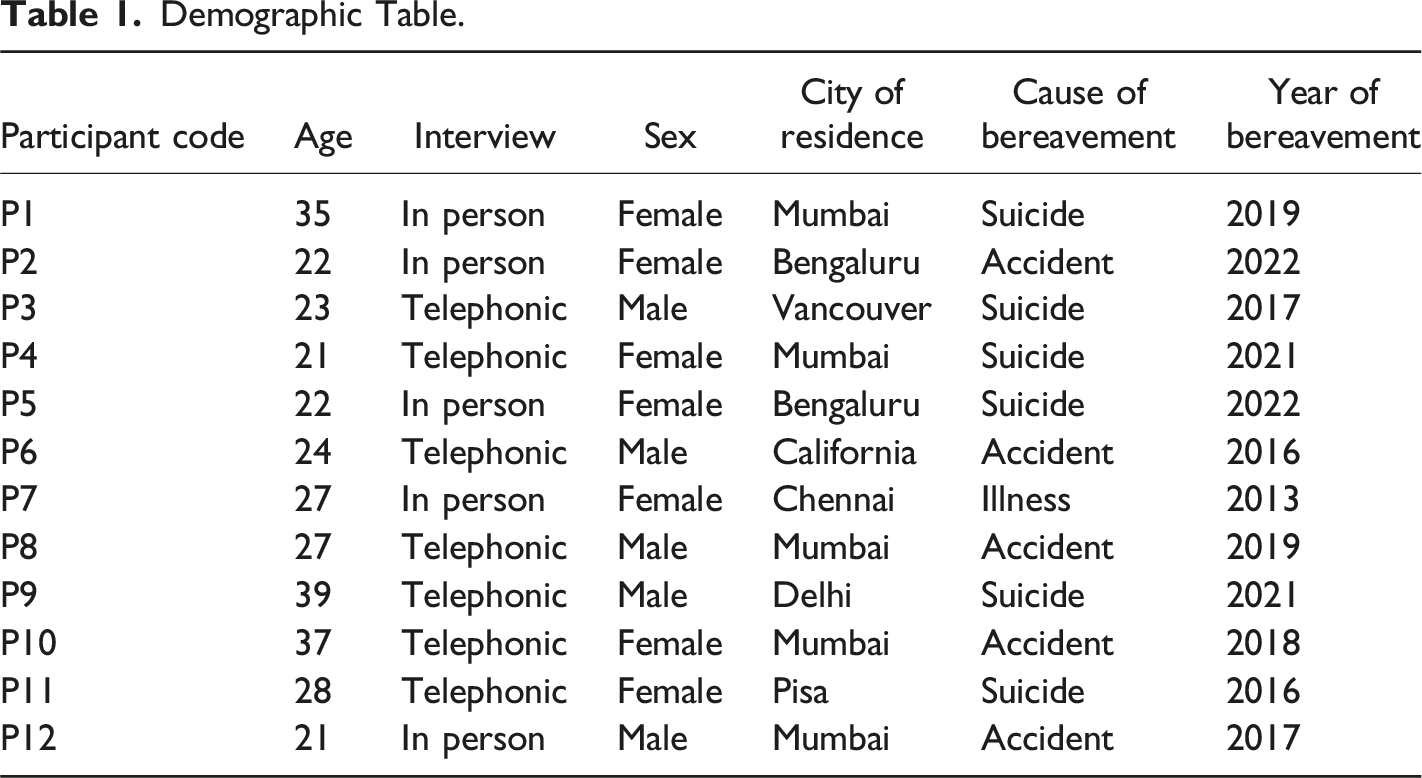
Participants
Demographic Table.
Measure
The researchers devised a semi-structured interview guide (See Appendix A) using the dual process model (Stroebe & Schut, 2010) and the Hogan Sibling Inventory of Bereavement (HSIB) (Hogan et al., 2021), building on the literature surrounding the topic. The guide had four types of questions: bereavement-related questions (from HSIB), loss-oriented questions, restoration-oriented questions, and meaning-reconstruction questions.
Procedure
Two experts, a head of department from a government hospital in Mumbai and a trauma-informed psychologist teaching at Christ (deemed to be) University, Bengaluru, validated the interview guide. Before starting data collection, the researcher obtained approval from the Research Conduct and Ethics Committee (RCEC) at Christ University, with details available. Upon approval, the researcher recruited participants using purposive sampling. After obtaining informed consent from the participants, some interviews took place in person and others over online video conferencing. After each interview, the researcher recorded their impressions and thoughts on the particular interview to maintain reflexivity. The transcriptions and the analyses were done manually using Word documents.
Data Analysis
Nowell’s thematic analysis model (Nowell et al., 2017) was used to create the thematic framework. This model proposes six steps, or phases: (1) Familiarizing oneself with the data, (2) Inductively generating initial codes, (3) Searching for themes, (4) Reviewing themes, (5) Defining and naming themes, and (6) Producing the report.
After transcribing, the researcher reviewed each transcript three times with handwritten notes to familiarize themselves with the data. Then, they collated the notes and impressions to create a coding index. After the supervisor validated this coding index, the researcher manually coded the transcripts using paper and pen. After generating the initial codes, the researcher placed the themes in a Google Sheets document and added quotes from each transcript with participants’ codes.
Results
The analysis of the data resulted in six themes: three that revolved around the suppression of their grief, closely linked to bereavement: “The Demanding Familial Role”, “Damaging Impact of Societal Perception”, and “The Isolation that Accompanies the Grief”. The other three themes revolved around the expression of grief or coping: “Positive Role of Friends and Relatives”, “Unwavering Support Systems”, and “Continuing Bonds”. Figure 1 maps these various themes. Representation of the themes.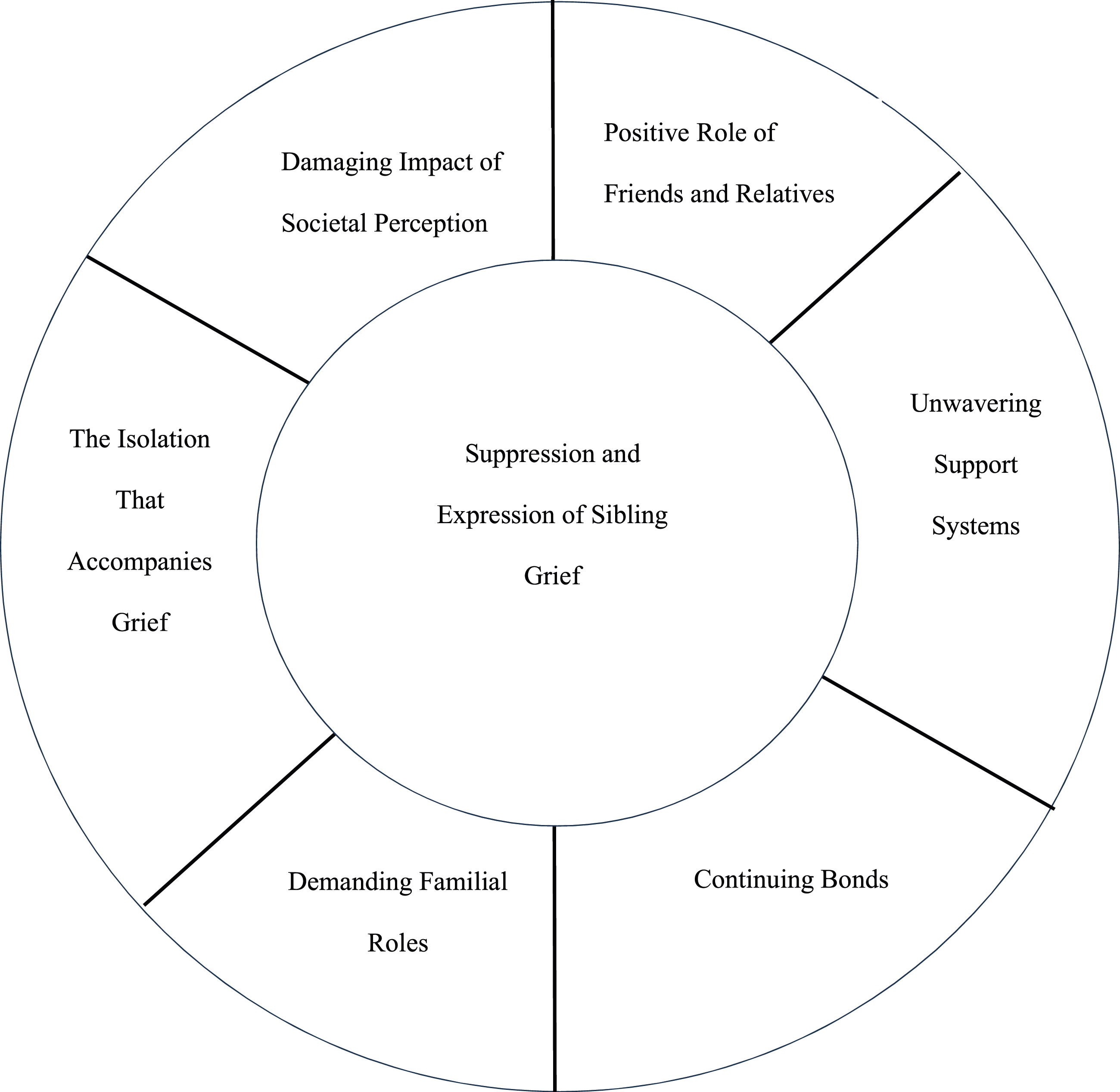
The impact of the bereavement was considerably high across all participants. Several participants talked about how the death of their sibling was “something that fundamentally changed us” (P9), and some of them were also astounded by their resilience to get through this, “I also admire the fact that I could do it at that point.” (P1). While there were individual differences in how these individuals perceived their bereavement process, with P6 highlighting “It is like we all have our set of circumstances that determine how we get through right?”, there were a few commonalities observed across several transcripts as well.
The Demanding Familial Role
This theme highlights the immense responsibilities participants felt they had to take on after losing a sibling. Many described an overwhelming sense of duty to support their parents emotionally and practically, often at the expense of their grief and well-being. P1 poignantly reflects by sharing, “My parents were in such a condition… I never wanted to marry… but immediately after he was gone, everything changed,” and “I knew it was my duty to get on… give my parents a sense of meaning… They just wanted to get me settled.”
The sense of duty is emotional and extends to practical responsibilities. “All the last rites and all were done by me… I was the one who put him at the crematorium,” P1 recounts, highlighting the burden of managing funeral arrangements. This participant also expresses a profound personal impact, stating, “I think this...has actually left a greater scar on me than my brother’s loss.” This sense of needing to do something echoes across participants, be it P3 getting down from the ambulance and heralding traffic or P10 travelling to the USA with her husband to retrieve her brother’s body.
P2 echoes this heavy burden, describing the shift in household responsibilities: “Mom refused to do all of the housework... So, it was an endless cycle of cleaning. Cleaning over and over and being the only person doing it.” This relentless task of maintaining the household underscores the added physical and emotional labour placed on surviving siblings. The emotional toll of taking on such responsibilities is significant. P3 shares, “I could cry and like now it’s like plus, it’s my, like, my parents would like, clearly, like…So it’s like, oh, I got to kind of step up now.” This participant reflects on the rapid maturation required, stating, “I was 17. And I was a bit less mature. And then I just have to turn the switch off and just like, skip a few years, and just be like, like, I’ve like, got a bunch of like a bunch of responsibility of making sure like they're alright?”
The theme also highlights a familiar feeling among participants of having to suppress their emotions to protect their parents. P3 notes, “I can’t cry in front of my parents... I didn’t want to push my feelings on them – that is not my priority. I have to make sure that they feel alright.” Similarly, P10 shares, “Because my parents were always, unke saamne toh I never cried (translation: I didn’t cry in front of my parents) much, much” and “Even till date, I am not comfortable showing my emotions in front of my mom or my dad.”
In some cases, the participants’ efforts to support their parents and maintain family cohesion led to long-term emotional scars. P11 recalls, “I think those 24 hours are the most painful period of my life... but I became like, okay, I never did like, I was not the responsible one, but at that time, I was like okay, if I don't give them food, they won’t eat, if I don’t eat, they won’t eat, so I had to like you know, manage and I don’t know how I got that in me, that strength to take care of everything?” The emotional labour involved in taking care of parents while managing one’s grief often leads to a sense of isolation and unresolved personal grief. P4 describes this dual burden, “I think it was always more of their loss than my own, you know? After hearing the news, I cried once or twice, and then I just became like a stone, walled, cold, and strong, so that I could take care of them.”
Isolation That Accompanies Grief
The sense of isolation mentioned in the previous theme extended through and beyond the familial domain, permeating the participants’ bereavement process. Participants frequently expressed their struggles to find someone with whom they could genuinely share their feelings. P1 mentions, “Not so much to my husband… I cannot really talk and share much with him”, highlighting the difficulty in connecting even with close family members.
The inability to openly express emotions further compounds this isolation: “For the first time in my life, I said, ‘I don’t care’... just stay out of this room that I want to wail.” The desire for private grieving space underscores the isolation even within the household. The challenge of discussing sibling loss is a recurring sentiment. P8 reflects, “I am so scared that I am losing memories of her. It has been five years and because no one wants to talk about it, I only have my mind to contend with, to keep these memories.” This inability to communicate grief can lead to a sense of future loneliness, as expressed, “Sometimes I feel lonely and anxious...because I will have nobody there to share a past with” (P1)
P2 captures the overwhelming nature of grief: “It’s like a wave that hasn’t passed through yet. Like sometimes it hurts, like you really feel like you're stuck and overwhelmed with all of it.” This sense of being trapped and overwhelmed often leads to emotional shutdowns: “The second it got too much, I would just shut down. And I’d be like, oh, okay. I can go through this.” The feeling of bearing the weight of the family’s grief alone echoes in, “It feels like you’re the one standing back, kind of holding everything back. And everyone’s just like, this happened.” She also talks about having to find a distraction for herself continuously as a coping mechanism, not letting this isolation “allow her brain to produce one single thought”
The lack of an outlet for grief is a common issue. P3 notes, “But your outlet is like pretty much your family members. And they are grieving as well. So yeah, outlet gets shut.” This mutual grieving process within the family can lead to irritability and increased solitude: “I became a little more irritable than I really was... I became a little more of a loner after that.” (P4) Even the activities that helped the individuals get through their grief came strongly from a source of isolation, with some coping mechanisms including meaningless distraction (P2), substance use (P3 and P6), and even frequenting the gymnasium (P8).
Discussing grief outside the family was also difficult. P5 shares, “It’s a very, it’s difficult to talk about with him because I you know didn’t know about it right because I haven't like talked about it especially to anybody in class” and, “I’ve talked like a lot to like my friends but them also like barely aise and I talk about him I cry and I feel like it’s only been an year and it affected me so much that I kind of couldn't deal with it.” The hesitation to bring up such a personal loss in casual conversations further isolates the grieving individual. There is an innate difficulty in expressing oneself or bringing up their sibling because they are afraid to take that kind of space (P5), or make it ‘myself-centric’ (P12)
P10 poignantly describes the numbness and emotional suppression that often follow a sibling’s death: “I was numb for like almost a month” and, “I don't cry in front of them.” The reluctance to show emotions, even to close family members, further isolates individuals in their grief: “I feel like I’m not comfortable showing my emotions in front of my mom or my dad,” and, “I don’t even show my husband that I'm crying. I don't show anybody actually that I'm crying.” Finally, P12 encapsulates with a famous quote: “There is this quote by Hellen Keller- the bereaved are never alone, we belong to the company of those who have known suffering. And while that sounds great on the face of it, very few have lost the loss I have. It is alienating, and stupid, and just..lonely. I don't know where this company she mentioned exists”.
Damaging Impact of Society
In a collectivistic culture like India’s, one cannot alienate the social aspect of bereavement. Regardless of how isolating the bereavement process is, the way society exists and functions around an individual can often reinforce the isolation. These expectations, judgements, and prejudices played a significant role in shaping the process of bereavement for the participants. These triggering situations where the participants felt impacted ranged from people ‘speculating’ while they had come to give their condolences (P1) to a trigger as nondescript as seeing a friend’s Instagram story with their sibling and feeling a sense of immense loneliness (P6).
P6's frustration echoes the need to defend against societal judgments: “The way people gathered, just for gossip- made me want to puke.” This reflects how societal behaviours can turn mourning into a spectacle, intensifying the sense of isolation. The societal expectation to move on quickly also emerged as a significant theme. P1 describes, “I feel like a lot of the attitudes which people around me have taken is, after the point of time, you just learned to live with it.” This expectation dismisses the ongoing nature of grief and pressures individuals to appear ‘normal’ prematurely. P10 further illustrates the societal discomfort with prolonged grief: “Then the other hurtful thing that happened is you could see that, you know, people start getting, they're there for you initially for like one month, two months and then they start getting normal. But you are not normal yet.”, highlighting the disparity between the individual's grieving process and societal expectations.
The taboo surrounding death, or suicide in particular, in Indian society also exacerbates the isolation felt by the participants. P3 notes, “Talking about it quite difficult coz especially in India got super difficult because it’s like, taboo and stuff.” This cultural reluctance to discuss death openly can lead to additional loneliness and frustration for those grieving. P5 shares a similar sentiment, “Recently one of the teachers, supervisors in therapy internship asked me and I was like in front of the class I didn't say suicides. I said accident. I was like a very split decision and I regretted it as soon as it came out. I'm like that is not what I meant to say. But I get it.” This indicates how the stigma surrounding certain types of death can force individuals to alter their narratives to avoid judgment.
The comparison with peers who have not experienced such loss further isolates grieving individuals. P6 expresses this poignantly, “Sometimes it also feels like, just make people stop existing. They move on with their lives, post with their siblings on Instagram, and f*** it feels like shit.” Constantly being reminded of what they have lost can deepen the sense of isolation and envy. P1 echoes this sentiment, “I see my friends and their siblings. And I can’t help but like, you know, if something inside just shatters.”
The damaging impact of societal expectations, judgments, and insensitivity plays a significant role in the bereavement process. Participants felt isolated not just by their grief but also by the way society responded to their loss, highlighting the need for greater empathy and understanding in communal responses to bereavement.
Positive Role of Friends and Family
The bereavement process is deeply personal and often excruciating, but the presence of a supportive, non-judgmental environment can significantly ease this journey. Friends and family who offer empathy, understanding, and unconditional support are crucial in helping individuals navigate their grief.
Participants shared how their close relationships provided a safe space to express their emotions without fear of judgment. P1 highlighted the healing impact of new life, stating, “And a year later I conceived and redacted (her son), you know, he has just, he has just healed us all.” This new addition to the family brought a sense of hope and renewal. The act of mutual caregiving within the family is evident in P1’s reflection, “I was thinking I am taking care of them, but I know that they were taking care of me.” This reciprocal support underscores the importance of family in the healing process.
In contrast to the isolating and judgmental experiences previously discussed, the participants found solace in the presence of empathetic friends. P2 described how friends maintained a delicate balance between normalcy and acknowledgment of loss: “But I think my friends have also been people who have kept it stable, so to speak. Like, they tried their best to not bring it up, but they didn’t pretend like nothing happened.” The involvement of extended family members also proved beneficial. P2 mentioned, “my aunt and uncle especially. They would uh they try taking me out and just talking to me or making sure that I’m at least going out of the house… So that helped.” P9 had a similar experience, with his maternal side of the family being a huge help. The proactive efforts of relatives to engage and support the grieving individual were crucial in preventing the deepening of isolation, providing a sense of security in a time of vulnerability.
People who did not know their late siblings provided a unique form of support, as noted by P3: “For me it was people who hadn't like didn't know him and stuff so it was easier for me to kind of open up and since then I have kind of dealt with it a lot better.” This distance from the shared loss allowed the participant to speak more freely about their feelings. P8 echoed this sentiment: “It isn’t just the old ones. I think the friends I have made here (referring to California), have been so good about the whole thing. They get it, I think, what I need, and when I need it. That's important, you know?”
The power of community was also evident. P5 described the supportive presence of friends and acquaintances during rituals: “But when you actually see people there, you realize that there were people who loved him. And love him and will carry on with him. There are people who cried for him. There are people who will stay with you even if you are going through your worst times. That was really nice.” The stark difference between feeling judged and feeling supported is encapsulated in P4’s testimony: “Friends. I don’t know how to convey or quantify how much my best friends have helped me through this... They were everything. They've been everything. Without the two big idiots in my life, I could have never been through this. Anything I say would never be enough.” This sense of community, of being part of something bigger, is a powerful source of comfort and strength in the face of grief.
Support Systems
While friends and family provide essential emotional support during bereavement, additional resources like therapy and support groups play a crucial role in navigating the complex process of grief. These structured support systems offer professional and peer assistance that complements personal relationships, providing a more comprehensive approach to healing.
Therapy emerged as a critical resource for many participants. P1 shared how beginning therapy in October, accompanied by medication, was a necessary step: “then October is when I began with therapy, and she said you have to take medication. It’s grief, but you have to go through a marriage.” Therapy provided a structured environment to manage grief alongside life’s other stressors. Similarly, P2 found therapy beneficial despite initial family resistance: “Systemically, not really. I mean, my parents don’t believe in therapy, so no. I had to seek that out myself.” This illustrates the importance of seeking help even when it goes against familial or cultural norms.
P5 and P7 underscored the transformative power of therapy, with P5 noting, “Therapy has helped, especially me, because I’m not talkative at all. So, you know, that way to have that space to talk because I need it.” P7 elaborated on the deeper self-understanding gained through therapy: “I do feel like even though it helped me with my grief. It actually helped me understand myself more.” This insight illustrates how therapy can address underlying issues affecting one's grief process.
Participants also found support groups to be invaluable. P1 quoted: “I think that is where we had conversations. I didn’t talk as much that I've spoken to maybe friends but I really felt understood.” This group provided a unique sense of understanding and shared experience that was unavailable even among close friends or family. The kinship felt within these groups, as noted by P1, fostered a sense of belonging and mutual empathy: “we feel such a kinship with each other it's like we found our tribe.”
P9 highlights something very similar, “I’m part of a suicide survivors group, actually, which has helped quite a lot. Fairly active member of it. We meet virtually just like this once every month.” The regularity and structure of these meetings provided a consistent support network, helping participants process their grief over time.
In addition to therapy and support groups, some participants turned to creative outlets as therapeutic tools. P3 discussed using art as a form of therapy: “And this getting to talk about it and use art as a form, like therapy and stuff and like making sense of and kind of like interpreting and hearing how I think I should like, and like this one positive reinforcement.” This creative expression provided an alternative means of processing emotions and finding solace.
P3 mentioned the financial strain of therapy during the lockdown: “I paid out a bit from my own pocket and you know, and since in the lockdown I was not earning anything, it was a bit difficult?” This highlights the need for accessible mental health resources, particularly during times of crisis.
Continuing Bonds
Continuing Bonds (CBs) illuminate the enduring connection between the departed and those they left behind. Through various forms of remembrance, individuals keep cherished memories alive, fostering a sense of closeness even in absence.
P1 reminisces about preserving their connection through digital dialogue: “I do talk to him... I have a word document... which is my letter to my son.” P4 also emphasizes on how she “Talk to her when I am all alone, and it’s late at night”. This kind of conversation with the sibling that passed away often helps the individual through their process of bereavement.
Sensory triggers evoke vivid memories, offering moments of connection. P1 recalls a familiar scent: “I still sometimes get the smell... I can still sometimes get the smell” Material manifestations of CBs, such as trust funds and personal belongings, offer tangible ways to honor and remember the deceased. P1 describes their ongoing tribute through financial contributions: “After [name redacted] passed away, I’ve been putting every month... I contribute a fixed amount.” P7 resorted to tangible reminders, like keeping her belongings around, and even “sometimes when I, like, actively want to feel her presence, I sort of light lamps around the house”. Similarly, P2 finds solace through “I have some of her clothes, and I refuse to wash those clothes, because I like smelling them sometimes.”
These extend beyond rituals and can include reading the books that one had gotten them (P8), watching movies that they liked (P11), or even something as simple as looking up at the stars while on a walk and thinking about them (P10). Thus, these continuing bonds serve as transitional reminders of their siblings, to help ease the process of bereavement. Through these acts of remembrance, the departed remain present in the hearts and minds of those left behind, offering solace and comfort in times of grief.
Discussion
This qualitative exploration of surviving siblings’ bereavement revealed a multifaceted grieving process. The participants’ experience narrated a story of profound loss and impact on their psychological, emotional and social well-being, which corresponded with the current body of literature (Eilertsen et al., 2013). The overarching theme, the “suppression and expression of sibling grief”, encapsulates the challenges and the protective factors in their process of bereavement. The themes reflect the loss of one’s sibling, catalyzing the loss of familial dynamics, social memberships, extended friendship circles, and one’s sense of self.
The loss is like cutting the four legs of a table, making it impossible for a table to remain upright. The way the participants suppress their grief during this bereavement process often results in a significant change: the table ceases to be a table. In a situation like this, it becomes essential to have other pillars to hold this table up, be it close friends, support groups, therapy, or even a sense of connection to their late sibling. The themes that arose were: “The demanding familial role”, “Isolation that Affects Grief”, “Damaging Impact of Society”, “Positive Role of Friends and Family”, “Support Systems”, and “Continuing Bonds”
“The Demanding Familial Role” highlights the substantial responsibilities that surviving siblings assume after a sibling’s death, emphasizing the dual role of griever and caregiver. Towers (2022) has explored this restructuring of familial norms and values, but this study expands on that within the Indian context. Participants in this study felt a strong sense of duty to support their parents emotionally and practically, often at the expense of their grief. The current body of literature has explored the role of health professionals (October et al., 2018) or paediatricians (Weaver et al., 2023), but none explore the burden placed upon the surviving sibling. It leads to the suppression of personal grief to fulfil family obligations. Despite this huge burden, three participants reported that despite suicidal ideations after this loss, they “could not do that to their parents”, which contraindicates current research findings of higher suicidal behaviours in surviving siblings (Adams et al., 2019; Funk et al., 2018). The cultural expectation in India to prioritize familial duties (Warrier et al., 2019) perhaps explains this ‘family over anything else’ approach observed in the participants.
“Isolation That Accompanies the Grief” emerged as a significant theme, with participants feeling a profound sense of loneliness despite being surrounded by family. This finding resonates with the literature on bereavement, which often points to the isolating nature of grief (Davies, 1991). However, in the Indian context, the collectivist nature of society might be expected to mitigate feelings of isolation (Ariapooran et al., 2018). The current study’s findings negate this and suggest that the intense focus on fulfilling family roles and societal expectations can exacerbate feelings of isolation, even within a collectivist culture. This is underscored by Birenbaum et al.’s study (1990), which explored the lower social competence of surviving siblings owing to internalizing their siblings’ deaths (Kenney et al., 2022). In suicide cases, participants expressed pronounced guilt and internalization, with almost all those whose siblings died of accidents expressing that they “would not know what to do” if it were suicide. Under the “Damaging Impact of Society”, participants reported feeling pressured to conform to societal norms of quickly moving on. This aligns with the findings of Nair and Banerjee (2020) regarding the societal discomfort with prolonged grief. The taboo surrounding certain types of death, particularly suicide, further isolates individuals and complicates their grieving process (Das et al., 2021). This highlights the critical need for public awareness and education to foster a more supportive and understanding societal response to bereavement. While all this suppression is occurring, facilitating spaces for expression becomes essential for bereaved individuals to cope with their loss.
In this regard, the “positive impact of friends and extended family” who offer empathy and support plays a significant role. This support system can provide a buffer against the isolating effects of grief and supports earlier findings of Hogan et al. (2021). Professional support systems, including therapy and support groups, were identified as critical resources for managing grief. Participants who engaged in therapy found it beneficial in navigating their grief, which aligns with the broader literature on the positive impact of therapeutic interventions (Moriconi & Cantero-García, 2022). The finding of continuing bonds is consistent with the literature, which indicates that maintaining continuing bonds can lead to better psychological adjustment and posttraumatic growth (Packman et al., 2006). The study suggests that these bonds provide a sense of comfort and continuity, helping individuals navigate the various life milestones that follow sibling loss.
Implications
A pressing need underscores this analysis to have structures that protect and nurture these surviving siblings through bereavement. It has real-world applications, especially in grief counselling and support services. The firm restructuring of familial structures burdens participants who might need more time to work through their problems. There is a need to recognize how this influences how ‘relationships are navigated and negotiated over time’ (Towers, 2024). It emphasizes the need for healthy connections with people to get through their loss, and social support from friends, peers, and even teachers plays a considerable role in adjusting after their loss (Sharp et al., 2018).
The themes also reveal aspects of bereavement in the Indian context that researchers have not yet explored. These unique challenges of familial burden, taking on responsibility and navigating social nuances can inform practising therapists and help maintain competence while dealing with such clients. The themes also uncover aspects of bereavement in the Indian context that researchers have not yet explored. If the therapist does not understand these contexts, it can cause much harm to these clients. The results also indicate the need for more support groups for surviving siblings, where people can connect with others who have gone through similar experiences (Hogan et al., 2021). In an Indian context, people expect support from those who care about them (Das et al., 2021) rather than from individuals who have experienced similar situations. The few groups that exist are more parent-centric than sibling-centric. Participants reported having to find support in their parents’ support groups or join suicide survivors’ groups because there were no support groups tailored for them.
Lastly, the outcomes of this investigation hold significance for policies about grief support and mental health services. Recognizing sibling bereavement in leave policies, educational initiatives for psychoeducation of teachers in schools and colleagues in the workplace, and even media representation and public awareness campaigns can make a huge difference.
Limitations
This study faces several limitations, which future research can look to address. The study was limited to 12 participants, which may not fully capture the diversity of experiences among all surviving siblings in India. A larger sample size with participants from varied backgrounds could provide more comprehensive insights. Secondly, there might be self-selection bias, where participants who chose to share their experiences might have been more inclined to seek and value support, possibly skewing the results. Those who did not participate may have different experiences and coping mechanisms. Lastly, it is essential to remember that these are all retrospective accounts, where recall bias might play a significant role. Longitudinal studies might yield more accurate results while exploring sibling bereavement.
Conclusion
This qualitative exploration identifies six key themes: “The Demanding Familial Role,” “Isolation That Accompanies the Grief,” “Damaging Impact of Society,” “Positive Role of Friends and Family,” “Support Systems,” and “Continuing Bonds.” These themes underscore the dual nature of grief, where suppression and expression coexist and significantly impact the grieving process. Participants frequently felt the burden of supporting their parents emotionally and practically, often at the expense of their grieving process. This duty to family led to a sense of isolation, compounded by societal expectations and stigmas, particularly surrounding deaths by suicide. Conversely, the presence of empathetic friends, supportive extended family, and professional resources like therapy and support groups emerged as critical factors in navigating grief. Continuing bonds with the deceased provided comfort and helped maintain a sense of connection. The findings highlight the importance of comprehensive support systems that consider cultural and societal nuances, emphasizing the need for tailored interventions in grief counselling and support services.
Footnotes
Declaration of conflicting interests
The author(s) declared no potential conflicts of interest with respect to the research, authorship, and/or publication of this article.
Funding
The author(s) received no financial support for the research, authorship, and/or publication of this article.
