



Abstract
The death of a spouse in the older adult is a devastating loss. Given that older adults employ unique strategies for adapting to bereavement, this study was conducted to aim explaining the adaptation strategies of the older adult in the face of death of a spouse. The experiences of 21 participants were collected through semi-structured interviews and analyzed using the conventional content analysis approach of Lundman and Granheim’s (2004), which led to the creation “Phantom Spouse” as the main category with four categories: “1-speaking to the deceased, 2- Establishing and maintaining the privacy of the deceased, 3- Being committed to the deceased, 4- Inducing the feeling of the presence of the deceased” and explained fourteen sub-categories. The concept of the phantom spouse represents a novel strategy for maintaining a symbolic and emotional connection with the deceased which leads to facilitating the adaptation process of the older adult to the bereavement of their spouse.
Couples play a crucial role in supporting one another, contributing to the overall quality of life of their partners (Liu et al., 2024). The death of a spouse, while an inevitable event for older adults who have shared their lives with a partner (AA & Stover, 2023), is accompanied by grief and is generally seen as a normal part of aging. However, for many older adults, the transition from being married to becoming widowed is one of the most challenging and emotionally devastating experiences, often leading to significant stress and emotional turmoil. Globally, around 31% of women aged 65 to 74 are widowed, and this figure rises to 80% among those aged 85 and above. Similarly, 9% of men aged 65 to 74 are widowed, with the percentage increasing to 47% for those aged 85 and older (Owen, 1996). In Iran, statistics reveal that 8% of older adult men and 48% of older adult women are widowed.
The death of a spouse and subsequent widowhood can pose significant health risks for older adults and have a profound impact on their well-being and daily life (Noei et al., 2017). This experience is closely linked to increased mortality rates and can exacerbate the risk of various diseases in the months following the spouse’s death (Beischel, 2019; Kashani Khatib et al., 2019; Naef et al., 2013). Lifestyle changes that occur after the death of a spouse are associated with a higher incidence of nearly all types of cancer and are considered a risk factor for stroke (Rafii et al., 2019). Additionally, there is a strong correlation between bereavement and the onset and severity of cardiovascular diseases, with older men who experience the death of a spouse also showing an increased risk of developing type 2 diabetes (Martín-Timón et al., 2014).
This unfortunate event, occurring at a time when older adults are already experiencing a decline in their physical and social resources, carries a significant risk of negative outcomes, necessitating considerable adaptation efforts (Bagheri-Nesami, 2011). Without effective adaptation, there is an increased risk of mortality for older adults (Lekalakala-Mokgele, 2018). Rudolph et al. highlighted that adaptation serves as a key factor in mediating the relationship between a stressor and the resulting outcomes (Rudolph et al., 1995). This implies that the methods and strategies individuals employ to adapt to stress can either mitigate or exacerbate the impact of adverse life events, potentially influencing the development or worsening of mental health disorders (Ghesquiere et al., 2013). The challenges of aging, particularly the death of a life partner or spouse, represent critical demographic and social issues with substantial implications for both individual well-being and societal quality of life (Bastami et al., 2016).
To address the challenges posed by the death of a spouse and successfully navigate the adaptation process, older adults require effective strategies (Hajatnia et al., 2021). These strategies often involve cognitive and behavioral approaches aimed at managing, controlling, and reducing both internal and external conflicts (Mehri Nejad et al., 2017). Depending on individual resources and contextual factors, people utilize various strategies to adapt to the challenges associated with the death of a spouse (Fathi, 2020; Lawrence et al., 2022). The response of older adults to the difficulties and distress of this period particularly the profound impact of losing a spouse (Carr et al., 2005), is linked to a decline in their abilities and skills, necessitating reliance on past adaptation experiences (Kirby et al., 2018).
Despite the importance of these strategies, there is limited information on the specific behavioral, emotional, and cognitive methods employed to manage the death of a spouse and their effectiveness in aiding older adults’ adaptation (Rodgers, 2004). Numerous studies worldwide have examined adaptive strategies in response to bereavement, recognizing it as an unavoidable life experience. Research into adapting to bereavement has been extensively explained through both quantitative and qualitative studies, ranging from investigating the meaning of death to identifying adaptive strategies among older adults. Several studies have examined older adults' experiences following the death of a spouse and the strategies they employ during the bereavement period (Nouri et al., 2024). Other research has focused on understanding the significance of bereavement through qualitative analyses of older adults’ experiences (Holm et al., 2019), as well as adaptive strategies in response to death among older adults (Spahni et al., 2015). Additionally, studies have explained adaptive models for spouses of cancer patients (Asai et al., 2012) and strategies used by older adults adapting to the death of a child (Safa et al., 2024).
However, there are notable differences in these studies, including variations in the bereaved population (Stroebe & Schut, 2010), the nature of the bereavement, and the ratio of surviving older adults to the deceased (Ajiboye & Ajokpaniovo, 2019). Differences also arise from the research methodologies employed, whether quantitative or qualitative (Holm et al., 2019), and, most crucially, the contextual factors influencing the strategies used (Pan, 2020).
Given that the adaptation process of older adults facing spousal bereavement has not been explained qualitatively and considering the lack of context-specific studies in Iran, as well as the limited number of both quantitative and qualitative studies conducted elsewhere with varying objectives, it is important to recognize that this phenomenon manifests differently across cultures, ethnicities, social classes, and age groups, each with distinct personal and social backgrounds (Ajiboye & Ajokpaniovo, 2019). Therefore, conducting a qualitative study in Iran is crucial, especially considering the significant role of cultural, moral, and religious principles (Pan, 2020). This approach is essential for a deeper understanding and explanation of human behaviors related to bereavement (Angrosino, 2007; Hopkins-Williams, 2007).
This research seeks to address the existing knowledge gap by investigating the following questions: How do older adults adapt to the death of their spouse, and what strategies do they employ based on their contextual conditions?
Objective of the Study
The present study was conducted with the aim of explaining the adaptive strategies employed by older adults in response to the death of their spouse in Tehran, the capital of IRAN.
Methods
Study Design
This descriptive qualitative research, employing the conventional content analysis method and following the approach of Graneheim and Lundman (2004), was conducted to investigate the strategies older adults use to adapt to the death of a spouse. The study took place in Tehran, Iran, between 2021 and 2023. Content analysis, as a qualitative research methodology, is designed to generate new insights, deepen the understanding of phenomena, and identify practical strategies within processes (Krippendorff, 2018). Ethical approval was secured from the relevant ethics committee before data collection commenced. Informed written consent was obtained from each participant, and they were made aware of their right to withdraw from the study at any stage. No participants chose to withdraw.
Study Setting
The study included older adults aged 60 and above who had experienced the death of a spouse in their later years. Participants were selected using purposive sampling from public places, parks, places of worship, and outpatient rehabilitation centers in Tehran, Iran. Both male and female participants were included. Efforts were made to ensure diversity in terms of employment status, income, duration of bereavement, financial situation, residence, and literacy levels. The selection criteria were as follows: 1- Participants were over 60 years old. 2- They were willing to participate in the study and engage in interviews. 3- They could communicate effectively and speak Persian. 4- They had normal cognitive status, indicated by a score of 8 or higher on the Abbreviated Mental Test (AMT). 5- They were living at home (not in a nursing home).
The timing and location of the interviews were arranged with the participants. A total of 21 participants were interviewed until data saturation was achieved, meaning no new information emerged and the collected data corroborated previous findings.
Data Collection Procedure
Data collection and analysis were carried out from February 2021 to September 2023. Data were gathered through interviews and field notes. With participants’ consent, face-to-face interviews were conducted and recorded using an MP3 recorder. Initially, the interviews were unstructured; participants were invited to share their experiences of adapting to the death of their spouses and how they managed through that period. The researcher encouraged participants to speak openly and freely about their personal experiences without providing specific prompts.
Examples of open-ended questions used in the unstructured interviews included: “How has your life been since the death of your spouse?” and “How did you adapt to their death?” Following the analysis of the initial interviews, subsequent rounds involved semi-structured interviews with more focused questions, developed based on insights gained from the previous interviews. These later interviews aimed to explore the contextual factors and conditions affecting older adults’ adaptation to the death of a spouse. Examples of questions used in the semi-structured interviews included: “What factors have improved or worsened your situation?” and “How did your life evolve after the death of your spouse?” In the later stages of the interviews, probing questions such as “Can you elaborate on that?” and “Could you provide an example?” were used to gain deeper insights. Interviews were conducted both in person at senior homes, parks, and other public venues and over the phone. With participants’ consent, all interviews were recorded using a digital device (Okereka et al., 2024) and subsequently transcribed into text. The interviews lasted between 30 and 60 minutes. In addition to the interviews, the researcher employed observational methods to gain a deeper understanding of the phenomenon and validate the information obtained from the interviews. Observations were recorded and analyzed through field notes. Data collection continued until saturation was reached, meaning that no new data or observations emerged in the final two interviews, and the information collected did not introduce new concepts or categories. In total, 23 interviews were conducted with 21 participants, with two individuals being interviewed twice.
Data Analysis
The data analysis followed the stages outlined by Graneheim and Lundman (2004): 1. The researcher transcribed the interviews and observations into written texts and reviewed them multiple times to grasp the overall context and flow of the data. 2. The entire set of interviews and observations was treated as the unit of analysis. 3. Words, sentences, or paragraphs were identified as semantic units—groups of words and sentences related by content. These semantic units were then aggregated and organized based on their content. 4. The semantic units were abstracted and conceptualized, and codes were assigned to them based on their underlying meanings. 5. The researcher compared these codes to identify similarities and differences, then categorized them into more abstract groups with specific labels. 6. Finally, by examining the categories in relation to each other and reflecting deeply on them, the researcher identified the overarching themes within the data. (Graneheim & Lundman, 2004).
The Trustworthiness of the Data
The researcher evaluated the accuracy of the data using the four criteria proposed by Guba and Lincoln (Forero et al., 2018). 1. 2. 3. 4.
Ethical Considerations
The present research was carried out in full compliance with the Declaration of Helsinki, and this study approved by the Ethics Committee of the School of Nursing and Midwifery, Tehran, Islamic Azad University of Medical Sciences before starting the first interview (Ethics Approval Code:IR.IAU.PS.REC.1401.263).
To ensure full adherence to ethical considerations, the researcher briefed all participants on the study’s purpose and methods. Upon agreeing to participate, each participant provided informed consent. The consent form outlined the voluntary nature of participation, the right to withdraw at any time, and a commitment to confidentiality, particularly regarding the protection of audio files and the anonymity of participants’ identities.
Results
Demographic Characteristics of Participants.
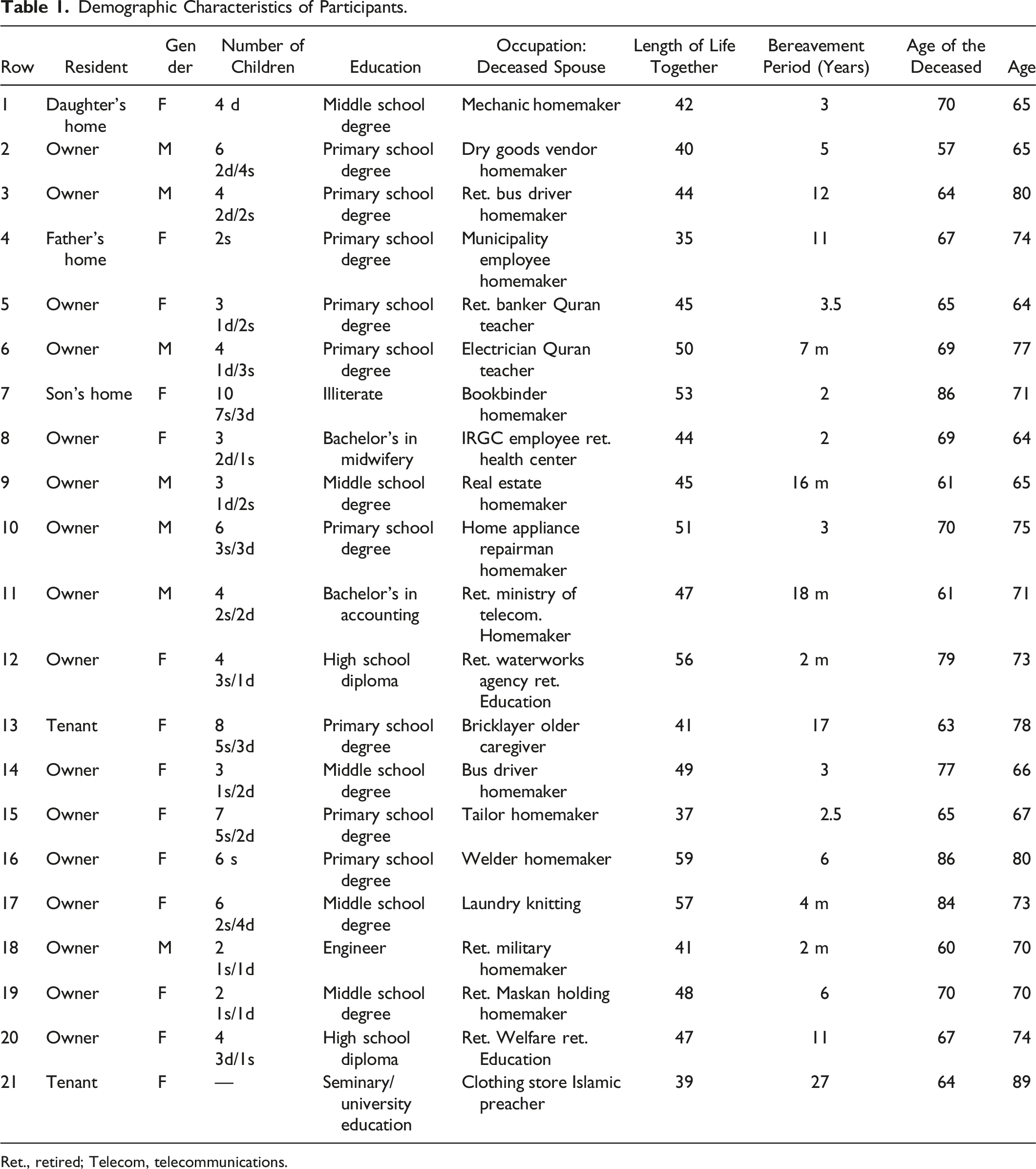
Ret., retired; Telecom, telecommunications.
Main Category, Categories, and Sub-Categories.
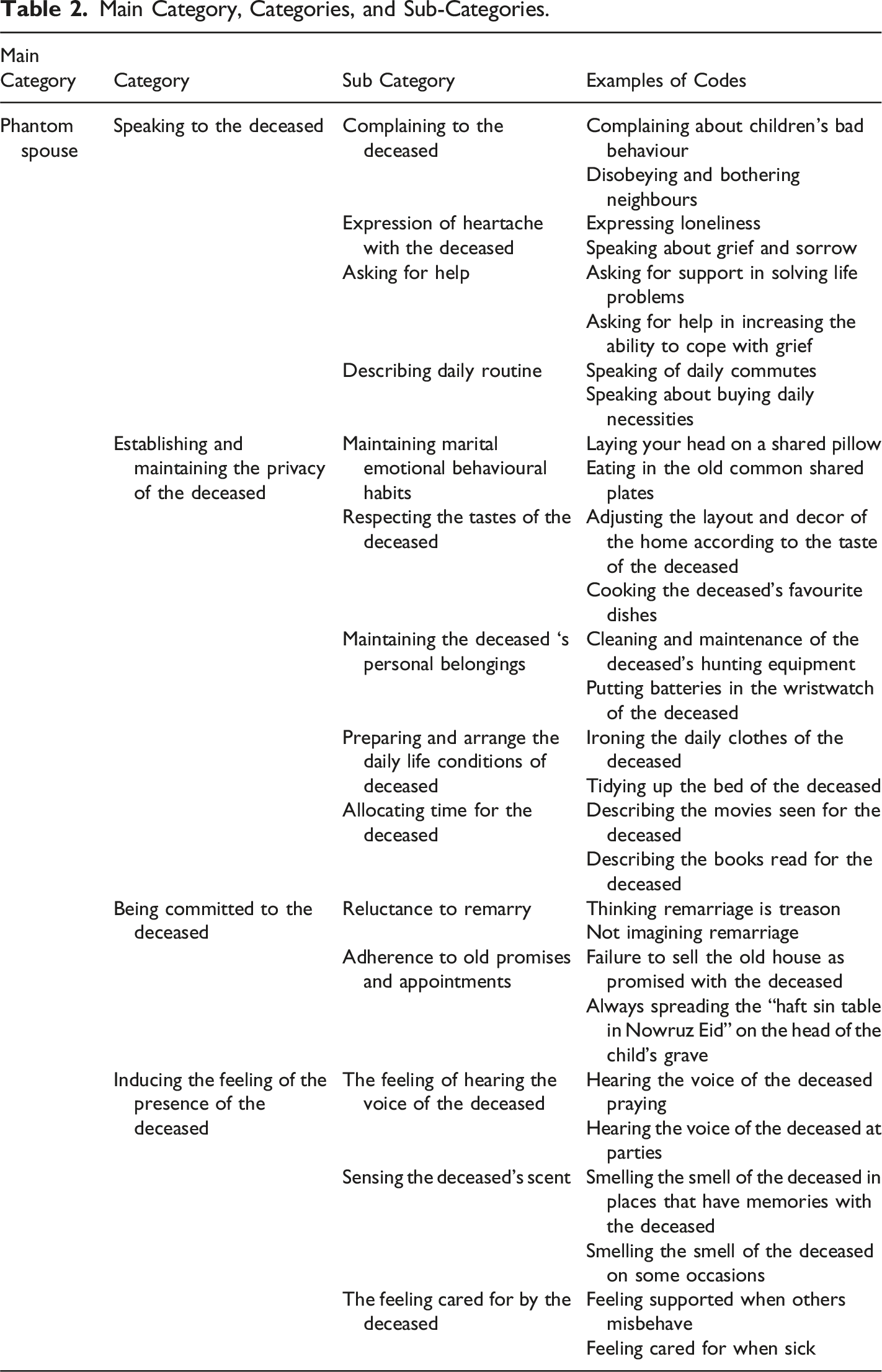
Phantom spouse, as the main category includes four categories: 1- speaking to the deceased with 4 sub-categories 2- Establishing and maintaining the privacy of the deceased with 5 sub-categories 3- Being committed to the deceased with 2 sub-categories and 4- Inducing the feeling of the presence of the deceased with 3 sub-categories.
Speaking to the Deceased
Speaking to the deceased is entirely one-sided, spontaneous, and covers various topics, including complaining to the deceased, expressing heartache, seeking help, and describing daily routines.
Complaining to the Deceased
Complaining is expressed in the present tense, reflecting the surviving spouse’s dissatisfaction with life conditions after the death of their partner. The spouse recounts these circumstances to the deceased in a manner that absolves them of guilt and seeks the deceased’s spiritual support. (P5): I blame everyone and everything. When I come home from being out, I grumble. From the car breaking down, to the high prices, to having to go shopping alone, to the bad weather, to the unpleasant behavior of my husband’s relatives, to the pain in my knees. It’s as if he’s sitting quietly in a corner, just listening to me. I complain constantly, but eventually, I calm down. It’s like water being poured on a fire.
Expression of Heartache With the Deceased
Expression of heartache with the deceased occurs when the surviving spouse narrates the grief, suffering, and sorrow caused by the death of their partner, reflecting on its impact across various aspects of life. (P2): I always feel heartache when I think of my late wife. I come to this room, sit in a corner, and recount all the sorrow and pain I’ve felt since her departure. Since you left, loneliness has humiliated me. I can’t bear to be apart anymore. Take me to you.
Asking for Help
Asking the deceased for help involves the surviving spouse, in their grief and desperation, expressing life’s challenges to the deceased and seeking their assistance in resolving these issues (such as the care of the deceased’s yard). (P17): I talk to him as if he’s still here. Many times, when a problem arises, I sit down and say, as I always do, ‘This tangled knot can only be undone with your hands. Please do something about it.’ Just like back then, I told him to fix the programs himself.
Describing Daily Routine
The surviving spouse gradually attempts to adjust to life after the partner’s death, continuing to engage in familiar behaviors, such as speaking to the deceased about everyday events in detail. (P3): I tell her everything from morning to evening. I update her on the prices, ask her what to buy and what to avoid. Our son bought a car, and our granddaughter is going to university. Water is dripping from the pipes, and I forgot to put naphthalene between the blankets and mattresses, so they’re all infested with termites. In short, I tell her everything I see and hear.
Establishing and Maintaining the Privacy of the Deceased
Privacy generally has multiple dimensions, with different meanings when applied to the deceased versus the living. The surviving spouse defines privacy for the deceased, similarly to how it is defined for the living, as an adaptive strategy.
Maintaining Marital Emotional Behavioral Habits
Engaging in emotional behaviors for two people as a habit serves as a reminder that, despite the death of the deceased’s body, the relationship is not destroyed and can continue. (P12): Ever since the old days, he always wanted us to be alone for both birthdays and wedding anniversaries. Now, every year I attend the celebration alone, wearing the same clothes he liked, the same hairstyle, and preparing the same foods he enjoyed. The same jokes we used to share. We used to play board games together, so I’ll go get a board and play for both of us. I can still smell it. I always feel his presence.
Respecting the Tastes of the Deceased
Preserving traces of the deceased’s preferences in the absence of their body can create a familiar and nostalgic environment, allowing the surviving spouse to maintain a new form of relationship with them. (P18): I haven’t touched the decorations in the house. She was very particular about things. Her sewing machine is still in its original place. Everything, even the prayer tent and prayer mat in the room, remains where it was. I didn’t empty her closet. Her kohl container is still in front of the mirror, and her jewelry and watch are all in their rightful places. Everything that belonged to my wife and was important to her, I keep with respect.
Maintaining the Deceased’s Personal Belongings
Maintaining and protecting the deceased’s personal belongings ensures respect for their privacy, which was previously upheld because of their presence and life. Now, however, it is done to preserve the deceased’s privacy in their physical absence, maintaining their role and spiritual presence, even in a phantom form. (P19): God bless him, he loved guns and hunting. When he had free time, he would gently handle all these things. Since he passed, I took them out of the closet and placed them in a decorative wooden cabinet in the living room. I framed his photos and put them up around the house. I keep his wallet in my bag. He also had a ring with an agate gemstone, which we bought together in Mashhad. I wear the ring on my finger now. We both wore glasses, and now I put the frames on my eyes. I don’t know why, but even though he’s no longer here, I always feel his presence next to me.
Preparing and Arrange the Daily Life Condition of Deceased
Some individuals, in the stage of denial, adjust to the situation by ignoring the death and loss of the deceased, attempting to make everything seem normal. In contrast, other bereaved individuals, fully aware of the deceased’s physical absence and having accepted their death, try to continue their normal lives and improve their circumstances with minimal changes to adapt. (P 14): My husband was sensitive to cold weather. When it got cold, I would warm the air for him. I took out a winter coat for him from the closet. He always preferred to wear light-colored shirts, especially white. Ironing his clothes was important to him. At the time, I didn’t enjoy spending all my time ironing his clothes, but now I arrange his clothes almost every day. It’s as if he’s standing next to me, happy that his clothes are neatly arranged.
Allocating Time for the Deceased
Spending time with the deceased, despite the reality of their physical death, helps slow the full acceptance of their passing. This allows the bereaved to meet psychological needs, such as loneliness and fear of death, and facilitates a prolonged process of understanding and adapting to the loss, ultimately preserving the connection with the deceased spouse. (P8): It feels like I’m still living with him, telling him about the books I read and the movies I watch. I imagine.
Being Committed to the Deceased
Commitment is a fundamental and important aspect of the relationship between spouses. However, being committed to a spouse who has passed away and is physically absent forever can take on different meanings. Persisting in commitment to the deceased through imagination, thoughts, and behaviors becomes a strategy for coping with their death and forming a new relationship with them.
Reluctance to Remarry
Reluctance to remarry stems from the inability to imagine a replacement for the deceased, reflecting both a visible and hidden obligation that persists even in the absence and physical death of the spouse. (P3): I can’t believe that someone whose wife has died would remarry. Can I forget her memories just because of her death? A death that can’t take the memories with it. I think that those who remarry after the death of their spouse must have had unresolved issues before their passing. In my opinion, they are not truly human, not real people—this feels like a kind of betrayal.
Adherence to Old Promises and Appointments
After the death of a spouse, it may seem that adherence to promises and commitments from their shared life is no longer relevant. However, some older adults continue to honor these promises and commitments, even after accepting the death and physical absence of their spouse. This adherence to past promises serves as an adaptive strategy for coping with the death and loss of the spouse, allowing them to maintain a symbolic relationship with the deceased. (P14): In our life together, we had promises and special dates from the very first day. After the drowning of our son, we made a promise: no matter where we were in the world, every New Year, we would set the Haft Sin table on our son’ grave. And we always kept that promise. Now, since he has passed away, I continue to honor those commitments and keep them.
Inducing the Feeling of the Presence of the Deceased
Feeling the presence of the deceased, even after accepting their death and loss, aids in accepting grief and facilitates adaptation to the loss, which can manifest in various ways. While this feeling may be unconscious and short-lived for some, in this study, it has been experienced over a longer period as a strategy to improve the well-being of the surviving older adult.
The feeling of Hearing the Voice of the Deceased
Inducing the feeling of hearing the voice of the deceased, regardless of religious beliefs, helps the surviving spouse, even after accepting the death, dedicate specific time and space to this experience. This reinforces and solidifies the role of the phantom spouse and their spiritual presence. (P7): The truth is, before my husband’s death, I was very afraid of death, but now, sometimes I feel his presence. There are certain places I go where I feel him near. At my grandson’s wedding, I felt like he was in the crowd. I could hear his voice. And at the time of the morning call to prayer, sometimes I feel the sound of him praying.
Sensing the Deceased’s Scent
Inducing the smell of the deceased, as a sign of their presence, helps stabilize and reinforce their spiritual presence and the role of the phantom spouse. This can occur despite accepting the death and physical absence of the deceased, through spreading a familiar, special scent or smelling their clothes and belongings.
(P4): I always feel his presence. It seems like he knew that if he left, I would be alone. He feels near, though I don’t see him or hear his voice. But people can say whatever they want. I’ve told everyone that my husband is still in this house, very close to me. He hasn’t gone anywhere—he’s so close that I can still smell his scent and feel his breath.
The feeling Cared for by the Deceased
Inducing the feeling of the deceased’s presence in the house, despite the certainty of their death, can cast a shadow over and affect the entire adaptation process of the surviving spouse. This feeling helps create and stabilize a role that the surviving older adult needs during the grieving process to continue living. (P14): He was always my supporter and refuge. When he was alive, our daughters never dared to disrespect me in the slightest. Now, every day, they harass me over the inheritance. Before his death, he knew his daughters well and left all his property in my name. When someone hurts me or when I’m sick, I don’t need anyone at all. I know he sees me, and I know he is watching over me. When I feel his presence, I calm down, as if he is still defending me. It’s like he’s still here.
Discussion
In this study, a concept called the ‘phantom spouse’ emerged as an adaptive strategy in the process of helping older adults cope with the bereavement of their spouse. This concept has rarely been discussed in previous studies and has often been overlooked by researchers. This research is the first qualitative study to draw conclusions based on its findings about the ‘phantom spouse’ as a means of establishing a continuous bond with the deceased. The ‘phantom spouse’ serves as an adaptive strategy for maintaining a long-term connection with the deceased, helping individuals find meaning in their grief and adapt to it. One study suggests that maintaining a continuous bond with the deceased positively impacts the challenges of bereavement and aids in finding meaning in the loss. This is because the meaning of life is often found in relationships with loved ones, and in order to continue, adapt, and rebuild identity after bereavement, it is necessary to continue the relationship with the deceased in a new format and quality. (Klass et al., 2014).
In another research, he proposes the continuous bonds with the deceased in order to find meaning in bereavement and adapt to the grief of loss for the benefit of the bereaved (Klass & Walter, 2001).
In the present study, the continuous bond with the deceased is entirely one-sided, with the bereaved person acknowledging the truth of the deceased’s death and physical absence. These findings align with previous research, which suggests that continuous bonds with the deceased are considered secure and adaptive only when internalized. When externalized, such as in the form of hallucinations, these bonds are viewed as abnormal and associated with unresolved loss (Field & Filanosky, 2009).
The findings revealed that most older adults unconsciously employed one or more ‘phantom spouse’ strategies without prior training. A study explored the overall effect of perceived communication with the deceased on the bereavement process. The majority of participants reported that communicating with their deceased spouse regardless of whether the communication was interpreted as pathological or spiritual helped facilitate the acceptance of grief, provided comfort, promoted personal growth, and reduced existential fear associated with positive grief (Mitchell et al., 1983).
Most older adults, without reporting experiences of seeing, touching, or hearing the deceased, mentioned speaking to them privately, expressing heartache, feelings of abandonment, and complaints about daily events, family relationships, and sometimes even the smallest issues. In this context, DeGroot (2018) conducted a study with 20 participants, highlighting how individuals strive to maintain their relationship with the deceased. They noted both similarities and differences compared to typical interpersonal communication. The study showed that in communication with a person who is not physically present, the sender and receiver roles are represented internally, with the message and feedback based entirely on the bereaved person’s beliefs about the deceased’s responses. This perspective on verbal communication aligns with the findings of the current study.
In another study, speaking to the deceased is framed within a religious context, where spiritual beliefs that consider life eternal justify communication with the dead (Scarre, 2012).
In this study, speaking to the deceased had a different content, but similar to the studies mentioned, it was done primarily to maintain the relationship and create a bond with the deceased. During the interviews, participants described creating a new space and privacy with the deceased, which they attempted to preserve through certain behaviors. The deceased’s belongings, including written memories, photos, items with spiritual or material value, letters, texts, and digital content, are often handled with little regard for the deceased’s intellectual rights (Mulligan et al., 2016).
Some surviving older adult spouses admitted that, except for the deceased’s body, which they buried, they collect, record, and protect all of their spouse’s material and spiritual belongings in a private space. This helps cover a part of the physical absence of the deceased and provides emotional support for the bereaved. While this form of preserving shared privacy with the deceased has not been extensively mentioned in studies, it has been discussed sporadically in some research (Scarre, 2013).
Studies that emphasize the privacy of the deceased after their death focus on preserving and protecting their dignity, information, assets, and wishes, even in their absence, rather than on their rights. The privacy a person established during their life should remain valid after their death (Buitelaar, 2017).
Generally, privacy is defined as the creation and maintenance of boundaries, a concept that applies to both living and deceased individuals. Some surviving spouses have used the strategy of creating and preserving privacy with a unique and deeply personal definition as a way to cope with their loss (Margulis, 1977).
Some older adults managed to establish a relationship and create a bond with the deceased, considering themselves committed to them and often avoiding remarriage. The participants had varying definitions and views on commitment to the deceased, and their perspectives were directly related to remarriage. While not all participants opposed remarriage, some considered their commitment to the deceased to end upon their death. However, a group of participants who used the ‘phantom spouse' strategy expressed two views: 1) Remarriage, despite the need to remain committed to the deceased, is incompatible with that commitment, and 2) Remarriage should involve maintaining privacy with the deceased and honoring the commitment to them.
Some studies reveal a gender disparity regarding replacement, remarriage, or remaining committed to the deceased spouse. These studies suggest that individuals with strong social support and robust family and social relationships are less likely to pursue remarriage and are more inclined to remain loyal to their deceased spouse (Carr, 2004). In the current study, the concept of the phantom spouse serves as a form of supportive companionship and social support, helping the surviving spouse maintain their commitment.
Another study highlights the benefits of remarriage for older adults following the death of a spouse, including improved quality of life, better health, increased happiness, and greater life satisfaction. However, the study notes that these benefits are influenced by factors such as age and the timing of remarriage, and that feelings of unhappiness and depression generally decrease over time after the spouse’s death (Osmani et al., 2018). It can be noted that the phantom spouse strategy may depend on time; as time passes and the bereavement period lengthens, the use of this strategy tends to decrease, while the desire to remarry increases. Overall, there is a need for further study and investigation into the role of the bereaved spouse’s gender and other factors that influence the adoption of the phantom spouse strategy.
Inducing the feeling of the deceased’s presence is a key strategy in forming the concept of the phantom spouse, and it has been reported more frequently than other strategies, with previous research supporting this. Older adults often describe this sensation as one of relaxation, which may sometimes seem like an illusion to others. For instance, some individuals keep the deceased’s room and belongings unchanged, avoiding actions that might disrupt this sense of presence. Despite acknowledging the reality of the deceased’s death and physical absence, they continue to perceive their presence in a unique and personal way. Holm et al., in a qualitative study on the meaning of mourning among older adults who have lost a spouse, found that sensing the deceased’s presence helps alleviate the painful experience of loneliness. This finding aligns with the results of the current study (Fry, 2001).
In another qualitative study exploring the meaning-making process of bereaved individuals through the strategy of feeling the presence of the deceased, the findings demonstrate the positive effect of this strategy on enhancing self-perception and meaning-making (Keen et al., 2013).
In another qualitative study by Steffen & Coyle (2011), which examined the impact of sensing the deceased’s presence on meaning-making, several benefits were identified. These included maintaining a connection with the deceased, sustaining the relationship, and finding meaning through existential, spiritual, and religious perspectives as a result of employing this strategy. Overall, it appears that feeling the presence of the deceased, despite variations in experience due to different cultural, religious, and social backgrounds, is a useful and effective strategy for finding meaning in mourning and facilitating the adaptation process. Based on the results of this research, the strategies employed by bereaved older adults represent novel components that have been less thoroughly examined by researchers. In 1988, Lang first introduced the concept of the ‘phantom spouse’ as a useful adaptive strategy for couples who experience distance due to busy work schedules, long trips, or other reasons (Lehman, 2016).
Conclusions
It is important to recognize that the strategies used by bereaved individuals are not always effective or beneficial, and the adaptation process for older adults does not always follow a healthy or successful path. Many factors influence the formation, selection, application, and continuation of these strategies. Sometimes, there is a fine and often invisible line between what is considered good and bad, successful and unsuccessful, healthy and unhealthy. The ‘phantom spouse' strategy, while clearly bordering on psychotic disorders such as delusion, denial of truth, and detachment from reality, is presented in this study as a strategy that navigates the fine line between fantasy and reality in a way that can be compatible with the bereavement process.
Contrary to common belief, talking to the deceased, maintaining privacy with them, adhering to the obligations they held during their lifetime, and inducing a sense of their presence are not necessarily signs of disorder or obstacles to adapting to their death. Instead, these behaviors contribute to the phenomenon known as the ‘phantom spouse,' which can accelerate the stages of grief, helping the bereaved to reach acceptance more quickly and find meaning more effectively. Like many strategies, the ‘phantom spouse’ can act as a double-edged sword, depending on its intensity, duration, and proximity to reality. However, when used alongside the understanding and acceptance of the reality of the deceased’s permanent absence, it can serve as a means of restoring the connection with the deceased. To maintain a new and symbolic relationship with the deceased, the concept of the ‘phantom spouse’ is a relatively new strategy that many older adults unconsciously adopt. This strategy has been found to facilitate their adaptation process and is worth considering due to its positive effects.
Footnotes
Acknowledgments
The current research was conducted as part of a nursing doctoral thesis at the Islamic Azad University of Medical Sciences in Tehran. The authors also feel obliged to thank all the older participants in this study.
Authors’ Contributions
S.N, contributed to the conceptualization and methodology. As the first author, A.S took part in the conceptualization, methodology, data collection, data analysis and writing of the manuscript. N.DN was involved in conceptualization, supervision, and review and editing of the manuscript. T.N also supervised the data analysis. All authors contributed to the article and approved the submitted version.
Declaration of Conflicting Interests
The author(s) declared no potential conflicts of interest with respect to the research, authorship, and/or publication of this article.
Funding
The author(s) received no financial support for the research, authorship, and/or publication of this article.
Ethical Statement
Author Biographies
