




Abstract
In this article, we assess how a homestead food garden intervention influences the income of participating vegetable farmers in South Africa. The findings show that there is a significant improvement in the income of these farmers. Specifically, the participating vegetable farmers observed an increment in their gross margins of between 39.28% and 44.49%. Our findings further indicate that households with larger farm plots have higher gross margins in a production season. The underlying impact of the participating households with farmland larger than one acre is a surge in growth margin of 35.33–44.61% relative to those owning less than1 acre. Given the benefits of the intervention, stakeholders and policymakers should expand the programme and design strategies that will foster participation. Policies to consider include the availability of farm plots and the readiness of the household to participate in vegetable production. Other Southern African Development Communities as an important food policy intervention, which can improve household income, can adopt the programme.
Introduction
Globally, increasing food production towards meeting the food needs of people, food security, safety, quality and nutrition presents a critical food policy issue that policymakers are seeking to achieve. This situation has arisen because more than 600 million people across the globe do not have adequate access to quality food, predominantly in emerging economies (Sasson, 2012). Rapid increases in population and climate change are expected to put a lot of stress on the food scarcity situation in the years to come (Food and Agriculture Organization (FAO), 2009). The increase in population requires substantial increases in food production. Meanwhile, with the current variations in climate, pressure is mounting on governments and policymakers to design, formulate and implement food policy interventions that are economically efficient and environmentally sustainable.
The South African government, in an attempt to address some of these food policy issues, has implemented a number of land, food and agricultural policies aimed at increasing food production, reducing food insecurity, malnutrition and hunger, and improving the income and livelihood status of households, particularly in rural areas (Department of Agriculture, Forestry and Fisheries (DAFF), 2014). Among these policies are the Agriculture and Land Reform Policy (ALRP), the Comprehensive Agricultural Support Programme (CASP), and the South Africa Integrated Food Security Strategy (SAIFSS). Given the colonial history of South Africa, access to land for farming is a major food policy issue attracting much debate in South Africa (DAFF, 2014).
An important food intervention within SAIFSS is the implementation of a homestead food garden programme. The programme encourages households and individuals to utilize the farm plots available to them for vegetable production, mainly for household consumption, but also to sell the surplus for income generation (Galhena et al., 2013). Advocates of homestead food gardening indicate that households produce crops that are mostly preferred locally. This intervention is considered a more sustainable intervention for improving rural households’ food and nutritional security and income status (Galhena et al., 2013), because it is managed at the household level and the participating households obtain hands-on training in garden management and mentorship programmes. In addition, the households receive adult farming education and training in accordance with the objectives of the intervention (Galhena et al., 2013; Nkosi et al., 2014). Various authors have evaluated the effects of similar homestead food gardening projects and concluded that they have profoundly improved the nutritional status of households, particularly that of children in terms of their vitamins intake (Faber et al., 2002, 2011; Nkosi et al., 2014). Pandey et al. (2016) demonstrated that agricultural interventions, such as home gardens, enhance nutrient intake and nutritional outcomes in South Asia.
What has not been investigated is the extent and precise effect of the intervention on rural households’ incomes in South Africa. Most of the emphasis has been on food and nutritional security. Meanwhile, the available evidence suggests that part of the produce from the intervention is sold to generate income (Bahta et al., 2018). Also, the causal effect of farm plot sizes on the output of the homestead food garden intervention in South Africa has not been explored rigorously. A search of the literature revealed that few or no known studies have explored the impact of the homestead food garden intervention in relation to land access in the Southern African region. This study bridges this knowledge gap by examining how participation in the homestead food garden intervention can improve the income status of smallholder vegetable farmers in South Africa, relating the access to land to the impacts of the outcome of the food intervention using two parametric modelling techniques that account for selection bias, as well as evaluating the impact of the programme.
Background to and implementation of the homestead food garden intervention
The food garden intervention was initiated in 1997. For its implementation, the Gauteng Department of Agriculture and Rural Development (GDARD) first called for service providers who could deliver farm inputs to the beneficiaries. After the appointment of service providers, the GDARD met with stakeholders in targeted local municipalities to brief them on the department’s target for that financial year. A second meeting was set with the ward councillors to explain and roll out the programme. As soon the programme had been approved by the councillors, a public lecture was organized to explain the programme to the community. Members of the community who willingly agreed to join the programme receive further information about the voluntary programme to ascertain their willpower and readiness to start food gardening (Department of Agriculture, Conservation and Environment (DACE), 2002). Following the voluntary programme comes 3 days’ training on household nutrition (day 1), soil preparation and planting (day 2) and farm maintenance, pest and water management (day 3). After the training, the participants receive a package consisting of seeds, fertilizers (organic) and garden tools (watering cans, hoes, rake and fork) (DACE, 2002). The common crops grown by participants include cabbage, spring onion, carrot, spinach, French beans, tomatoes and beetroot (Gauteng Agricultural Development Strategy (GADS), 2006). The intervention is rolled out annually, with periodic monitoring and discussions to ensure sustainability.
It is important to note that access to farm plots or land for gardening is of paramount importance for the success and the sustainability of the intervention. Therefore, the Land Reform Programme in Gauteng allows individuals or groups to receive land through either the Land Bank or the DAFF. These bodies act as the legal entity through which beneficiaries are allocated a given area of land, provided their applications are approved. The land received by the beneficiaries for agrarian purposes, such as the homestead food garden programme, belongs to the state, because these lands are part of the state-registered lands. They are transferred to the beneficiaries for the purpose stated during the application (Aliber et al., 2013). Individuals receive farmlands ranging in size from 0.20 ha to 2.50 ha. Groups or cooperatives, on other hand, can receive 10 ha or more, depending on the size of the group (Aliber et al., 2013). Individuals who already own land are also allowed to participate in the homestead food garden programme.
Material and methods
Theoretical framework and empirical specifications
Households’ choice of homestead food garden intervention is subject to household, farm, social, economic and political factors, as well as the individuals’ perceptions of the benefits associated with the programme. Before a household will join the intervention, they first study its benefits by contacting those who have participated in the same or similar interventions before (Genius et al., 2014). Let’s assume that the vegetable production of a given household is a linear function, expressed as:

where yi
represents vegetable production,
Let the benefit that household i derives from joining the intervention be


where Zi
is made up of household, farm, social, economic and political factors, not excluding the features and attitudes towards the intervention,

where

where

where
Accrediting gross margin difference to the decision of households to join the intervention is challenging when using field data due to the lack of detailed information on counterfactual effects (Dehejia and Wahba, 2002). Nonetheless, the application of propensity score matching (PSM) and endogenous switching regression (ESR) methods are well documented in the literature for dealing with issues of counterfactual and selectivity effects (Amare et al., 2012; Bahta et al., 2018; Lee, 1982). The former approach (PSM) only considers observed factors, whereas the latter (ESR) takes into account both observed and unobserved factors (Amare et al., 2012; Lee, 1982). Hence, we employed the ESR in our estimations. For households that joined the intervention, their realistic net benefits are stated as:

where

where
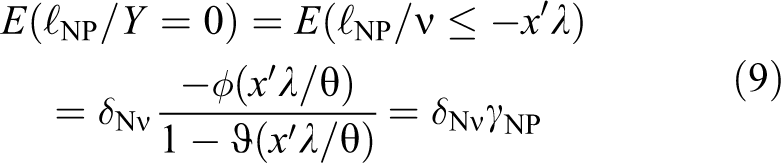

ϕ and ϑ are the likelihood density and cumulative distribution functions, respectively.
Two-stage models are estimated jointly through a full information maximum likelihood (FIML) procedure (Lokshin and Sajaia, 2004). We first determined using a probit model. Endogenous switching is observed when either

The last term (

The difference between equations (11) and (12) becomes the change in gross margin or average treatment effect (ATT) resulting from joining the intervention (Smith and Todd, 2005). These average treatment effect estimates from the ESR are considered efficient and unbiased. We also examined what will happen if households that did not join the intervention decide to join and also if those that joined decide to leave. These scenarios are stated in equations (13) and (14).


In situations in which there are not biases from unknown factors, PSM can be employed to evaluate the impacts of joining the intervention.
Data and sampling
The data used in this study were obtained from rural households in the Gauteng province of South Africa using a structured questionnaire. The households were selected using multiple sampling approaches. Firstly, the Gauteng province was selected, because it is one of the main provinces where the homestead food garden intervention has been implemented and promoted for a long period, which for successful impact assessment. Also, the province was selected due to access to beneficiary information. Secondly, we used balloting to select five municipalities from a list of municipalities in which the policy intervention had taken place. Specifically, we sampled Johannesburg, Tshwane, Ekurhuleni, West Rand and Sedibeng, from which 77, 78, 131, 103 and 111 households, respectively, were randomly selected using balloting to reduce bias in household selection. The differences in numbers are due to a proportional number of rural households in each of the municipalities. Overall, 500 households were sampled, consisting of 234 households that joined the intervention and 266 that did not join.
Results
Summary characteristics of variables used in the analysis
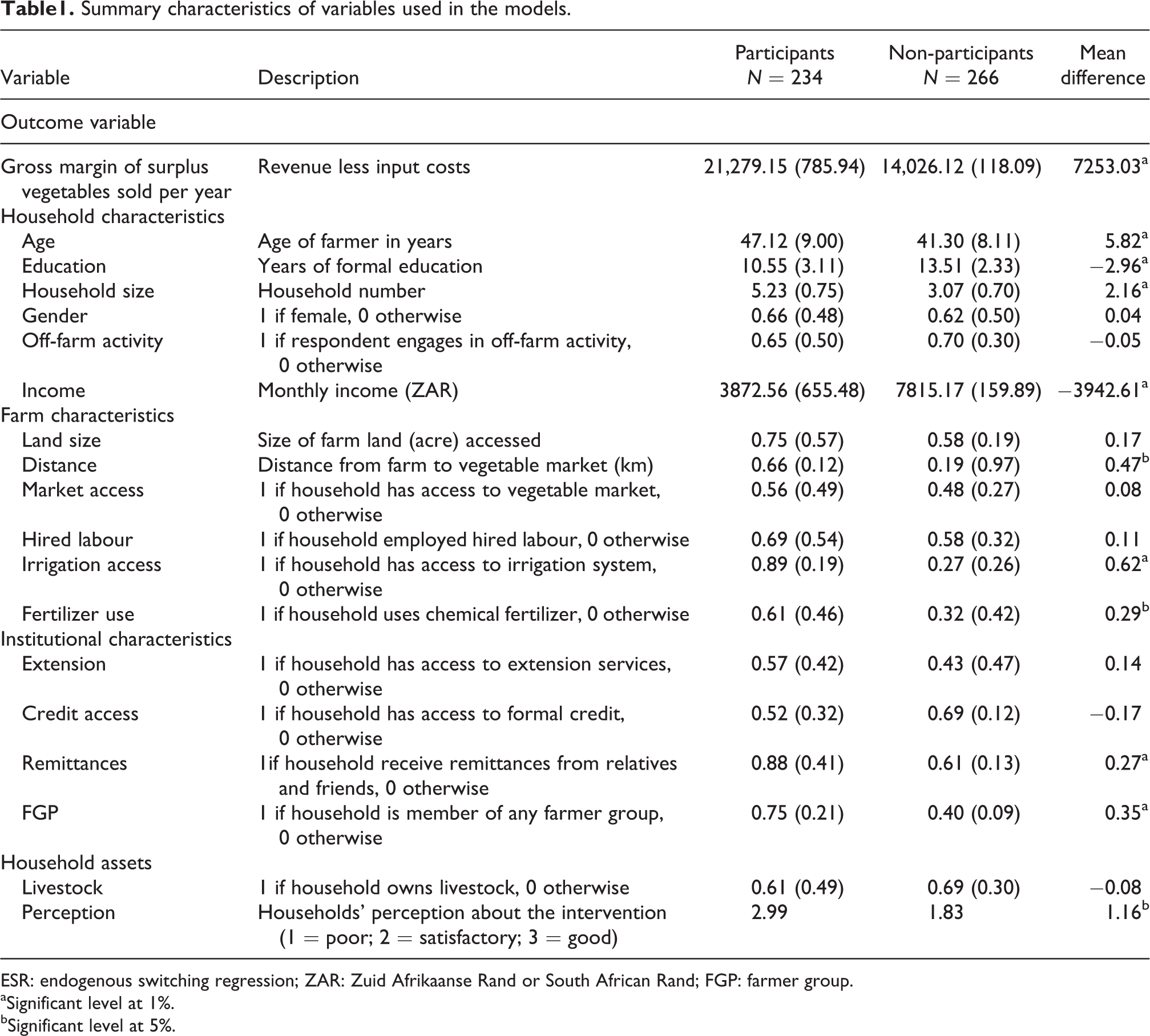
The sample comprised 46.8% participants and 53.2% non-participants (see Table 1). Mean differences were calculated to ascertain significant variations in respondent characteristics. The average gross margin of vegetables sold per year for households that joined the intervention was about Zuid Afrikaanse Rand or South African Rand (ZAR) 7 253 higher than for those that did not join. The gross margin was used because there was no reliable data on fixed capital.
Summary characteristics of variables used in the models.
ESR: endogenous switching regression; ZAR: Zuid Afrikaanse Rand or South African Rand; FGP: farmer group.
aSignificant level at 1%.
bSignificant level at 5%.
Respondents who joined the intervention were about 6 years older than those who did not participate. This indicates that the intervention attracts older people. Respondents who joined the intervention were likely to be less educated relative to those who did not join. Those who joined the intervention had larger households, with a mean of five. Females dominate in the home food gardening intervention. The mean monthly income of homestead food garden programme participants and non-participants was ZAR3 872.56 and ZAR7 815, respectively. The monthly income of respondents who did not join the intervention was ZAR3 942.61 higher than that of those who joined the intervention.
The mean size of farmland accessed by those who joined the intervention and of the non-participants was 0.75 and 0.58 acres, respectively. About 69% of the participants relied on hired labour for farming, compared to the 58% of non-participants who used hired labour. More participating households had access to simple irrigation facilities, fertilizer and extension services relative to those who did not join. About 52% of the households that joined the intervention accessed credit, compared with 69% of those who did not join. Furthermore, 75% of the respondents who joined the intervention were members of farmer groups, relative to 40% of those who did not join. The perception of households that joined the intervention was positive and higher than that of those who did not join. This implies that participants have a good perception of the benefits of the homestead food garden intervention.
Empirical results
Factors that make households and individuals more or less likely to join the intervention
Table 2 shows factors that influence households’ decisions to join the homestead food garden intervention. Education was significantly negative, at the 1% level, for the selection equation (i.e. participation decision). Thus, as educational level increases, the possibility of households joining the homestead food garden intervention decreases. Household size was significantly different from zero and positive at the 5% level for the selection equation. Being female was statistically significant and positive at the 1% level for the selection equation. Engagement in off-farm activities had a negative and significant effect on the participation decision of households at the 1% level. As income increases, the likelihood of joining the intervention also increased at the 1% level.
Two stage ESR results for participation and impact on gross margin.

ESR: endogenous switching regression; FGP: farmer group.
aSignificant level at 1%.
bSignificant level at 5%.
cSignificant level at 10%.
Access to large farmland had a significantly positive effect on participation at the 1% level. The use of hired labour was negative and significant at the 5% level. Access to irrigation facilities had a positive and significant effect on a household’s participation decision at the 1% level. Concerning institutional characteristics, access to extension services had a significant and positive effect on a household’s decision to join the intervention at the 5% level. Access to credit was significantly positive at the 1% level. Access to remittances from relatives and families had a positive and significant effect on the participation decision of households at the 1% level. Being a member of a farmer group had a significant and positive effect on the participation decisions of households at the 5% level. Ownership of livestock had a positive and significant effect on the participation decisions of household at the 1% level. A positive perception of households about the intervention had a positive effect on the participation decision at the 1% level.
Effects of observed and unobserved factors on gross margin of vegetables
In the last column of Table 2, we present other significant factors besides joining the intervention that influence the gross margins of vegetables sold. The results indicate that educational level, household size, gender, income and participation in off-farm activities are significantly different from zero and positive at the conventional levels (1, 5 and 10%) for both categories of respondents. Age has a significantly positive effect on the gross margin of those who joined the intervention, at the 5% level.
Regarding farm characteristics, the results indicate that the large land size, irrigation access and fertilizer use variables had significantly positive effects on the gross margin of both categories of respondents. Furthermore, factors such as longer distance to market and use of hired labour had significantly positive effects on the gross margin of both categories of respondents, at the 1% and 10% levels. For the institutional factors, we found that credit and vegetable market access had a significantly positive effect on the gross margins of those who joined the intervention and those who did not join. In addition, ownership of livestock had a positive effect on the gross margins of both categories of respondents.
Self-selection takes place in vegetable producers’ involvement in the intervention, as shown by the significance of the covariance terms, and this means that the gross margins of those who did not join the intervention might differ if they should decide to join (Heckman, 1979). The positive sign for
Impact of the intervention on gross margin: ATT estimates from ESR and PSM
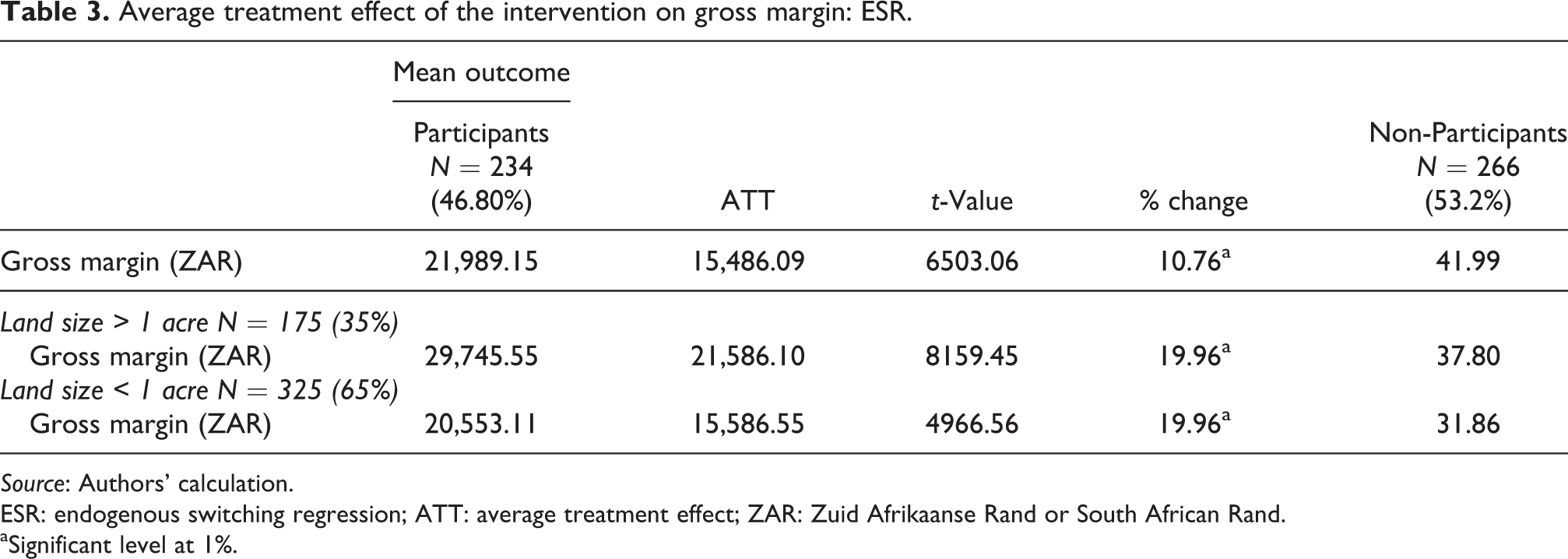
The average treatment effects of joining the intervention and size of farm plot on the gross margin of vegetable producers are presented in Table 3. The estimates reveal that joining the intervention tends to increase the gross margin of surplus vegetables sold per year by 41.99%.
Average treatment effect of the intervention on gross margin: ESR.
Source: Authors’ calculation.
ESR: endogenous switching regression; ATT: average treatment effect; ZAR: Zuid Afrikaanse Rand or South African Rand.
aSignificant level at 1%.
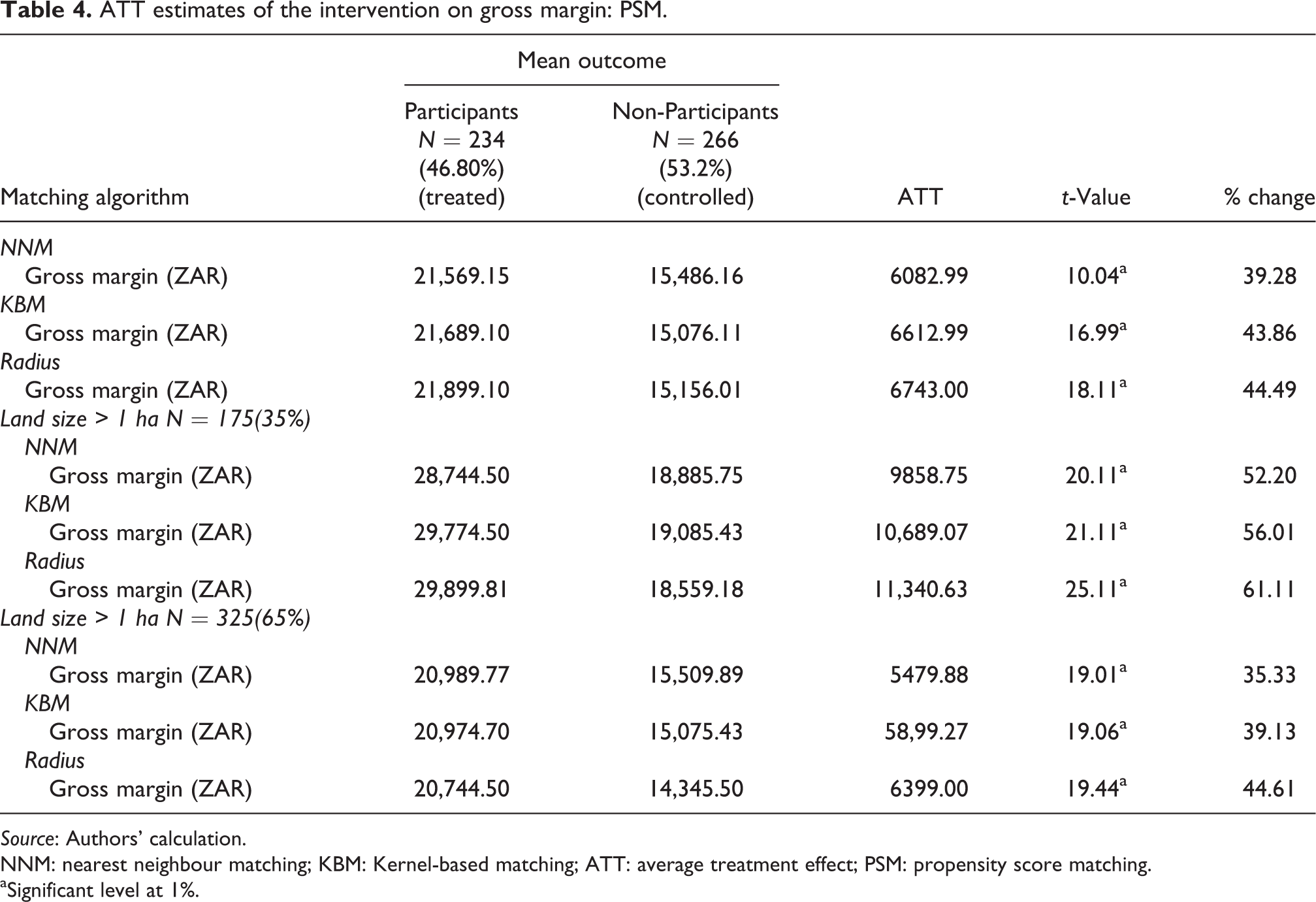
From the PSM estimates in Table 4, it can be seen that joining the intervention significantly increases the gross margin from 39.28% to 44.49%. It is worth mentioning that the PSM estimates are presented to give an overview of the impact of the intervention if selection biases are not accounted for.
ATT estimates of the intervention on gross margin: PSM.
Source: Authors’ calculation.
NNM: nearest neighbour matching; KBM: Kernel-based matching; ATT: average treatment effect; PSM: propensity score matching.
aSignificant level at 1%.
Sensitivity analysis of the impact of land access on gross margins: ESR and PSM estimations
Also presented in Table 4 are the gross margin for farmlands smaller and bigger than one acre. From the ESR, it is clear that households that had access to more than 1 acre of farmland for gardening obtained ZAR8 159.45 more than their counterparts who did not join. Thus, the real effect of joining the intervention is an increase in gross margin of vegetables sold per year – by 37.80% for vegetable-farming households that had access to more than 1 acre of farmland.
For the ESR estimations of households that had access to less than 1 acre of land, the results indicate that the real impact of the intervention is an increase in gross margin, by 31.86%. Specifically, the gross margins for both categories of households that had access to more than an acre of land was ZAR21 586.10 and ZAR8 159.45, respectively, relative to their counterparts that had access to less than an acre of land, with gross margins of ZAR15 586.55 and ZAR4 966.56, respectively.
Discussion
From a descriptive point of view, the gross margin of non-participating households is about 52% lower than that of households that joined the intervention. However, this mean difference may confound the impact of participating in homestead gardens on the gross margin with other, unobserved factors, and as such this cannot be considered as the real effect of the intervention on the gross margin of vegetable farmers (Abdulai and Huffman, 2014). We estimated the average treatment effect using the ESR method due to the observed selection bias, which can be ascribed to unknown factors. The ESR estimates reveal that joining the intervention tends to increase the gross margin of vegetable producers by 41.99% per annum.
Using the PSM, we found that joining the intervention significantly increased the gross margin of vegetable farmers – by 39.28–44.49% – using different methods. Comparing this result to the ESR estimates, it can be inferred that, without accounting for unobservable factors, the real impact of the intervention can either be underestimated or overestimated. However, the PSM results confirm the ESR estimates, which indicate that joining the intervention has a positive impact on the gross margins of vegetable producers in South Africa. Therefore, the promotion of households’ involvement in the homestead food garden intervention can be beneficial to rural households’ welfare by increasing their income.
When comparing our findings to previous studies in sub-Saharan Africa and other emerging economies where gardening was introduced, we see that Webb (2000) found that there was a considerable relationship between the intervention and nutrition in the North West and Eastern Cape provinces of South Africa and in Zimbabwe. However, Webb (2000) only described the relationship between home gardening and nutrition, without empirically examining the factors that influence participation in or adoption of food gardening as examined in the present study. Makhotla and Hendriks (2004) and Faber et al. (2002) also found that home gardening has a significant impact on the nutritional status, nutritional diversity and vitamin A intake of children in Lesotho and South Africa.
In Southern Nigeria, Ndaeyo (2007) assessed the effects of homestead farming on household food security using descriptive analysis such as percentages and frequencies. It was found that homestead farming functions to improve food security. These studies have contributed to a better understanding of the effect of home gardening on food and nutritional outcomes, without considering the income generated from the sales of surplus vegetables. Additionally, the physical, social, economic and institutional factors driving household participation in home gardening considered in the present study were not considered in the previous studies. Furthermore, most previous studies focused only on children and used small samples (Faber et al., 2002; Makhotla and Hendriks, 2004; Webb, 2000), whereas this study was conducted at the household level with a large sample.
In Bangladesh, it was found that the success and sustainability of home gardening depend significantly on access to land, water and practical guidance (Marsh, 1998). This agrees with our findings, which demonstrate significant effects of access to land and irrigation facilities on participation decisions and gross margins.
From our empirical findings, it emerged that there are selectivity effects of the impact of joining the homestead food garden intervention on the gross margin of vegetable-producing households. This implies that there is possible sample selection bias that previous studies (Faber et al., 2011; Makhotla and Hendriks, 2004; Nkosi et al., 2014; Pandey et al., 2016) failed to account for. The novelty in our findings is that we employed impact-evaluation approaches that took into account selection bias and unobserved factors that lead to misleading results and the undervaluing of intervention outcomes. Therefore, it is imperative for policy analysts who are interested in knowing the precise impact of such policy interventions to factor in selectivity effects using impact-evaluation approaches that take into account unobserved factors and selection bias. We found the existence of negative selection bias in joining the intervention, and that the intervention favours vegetable farmers whose gross margins are below average and this agrees with the government’s objective of reducing poverty among rural households while increasing food production and consumption and food security.
Of further importance and novelty in our study is the impact of land access on the gross margin of households. Access to land appears to have a meaningful impact on vegetable production and the gross margin of vegetable-producing households in the study area. It emerged that vegetable-producing households that have more than 1 acre of farmland have significantly higher gross margins relative to those that have less than an acre. Hence, to sustain the intervention, secure access to land should be a key factor that needs to be given attention in South Africa. We suggest that policymakers should consider running the intervention along with the agriculture and land reform policies. Particularly, we recommend that most of the households that have access to land should be encouraged to participate in the intervention, rather than encouraging households that do not have access.
Stakeholders in the intervention can enhance household participation by creating a positive attitude towards the intervention. Finally, we suggest that more households should be motivated to join the intervention, given the estimated benefits in terms of food production and income generation. The sustainability of the homestead garden intervention also depends on monitoring by and technical assistance from the programme implementer. To sustain the intervention, there is a need for more community involvement and two-way practical knowledge exchange among all stakeholders.
Conclusions
This research has evaluated the impact of one of the most important interventions, known as the homestead food garden, on the income status of vegetable farmers in peri-urban areas. The research also linked the intervention, gross margins and access to land for policy purposes. The research emphasizes that joining the intervention can significantly improve the income status of households in the peri-urban areas of South Africa. The government, development partners and policymakers should encourage more people to participate in the intervention, given the potential benefits. The information provided in this research unveils policy-relevant personal, farm and institutional factors that are needed to facilitate participation in and the sustainability of the homestead food garden intervention. It also provides the rationale for implementers of and stakeholders in similar food intervention to consider land access in their future policy frameworks to achieve the goals of the intervention.
Footnotes
Declaration of conflicting interests
The author(s) declared no potential conflicts of interest with respect to the research, authorship, and/or publication of this article.
Funding
The author(s) received no financial support for the research, authorship, and/or publication of this article.
