



Abstract
Tropical and subtropical forage (TSTF) germplasm collections in the international centres of International Center for Tropical Agriculture (CIAT) and International Livestock Research Institute (ILRI), and in many national centres of developed and developing countries are under threat due to reduced financial support. Subsequent lack of skills in taxonomy, diversity assessment and adaptation would preclude them playing their crucial role in underpinning forage research for tropical and subtropical farming systems, to meet the growing global demand for livestock products together with reducing their environmental footprint. Also due to well-meant legal changes of biodiversity ownership as well as a current political culture of ‘us versus them’, germplasm collecting and sharing has become challenging. As a result, most centres have become inward-looking, have few links to other members of the global TSTF research community, including other TSTF genebanks, and are struggling to do the basics of conserving their current holdings. Undoubtedly, valuable germplasm has already been lost, and most genebanks lack the skills and knowledge to add value to research programs to develop new forages or select the best options for new environmental uses. This decline has been a relatively rapid process and reached the crisis point of today in just 20–25 years. This article proposes a four-pronged strategy based on improved efficiency, effectiveness, awareness and collaboration that should be adopted urgently. Swift and drastic action is required of international agencies, national governments, researchers and industry bodies. Much of the germplasm was collected from regions that have since undergone massive development or other changes in land use. Failure to act now will, consequently, result in further loss of genetic material forever and associated passport and descriptive information.
Keywords
The situation of tropical forage genetic resources today
A golden era for tropical and subtropical forages
Tropical and subtropical forages (TSTF) are mostly species new to agriculture and have had outstanding impact in the last approximately 50 years. Among the most important species have undoubtedly been buffel (Cenchrus ciliaris), rhodes (Chloris gayana) and guinea grass (Megathyrsus maximus 1 ) (Clements and Henzell, 2010) as well as Stylosanthes hamata and S. scabra in North Australian extensive pastures (de Leeuw et al., 1994; Stace and Edye, 1984) and brachiaria (Urochloa spp.), underpinning a vast beef cattle industry in Brazilian grasslands (Jank et al., 2014). Shelton et al. (2005) and White et al. (2013) give details on these and several other cases, where TSTF have demonstrated their importance in a wide range of agro-ecologies and production systems. Importantly, the impacts have been both on commercial scale and in smallholder systems, and have supported beef, dairy, swine, small ruminant and even aquaculture.
These diverse and important contributions to production and to livelihoods have only been made possible through exploration and collection of wild species (Reid, 1995), and their evaluation for use in the many environments and systems in which livestock are produced in the tropics and subtropics. This vital link between new forage species and their origins in a TSTF genetic resources system or program is not widely recognized (Maass and Pengelly, 2019).
Just as importantly, TSTF research support has been challenged by environmental issues. These include the recognition that livestock production is a significant contributor to greenhouse gases, and perceptions that some TSTF species pose considerable risks as invasive weeds (see Maass and Pengelly, 2019).
The combination of these factors (Figure 1), together with the outstanding impacts of the early decades not being easily repeated, means that support for TSTF research and genetic resource conservation has declined considerably. With the loss of financial resources and skills now extending well into its third decade (Clements and Henzell, 2010; Maass and Pengelly, 2001; Muir et al., 2014), it is impossible to maintain all germplasm currently in the major genebanks at international ‘to-the-letter’ standards (Maass and Pengelly, 2019). In this article, we argue that implementing prioritization, strong focus on forage and environmental potential of species, and proactive teamwork among the few engaged players left appears to be the only way out for long-term sustainability of tropical and subtropical forage genetic resources.
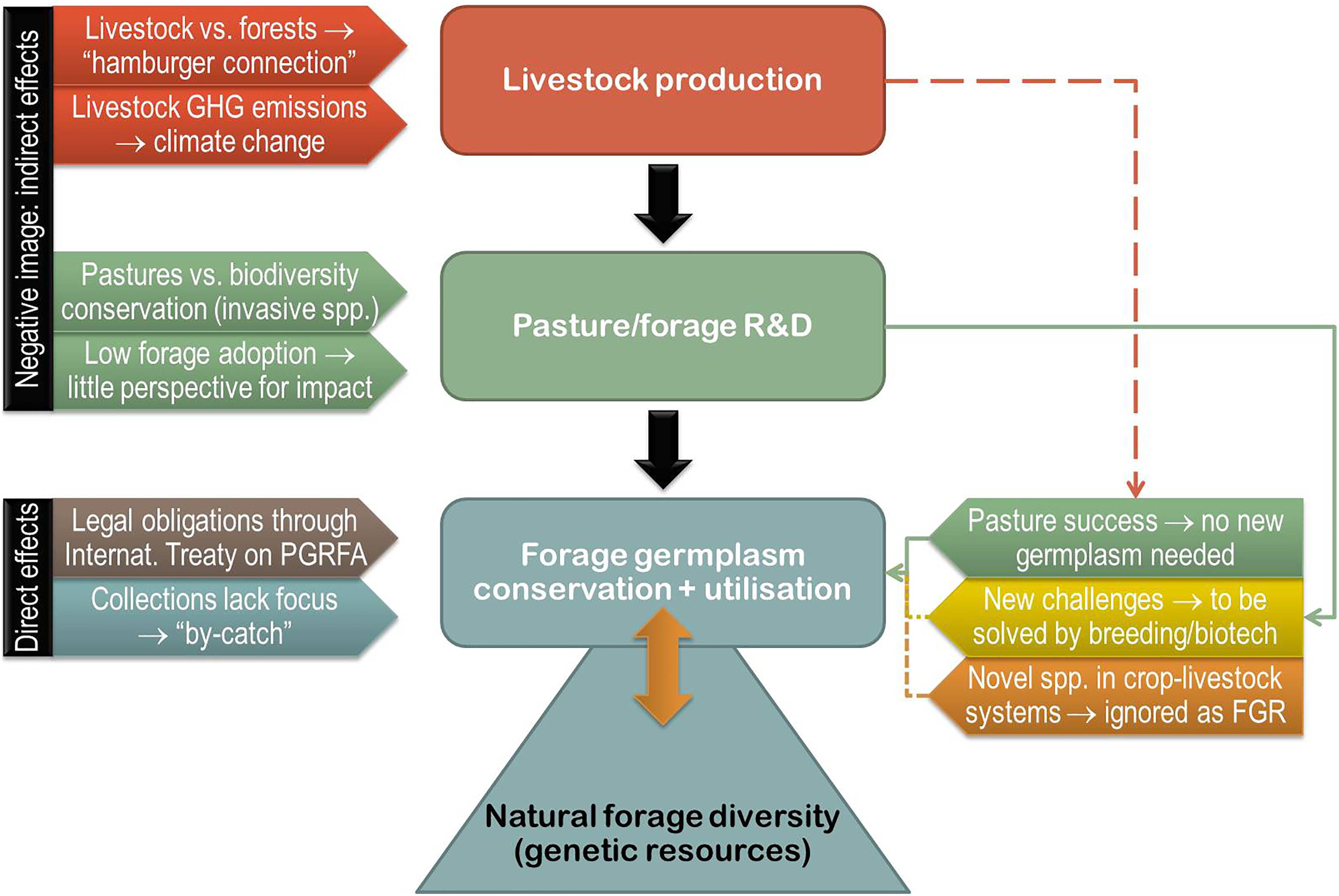
Scheme of influences on image, activities and, ultimately, funding in tropical and subtropical forage genetic resources. FGR: forage genetic resources; GHG: greenhouse gases; PGRFA: plant genetic resources for food and agriculture; R&D: research and development.
Biodiversity first – Well-meant policies create barriers to better utilization and livelihoods
The TSTF collections in the international centres of the Consultative Group on International Agricultural Research (CGIAR) and elsewhere were conceptualized and assembled with the prime aim of underpinning research into new pastures and forages (Reid, 1995). FAO was an early proponent for plant exploration, collecting and introduction of herbage and fodder plants for grassland and fodder development projects (Pistorius, 1997). Williams, Reid, Burt and others (e.g. Burt et al., 1976, 1979; Reid, 1995) sourced potential forage legumes for climate analogues of Australia, while Schultze-Kraft and Giacometti (1979) targeted potential pasture plants adapted to the acid soils of the tropics and subtropics. This consistent focus on potential use of collected germplasm remains the principle reason for the existence of the global TSTF collections. However, changes in biodiversity ownership, and how it can be exchanged and used, have necessitated that genebanks put greater focus on conservation and reporting than on being a conduit to better livestock production, livelihoods and environmental outcomes.
Following the Convention on Biological Diversity (CBD; https://www.cbd.int/), the entire international TSTF collections held in trust by the CGIAR genebanks were placed under the auspices of the Food and Agriculture Organization of the United Nations (FAO) by the CGIAR in 1994, although parts were ‘working collection subsets of germplasm held elsewhere’ for easier distribution (Lazier, 1984). In 2006, the CGIAR and FAO, acting on behalf of the Governing Body of the International Treaty on Plant Genetic Resources for Food and Agriculture (PGRFA; http://www.fao.org/plant-treaty/en/), agreed to place the in-trust collections within the purview of the Treaty. As a result of these decisions, the new status of the germplasm was interpreted as requiring every accession to be conserved in perpetuity, at a uniform priority, regardless of potential forage or environmental worth. These decisions also committed the CGIAR centres to observe globally agreed standards to ensure long-term conservation of plant genetic resources (FAO, 2014), which include set criteria for availability of an accession (i.e. legal accessibility, genetic integrity, adequacy in terms of number of seeds, high viability and tested health status), and requirement for safety duplication in at least one other site.
Compliance with these requirements is costly and time-consuming. Seed availability necessitates regular viability testing and eventual regeneration in the field under specific conditions. Seed increase for these mostly wild, undomesticated species can be problematic (and costly), especially given there is usually little knowledge of their reproductive biology regarding optimum environmental conditions, outcrossing rates and pollination (Hanson and Maass, 1997). Data generation and management add further to the demands of conserving accessions, as compliance requires passport, characterization and evaluation data be publicly available.
Hampered germplasm exchange – Hampered collaboration
Annex 1 of the Treaty aims to create ‘a global, virtual pool of genetic resources for 64 crops and forages’, for which the ‘Multilateral System of Access and Benefit Sharing’ applies (Galluzzi et al., 2016). Although only a handful of the many hundreds of mostly wild TSTF species have been included in Annex 1, there are agreements (Article 15) between the Treaty and the international centres ensuring that TSTF germplasm can be dealt with as if it was included in Annex 1 and, hence, treated in line with the norms of the Multilateral System (Thormann et al., 2019). Consequently, the CGIAR-held TSTF germplasm is exchanged under a Standard Material Transfer Agreement.
The situation pertaining to germplasm held in national genebanks is both obscure and inconsistent. If a country has signed and ratified the Treaty, the vast majority of their TSTF germplasm collections are still not considered to be held under the Treaty as they are not in Annex 1. However, not all countries have signed and/or ratified the Treaty. Tropical/subtropical countries, such as China, Mexico, South Africa and Vietnam, which hold significant TSTF germplasm or are major TSTF germplasm users, have not signed the Treaty (http://www.fao.org/plant-treaty/countries/en/) and, as such, their PGRFA are not part of the Multilateral System. Therefore, access to their PGRFA has to be negotiated bilaterally.
The fact that most TSTF are non-Annex 1 species of the Treaty has produced undesirable consequences. Some national forage researchers and institutes expressed the view that negotiating on non-Annex 1 taxa was too complicated and time-consuming. Researchers in Argentina, for instance, are endeavouring to widen their diversity for plant improvement by conventional breeding in germplasm already held rather than seek new germplasm from other countries. Brazil and India are two countries among several that are reluctant to exchange their indigenous germplasm until there is greater clarity on how non-Annex 1 species are treated best.
These unforeseen implications undoubtedly reduce potential benefits that TSTF germplasm can provide. Especially, resources spent on conserving low-priority germplasm are at the cost of research on characterization, adaptation and diversity of priority species that have the potential to deliver production, as well as environmental and livelihood impacts. In addition, germplasm is not readily shared, and far too much emphasis and energy is being dedicated to endless discussions about the status of germplasm without any foreseeable resolution.
SOS – Time for rescue operations
Decades of both strategic and opportunistic plant collecting, and confusing international policies have resulted in TSTF genebanks shouldering the burden of conserving large numbers of accessions across diverse species. The obligation, real or perceived, to conserve this mass of material has coincided with a steep reduction in resources available for TSTF research and genebanks, which has magnified the challenge for those responsible.
National genebanks with TSTF germplasm have become increasingly threatened as forage programs have closed or reduced over the past 20–25 years in parallel with declining investments in TSTF (e.g. Muir et al., 2014). A backup of the University of Florida collection assembled by AE Kretschmer at Fort Pierce has been sent to the USDA genebank in Griffin, Georgia. Whether viability of that collection is still up to standard is not known (K Quesenberry and JB Morris, 2019, personal communication). A similar fate awaited collections in South Africa, Argentina and Kenya. In Australia, which led the world in TSTF genetic resources for decades, the Commonwealth Scientific and Industrial Research Organisation (CSIRO), the national science agency, made the decision to close its Australian Tropical Forages Genetic Resource Centre in 2000, in response to the change in priorities to rangeland management and the perceived threat of introduced pasture plants as environmental weeds (Cook and Dias, 2006). Samples from the majority of accessions of that collection, at least as large and diverse as any other at that time (Hanson and Maass, 1997), were despatched to the International Center for Tropical Agriculture (CIAT) and International Livestock Research Institute (ILRI; since 1995) to ensure they remained available internationally and, within Australia, to the Queensland State Department of Primary Industries (QDPI; now, Qld Department of Agriculture and Fisheries (QDAF), Australia). By 2013, the QDPI collection was itself under threat from reduced funding, but was saved through its incorporation into the Australian Pastures Genebank (APG) under the South Australia Research and Development Institute (SARDI). That, in turn was under threat of sustained funding again by 2018 (S Hughes, personal communication). On a more positive note, Brazil has maintained a network of active germplasm banks composed of mostly endemic TSTF species and has invested in a national genebank for long-term conservation (Alves and Azevedo, 2018).
The CGIAR has sought to maintain its ex situ collections under ever-increasing funding challenges associated with reduced interest in TSTF research. ILRI and CIAT are currently considering how their two TSTF collections can be best conserved and harmonized under a common set of processes and management with the prospect of CGIAR genebanks remaining a key part of the future long-term maintenance of TSTF germplasm.
In short, TSTF germplasm globally has been under threat for at least 20 years (Maass and Pengelly, 2001) and that threat has reached crisis level. Already some germplasm of priority species is certain to have been lost from ex situ collections forever. Examples are part of the Kitale collection in Kenya and the South African Agricultural Research Council (ARC) forage germplasm collection. Some losses are more acute because widespread land use changes and habitat depletion have resulted in near or total disappearance of key species from their environments of origin (IBPGR, 1984; Schultze-Kraft and Giacometti, 1979; Schultze-Kraft et al., 1984); for example, species from the legumes Stylosanthes or wild Arachis in Brazil’s Cerrado savanna.
The crises of germplasm conservation and loss, reduced resources being spread too thinly across large, diverse collections and the reduced focus on potential benefits need to be addressed urgently. The question is what options the TSTF community has to address the overall crisis.
A Global Strategy
A Global Strategy for the Conservation and Utilisation of Tropical and Sub-Tropical Forage Genetic Resources was developed through the Global Crop Diversity Trust with input from across the tropical forage genetic resources community (Pengelly, 2015). Several genebanks around the world that hold substantial germplasm collections of TSTF species contributed to the development of that strategy. These included the international centres CIAT, ILRI and the World Agroforestry Centre as well as key genebanks in Australia, Brazil, South Africa, United States of America, Mexico and Kenya (Figure 2).

Tropical forages collections surveyed: 15 genebanks from 12 countries comprising 7 national (several genebanks per country), 1 regional (not shown) and 4 international genebanks (ICARDA not shown), with about 90,000 accessions held. Modified from map produced through Genesys (2015). CIAT: International Center for Tropical Agriculture; ICRAF: World Agroforestry Centre; ILRI: International Livestock Research Institute.
The strategy attempts to address the almost unanimous view from national and international genebanks that they were struggling to implement anything like best practice in genebank management, and that skills and resources had declined significantly. The strategy’s overall objective was to propose a pathway for TSTF genebanks to provide germplasm and leadership for forage research and development, and collaboration through exchange of ideas, data and staff. The three main themes – (1) rebuilding community, (2) achieving greater efficiency in conservation and (3) improving utilization – require different immediate implementation targets and pathways to be applied to a range of different genebanks.
Within each of these themes, several implementation issues or practices have been tackled since 2016. Full implementation, however, is a multi-year process. The initiative of prioritizing species (Cook and Schultze-Kraft, 2016) has been taken up by the APG (Hughes et al., 2017). Communication and community building was improved through the publication of a newsletter that has been sent to more than 600 recipients worldwide (Maass and Pengelly, 2016–2019). In addition, several national and international institutions have been visited to promote the strategy, and aiming to establish a network of the TSTF community.
The challenge for conservation and ongoing genetic resources research is to undertake changes in management and practices that will convince donors, governments, institute management and industries that TSTF germplasm is worthy of support. The strategy has four interwoven considerations: Efficiency Efficacy Awareness and knowledge Teamwork and trust
Efficiency
Three actions provide opportunities to greatly improve the present inefficient TSTF germplasm conservation system.
Focus on priority taxa
Too much effort is currently devoted to low-priority taxa and duplicates. Today ‘unwanted’ (‘by-catch’) germplasm needs to be removed from the system as soon as possible and efforts switched to the higher priority taxa. Critical germplasm is that portion that can be reasonably expected to contribute to agricultural farming systems, environmental benefits and associated livelihoods in the next decades. While some would argue that the germplasm of little or no potential as TSTF should also be maintained, the truth is that attempting to conserve it all according to globally agreed standards (FAO, 2014) will result in not being able to adequately maintain the critical portion. Spreading the resources too thinly will have disastrous results.
Implementing taxa prioritization (Cook and Schultze-Kraft, 2016) and being prepared to lose the lowest priority germplasm is seen as a must. Archiving 2 the lowest priority species is a matter for debate and perhaps it is important in relation to compliance with the Treaty. For the people who depend on agricultural systems and environmental sustainability, it really does not matter now and this is unlikely to change in the future. There has been little or no thought given to applying accepted mechanisms, especially by CGIAR genebanks. Engels and Visser (2003) suggest that ‘Following a reassessment of the genebank’s mandate, a curator decides that some accessions are not within its mandate or are no longer needed in the collection’. That needs to happen now.
Core collections
TSTF germplasm centres have rarely put effort into developing core collections of high-priority taxa. Even when characterization has already been carried out, there appears to be a reluctance to use this knowledge to develop representative core sets, towards which they can put greater effort.
Data curation and management
Data management is piecemeal. Neither of the international centres has as yet fully adopted and transferred TSTF data to the agreed standard of data management system, GRIN-Global (https://www.grin-global.org/). Only Australia (APG) and Brazil have fully transferred or integrated previous data management systems to GRIN-Global (Alves and Azevedo, 2018; Hughes et al., 2017). Most national – if signatories to the Treaty – and the international centres have agreed in principle to upload accession data into Genesys (https://www.genesys-pgr.org/), the ‘global gateway to genetic resources’. Unfortunately, the information in Genesys is only as good as the information provided by the genebanks. As taxonomy has progressed in many TSTF taxa, the same accession held in more than one genebank may appear under different species identities if updating lags; for example, in Genesys Desmanthus collector’s number CF 764 appears as D. leptophyllus CPI 92809 (correct ID) as well as D. virgatus ILRI 312 (outdated taxon ID). Confusion is further enhanced by many TSTF accessions having been registered with a supposedly unique digital object identifier (DOI) in Genesys without recognition of the redundancy caused by duplicates, triplicates or even greater numbers of multiple entries held elsewhere, possibly with other DOI. The multiple accession numbers assigned to a particular early Stylosanthes scabra accession illustrate the challenges arising from multiple unlinked registrations (Figure 3). An unfamiliar user could request all 13 entries recorded in Genesys and, thus, waste valuable resources in subsequent research when targeting multiple samples of what is an accession with the same origin.

An example of entry and re-entry causing inter-centre as well as internal within-centre duplication of an early Stylosanthes scabra accession maintained in international collections; a total of 13 entries and six DOIs could be determined for this accession (Genesys, 2019). Modified from information compiled and schematized by BL Maass in 1984. APG: Australian Pastures Genebank; CF: Central Farm/IDRC-Project, Belize; CIAT: International Center for Tropical Agriculture, Colombia; CPI: Commonwealth Plant Introduction, Australia; CSIRO: Commonwealth Scientific and Industrial Research Organisation, Australia; ILCA/ILRI: International Livestock Centre for Africa/International Livestock Research Institute, Ethiopia; IRI: IBEC (i.e. International Basic Economy Corporation) Research Institute, Sao Paulo, Brazil; IRFL: University of Florida, USA. DOI: digital object identifier.
Duplication of accessions has caused an ‘inflation of inventories’ (Schultze-Kraft et al., 1984) with subsequent significant extra workloads. A major contribution to this duplication has been the practice of sharing multiple times large proportions of the germplasm collected during early missions to Brazil, Kenya, Zimbabwe, Belize and the Caribbean. This germplasm has been duplicated multiple times among the major institutions such as CIAT, CSIRO, the Brazilian Agricultural Research Corporation (Embrapa), the University of Florida and International Livestock Centre for Africa (ILCA; 1974–1995; now, ILRI). It has been estimated that the world Centrosema collection held in these five institutions has 37% duplications (Schultze-Kraft et al., 1990) and, similarly, that the global Leucaena collection is estimated to have >25% duplication (Hughes et al., 1995).
The cost of this sort of inefficiencies is significant to the genebank as well as to users. D Graetz (2019, personal communication) estimated that every extra 150 accessions cost the APG 80,000 AUD (i.e. approximately 55,000 USD) for regeneration alone. Duplication adds additional costs to the efforts of assembling well-curated passport, characterization, and evaluation data that can be cross-referenced and used in genebank management and in selecting germplasm for research.
Efficacy
Targeting best-fitting plants
TSTF collections were undertaken to provide the foundation for new forages and plants to fulfil environmental roles. However, the decline in forage research and number of forage researchers has resulted in those managing genebanks being unable to assemble the critical mass of expertise across plant taxonomy, diversity, geography and adaptation. Their focus, and that of their teams, has shifted to genebank management, for example, seed viability testing, genebank design and construction, seed regeneration, as well as to molecular studies that have more to do with gene discovery and ‘omics’ approaches through next-generation molecular tools (e.g. Pereira et al., 2018). Undoubtedly, these are important roles, but they do little to help genebanks fit the best existing genotype into targeted agro-ecological niches and production systems. Despite the strong case for more agro-ecological engagement, however, the younger generation of researchers and sometimes their managers appear more excited about applying the latest technologies than investing in ‘old-fashioned’ observation, descriptive assessment, field-based selections and data analysis used by former germplasm specialists and conventional breeders.
Despite the absence of agro-ecological experience in genebanks, tools are available to assist genebanks match species and accessions to potential roles. The current lack of awareness of species diversity and plant adaptation makes the use of the Tropical Forages Database selection tool, also called ‘SoFT’ (Cook et al., 2005), even more important. SoFT was developed for that purpose. Although the tool has had 15,000 users per year for about 15 years (Peters et al., 2015), it is clear that TSTF genebanks are not using it, or any similar tool, as effectively as they might to frame their advice and selection of germplasm for distribution.
Seed supply
Seed supply is another key efficacy issue. Standard practice would have genebanks supply a minimum of 30–50 viable seeds to users (FAO, 2014). This works well for crop species, where relatively high seed yields and rapid reproduction, even in early landraces, can be expected, and where plant breeding rather than selection from natural (wild) diversity of undomesticated plants is the pathway to new cultivars and utilization. However, TSTF species have intrinsically low seed yields, and so those few seeds supplied by genebanks need to be multiplied at least twice before seed quantities allow any meaningful field evaluation to be commenced. This makes evaluating new forage options almost impossible in projects that are usually funded for 3–5 years. Consequently, many projects do not even consider what forages might fit best. Rather, they accept the status quo in respect to forages and focus on some other part of the production system. Too often, they are forced to take whatever commercial seed is available, which may be far from the best-fitting genetic material of a species (e.g. Whitbread et al., 2011).
If genebanks were able to supply greater quantities of well-adapted elite material, then their selections and their value in the supply chain of new forages would be greatly enhanced. While it can be argued that it is not the role of genebanks to operate as seed suppliers to fast-track evaluation and ultimately utilization, the counterarguments are who else would play this role, have access to the germplasm in the first place and why would the opportunity for genebanks to be more relevant in terms of on-the-ground impact not be a good thing.
One option to address the seed issue is to consider units that are dedicated to keeping up to date with what is considered elite germplasm. They would produce sufficient seed to supply carefully selected accessions to research and small development projects. Adopting such a model would go some way towards separating out what appear to be conflicting priorities of conservation and genetic diversity aspects of TSTF germplasm on the one hand, and the supply of germplasm to support utilization on the other. These two roles would require different sets of skills and resources, but would have to remain closely linked to ensure that the system takes advantage of innovations (e.g. the example of mucuna in southern Africa depicted by Maass and Pengelly, 2019). Such a strategy should result in TSTF being conserved more efficiently and safely and, at the same time, provide a pathway to achieve on-the-ground impacts, the prime purpose of all this collecting and forage research.
Awareness and knowledge
There is strong evidence that both national and international genebanks have become more inward-looking in the last decades as their resources have declined. Discussions between genebank managers and the authors during the development and implementation of the TSTF strategy revealed that these managers have a sound understanding of the role and the diversity of key species in their environments. However, those same discussions revealed that they were largely unaware of forage evaluation and utilization elsewhere.
The Tropical Forages Database (Cook et al., 2005) is an expert system developed to provide a vehicle for prospective TSTF users to take advantage of decades of research, which defined potential value, limitations and roles of key forages. Efforts have also been made to document the many successes associated with TSTF (e.g. Shelton et al., 2005; White et al., 2013). The recent Newsletter series produced by Maass and Pengelly (2016–2019) highlights several of these and more recent successes. Being scarcely aware of these successes happening outside their world, regional genebank managers are unable to take advantage of them. Successes elsewhere ought to influence what they might select and provide for the next wave of users, and also prompt them to consider how the germplasm that they hold, possibly uniquely, might strengthen those successes.
An alarming indicator of this inward focus of genebanks generally, and international genebanks in particular, is that both CIAT and ILRI genebanks now have a predominance of TSTF germplasm distribution to users in their host country. In the past 5 years, >50% of recipients of seed samples from CIAT have been Colombian with the corresponding figure for the ILRI genebank being >60% to Ethiopian recipients. This suggests that both international genebanks are in danger of becoming internationally funded de facto national genebanks. This is an alarming development and one that is at complete odds with their mandate and international responsibility. Moreover, opportunities for exchange of ideas at international forums are rare. Even the International Grassland Congress, arguably the lead conference in which international efforts in TSTF genetic resources conservation and use might be highlighted, is devoting little time for pertinent discussions.
Teamwork and cooperation
The isolation of operation of the TSTF genebanks today contrasts the close collaboration between 1960 and the mid-1990s, when joint research, long-term visits, joint collecting missions, free exchange of germplasm (Schultze-Kraft and Giacometti, 1979) and long-term collaborative research programs were far more the norm; for example, CIAT and CSIRO (on Centrosema); the Australian QDPI and the Indian National Bureau of Plant Genetic Resources (NBPGR) (on Bothriochloa); CSIRO and ARC South Africa (several grass genera ex South Africa); University of Florida, USA, and Embrapa (collecting and evaluation of Arachis and other legumes from Brazil); CSIRO, CIAT and Embrapa (collaborative legume collecting in Brazil); CIAT and ILCA/ILRI (collecting Urochloa from eastern and southern Africa); Embrapa and CIAT (Urochloa evaluation); and several more.
With limitations of and competition for available funding, it is probably unrealistic to expect a similar degree of collaboration today, but present collaboration is minimal. CIAT has no real connection with the APG and neither does ILRI. Brazil and CIAT now run largely independent plant improvement programs on Urochloa and Megathyrsus. Although the large Indian Grassland and Forage Research Institute (IFGRI) in Jhansi has abundant forage research capability, there is rapid staff turnover, and their networks seldom extend beyond the country. Across several institutions in Argentina, there are several effective forage researcher groups developing a future vision (e.g. Pensiero and Zabala, 2017), but limited funds prevent travel outside the country. The lack of travel opportunity appears to be restricting the thinking of researchers regarding future needs due to climate and other changes, and how they might apply to their own regions (Muir et al., 2014; Pensiero and Zabala, 2017; Truter et al., 2015). Despite the many benefits that could flow from collaboration (Figure 4), globally, few key genebank personnel have ever met each other. The laudable exception are recent staff exchange visits by CIAT and ILRI in 2018 and early 2019. The new Brazilian initiative creating an online discussion forum for TSTF improvement (Pereira et al., 2018) could be a more contemporary and economical approach of extensive exchange for the younger generation.
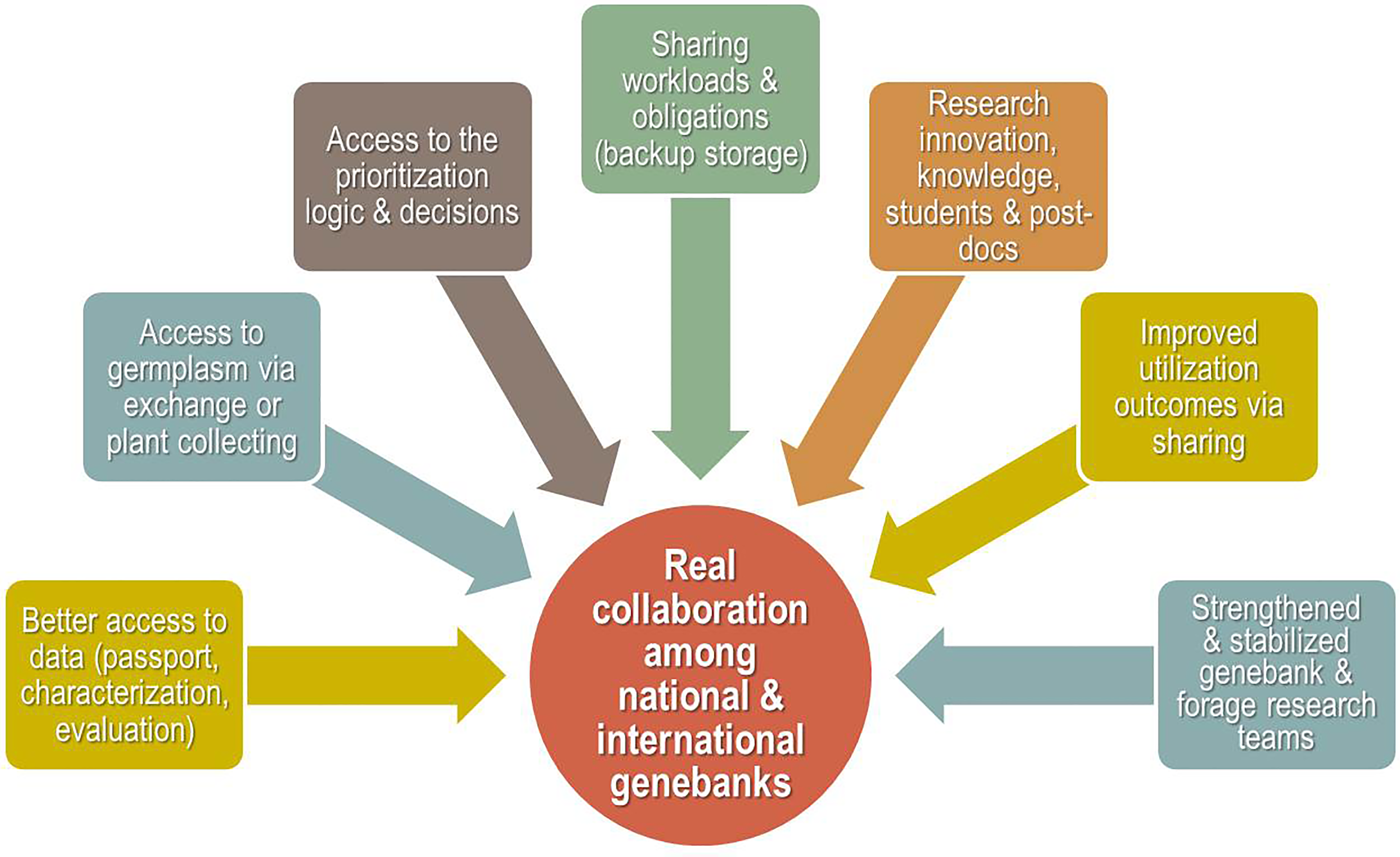
Some of the benefits that could be expected from greater collaboration among genebanks and tropical and subtropical forage researchers.
Under-resourced genebank teams understand that, faced with conserving large and diverse TSTF collections, germplasm will be lost because of sheer numbers. Appropriate regeneration is costly, more so in outbreeding species. Yet conservation priorities, when considered at a global community level rather than at an individual genebank level, could be more efficient and effective. For instance, regeneration undertaken at a genebank, which has a comprehensive collection of a key species, could be expanded to collaborative investigations in morpho-agronomic and/or molecular diversity and analysis of passport data. This could be along the lines of joint programs undertaken in past decades between partners from Brazil, CIAT, Australia and ILRI (e.g. do Valle et al., 1993; Negawo et al., 2018; Pengelly and Maass, 2001; Pengelly et al., 1997; Thomson et al., 1997). Joint characterization could lead to developing core collections with only minimal strategic exchange of key accessions subsequently being necessary, as happened for lablab between CSIRO, ILRI (Pengelly and Maass, 2001) and CIAT and, more recently, for Napier grass between Embrapa-Dairy Cattle Center and ILRI (Negawo et al., 2018).
Collaboration should also enable genebanks to explore alternatives to some of the barriers to rapid supply of germplasm to users. Where seed of selected accessions is in short supply, requests could be forwarded to other genebanks, which hold sufficient seed. Similar responses could overcome other more complex barriers such as those directly related to the Treaty. For example, the Ethiopian government imposed an embargo on all non-Annex 1 germplasm leaving Ethiopia and the ILRI genebank in 2018. While this example is likely to be a temporary barrier, it highlights the benefits of having relationships and systems in place to overcome such occasional challenges.
Failing future generations?
In conclusion, both national and international genebanks with TSTF germplasm are struggling with the demands of conserving and studying thousands of accessions representing hundreds of species across two large and diverse plant families. For over 20 years, national and international genebank teams have suffered the loss of resources, especially skills and experience that would enable them to undertake what is their prime obligation: to provide germplasm and advice on diversity and adaptation for forage research teams.
The whole TSTF system is haemorrhaging, while the long-predicted demand for livestock products surges around the world (Herrero et al., 2018; ILRI, 2019), and the need to feed these animals as well as possible continues. This is not just a problem for resource-poor countries; but, while the TSTF collections in Australia, the United States of America and Brazil are under threat, collections in Kenya, South Africa and Argentina are more so. Most concerning is that, because of a range of intersecting resource, skills and political factors, the internationally funded CGIAR centres are unable to play the crucial role they were mandated.
Donors throwing more money at the problems is unlikely and, even if this were to happen, the probability of achieving vast improvements in the system would be remote. New policies and practices in conservation, priority setting and effective collaboration are just some of the immediate needs. However, the genebank community must recognize that another round of workshops is not the solution. Real collaboration is about working together for prolonged periods and benefiting from that collaboration through improved efficiency, effectiveness, training and innovation (Figure 4). TSTF genebanks around the world hold valuable forage germplasm, albeit along with much that has no forage potential. The crisis needs to be addressed by a new approach of working together and implementing the various elements of the strategy outlined here. Failure of key stakeholders, including FAO, the Crop Trust, CGIAR, national agencies and donors, to make real progress towards recovery within the next 5 years, will undoubtedly result in more failure in the system and the loss of an even greater proportion of irreplaceable TSTF germplasm. Worse, the opportunities that this germplasm could bring to often-aspired future generations of livestock producers and environmental managers in the developing and developed world will also be gone.
Footnotes
Acknowledgement
The Global Crop Diversity Trust, particularly Charlotte E Lusty, is acknowledged for commissioning the development of the ‘Global Strategy for the Conservation and Utilisation of Tropical and Sub-Tropical Forage Genetic Resources’ and its implementation by supporting visits to institutions involved in forage genetic resources conservation and research in Argentina, Australia, Brazil, India, Kenya, and South Africa, as well as to CIAT and ILRI. We thank especially CIAT and ILRI for sharing data with us. And we are grateful for constructive comments by Mr Bruce G Cook, Dr Jim P Muir and Dr John W Miles on earlier drafts.
Declaration of conflicting interests
The author(s) declared no potential conflicts of interest with respect to the research, authorship, and/or publication of this article.
Funding
The author(s) received no financial support for the research, authorship, and/or publication of this article.
