




Abstract
The conditions that made smallholders important during the Soviet period no longer exist. Economic and societal changes mean that smallholders’ historical role is less relevant to contemporary Russian life. Smallholders’ food production is in decline, and smallholders are likely to experience continued marginalization going forward. Niche specialty markets cannot compensate for the broad-based decline in household production. Mega-farms and supermarket chains present unprecedented challenges to Russia’s smallholders, whose future is less certain than at any time in the past 40 years.
Introduction
Smallholders play useful roles in many regions of the world in combatting rural poverty, serving as an engine for rural development, and providing food security (Hazell et al., 2010). Even before COVID-19, the restructuring of the international food system with concentrated power in agribusiness, the emergence of supermarkets, and the financialization of the global food system called into question whether those same roles still apply (Clapp and Isakson, 2018; McMichael, 2013). In that vein, scholars have long been aware that although smallholders account for a significant percentage of global food production (much of which is self-consumed), they face myriad problems in accessing credit (World Bank, 2007), establishing links to supply chains and integrating with retail chains (Dries et al., 2009), and creating cooperatives to protect their interests despite the fact that collective action has been shown to improve prices received by smallholders (Bernard et al., 2008; Markelova et al., 2009; Wollni and Zeller, 2007).
In Russia, smallholder production at the household level has a rich tradition, dating back more than a century. In particular, the food production from the household garden, or lichnoe podsobnoe khoziaistvo, not only has been a supplementary source of food for rural food security, but also has played an essential role for the urban population at various times, for example during World War II and in the 1990s. For decades, analysts noted that Soviet-era smallholders’ accounted for a high percentage of output of meat and milk, eggs, potatoes, vegetables, and berries (Lazutin, 1981: 95). Their food production was disproportionate to the amount of land that they farmed, and for that reason smallholders were closely analyzed because of their historical role in compensating for an inefficient socialized sector during the Soviet period (Lerman et al., 2004; Medvedev, 1987; Wadekin, 1973). Production from household gardens, called lichnoe podsobnoe khoziaistvo, was highly popular, with 96% of agricultural workers engaged in subsidiary agriculture which for rural dwellers provided a reliable source of high-quality food and for urban residents served as a buffer when food availability was sporadic in state stores (Kalugina and Antonova, 1984: 42, 153–162).
In the early post-Soviet period, lichnoe podsobnoe khoziaistvo production provided rural and urban food security during the turbulent economic decline of the 1990s. In addition, smallholders have had substantial economic importance as a source for food security and as a pathway away from the institutions of socialized agriculture. Some households expanded their gardens into private farms, and a small percentage of households intensified their production and became commercialized even while retaining their lichnoe podsobnoe khoziaistvo status (Uzun and Saraikin, 2012). In this regard, the nature and extent of smallholders’ adaptation to market institutions at the household and village level has been a central line of inquiry (O’Brien and Patsiorkovsky, 2006; Wegren, 2014). The breadth, scope, and depth of Western research on smallholders in Russia contrasts with an allegation of “silence about the post-socialist smallholder” (Visser et al., 2019: 500). 1
Similar to global changes that are creating new questions about the role of smallholders, the historical role of smallholders is changing. Due to the transformation of Russia’s food system during the past 20 years, smallholders are becoming marginalized. The purpose of this article is to analyze the decline of smallholders in Russia. The article contributes to the literature in two main ways. First, it updates data and trends about smallholders in Russia. Second, it looks at smallholders from a different perspective. In particular, my analytical framework analyzes Russian smallholders and their role in society. As society changes, so too does their role, which will vary based on the time period. In short, my presumption is that smallholders do not operate in a vacuum. By examining holistically the societal context in which smallholders operate and how that context affects their function and contribution, I hope to provide a unique line of analysis.
The central question addressed herein is: does a modern (or at least modernizing) agricultural sector need household producers who are oriented toward self-consumption? Within that overarching question, the article is structured around the questions: (1) Who are smallholders in Russia today? (2) Are Russia’s smallholders still economically important? (3) How has Russia’s smallholders’ role changed? (4) What are prospects for Russia’s smallholders going forward? The source material for this article consists of secondary sources in English; Russian language journals, newspapers, and online sources; Russian statistical books; Russia’s 2016 agricultural census; and observations from fieldwork in urban and rural Russia.
The article makes two arguments, one broad, one specific. The broad argument is that smallholders should be understood as part of society, not just a rural economic actor who is divorced from society. Society and social need condition the necessity for and thus operation of lichnoe podsobnoe khoziaistvo production. Thus, the societal context needs to be considered to understand how smallholders fare. The second argument flows from the first. Smallholders have been part of the traditions and practices that defined rural society in Russia for more than a century. Tending to the garden and growing food was a daily routine of rural dwellers (Round et al., 2010). Smallholding activity went beyond growing food. It played a key role in the formation of social networks, interactions with neighbors and community, and influenced social standing in the village (O’Brien et al., 2000; Paxson, 2005). Thus, smallholder production has been part of the fabric of rural society and social interaction in villages.
The specific argument about Russia’s smallholders is that their role has changed due to broader economic and societal changes. Russia’s agrarian economy has changed, now dominated by mega-farms called agroholdings, the largest of which control hundreds of thousands of hectares (Wegren et al., 2018: 16–18). These mega-farms are modern, technologically advanced, and globally competitive, unlike the state and collective farms from the Soviet period. Russia’s food retail environment has also changed, with grungy, mostly empty state food stores replaced by modern, clean, well-supplied retail chains and supermarkets, both Russian and foreign. Russia’s food security situation has changed. No longer do consumers need to venture to the local farmers’ market to search for food as during the 1990s. Consumers are more food secure than at any time in the past 40 years. As a result of these societal transformations, the rituals of everyday life have changed. Growing food in one’s household garden was a necessity, and that in turn defined how personal time was used. Now people have money to buy food and food is available to buy, and those two things mean that people can spend their time in other ways. In short, Russia’s smallholders had a defined role in the previous agrarian system, but economic and societal changes mean that the historical economic role played by smallholders is less relevant today.
Who are smallholders in Russia?
International agencies define agricultural smallholders as family owned and operated agricultural production on two or fewer hectares of land (World Bank, 2003). Globally, 84% of family farms are smaller than two hectares (FAO, 2015). Using the internationally accepted definition, smallholders in Russia account for 99% of all food producers in terms of sheer numbers but use only 9% of arable agricultural land according to Russia’s 2016 agricultural census (Rosstat, 2018a: 48, 92). Similar to global smallholders, in Russia smallholders are numerically dominant, under-capitalized, politically weak, have poor connections to supply chains, and (by definition) average land holdings are very small.
Russia has different forms of smallholding agricultural activity but one of the most common are dacha plots, which are weekend and seasonal homes in rural or peri-urban areas used by urban dwellers who want to escape the city and return to nature for relaxation (Rusanov, 2019). Traditionally, dachas have land surrounding the dwelling and these plots average .11 hectares in size (Rosstat, 2018a: 87). In recent years there has been a “dacha boom” in peri-urban areas that consist of large homes in modern communities without land (Averkieva et al., 2016). This form of smallholder activity uses a tiny percentage of agricultural land in aggregate and produces food for self-consumption.
The best-known and most widespread smallholder activity is the household garden, or lichnoe podsobnoe khoziaistvo, which translates as “personal subsidiary farming.” It was the most economically significant in terms of food output in the Soviet period. In the post-Soviet period, lichnoe podsobnoe khoziaistvo remains significant and for that reason it is the focus for the remainder of the article. Smallholding in the form of lichnoe podsobnoe khoziaistvo typically entails land surrounding a rural dwelling; urbanites may also obtain land for subsidiary food growing but that land is located far from the apartment. Urban dwellers had the right to use land to grow food in the Soviet period and that remains true today. Household plots were regulated in size in the Soviet period depending on where household members were employed (Wadekin, 1973). Today, the size of a household garden is regulated by regional land laws with the most common limit being 3 hectares, although the vast majority of lichnoe podsobnoe khoziaistvo plots are less than .5 hectares. The 2016 agricultural census found the average size of lichnoe podsobnoe khoziaistvo to be .7 hectares throughout the nation—with rural gardens sized .8 hectares and urban gardens sized .3 hectares (Rosstat, 2016: 7). There are significant regional differences based on soil quality and climate. Similar to urban residents, rural dwellers may lease additional land that is located away from their house. A small percentage of households with lichnoe podsobnoe khoziaistvo have become commercialized and their food production is their main livelihood (Uzun and Saraikin, 2012), but for most households lichnoe podsobnoe khoziaistvo production yields small amounts of supplementary income and is mainly a source of food for the household.
A differentiation between forms of smallholding in Russia is important because sometimes there is confusion. It is sometimes claimed that about 50% of Russia’s agricultural output (in ruble value) comes from smallholders, a statement that is misleading and inaccurate (Visser et al., 2019: 500). The 50% (which is actually closer to 42% based on official statistics) is derived by including the value of food output from all private farmers plus output from lichnoe podsobnoe khoziaistvo. The problem is that more than 80% of private farmers have land holdings in excess of four hectares and therefore by definition cannot be included as smallholders, which means that their production cannot be included in the smallholding category. According to the 2016 agricultural census, only 17% of private farmers have land holdings that are smaller than four hectares (the lowest unit of measurement in the census), and thus it is clear that most private farmers cannot be considered a smallholder. Overall, the average size of a private farm in Russia increased from 43 hectares in 1995 to over 241 hectares in 2016, which supports the idea that most private farmers are not true smallholders. This conceptual fuzziness should not occur because private farmers are significantly different in several ways from true smallholders, as illustrated in Table 1.
Comparative models of Russian smallholders and private farms.
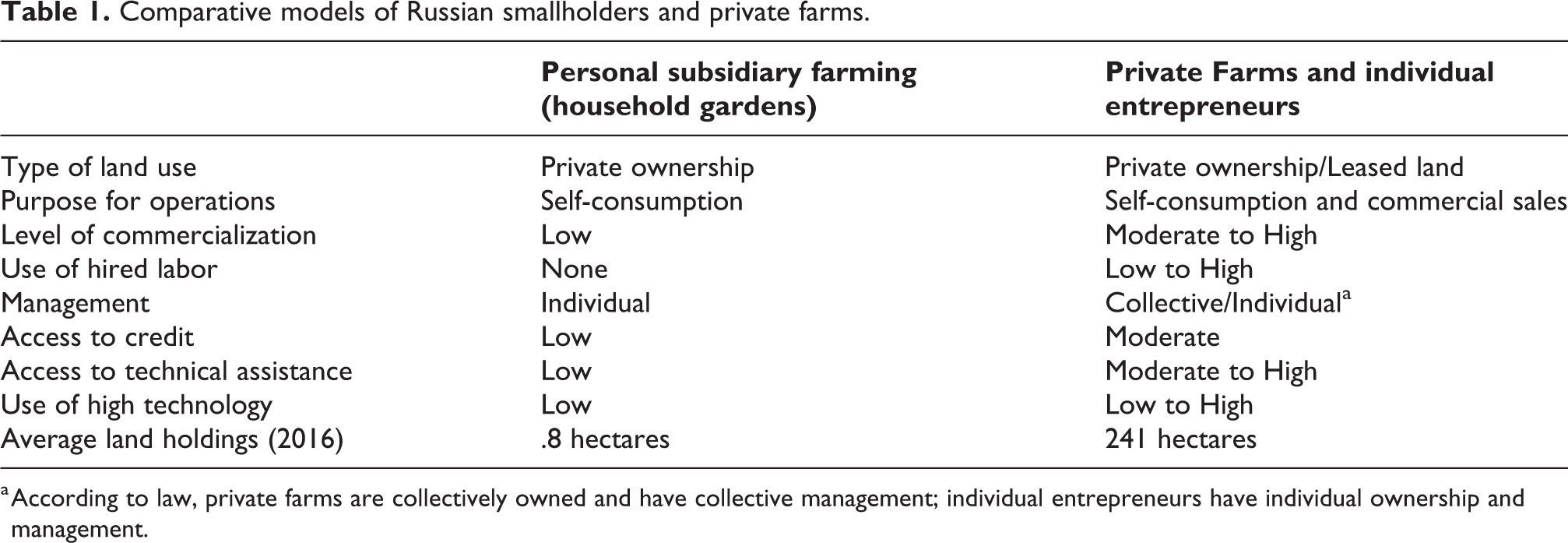
a According to law, private farms are collectively owned and have collective management; individual entrepreneurs have individual ownership and management.
The table shows significant differences among the different forms of smallholder activity. In particular, private farms: (1) have larger land holdings (see below); (2) use hired labor; (3) have moderate to high levels of mechanization; (4) are legally registered as a commercial enterprise whose output is subject to taxation; (5) have access to targeted federal and regional assistance programs; and (6) engage in agricultural and non-agricultural activities.
Are smallholders still economically important?
This section examines the economic significance of lichnoe podsobnoe khoziaistvo. I hypothesize that lichnoe podsobnoe khoziaistvo is in economic decline. Three measurements are used to support the hypothesis that smallholders are in decline: food output, land, and animals.
Food output
Lichnoe podsobnoe khoziaistvo has been historically significant because of its food production, which was disproportionate to the amount of land that smallholders cultivated. In the Soviet period, lichnoe podsobnoe khoziaistvo used less than 2% of agricultural land but accounted for large percentages of meat, eggs, potatoes, honey, vegetables, and milk production. In the 1980s, for example, household gardeners accounted for an estimated 25–30% of the ruble value of food production (Kalugina, 1991), as well as more than one-half of the food consumed by rural households (Medvedev, 1987: 364). Typically, household production consisted of potatoes, carrots, cucumbers, and small fruits and berries for consumption. Rural households may have kept a cow, sheep, goats, a pig or two, and chickens for milk, meat, and eggs. That said, already by the late 1980s a fairly significant percentage of households did not desire to raise animals. According to government data, in the Russian Republic 28% of lichnoe podsobnoe khoziaistvo operators did not want a cow, 31% did not want a pig, and almost 50% did not want sheep or goats (Goskomstat SSSR, 1989: 108).
In the 1990s, output from lichnoe podsobnoe khoziaistvo rose to from 32% of production in 1992 to a high of 59% of the ruble value of production at its peak in 1998 (Goskomstat, 2001: 199), and it remained above 50% into the early 2000s (Pallot and Nefedova, 2007). The relative increase in contribution was due to both declines in production by large farms and an increase in production from lichnoe podsobnoe khoziaistvo. Since the mid-2000s, however, household garden production has been in decline in both volume and relative contribution to national food supply. This period corresponds to the recovery of large farms and the emergence of agroholdings as significant food producers. In 2019, according to official statistics, lichnoe podsobnoe khoziaistvo accounted for the lowest ruble value of food production since the mid-1980s, 28%, down from 51% in 2000, while farm enterprises produced 58% of the nation’s food, up from 45% in 2000 (Rosstat, 2020: 355). There is nothing to suggest that smallholders’ decline is over. The qualitative aspect is also important: smallholder production is for self-consumption while farm enterprises sell their raw production to processors and this food eventually ends up in retail stores.
While proponents of lichnoe podsobnoe khoziaistvo often praise the significant output from the sector, there are reasons to suspect that macro-level data about food production from lichnoe podsobnoe khoziaistvo may be too high. Russia’s statistical agency, Rosstat, does not collect annual production data from households because their production is not subject to the value added tax and their food sales are not subject to income tax, and thus there is no mechanism to collect specific data. In short, what we think we know about smallholder production may be little more than best-guess estimates. Actual smallholder production could be significantly lower, we really do not know.
Land
While yearly household food production is estimated, hard data on land holdings may be gleaned from agricultural censuses. Comparing Russia’s 2006 and 2016 agricultural censuses, total land area used for lichnoe podsobnoe khoziaistvo increased, but the amount of arable land increased only marginally and did not change at all in rural areas, 2.3 million hectares in both censuses. Smallholders continue to use a low percentage of total arable land.
In terms of sown land, in the 2016 census lichnoe podsobnoe khoziaistvo had 2.1 million hectares of cultivated land compared to 79.2 million hectares for all agricultural producers. In short, smallholders used just 2.65% of all cultivated land. Despite land privatization and the right to buy or lease additional land, households do not control a much higher percentage than during the Soviet period. Thus, a lack of land acquisition more so than insecure property rights has held back household food production.
Animals
Operators of lichnoe podsobnoe khoziaistvo are structurally limited by their small land holdings. The 2016 census shows that 65% of households with lichnoe podsobnoe khoziaistvo have .2 hectares or less; and 79% have .3 hectares or less (Rosstat, 2018a: 220–221). Fewer than 2% of households have land holdings between one and three hectares (Rosstat, 2018a: 220). At least two hectares are needed to raise one cow (Uzun, 2012). To obtain land to raise and feed animals, households need to lease additional land away from the dwelling. However, household survey data found that only a small percentage of rural households lease additional land away from the dwelling that would allow livestock to be raised (Wegren, 2009: 107–137). The mean size of a leased land plot for ordinary farm workers lease is less than one hectare, not enough to raise livestock (Uzun, 2012). The low participation rate in land leasing is reflected by the percentage of households with lichnoe podsobnoe khoziaistvo that do not raise any cows or pigs. In the 2016 census, 88% of households with lichnoe podsobnoe khoziaistvo raised no horned cattle, 90% raised no cows, and 93% raised no pigs (Rosstat, 2018b: 306–387).
Moreover, comparing data from the 2006 and 2016 agricultural censuses illustrates the long-term decline in animal husbandry on lichnoe podsobnoe khoziaistvo. During that period, the number of horned cattle owned by households fell by about 28% or 2.8 million head; households’ cows declined by one-third or 1.3 million head; households’ pigs fell by more than 55% or 4.3 million head; households’ goats dropped by 25% or 500 thousand head; and households’ poultry fell by more than 22% or almost 29 million head. The reasons for the decline vary by specific animal but generally are attributable to cost, inconvenience, outbreak of disease, or shifting values. This broad-based decline in animal husbandry reflects a restructuring of meat production away from households and toward agroholdings. In 2018, the top 20 agroholding companies produced about 56% of the nation’s pork and two-thirds of its broilers.
Change in smallholders’ role
Russia’s smallholders’ share many of the same disadvantages that exist in other countries, but in Russia their economic importance has changed because of societal changes. Since about the year 2000, Russia’s agrarian economy has changed, its food system has changed, its food security situation has changed, and the agrarian power structure has changed, all of which mean that the historical role played by smallholders is less relevant.
The household garden has been an important feature of Russia’s society and countryside for more than a century. Household gardening is steeped in tradition and offers a sense of getting back to nature because labor is non-mechanized, fertilizer is usually organic, and the connection between growing food and consumption is direct. During the Soviet period, lichnoe podsobnoe khoziaistvo became part of the daily routine, the fabric of everyday life, and that remains true today. Smallholders continue to have useful social roles to play in contemporary rural Russia. Food production from lichnoe podsobnoe khoziaistvo is integral to social interaction and economic exchange in villages. That situation is unlikely to change. In addition, lichnoe podsobnoe khoziaistvo transfers tradition and rural culture from generation to generation, and is part of everyday rural life (Agafonov, 2012). Other authors have also noted that even with economic marginalization, smallholding activities provide “spaces of resistance and coping tactics” (Round et al., 2010: 1198). Thus, it is clear that the utility of smallholding was and remains multidimensional. Those aspects will likely remain as long as there are rural dwellers who engage in lichnoe podsobnoe khoziaistvo.
The primary economic roles of lichnoe podsobnoe khoziaistvo in Soviet society were to supplement the family diet and to ensure household food security. Because lichnoe podsobnoe khoziaistvo was a “remnant of capitalism” and a representative of the “private sector,” it was contested by the Soviet regime at various times, and state policy exhibited tension between ideological antipathy and the practical need for food from households (Hedlund, 1989: 14–34). In 1933, household gardening was legalized for rural dwellers, and by the 1980s almost every rural household operated lichnoe podsobnoe khoziaistvo (Kalugina and Antonova, 1984). Household production was important particularly for rural households who tended to consume their own production. It is estimated that more than one-half of rural food consumption came from their own production (Medvedev, 1987: 365). Urban households with lichnoe podsobnoe khoziaistvo also used their food production as a source of food security when availability in state stores was unreliable.
In the 1990s, smallholders and their lichnoe podsobnoe khoziaistvo economic role was to provide a safety net for food security as retail prices skyrocketed and real incomes contracted. Both rural and urban dwellers used their lichnoe podsobnoe khoziaistvo to ensure their food security during economic collapse, and thus it represented an important survival strategy (Kalugina, 2000). From the state’s perspective, the more food produced and made available from lichnoe podsobnoe khoziaistvo, the less the chance that angry urban consumers would take to the streets to protest skyrocketing food prices.
In contemporary Russian society, the economic role for lichnoe podsobnoe khoziaistvo lacks the clarity of the past. Given the ever-increasing economic power of agroholdings and the spread of supermarkets, it is not clear what the role of lichnoe podsobnoe khoziaistvo is today; it is not clear to what extent household producers who are oriented toward self-consumption are needed.
In the 1980s and 1990s, the stalls at urban farmers’ markets, found in nearly every medium-sized city and up, were occupied by household members with lichnoe podsobnoe khoziaistvo who sold their potatoes, carrots, berries, cucumbers, and other household production. Farmers’ markets were an important of food for urban consumers who were often frustrated at the absence of food in state stores. Today, stalls at urban markets are run by hired traders who sell produce from large farms. Farmers’ markets themselves have largely been supplanted by supermarkets in many cities. Lower income households tend to shop at large supermarkets and small food stores most often, followed by local food markets as the third most popular option. Almost three-quarters of upper income households shop at large supermarkets, making it the most popular choice. Upper income households are also more likely to order online and utilize home delivery. Thus, the contemporary urban consumer in Russia has broken from the state food store/farmer market dichotomy that existed during the Soviet period and now enjoys a multiplicity of choice about where to obtain food.
Not only have smallholders been displaced by traders, they find it exceedingly difficult to break into high-value supply chains for structural reasons, as is true in many other developing and middle-income countries (International Finance Corporation, 2019: 5–10). Questions over food quality, deliverable volume, and reliability of supply, are all relevant factors that create disincentives for processors and retailers to integrate smallholders into their supply chains.
The uncertain economic role for lichnoe podsobnoe khoziaistvo is also reflected in regional policies toward household food production. Despite a “green light” from a capitalist system that encourages higher production, regional outbreaks of swine fever and bird flu have led to the reintroduction of many restrictions on smallholders. In short, regional governments play higher priority on protecting the interests of agroholdings than on output from lichnoe podsobnoe khoziaistvo. Some regions placed limits on the number of household animals (similar to the Soviet period). In the most extreme case, at the end of 2018 the regional government in Kaliningrad oblast banned the raising of pigs on household plots, leading to a 99% reduction in the number of pigs raised by households (Kvedomosti.ru, 2019). The Ministry of Agriculture supports regional limits on the number of pigs raised by operators of lichnoe podsobnoe khoziaistvo. Others require households to register their animals with local authorities to monitor the outbreak of disease. In early 2018, 74 hotspots for swine flu were identified, 41 of which came from household production (Diatlovskaia, 2018). In July 2018, Rossel’khoznadzor quarantined 40 hotspots involving household production in Kaluga, Kursk, Samara, Penza, Saratov, and Orel oblasts (Kvedomosti.ru, 2018). Because the lack of sanitary conditions in household production is a threat to corporate interests, agroholdings have played a role in lobbying regional governments for increased regulation of household producers in an attempt to contain the spread of disease.
In addition, smallholders’ economic role has become uncertain due to changing preferences among Russia’s urban consumers, who today are sophisticated and demand both better quality and selection when food shopping. They have grown accustomed to modern, clean, well-stocked supermarkets, particularly in medium-sized and large cities. Yet, household production from lichnoe podsobnoe khoziaistvo consists of raw and unprocessed food. It is one thing for household producers to sell potatoes, vegetables or berries to Soviet-era consumers who had few shopping options, but contemporary consumers who shop at supermarkets and who increasingly opt for prepared and packaged foods have different expectations.
Let us consider the question from a different angle: what would be the consequences for urban food security if lichnoe podsobnoe khoziaistvo production continues to drift downward and becomes mostly a recreational activity? Would the average urban consumer in Moscow or any other large city in Russia feel an economic impact? Probably not much. Today, urban consumers are more likely to shop at a supermarket than visit a farmers’ market. Agroholdings and other large farm produce most of the food that ends up in retail stores. Private farmers are filling niche markets, such as small family-run companies that produce craft cheese. Private farmers are also capturing the organic food and online ordering and delivery segments, although large retail chains are also developing online ordering. In other words, the economics of lichnoe podsobnoe khoziaistvo are increasingly disadvantageous. Even operators of lichnoe podsobnoe khoziaistvo themselves understand that buying milk is cheaper than raising a cow, and buying potatoes is cheaper (and more convenient) than growing one’s own. Further, policy remedies are available to compensate for production from lichnoe podsobnoe khoziaistvo. Cheap vegetables can be imported from any number of countries: Turkey, Morocco, member states in the Commonwealth of Independent States, or members of the Eurasian Economic Union. Cheap meat can be imported from Latin America or China. In short, if the analysis herein is correct, the economic centrality of lichnoe podsobnoe khoziaistvo has passed and its marginalization may continue without great harm to Russia’s food security.
Looking ahead
Based on the discussion above, the future of lichnoe podsobnoe khoziaistvo in Russia appears unclear. As argued above, its economic role has changed and its importance is in decline as society evolves. It is entirely possible that output from lichnoe podsobnoe khoziaistvo will fall to 15–20% of the value of food production. It is also probable that within 10 years food production from private farmers will surpass the level from households. If that happens, lichnoe podsobnoe khoziaistvo will take on regional importance, in particular, in Russia’s north, far north, and far east where retail food is more expensive, food needs to be imported, and agricultural production from farm enterprises is low due to marginal farmland and harsh climate. In the best agricultural areas of Russia, lichnoe podsobnoe khoziaistvo is already marginalized and the least important source of food production when measured in ruble value. Furthermore, the future is especially ambiguous because Russia’s agricultural sector is in the early stages of a technological revolution that will lead to further concentration of economic power in agroholdings. Large agribusiness will render household producers increasingly obsolete, at least for food security for urban consumers.
The future for lichnoe podsobnoe khoziaistvo is also clouded by other factors. First, whereas smallholder farming in developing countries is often a way of life, for smallholders in Russia it has always been subsidiary food production or a hobby that is operated during free time. Only a tiny percentage of lichnoe podsobnoe khoziaistvo operators derive their entire income from food production (Uzun and Saraikin, 2012). As employment opportunities continue to diversify toward non-agricultural jobs in rural areas, it is entirely possible that household gardening as a hobby will further decrease as people choose to use their free time in other ways.
A second factor concerns long-term demographic trends in the countryside. Rural dwellers under the age of 30 continue to be the largest cohort migrating out the countryside. That age cohort also spends more time operating lichnoe podsobnoe khoziaistvo than other age groups according to government survey data (Rosstat, 2010). Pensioners have more time to operate the household garden but statistically spend less time doing so. Pensioners also have less energy to engage in all of the activities that are inherent to selling food such as loading the car (or packing the produce to take a bus), the actual travel, unloading, displaying, selling all day, and then repeating the packing/travel and unloading for the return trip. As noted above, during the past 10 years or so traders are replacing people who sell their own production at urban markets.
A third factor is value change. As incomes rise, people develop different ideas about how to spend their leisure time. The same happened among former communist states in Eastern Europe. The economic contribution to food output by household production plummeted to single digits in all but Romania and Bulgaria. As rural incomes rose, post-materialist values supplanted the desire to grow one’s own food. It is hard to imagine that lichnoe podsobnoe khoziaistvo in Russia may be different.
Conclusion
Russia as a case study holds lessons for global smallholders. While smallholders around the world face similar limitations in access to credit, supply chains, market information, and advanced agricultural technology, the lesson drawn from this article is that prospects for smallholders are not solely determined by those limitations. The Russian case fits into previous conclusions about mixed patterns of inclusion of smallholders during the restructuring of an agrifood sector (Reardon et al., 2009).
Throughout the years lichnoe podsobnoe khoziaistvo has held a special place in Russia’s food system as an important contributor to local food supply. I have argued that how smallholders fare is influenced by their economic role during a given time period. This article considered several trends and factors that make it likely that household food production will continue to decline in absolute volumes and relative to other producers in Russia’s contemporary agrarian system. Driving the decline is an uncertain economic role, which raises the question where smallholders fit in Russia’s contemporary agrarian system. Russia’s countryside will remain stratified, which means that some households will adapt and thrive better than others. But for the bulk of rural households, their lichnoe podsobnoe khoziaistvo may evolve into primarily a recreational activity, which, if that occurs, will result in a further decrease in food output.
On the positive side, the relative decline of smallholders means that Russia’s food distribution and retail sectors are operating well. Urban consumers are more food secure than at any time in the post-Soviet period due to higher output from large farms and a diversity of choice about how to obtain food. Further, as consumer incomes rise and values change, there is the also the possibility for smallholders to fill new niches. For example, smallholders may produce high-quality organic food near large urban areas where consumers have high disposable income and are concerned how their food is grown. Last, despite a decline in economic importance, there are historical and cultural traditions associated with lichnoe podsobnoe khoziaistvo that cannot be ignored. Rural dwellers enjoy “working in the yard” even though the work is hard manual labor. They take pride in seeing their labor turn into food. They enjoy the feeling of growing their own food sustainably. But the days of lichnoe podsobnoe khoziaistvo playing a significant role in the lives of urban consumers are over.
Footnotes
Acknowledgement
The author thanks two anonymous reviewers for their comments.
Declaration of conflicting interests
The author(s) declared no potential conflicts of interest with respect to the research, authorship, and/or publication of this article.
Funding
The author(s) received no financial support for the research, authorship, and/or publication of this article.
