



Abstract
This study examines the impact of increasing climate variability on food production in South Africa, focusing on maize and wheat yields. A two-way fixed effects panel regression model was used to assess the climate variability impacts, analysing secondary data for the period 2000 to 2019 for nine provinces in South Africa. The study found that increasing climate variability has a negative impact on maize and wheat production in South Africa. Specifically, the results indicated a negative correlation between mean annual temperature with both maize and wheat yields. A decrease in precipitation affected maize yields negatively, while the impact on wheat yields was positive, although insignificant. This analysis, therefore, depicted that crop yields generally increase with more annual precipitation and decrease with higher temperatures. The study recommends that funding initiatives to educate farmers on increasing climate variability and its effects on farming activities in South Africa should be prioritised.
Introduction
The global impact of climate change is substantial, and South Africa is not exempt from this phenomenon (Masipa, 2017). Climate change, variability and extremes are prevalent modern-day realities that have the potential to impact development on the African continent negatively (Zinyengere et al., 2014). Global climate models provide evidence that displays significant shifts in climatic patterns, which are projected to continue into the foreseeable future (Shukla et al., 2019). Climate change has the potential to disrupt progress towards global food security, agriculture and the environment (Van Wyk and Dlamini, 2018). Agriculture holds a critical role in food production as it is responsible for feeding nations (Zwane, 2019).
The African continent is characterised as the most vulnerable to climate changes (Baarsch et al., 2020; Masipa, 2017). This is due to its high dependence on agriculture and natural resources, and, ironically, it has the most limited ability to adapt to climate change (Bozzola et al., 2018). Africa’s vulnerability is further exacerbated by the spread of HIV/AIDS, lack of access to land due to the land tenure schemes in existence, a deficiency of water, slow technological advancement and institutional mismanagement (Ochieng et al., 2016). This necessitates robust response strategies for mitigation and adaptation to contend with the threats posed by climate change (Ochieng et al., 2016).
The purpose of the study was to determine the impact of climate variability on the production of major crops (maize and wheat) in South Africa. The objective was to develop and apply a country-level production function model to measure and analyse the impact of climate variability on production, using maize and wheat yields as a case study. Maize and wheat are South Africa’s most valued crops used for exports and are staples in domestic food production. These commodities are vulnerable to increased temperatures and changing rainfall patterns. Rising carbon dioxide levels could support a general level of crop development, but yields are generally predicted to decrease under extreme climate variability. The sector will deteriorate, which will affect the food supply (Johnston, 2019).
Food production
Global food production is currently threatened by the effects of climate variability and climate extremes (Gomez-Zavaglia et al., 2020). Climate variability creates a strain on water resources, hydropower, human health and food security for low- to middle-income countries and the entire world (Nhamo et al., 2018). Studies on climate impacts and adaptation strategies, such as the impacts on maize, wheat and rice production, are ongoing (Amnuaylojaroen et al., 2021).
The latest data from the World Bank on crop production was used with population growth in the same year (2016) in Figure 1 and displays how the population has been increasing at rates greater than the crop yield increase rate over the past two decades. The average increase in crop production has been 1.05%, and the average population growth rate has been 1.27% from 1996 to 2016. This is a concern, which implies that millions of people will be subjected to reduced food security (Masipa, 2017).
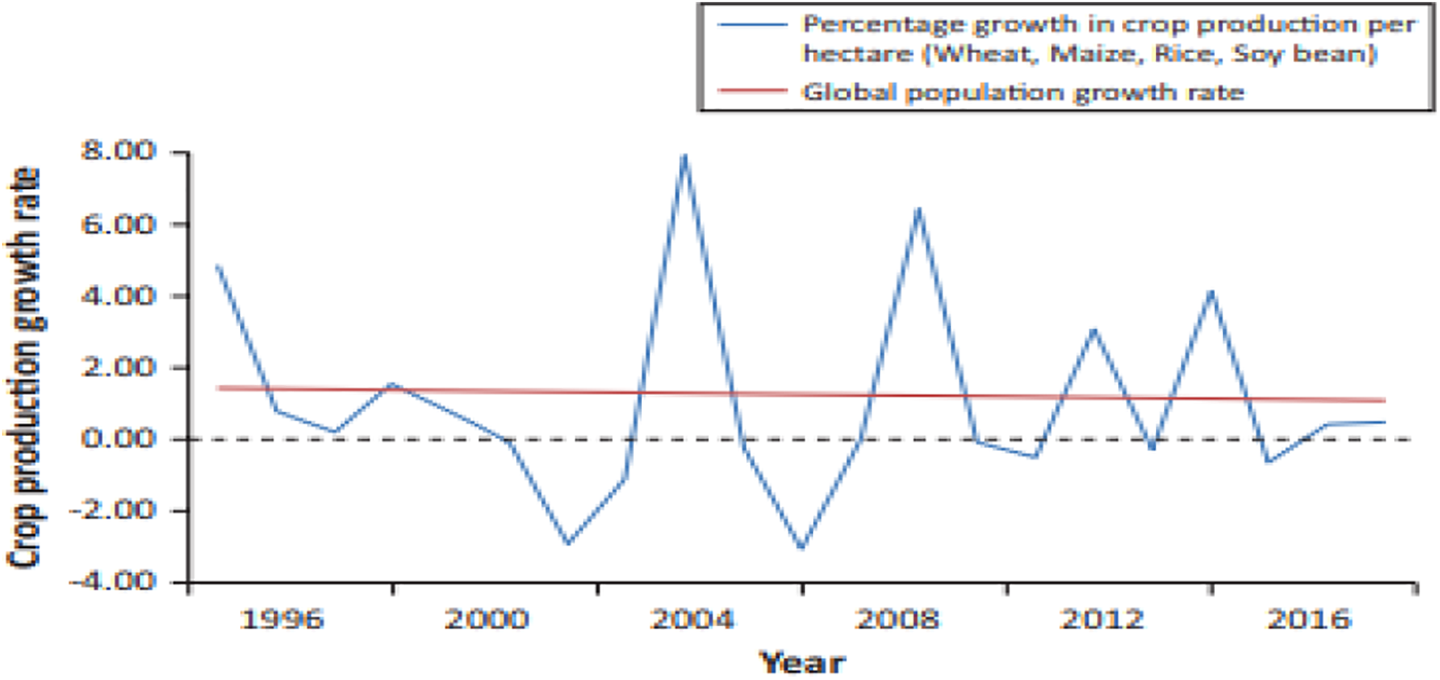
Crop production and population growth. Source: World Bank, 2016.
Agricultural productivity is heavily reliant on climate. For that reason, the possible impact of climate change on food production is an added constraint on the global food system that is already under strain to keep up with changing consumption patterns and associated water and land scarcity (Beddington, 2010). The majority of the population increase will occur in Africa and Asia, regions that are already food insecure, possibly pushing their food production systems over the edge due to the additional stress (Roudier et al., 2011). Mouël et al. (2018) further estimate that food requirement will more than quintuple in Africa by 2050 and more than double in Asia.
Climate change
The world’s climate has always been changing; however, the climate is now changing faster and unnaturally due to the impact of human activities (Zwane, 2019). Climate change causes pressure on the earth’s natural environment and has adverse effects on the population and their livelihoods (Benhin, 2015). Global mean temperature increases due to concentration traps due to increased greenhouse gas emissions (Misra, 2014). Both human societies and ecosystems are adversely impacted by climate change as incidents of droughts, floods, and other climate extremes occur more frequently, which, in turn, affect farming lands, livestock and all other essential activities for food production (Gould and Lewis, 2014).
Climate change impacts have generated conditions for deterioration in agricultural production (van Wyk & Dlamini, 2018). This then leads to an escalation of food inflation worldwide and shortages in food for the developing countries where the poor suffer as they cannot afford the increased food prices (Misra, 2014). Interestingly, there are expectations that climate change may lead to some beneficial impacts, especially for temperate regions (Bozzola et al., 2018). Carbon fertilisation would occur, growing seasons will be longer, and enhanced crop growth conditions are predicted to improve gains in crop productivity, particularly in regions of high-latitude, such as northern China and various other parts of North America and Europe (Kurukulasuriya and Rosenthal, 2003).
Precipitation and temperature
Five main factors would lead to a change of agricultural productivity by climate change: temperature, variations in precipitation, climate variability, carbon dioxide (CO2) fertilisation, and surface water runoff (Calzadilla et al., 2013). The key contributor to yield variability is precipitation since it is far more variable than possible crop evapotranspiration, the feature that regulates the water requirements of crops (Reilly et al., 2003). Reilly et al. (2003) used an econometric analysis of agriculture in the US and found that greater precipitation levels result in a decrease in yield variability (Reilly et al., 2003). Though the climate variability risk is reduced by irrigation, irrigated farming systems rely on surface runoff or groundwater availability, which are also subject to change from climate change. Consequently, the yield gap between irrigated and rain-fed agriculture is reduced by higher precipitation, but extreme rainfall causes waterlogging and flooding, which could negatively impact (Falloon and Betts, 2010).
The length of the growing season is controlled by soil moisture and temperature, which also controls the water requirements of the crop and crop development. Generally, high temperatures will reduce periods of frost, positively affecting cultivation in cool climate borderline areas. The same high temperatures would reduce the crop cycle and lessen crop yields in arid and semi-arid croplands due to increased crop water requirements as a result of higher temperatures (Parry et al., 2007).
The projected increases in mean temperatures and precipitation will not manifest by constant gradual changes but will, instead, be experienced as increased frequency, duration and intensity of hot spells and precipitation events. Whereas the annual occurrence of hot days and maximum temperatures are expected to increase in all parts of the globe, the mean global increase in precipitation is not expected to be uniformly distributed worldwide. In general, it is projected that there will be a shift to extremes, with wet regions becoming wetter and dry regions becoming dryer (Bengtsson and Hodges, 2019).
The South African context
The commercial farming sector of South Africa remains critical to the development of the economy and improving food security in the entire Southern African Development Community (SADC) (Benhin, 2015). Agriculture is predominantly rain-fed, sustaining the livelihoods of over 60% of the population. Land with irrigation potential is approximately 20 million ha, while 3.9 million ha (accounting for about 6.6% of the cultivated area) of all land under cultivation is equipped for irrigation (Nhamo et al., 2018). These factors, coupled with climate variability, would have adverse effects on agricultural production, leading to lower farm revenues and an upsurge of poverty, hunger and malnutrition, particularly in rural areas highly dependent on rain-fed agriculture (Ali, 2018).
South Africa has a high evaporation level and receives an annual rainfall of 450 mm, a low amount compared to the 860 mm world average. Only 10% of South Africa’s total land area receives 750 mm, 50% of which is used for agriculture (Zwane, 2019). Furthermore, South Africa’s warm baseline climate has been getting hotter (Mbokodo et al., 2020). The daily average maximum temperatures in South Africa are projected to increase by up to 2°C in summer across the country’s plateau from 2010 to 2039 (Mbokodo et al., 2020).
A significant portion of South Africa’s population reside in rural areas and depend on land and agriculture as a source of livelihood, either directly or indirectly (Van Wyk and Dlamini, 2018). Any adverse changes in South Africa’s climate are likely to destabilise food production and security in the region and to some extent globally, since South Africa is one of the major economic powers in sub-Saharan Africa and the Southern Africa region in particular (Tibesigwa et al., 2017).
Maize contributes approximately 70% of grain production in South Africa and covers approximately 60% of the cropping area. In addition, 40% of maize is used as livestock feed (Haarhoff et al., 2020). It is a summer crop cultivated predominantly in semi-arid districts of the country and is highly susceptible to changes in both temperature and precipitation (Benhin, 2015). Maize has an inelastic demand; therefore, a decrease in maize production may increase total revenue and food insecurity within the Southern African region (Akpalu et al., 2008). A study on the impact of climate change on food security in South Africa established that the increase in climate variability poses a significant risk to food security in sub-Saharan countries, ranging from crop production to food distribution and consumption (Masipa, 2017). Faramarzi et al. (2013) confirm this and argue that, in sub-Saharan Africa, many countries are currently water-stressed, and climate variability is projected to exacerbate the situation.
Tibesigwa et al. (2017) concluded that a simultaneous increase in temperature and decrease in precipitation reduces productivity and a temperature increase alone has a more significant effect than a precipitation decrease. Calzadilla et al. (2014) used an updated GTAP-W model, which differentiates between irrigated and rain-fed agriculture. They concluded a GDP decline of up to 0.6% is expected in South Africa due to climate change, along with a decrease in crop production. For South Africa to adapt to the adverse impacts of climate change, yield enhancements exceeding 20% over baseline investments in agricultural research and development would be required.
Akpalu et al. (2008) investigated the impact of climate variability on maize in the Limpopo Basin of South Africa. They posited that increased temperature, precipitation and irrigation all have a positive effect on yield. Rainfall has a more substantial impact on the yield of maize compared to the effect of temperature, meaning that, if climate change reduces precipitation while simultaneously increasing temperature at the same rate, the impact of climate variability on maize yield would be negative.
Materials and methods
The study focused on the nine provinces in South Africa, where maize and wheat are grown as a means of purposive sampling to simulate the impact of increasing climate variability in South Africa as a whole. The study used secondary data from 2000 to 2019. Data for temperature and precipitation were utilised as the independent variables, and maize and wheat yields were the dependent variables. A quantitative research approach to analyse crop yield data for maize and wheat was obtained from the Department of Agriculture, Land Reform and Rural Development of South Africa, and climate data obtained from the South African Weather Service.
Model specification
Panel regression models were developed for each of the two crops (maize and wheat) as the statistical method and a methodology to determine the effects of climate on crop yields and interrogate the cross-sectional and temporal attributes of the dataset. The data set is a panel where Y = mean annual temperatures (and rainfall) for nine provinces from 2000 to 2019.
The general model for the panel data has been described, as shown in Equation (1).

where:
unit of observation in space;
unit of time observation (2000 to 2019);
vector 1 × K of exogenous variables (temperature and rainfall);
heterogeneity measurement factor;
error term; and
model parameters.
Depending on the assumption made about the term Zi, there was a choice between three applied models (pooled, fixed effects, and random effects). If Zi contains only the constant, it provides consistent and efficient estimators for the common coefficient α and the slope vector β (De Medeiros Silva et al., 2019).
Fixed effects model
The fixed effects model is appropriate since the independent variables, temperature and rainfall, are linked to one or more regressors (Verbeek, 2009). The objective of the fixed effects model [Equation (2)] is to control the effects of the missing variables that differ between provinces and are constant over time. The intercept is assumed to vary from one province to another but is constant over time; therefore, the model is named fixed effects (Hill et al., 2005).

in which:
αi Ziα, which is Zi when the individual heterogeneity has a constant term and a set of unobserved variables.
Panel data model regressions
The effects of climate variability on maize and wheat yields were analysed by implementing the following panel data regression models, one for each maize and wheat yield. In regression 1 [Equation (3)], the constant, temperature and rainfall were analysed for maize yields. In regression 2 [Equation (4)], the constant, temperature and rainfall were analysed for wheat yields.


Dummy variables were included in the regressions, and definite variables were converted into numerical variables using a technique to ‘quantify’ an attribute of a qualitative variable using artificial variables that presented values of 1 or 0 (signifying the lack or presence of an attribute, respectively).
Formulation
The hypothesis was tested based on the assumption of the following production function [Equation (3)] making use of a partial derivative of the production function in relation to the factor, by joining temperature and rainfall as independent variables in the model:

Diagnostic analysis
Grubb’s test was conducted to determine the existence of any outliers, and no potentially problematic outliers were detected. In addition, the regression assumptions were evaluated, and the residuals were found to be normally distributed. A crude check was also performed for spatial autocorrelation in the residuals. There were no observations that had an undue influence present, and, therefore, no observations were removed. The model was found to meet all assumptions, with none violated. The regression model results were, thus, accurate.
Results
The hypothesis was tested based on the assumption of the following production function, making use of a partial derivative of the production function relative to the factor, by linking rainfall and temperature as independent variables in the model:


Table 1 shows that the relationship between rain and maize yield is statistically insignificant; however, the coefficient confirms a positive relationship between rain and maize yield. For a 1 mm decrease in rainfall, maize production decreases by 0.062 t/ha. This result is in line with findings by Adisa et al. (2018), who concluded that a decrease in precipitation leads to prolonged drought conditions that impact maize production negatively. Similarly, future rainfall will reduce in the ranges of 5–10%, due to the semi-arid nature of South Africa during the mid-21st Century, with smallholder and dryland farmers being the most affected, in comparison to irrigation and large-scale or commercial farmers (Bryan et al., 2009).
Rain and mean annual temperature impact on maize.

The results in Table 1 also reveal that the mean annual temperature has a significant impact on maize yields in South Africa. These results are in line with findings from Lobell et al. (2011). They reported a 1% yield reduction associated with each degree-day spent above 30°C under optimal rain-fed conditions (which rises to 1.7°C under drought conditions). Adisa et al. (2018) provided evidence that, in the context of global change, temperature increases lead to a higher rate of evapotranspiration; the coefficient confirms a negative relationship between mean annual temperature and maize yields in South Africa. Parry et al. (2007) concluded that high temperatures reduce the crop cycle and reduce yields in arid and semi-arid croplands due to increased crop water requirements as a result of higher temperatures.
For a 1°C increase in mean annual temperature, maize production decreases by up to 0.176 t/ha, which is quite significant considering that the country’s average maize yield is 5.85 t/ha. Indicators of climate change are projected to be most severe in the northern regions of the country. 1–3°C is the expected range of the temperature increases (Bryan et al., 2009).
Table 2 confirms that an increase in rain beyond what is required has a negative effect on wheat yields. This is because precipitation impacts production positively until it peaks (excessive rainfall) and then takes on a diminishing effect (Elum et al., 2018). While the results indicate a negative relationship between rain and wheat yields, there is no significant impact. For every 1 mm increase in rainfall, wheat production only decreases by 0.027 t/ha.
Rain and mean annual temperature impact on wheat.

The negative correlation is also a result of the impact of irrigation on yield, which is positive and suggests that the present system of irrigation mitigates the effect of reduced precipitation on yield to a large extent. The wheat area under irrigation has been increasing in South Africa over the years. As a result, close to half of the total South African wheat crop is produced under irrigation, mainly in the Northern Cape (Davids et al., 2015).
As expected, there is a negative relationship between mean annual temperature and wheat production. Table 2 shows that the impact of mean annual temperature on wheat yields is not significant. The results show that for a 1°C increase in mean annual temperature, wheat production decreases by 0.141t/ha. This confirms previous findings by Lobell et al. (2008). In a global study that projected crop response to climate in the early 21st century and using statistical methods, they showed that South Africa will likely suffer negative impacts on crops without sufficient adaptation measures. The study projected an average decline in maize, wheat, soybean, sugar cane and sorghum yields of 28%, 16%, 8%, 6%, and 2%, respectively.
Diagnostic analysis
Grubb’s test was conducted to determine the existence of any outliers. The G test statistic was calculated and compared to the G critical value at the 5% significance level. The p-value for all the variables used in the panel regression models was found to be greater than 0.05. Hence there were no potentially problematic outliers detected. In addition, constant variance (homoscedasticity) and normally distributed errors are two essential assumptions of any linear model, including linear fixed effects panel models (Helmreich, 2015). The regression assumptions were evaluated, and the residuals were normally distributed. The model was, therefore, found to meet all assumptions. In other words, no assumptions were violated, and the regression model results are accurate.
Discussion
The main findings of the two-way fixed effects (2FE) regression and the multiple regressions for each province confirmed the expectation that the effects of climate change (increased temperature and decreased precipitation) have an impact on food production (maize and wheat yields). The results of this study are in line with the theory of increasing mean temperatures, as confirmed by Ma et al. (2019). The rising global mean temperature is thought to change climatic patterns such as floods, droughts, and incidents of the El-Niño and La-Niña, thus affecting human life and global food production and having a negative effect on the main pillars of food security: availability, accessibility, utilisation and system stability (Ma et al., 2019). Further to this, studies show that the worldwide mean temperature has risen by 0.74°C during the past 100 years (Misra, 2014).
Furthermore, the two-way fixed effects (2FE) regression results show that the impact of temperature on maize yield is more substantial than precipitation. This is in line with a study by Akpalu et al. (2011). They found that rainfall on maize yield is weaker than temperature and discovered that the impact of climate variability on maize yield could be harmful if it simultaneously marginally increases temperature but reduces precipitation to a considerable extent. This was also confirmed with empirical evidence by Tibesigwa et al. (2017), who concluded that a simultaneous increase in temperature and a decrease in precipitation reduces productivity, while a temperature increase alone has a more significant effect than a precipitation decrease.
Reilly et al. (2003) found that changes in temperature and precipitation directly influence crop production. The major source of all freshwater is precipitation; it determines the soil moisture level, a critical crop growth input. Furthermore, the key contributor to yield variability is precipitation, since it is far more variable than possible crop evapotranspiration, the feature that regulates water requirements of crops (Reilly et al., 2003). This is in line with the study’s main finding regarding the impact of precipitation on maize yields: that, for a 1 mm decrease in rainfall, maize production decreases by 0.06.2 t/ha. In addition, the study’s findings that, for a 1°C increase in mean annual temperature, maize yield decreases by 0.176 t/ha also align with the theory of Lobell et al. (2011). These researchers postulate that, although maize is widely cultivated from the northern to the southern hemisphere in humid and semi-humid, arid and semi-arid areas (Meng et al., 2016), the production of maize will increasingly be negatively impacted by water scarcity. In addition, water demand and supply will likely be affected by climate change, intensifying this issue in the future. As climate change involves warming, this will further compromise maize yields (Lobell et al., 2011).
An interesting and unexpected finding was the negative correlation between precipitation and wheat yields, interpreted as no or negligible relationship. This is likely because the wheat area under irrigation has increased from 19% in 2007 to 27% in 2013 and keeps increasing. As a result, close to half of the total South African wheat crop is produced under irrigation, mainly in the Northern Cape, which implies decreased reliance on actual rainfall (Davids et al., 2015). Findings by Shew et al. (2020) suggest that large reductions in wheat yields occur when temperatures exceed 30°C and that warming impacts will increase non-linearly under uniform warming scenarios. The findings of the study were that, for every 1°C increase in temperature, wheat production decreases by 0.141 t/ha. The impact of increasing temperature on wheat yields was more severe than the rising temperature impact on maize yields.
Conclusion and recommendations
The empirical results presented in this study provided adequate evidence that climate change would impact the crop sector in South Africa. The provincial heterogeneity of South Africa’s climate is a determinant of food crop production in the various provinces. Differences in precipitation and temperature have varied effects on crop yields in South Africa. For example, steadily decreasing rainfall has negatively affected maize yields, while it seems to have negligible or no effect (or an even positive effect) on wheat yields. As for the variability of mean annual temperature, it negatively affects yields as it increases. An increase in variability in temperature would reduce both maize and wheat yields. Increasing temperature did, however, exhibit a more severe impact on wheat compared to maize yields. This analysis, therefore, depicted that crop yields generally increase with more annual precipitation and decrease with higher temperatures. Furthermore, the simultaneous occurrence of an increase in temperature and a decrease in rainfall would have an even harsher negative effect on crop yields.
A priority should be to address the biggest challenge of funding initiatives to educate farmers on increasing climate variability and its effects on farming activities in South Africa. Specific and focused programmes are required firstly to enhance farmers’ awareness of climate change. Prevention of some of the harmful impacts, such as decreased yields and revenues, is definitely possible by more effective farm planning, insurance and diversification and better forecasting or monitoring weather conditions. Education is critical and should not only be targeted at farmers but should be broadened and introduced in tertiary level and school curricula in subjects such as Geography, Agriculture, and Economics.
There is enormous scope for further research on the impact of different crops having different water use requirements (under the same weather conditions). Furthermore, additional research could be conducted on the critical differences in C3 and C4 crop physiology, phenology and carbon allocation in maize and wheat. Wheat has the classic C3 photosynthetic pathway in its leaves to make it less efficient in hotter and drier climates. Further research on these topics will benefit the effectiveness and efficiencies in maize and wheat production.
Footnotes
Declaration of conflicting interests
The author(s) declared no potential conflicts of interest with respect to the research, authorship, and/or publication of this article.
Funding
The author(s) received no financial support for the research, authorship, and/or publication of this article.
