



Abstract
COVID-19 pandemic has disrupted the Indian agricultural system extensively. Nevertheless, the recent quarterly GDP estimates post-COVID scenario showcase robustness and resilience in Indian agriculture, the only sector to register a positive growth of 3.4% during the financial year (FY here after) 2020–21 (Quarter 1: April 2020 to June 2020). At the same time, the immediate past quarter growth was estimated at 5.9% witnessing a decline by 2.5% point. In this context, we aim to synthesize the early evidence of the COVID-19 impact on the Indian agricultural system viz., production, marketing and consumption followed by a set of potential strategies to recover and prosper post-pandemic. Survey findings indicate that the pandemic has affected production and marketing through labour and logistical constraints, while the negative income shock restricted access to markets and increased prices of food commodities affecting the consumption pattern. The pandemic wreaked a substantial physical, social, economic and emotional havoc on all the stakeholders of Indian agricultural system. Seizing the crisis as an opportunity, the state announced a raft of measures and long-pending reforms. We propose a 10-point strategy ranging from social safety nets, family farming, monetizing buffer stock, staggered procurement to secondary agriculture to revive and prosper post-pandemic.
Introduction
COVID-19, originating from Wuhan, China – the epicentre – has eventually spread through the whole world and emerged into a pandemic. India has already become a hotspot for the virus, next to the USA, infecting 9.6 million (14.6% of global infection) as of December 6th, 2020 1 which has resulted in a decline of 23.9% gross domestic product in quarter 1, FY 2020–21. 2 A pandemic shock can have a greater significance on economies due to lost human lives compared to a weather shock such as drought or flood or a trade embargo. Undoubtedly, all these shocks affect agricultural systems; however, pandemic shocks affect all the sectors of an economy. The pandemic disrupts demand and supply of food impacting the global supply chain; while droughts tend to be localized affecting only the associated sector or stakeholders (Mishra et al., 2021). Similarly, shocks due to a trade embargo affect a particular sector and can be corrected in the short-term with suitable policy measures. For instance, in case of supply shortage due to droughts, globally linked wholesalers and retailers procure from other sources to avoid adverse effects (Mishra et al., 2021). On the contrary, pandemic impact may be far-reaching and harsher and may even plunge a country into recession.
As a protective and preventative measure, the Indian government ordered a nationwide lockdown, the severity of which is rated >80 in the global stringency index, from 25th March, 2020 3 affecting the economy including agriculture. The agriculture sector registered positive growth post-pandemic (3.4% FY 2020–21 Quarter 1: April to June) but less than its immediate past quarter growth (5.9% FY 2019–20 Quarter 4: January to March) witnessing a decline by 2.5% point due to the impact of COVID-19. Quarter 1 (FY 2020–21) positive growth in agriculture, although attributed to a bumper crop harvest coupled with relaxation in agriculture related activities during the lockdown, has not witnessed a significant increase in the farm income but registered an inflation of 2.3% (ET, 2020). The reverse labour migration led to scarcity of labour which affected harvesting of the winter (November–March) crops like wheat and pulses adversely in the intensively cultivated north-western plains of India (Dev, 2020). Secondly, the restrictions on movement disrupted the supply chains, hampering the uninterrupted flow of inputs for and outputs of agricultural activities (Barrett, 2020; Carberry and Padhee, 2020). Supply of perishable commodities were affected more, challenging the food and nutritional security of the vulnerable sections of the society (Harris et al., 2020). Huge buffer stocks of rice and wheat supplemented by a record harvest in 2019–20 crop season enabled the Indian food system to tackle the pandemic (Padhee and Pingali, 2020; Pothan et al., 2020). At the same time tonnes of food grains were wasted according to a government report, at the Food Corporation of India (FCI) storage structures, since May 2020. 4 The COVID-19 induced lockdown exacerbated food loss at production, marketing, distribution and wastage at household consumption level. For instance, due to lack of demand and logistics, food commodities such as milk, 5 vegetables 6 and fruits 7 were wasted at farm level while distribution of milk by the Anand Milk Union Limited (AMUL) – the largest milk cooperative in India – was also affected. 8
Besides the pandemic creating a panic situation, locust infestation from East Africa to India had a catastrophic effect on agriculture (Timilsina et al., 2020). Natural calamities like cyclones and floods in eastern and western states caused devastation adding to the woes. Farmers faced a difficult time in sowing summer (April–June) and south-west monsoon (July–October) season crops, harvesting winter (March–April) crops and making marketing decisions. During the state procurement operations of the winter harvested wheat, due to the need for adhering to the social distancing norms, the Government of India suspended the Agricultural Produce Market Committee (APMC) Act enabling many temporary local markets and procurement centres. Seeing the successful completion of a record procurement operation, the Government of India sensed an opportunity in the pandemic to usher in various reforms to agricultural marketing and minimize restrictions on movement and sale of agricultural commodities by promulgation of three ordinances that included amending the APMC Act to allow private trade, encouraging contract farming to safeguard the agreement on price assurances and amending the Essential Commodity Act 1955 (Government of India, 2020b). COVID-19 has exposed vulnerabilities and power imbalances in the Indian agricultural system for learning and building resilience against future shocks. The pandemic also highlighted the underlying inequalities and income disparities across the society as manifested by the responses of different strata. Short-term coping is important and an utmost priority, as the pandemic, though seemingly abating, may possibly revive, affecting the economy including agriculture; impeding food security and livelihoods. In this context, the paper aims to highlight the impact of COVID-19 on the Indian agricultural system along with potential strategies (10-point) for post-pandemic recovery.
Impact of COVID-19 on the Indian agricultural system: Production, marketing and consumption
Uncertainty imposed by the crisis, restrictions on inter-state movements and absence of transportation disrupted the food supply chains and spiked food prices (Kalsi et al., 2020) and affected farm operations (Table 1). Our analysis using the official time series price data of 284 days spanning from 01.11.2019 to 10.08.2020 9 of major food commodities indicated that the wholesale and retail prices of pulses, wheat flour and milk was 1–5% higher a month post-lockdown; prices of edible oils and staple cereals (rice and wheat) were 4–9% lower because of removing import restrictions and government interventions like free distribution of food grains. Vegetable prices rose with tomato prices increasing by 77–78% in a week and 114–117% a month post lockdown (for more details see Cariappa et al., 2020a). Markets saw increased arrivals in May owing to distress sale and market reforms insulated farmers from lower prices (Varshney et al., 2020). Smaller cities and rural areas saw higher price rises than the urban areas (Cariappa et al., 2020a; Narayanan and Saha, 2020).
Impact of COVID-19 on the Indian agricultural system.
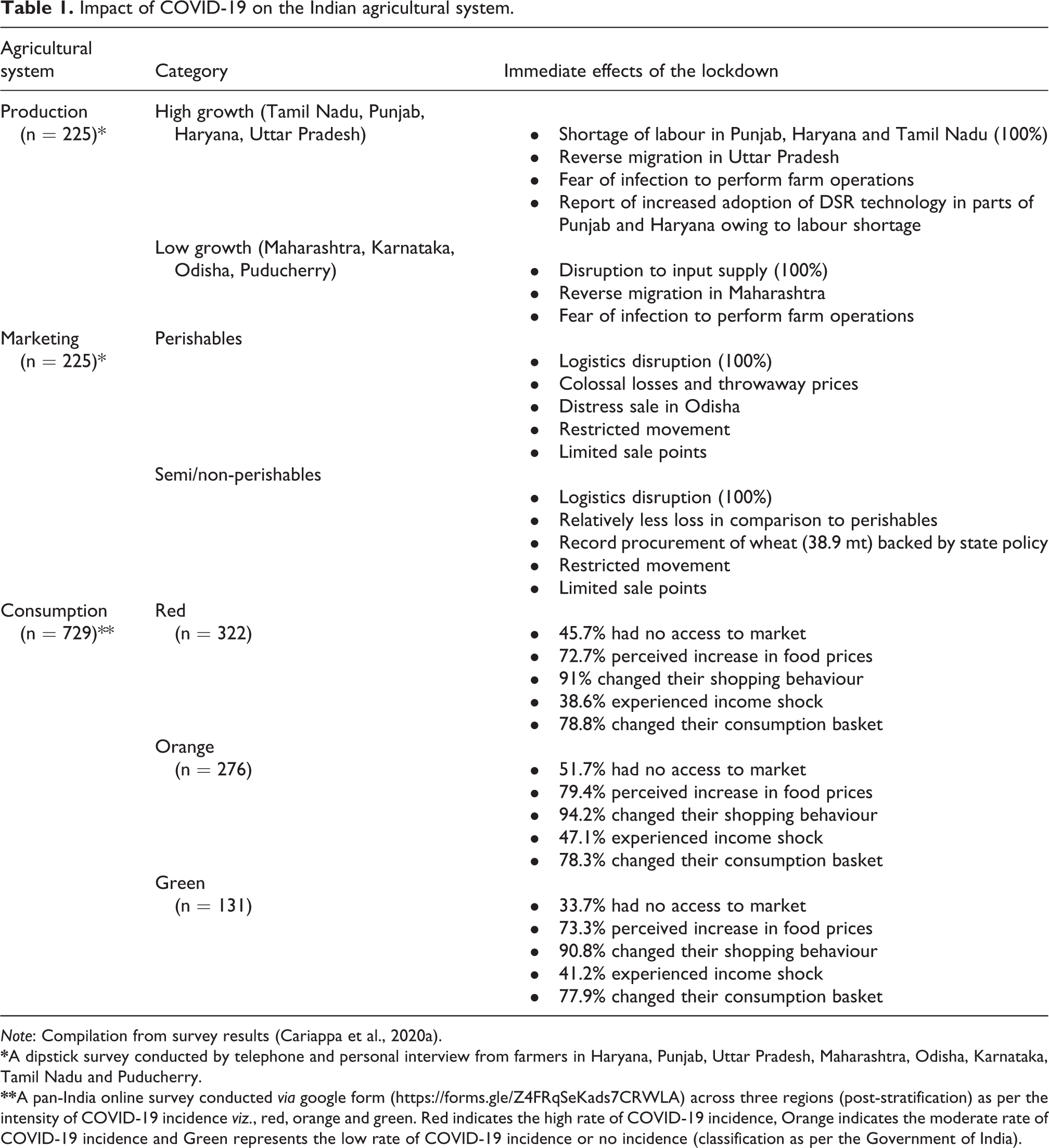
Note: Compilation from survey results (Cariappa et al., 2020a).
Survey results indicated that three-fourths of the consumers reported a price rise in food commodities during the lockdown (Table 1) (for more details see Cariappa et al., 2020a). The concern is that the skyrocketing prices might lead to social unrest (Bellemare, 2015); however, the Government of India has managed the situation deftly with timely market reforms and social safety nets for the poor, migrants and farmers. Looking at the scale of COVID-19 spread and the panic created, food prices were quite resilient (except for vegetables). Resilience of the sector might be partly due to timely short term policy support (Varshney et al., 2020) and therefore we are nowhere near a price spike yet (Barrett, 2020).
COVID-19 induced lockdown in India disrupted food markets which forced consumers to alter their consumption patterns. Consumers prioritized what they wanted and what they really needed. Various surveys report that individuals lost their jobs or their income decreased during lockdown (Arun, 2020; Cariappa et al., 2020a; Imbert, 2020; Ray, 2020). The lockdown coupled with sudden negative income shock posed serious concerns about food and nutrition security in India. In a survey of 2259 migrant youth, 32% reduced their daily food intake (Imbert, 2020). Consumers changed their behaviour patterns by reducing consumption of non-essentials, reduced market visits, stocking and consumption behaviour changed equally across intensity of incidence viz., green, orange and red (Cariappa et al., 2020a).
10-point strategy to strengthen the agricultural sector post COVID-19
Our aforementioned discussion on the impact of COVID-19 on the Indian agricultural system enabled us to arrive at a 10-point strategy for strengthening the sector against the crisis and sustainability issues (Workie et al., 2020) posed by the pandemic (Figure 1).
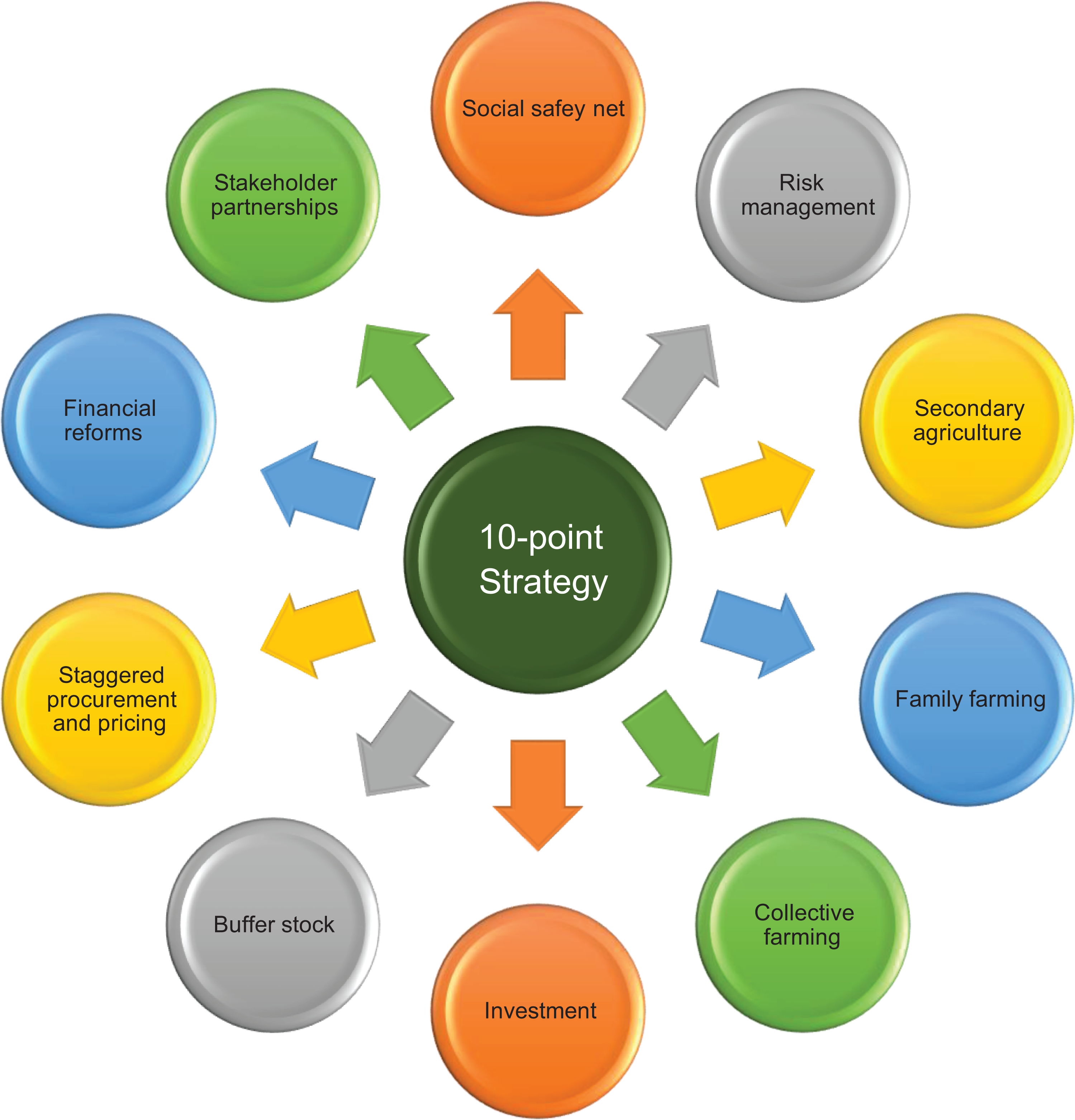
10-point strategy to strengthen the agricultural sector post COVID-19.
Social safety nets
The imminent shut down stopped production leading to job and income loss and demand recession. The pandemic also led to food loss and wastages that affected the food and nutrition security especially of the vulnerable sector, though briefly, and can have lifelong impacts on capabilities. The government and private interventions should warrant managing the food loss and waste, reviving the demand and food intake. To manage the food waste at household level, implementation of good food management practices like preparation of shopping lists and planning the course of meals are advocated (Principato et al., 2020). India’s employment guarantee scheme – Mahatma Gandhi National Rural Employment Guarantee Act (MGNREGA) could employ migrants who have come back to their own villages and direct transfers could put cash into the hands of poor who do not have access to MGNREGA. Government expenditures should thus be towards increased funding for MGNREGA (employment), PM-KISAN (cash transfer to farmers under the Prime Minister-Farmer Honour Fund) and PDS (offering nutri-rich foods through public distribution system). Alternatively, distribution of ‘food coupons’ or ‘combo packs’ comprising a basket of goods especially biofortified foods like zinc and iron rich cereals and millet will facilitate the nation towards the pathway in ensuring nutrition security (Sendhil et al., 2020b).
Price and revenue risk management
COVID-19 had less or negligible effect on food prices (except for vegetables). However, food prices are plagued by high volatility which translates into price risk to farmers. The Government should consider setting up a price stabilization fund to insulate farmers from the price risk. Further, crop insurance in India generally covers only the yield risk; COVID-19 has presented the government an opportunity to transform the crop insurance scheme which covers the revenue (yield and price) risk of farmers (Cariappa et al., 2020b). Alternatively, farmers and consumers can avail the benefits of futures trading to buy/sell the standardized commodity contracts at a pre-decided price for delivery in the future (Sendhil et al., 2013). To meet the contract size set by the commodity exchanges, Farmer Producer Companies (FPCs) can transform themselves into aggregators.
Shifting the focus from primary to secondary agriculture
COVID-19 induced lockdown has disrupted agricultural labour markets that witnessed huge reverse migration. A survey reports that 45% of the migrants returned home during lockdown (Imbert, 2020). Structural weakness in the system should be addressed to enable recognition of farming as an enterprise. Processes which add value to primary agricultural production systems and enterprises which source raw materials from crop residues, by-products and waste from primary agriculture should be promoted (Dey, 2019). For instance, cotton stalks have a wider and untapped scope for use as soft and hard boards, paper and pulp manufacture (Chengappa, 2013). Accelerating research on high-end secondary agriculture products is urgently needed. Development of fruit-based ice cream, converting bamboo or wood waste to fancy decoration, preparation of sweets from bovine milk, use of natural fibres and culled potato to prepare bio-plastics, pectin extraction from fruit peeled wastes and bio-ethanol production are some examples. 10 Further, innovations in the post-harvest technologies of medicinal and aromatic plants which supply raw materials to herbal medicines, pharmaceuticals, cosmetics, and food flavour industries could increase export potential and create employment (Chengappa, 2013).
Family farming
In strategizing to strengthen the agricultural sector, we must pay attention to the concept of sustainability. Nothing comes closer as family farming to the exemplar of sustainable food production (FAO and IFAD, 2019). Family farmers not only produce food; they save biodiversity, produce nutritious and local foods, develop new strategies and develop innovations to tackle social, economic and environmental challenges (FAO and IFAD, 2019). FAO suggests affirmative policies to support family farmers as a solution to the unsatisfactory world food system in which one-third of the food produced goes to waste.
Collective farming
Crop farmers should heed the successful cases like dairy cooperatives to increase productivity and profits. Unlike cereals, pulses and vegetables, milk prices were not affected by the lockdown (Cariappa et al., 2020a). The procurement, processing, and distribution network of dairy cooperatives resisted the exogenous shock. Crop farmers should come together either as cooperatives or farmer producer organizations (FPOs) or farmer producer companies (FPCs) and work in the network of the international food system. Through aggregation (of inputs used and output produced), economies of scale can be ensured. Nudging by the union government on the principles of cooperative federalism (as done for Goods and Services Tax) is required for land reforms and contract farming. These steps together will have the potential to overcome challenges of production and marketing risks of the farmers.
Investment in agricultural research and development
The estimated annual growth (in real terms) from 2014–15 to 2018–19 in agriculture and allied sectors was 2.9% (Government of India, 2020a). While the Indian economy contracted by 23.9% in the first quarter of 2020–21, agriculture was the only sector to register a positive growth of 3.4% (ET, 2020). It is time to realize that agriculture sector could keep the growth engine sputtering when other sectors fail to rise to the occasion despite the farmers facing enormous amount of production and marketing risks even during normal times. Undoubtedly, inclusion of the private sector increases the investment flow as well as efficiency in functioning of the system. Private and government investments in agricultural research and development, insurance, finance, mechanization, cold storage, logistics, automation, digital procurement and distribution (e-marketing) should be taken up as a priority.
Buffer stock
Monetizing the excess stock in the buffer could be a potential source of revenue for the union government. The stock held by the Food Corporation of India has in store more than double the buffer stock norms and is worth at least ₹1,50,000 crore (US$205 billion) (Gulati, 2020). Monetizing the surplus besides revenues, may also reduce huge maintenance and logistics costs. This amount could be invested in promoting rural agriculture enterprises or capacity building, drought proofing, etc. Again, to reduce wastage through scientific storage is urgently needed.
Staggered procurement and pricing
During pandemic situations which disrupt logistics, markets, storages, etc. the government can opt for a staggered procurement and pricing strategy which accounts for the threshold level in cost of storage (Sendhil et al., 2020a) especially for staples like rice and wheat produced and consumed by millions. This would also encourage farmers to store the commodities at farm level, providing storage is available, against distress selling.
Reforms in agricultural finance
Access to cheap loans has to be enabled, especially for small and marginal land holders to revive the sector. Restructuring agricultural loans and repayment schedules, withholding the declaration of long-term loans as non-performing asset (NPA), interest subvention on availed loans during the moratorium period etc. should be implemented to safeguard the livelihoods and welfare of the poor.
Stakeholder partnerships
Concerted efforts and inter-institutional partnership (regional as well as global) are inevitable (Baudron and Liegeois, 2020) as envisaged in the Sustainable Development Goal 17 to strengthen the weaker and vulnerable sections of the society. Stakeholder partnerships help to bridge the information and knowledge gaps by creating awareness, leveraging Information and Communication Technologies (ICTs) including social media platforms. The idea here is to educate people not to opt for panic buying and hoarding essential items, to maintain hygiene of market functionaries, and to sanitize market yards in addition to social distancing which are essential for smooth functioning of the markets in lieu of COVID-19 crisis (Workie et al., 2020).
Conclusions
The pandemic led crisis has wreaked havoc on both the Indian and global agricultural system. A global food security crisis is in potentially looming that cannot be countered without understanding the impacts of COVID-19 on the agricultural system, especially of the developing countries. A host of food exporting nations viz., Kazakhstan, Myanmar, Russia and Vietnam have imposed cereal trade restrictions like bans, quotas and licensing (GTA, 2020) which are distorting the global food supply. Disruptions in supply and/or value chains leads to food wastage unleashing volatility in prices and having implications to food and nutritional security. For instance, Bangladesh witnessed a significant level of food wastage in perishables like milk and vegetables, and reduced consumption of non-vegetarian items like poultry products and fish – a major source of protein – owing to misinformation concerning the spread of COVID-19 (Termeer et al., 2020a). India too has witnessed a steep reduction in consumption of poultry meat for some time due to the same reason causing enormous income loss to poultry farmers. The poverty rate has increased by 9% during the lockdown period in Ethiopia, and a survey of 3107 households revealed income loss for 38% of casual labourers while 90% reported food affordability as a major concern (de Roo and de Boef, 2020). Kenya witnessed around 15% fall in crop productivity owing to disruption in extension services and increased demand for vegetables and staples due to stockpiling. The poverty rate in Kenya is likely to rise by 13% point with an estimated 3 to 3.5 million slipping from food security in the near future (Termeer et al., 2020b). Impacts of COVID-19 in Mali are abysmal. Around 70% of the households surveyed (n = 1766) reported hunger with 25 to 28% not able to buy the basic food items despite the average consumer prices remaining relatively stable (de Roo et al., 2020).
Initial investigation in India shows that restriction on movement, transportation problems and reverse labour migration have disrupted domestic supply chains which ultimately contributed to rises in wholesale and retail prices of a few commodities like pulses, wheat flour, milk and vegetables. Although buffer stock of food grains and harvest from previous crops restricted any immediate fallout but was not sufficient when three-fourths of the consumers reported price hikes in the essential commodities. India – as per the Nomura Food Vulnerability Index (ranked 44) – has been placed as less vulnerable to large price swings than its neighbouring countries like Bangladesh (12), Philippines (23), Pakistan (32) and Hong Kong (42) (Subbaraman and Loo, 2020). Trade distortions in major rice exporters like Thailand and Vietnam increased prices in global markets adversely impacting African countries relying largely on food imports (Sers and Mughal, 2020). Although India has emerged as self-sufficient and a net exporter of food in recent years, the pandemic led chain of events has variously affected the domestic agricultural systems specifically production, marketing and consumption. Provinces with high economic or agricultural growth faced labour migration and shortage of labour, while states with low growth faced disruption in input supply and risk of infection through exposure to various operations. Due to logistic disruption and limited sale points, distress sale was observed for the marketing of perishable commodities, especially in states with less resources like Odisha. In the case of non-perishable commodities, although the loss was less compared to the perishables, there was a decline in sales. On the consumption front, the effect of the pandemic on consumer behaviour seems more or less similar across three regions of COVID-19 incidence viz., red, green and orange. No access to markets has been reported by 45.7%, 51.7% and 33.7% of the consumers across red, orange and green zone, respectively while 72.7%, 79.4% and 73.3% perceived an increase in food prices. More than 90% of consumers across all the regions have changed their shopping behaviour. As the pandemic continues to threaten the global food system, the role of state becomes much more pertinent. In order to protect and safeguard the livelihoods of millions of people associated with the agricultural system, the state should increase spending on social safety nets immediately and take up other short and medium term strategies. Raising revenue by offloading excess buffer stock and increased credit to the agriculture sector should be the top priority for post-pandemic economy restoration.
Footnotes
Acknowledgements
The authors duly thank the respondents (consumers and producers) for sparing time and responding to the survey. The authors are grateful to the Chief Editor and anonymous referee for their useful comments and suggestions in improving the quality of the manuscript. We also acknowledge the editorial help rendered by the FolioTS (Puducherry).
Authors’ note
Views expressed here are personal and not of the respective organization.
Declaration of conflicting interests
The author(s) declared no potential conflicts of interest with respect to the research, authorship, and/or publication of this article.
Funding
The author(s) received no financial support for the research, authorship, and/or publication of this article.
