



Abstract
To improve productivity, several improved high-yielding sweetpotato varieties have been developed and released by breeders. However, most farmers still grow low-yielding landraces known also as farmers’ varieties. Farmers choose varieties to grow based on their preference for the attributes (traits) embodied in those varieties. Past studies have examined drivers of trait preference using neoclassical economic theory. This study departs from previous ones by applying principles from economic psychology to assess preference for, and prioritization, of sweetpotato traits among male and female sweetpotato farmers. Data used was data collected using focus group discussions and laddering, an in-depth personal interview process, and analysed using descriptive and means-end chain analyses. The study identifies mental constructs associated with farmers’ trait preference and prioritization, namely: the characteristics farmers mentally associate with the prioritized traits, the benefits those traits confer, and the life goals (i.e. values) they enable farmers to attain. Focus group discussions revealed that, among agronomic traits, high root yield is the most preferred/prioritized trait across gender categories and was followed by stress tolerance and underground root storage longevity. The most preferred quality traits across gender groups are root size and mealiness. Women, however, prioritized early maturity over men. The means-end-chain analysis identified several mental constructs farmers mentally associated with trait prioritization. They are increased sales, more income, food security, savings, and investment. These benefits are linked to various life goals (values) farmers aspire for namely, respect, security, achievement, and happiness. These findings imply that farmers’ choice of sweetpotato varieties to grow is driven by the agronomic and quality traits the varieties embody. The findings further imply that psychosocial factors underpin trait preference and prioritization by farmers.
Introduction
Sweetpotato (Ipomoea batatas L), a starchy tuberous crop from the family Convolvulaceae, is a major food staple in many developing countries. On a worldwide scale, it is second in importance to the cereal staples, namely wheat, maize, and rice, in economic importance (Odondo et al., 2014). It is an important food security crop in many sub-Saharan African countries, and a major famine and disaster/emergence response crop due to its short maturity, drought tolerance, and ability to grow on marginal lands (Heck et al., 2020; Mukhopadhyay et al., 2011). Improved biofortified varieties which are enriched with Vitamin A are effective for combating vitamin A deficiency, a major public health problem in developing countries (Juma Okello et al., 2018). Sweetpotato can also be used to address some of the long-term concerns about building ‘micronutrient resiliency’ among food and nutrition-insecure populations in expectation of future pandemics or other crises and in fragile environments characterized by protracted climate-change-induced shocks (Heck et al., 2020).
Uganda is currently the fifth largest sweetpotato producer after China, Nigeria, Tanzania, and Indonesia. However, Uganda's sweetpotato productivity has been constrained by several biotic and abiotic factors. Key among the biotic factors is the sweetpotato virus disease (SPVD) which can cause up to 98% yield loss (Namanda et al., 2019). Thus sweetpotato breeding programs efforts in Uganda have focused on developing varieties resistant to SPVD (Yada et al., 2013). These efforts have resulted in the release of several sweetpotato varieties with moderate to high levels of field resistance to SPVD (Mwanga et al., 2002). Specifically, Uganda's sweetpotato breeding programs had by 2019 released 19 moderately to highly resistant SPVD varieties, eight of them orange-fleshed sweetpotato (OFSP) varieties. The OFSP varietieshave been bred to combat vitamin A deficiency, a major public health problem in Uganda and other developing countries (Low et al., 2017).
Despite the large number of released improved varieties, most sweetpotato farmers continue to grow local landraces, also known as farmers’ varieties. Zawedde et al. (2014) argued that Uganda has one of the largest number of farmer varieties in the world, making it a secondary centre of sweetpotato diversity. Indeed, Yada et al. (2013) collected more than 1300 varieties of sweetpotato from farmers across Uganda. Most farmers tend to prefer these local varieties to the improved ones and, hence continue to grow them despite their inferior performance/yield in the presence of SPVD.
Farmers’ decision to grow improved varieties depends on the advantages (or benefits) such varieties offer over their local counterparts (Mwiti et al., 2020). Most farmers will therefore choose to grow a new variety if it has a preferred set or combination of desired traits or offers greater benefits than other existing varieties (Acheampong, 2015). However, this line of argument stems from neoclassical economic theory which has been the dominant theory used to examine the drivers of choice of crop varietal traits (Acevedo et al., 2020; Mulwa et al., 2023; Sanya et al., 2020; Thiele et al., 2021). The theory is premised on the assumption that choice actors (i.e. farmers in our case) have perfect information of the choice environment and are rational in their decision-making process. New institutional economics (NIE) theory however argues that this assumption grossly simplifies decision making (Urbina and Ruiz-Villaverde, 2019). NIE specifically rejects the rationality assumption (Hodgson, 2007). Our study departs from reliance on neoclassical economic analysis and instead applies principles from economic psychology to examine drivers of farmer preference for specific crop varietal traits and trait prioritization by farmers. More specifically, this study addressed the following research questions using theories of economic psychology: (i) What are psychosocial factors driving farmer preference for and ranking of specific sweetpotato traits? and (ii) Are there differences in these psychosocial factors between women and men farmers?
Recent studies have shown that women and men have different preferences for varietal traits. Ssali et al. (2023) found that women have a strong preference for sweetpotato quality traits such as mealiness, sweetness, and firmness. Mulwa et al. (2023) similarly found that women prefer sweetpotato quality traits namely taste, high dry matter, and vitamin A, while men preferred agronomic traits including yield and early maturity. Mudege et al. (2021), on the other hand, find, in the case of potatoes, that women preferred taste and tuber size. We therefore assess differences in psychosocial factors by gender in this study. Moreover, extant studies suggest that women and men farmers make decisions, including crop varietal choices that are intersected by complex social factors (Weltziem et al., 2019). Ojwang et al. (2023) also showed that certain crop varietal traits can be harmful to women. Polar et al. (2021) suggested that trait choices can empower women while Tavenner and Crane (2019) recommend the need for intersectional analysis in gender research.
The literature also highlights the role of gender in the technology use/adoption decision-making process (Ojwang et al., 2023; Polar et al., 2021; Tufa et al., 2022; Weltziem et al., 2019). These studies specifically highlight the importance that gender plays in the selection of the varieties grown and the impact some crop varieties can have on women and men farmers. According to this literature, focusing on the variety alone can mask many aspects that can be harmful or beneficial to farmers. This is because a variety embodies many traits, some with a positive impact on gender, others negative. Take for instance yield. Crop breeders hold yield dearly in the breeding programme. This trait is what, to the breeder, holds the key to a food-secure world. But when closely examined with a gender lens, yield can be harmful to women when the boost in productivity increases market participation and wrestles control of the crop from women to men who tend to control revenues from crop sales (Galiè et al., 2019; Osanya et al., 2020). Early maturity, another key varietal trait in breeding programmes targeting arid and semi-arid tropics, can also have harmful effects on women (Ojwang et al., 2023). This occurs when, owing to high prices in the market early in the harvest season, the early maturing variety shifts production orientation to selling the crop, at high prices. The high returns from such sales are likely to attract men's takeover of the crop (Dolan, 2001). This has led some authors to equate varietal and trait choices to women's empowerment (Polar et al., 2021; Tufa et al., 2022). Traits can be empowering to women if the choices made foster women's control of resources and income. However, this requires that the release of varieties embodying the traits that are likely to harm a particular gender is accompanied by strategies that abate such harm (Ojwang et al., 2023).
Past studies further highlight the effect of the complex environment/space within which women and men farmers make varietal choice decisions (Krishna and Veettil, 2022). Within such environment several social, environmental, and economic factors intersect making choices very complex. Weltziem et al. (2019), for instance, indicated that the intersection of multiple social characteristics has a strong influence on variety selection by farmers. Polar et al. (2021) argued that poor adoption of new crop varieties is partly caused by the fact that gender differences in trait preferences tend to compare men and women without paying attention to intersectional characteristics. Tavenner and Crane (2019), therefore, strongly recommend that gender power relations in farming warrant close consideration of intersectionality in gender analysis. In this study, we therefore examine how motivations for varietal traits preferences, and ranking, differ for men and women. We further analyse what explains these differences from an economic psychology point of view.
This study applies the means-end-chain (MEC) theory based on economic psychology in assessing motivations behind farmers’ preference for and ranking/prioritization of most desired sweetpotato traits and delves into gender differences discussed above. The MEC analysis has been used widely in marketing and was first applied in agriculture by Lagerkvist et al. (2012). Okello et al. (2019) have also applied the theory in agriculture. They used it to examine the drivers to of the decision to purchase improved potato varieties. Our study builds on their work by assessing the choice/preference for specific traits embodied in sweetpotato varieties while abstracting from focusing on specific varieties to overcome the problem of attachment bias.
The study focuses on sweetpotato farmers in the Central region of Uganda, one of the main sweetpotato producing regions, but also one that has the greatest prevalence of SPVD. Sweetpotato is a major food staple in the region, hence sensory characteristics are important to farmers. Therefore, farmers in the region have to select varieties that embody the traits most desired and can perform well under virus pressure. So, what varietal traits do they prefer and rank highly in the choice of a variety to grow? And, what drives the preferences and ranking? We turn to these questions after describing the methods used below.
Materials and methods
Theoretical framework: MEC analysis
This study uses economic psychology to investigate farmer motivations for the choice of sweetpotato variety to plant. A farmer, in the selection of a variety, is likely to be driven by the services it offers (Mwiti et al., 2020). In our context, these services are equivalent to the bundle of traits embodied in a variety. Breeders refer to this bundle of traits as the target product profile (Tiwari et al., 2023). We specifically use the MEC theory to examine the drivers of the combination of traits that are given the highest priority by the farmer when deciding what variety to plant. The theory was developed by Gutman (1997) and Olson and Reynolds (2001) and has been used widely in the fields of marketing and psychology to study factors influencing choice or decision-making by consumers (Santosa and Guinard, 2011). MEC theory basically explains how the characteristics of a product/technology (known as attributes) are mentally associated with its benefits (usually known as consequences), and ultimately with the personal goals (i.e. values) that drive the decision to use the technology. It's first application in agriculture was by Lagerkvist et al. (2012) who used it to study mental models associated with the decision to use pesticides in control of diseases by kale producers.
The generic MEC theory posits that perceived self-relevant product attributes (A) are associated, in an individual's mind, with consequences (C) which are, in turn, driven by certain personal values (V) an individual aspires to fulfil in life. Attributes relate to the recognizable product features or characteristics and are usually at the base of the MEC analytical hierarchy. Attributes can also define the characteristics of the technology of interest (Urrea-Hernandez et al., 2016). In the context of this study, attributes describe specific traits embodied in sweetpotato varieties, and that the farmers regard as a must-have in a variety to be planted.
Each attribute is normally associated with one or several consequences in the MEC hierarchy. Consequences are the desired outcomes that an individual wants in a technology/variety, and can be direct, indirect, physiological, psychological, or sociological in nature (Gutman, 1997). In the context of this study, consequences can include increased yield, increased revenues from sales, and increased profits. This formulation is a major departure from the neoclassical economics approach which treats profit maximization as the ultimate goal economic actors strive for in making farming decisions.
Values are the end states of the MEC hierarchy and are the cognitive representations of an individual's existential goals. They are the needs/desires/aspirations that motivate the decisions and actions taken by an individual. Values represent the personal standards that guide an individual's decisions and actions. According to Gutman (1997) values that ultimately motivate individual behaviour or decision to consume a product or adopt a technology include happiness, healthiness, security, peace, and sense of belonging. Values however can be context-specific and may depend on the product or technology under consideration.
The attributes, consequences, and values form the mental constructs, also referred to as mental models because they are the meaning representations of hidden/latent mental concepts about technology or activity (Lagerkvist et al., 2012; Urrea-Harnandez et al., 2016). The attribute–consequence–value (A-C-V) sequence forms a chain (also known as a ladder) that represents the relationship between an attribute of technology (i.e. the trait) and a core/personal value(s) in an individual's mind. A collection of all the ladders for a given case forms a hierarchical value map (HVM) that illustrates all the major means-end, and the A-C-V connections. The HVM describes individuals’ perceptions, subconscious thoughts, and behaviour based on their core/personal values. The ordering of attributes, consequences, and values in the HVM provides the structure of mental models or the motivational structure underpinning decisions.
Empirical methods
Data sources and sampling techniques
This study used qualitative and quantitative data collected from sweetpotato growers in Mpigi district of Central Uganda. Data was collected in December 2019 using focus group discussions (FGDs) and laddering. FGDs followed a guide with a checklist of discussion questions and were differentiated by gender. That is, the women and men interviewed were separated. A semi-structured questionnaire was used in the collection of basic quantitative data including demographics and household-specific information, and varietal trait scores/ranks. Trait ranking was done by voting. At the end of each FGD, one male and one female farmer were randomly selected to participate in the laddering interviews. The FGDs and the laddering activities were done sequentially, with the former providing the list of traits that fed into the latter.
Sampling was done in three stages using a multistage sampling technique. First, the study area, that is, Mpigi district in the Central region of Uganda was purposively selected. The district has hosted several on-farm varietal adaptive trials in the past, including varieties bred for virus resistance.
Second, using the probability proportionate to size sampling method, 24 parishes from eight sub-counties of Mpigi district were selected. Third, 27 villages were selected from the 24 parishes using systematic random sampling and probability proportional to size sampling. Two FGDs were held in each village, one for men only, and the other for women only. Each FGD was comprised of approximately eight participants. The participants included young and older, small and medium-scale, and subsistence and market/commercial-oriented sweetpotato farmers. A total of 27 female FGDs and 23 male FGDs were conducted. Male FGDs in four of the selected villages failed to take place because of logistical and mobilization challenges (such as failure to meet the required group composition). A total of 37 laddering interviews were conducted. The interviews and discussions were conducted in the local language (Luganda) by a trained research assistant and one of the co-authors.
Data collection and analysis
Varietal trait elicitation and ranking
FGDs were conducted to identify score/rank key sweetpotato traits most preferred by farmers. The Nominal Group Technique (Delbecq et al., 1975) was used to elicit traits. Following this technique, FGDs were implemented in four major steps: namely, silent generation, round robin, clarification, and ranking. Under the silent generation stage, each participant was first asked to fill out forms that capture his/her personal information. Next, using the question: ‘Which sweetpotato traits are important to you? Please list them’, each participant was asked to record all preferred sweetpotato traits without discussing with others. Farmers who were illiterate were assistant by a research assistant to complete the exercise.
In the round-robin stage, male and female farmers in respective groups were asked to list, one at a time, all their pre-listed preferred traits until all traits were exhausted. They were also encouraged to add any other traits missed. The traits generated during the round-robin phase were recorded on a flipchart for all participants to observe.
During the clarification stage, the research assistant interrogated the understanding of each listed trait to ensure that all participants had the same understanding of each trait, for informed ranking/prioritization. The trait list was revised, and those with the same meaning were grouped together, and duplicates were removed. The research assistant ensured that the amalgamation of similar traits was by group consensus (Delbecq et al., 1975). The outcome of this stage was a concise list of farmer-preferred sweetpotato traits used in participant ranking.
Finally, in the ranking stage, participants were asked to select and then rank, by voting, their top five most preferred traits from the universe of traits on the flipchart. They were urged to consider all aspects of each trait (including the benefit and consequences it confers) in deciding its rank relative to others. To aid the voting process, each participant was given five dry bean grains. Hence, each individual voted on their preferred traits. In this exercise, the more beans were awarded to a trait, the higher the preference for the trait, and vice versa. Once voting was complete, the total bean grains allocated to each trait were counted, and five traits with the greatest number of beans were selected. Ranks were then awarded based on the total bean count, with rank 1 (most preferred/prioritized) given to the trait with the highest bean count, rank 2, the second highest in bean count, and so on, up to rank 5.
Descriptive analysis
This study used STATA 13 to run the descriptive analysis used to generate summary statistics (including the mean, minimum, maximum, and standard deviation) of FGD participants. MS-Excel spreadsheets were used to record the votes allocated to the different traits. Data on group-based scores were used to generate gender-disaggregated statistics relating to each trait. The average score of each trait across all groups in each gender category was calculated using simple statistical means. Table 1 describes the data and variables collected.
Definition of sweetpotato traits identified by study participants.

Included nutrition and health benefits/beta normalcarotene content/vitamin A content (flesh colour is orange).
Included high dry matter/hard root texture/ hardness after boiling.
Laddering technique
Laddering is one of the most widely used techniques for uncovering the mental constructs and goals/values people associate a product or technology with (Kilwinger, 2020). The technique has its roots in the personal construct theory developed by Kelly (1955). It has been extensively used in studies that attempt to delve into the sub-conscious world of an individual's mind (Veludo-de-Oliveira et al., 2006; Nunkoo and Ramkissoon, 2009).
Both hard and soft laddering interview techniques were used in this study. The former entails intervening during the interview to seek clarifications about the constructs identified by the respondent. The latter, on the other hand, allows the respondent to spell out the mental constructs uninterrupted (Lagerkvist et al., 2012).
In the context of our study, a variety of characteristics/attributes represent the various traits pursued by the breeding program. We focused on the traits identified by the respondent as the most desirable/preferred traits. Following Reynolds and Gutman (1988), we then used the laddering technique to generate consequences and values associated with each trait. The laddering technique uses simple ‘why is that important to you’ questions to delve into the subconscious mind of the respondent and unearth/surface the deep-seated/real reasons (also known as mental constructs) decisions they make.
The interview commenced with the following statement: ‘We noticed that you selected trait [xx] as the most important sweetpotato trait you rely on to decide which variety of sweetpotato to plant. Why is trait [xx] important to you?’
For each of the top three 1 (highest) ranked varietal traits, the interviewer started the laddering by initially asking: ‘Why is it important to you that you should have [… name of trait identified…] in the sweetpotato variety you choose to plant?’ Subsequent series of ‘why is that important to you’ were used to elicit responses until all the constructs related to the selected traits were exhausted. This method of interview has the advantage of ‘inducing’ respondents to dig into the subconscious mind and retrieve the constructs associated with motivations driving actual actions or decisions, and the associations among identified constructs in the respondent's mind (i.e. mental maps of the constructs).
After the interviews, a set of summary codes were developed using content analysis while ensuring that all the attributes, consequences, and values mentioned by the respondents were covered. The personal values identified by the respondents were sorted according to Reynolds and Gutman's (1988) classification. The coded data was entered in and analysed using LadderUX software which aggregates the individual ladders into a hierarchical value map. In order to assess differences in the motivational structure for male and female respondents, HVMs were generated for men and women respondents separately, in addition to one that combined (aggregated) the two groups.
Results
Characteristics of study participants
Table 2 shows that a total of 142 men and 144 women participated in the FGDs. The ages of the participants ranged from 19 to 95 years. Female participants were, on average, older (46 years) than their male counterparts (44 years).
Descriptive statistics of characteristics of focus group discussion (FGD) participants based on sex.

Significant at 5% level (p < 0.05).
Significant at 1% level (p < 0.01).
The average years of formal education for male and female FGD participants were 8 and 7 years, respectively. There was a significant difference (p < 0.05) between male and female participants with respect to years of formal education. Further, the results show that both female and female FGD participants had been growing sweetpotato, on average, for 18 years.
Overall, 83% of the respondents owned the land they used. The proportion of female and male participants who owned their farmlands was 85% and 82%, respectively. The male farmers owned larger farmlands (3.18 acres) than the female (2.31 acres). The average area under sweetpotato during the season preceding the survey was larger for male (0.60 acres) than female (0.46 acres) farmers. In addition, male farmers produced, on average volume of sweetpotato (5.2 bags) per season than the females (3.8 bags).
Sweetpotato traits ranking
Table 3 presents trait ranking by farmers for the 18 traits identified as the most preferred sweetpotato traits by the different discussion groups. Based on the average vote scores of each trait, the three highest-ranked traits by men, in order of importance were root yield, root size, and stress tolerance (drought and soil fertility). Mealiness, a key consumer trait, was ranked fifth. For women, the top three traits were root yield, mealiness, and early maturity. Overall, the top three preferred sweetpotato traits across genders were root yield, root size, and stress tolerance. There was a significant gender difference in the scores awarded to root size (p < 0.05) and stress tolerance (p < 0.1).
Average vote scores of the five most preferred sweetpotato traits, by sex.

Values followed by the same letter indicate the same level in the hierarchical order of preference by the respective gender categories. Based on the magnitude of the average values,
Significant at 10% level (p < 0.1).
Significant at 5% level (p < 0.05).
Motivations for the selection of specific traits as the most preferred
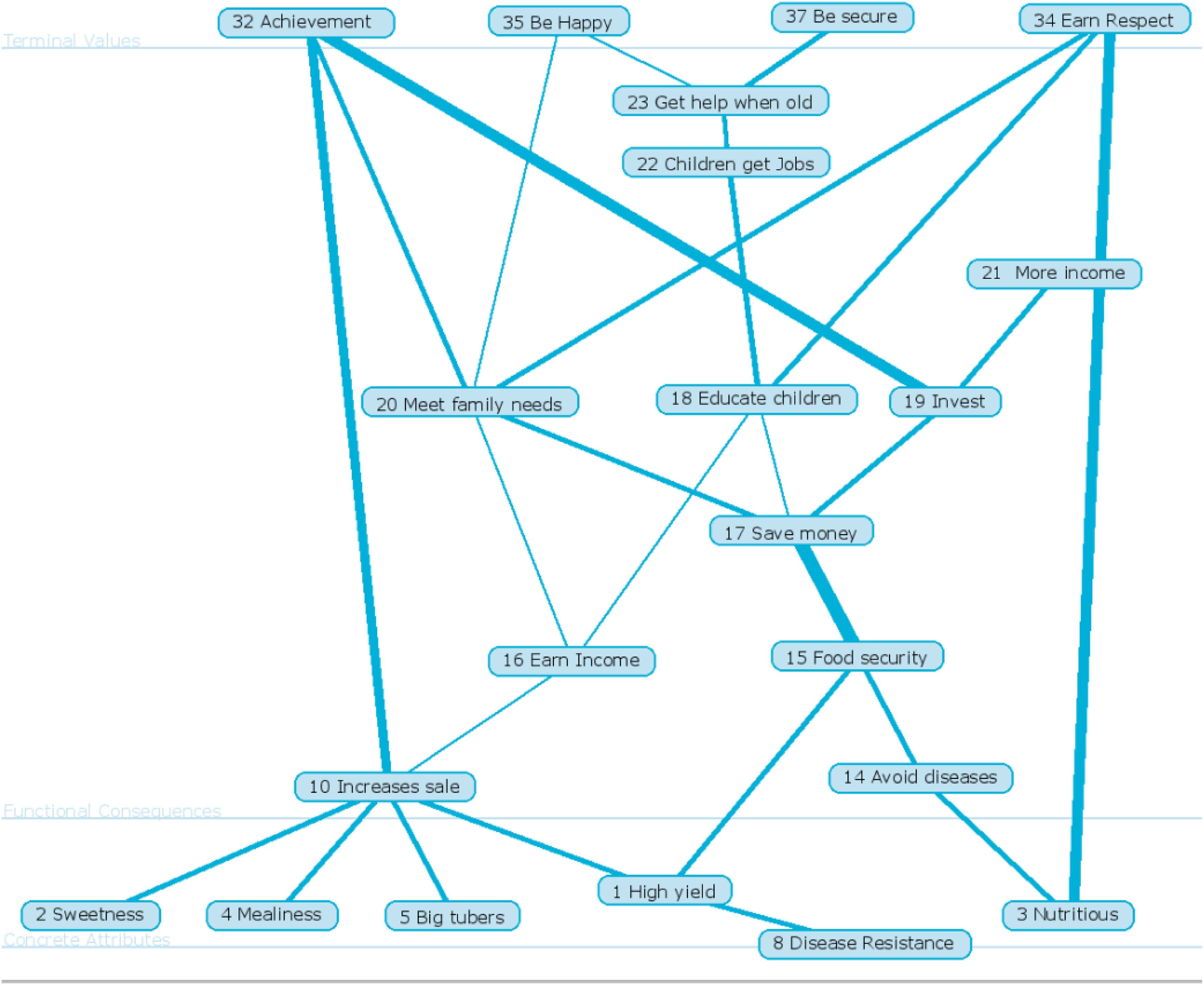
In this section, we turn to the psychosocial drivers of trait preference and prioritization in sweetpotato. Figure 1 presents the aggregate hierarchical value map combining both male and female respondents. It provides the attributes, consequences, and values women respondents associate sweetpotato traits with. Note that the size of the connecting line denotes the strength of the association between the constructs.
Aggregate hierarchical value map (HVM) of male and female farmers.
The figure shows that the characteristics (traits) most preferred by the farmers, in general, can be grouped into agronomic (big roots, high yield, and disease resistance) and quality (sweetness, mealiness, and nutrition). The laddering interviewees, however, identified two new quality traits not identified in the FGD, namely sweet and nutritious. The latter was mentioned in the context of richness in vitamin A.
The agronomic and quality traits are associated with five key benefits, that is, consequences, namely increased sales, food security, saving money, investing, and more income. An interesting observation in Figure 1 is that both male and female farmers mentally associated quality traits/attributes (sweetness and mealiness) with increased sales.
Overall, the benefits study respondents mentally linked to most desired sweetpotato traits are increased sales, avoiding diseases, earning income, meeting family needs, food security, saving money, investing, educating children, children getting jobs, get help when old. These benefits were ultimately linked to four values (life goals): achievement, happiness, be secure, and earning respect.
Figure 2 presents the HVM for male respondents only. It shows that male respondents identified three traits only namely big roots, disease resistance, and yield. These traits are similar to those identified by the FGDs. They show that men preferred agronomic traits.

Hierarchical value map for male farmers.
As in the combined/aggregated HVM case, disease resistance and yield are mentally associated with several consequences: ‘food security’, ‘saving money’, and ‘educating children’. These consequences are, in turn, ultimately mentally associated with ‘happiness’ as a life goal (value). Note also the very strong mental link (as shown by the thickness of the connecting lines) between ‘food security’ and ‘be happy’; ‘educate children’ and ‘be happy’; ‘save money’ and ‘invest’; ‘invest’ and ‘more income’.
Lastly, Figure 3 presents the HVM for female respondents. Unlike their male counterparts, the key traits driving the choice, as indicated by the size of the lines, of the variety planted are the quality traits (namely nutritious and mealiness). Here, now, ‘nutritious’ is mentally associated with health (i.e. ‘avoid diseases’) which together with mealiness is strongly associated mentally with a life goal of happiness. Female participants further strongly associated educating children and saving money with happiness and a sense of achievement, respectively.

Hierarchical value map for female farmers.
Discussion
These findings of the descriptive analysis characterizing the respondents show, with respect to education, that most farmers had a basic/primary level of education. Level of education affects the varietal preferences which are in turn reflected by the kind of varieties farmers choose to plant (Acevedo et al., 2020; Doss and Morris, 2000). More educated farmers are likely to be more exposed to new/improved technologies and can better understand what such technologies offer (in terms of superior traits) that are different from local ones. In addition, the finding that the majority of the farmers who participated in this study had many years of experience in sweetpotato farming can have two implications. First, farming experience can result in a greater understanding of what varieties do better under local production conditions and are most preferred by the market, which is in turn determined by the bundle of traits that characterize such varieties. Secondly, experienced farmers are likely to be senior in age. Studies indicate that age is positively correlated with risk aversion (Brown et al., 2019; Gomez-Limon et al., 2003). Risk-averse farmers are less likely to adopt new varieties even when they offer certain superior traits but are more prone to failure under variable weather conditions. Mohan (2020) further found that women are more likely to have different average levels of risk aversion than their male counterparts.
Just as previous studies have found, root yield dominates other traits with more agronomic traits featuring in the top-three ranked traits (Ojwang et al., 2023; Okello et al., 2022). This trait has been used by breeders in the past to justify overemphasis on agronomic traits because it has immediate importance on food security (through availability) (Okello et al., 2022). With respect to gender, the only quality trait identified by both women and men to be of great importance was mealiness, with women ranking it third while men ranking it fifth. Mealiness is a cooking quality trait. This finding corroborates those of (Kawarazuka et al., 2023). The results found other gender differences in the prioritization of the traits. Early maturity was among the top five most preferred traits by female farmers but not for male farmers. Women tend to prefer varieties that can mature quickly (Boserup et al., 2013; Pierotti et al., 2022). Overall, men had a greater preference for market-oriented traits namely yield/production and root size, ranking them as first and second. Ojwang et al. (2023) associated these traits with negative gender impact mostly because they focus on the market which can reduce food supply in the household and create disparities resulting from control of income earned from sales.
Put together, the farmer, farm, and production characteristics indicate that many factors intersect sweetpotato farming, hence decision making. Hence, intersectional analysis of how gender interacts with other factors in influencing varietal trait choices can be beneficial. It is, however, beyond the scope of this article to delve deeper into gender and intersectionality in breeding and suggest that future research investigates this. That notwithstanding, our findings indicate that men produced more sweetpotato from higher average land size than their women counterparts. This suggests that there could still be some disparities in access to complementary production inputs between women and men participants in this study. Indeed, Makate and Mutenje (2021) find, in Malawi, that women and men don’t have equal access to key farm inputs, such as improved seeds and fertilizers that influence yields. In the context of our study, such unequal access to inputs can be in the form of disparity in access to improved sweetpotato seed/vines. Women tend to obtain vines from their local networks (McEwan et al., 2021) which tend to be of poor quality resulting in low yields. These findings however demonstrate less gender disparity in the ownership/access to land, a key production resource in sweetpotato farming.
The findings of aggregate HVM (shown in Figure 1) seem to suggest that, just as in the case of consumers, farmers’ choice of the variety to plant is driven by quality traits. Note, for instance, that of the six traits comprising the attributes, four are quality traits. This finding is yet another evidence to breeders of the importance of quality traits to breeding customers (i.e. farmers). More importantly, this finding shows that MEC analysis yields findings that corroborate those from conventional neoclassical economics theory. Additionally, as in the case of the FGDs, mealiness was identified by respondents as a major trait, further showing that the findings are ‘robust’ across the methods.
Figure 1 also indicates that both male and female farmers mentally associated ‘disease resistance’ and ‘high yield’ with ‘food security’, which is in turn mentally linked to saving money. The mental link between yield and disease resistance in this map with food security is straightforward. Both yield and disease resistance increase supply, hence availability, of food in the household. It is also interesting to note that the trait ‘nutritious’, in the aggregate HVM, is strongly linked in the minds of male and female farmers to ‘more income’ which is ultimately linked to ‘earn respect’. The very thick arrow connecting the two constructs indicates that a large number of study participants made this connection between the two traits. There is evidence to breeders that farmers attach high importance to this trait (i.e. nutritious), which is a proxy trait for the roots that are rich in vitamin A. It would further seem that participants associated the trait ‘nutritious’ (found vitamin A-rich OFSP varieties) with income-earning opportunities rather than health advantages. This finding is perhaps capturing the fact that OFSP varieties were often promoted as beneficial for both health (nutrition) and profit (income), the latter arising from high yielding ability of those varieties (Low and Thiele, 2020). It is also worth noting that, just as in the group ranking (during FGD), root yield featured among the leading agronomic traits driving the selection of variety grown by farmers.
It is further notable that ‘saving money’ in Figure 1 is linked to being able to ‘educate children’ and ‘invest’ (both of which are consequences/benefits), and ultimately to ‘be happy’, ‘be secure’, and ‘earn respect’ as life goals (i.e. human values). These mental linkages highlight the importance to farmers of paying school fees for their children's education. These findings are in line with past studies on MEC analysis (Lagerkvist et al., 2012; Okello et al., 2018). They also support the findings by Reardon et al. (2000) that parents see the education of their children as an investment with future payoffs. Figure 1 further shows that ‘increased sales’ is strongly linked to ‘achievement’ in the minds of these farmers, as is the ability to ‘invest’.
The results presented in the HVM for males only (Figure 2) capture some of the relationships in Figure 1 as would be expected because the latter group encompassed male respondents. Results in Figure 2, however, indicate that male participants were mentally driven in their choice of traits, and in the varieties to grow, by food security, money, and investing in their future (i.e. ‘be secure’). Further, the strong mental link between ‘meet family needs’ and ‘achievement’, ‘earn respect’ and ‘be happy’ suggest that male participants’ choices are strongly influenced by the desire for social recognition and self-happiness – key life goals. Specifically, the link between ‘meet family needs’ and ‘achievement’ (a life goal) strongly indicates that men select varietal traits that contribute towards them fulfilling their responsibility/obligation of meeting the needs of/providing for their families. These findings clearly indicate that there is more that goes into the farmer decision-making process regarding varietal selection than only the profit-maximization goal assumed by neoclassical economic analysis. They demonstrate that social aspects (such as societal expectations and one's satisfaction/fulfilment/happiness) are as important, if not more, as are the desire to earn income and maximize profits. Importantly, these findings indicate that breeding programs designed only with improvement on income and food security (i.e. economic objectives) as the goal fails to address these crucial social dimensions.
As in the aggregate and male HVMs, results of female HVM in Figure 3 imply that ‘high yield’ is mentally associated with ‘food security’, ‘saving money’, and a sense of ‘achievement’ by female respondents. Notably, there was no focus by female respondents on ‘invest’ and ‘more income’, clearly suggesting that female participants are less driven by these mental constructs compared to their male counterparts. Instead, they are driven in their choices by household food security, children's welfare, family health, and social recognition (i.e. respect and being seen as achievers). Apart from food security, the rest of these are constructs that usually are not part of the parameters considered in making breeding decisions.
Conclusions
This study concludes that male and female sweetpotato farmers’ preference for sweetpotato variety to grow is driven by both agronomic and quality/sensory attributes. It also concludes that there are gender differences in trait prioritization with women leaning towards (i.e. mealiness, root size, and nutrition) while men prioritizing agronomic traits (i.e. high root yield and stress tolerance underground root storage longevity). Results of the MEC analysis delve into the motivations that drive the preference and prioritization of these traits by borrowing from economic psychology. They lead us to conclude that the prioritization of varietal traits by farmers is driven by the personal life goals farmers aspire to attain. These goals include the feeling of being respected, and secure, as well as the sense of happiness and achievement – that is, social recognition. These life goals arise from, among others, the benefits farmers associate with growing sweetpotato namely, food security, increased incomes, more money, and being able to educate children and also to invest into the future.
Moreover, we conclude that the life goals (values) driving the preference for specific sweetpotato traits are not totally identical among women and men farmers, male farmers much more strongly aspire for a sense of achievement and desire to be respected while women are driven much more by the need to be happy. These findings indicate that mental constructs associated with trait preferences differ between men and women sweetpotato farmers. These findings imply the need for breeding programs to pay attention to gender and quality traits. They further imply that there are deep-seated personal life goals behind the choices farmers make and that profit-making and food security are only a means to these end goals, but not an end in themselves as neoclassical economics proposes. Breeding programs designed with only income/profit maximization and food security improvement in mind miss these crucial social dimensions.
Footnotes
Acknoweledgements
We acknowledge that we undertook this study as part of the CGIAR Research Program on Roots, Tubers, and Bananas (RTB) under the “Demand-driven Sweetpotato Breeding in Uganda” project implemented by the International Potato Center (CIP). The study was supported by the CGIAR's Excellence in Breeding Platform, the Bill and Melinda Gates Foundation through its investment (OPP1213329) awarded to the International Potato Center (SweetGAINS project), the United Kingdom's Foreign, Commonwealth & Development Office (FCDO), through Grant No. 300649 (Development and delivery of biofortified crops at scale) awarded to the International Potato Center, the United States Agency for International Development, and the Bill & Melinda Gates Foundation through its investment OPP1178942 (RTBFoods-Breeding RTB products for end-user preferences), coordinated by the French Agricultural Research Centre for International Development (CIRAD), Montpellier, France. We also acknowledge additional funding from CGIAR Trust Fund on Market Intelligence Initiative (Work Package 1) in the writing and revision of the final manuscript versions. We further acknowledge contribution of Hugo Campos, Deputy Director General, Research and Innovation at CIP in conceptualization and preparation of the project proposal.
Declaration of conflicting interests
The author(s) declared no potential conflicts of interest with respect to the research, authorship, and/or publication of this article.
Funding
The author(s) disclosed receipt of the following financial support for the research, authorship, and/or publication of this article: This work was supported by the Foreign, Commonwealth and Development Office, Bill and Melinda Gates Foundation, The CGIAR Trust Fund of Initiative on Market Intelligence (grant number 300649, OPP1213329).
