



Abstract
This paper explores the potential role of the private sector, particularly the crop protection industry, in enhancing emergency pest prevention, preparedness and response (EPPPR) in relation to invasive pests. By leveraging their position and knowledge, private companies can contribute significantly to mitigating pest-related risks, enabling sustainable responses. We outline a comprehensive framework for EPPPR, covering prevention, preparedness, early detection, emergency response and integrated pest management, and we discuss how the private sector can contribute to this framework.
We highlight the value that greater private sector involvement could bring to emergency pest prevention, preparedness and early pest detection through its on-the-ground networks and data-sharing capabilities with national plant protection organisations. Additionally, we stress the importance of robust and agile regulatory frameworks and policies for creating an enabling environment for the effective management of emergency pest outbreaks. We also emphasise the potential opportunities provided by private sector investment in research and development in driving innovation in pest management technologies.
By fostering partnerships with governments, international organisations, local communities and other stakeholders, the private sector can play a vital role in building a resilient agricultural system capable of withstanding pest challenges.
Keywords
Introduction
Globally, the spread and adaptation of invasive and migratory plant pests and pathogens pose a real and present threat to agricultural crop production, food security, and trade. In 2019, the annual economic cost of biological invasions in harming human health, nature and food systems was estimated to exceed $423 billion – a cost which has quadrupled since 1970 (Roy et al., 2023).
The threat of emergency pest outbreaks is particularly pronounced in Africa due to its diverse landscapes and numerous political boundaries. Experience from recent occurrences, like the fall armyworm (Spodoptera frugiperda) invasion and surges of species such as the desert locust (Schistocerca gregaria), underscores the need for a cohesive and coordinated approach to addressing emergent plant pest crises (Plant Health Strategy for Africa 2022–2036, 2023).
We believe that robust and coordinated management procedures must be put in place to prevent emergency pest outbreaks and mitigate their negative impacts. While the coordination and management of emergency pest outbreaks are primarily public sector responsibilities, the private sector can also play a valuable role. This aligns with the United Nations’ Sustainable Development Goal 17: Partnerships for the Goals, which encourages and promotes effective public, public–private and civil society cooperation to build on the experience and resourcing strategies of partnerships.
For the purposes of this paper, the private sector is considered with particular focus on the crop protection industry, comprising manufacturers, importers, formulators, retailers and registrants of crop protection products, as well as providers of services such as pesticide application and stewardship guidance for responsible use. The private sector is heterogeneous: enterprises can vary in their size (local, national or multinational), the number and type of products or services they provide, and whether they invest in research and development of new products, or simply manufacture and trade in off-patent products. Associations representing groups of companies can also play a role.
Often, the rush to respond to an emergency pest outbreak means that imports of pesticides are done in a sporadic and unstructured manner, without adequate consultation with stakeholders such as the private sector. Challenges include inefficient risk management and procurement mechanisms that can lead to the deployment of ineffective products, and/or to excessive imports of pesticides. This generates stockpiles which become obsolete, creating additional challenges. Use of unregistered or counterfeit products is also an issue (Haggblade et al., 2023).
There are opportunities to improve the response to emergency pest outbreaks through greater involvement of the private sector. First of all, advice can be provided on the use of appropriate products. In addition, innovative products are becoming more accessible, and there is increased potential to use new, more efficient technologies such as drones to apply them. Governments could also be supported more in preventing the importation and sale of illegal pesticides. Manufacturers of pesticides could provide information to support contingency planning before a pest invasion to help farmers, authorities, and other stakeholders working to mitigate outbreaks at both national and local levels, to make informed decisions during the emergency response. The private sector could also strengthen the provision of guidance on stewardship and resistance management.
In this paper, we outline how the private sector could provide a supporting role in emergency pest prevention, preparedness and response (EPPPR) and present examples and suggestions as to how the private sector's role can be enhanced to increase the effectiveness of EPPPR nationally, regionally and internationally.
The perspectives presented in this paper are based on the authors’ experiences in participating in emergency pest responses, as well as literature and interviews with 60 experienced key informants in the public and private sectors who were asked specifically to comment on emergency pest response procedures and the potential role of the private sector.
Key definitions
Crop pests are ‘any species, strain or biotype of plant, animal or pathogenic agent injurious to plants or plant products’ (IPPC Secretariat, 2022). A crop pest can be considered an ‘emergency plant pest’ if it is one of the following (after NSW Department of Primary Industries, 2015):
a known pest outside of the focal country but not previously occurring in the focal country, e.g. an invasive species such as fall armyworm a pest that already occurs sporadically in the focal country and is being controlled to minimise further ingress and spread a variant form of a pest already endemic in the focal country, e.g. when new races emerge that are more virulent, or a pest changes its host range an entirely new or unknown pest of uncertain origin.
The impact of emergency pest outbreaks
Invasive species have multiple direct and indirect impacts (Bradshaw et al., 2016; Eschen et al., 2021). They reduce yield and quality, and increase production costs, which may have various knock-on impacts on livelihoods. Management efforts can have a range of indirect costs, through non-target and environmental impacts. Invasive species can also increase susceptibility to other pests (Grunseich et al., 2020).
Emergency pest outbreaks can be associated with:
Framework for EPPPR
The organisational arrangements for EPPPR vary from country to country and region to region, but the key functions remain the same (IPPC Secretariat, 2022; Ochilo et al., 2022). These have been determined with reference to international standards, strategies and guidelines on EPPPR.
Figure 1 lists the key functions along each stage of the invasion curve. In practice, some functions may be omitted, or executed at different stages than as outlined, depending on when the pest is detected and diagnosed, the speed of pest spread, and the speed with which the response is mobilised.
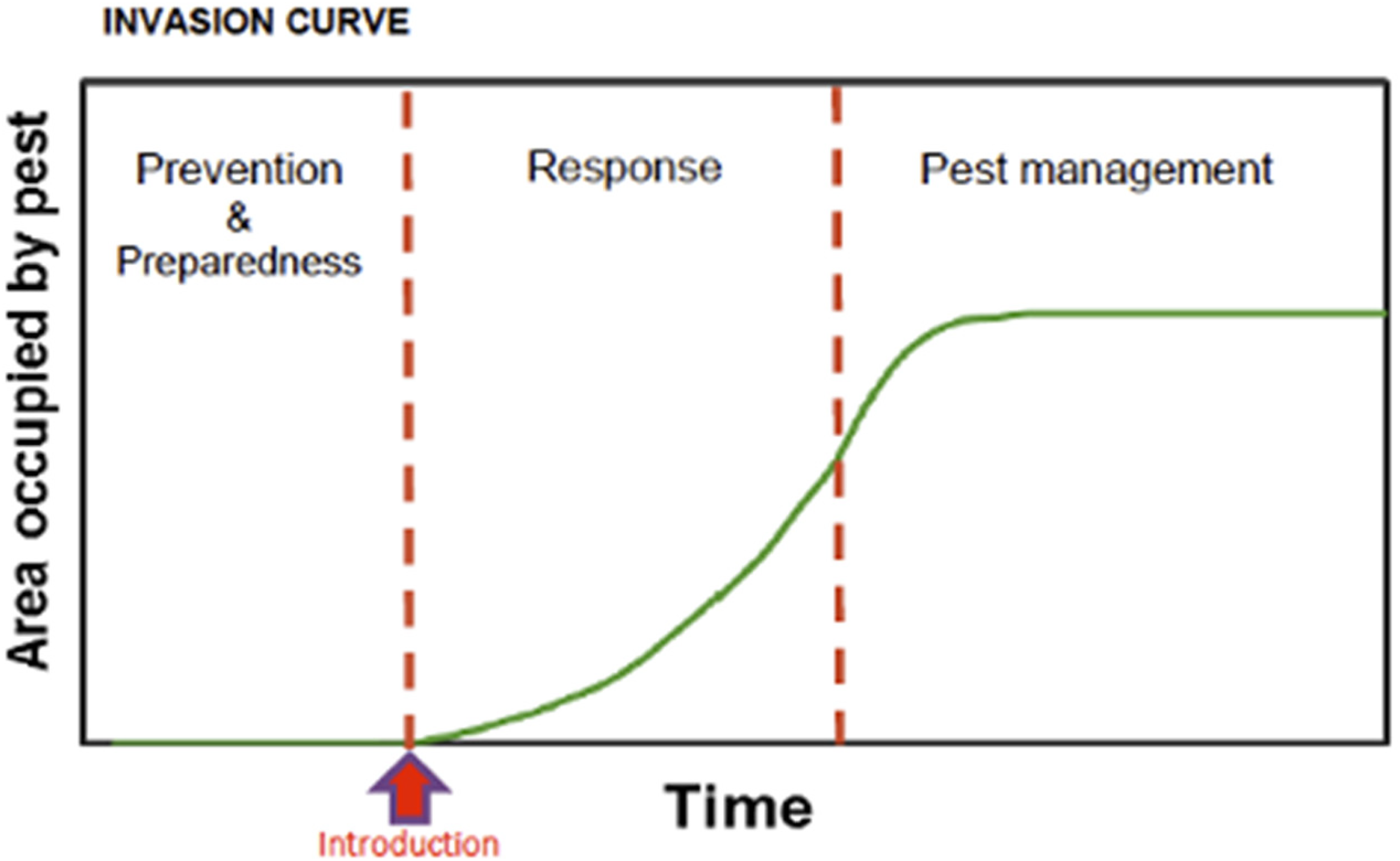
Generalised graph of the spread of an invasive pest population.
In this paper, we refer to the invasion curve in Figure 1 and some of the key considerations for EPPPR in Table 1, and how the private sector can contribute at each stage.
Key considerations for EPPPR applicable at different phases of the pest invasion.

Prevention and preparedness
Prevention refers to processes designed to reduce the risk of new pests being introduced, while preparedness means being ready to react should an emergency pest outbreak occur. Two key elements of prevention and preparedness are the identification and analysis of pest risks, and contingency planning.
Horizon scanning and pest risk analysis
While it would be desirable to prevent any pest emergency from arising, a more cost-effective approach in practice is to focus on mitigating the greatest risks. This involves identifying, assessing and monitoring possible changing risks through horizon scanning and pest risk analysis. Horizon scanning is a systematic process to identify early signs of potential pest risks, and it is intended to alert organisations such as national plant protection organisations (NPPOs) of emerging issues or changes to the level of risk (Antoniou et al., 2024). Pest risk analysis is the ‘process of evaluating biological or other scientific and economic evidence to determine whether an organism is a pest, whether it should be regulated, and the strength of any phytosanitary measures to be taken against it’ (IPPC Secretariat, 2022). At a national level, horizon scanning and pest risk analysis are the responsibility of NPPOs, who engage with other experts as necessary, utilising information from a range of sources.
Kenya and Ghana, for example, have recently conducted horizon scanning exercises to identify invasive species not yet present that nevertheless pose a threat (Kenis et al., 2022). This involved a rapid risk assessment, considering the likelihood of introduction and establishment, and the projected economic and environmental consequences. Horizon scanning should be an ongoing process in which risks are continuously monitored and updated.
We believe that increased collaboration with the private sector could strengthen national governments’ horizon scanning and pest risk analysis by leveraging its knowledge, technology, and expertise to anticipate the impacts of these threats to agriculture. For example, the integration of data analytics and work involving AI could contribute significantly to predictive modelling and risk assessment related to pest outbreaks. These technologies can analyse vast amounts of data from various sources, identifying patterns and trends that may indicate emerging threats. By providing actionable insights, AI and data analytics may help stakeholders make informed decisions and implement preventive measures before pest populations reach critical levels. They may also contribute to better stock allocation, thus helping to prevent obsolete stocks.
As an example, the Food and Agricultural Organization (FAO) partnered with academics, researchers, and private-sector partners to make use of cutting-edge technologies for improving desert locust early warning (FAO, 2024). This shows how advantageous partnerships between NPPOs and the private sector can be, particularly in connection with the advanced forecasting of potential pest outbreaks.
Contingency planning
A central part of preparedness is contingency planning, which involves putting policies and processes in place that are needed to be able to respond in the event of an outbreak. Contingency plans may be general, to respond to any emergency that arises, but they may also be focused on the highest-risk species.
Many countries in Africa and elsewhere around the world have policies to govern and guide EPPPR. These can appear in plant health regulations (as is the case with the Kenyan Plant Protection Bill 2021), formal strategies (as is the case with Ethiopia, Ghana and Kenya), and plans (as is the case with Ghana and South Africa) (Honger et al., 2023; Williams et al., 2023). By having specific EPPPR policies, countries can ensure funds can be quickly mobilised and frameworks for a coordinated response are in place, thereby enabling a rapid response. See Box 1 for details of how this benefited the planning and response to fall armyworm in South Africa.
For both general and specific contingency plans, national governments should take the lead, as recommended by International Plant Protection Convention guidelines (IPPC, 2023) . These contingency plans may include a range of emergency measures, but importantly, they also describe the responsibilities of different stakeholders in the event of an outbreak, including logistical requirements and even funding sources. The IPPC guidelines emphasise the importance of including all stakeholders, and, as we describe below, the private sector can be an important player in emergency responses. Therefore, we suggest there would be significant benefits from greater involvement of the private sector in national-level contingency planning.
Fall armyworm response in South Africa South Africa is one of few countries on the African continent with a generic EPPPR plan in place, which highlights the private sector as an important stakeholder and partner in emergency pest response, as well as the need for emergency pesticide registration. The plan provides for two committee structures: a standing National Emergency Pest Policy Committee (NEPPC), and ad-hoc Pest Steering Committees (PSCs) to address operational issues for each emergency pest. The plan provides for private sector involvement in both the NEPPC and PSCs. This process was put into effect when fall armyworm (S. frugiperda) was detected in South Africa in early 2017, with the industry body Insecticide Resistance Action Committee providing training and information on FAW identification, control and resistance management. One of the outcomes of this good public-private coordination was that appropriate pesticides for FAW control were rapidly identified and publicised, and fast-track approvals were provided in only three weeks.
Contingency plans for specific high-risk pest threats can streamline stakeholders’ responses to outbreaks. The private sector should be engaged early in the contingency planning process and invited to contribute input on effective control measures. For example, new-generation pesticides could, where appropriate, be prioritised. Companies with experience in managing a pest in other areas where it occurs can provide information on relevant products. Regional and local industry associations can also play a role in this process.
Strengthening strategic partnerships between the private sector, governments, and research institutions can enhance the effectiveness of contingency planning by pooling expertise, coordinating response efforts, and advocating for supportive policies. Private companies may also be able to provide insights on certain supply chain issues and provide links with their ongoing farmer and spray service provider (SSP) training programmes. Murray et al. (2019) highlighted the value of SSPs trained by CropLife in the context of the fall armyworm invasion in Kenya.
At a global level, there is potential for the private sector, specifically trade associations such as CropLife International, to work with partners such as the FAO and the World Health Organization (WHO) to improve international emergency responses. The IPPC Strategic Framework 2020–2030 includes strengthening pest outbreak alert and response systems (POARS), to enable timely and effective action against new pest incursions, and the POARS focus group recommendations highlight the need for private sector involvement (IPPC Secretariat, 2022).
Response
Early stages of the invasion or outbreak
Early detection of plant pests is crucial for effective management and mitigation of potential outbreaks. First detection of pests usually happens at ground level, for example by a farmer or an extension agent, when a pest is already causing damage. This has been true of fall armyworm, Tuta absoluta, various viroids and other pests.
The private sector, working closely with farmers, could play a key role in this early detection and warning framework. Active participation of the private sector in pest surveillance programmes could enhance the on-the-ground data collection essential for timely and accurate pest detection, thus benefiting the communication and guidance provided by NPPOs.
Early involvement in the recognition of emerging pest issues allows the private sector to identify appropriate control measures and apply for authorisation for their use to control the pest, importing products as needed.
From an official perspective, specific surveillance is the gathering of data by NPPOs over a defined period. Specific surveillance includes surveys conducted to determine which species are present or absent in an area and to characterise the pest populations. Information from specific surveys helps to determine the status of a pest, to guide actions, and to support communications with trade partners and other concerned countries.
South Africa is an example of a country with an active pest surveillance programme (Republic of South Africa, 2013). The government carries out monitoring for priority pests, e.g. using pheromone traps. Both the government and parts of the private sector monitor for reports of new or unfamiliar pests from farmers. Likewise in Kenya, information gathered by the Kenya Plant Health Inspectorate Service on pest outbreaks often originates from farmers (Mugambi et al., 2016).
Approval of pesticides for emergency use
The WHO Guidelines for the Registration of Pesticides recommend that provisions ‘be made to allow certain pesticides that are not registered to be used in emergency situations to control certain pest outbreaks in agriculture or public health under exceptional circumstances’, (WHO, 2010) but no detailed guidance is provided on the application of such provisions. Nevertheless, the existence of a responsive emergency registration process is key to offsetting the misuse of inappropriate products that has been characteristic of emergency responses in the past. Proactive cross-referencing to existing approvals of candidate products in other jurisdictions may allow risks to be evaluated sufficiently in advance.
Many countries have existing regulatory processes which allow for expedited pesticide review and approval. In some countries, prior declaration of an emergency may be required for emergency use authorisation to be given. However, there is the danger that an official declaration of the presence of a pest or the declaration of a pest emergency can be held back by countries who perceive that reporting pests will have trade repercussions.
Engagement with key stakeholders and the pesticide industry, particularly companies with prior experience with the pest, could help to inform the selection of safe and effective pesticides, and preference should be given to pesticides that have already been registered and thoroughly evaluated in neighbouring countries and/or in similar agroecological zones in other regions. To ensure that the registration of emergency pesticides is run as efficiently as possible, the private sector could work with the public sector more intensively to develop and implement best practice for emergency use authorisation so that effective pesticides can rapidly be made available when needed during emergency pest outbreaks.
In several countries, such as Australia, Bangladesh, Ghana, Kenya and South Africa, insecticide registration was fast-tracked in response to the fall armyworm invasion. The speed with which pesticides were approved under these fast-track procedures was generally seen in a positive light, and our experience has been that making fast-track approvals possible depends on good coordination between stakeholders such as pesticide regulators, ministries of agriculture and the private sector. By contrast, some countries which did not involve the private sector ended up promoting pesticide products unsuitable for the containment of fall armyworm.
While the emergency registration of pesticides is a critical step in EPPPR (Suguiyama et al., 2020), it is only the first step in getting the pesticides to the farmer. Even after a pesticide has been approved, the supply chain needs to be activated, regulatory requirements need to be adhered to, proper distribution networks must be secured, and partnerships with key stakeholder groups need to be supported to ensure farmers receive training in safe handling practices. This underscores the need for a comprehensive approach that includes public–private planning for the logistical aspects in emergency pest response strategies. Box 2 gives an example of public-private planning at the international level during the most recent desert locust upsurge. This comprehensive approach is being developed further in Kenya, where CropLife's Communicating Reliable Information Systems to Agriculture and Logistics traceability system is currently being evaluated towards improving the coordination of pest management responses (CropLife International, 2017a, 2017b).
Desert locust control in Africa and the Middle East
Desert locust (S. gregaria) upsurges prompt emergency response at multiple levels, and pesticide application is the main control method. FAO convenes a Pesticide Referee Group, an independent body of experts that advises on the efficacy and environmental impact of pesticides for locust control. The group reviews reports, publications and other information provided by the crop protection industry and, in 2021, produced a list of recommended pesticides. The top two priority items on the list were the biopesticide Metarhizium acridum, and a group of insect growth regulators. However, these products were little used (Retkute et al., 2021) for reasons including lack of availability, absence of registration in some countries, and cost. Only in East Africa was Metarhizium used on a significant area, mainly in Somalia which benefited from an agreement with the manufacturer for deliveries over a 12-month period in advance (Owuor and McRae, 2022). Private sector organisations were also involved in the aerial application of pesticides, and in some countries, private contractors carried out ground spraying, reportedly to good effect.
Constraints
The misuse of pesticides is not unique to emergency pest outbreaks but it can be exacerbated by the circumstances of the outbreak. For example subsidising pesticides and providing them for free can foster unnecessary pesticide use and lead to risky behaviours (Tambo and Liverpool-Tasie, 2024). Farmers may react to anticipated losses by spraying more often and at higher concentrations.
Panic in the face of pest emergencies also presents an opportunity for bad actors to exploit the situation, for example through selling illegal pesticides. It is important to note that the proliferation of illegal pesticide products significantly undermines the efforts of legitimate private-sector companies striving to support EPPPR.
Private companies invest heavily in research and development to create safe and effective pesticides that fulfil regulatory requirements. The presence of inferior or illegal products from ‘bad actors’ in the market dilutes their efforts, as farmers may (inadvertently) use illegal pesticides that fail to control pests effectively, leading to crop losses and a perceived lack of trust in the efficacy of genuine products. This misperception can damage the reputation of reputable manufacturers, eroding trust in their brands and products.
Furthermore, the private sector is often engaged in extensive educational and stewardship programmes aimed at promoting the proper use of pesticides among farmers. This includes training on application techniques, safety measures, and integrated pest management (IPM) strategies to minimise the impact on non-target organisms and the environment (CropLife International, 2023). The presence of illegal products in the market compromises these initiatives: by doing so, it hampers the efficacy of EPPPR while creating significant economic and operational challenges for those committed to safe and effective pesticide stewardship.
Industry associations work to reduce the negative impact of illegal pesticides through advocacy, collaboration, education, and innovation. They advocate for stronger regulatory frameworks and enforcement mechanisms, working closely with governments to develop policies that deter the production and distribution of illegal pesticides. By fostering partnerships with industry players, national authorities, international organisations and local communities, industry associations build a unified front against illegal products. These collaborations also include capacity-building efforts, such as training customs and regulatory officials to better identify and intercept illegal pesticides.
Building the role of the private sector in EPPPR
Having outlined some of the potential ways the private sector can add more value to EPPPR, we now consider how this can be better integrated into coordination mechanisms over the long term. The inclusion of the private sector depends on the recognition of their potential contribution, and overcoming the constraints and preconceptions that prevent this.
Institutional coordination mechanisms
Many stakeholders can play a role in EPPPR, but if coordination mechanisms are not in place in advance, response efforts can be fragmented.
The private sector can support EPPPR by participating in relevant coordination mechanisms at international, regional and national levels. At a national level, such groups should be convened by NPPOs or other governmental agencies with the mandate for EPPPR, and they should have terms of reference such that objectives and roles are clearly defined, with clear project management rules in place.
Where coordination mechanisms are missing or are inadequate, a first step would be to identify and map relevant stakeholders and then share roles, duties and responsibilities. While the private sector cannot be expected to take up this role, it could encourage and support the engagement of nationally mandated organisations. This analysis is particularly useful for identifying common interests (e.g. the private sector and the public sector are both interested in avoiding the accumulation of obsolete pesticides).
It is crucial to provide for private sector involvement in these coordination efforts on an ongoing basis, not just when an emergency arises. This will ensure that knowledge and expertise are continually shared between stakeholders, so that when an emergency pest outbreak occurs, all parties have clear and defined roles to play in tackling it.
Policy processes
An important way private sector involvement in EPPPR can be promoted is through greater participation in the processes by which policies, strategies, regulations and other instruments are designed. Stakeholder participation in such processes is beneficial (Daniels and Gebhardt, 2021), and private sector input providers are an important group in this context (Möhring et al., 2020). Although different stakeholders may have different and even conflicting objectives, greater participation should improve the quality and implementation of policy (Wiedemann, 2022).
Ideally, the leaders and convenors of policy processes would promote stakeholder participation, although agricultural policy has often been top-down, particularly in lower-income countries. Nevertheless, there are examples of private sector involvement in relevant policy processes in EPPPR. The African Union's Plant Health Strategy for Africa was developed with guidance from a Plant Health Strategy Advisory Group, which included the private sector. Ghana has developed an ‘Emergency response plan for invasive alien plant pests’, which identified CropLife Africa and Middle East as an important stakeholder and participant. Trade associations are generally better placed to contribute to EPPPR policy processes than individual companies.
Role of industry associations in EPPPR
As an example of a global association representing the multinational research and development sector of the plant science industry, CropLife International represents a broad range of expertise in pest management. Through advocacy, CropLife International promotes the implementation of robust regulatory frameworks to facilitate the availability of innovative products on the market. This paper argues for an extension of this approach to the rapid registration and deployment of emergency pesticides, ensuring that farmers have prompt access to authorised and effective tools to combat emergency pest outbreaks.
CropLife International and its members support stewardship activities and contribute significantly to the education and training of farmers and agricultural professionals. During an emergency pest outbreak, these educational initiatives can significantly support farmers to adopt effective and sustainable pest control measures.
Pest management
Should containment or eradication efforts fail, and a formerly emergent pest becomes endemic, the response enters the pest management phase. Here, the private sector could make contributions in terms of information provision to regulators, the promotion of IPM (Green, 2010), and stewardship as integral parts of the response.
Regulatory aspects
Where pesticide approvals are given for emergency use, they are conditional and are typically only valid for two years or less. Pesticide regulators then expect to receive applications for full registrations, but this does not always occur, as companies may be reluctant to invest in full registrations if future pest outbreaks are expected to be sporadic. Approaches applied by the Minor Use Foundation and Committee Linking Entrepreneurship-Agriculture-Development, formerly COLEACP – an inter-professional association promoting sustainable horticultural trade between the EU and the ACP countries – to facilitate minor use registrations could be adapted to pest management following emergency pest outbreaks (CropLife International, 2012).
Integrated pest management
EPPPR embraces the principles of IPM by emphasising a balanced approach that combines prevention, preparedness and the appropriate response measures. IPM combines biological, chemical, physical and crop-specific management strategies and practices to grow healthy crops and minimise the use of pesticides, reducing or minimising risks posed by pesticides to human health and the environment for sustainable pest management (FAO, 2024).
Members of global crop protection industry associations such as CropLife International are proponents of IPM through their commitment to the International Code of Conduct of Pesticide Management.
Key components of IPM include regular monitoring and accurate identification of pest species, understanding their life cycles and behaviour, and implementing targeted control measures only when pest populations exceed economic thresholds. The use of precision agriculture technologies, such as remote sensing and data analytics, can be developed and deployed to monitor pest populations and environmental conditions in real-time, allowing for timely and precise interventions.
Private sector companies conduct education and training activities which contribute to the effective adoption of IPM. Such activities could be built on by government departments seeking partnerships with collaborating organisations for the identification, monitoring and management of emergency pests. This grass roots involvement would enhance the overall surveillance network and enable a more rapid response to potential outbreaks.
By integrating various pest management tactics and continuously evaluating their effectiveness, IPM fosters a dynamic and adaptable approach to pest control.
Stewardship
EPPPR should consider stewardship aspects of the pesticide life cycle to reduce risk. Campaigns to respond to pest outbreaks involving the bulk purchase, distribution, and mass spraying of pesticides should have built-in risk mitigation measures, such as ensuring the availability of appropriate PPE and requiring that persons handling pesticides are trained in responsible use.
Systems for managing empty pesticide containers have been established in more than 50 countries worldwide, usually through public–private partnerships or collaborations. In addition to risk management benefits, these systems can also reduce greenhouse gas emissions if they extend to recycling (inpEV, 2023).
There are also further opportunities for risk reduction. For example as part of its stewardship activities, CropLife International has produced extensive guidelines for each stage of pesticide life cycle management which are aligned across its member companies such as its Responsible Use Manual (CropLife International, 2017a, 2017b) and the Roadmap for Establishing a Container Management Program (CropLife International, 2015). Member companies provide extensive training on responsible pesticide use and support activities related to container management. CropLife and other industry associations can contribute to improving the management of emergency pests through the development of additional technical guidelines, for example on emergency registrations.
Conclusions
This paper underscores how the private sector could contribute to enhancing the effectiveness of EPPPR. By leveraging their expertise and knowledge, private companies could contribute to mitigating pest-related risks and support sustainable agricultural practices through educational outreach and training programmes. The integration of private sector initiatives into EPPPR can be realised through several key approaches:
Firstly, private sector organisations often engage directly with farmers and agricultural communities, providing them with the capability to gather real-time data on pest outbreaks. Enhancing ground-level detection could significantly improve the early identification and reporting of pests to allow for prompt and effective responses. For instance, companies could collaborate more intensively with NPPOs to enhance surveillance programmes by supplying supporting information.
Secondly, the private sector could contribute to research projects and pilot programmes to further enhance pest management practices. By advocating for supportive policies and effective regulatory frameworks, the private sector could enable an environment that promotes robust horizon scanning and effective pest management strategies.
Thirdly, government departments could consult the private sector more as they look to develop and enforce regulations that deter the production and distribution of illegal pesticides, increasing the likelihood that safe and effective products are used by farmers confronted with invasive pests during emergency outbreaks.
We believe the integration of the private sector is not only beneficial but essential for the advancement of sustainable EPPPR. If included in government-led, proactive, collaborative efforts with international organisations and local communities, the private sector can play an important role in building a more resilient agricultural system that is better able to withstand pest invasions.
Footnotes
Acknowledgements
The authors also wish to acknowledge the interviewed experts for their contribution to this report through their valuable insights and information.
Declaration of conflicting interests
The authors declared the following potential conflicts of interest with respect to the research, authorship, and/or publication of this article: Bayer AG is a producer of crop protection products. CropLife International is a trade association representing producers of crop protection products. The CABI authors have no interests to declare.
Funding
The authors disclosed receipt of the following financial support for the research, authorship, and/or publication of this article: CABI is an international intergovernmental organisation, and we gratefully acknowledge the core financial support from our member countries (and lead agencies) including the United Kingdom (Foreign, Commonwealth & Development Office), China (Chinese Ministry of Agriculture), Australia (Australian Centre for International Agricultural Research), Canada (Agriculture and Agri-Food Canada), Netherlands (Directorate-General for International Cooperation), and Switzerland (Swiss Agency for Development and Cooperation). See  key-donors/ for full details.