




Abstract
This study examined the relationship between mental toughness (MT), subjectively perceived performance, and dispositional flow in a sample of 114 high-performing ironmen and standard distance triathletes (Mage = 28.81 years, SD = 3.45) recruited from triathlon clubs. Participants completed the Mental Toughness Questionnaire, Dispositional Flow Scale, and self-rated subjectively perceived performance. Pearson’s correlations between these measures revealed a significant, positive relationship between global MT and subjective performance ratings (r = .62, p < .01) and between global MT and all Dispositional Flow subscales (r = .67–.81, p < .05). Linear regression analyses found that MT subscales accounted for 64% of the variance in dispositional flow. Subjective performance ratings did not add significantly to the regression model. Overall, these findings suggest that MT may contribute positively to ironman competitors’ and triathletes’ exertion of the cognitive and emotional control necessary to experience flow and perform better. We discuss these results in the context of ironman and triathlon competitions.
Introduction
Ironman is arguably one of the most physically demanding events in sport; successful ironman performance requires proficiency in three different endurance-based sports events. The training demands are varied and intense over prolonged periods, and competitions can range from 30 minutes to several hours in length. Ironman or triathlon performers must maintain focus during periods of extreme physical and emotional stress. Accordingly, one personality characteristic that could be useful in dealing with the many challenges of competitive ironman events is mental toughness (MT). The MT construct is thought to combine cognitive, affective, and behavioral qualities that allow a performer to persist in the pursuit of personal goals despite experiencing setbacks and stressors (Gucciardi, Gordan, & Dimmock, 2008). Research has shown that three major components of MT—control, constancy, and confidence—are characteristic of successful performers (Meggs, Diztfeld, & Golby, 2014) who exhibit higher pain thresholds (Gucciardi, 2016) and tend to experience “flow” during competition (Crust & Swann, 2013). “Flow” is an experience defined as an optimal performance state, characterized by fluid, autonomous movement, cognitive clarity, and positive affect (Csikszentmihalyi, 2000, 2002; Swann, Keegan, Piggott, & Crust, 2012).
There are nine dimensions of the flow experience (Csikszentmihalyi, 2000). The first three are challenge-skill balance, action-awareness merging, and clear goals; these dimensions are thought to permit the occurrence of optimal flow conditions (Nakamura & Csikszentmihalyi, 2002). The remaining six dimensions are unambiguous feedback, concentration on task, sense of control, loss of self-consciousness, time transformation, and autotelic experience; these dimensions are proposed experiential characteristics of flow. Together, these flow dimensions have been termed an autotelic experience (Csikszentmihalyi, 1975). Cskikzentimihayli’s flow model has found support from Kawabata and Mallett (2011). Moreover, Nakamura and Csikszentmihalyi (2002) speculated that an autotelic personality may underlie the propensity to experience flow in sport. However, there has been no clear research progress in the attempt to identify specific aspects of this autotelic personality trait, and a more thorough understanding of the individual differences that underlie a propensity toward the flow experience is still needed (Koehn, Morris, & Watt, 2013). Researchers have suggested that flow has both a dispositional component (i.e., the tendency of an individual to experience flow in various circumstances) and a state component (the extent to which an athlete experiences flow in that specific moment), and researchers have conceptualized individual differences in the frequency with which people experience dispositional flow (Jackman, Swann, & Crust, 2016). Measures of dispositional flow have moderate correlations with other individual differences such as athletic self-concept, perceived skill, and perceived performance (Jackson, Thomas, Marsh, & Smedhurst, 2001). However, a large amount of variance in dispositional flow remains unexplained. Therefore, further research that explores the psychological factors underlying dispositional flow is needed.
Recently, personal confidence has emerged as an important antecedent of dispositional flow (Crust & Swann, 2013; Jackson & Kimiecik, 2008; Koehn, 2013; Koehn et al., 2013; Nicholls, Polman, & Holt, 2005). A collection of studies (Koehn & Morris, 2012; Koehn et al., 2013; Stavrou & Zervas, 2004) has found trait sport confidence to be significantly correlated with dispositional flow compared with other variables (e.g., anxiety, imagery use, and action control), and Stavrou and Zervas (2004) found strong relationships between confidence and all component measures of dispositional flow, except time distortion. As personal confidence is also a central component of several different MT models (e.g., Clough, Earle, & Sewell, 2002; Crust, 2008; Gucciardi et al., 2008), MT may also be a strong predictor of flow.
Crust and Swann (2013) found support for an association between MT and flow in that they discovered that the MT subscale of confidence was the strongest predictor of dispositional flow, although commitment and challenge were also significant predictors. When examining the reciprocal relationship between these variables, they found that the Flow subscales of challenge-skill balance and control were also significant predictors of MT. These findings indicate that the development of confidence and, by extension, MT increases the likelihood of dispositional flow by motivating individuals to reach an optimal skill-challenge balance.
However, the nature of this relationship between MT and flow may depend to some extent on the sport activity (training or competition) and the skill level of the participants (Koehn et al., 2013). Jackson (1995) originally proposed that the importance of flow may vary between sports. It is important to note, however, that previous studies either neglected the relationship between performance and dispositional flow (e.g. Jackman et al., 2016) or utilized amalgamated diverse sporting samples (e.g., Jackson, 1995). As noted, ironman is one of the most physically and mentally demanding of all endurance events; thus, empirical data for this sport activity may give additional insight into the psychological factors underlying flow. Flow state has previously been found to predict participant performance ratings in cycling (Jackson et al., 2001), which is one event in ironman and triathlon competitions. Because Stavrou, Jackson, Zervas, and Karteroliotis (2007) also found positive associations between athletes’ flow measures and their performance states, individuals who have higher trait MT and global trait flow scores are more likely to report higher subjective performance ratings.
Another important task or event factor difference between ironman and regular triathlon is the event duration. As flow has been related to rhythmical, long duration endurance events (Carter & Sachs, 2012), it is unclear whether the longer duration of ironman may predispose these athletes toward less frequent experiences of flow. Some researchers have argued that the longer an activity lasts, the more likely athletes are to reach an optimal state of flow (Csikszentmihalyi, 2002), and further support for this argument was provided by Koehn et al. (2013) in a field-based study. Further research is needed to examine the extent to which flow may be experienced in different sporting events. Competitive standard distance triathlon and ironman events present a unique opportunity to compare such differences. In considering athletes’ differences in MT and flow during these activities, it is important to consider the differences in demands between these two competitive events. Standard distance ironman triathlon involves a 3.8 km swim, 180 km cycle, and 42.2 km run. The standard distance triathlon has a 1.5 km swim, 40 km cycle, and 10 km run. The physiological and psychological demands of these activities are therefore very different. In a sprint triathlon, an ability to balance between endurance and speed and to alternate between internal and external foci of attention and intermittent concentration appears to be important. For an ironman competition, the ability to tolerate pain and fatigue and maintain a moderate consistency of effort while disengaging from bodily sensations (pain) is thought to be essential (Crust & Clough, 2005). The primary outcome goals for each event also tend to differ; standard triathletes tend to focus on performance time and relative position, whereas ironman competitors focus primarily on completing the event.
This study had three aims. The first aim was to explore correlations among athletes’ MT, subjective performance ratings, and dispositional flow. We predicted that those with a high MT trait would have higher dispositional flow scores and that those with high levels of subjective performance ratings would also report higher dispositional flow. The second aim was to explore through regression analysis whether trait MT and subjective performance ratings could differentially predict global dispositional flow in ironman and standard distance triathletes. We predicted that subjective performance ratings would explain additional variance in global dispositional flow over and above that explained by MT. The third aim was to examine differences in dispositional flow and MT between ironman athletes and standard distance triathletes.
Method
Participants
We collected data from 114 high-performing ironman and standard distance triathlon athletes from clubs across England. Of these 114 participants, 12 were ironmen, 36 were half-ironmen (half-ironman is half the ironman distance) and the rest, 66, were standard distance triathletes. They were all currently competing in triathlon events and had experience ranging from 8-25 years (Mexperience = 12 years; SD = 4.57). All athletes trained between 9-13 hours per week (Mtraining = 10.23 hours, SD = 2.59). There were 34 female participants in total and 11 female ironman athletes (Mage = 28.81 years, SD = 3.45). Participants were informed of the benefits and risks of the study prior to providing the written informed consent required for further participation in the study. This protocol was approved by the University ethics committee.
Measures
Mental toughness
We used the 18-item Mental Toughness Questionnaire (MTQ18; Clough et al., 2002) to assess the MT construct. Participants rated the MTQ18 items on a 5-point Likert-type scale anchored at 1 = strongly disagree to 5 = strongly agree. The MTQ18 has shown adequate reliability and validity properties in recent studies (Clough et al., 2002; Gerber et al., 2012, 2013).
Dispositional flow
We used the Dispositional Flow Scale (DFS-2; Jackson, Martin, & Eklund, 2008) to assess the athletes’ tendencies to experience flow (Jackson & Eklund, 2002). The underpinning model is based on the nine dimensions of flow (Csikszentmihalyi, 1990), and the DFS-2 has 36 items (e.g., “I am challenged, but I believe my skills will allow me to meet the challenge,” “Things just seem to happen automatically,” “My attention is focused entirely on what I am doing,” “I have a sense of control over what I am doing,” “I really enjoy the experience”) to which respondents provide answers on a 5-point Likert-type scale, anchored from 1 (never) to 5 (always). The DFS-2 consists of nine factors (four items for each factor) referring to the dimensions leading to the flow state or lack thereof (i.e., challenge-skills balance, action-awareness merging, clear goals, unambiguous feedback, concentration on the task at hand, sense of control, loss of self-consciousness, transformation of time, and autotelic experience). The DFS-2 leads to a global score for dispositional flow, using the scores obtained from all items, and this global score was used in this study. The scale has received support in terms of its construct validity (Jackson et al., 2008) and internal consistency (Jackson & Kimiciik, 2008).
Subjective performance ratings
Immediately following their respective competitions (within 10 minutes of the competitive race), all athletes were asked to rate their performance on a scale anchored from 1 (my poorest performance) to 100 (my very best performance).
Procedure
Following participants’ provision of informed consent and compliance with all guidelines from the University ethics committee, we collected all questionnaire data online. We sent an e-mail requesting volunteers for a psychological study on triathletes to potential participants in triathlon clubs via social media websites. Those individuals who expressed an interest in the study were e-mailed a packet with an information sheet, consent form, the two questionnaires (MTQ18 and DFS-2), and the Subjective Performance Rating Scale to be completed on the day of their respective event. The self-report measures—MT, DFS, and subjective performance—were completed in a counterbalanced order. Instructions on questionnaire completion were provided by a trained sport psychologist and stated “please complete the measures in this order (we used a counterbalanced design to self-report completion) immediately following your competition race, ideally this should be within 30 minutes of racing.” Prior to taking part in the study participants had not received any specific, formal psychological skills training. Moreover, participants were all involved in tapering training leading up to the event, meaning they had 48 hours of complete rest prior to the target competition.
Data Analysis
Correlation Matrix of the Dispositional Flow Subscales, Mental Toughness, and Subjective Performance Perception.
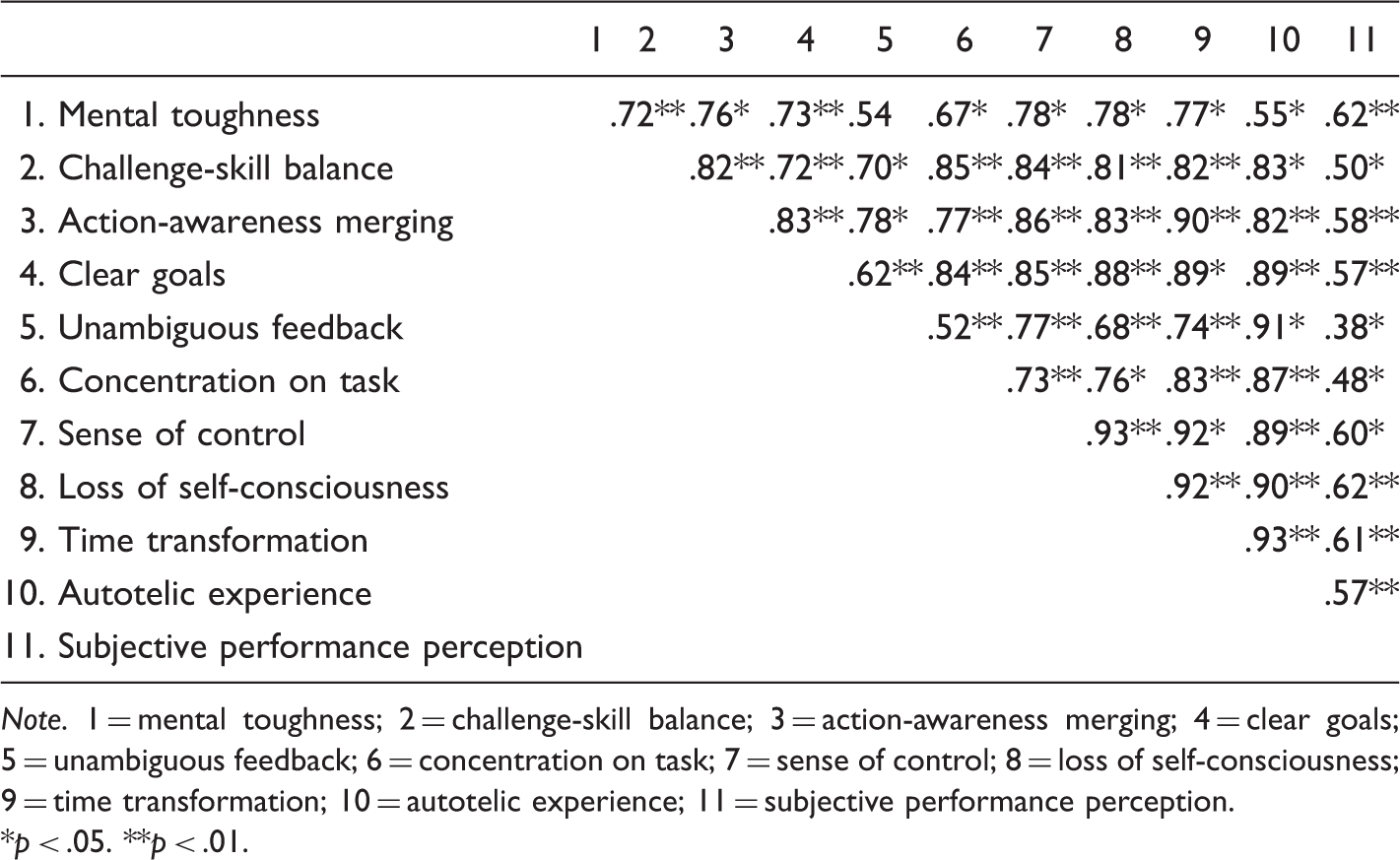
Note. 1 = mental toughness; 2 = challenge-skill balance; 3 = action-awareness merging; 4 = clear goals; 5 = unambiguous feedback; 6 = concentration on task; 7 = sense of control; 8 = loss of self-consciousness; 9 = time transformation; 10 = autotelic experience; 11 = subjective performance perception.
*p < .05. **p < .01.
Means (Standard Deviation) in Mental Toughness and Flow Subscale Scores Between Ironman and Triathletes.

Note. 1 = mental toughness; 2 = challenge-skill balance; 3 = action-awareness merging; 4 = clear goals; 5 = unambiguous feedback; 6 = concentration on task; 7 = sense of control; 8 = loss of self-consciousness; 9 = time transformation; 10 = autotelic experience.
Results
Prior to correlational analysis (Table 1), assumption checks revealed no missing cases. Regression diagnostics revealed no colinearity issues as indicated by tolerance and variance inflation factor statistics. Visual inspection of probability plots and scatterplots revealed acceptable normality and homeodasticity of the residuals. Prior to independent t tests, equal variance checks revealed violations in all four Flow subscales (Challenge-Skill Balance, Clear Goals, Unambigious Feedback, and Concentration on Task) which were all corrected with a Levene’s test. Table 2 shows the means and SDs for ironman or half-ironman and standard distance triathletes with respect to MT and flow scores. Regarding the results, Pearson’s correlational findings showed a significant, strong positive correlation between all Dispositional Flow subscales (except “unambiguous feedback”) and MT; r = .67–.801, p < .05. There was also a significant, strong positive correlation between MT and performance; r = .72, p < .01. Moreover, there was a significant, moderate positive association between dispositional flow and subjective performance ratings; r = .615, p < .01 (see Table 1).
Linear and Multiple Regression With Mental Toughness and Subjective Performance Perception as Predictors and Global Trait Flow as the Outcome Variable.

***p < .001.
Independent t tests (Bonferonni-corrected) showed that the ironman athletes had significantly higher trait MT (M = 66.53, SD = 6.56) than the standard distance triathletes (M = 58.10, SD = 7.26), t(112) = 8.43, p < .001 (see Table 2). Ironman athletes also had higher challenge skill balance, t(77.4) = 7.91, p < .001; action-awareness merging, t(112) = 7.17, p < .001; clear goals, t(87.1) = 5.58, p < .001; unambiguous feedback, t(95.5) = 6.07, p < .001; concentration on task, t(92.27) = 5.50, p < .001; sense of control, t(112) = 6.54, p < .001; loss of self-consciousness, t(112) = 5.43, p < .001; time transformation, t(112) = 6.47, p < .001; and autotelic experience, t(112) = 5.69, p < .001.
Discussion
The primary aim of this study was to explore correlations among MT, subjective performance ratings, and dispositional flow in a large, collective sample of ironmen and standard distance triathletes. We found significant, positive relationships between most Dispositional Flow subscales, global MT, and subjective performance ratings. First, the correlations between Dispositional Flow subscales and MT were moderate–strong in magnitude, indirectly supporting the contention that confidence (a central component of MT) is critical to the frequent experience of flow. Other research (e.g., Koehn et al., 2013; Stavrou & Zervas, 2004) found that trait confidence (conceptually similar to MT) has a strong positive relationship with all measures of dispositional flow (except time transformation) and state flow. The strongest correlation we uncovered was between MT and the loss of Self-Consciousness subscale, closely followed by the time transformation and the Action-Awareness subscales. The first two of these factors are both experiential and trait aspects of flow, while the third is one that is thought to facilitate flow. These findings indicate that the frequency with which an athlete experiences these aspects of flow is positively related to MT in triathletes. Therefore, the performance advantage of MT may lie in both a better ability (compared with less mentally tough athletes) to experience flow and facilitate achieving that experience (or set the stage for it). Jackson, Ford, Kimiecik, and Marsh (1998) argue that different sports bring about different degrees of flow state. Therefore, these three factors may be the most central to experiencing flow in endurance triathlon events.
Another key finding was that perceived performance shared the strongest relationships with MT, and Flow subscales of loss of consciousness, and transformation of time. Thus, high mentally tough athletes (vs. less mentally tough athletes) may have the particular resources needed to become immersed in an endurance activity and experience a loss of consciousness and a unique experience of time. These aspects of flow would appear to be particularly beneficial for endurance athletes to cope with the physically demanding challenge over prolonged periods of time. For these athletes, the ability to experience a rapid passage of time and disassociate from physical sensations would likely increase their ability to perform at a high intensity for longer periods. This suggestion is congruent with previous research in that Schumacher, Becker, and Wiersma (2016) found that long-distance channel swimmers tended to remain disassociated from their expectations and maintain a mindfulness focus to self-regulate emotion and pain. Moreover, Jackson et al. (2001) argued that time transformation and loss of consciousness reflected particularly deep states of flow. This argument was supported by similar findings of canonical correlations of the flow state or DFS by Jackson et al. (1998, 2001) and Koehn (2013) who found that all flow dimensions loaded strongly on global flow, except transformation of time and loss of self-consciousness. Therefore, these two flow components may be more relevant during extremely strong flow episodes.
A secondary study aim was to investigate whether trait MT and subjective performance ratings would predict global dispositional flow in high-performing triathletes. Our results highlighted a significant amount of shared variance among MT and dispositional flow, but subjective performance ratings did not improve on the level of flow variance predicted by MT. The strong predictive relationship between MT and global flow is consistent with the previous findings that examined confidence as an antecedent of flow (Crust & Swann, 2013; Jackson & Kimiecik, 2008; Koehn, 2013; Koehn et al., 2013; Nicholls et al., 2005), as confidence has been related to MT.
Third, we examined differences between ironman and half-ironman athletes versus standard distance triathletes on their Dispositional Flow subscales and on MT. The ironman and half-ironman group was found to be significantly higher in MT and on all Flow subscales than the standard distance triathletes. Thus, the ironman and half-ironman group have more frequent experiences of the antecedent conditions permitting flow (e.g., challenge-skill balance) and of the dimensions of flow (e.g., concentration on task, sense of control). This finding is somewhat surprising, as the longer duration of ironman may have been associated with an increased likelihood of fatigue and discomfort that might decrease the frequency and experience of flow, relative to standard distance triathletes. The findings that ironman competitors scored higher in terms of MT than standard distance triathletes may make sense in terms of the increased demands of the sport. However, as this is a correlational study, it cannot determine the extent to which this MT difference between the two groups is a consequence of taking part in the event or other dispositional antecedents. Higher MT scores of the ironman group may also account for some of the Flow subscale differences between the two groups. (e.g., sense of control and loss of self-consciousness were both strongly correlated with MT in the whole sample).
The findings of this study provide support for the importance of MT in attaining optimal performance states and successful performance in ironman and triathlon. However, a number of methodological limitations should be noted. Importantly, this study was cross-sectional in nature, meaning that the causative or directional influence between these variables cannot be assured (Keller & Bless, 2008). Individuals who experience themselves as mentally tough may also experience themselves as apt to experience flow, without one experience having caused the other, especially as all research of this kind must rely on self-report to measure the flow experience. Similarly, cross-sectional studies cannot reveal the stability of these relationships in a given individual over time and across contexts. Also, the sample size overall and within the groups was low, therefore limiting generalization of the results. Future research may wish to explore the strength and nature of the relationship between MT and dispositional flow within individuals over time over multiple competitions as well as between individuals engaged in different sports. Also, further research might include an attribution-based performance measurement (e.g., Coffee & Rees, 2008), as this type of performance measurement may be more sensitive.