




Abstract
The purpose of this research was to study the effects of a whole-body vibration (WBV) warm-up for improving fencers' performance on variables derived from a lunge reaction test, the 10-meter sprint, and the countermovement jump. We compared fencer performances at four time intervals: (a) preintervention, (b) immediately postintervention, (c) 1-minute postintervention, and (d) 2-minute postintervention. Study participants were 16 male fencers. The vibration frequency was 30 Hz, and its amplitude was two mm. After each WBV session, participants significantly improved their performance on all measures at both one and two minutes after the intervention. Specifically, lunge reaction tests scores improved by 5.50% and 7.34%, respectively, relative to preintevention testing (p < .01), peak power output improved by 4.94% and 11.52%, respectively (p < .05), and maximum rate of force development improved by 13.41% and 18.38%, respectively (p < .01). Acute WBV (frequency = 30 Hz, peak-to-peak amplitude of two mm) induced neuromuscular activation and improved lunge reaction scores, agility, and power.
Introduction
Fencing is a high-intensity exercise with dynamic movements driven by skeletal muscle systems under high impact. Maintaining the stability of the lower limbs during attacking and defending movements is a principal focus in competitions (Sinclair, Bottoms, Taylor, & Greenhalgh, 2010). Several studies have explored motor coordination and control capabilities of fencing movements (Akpinar, Sainburg, Kirazci, & Przybyla, 2015; Guilhem, Giroux, Couturier, Chollet, & Rabita, 2014) and have shown them to require critical asymmetric movements and neuromuscular coordination. The strength and power of the musculoskeletal system are extremely important for high performance (Murgu, 2006), as unilateral movements of the upper and lower extremities and their effects on limb kinematics and dynamics create a considerable burden on the neuromuscular system (Kawałek & Ogurkowska, 2014).
The movements generally used in fencing are advance, retreat, fleche, and lunge. A greater range of motion and muscle strength are required for the fleche and lunge techniques (Cronin, McNair, & Marshall, 2003; Williams & Walmsley, 2000). For example, in the lunge movement, muscular power is exerted by the ankle plantar flexors and the knee/hip extensors of the hind leg. Subsequently, in the flight phase, additional force is provided by the hip flexors and extensors of the front leg. Strength is provided by both feet push off in a periodic manner (Morris, Farnsworth, & Robertson, 2011). In the initial phase, the propulsion of the hind leg drives the trunk forward. Therefore, muscular power of the lower limbs is critically important for fencers. Because rapid responses to movement strength are required for fencing, a special training mode is necessary to induce the greatest neuromuscular integration during such a high-velocity muscle contraction process to improve performance (Tsolakis, Kostaki, & Vagenas, 2010).
Whole-body vibration (WBV) has been widely applied in physical therapy and fitness training (Cochrane, 2011; Soligard et al., 2010). Biological responses to mechanical vibrations are dependent on various vibrational methodologies and individual systemic physiological characteristics and specific tissue changes (Jordan, Norris, Smith, & Herzog, 2010). The functional changes after WBV are attributed to the enhancement of neuromuscular function (Eklund & Hagbarth, 1966). The muscle response to vibration is a natural reflex, defined in the scientific literature as the tonic vibration reflex. When the myofascial systems are mechanically stimulated, Ia circular helical myelin fiber tips are activated, leading to muscle contractions that activate α motor neurons (Eklund & Hagbarth, 1966; Palmieri, Ingersoll, & Hoffman, 2004). WBV generally involves explosive training modes to enhance sprinting, jumping, and maximum strength for athletes. For instance, the movement components of such training can be used to assist the development of muscular power in athletes (Bullock, Martin, Ross, Rosemond, Jordan, & Marino, 2009; Turner, Sanderson, & Attwood, 2011). Turki et al. (2012) stated that physiological training or warm-up and muscle activation before competitions have been shown to improve strength, speed, and agility. An effective warm-up method (i.e., static stretch, dynamic stretch, proprioceptive neuromuscular facilitation [PNF] stretch and mach drills) that can enhance the degree of muscle activation and reduce injury risk is of high value (Soligard et al., 2010).
Fencing requires accuracy, agility, and power which shorten the fencer's reaction time and assist the more powerful movements of the lower limbs, a key point to victory in competition. In the process of alternately attacking and defending, both fencers must react rapidly and make continuous counterattacks by observing and judging the opponent's movements. Previous studies have shown that the acute effects of WBV can improve the performance in drop jump height, contact time, the reactive strength index, proprioception, and peripheral nervous system functioning (Cloak, Nevill, Smith, & Wyon, 2014). Many have applied WBV to different athletic training programs to improve maximum strength, including for sprinting and soccer (Cloak et al., 2014; Moddie, Benson, Gordon, & Lythgo, 2015). As fencing combines both strength and speed and fencing competitions are so short as to fall within a time period in which WBV effects are still evident, more research is needed to explore fenders' neuromuscular response to vibration stimulation (Tsolakis, Kostaki, & Vagenas, 2010). Therefore, this study determined fencers' explosive strength, muscle strength, and fencing-specific agility after a single session of WBV stimulation, comparing atheltes' reactions at various time intervals after the WBV intervention. We hypothesized that there would be a change at each of the different time event performance measures following an acute bout of WBV.
Method
Participants
For this research, we recruited 16 male fencing athletes (Mage = 19.63, SD = 1.07 years; Mheight = 180.95, SD = 6.46 cm; Mweight = 74.37, SD = 8.49 kg) from the Taiwan National Fencing Team. The fencing level of three of the fencing athletes was in the top three categories of world-class competition. To minimalize the influence of extraneous participant variables, all fencers had to meet the following inclusion/exclusion criteria: (a) at least five years of professional fencing training; (b) avoidance of any previous stimulation-induced muscle activation methods, leading to neural adaptations to enhance muscle strength; (c) no prior participation in other research involving neuromuscular mechanical stimulation in the 6-month period immediately preceding this research; (d) membership on the national fencing squad; and (e) sufficient sleep in the past 24 hours (Eight hours sleep).
Experimental Design
We contacted all participants prior to the start of the training program and explained the experimental process and the movements to be performed. The measured variables included scores from the lunge reaction test (LRT), maximum speed of start-up test, and maximum power test. To avoid muscle activation and fatigue effects, each variable (countermovement jump [CMJ], 10 meter sprint [10MS], and LRT) was measured at 48-hour intervals for each test. All participants underwent the testing at the same time. Because the effects of WBV are extremely time sensitive (Cormie, Deane, Triplett, & McBride, 2006), CMJ, 10MS, and LRT data were collected immediately after (immediate-post), one minute after (1-min-post), and two minutes after (2-min-post) each WBV treatment session. Armstrong, Grinnell, and Warren (2010) found that the most appropriate time to assess fitness is within five minutes of WBV; after that time, the effects begin to decrease. Also, since fencing matches do not exceed three minutes, relevant studies have performed measurements at these three time intervals following WBV intervention and have reported significant benefits from it for athletes of other sports. This study is the first to examine the lunge technique used in fencing.
Procedures
To prevent fatigue from affecting the experimental data, each participant was required to remain in a resting state before receiving the WBV stimulation. We used a synchronous vibration platform (AV-009, Body Green, Taipei, Taiwan) to produce a synchronous vibration that could be set 30 hertz per second (Hz) and a peak-to-peak amplitude (the amount of vertical displacement caused by the power plate) of two mm as per prior research (Cormie et al., 2006; Wallmann et al., 2019). We set the WBV duration at 60 seconds to stimulate leg extensor muscles (Di Giminiani, Masedu, Tihanyi, Scrimaglio, & Valenti, 2013). This protocol followed the example of other studies that utilized vertical jump, power, and agility variables in their research (Adams et al., 2009; Armstrong et al., 2010; Cormie et al., 2006). Hence, participants stood on the vibration platform, in the half squat position for the 1-minute duration of the protocol, and we then measured and compared their performance to preintervention testing immediately after WBV stimulation and at one and two minutes afterward.
Dependent Measures
Lunge reaction test
We employed our own lunge agility test system (including visual stimuli) to test the fencers' attacking agility. This system used a MSP430 microcontroller (F149, Texas Instruments Inc., USA) as the control kernel. We used C programing language to write the chip's firmware. The chip simultaneously controlled a signal light for randomized visual stimulation and recorded contact-switch signals for recording reaction time. We set the frequency of the samples to 1000 Hz and sent sample data to a computer through a RS-232 interface for real-time display and data storage (Ho, Lin, Chen, Chiu, & Chen, 2016).
The fencers were required to perform their own customary attacking postures. Following the protocol used by Gutiérrez-Dávila, Rojas, Caletti, Antonio, and Navarro (2013), we placed a human-shaped target at a distance equal to 1.5 times the fencer's body height. Fencers could adjust the distance to the target based on their customary positions. The trunk of the human-shaped targets was 0.70 × 0.55 m. A circle with a diameter of 0.09 m was placed at 70% of the fencer's body height, and, in its center, was a tact switch for effectively identifying the ending point of the lunge.
10 meter sprint
Fencers performed the 10MS from a standing start. We placed two timing gates (Smart Speed, Fusion Sport, Queensland, Australia) to record the time and began recording when the fencers passed through and cut off the first infrared ray. The fencers self-initiated each test with no prompts. Data were recorded by the timing gate using a sampling frequency of 1000 Hz. For data analysis, we used the average of three sprints as the pre-WBV intervention performance.
Counter movement jump
The maximum power of the lower limbs was measured by the CMJ. For this test, the participants squatted in their normal stance before jumping. To prevent the swinging movements of the upper limbs from affecting jump performance, the participants were required to jump with their hands on their hips. The peak power output (PPO) to the ground, relative net impulse (RNI), and the maximum rate of force development (mRFD) were calculated by extraction of raw CMJ data. Force and power (mean and peak) values were converted to values relative to body mass (Gathercole, Sporer, Stellingwerff, & Sleivert, 2015). The fencers stood on a Kistler force platform (9260AA, Kistler Ltd., Switzerland) on both feet and completed three CMJ's. The mean of their three test scores served as the parameter in further data analysis. Furthermore, we used the individual body weight of each participant as the basis for standardization (body weight, BW). The data were recorded by the Kistler force platform using a sampling frequency of 1000 Hz.
Data Analyses
We used a computer program written in MATLAB (Version R2008a; The MathWorks Inc., USA) to calculate the score of maximum power, 10MS, and response time of the lunge. We analyzed these data for statistical significance with SPSS software (version 20.0; SPSS Inc., Chicago, IL, USA). We used intraclass correlation coefficients (ICC) to measure data reliability. The test–retest reliability of the repeated-effort test was evaluated using ICC (Sheppard et al., 2007; Shrout & Fleiss, 1979). The probabilities that the true difference in performance were negative, trivial, or positive were expressed as percentages, reflecting the following descriptors: <1%, almost certainly not; 1%–5%, very unlikely; 5%–25%, unlikely; 25%–75%, possibly; 75%–95%, likely; 95%–99%, very likely; and >99%, almost certainly. Cohen's effect-size statistics reflected the following descriptors: >0.5, large; 0.1–0.3, moderate; and <0.1, small. One-way repeated measure analyses of variance (ANOVAs) and least significant difference post hoc methods were used to determine the variance and post-WBV testing time differences of performances on the LRT, 10MS, and CMJ (PPO, RNI, and mRFD). We used the statistical significance level of 5% for all analyses.
Results
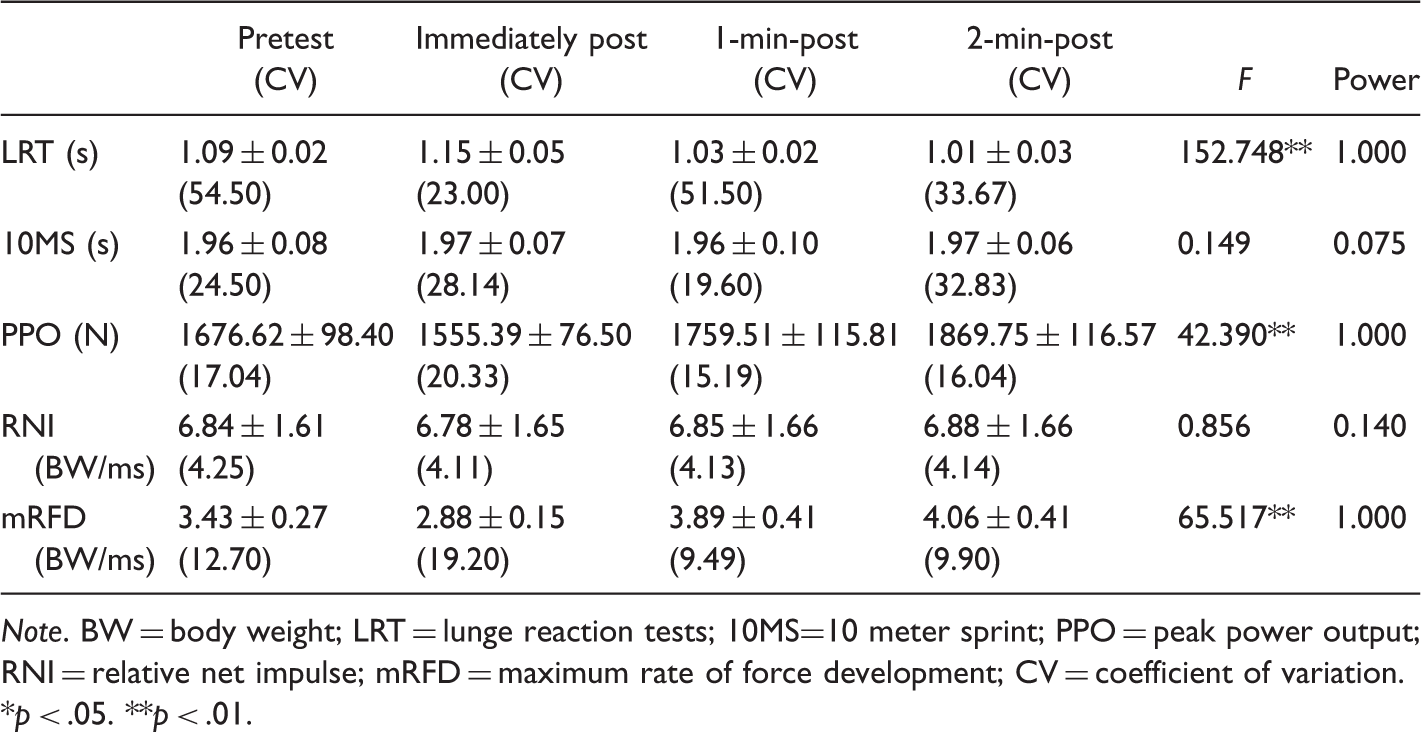
Results of the ICC analyses showed that the tests had excellent reliability, with high ICC values for the LRT (pre-WBV = 0.876, 95% CI [.476, .917]), the 10MS (pre-WBV = 0.647, 95% CI [−.011, .877]), the PPO (pre-WBV = 0.94, 95% CI [−.825, .979]), the RNI (pre-WBV = 0.99, 95% CI = .997) and the mRFD (pre-WBV = 0.87, 95% CI [.623, .95]). The results of test and retest measurements indicated good reliability on the repeated-effort test. Descriptive statistics for agility (LRT, 10MS, PPO, RNI, and mRFD) are provided in Table 1. In addition, percentage of improvement after vibration stimulation is shown in Figure 1.
Percentage of improvement after vibration stimulation. Results of the Tests Measured After the Vibration Intervention (mean ± SD). Note. BW = body weight; LRT = lunge reaction tests; 10MS=10 meter sprint; PPO = peak power output; RNI = relative net impulse; mRFD = maximum rate of force development; CV = coefficient of variation. *p < .05. **p < .01.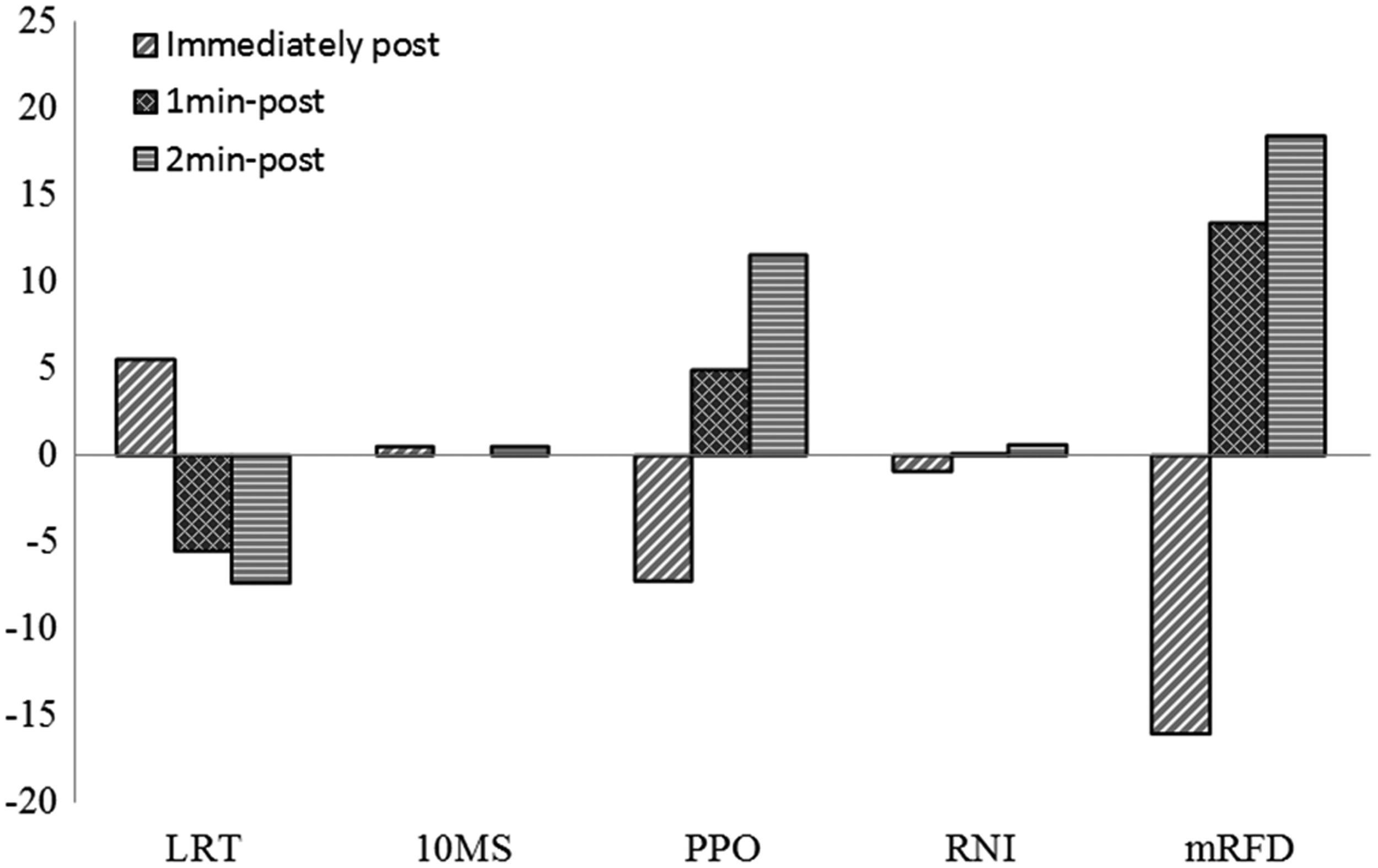
Lunge Reaction Test
For the LRT, the one-way repeated measures ANOVA showed a significant difference between testing times (F = 152.748, p < .01, power = 1.000). The reaction times of the 1-min-post (p < .01, 5.50%) and the 2-min-post (p < .01, 7.34%) times were greatly improved, relative to the pre-WBV performance. The extent of improvement at the 2-min-postmeasurement was greater than that at the 1-min-postmeasurement. Post hoc test indicated that the 1-min-post and the 2-min-posttests exhibited improvements over the pre-WBV and the immediately post-WBV performances. Furthermore, we found a difference between the 1-min-post and the 2-min-post-WBV performances (Table 1).
10 Meter Sprint
For 10MS, the one-way repeated measures ANOVA showed no significant difference between testing times. The time score performances of the fencers at each of the separate testing intervals were not significantly improved over the pre-WBV performance (Table 1).
Countermovement Jump
On the CMJ test, we recorded the power of the lower limbs under PPO tests. The one-way repeated measures ANOVA indicated a significant difference between performances at different times (F = 42.390, p < .01, power = 1.000). The 1-min-post (p < .01, 4.94%) and the 2-min-post (p < .01, 11.52%) were profoundly improved, relative to the pre-WBV performance, and performance at 2-min-post-WBV was better than at 1-min-post-WBV. Also, post hoc test showed that performance was most improved at 2-min-post-WBV (Table 1).
For RNI tests, the one-way repeated measures ANOVA indicated no statistically significant difference between performances at different times. There was no significant improvement at any time interval (Table 1).
For mRFD tests, there was a statistically significant performance difference for testing time point (F = 65.517, p < .01, power = 1.000). The 1-min-post (p < .01, 13.41%) and 2-min-post (p < .01, 18.38%) were greatly improved relative to pre-WBV testing, and the improvement at the 2-min-post-WBV point was better than that of the 1-min-post-WBV point. Post hoc test indicated that the 2-min-post-WBV performance was most significantly different from pre-WBV testing (Table 1).
Discussion
We conducted this study to determine the acute effects of WBV for fencing performance. Our results demonstrated that the reaction times for lunge agility were faster at the 1-min-post-WBV and 2-min-post-WBV performance points. Previous studies on interventions with single WBV stimulation sessions revealed that, when tests were conducted immediately after stimulation, participants exhibited no improvement in their fitness and exercise performances. In prior studies, significant improvement was observed only when the tests were conducted at certain periods after simulation intervention (Bullock et al., 2009; Cormie et al., 2006). Similarly, in our study, single WBV stimulation sessions improved fencers' performance at various post-WBV time points, except for the point immediately following the intervention. The greatest extent of improvement in agility, speed, and explosive strength was observed when performance tests were conducted two minutes after the intervention. Since previous studies have indicated that agility and power are interrelated, it is important to measure these attributes when testing athletes' physical abilities (Negra et al., 2017).
In previous research, WBV has been used as a warm-up exercise, and muscular power, agility, and muscular temperature were significantly improved by short-duration WBV (five minutes), delivered at low-amplitude (0.83 mm) and low-frequency (40 Hz) WBV (Lovell, Midgley, Barrett, Carter, & Small, 2013). Our findings are in accordance with these prior results as we too found improvements in agility and muscular power after low-amplitude vibration stimulation of the neuromuscular system. Mechanical vibration may be used to stimulate and increase the sensitivity of muscle spindles, while it also reduces the recruitment threshold of motor units and inhibits cocontraction by activating the tonic vibration reflex, thereby increasing the sensitivity and contraction rate of muscles; this facilitates the generation of speed strength and reduces time required for movement (Pollock, Woledge, Martin, & Newham, 2012). Previous studies have indicated that a simple reaction time test can be used effectively to quantify athletes' agility (Yang, Chou, Chen, Shiang, & Liu, 2017), and this study also confirmed that vibration stimulation can reduce fencing athletes' warm-up times and improve their performances. This benefit may be particularly important for fencers, since fencing competitions are so short as to fall within the short period of post-WBV benefit.
In this study, we showed inducement of the neuromuscular systems of athletes' lower limbs in a single session of vibration stimulation. Because the fast power of lunge movements is induced by pushing and stamping motions of the lower limbs, the motor pattern of this movement is consistent with the stretch-shortening cycle. In addition, stretch-shortening cycle mechanisms could be excited through vibration stimulation, effectively accelerating the speed of neuromuscular contraction to increase performance scores by completing movements rapidly. Fencers mostly focus on horizontal movement due the demands of their sport. Short-distance sprints may be used to test horizontal explosive strength and thereby indicate speed strength. While, in our study, participants did not show significant improvement on the 10MS after receiving WBV stimulation, Bullock et al. (2009) had the same nonsignificant result when they used WBV stimulation with elite ice skaters and then measured their performances on 30-meter sprints.
Past research has shown that the power of the lower limbs can be effectively improved by a single session of WBV, mainly shown in the capacities of PPO and jump (Bedient et al., 2009). In our use of CMJ power tests, we found significant improvements in PPO and mRFD at the 1-min-post-WBV and 2-min-post-WBV performance times. Thus, our results showing the influence of WBV on power were in line with Cormie et al.'s (2006) finding of WBV effect on explosive strength. Specifically, Cormie et al. applied sessions of 30-minute stimulation with a vibration frequency of 30 Hz and amplitude of 2.5 mm and observed significant improvement in participants' jump height. In this study, our comparison of WBV effects on different motor tests administered at different time points revealed that PPO significantly improved immediately after or at 1 minute after the intervention. In previous research, the highest PPO benefit was associated with low-intensity stimulation (30 Hz) (Bedient et al., 2009), while in our study, there was a postintervention benefit (relative to a preintervention performance) when participants were tested two minutes post-WBV. This finding suggests that our 2-minute postintervention testing time point fell within the 5-minute window of WBV efficacy previously identified as the period before athletic performance decreased again to preintervention levels (Bedient et al., 2009; Cormie et al., 2006).
Previous studies have reported that WBV stimulation can improve CMJ performance (Annino et al., 2017), and our study also explored mRFD and RNI performances. We found that WBV stimulation induced muscle reflexes and affected muscle activation speed measured by mRFD, but athletes' power (measured by RNI) may have decreased under the effect of stimulation. Muscular activation speed and speed strength are crucial attributes for fencers, and some prior studies on vibration stimulation have not tested the specific movements involved in fencing. In this study, we designed a reaction time test based on fencing movements to explore the effect of WBV stimulation on the specific movements and sport performance of fencers. Our results may serve as a reference for fencers regarding the use of vibration stimulation in warm-ups before training or competitions, since we found that WBV stimulation can improve speed strength, activation speed, and agility.
A limitation of our study is the reduced sample size, introducing caution in our conclusions, though fencers in this study were diverse in that they were international. The results of this study may not be generalizable to populations differing from the sports and exercises. Another limitation was the set intensity of parameters (frequency, amplitude, and time) for measuring the effects of WBV. While we showed that fencers' lunge agility was effectively improved by acute WB, there were no conclusive results regarding the settings that should be used for optimal results. Further studies should help determine the ideal intensity for acute WBV.