




Abstract
This study aimed to evaluate the test–retest reliability of soccer skill tests belonging to the F-MARC test battery. To avoid bias during talent identification and development, coaches and scouts should be using reliable tests for assessing soccer-specific skills in young male players. Fifty-two U-14 outfield male soccer players performed F-MARC soccer skill tests on two occasions, separated by 7 days. After familiarization, we administered two trial sessions of five skill tests: speed dribbling, juggling, shooting, passing, and heading. We assessed absolute reliability by expressing the standard error of measurement as a coefficient of variation with 95% limits of agreement, and we assessed relative reliability with the intraclass correlation coefficient and with Pearson’s correlation (r). The results demonstrated satisfactory relative and absolute reliability for speed dribbling, right foot juggling, short passing, shooting a dead ball right, shooting from a pass, heading in front, and heading right. However, reliability values for left foot juggling, chest-head-foot juggling, head-left-foot-right foot-chest-head juggling, long pass, and shooting a dead ball left tests were not strong enough to suggest their usage by coaches in training or sport scientists in research.
Keywords
Introduction
Soccer is a multifactorial sport involving technical, tactical, mental, physical, and physiological components (Stølen, Chamari, Castagna, & Wisløff, 2005). During a 90-minute match, soccer players perform a wide range of complex dynamic movements with the ball in response to unpredictable situations influenced by the ball, teammates, and opponents (Cortis et al., 2013). Time-motion analysis have reported that elite players perform an average of 16.7 short passes, 5.9 long passes, 2.5 headers, 23.8 receives, 17.6 dribbles, and 1.8 shots per match (Bloomfield, Polman, & O’Donogue, 2007). Likewise, it is well documented that successful teams retain ball possession during longer time intervals (Lago-Peñas & Dellal, 2010). Thus, to better team performance and obtain a high percentage of lengthy possessions, soccer players must be able to pass the ball accurately when in situations with a high density of opponents and a reduced playing area (Wallace & Norton, 2014). Similarly, other technical performance indicators such as number of shots and shots on goal can discriminate between top and bottom tier teams (Lago-Ballesteros & Lago-Peñas, 2010). Therefore, technical abilities are a principal determinant of a player’s success in soccer.
Talent identification in youth soccer is the process used by coaches to determine which participants display characteristics with potential to reach an elite soccer level (Williams & Reilly, 2000). However, this process is extremely complex and depends on a broad range of player factors (e.g., anthropometric characteristics, physical capacities, and technical abilities; de Gouv̂a et al., 2017). In this sense, Reilly, Williams, Nevill, and Franks (2000) indicated that physical and physiological attributes of soccer players seem to be insufficient for reaching high levels of performance and must be complemented with an adequate grounding in soccer-specific skills. Soccer skills have been shown to distinguish between non-elite and elite youth players of different age groups (Huijgen, Elfrink-Gemser, Post, & Visscher, 2009). A longitudinal analysis by Huijgen et al. (2009) demonstrated that, during the ages of 14–18 years, elite soccer players, relative to amateur players, averaged 0.3 seconds faster on 30-m peak dribbling performance and were one second faster on repeated dribbling performance.
Currently, the measurement of a soccer player’s technical skill potential constitutes an essential element of talent identification and development (Sarmento, Anguera, Pereira, & Araújo, 2018). In this process, soccer coaches (and sports scientists) should use valid, objective, and reliable tools to discriminate between skillful and less skillful players. In the scientific literature, one oft-cited group of tests elaborated by FIFA (Fédération Internationale de Football Association) has been the F-MARC (FIFA Medical Assessment and Research Centre) battery (Rosch et al., 2000). This battery was designed to assess several technical skills: juggling, speed dribbling, passing, shooting, and heading (Rosch et al., 2000). Several studies used the F-MARC test battery to evaluate long-term effects of training (Tessitore et al., 2011), how the development of technical skills related to player maturity (Malina et al., 2005), return-to-play readiness after injury (Fuller & Walker, 2006), player fatigue (Draganidis et al., 2013), differences between technical skills of players in different playing positions (Erkmen, 2009), and player competitive levels (Rosch et al., 2000). Despite heavy scientific use of this tool, to our knowledge, no previous studies have analyzed the test–retest reliability of the F-MARC test battery.
Test–retest reliability has been defined as the consistency or repeatability of measurement between trials (in the same training session) or testing sessions (on different days) by the same individuals (Hopkins, 2000). Within the science of tests and measurements, a fundamental prerequisite for depending on any measurement tool is a test’s validity (i.e., ability to accurately measure what it intends to measure) and reliability (consistency; Thomas, Silverman, & Nelson, 2015). Atkinson and Nevill (1998), and many measurement experts before them, have argued that a test must be reliable in order to be valid. Since consistent information about a player’s technical ability is a chief concern for soccer clubs, soccer skill tests must establish test–retest reliability prior to test usage (Atkinson & Nevill, 1998). In this context, more research is needed to identify test–retest reliability levels of popular soccer skills tests. Accordingly, in this study, we aimed to evaluate the test–retest reliability of eight soccer skill tests belonging to the F-MARC test battery in order to support clubs, coaches, and further soccer researchers with relevant information regarding the availability of soccer tests with sound psychometric properties for assessing the technical performance.
Methods
Overview
This investigation examined the absolute and relative reliability of the F-MARC test battery for assessing soccer skills. To determine this skill test reliability, we had players performing the following eight F-MARC techniques suggested by Rosh et al. (2000): (a) juggling, (b) juggling (body), (c) speed dribbling, (d) long passing, (e) short passing, (f) shooting a dead ball, (g) shooting from a pass, and (h) heading. The test–retest reliability was performed by administering these techniques over two different training sessions, separated by seven days (Figure 1). On both testing sessions, testing took place at the same time of the day 18:00 hours or 6 p.m.) so as to minimize the effects of varied circadian rhythms on the athlete’s testing performance. To avoid anticipated trial order effects, we randomized the order of trial presentation using random number generator software. All players were given pretest guidelines to (a) perform no strenuous physical activity for 72 hours prior to the testing sessions, (b) avoid dietary caffeine intake 48 hours before measurement, and (c) consume no food for at least three hours before testing. In addition, in each testing session, all participants wore the same athletic equipment. Before each of the test–retest sessions, players were asked whether they had fulfilled these researcher requirements.
Flowchart of the study design.
Participant Sample
We recruited a total of 52 U-14 outfield male soccer players (M age = 13.5, SD = 0.3 years; M height = 161.5, SD = 3.75 cm; M weight = 48.8, SD = 7.7 kg) with at least four years of soccer experience for this study. All players were training three times per week and playing in one competitive match over each weekend. We carried out these procedures during the second part of the competitive season (February). This study was approved by the university’s ethical committee review board and conformed to all recommendations of the Declaration of Helsinki. All players and their parents or guardians signed a written informed consent document indicating their voluntary participation and understanding of all risks.
Procedure
To avoid learning effects from successive testing, players first underwent a 2-week familiarization period with all testing procedures. All data collection and test sessions were performed in an indoor court where ambient temperature ranged from 18°–21℃. All tests were performed at the same venue under identical conditions and supervised by the same test leader. The examiner was a graduate in sport sciences with a wide experience in soccer measurement. Before testing, all participants performed 10 minutes of standardized warm-up comprised of two minutes of light active static stretching (10 repetitions for hamstrings, quadriceps, and calf muscles) and five minutes of jogging, followed by short distance accelerations (three submaximal sprints, progressing to 90% of their maximal velocity for the shuttle distance [30 + 30 m]). This routine was supervised by the team’s physical trainer before the tests. According to Rosch et al. (2000), player’s score was calculated separated for each test. The layout of technical tests can be seen in the supplementary material (adapted from Rosch et al., 2000).
Juggling (foot)
Participants began with the ball in their hands, and the testing trial started when the ball was dropped to the foot. Players juggled the ball with their foot, trying to touch the ball as many times as possible (see Supplementary Figure 1). The trial attempt finished when the ball contacted the ground. Each successful touch had a value of one point, and the maximum score was 25 points. Researchers allowed three attempts for each foot.
Juggling (body)
The coach threw the ball to the player’s chest from a distance of five m. Players performed contacts with the ball in the following order: (a) chest-foot-head, (b) head-left foot-right foot, and (c) foot-chest-head (see Supplementary Figure 2). The successful performance had a value of one point. Researchers allowed a maximum of three attempts per player.
Speed dribbling
Researchers instructed the players to complete a 50-m dribbling circuit in the shortest time possible following the sequence proposal by Rosch et al. (2000). Photoelectric cells (DSD Laser System, León, Spain) were used to measure the time to completion and to increase test reliability. The players stood with the ball at their foot behind the start line, and the trial began on the voice signal “Ready-Go.” After covering five m, the player turned to the right, around the first cone of the triangle. The cones should be dribbled in a pre-established order (see Supplementary Figure 3). Next, the player had to make a 180° turn dribbling the ball around the block. Then, the player dribbled as quickly as possible, played the ball to one side of the block and ran around the other side to collect it. Finally, the speed-dribbling test finished when the player ran through the gate with the ball under his foot. According to the literature (Rosch et al., 2000), the players were free to choose to perform the test with their preferred foot.
Long passing
In this test, the ball was first placed in a dead position (see Supplementary Figure 4). The players were instructed to pass the ball to a circle with a diameter of four m located in a 10 × 10 m square target area. Three points were assigned when the pass entered in the circle or touched its circumference, and one point was assigned when the ball landed elsewhere in the square. No points were given if the ball went outside of the square target area. The player’s score was the sum of all points over five attempts, following an initial trial attempt before the test. During the long passing test, they performed the task with their preferred leg.
Short passing
For the short passing of a moving ball test, players had five attempts to score into a goal (0.6 m high × 0.9 m wide) placed 11 m from the middle of a rectangle area. The players stood behind the start line and dribbled the ball to a passing line designated by two cones (see Supplementary Figure 5). Three points were assigned when the ball went inside the goal, and one point was given when the ball hit the crossbar or goalpost. No point was assigned if the ball went outside of the goal. During the short passing test, players performed with their preferred leg. The player’s score was the sum of points over five attempts.
Shooting dead ball
To evaluate accuracy in shooting a dead ball, we located the shooting line 16 m from the middle of the goal. The goal was divided into six segments with the same dimensions (see Supplementary Figure 6). Each player shot the ball from behind the line following a predetermined sequence of shots (Rosch et al., 2000). We measured a total of three attempts at the top right and top left segments of the goal. Three points were assigned when the ball went into the correct segment, one point when the ball hit the crossbar or goalpost, and one point when the shot went inside into the top middle segment. No point was assigned if the ball went into the lower segments or outside. Players executed this task with both legs.
Shooting from a pass
For this test, we placed with the ball on the edge of the penalty area, at the height of the goalkeeper’s box, and performed a 20-m ground pass (see Supplementary Figure 7) to the player. After running five m, players had to shoot the ball into the goal directly from the researcher’s pass. If the player claimed that the pass was not sufficiently accurate, they could repeat the attempt. Scores were based on five attempts. Six points were assigned if the players shot into the top right or left segments, one point if the players hit the crossbar or goalpost of these segments, two points if players shot into the top middle segment, and one point if players shot into the lower segments.
Heading
According to Rosch et al. (2000), the heading test was divided into two parts. In the first part of the test, a researcher stood in front of the middle of the soccer goal and passed the ball to the player’s head. From the penalty spot, the players ran three m before they headed the ball into the goal (see Supplementary Figure 8), divided, as before, into six equal segments. Each player made three attempts following an initial trail attempt. Six points were assigned if the ball went into the top right or top left segment, one point if the ball hit the crossbar or goalpost of this segment, and three points if the ball went in the lower left or right segments. No point was assigned if the ball went in the lower middle segment.
For the second part of the heading test, the researcher was located three m from the goalpost (right) and threw the ball to the player’s head (see Supplementary Figure 9). The player stood three m behind the penalty spot, where they had to head the ball into the goal. The researcher gave a total of three attempts and, on each attempt, assigned six points if the ball went into the top left segment, one point if the ball hit the crossbar or goalpost of this segment, three points if the ball went in the lower segment, two points if the ball went in the top middle segment, and one point if the ball went in the lower middle segment. No point was assigned if the ball went in the right segment.
Statistical Analyses
All data are presented as means (M) and standard deviations (SD) with 95% confidence intervals (95% CI) where specified. We verified the assumption of normality of the data distribution using the Shapiro–Wilk test, and we verified homogeneity of variance with Levene’s test. Statistical analyses were performed using the statistical package SPSS for Macintosh (version 20.0, Chicago, IL). To investigate any systematic bias, we conducted a paired Student’s t test to test a hypothesis of no difference between the sample mean score for the test versus the sample mean score for the retest. In addition, we calculated Cohen’s d effect sizes (ES) for any identified statistical differences. ES values of 0.2, 0.5, and 0.8 were considered to represent small, medium, and large differences, respectively (Cohen, 1988). Relative reliability was assessed by Pearson’s correlation (r) and intraclass correlation coefficient (ICC). An ICC ≥ 0.7 indicated satisfactory reliability, ≥ 0.75 good reliability, and ≥ 0.9 excellent reliability (Atkinson & Nevill, 1998). The level of correlation was fixed in the following categories: very strong (r ≥ .80), moderately strong (r = .79–.60), fair (r = .59–.30), and poor (r ≤ .299; Chan, 2003). Absolute reliability was assessed with a standard error of measurement (SEM), expressing the typical error as coefficient of variation (CV; Hopkins, 2000) and using 95% limits of agreement analysis as described by Bland and Altman (1986). According to previous reliability studies, a CV of less than 10% was set as the criterion for reliability (Atkinson & Nevill, 1998). Finally, Pearson’s correlation (r) was used to assess the association between different tests. The size of the correlation was evaluated as follows: r < .7 low; .7 ≤ r < .9 moderate, and r ≥ .9 high (Vincent & Weir, 2012). We set the statistical significance level at p ≤ .05.
Results
Systematic Bias Between Trials.
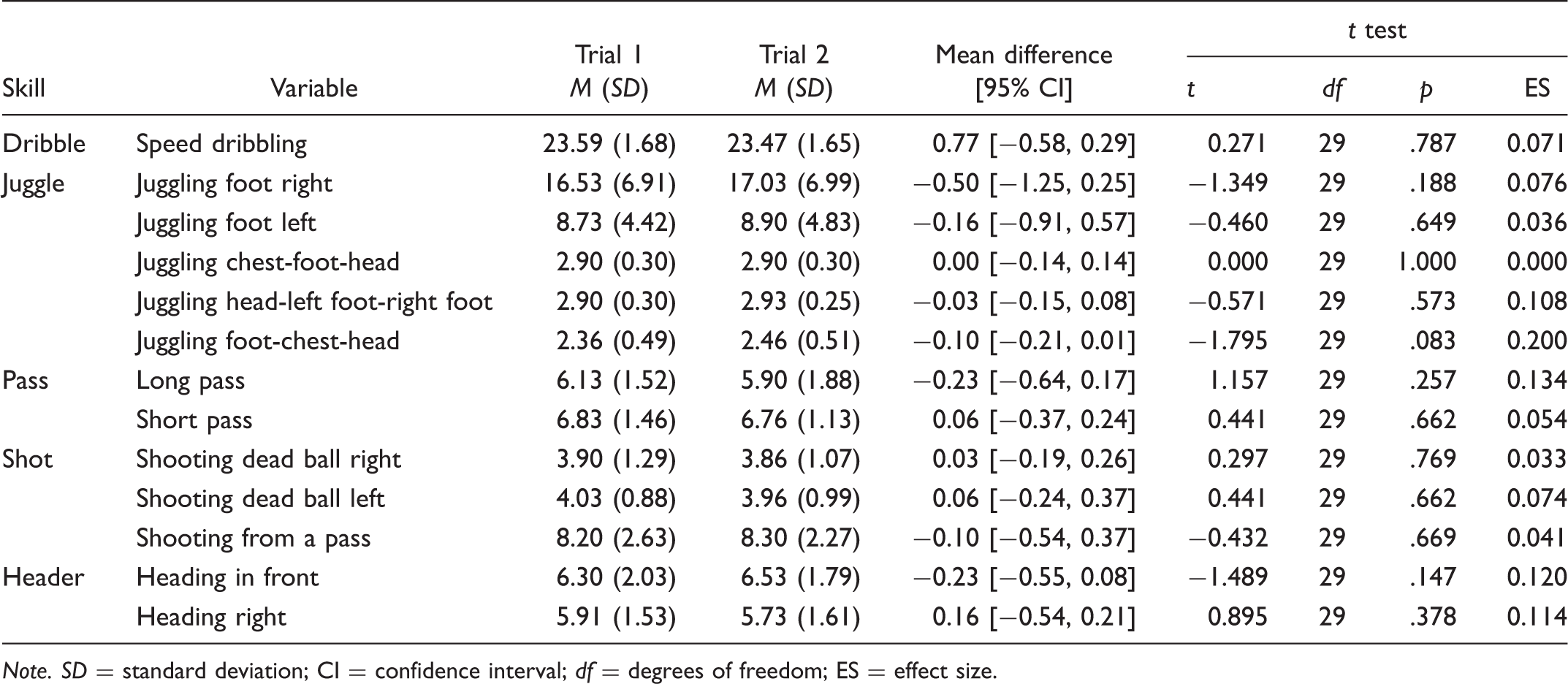
Note. SD = standard deviation; CI = confidence interval; df = degrees of freedom; ES = effect size.
Degree of Association Between the Tests of F-MARC Battery.
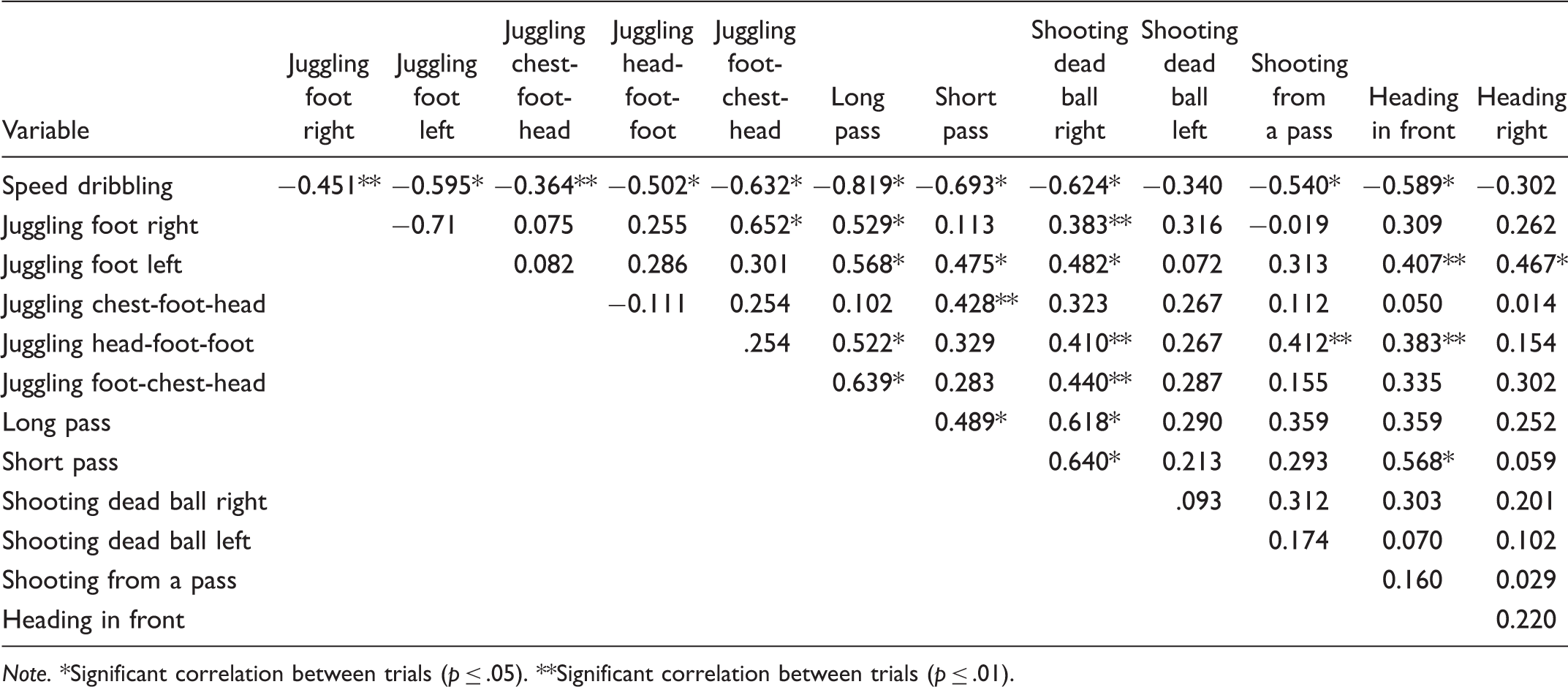
Note. *Significant correlation between trials (p ≤ .05). **Significant correlation between trials (p ≤ .01).
Relative and Absolute Test–Retest Reliability of F-MARC Test Battery.
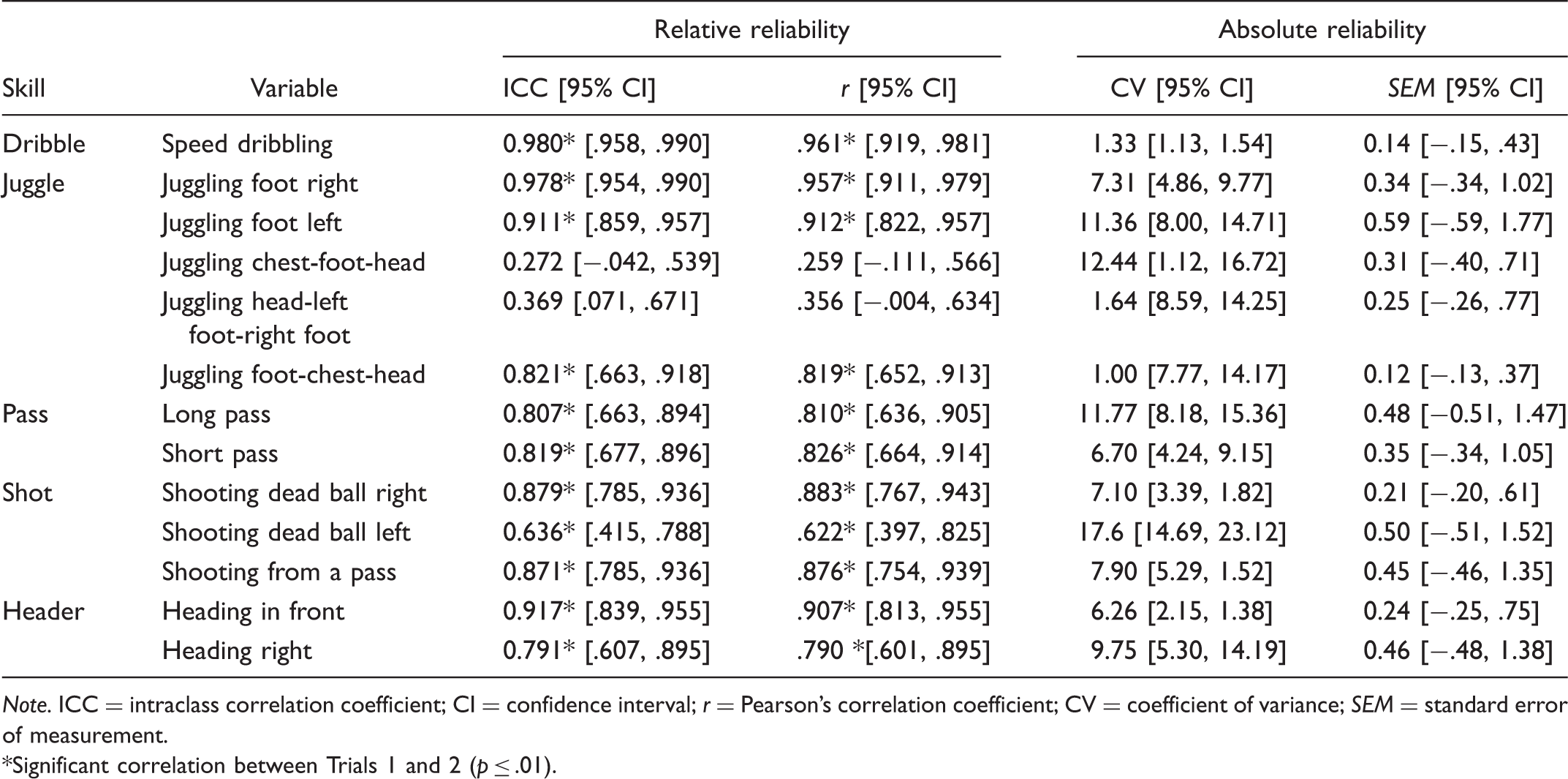
Note. ICC = intraclass correlation coefficient; CI = confidence interval; r = Pearson’s correlation coefficient; CV = coefficient of variance; SEM = standard error of measurement.
*Significant correlation between Trials 1 and 2 (p ≤ .01).
We analyzed absolute reliability with CV and SEM statistics (see Table 3). The coefficient of variation was lower than 10% for speed-dribbling (CV = 1.33%), juggling foot right (CV = 7.31%), juggling foot-chest-head (CV = 10.00%), short pass (CV = 6.70%), shooting dead ball right (CV = 7.10%), shooting from pass (CV = 7.90%), heading in front (CV = 6.26%), and heading right (CV = 9.75%). The SEM ranged from 0.12 to 0.59 and showed the same tendency as % CV. Figure 2 shows the Bland and Altman plots and reflects good absolute reliability for all soccer-specific skills tests.
Bland and Altman plot with limits of agreement (LOA) of test–retest.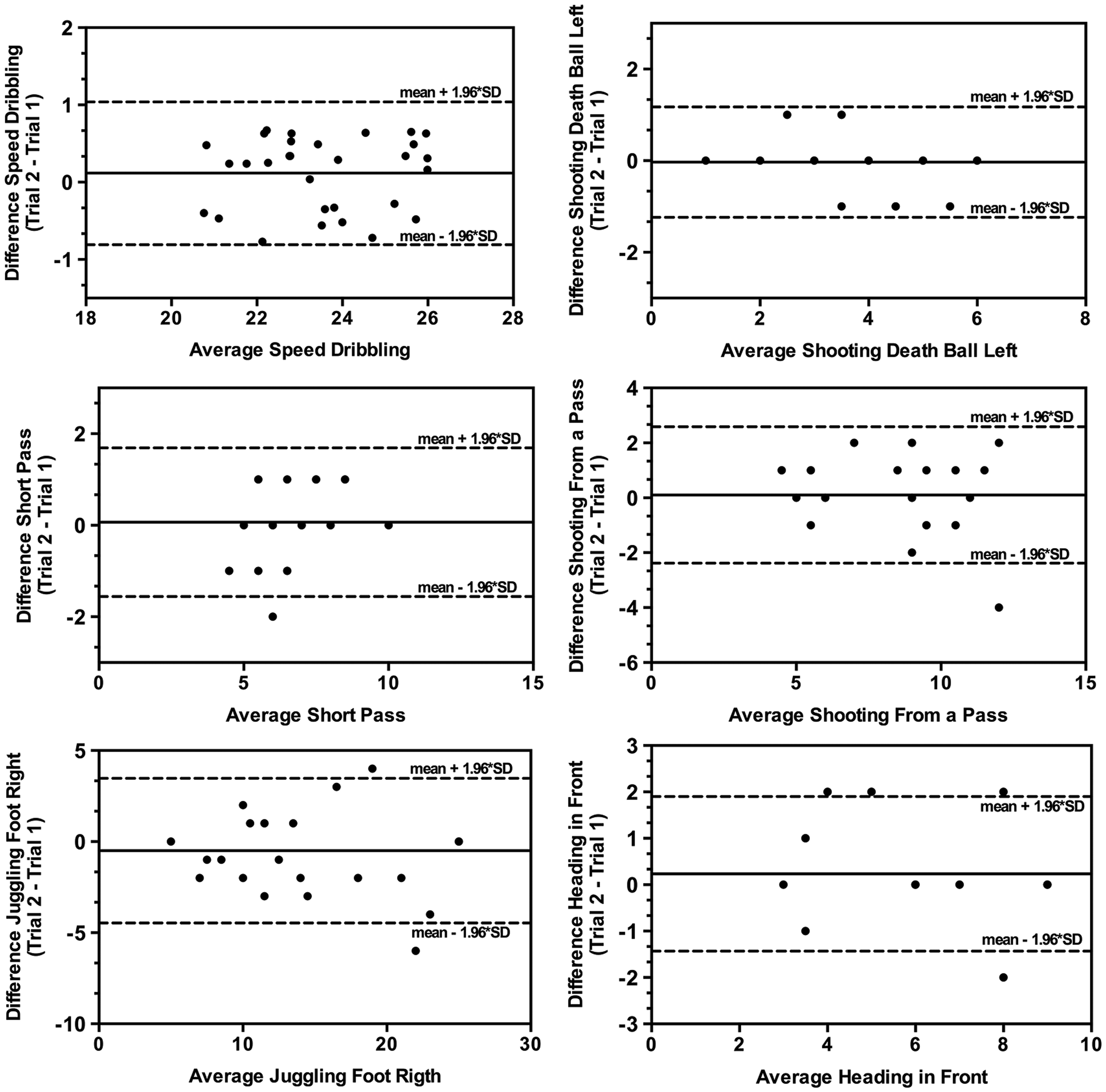
Discussion
Traditionally, coaches have relied on subjective impressions during the talent identification and athlete selection process (Williams & Reilly, 2000). To reduce talent identification bias and error, soccer coaches and scouts should use valid, objective, and reliable tools. In the scientific literature, one of the most well-known and cited tool is the F-MARC test battery (Rosch et al., 2000). However, despite many empirical investigations using the F-MARC test battery, no previous study has examined its absolute and relative reliability in its use with youth soccer players. Answering this need, the main finding of this study was that the F-MARC battery showed good to excellent reliability for assessing youth soccer players for the following technical skills: speed dribbling, juggling foot right, short pass, shooting dead ball right, shooting from a pass, heading in front, and heading right.
Dribbling is one of the most frequently performed technical actions during match play, and it is considered a decisive soccer skill (Huijgen, Elferink-Gemser, Post, & Visscher, 2010). Dribbling may also be a precursor skill for an action leading to a shot on goal or a pass, offering a team a strong tactical advantage (Ali, 2011). Past researchers have determined dribbling to be a key technical ability that can distinguish elite from non-elite soccer players (de Gouv̂a et al., 2017; Huijgen et al., 2009; Rosch et al., 2000). Hence, a tool to evaluate dribbling reliably would be crucial for coaching staff. This study found showed excellent (ICC = 0.980) and very strong (r = .961) levels of relative and absolute reliability (CV = 1.33%) on the dribbling speed test we administered. Since previous investigations have revealed that speed in running with the ball identified the best players (Zago et al., 2016). Our results suggest that F-MARC’s dribbling test could be used in soccer academies to assess youth players’ potential, avoiding subjective error and bias associated with coaches’ observations when trying to identify and develop talent (Furley & Memmert, 2016; Peña-González, Fernández-Fernández, Moya-Ramón, & Cervelló, 2018).
As the main aim in team soccer play is to score the most goals, soccer shooting skill is a highly relevant technical asset (Ali, 2011). Several soccer shooting tests have been designed and can broadly classified into shooting speed and shooting accuracy tests (Radman et al., 2016). In past research, the F-MARC’s shooting tests have been used to analyze the long-term effects of training (Tessitore et al., 2011). Our study found the relative reliability of the test to be good (ICC = 0.879) and very strong (r = .883), and the absolute reliability to be good (CV = 7.10%) for shooting a dead ball with the right foot and shooting from a pass. However, absolute and relative test–retest reliability for shooting a dead ball with the left foot was poor. Motor control studies have revealed a strong preference for dominant-leg in mobilization versus stationary tasks (Bacelar & Teixeira, 2015). Thus, our finding of poor test–retest reliability for shooting a dead ball with the left foot would seem to be caused by intrinsic features of this motor task. In light of these reliability findings, the F-MARC’s shooting test should be conducted with the player’s preferred leg.
Researchers have used juggling tests to assess soccer coordination (Rosch et al., 2000; Vanderford, Meyers, Skelly, Stewart, & Hamilton, 2004) even though players do not normally have to juggle the ball during dynamic play (Ali, 2011). Our results showed low levels of reliability for all juggling tests, except juggling with the right foot (ICC = 0.978; r = .957; CV = 7.31%). Multi-joint actions require excellent timing and transfer of energy between interlimbs (Cortis et al., 2009), making a juggling test that uses several body parts an inconsistent measure of motor system skills compared with juggling with only one (the preferred) leg.
A teams’ passing accuracy is essential to maintain longer ball possessions (Lago-Peñas & Dellal, 2010), and during a competitive season, successful teams have demonstrated higher possession length than unsuccessful teams, regardless of the evolving match status (Lago-Ballesteros & Lago-Peñas, 2010; Lago-Peñas & Dellal, 2010). The F-MARC test battery includes two tests to examine short and long distance passing ability, respectively, in soccer players of different skill and age levels. In our study, the short passing test showed good (ICC = 0.819) and very strong (r = .826) relative reliability, and good (CV = 6.70%) absolute reliability. In past research, the short passing test demonstrated discriminative validity; skills of soccer players in the same age cohort were distinguishable by their scores on this test (Rosch et al., 2000). Of likely practical interest to coaches and sports scientists, the Loughborough Passing Test (LSPT) has also been used extensively by researchers to evaluate the acute and long-term effects of training (Wen, Robertson, Hu, Song, & Chen, 2018). The LSPT also allows users to assess multifaceted aspects of soccer skills, including short passing, dribbling, control, and decision-making. A recent review showed that LSPT presented similar levels of relative and absolute reliability as the F-MARC passing test (Wen et al., 2018).
In our study, the long passing test revealed good (ICC = 0.807) and very strong (r = .810) relative reliability, although it failed to show adequate absolute reliability (CV = 11.77%). Of note, however, this test revealed similarly poor levels of absolute reliability as other long passing tests (Haaland & Hoff, 2003; Rostgaard, Iaia, Simonsen, & Bangsbo, 2008). Perhaps, among U-12 soccer players, poor test–retest reliability is due to the players’ insufficient strength and coordination to pass the ball accurately over 36 m distances. The F-MARC passing tests provide discrete data according to a criterion-based outcome, and they do not require the specific decision-making that is necessary in real game situations. Therefore, as suggested by results from previous studies (Russell, Benton, & Kingsley, 2010; Wen et al., 2018), the scoring system could be redesigned to avoid reliability problems. For example, a potential alternative would be to use ecologically relevant measurement units such as distance, speed, and percentage of successful passes in judging this skill (Russell et al., 2010). Future studies should analyze the reliability of the F-MARC long passing test with these scoring modifications.
Soccer players can head the ball in a standing position or in motion, and they can perform various heading actions such as passing, clearing, or shooting to the goal. F-MARC heading tests have previously been used to assess heading accuracy and coordination, according to playing positions among professional soccer players (Erkmen, 2009). Likewise, Draganidis et al. (2013) used these tests to determine the impact of exercise intensity on soccer skill performance. Surprisingly, despite the importance heading actions during soccer matches, there is no reliability evidence regarding heading tests (Ali, 2011). Our study’s results suggest that the task of heading the ball in front of the middle of the goal revealed excellent (ICC = 0.917) and very strong (r = .907) relative reliability, and good (CV = 6.26%) absolute reliability. In addition, heading the ball from the right goalpost showed good (ICC = 0.791) and moderately strong (r = .790) relative reliability, and it provided good (CV = 9.75%) absolute reliability. In view of these results and the importance of heading skills in soccer, coaches and soccer academies should consider using heading tests for talent identification and development. However, a difficulty with these tests is the consistency of the examiner’s passes to the players (Ali, 2011), and further studies are necessary to evaluate the quality and consistency of those passes within the test.
To avoid bias during talent identification and development, coaches and scouts should use reliable tests to assess soccer-specific skills in youth male players. As reliable F-MARC skill tests are easy to administer and require relatively inexpensive equipment for soccer academies, our results should be of interest to coaches and trainers involved in athlete selection and development and to evaluate the effects of different training interventions aimed at enhancing soccer performance. Among this study’s limitations, however, is its reliance on a small participant sample, limiting the generalizability of these results. Future studies might focus on interrater reliability judgments of passes to players for some of these skills and on the sensitivity of technical skills tests to detect other skills among youth soccer players.
Conclusion
This study determined the following technical skill tests of the F-MARC battery were reliable methods of examining soccer skills in young soccer players: (a) the dribbling test, (b) right foot juggling test, (c) shooting a dead ball right test, (d) short passing test, (e) shooting from a pass test, and (f) heading test. However, reliability values for certain other tests were not strong enough to support their use by coaches and sport scientist researchers: (a) the left foot juggling test, (b) chest-foot-head juggling test, (c) head-left-foot-right foot-chest-head juggling test, (d) the long pass test, and (e) the shooting a dead ball left test.
Supplemental Material
Supplemental Material1 - Supplemental material for Test–Retest Reliability of Skill Tests in the F-MARC Battery for Youth Soccer Players
Supplemental material, Supplemental Material1 for Test–Retest Reliability of Skill Tests in the F-MARC Battery for Youth Soccer Players by Alexis Padrón-Cabo, Ezequiel Rey, Alexandra Pérez-Ferreirós and Anton Kalén in Perceptual and Motor Skills
Supplemental Material
Supplemental Material2 - Supplemental material for Test–Retest Reliability of Skill Tests in the F-MARC Battery for Youth Soccer Players
Supplemental material, Supplemental Material2 for Test–Retest Reliability of Skill Tests in the F-MARC Battery for Youth Soccer Players by Alexis Padrón-Cabo, Ezequiel Rey, Alexandra Pérez-Ferreirós and Anton Kalén in Perceptual and Motor Skills
Supplemental Material
Supplemental Material3 - Supplemental material for Test–Retest Reliability of Skill Tests in the F-MARC Battery for Youth Soccer Players
Supplemental material, Supplemental Material3 for Test–Retest Reliability of Skill Tests in the F-MARC Battery for Youth Soccer Players by Alexis Padrón-Cabo, Ezequiel Rey, Alexandra Pérez-Ferreirós and Anton Kalén in Perceptual and Motor Skills
Supplemental Material
Supplemental Material4 - Supplemental material for Test–Retest Reliability of Skill Tests in the F-MARC Battery for Youth Soccer Players
Supplemental material, Supplemental Material4 for Test–Retest Reliability of Skill Tests in the F-MARC Battery for Youth Soccer Players by Alexis Padrón-Cabo, Ezequiel Rey, Alexandra Pérez-Ferreirós and Anton Kalén in Perceptual and Motor Skills
Supplemental Material
Supplemental Material5 - Supplemental material for Test–Retest Reliability of Skill Tests in the F-MARC Battery for Youth Soccer Players
Supplemental material, Supplemental Material5 for Test–Retest Reliability of Skill Tests in the F-MARC Battery for Youth Soccer Players by Alexis Padrón-Cabo, Ezequiel Rey, Alexandra Pérez-Ferreirós and Anton Kalén in Perceptual and Motor Skills
Supplemental Material
Supplemental Material6 - Supplemental material for Test–Retest Reliability of Skill Tests in the F-MARC Battery for Youth Soccer Players
Supplemental material, Supplemental Material6 for Test–Retest Reliability of Skill Tests in the F-MARC Battery for Youth Soccer Players by Alexis Padrón-Cabo, Ezequiel Rey, Alexandra Pérez-Ferreirós and Anton Kalén in Perceptual and Motor Skills
Supplemental Material
Supplemental Material7 - Supplemental material for Test–Retest Reliability of Skill Tests in the F-MARC Battery for Youth Soccer Players
Supplemental material, Supplemental Material7 for Test–Retest Reliability of Skill Tests in the F-MARC Battery for Youth Soccer Players by Alexis Padrón-Cabo, Ezequiel Rey, Alexandra Pérez-Ferreirós and Anton Kalén in Perceptual and Motor Skills
Supplemental Material
Supplemental Material8 - Supplemental material for Test–Retest Reliability of Skill Tests in the F-MARC Battery for Youth Soccer Players
Supplemental material, Supplemental Material8 for Test–Retest Reliability of Skill Tests in the F-MARC Battery for Youth Soccer Players by Alexis Padrón-Cabo, Ezequiel Rey, Alexandra Pérez-Ferreirós and Anton Kalén in Perceptual and Motor Skills
Supplemental Material
Supplemental Material9 - Supplemental material for Test–Retest Reliability of Skill Tests in the F-MARC Battery for Youth Soccer Players
Supplemental material, Supplemental Material9 for Test–Retest Reliability of Skill Tests in the F-MARC Battery for Youth Soccer Players by Alexis Padrón-Cabo, Ezequiel Rey, Alexandra Pérez-Ferreirós and Anton Kalén in Perceptual and Motor Skills
Footnotes
Article Notes
References
Supplementary Material
Please find the following supplemental material available below.
For Open Access articles published under a Creative Commons License, all supplemental material carries the same license as the article it is associated with.
For non-Open Access articles published, all supplemental material carries a non-exclusive license, and permission requests for re-use of supplemental material or any part of supplemental material shall be sent directly to the copyright owner as specified in the copyright notice associated with the article.
