



Abstract
The think aloud (TA) protocol is used to capture conscious cognition for wide ranging applications. However, the methods used to train the TA technique have been inconsistent, involving a mixture of both traditional guidelines and task-specific examples. This study aimed to examine how best to train the TA process. We recruited 20 competitive golfers as research participants, and we randomly assigned them to equal sized groups of traditional TA training as described by Ericsson and Simon and task-specific training in which participants were familiarized with TA via task-specific examples. Following training, all participants performed a golf task and were asked to TA. We transcribed audiotapes of their verbatim TA content and analyzed them using a deductive framework. We also collected various social validation self-report measures to assess participant perceptions of TA training. Overall, we found no significant differences in the frequency or type of TA verbalizations when comparing traditional and task-specific TA training groups. However, participants in the task-specific training group reported more favorable perceptions of training and found training significantly clearer than did participants in the traditional training group. We suggest that these findings support traditional TA training following Ericsson and Simon’s training guidelines, but adding task-specific examples seems to increase the familiarity of TA use and facilitate more reliable and accurate cognition data for research use.
Introduction
Verbal reports from the think aloud (TA) protocol (Ericsson & Simon, 1993) have been used for decades to capture problem-solving and decision-making data (e.g., Bloom & Broder, 1950) in a variety of applications. TA has been used in medical settings in relation to pain management (e.g., Taylor, Allsop, Bewick, & Bennett, 2016), surgery (e.g., McRobert et al., 2013), nursing (e.g., Banning, 2008), teaching (e.g., Ellis, 2013), and within various sports to capture in-performance cognitions (e.g., Ward, Williams, & Ericsson, 2003; Whitehead, Taylor, & Polman, 2016). The terminology surrounding both TA and its verbal reports have been used interchangeably, with some researchers preferring the term TA (e.g., Welsh, Dewhurst, & Perry, 2018) and others using terms related to the specific time the reports were gathered, such as immediate and retrospective verbal reports (e.g., McRobert et al., 2013). While TA is a verbal report method that captures in-event cognitions, within this article, we use the term TA as an umbrella term for discussing past literature, and we offer greater detail regarding our use of the TA method.
TA requires a performer to verbalize his or her thought process continuously while performing. Ericsson and Simon (1993) proposed three TA levels: (a) Level 1: simple vocalizations of inner speech in which the individual makes no effort to communicate his or her thoughts; (b) Level 2: verbal encoding and vocalization of an internal mental representation that was not originally verbally coded (e.g., verbal encoding and vocalizing scents, visual stimuli, or movements) and conveys only the information that is in the participant’s focus; and (c) Level 3: explanations of the individual’s thoughts, ideas, hypotheses, or motives (Ericsson & Simon, 1993). For example, in Level 3 verbalizations, the performer might explain why a certain medical procedure should be conducted or why a certain golf shot or club was selected. It is important to note that most TA researchers have opted to study Level 2 TA verbalizations because Level 2 verbalizations capture an individual’s ongoing cognition within his or her short-term memory and are not obtained retrospectively from long-term memory (LTM). Retrieving information from LTM may slow the TA process and make the obtained data less naturally procured. During the performance of an activity, information in short-term memory is only briefly available (Newell & Simon, 1972). As the task continues and new information is presented, previous information is lost. Thus, affording the individual an opportunity to retrieve and verbalize information that is not directly needed for task performance and yields data that is not a product of any cognitive process that mediates the performance (Eccles, 2012).
The benefit of using TA is that it allows data regarding thought processes to be captured within real time and reduces the risk that memory decay and retrospective bias has on information gathered (e.g., Folkman & Moskowitz, 2004; Ptacek, Smith, Espe, & Raffety, 1994; Smith, Leffingwell, & Ptacek, 1999; Stone et al., 1998). Furthermore, TA allows researchers to identify potential differences in perceptual-cognitive processes between performers of varying expertise (Williams, Ford, Eccles, & Ward, 2011). For example, in early work, De Groot (1978) demonstrated TA evidence of domain-specific knowledge and mental representation by asking master and intermediate chess players to reconstruct the locations of chess pieces after viewing the board for only a few seconds. While master chess players showed significant superiority at this skill, compared with intermediate players, there were no group differences when chess piece locations were presented randomly on the board. This experiment showed that, over time and practice, the higher skilled chess players had stored thousands of chunks of chess-related information (a chunk was defined as a sequence of pieces with between piece intervals of less than two seconds) and could retrieve this information from LTM to give them greater familiarity with and easier recall of previously seen chess patterns after only a few seconds of viewing. However, they lost this advantage when random distributions of pieces were unrelated to this knowledge base.
Research using TA has identified cognitive differences between various levels of performers in a wide range of domains. Within medical research, McRobert et al. (2013) found that skilled physicians demonstrated higher diagnostic accuracy and selected better quality options during diagnostic reasoning, compared with less skilled physicians. In chess, researchers identified that Grandmaster players search more quickly and have superior pattern recognition compared with lower level players (Connors, Burns, & Compitelli, 2011). Furthermore, Whitehead, Taylor, and Polman (2015) found that thought processes of lower skilled golfers reflected greater focus on technical performance mechanics, whereas higher skilled golfers focused more on execution planning. Information gleaned through TA research methods may enable various practitioners to identify potential flaws in their cognitive strategies, and TA training may be an effective intervention for enhancing performance.
Despite Ericsson and Simon’s (1993) emphasis on the importance of TA training, their general instructions included one simple mental arithmetic task and one problem-solving task to familiarize participants with the TA technique. Specifically, Ericsson and Simon (1993) stated: Good, before we turn to the real experiment, we will start with a couple of practice problems. I want you to talk aloud while you do these problems. First, I will ask you to multiply two numbers in your head. So talk aloud while you multiply 24 times 34. Good! Now I would like you to solve an anagram. I will show you a card with scrambled letters. It is your task to find an English word that consists of all the presented letters. For example, if the scrambled letters are KORO, you may see that these letters spell the word ROOK. Any questions? Please “talk aloud” while you solve the following anagram! <NPEPHA = HAPPEN>. (pp. 375–379)
When learning a new skill, domain specificity is extremely important, especially in information processing. When a new skill is being processed, the body (one or more of the sense organs) identifies the task or stimuli and a response is selected, prepared and initiated. This process involves internal memorialized representations (De Groot, 1978; Elliot et al., 2010). During this new activity or engagement with a new stimulus, the activity is coded within the brain and identified as new or familiar, according to its similarity to other mental representations already stored in LTM. Lord and Maher (1991) provided a simplistic explanation for information processing associated with how a task is performed. Their view emphasized the energy required to perform the task. More specifically, the number of tasks that can be performed concurrently is limited by the combined amount of energy that tasks consume (Anderson, 1990; Kahneman, 1973). The energy requirements needed to perform a task depend on how well the task has been practiced. Therefore, novel tasks require much more energy or attention (controlled processing), while well-rehearsed tasks require fewer attentional demands (automatic processing). It could be argued that if a task, such as learning TA, is closely linked to the performance domain, then the energy to perform the task within this familiar environment may be less than if the task is not domain specific. Intuitively then, when learning TA in a specific environment, we might predict that the learning process will be easier with task-specific examples that allow connections to be made with task-specific representations already stored in LTM.
In an effort to supplement the traditional TA training methods recommended by Ericsson and Simon (1993), some researchers have added task-specific warm-up tasks to better familiarize participants with TA. North, Ward, Ericsson, and Williams (2011) provided the following information; “… several domain-specific examples were included as part of the training protocol. The training session included instruction and practice at thinking aloud, and retrospectively reporting these thoughts using a range of generic problems and task-specific video-based scenarios” (pp. 160–161). In Arsal, Eccles, and Ericsson’s (2016) study, participants “. . . practiced thinking aloud while putting twice over 89 cm” (p. 21). Runswick, Roca, Williams, and Bezodis (2018) stated, “… training included instruction on thinking aloud and giving immediate retrospective verbal reports by solving a range of generic and domain-specific tasks” (p. 711). Similarly, Calmeiro and Tenenbaum’s (2011, p. 226) second phase of TA training “… consisted of verbalization practice while putting” and Whitehead et al.’s (2015, p. 3–4) TA protocols were “… adapted to golf putting based upon the guidelines set out by Ericsson and Simon (1993) and Nicholls and Polman (2008).” Despite Whitehead et al. (2017, p. 18) providing participants with task-specific (cycling) video material prior to data collection, it is not entirely clear what this involved. Although it is positive to see that some task-specific TA training has been implemented in past studies, TA training procedures may be further strengthened by more consistent use of task-specific warm-up tasks to ensure that TA training can be replicated in follow-up research. Enhancing the specificity of TA instructions could lead to a number of favorable outcomes. First, as noted, more specific instructions might increase other researchers’ understanding of how TA was trained, and thus, enable its replication. To date, the literature affords limited information for follow-up researchers. Indeed, Samson, Simpson, Kamphoff, and Langlier (2015, p. 11) conceded that a limitation of their study was the “… non-sport nature of the warm-up tasks,” and they encouraged researchers to examine the effectiveness of TA training protocols. Second, greater TA instruction specificity might increase the participant’s ability to learn and use TA effectively, possibly enhancing the quality of verbalizations captured. Given the importance placed on upholding data gathering rigor in TA research (Ericsson & Simon, 1993), greater understanding is needed concerning the precise procedures utilized to train TA. These circumstances suggest a need for further research to examine optimal TA training methods and their impact on athlete verbalizations.
To shed further light on TA training effectiveness, it would appear intuitive to ask athletes for their opinions regarding the training process. To the author’s knowledge, previous research has not explicitly examined how participants perceive TA training. Traditionally, social validation procedures have been used to measure participant perceptions and satisfaction with an intervention (e.g., Mellalieu, Hanton, & Thomas, 2009; Thelwell, Greenlees, & Weston, 2006). Consequently, social validation affords a method for examining athlete perceptions of the respective components of TA training (e.g., clarity of verbal instructions, effectiveness of training exercises), and in turn, the effectiveness of TA training methods. Further research to examine methods of training TA may afford a more consistent approach to using TA, perhaps leading to a more in-depth understanding of expert performers’ cognitive processes across domains. Due to the exploratory nature of this article and a dearth examining explicit investigations of how TA is trained, we aimed to examine the impact of traditional and task-specific TA training procedures on both participants’ cognitive processes and their perceptions of training effectiveness. Given that more positive perceptions of TA training (e.g., confidence of using TA) might be associated with a higher willingness to verbalize one’s cognitions, we hypothesized that task-specific TA training would result in significantly more verbalizations than would traditional TA training. Given that task-specific training may promote greater storage of contextual information in the LTM, we also hypothesized that task-specific training would result in more favorable perceptions of TA training effectiveness compared with traditional TA training.
Method
Participants
We recruited 20 golfers from a golf club in the South of England and split them into two equal sized groups with comparable skills. We then randomly assigned the groups to either traditional TA training (n = 10; six men, four women; age: M = 42.7 years, SD = 11.8; golf handicap: M = 13.1, SD = 10.4) or task-specific TA training (n = 10; 10 men, 0 women; age: M = 43.0 years, SD = 14.2; handicap: M = 12.5, SD = 10.3). Participants in the traditional TA training group had an average of 11.2 (SD = 9.6) years of competitive playing experience, played at least once per week, and had played in an average of 19.6 (SD = 11.8) competitions in the 12 months leading up to their study participation. Participants in the task-specific TA training group had an average of 19.7 (SD = 9.0) years of competitive playing experience, played at least once per week, and had played an average of 11.1 (SD = 7.1) competitions in the 12 months leading up to their participation in the study. No participants had TA experience prior to participating within this study. All participants identified their ethnicity as white British. We secured institutional ethical approval for the study protocol, and we obtained informed consent from all participants prior to their participation.
Materials
TA training videos
All participants used their own golf clubs and balls to perform the golf task, conducted on a practice green at their home golf course. We used a Sony HXR-NX30N camcorder with radio microphone to record participant verbalizations. The mini radio microphone was attached to the participant’s collar, and we placed a wire inside the shirt connecting to the recording device placed in the participants’ pocket.
Content Summary of the TA Training Videos.
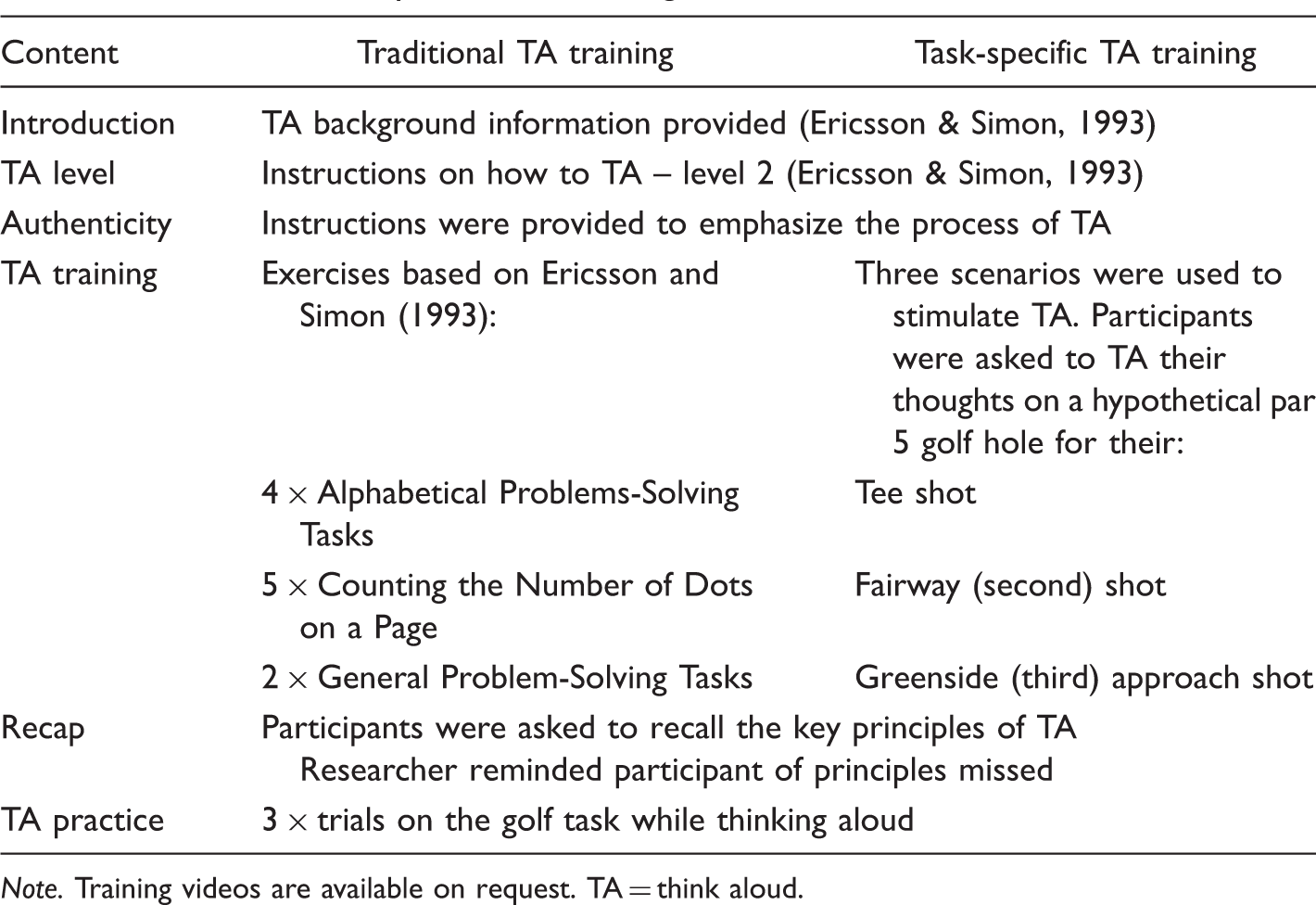
Note. Training videos are available on request. TA = think aloud.
The remainder of the videos consisted of the participants’ TA training treatment: traditional TA training or task-specific TA training. The training exercises used in the traditional TA training video were based on the recommendations of Ericsson and Simon (1993) and consisted of three different groups of tasks: (a) four alphabetical problem-solving tasks (e.g., what is the fourth letter after H), (b) five tasks counting the number of dots on a page, and (c) two general problem-solving tasks (e.g., name two vegetables that begin with the letter C). These training exercises have been used in a number of previous research studies (e.g., Nicholls & Polman, 2008; Samson et al., 2015; Whitehead et al., 2015).
The exercises used in the task-specific training video were developed for this study and consisted of three different golf scenarios: (a) Tee shot on a par 5 hole, (b) fairway (second) shot on a par 5 hole, and (c) greenside approach (third) shot over a bunker. For the first scenario, we provided the following information: It is the first hole of a monthly medal. You are standing on the first tee of a 473 yard par 5. You have been striking the ball very well and scoring very well in the lead up to this competition. It is a reasonably warm summer’s day and the course is firm and playing fast. The weather is overcast and there is a strong wind against. You are now playing your second shot on the same hole in the monthly medal. Again, you have been striking the ball very well and scoring very well in the lead up to this competition. It is a reasonably warm summer’s day and the course is firm and playing fast. The weather is overcast and there is a strong wind against. The pin is cut back right. Your ball is in the middle of the fairway and lying very nicely. Your ball is marked by the white ball on the right diagram. You are now playing your third shot on the same hole in the monthly medal. Your short game has been poor in the lead up to this competition. It is a reasonably warm summer’s day and the greens are playing firm and fast. The weather is overcast and there is a strong wind against. The flag is cut back right. Your ball is lying poorly in the left rough – marked by the white ball on the right diagram.
At the end of each description for the respective scenarios, participants were instructed, “Please use the information in the diagrams and tell us your thoughts on how you would play this shot.” At this moment, two diagrams appeared on the video to help facilitate TA. The diagram on the left provided a bird’s eye view of the hole and the yardages to and from its respective features (e.g., yardage to the bunker from the tee). The diagram on the right was a first-person view of the hole (albeit from an elevated position) and represented the information a golfer would gain while performing on a golf course. Once the participants received their TA training treatment, both groups were instructed to complete the TA training checklist to assess how well the participant had learned the requirements of TA. Finally, all participants were instructed to have three practice trials on the golf task while verbalizing to familiarize themselves thinking aloud. The traditional TA training video was 4:47 minutes in duration and the task-specific TA training video was 4:14 minutes in duration.
The golf task
The golf task was specifically designed for this study as a means to facilitate authentic short game golf shots (i.e., chipping and putting) that golfers would typically face during a round of golf. Given that every shot is different while playing a round of golf, we used three different hitting zones (see Figure 1). Hitting Zone 1 was positioned on an up-hill lie 15 m from the hole and exhibited an incline. Hitting Zone 2 was positioned on a flat lie 19 m from the hole and exhibited an incline. Hitting Zone 3 was positioned on a side-hill lie (ball below participant’s feet for a right-handed golfer) 11 m from the hole and exhibited a decline. All hitting zones were located on shortly mown grass and participants were permitted to place their ball within a 1-m squared area. The speed of the green was measured on a Stimpmeter. The total amount of feet the ball rolls from the Stimpmeter gives an approximation as to the pace of the green. The green measured an average of nine on the Stimpmeter. Participants were required to hit the ball in the hole in as few shots as possible and were allowed to select which club to use. To enhance the ecological validity of the task, a series of pressure manipulations were enforced (Baumeister & Showers, 1986). Participants were informed that they would be entered into a competition in which the participant with lowest score would receive three premium golf balls. Participants were also informed that their performance scores (i.e., amount of shots taken) would be published on a leader board that would be readily available for other participants to see before they performed their trials. Indeed, participants were informed of other participants’ scores before performing to facilitate the comparative and evaluative nature of the task.
Schematic representation of the golf task.
Measures
TA protocol
We recorded Level 2 verbalizations during the golf task. Participant verbalizations were transcribed verbatim.
Task commitment
We measured task commitment to determine the level of engagement with the task and to determine if there were differences in task engagement between participants in the two TA training groups. In accordance with research by Arsal (2013), we used the following item: “How committed were you to the task while performing?” Participants were instructed to rate their commitment on a scale, with 10% increments ranging from 0% (not at all) to 100% (very much).
TA training checklist
We designed the TA training checklist specifically for this study which required participants to recall seven key training components to successfully perform TA: (a) all verbalizations were confidential, (b) all thoughts were to be spoken, (c) refrain from explaining your thoughts, (d) use TA before and after your shot, (e) refrain from verbalizing during skill execution, (f) periods of silence will result in being prompted, and (g) swearing is permitted. This was used to assess how well the participants had learned the requirements of TA.
Self-efficacy
Self-efficacy for thinking aloud was measured to determine participants’ beliefs in thinking aloud while performing the golf task. In accordance with Bandura’s (1997) recommendation, participants indicated the strength of their self-efficacy for thinking aloud concurrently to performing the golf task by responding on a one-item Likert-type scale with 10% increments ranging from 0% (not at all confident) to 100% (completely confident).
TA social validation
Social validation procedures have been suggested as a means of strengthening the external validity of technical and practical action research by offering personal insight into the intervention through the participants’ experiences (Newton & Burgess, 2008). Social validity refers to the “consideration of social criteria for evaluating the focus of treatment, the procedures that are used and the effects that they have” (Kazdin, 1982, p. 479). Furthermore, social validation has been defined as a “supplemental method that facilitates involvement of multiple participants in the evaluation process” (Busse, Kratochwill, & Eilliott, 1995, p. 273). This study has therefore adopted a social validation approach to understand whether the participants considered the TA training procedures to be effective or acceptable (Kazdin, 1982; Wolf, 1978). In accordance with Page and Thelwell’s (2013) guidelines, we used quantitative social validation questions in an effort to better understand participants’ experiences in using TA. Participants were asked the following questions: (a) Did you enjoy the TA training? (with responses ranging from 1 = not at all enjoyable to 7 = very enjoyable); (b) How clear were the instructions in the TA training video? (with responses ranging from 1 = unclear to 7 = very clear); (c) With regards to helping you learn TA, how effective were the TA practice tasks in the training video? (with responses ranging from 1 = not at all effective to 7 = very effective); (d) With regards to helping you learn TA, how effective were the physical TA practice trials? (with responses ranging from 1 = not at all effective to 7 = very effective); and (e) Overall, how effective did you think the training was in preparing you to TA during the golf task? (with responses ranging from 1 = not at all effective to 7 = very effective). Participants were also asked the following qualitatively orientated open questions: (a) Is there anything that you would add to the TA training? And (b) Do you have any further comments regarding the TA training?
Procedure
Pilot study
In a pilot study prior to beginning this investigation, we recruited two moderately skilled golfers with handicaps of 7 and 10 and accumulated competitive playing experience of 12 and 10 years, respectively. Both golfers completed the entirety of the experimental procedure, with one receiving the traditional TA training and one receiving the task-specific TA training. Based on their feedback, participants were confident that they could verbalize while performing the golf task and that the equipment did not hinder their performance. Participants stated that the golf task was a realistic task which translated well to the golf course.
Experimental procedure
Prior to conducting the experimental procedure, all participants completed a demographic questionnaire and gave their written informed consent. All participants performed a total of 15 practice trials comprising of five trials from the three different hitting zones to familiarize themselves with the demands of the golf task (see Figure 1). Trials were performed sequentially (hitting zone 1, hitting zone 2, hitting zone 3, and so forth) to decrease the likelihood of boredom. We decided from the pilot testing that 15 practice trials were appropriate, as this provided sufficient time (without being too laborious) for participants to warm-up and familiarize themselves with the practice green. Each trial on the golf task required the participant to place the ball in the hitting zone, perform their usual pre-performance routine, hit the approach shot as they would on the golf course, walk up to where the ball finished, perform their usual pre-performance putting routine, and attempt to putt the ball into the hole in as few shots as possible. Participants were permitted to change their clubs as they normally would.
Participants then received their TA training video using an Apple iPad and Sony MDR ZX660AP headphones. Participants were required to complete the TA training checklist. To give participants an opportunity to practice using TA while performing, we gave them three practice trials. During this time, the researcher ensured the participant was competently using TA in line with the instructions given in the training video. Participants were then asked to rate their level of self-efficacy in thinking aloud while performing the golf task. Participants completed a series of nine trials on the golf task while thinking aloud. Participants were reminded to use TA throughout the nine trials and were told that if they were silent for a period longer than 5 seconds, they would be asked to resume thinking aloud. Although previous research has used 20-second (e.g., Nicholls & Polman, 2008) and 10-second (e.g., Whitehead et al., 2015) prompt durations to ensure the occurrence of verbalizations, the pilot study revealed the need to use a shorter duration prompt due to the relatively short gaps between skill executions on the golf task. A researcher walked to the side of the participants (approximately 5 m) during the golf task, and there was no communication except that the investigator reminded the participants to continue thinking aloud and what zone to hit from next (Nicholls & Polman, 2008). Other than the presence of the researcher, each participant performed alone. Participants were asked to rate their level of commitment with the golf task after the 15 practice trials and after the nine trials of thinking aloud. At the completion of the TA trials, participants completed the social validation questions and the self-efficacy scale (to assess efficacy of using TA in the future).
Data Analysis
We analyzed quantitative data gleaned from the task commitment scale, TA training checklist, self-efficacy scale, and the social validation questions using SPSS Statistics 23. Given that the data were normally distributed, we conducted a series of independent samples t tests to examine differences between the traditional TA training group and the task-specific training group.
TA Coding Framework.
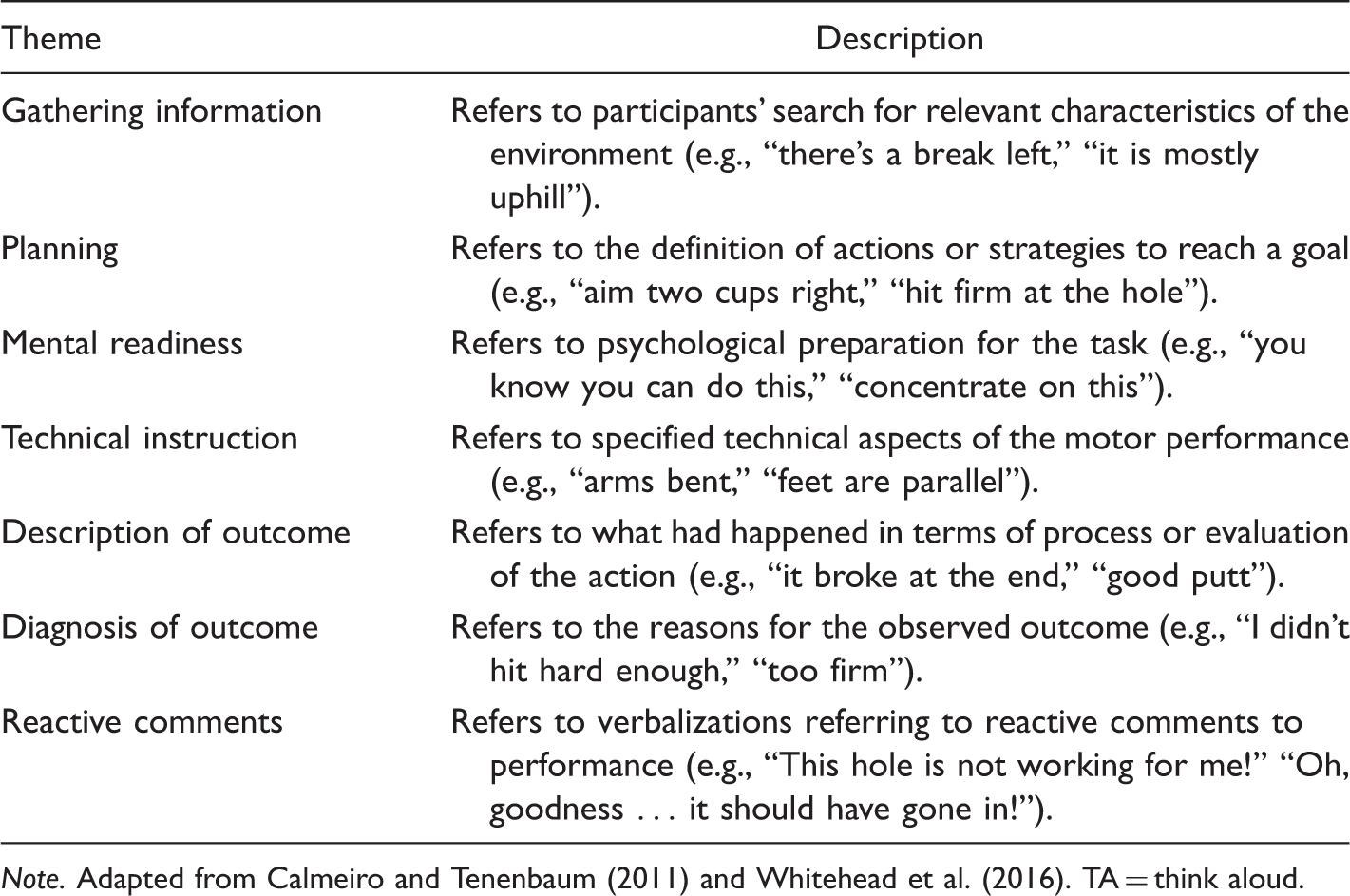
Note. Adapted from Calmeiro and Tenenbaum (2011) and Whitehead et al. (2016). TA = think aloud.
The second author independently analyzed the qualitative social validation data to ensure content familiarity. We used inductive content analysis to analyze these data (Scanlan, Stein, & Ravizza, 1989). Following previous research investigations of participants’ perceptions of using TA (Whitehead et al., 2018), we employed inductive reasoning to allow verbalization themes to emerge from the data and determined that these data generated three themes. To ensure rigor, the lead author then acted as a critical friend to ensure that data collection and analyses were plausible and defendable (Smith & McGannon, 2017).
Results
Content of TA Data
Means and Standard Deviations of Themes Verbalized, Task Commitment Scores, TA Training Checklist Scores, Self-Efficacy Scores, and Social Validation Scores Between the Traditional TA Training Group and the Task-Specific TA Training Group.

Note. M = mean; SD = standard deviation; TA = think aloud.
Task Commitment
Independent samples t tests showed no significant training group difference in postpractice commitment check scores or post-TA trial commitment check scores.
TA Training Checklist
An independent samples t test showed no significant training group difference in the amount of TA instructions recalled.
Self-Efficacy
An independent samples t test showed no significant training group difference in either postpractice perceived self-efficacy for using TA or future use perceived self-efficacy in using TA.
Social Validation—Quantitative
An independent samples t test showed a significant difference, t(9) = 2.377, p = .041, d = 1.063, in perceptions of instruction clarity between the traditional TA training group (M = 6.10, SD = 1.20) and the task-specific TA training group (M = 7.00, SD = 0), which favored the task-specific TA training group. No significant training group differences were found when comparing the remaining social validation questions (see Table 3 for descriptive statistics) for enjoyment of using TA scores, effectiveness of the in-video TA training tasks, effectiveness of the physical TA practice trials, or overall TA training effectiveness.
Social Validation—Qualitative
Analyses of verbal responses revealed three main themes within these data: Confidence, Task Understanding, and Further Support. Within these themes, it was apparent that participants in the traditional training group and the task-specific training group exhibited different qualitative thoughts about their training, detailed as follows.
Confidence
Both the traditional training group and the task-specific training group reported being confident in their use of TA. However, within the traditional training group, some participants reported that they may not have always verbalized everything that they would be thinking, as they were not always comfortable disclosing their thoughts. Participant 9 (traditional TA group) stated, “Some things I did not say, as I was not fully familiar with the task and not used to blurting things out.” Conversely, the task-specific group exhibited confidence in their ability to follow the training and use TA. For example, Participant 4 (task-specific TA training group) stated, “They were good because they played as a scenario that I could think and apply it to my own ability.”
Task understanding
Both the traditional and the task-specific training groups reported a general consensus that they understood the training tasks they were given. However, within the traditional TA training group, some participants reported losing their way and questioned some of the TA training tasks. For example, Participant 11 (traditional TA training group) stated, “I lost my way a bit through the training,” and Participant 13 stated, “The dots were effective, but the other parts of the task, not so much.” Participant 10 (task-specific TA training group) reported, “Yeah, it just gets you into the mode of thinking, with a prompt here or there if I wasn’t or when I should be doing. So it was good. Very helpful.” Participant 14 (task-specific TA training) stated, “I just thought it was pretty simple. It just wasn’t too complicated as well, and I was clear about what I had to do.”
Future support
Both TA training groups suggested that supplementary support would aid their ability to use TA proficiently. However, the recommendations provided were different, depending on the type of training received. Participants in the task-specific training group generally reported that they would like to have had more support in using TA in the future and be reassured that the process requires all thoughts to be verbalized. For example, Participant 10 (task-specific TA training group) stated, “I’d probably like to do more of it as it was a really good learning tool.” Furthermore, participants in the task-specific TA training group also reported that they would like to be reminded more, within the initial training, that all thoughts, no matter how obscure, should be verbalized. For example, Participant 2 (task-specific TA training group) stated, “I would have liked to be re-assured more that even strange thoughts should be spoken out loud.” Conversely, participants in the traditional TA training group reported that they needed feedback as to whether they were doing TA properly and would have liked more exercises linking TA to the golf environment. For example, Participant 11 stated, “I would have liked more comments around the process of TA,” and participant 2 (both traditional TA training group) specified, “It could have been more golf related.” Furthermore, Participant 15 (traditional TA training group) expressed the need for a clearer link to golf by stating, “I would have liked more feedback in terms of how the thinking aloud will then relate to golf and if I’m doing it properly.”
Discussion
The first aim of this study was to investigate whether the form or type of TA training would impact verbalization frequency. Our results led us to reject our hypothesis that the task-specific TA training would result in significantly more verbalizations when compared with the traditional TA training. We found no significant differences in verbalization frequency across the analyzed categories between the traditional TA training group and the task-specific TA training group (see Table 3). According to information processing theorists (e.g., De Groot, 1978; Elliot et al., 2010), familiarity of the stimuli to mental representations stored in LTM facilitates learning new skills. This was the basis for our hypothesis that task-specific training would yield more verbalizations than traditional TA during later use of TA. Despite the intuitive logic of this hypothesis, our data indicated no differences in verbalization frequency between these two TA training instructions, seemingly suggesting that rich TA verbalizations have been captured through the exclusive use of traditional TA training instructions in previous studies (e.g., Aitken & Mardegan, 2000; Nicholls & Polman, 2008; Samson et al., 2015) and that studies that used combined traditional and task-specific TA training instructions (e.g., North et al., 2011; Runswick et al., 2018; Whitehead et al., 2015) were comparable. This finding validates the large volume of studies that relied exclusively on Ericsson and Simon’s guidelines (1993).
The second aim of this study was to determine whether TA training type would impact participants’ subjective perceptions of TA training effectiveness. Overall, our hypothesis that task-specific TA training would result in more favorable participant perceptions of training effectiveness compared with traditional TA training was rejected. Analysis of the TA training checklist data revealed no significant differences between the training groups. Similarly, analysis of the self-efficacy data indicated no significant differences between the training groups, with both groups reporting very high levels (>86%) of self-efficacy to perform TA. Furthermore, analysis of the quantitative social validation data generally revealed no significant differences in perceptions of TA training, with both groups reporting that the TA training was enjoyable and effective (see Table 3). From a theoretical standpoint, these data are surprising, since we expected task-specific TA training to form stronger participant connections with mental golf representations of TA stored in their LTM, leading them, in turn, to grasp TA more effectively and become more efficacious in using TA. These contrary findings suggest that participant perceptions of TA training in studies that relied exclusively on traditional TA training instructions (e.g., Aitken & Mardegan, 2000; Nicholls & Polman, 2008; Samson et al., 2015) were similar to studies using combined traditional and task-specific TA training instructions (e.g., North et al., 2011; Runswick et al., 2018; Whitehead et al., 2015).
We did find a significant training group difference in participant perceptions of instruction clarity, providing some support for our contention that participants who received task-specific instructions would form stronger representations of TA in golf environments in their LTM, leading them to perceive task-specific instructions as having greater clarity with regard to their expectations of thinking aloud while playing golf. This specific analysis of the qualitative social validation data provides support for our contention that task-specific TA training may offer advantages over and above the traditional TA training procedures. When asked to further articulate their thoughts and feelings about their training, participants offered a number of meaningful insights about their experiences of learning and using TA. First, regarding the Confidence theme, participants receiving traditional TA instructions reported a lack of confidence in disclosing all their thoughts as they “weren’t fully familiar with the task.” Second, regarding the Task Understanding theme participants who received traditional TA training said that they needed further clarification on how to do TA and how the technique can be applied to golf and the task at hand. Finally, regarding the Future Support theme, participants in the traditional TA group expressed the need for the training exercises to have clearer links to golf. Again, this may link to the need for familiarization within the context of a given task; learning TA through task-specific instructions may be easier for participants within the specific context of golf, in this instance. While studies exclusively using traditional TA training instructions (e.g., Aitken & Mardegan, 2000; Nicholls & Polman, 2008; Samson et al., 2015) have captured valuable verbalization data, the instruction clarity and qualitative social validation data gleaned in this study suggest that the richness of verbalizations and participant confidence may have been enhanced by including task-specific training instructions. In this area, the instruction clarity and qualitative social validation data therefore serve to support previous studies which have used a combination of traditional and task-specific TA training approaches (e.g., North et al., 2011; Runswick et al., 2018; Whitehead et al., 2015).
Although this study successfully investigated TA training methods, study limitations include a lack of female representation within our participant sample. Indeed, close inspection of the literature reveals a general weakness in this regard in that very few studies (e.g., Arsal et al., 2016; Calmeiro & Tenenbaum, 2011; Kaiseler, Polman, & Nicholls, 2010; Whitehead et al., 2018) have included female participants. There is clearly a need for future research to examine TA protocols with representative female samples to better understand how TA can be best trained and utilized with persons of both sexes. Furthermore, future research should consider applying the methodology adopted within this study to different domains where TA has been adopted, such as medical and educational settings. A further consideration within this study could be the expertise level of the participant. Although this study ensured that both groups held a very similar skill level (i.e., golf handicap), this could be something for future researchers to consider when training participants to use TA.
Overall findings from this study indicated no differences in verbalization or content frequency and perceptions of training effectiveness between the traditional TA training protocols outlined by Ericsson and Simon (1993) and the task-specific TA training protocols designed for this study. This finding lends support to existing methods of TA training on which most past literature is based in sport and exercise psychology and beyond. In addition, this study’s findings provide confidence to researchers and practitioners seeking to train TA effectively. However, our findings also suggest that traditional TA training protocols may be enhanced, at least in terms of participants’ perceptions of their clarity by the use of task-specific training exercises. In an article outlining the utility of TA, Eccles and Arsal (2017) advocated the use of warm-up exercises to ensure that participants are familiar with verbalizing their thoughts out loud. Indeed, Eccles and Arsal (2017) outlined common pitfalls in applying the TA method, and specifically named among these: (a) allowing and encouraging descriptions and explanations of thoughts, (b) failing to use warm-up exercises, (c) thinking aloud for too long, and (d) possible concerns regarding participant reactivity. Given the findings from our controlled manipulations of TA training methods, future TA researchers and practitioners are strongly encouraged to harness Ericsson and Simon’s (1993) guidelines to train TA but also to integrate task-specific training exercises to enhance participant perceptions of the training process. While previous research (e.g., North et al., 2011; Runswick et al., 2018; Whitehead et al., 2015) has used a combination of traditional and task-specific instructions to train TA, this is the first study to provide an empirical test of advantages to this approach. While using task-specific instructions may not be essential, in the context of unfamiliar tasks, they may help participants with perceived TA instructional clarity.
Upon analyzing the qualitative data gleaned from this study, it is clear that participants valued the use of feedback and reiteration of principles when learning how to effectively TA. To the author’s knowledge, this study is the first to harness social validation methods to examine participant perceptions of TA and more specifically, how to best train TA. Although it was not possible to provide spoken feedback to participants in this study without compromising experimental control, researchers and practitioners are encouraged to monitor TA training progress (e.g., by using social validation methods such as TA checklists, measures of TA efficacy and open questioning) to ensure all participants learn how to effectively TA before data collection commences. It is important to note that previous research has used methods to monitor the learning of TA within training protocols (e.g., North et al., 2011), yet similar to the TA training instructions presented in the literature, the use of such learning monitoring methods has been inconsistent. Implementing more thorough TA training procedures will not only enhance the participant’s confidence of thinking aloud but will also enhance the rigor underpinning verbalizations, and in turn, the authenticity of verbalizations captured.
Footnotes
Acknowledgments
The authors would like to thank Chris Dowrick for collecting the data for the study.