




Abstract
Single leg balance training promotes significant increments in balance control, but previous reviews on balance control have not analyzed this form of balance training. Accordingly, we aimed to review the single leg balance training literature to better understand the effects of applying this training to healthy individuals. We searched five databases—PubMed, EMBASE, Scopus, Lilacs, and Scielo—with the following inclusion criteria: (a) peer-reviewed articles published in English; (b) analysis of adult participants who had no musculoskeletal injuries or diseases that might impair balance control; and (c) use of methods containing at least a pre-test, exclusive single leg balance training, and a post-test assessment. We included 13 articles meeting these criteria and found that single leg balance training protocols were effective in inducing balance control gains in either single- or multiple-session training and with or without progression of difficulty. Balance control gains were achieved with different amounts of training, ranging from a single short session of 10 minutes to multiple sessions totaling as much as 390 min of unipedal balance time. Generalization of balance gains to untrained tasks and cross-education between legs from single leg balance training were consistent across studies. We concluded that single leg balance training can be used in various contexts to improve balance performance in healthy individuals. These results extend knowledge of expected outcomes from this form of training and aid single leg balance exercise prescription regarding volume, frequency, and potential progressions.
Introduction
Published literature reviews have concluded that athletes (Brachman et al., 2017), healthy adults (Paillard, 2017), stroke patients (Veerbeek et al., 2014), and older adults (Lesinski et al., 2015; Low et al., 2017) benefit from balance training. Key outcomes have included reduced injury risks (Hübscher et al., 2010) and incidence of falls (Horak, 2006). Lesinski and colleagues (2015) proposed that, for balance training to be effective for increasing balance stability, a relevant training component is the challenge/difficulty imposed by the task. A potential strategy for increasing balance difficulty in training tasks is using a single leg stance to reduce the base of support, as this reduction challenges the neuromotor system to maintain body balance (Muehlbauer et al., 2012). Thus, there is evidence that single leg stance can be employed in balance training to impose a high balance demand, and several balance training programs have relied exclusively on single leg balance tasks throughout the training sessions (Kamikura et al., 2018; Vernadakis et al., 2012).
Previous research has investigated adaptation mechanisms associated with balance training through single leg stance. After a single trial in young adults’ unipedal balance training on an unstable platform, van Dieën et al. (2015) found that the neuromotor system quickly adapted to this challenge by reducing thigh and hip muscle activation, in association with decreased amplitude of center of mass oscillation. Similarly, others have found impressive gains in balance performance through single session (Marcori et al., 2020; Yasuda et al., 2018) or multiple-session (Laufer, 2008) training. Given its potential to improve balance stability to high levels, single leg balance training seems to be an alternative approach to more traditional balance training programs that have used bipedal exercises. Another interesting aspect of single leg balance training is its potential for cross-education (Paillard, 2017). Balance training on one leg can lead to performance gains of the contralateral leg (Zhou, 2000). Evidence from a limited number of studies to date that have investigated this phenomenon suggests that, after single leg balance training, performance gains of the contralateral leg are very similar to those observed in the trained leg (Laufer, 2008; Marcori et al., 2020).
The total time spent on single leg stance training throughout an intervention can be fundamental to interpreting the distinct results of previous studies. Even though previous literature reviews have analyzed the dose–response relationship of general interventions for balance training (Gebel et al., 2018; Lacroix et al., 2017; Lesinski et al., 2015), none of these reviews specifically evaluated training programs that applied exclusive single leg balance training. To the best of our knowledge, this is the first review to compile evidence of this method of balance training. Our aim in this systematic review was to analyze experimental research reporting the effects of single leg balance training applied to healthy individuals. In selecting studies for this review, we sought investigations that included at least a pre- and post-test assessment after an exclusive single leg balance intervention period. Our specific goals were to describe from these studies (a) the equipment, evaluation methods, and main outcomes of training; (b) training duration, frequency, and practice time; (c) task difficulty increments (progression) across training; and (d) balance control gains achieved.
Method
We followed the Preferred Reporting Items for Systematic Reviews and Meta-Analysis (PRISMA) recommendations (Moher et al., 2009) as closely as possible to conduct this review, and we indexed this review in the Prospective Register of Systematic Reviews (PROSPERO) database.
Inclusion Criteria
For this systematic review, we included results from research that aimed primarily to analyze the outcomes of single leg balance training in healthy younger and older adults. Additionally, our inclusion criteria were that (a) articles be peer-reviewed and published in English; (b) methods contained at least a pre-test, exclusive single leg balance training, and a post-test; and (c) participants were without musculoskeletal injuries or diseases that might impair balance control. Eligible articles had to present complete information regarding the training protocol, either in the main text or as supplementary material, and their methodological procedures had to lead to a sound conclusion.
Search Strategy
In our first step, our systematic search was for all articles published up to January 13th, 2021. Our search terms were: (“single leg [text word] OR “monopedal” [text word] OR “unipedal” [text word] OR “one leg” [text word]) AND (“balance training” [text word] OR “equilibrium training” [text word]). After performing the search, we applied filters for article language (English only) and type of content (articles only). Moreover, to not rely solely on review filters in the search engine, which can lead to overlooking interesting articles, we undertook a further manual search of the reference lists of selected articles to complete the article selection process. Next, two authors (AJM, and PHMM) independently analyzed all the retrieved articles to determine whether they met our inclusion criteria. Initially, articles were screened by reading their titles and abstracts. If the article was considered within our scope, it was read in full to confirm its eligibility for inclusion. In cases of divergence between the two authors performing these independent determinations, a third author (JAO) was consulted to assist a consensus.
Eligibility, Assessment Quality and Risk of Bias
We rated selected articles using the Physiotherapy Evidence Database (PEDro) scale. We selected this instrument for to its capacity to optimally measure the methodological quality of exercise interventions (de Morton, 2009). For these ratings, two authors (AJM and PHMM) independently rated the article using the PEDro scale. We calculated the Kappa coefficient to verify the level of agreement between these raters. We did not use the PEDro scale score as an eligibility criterion, but rather, as a critical descriptive critical tool for judging the quality of the research interventions. Figure 1 presents the flowchart of the selection process. Systematic Review Flowchart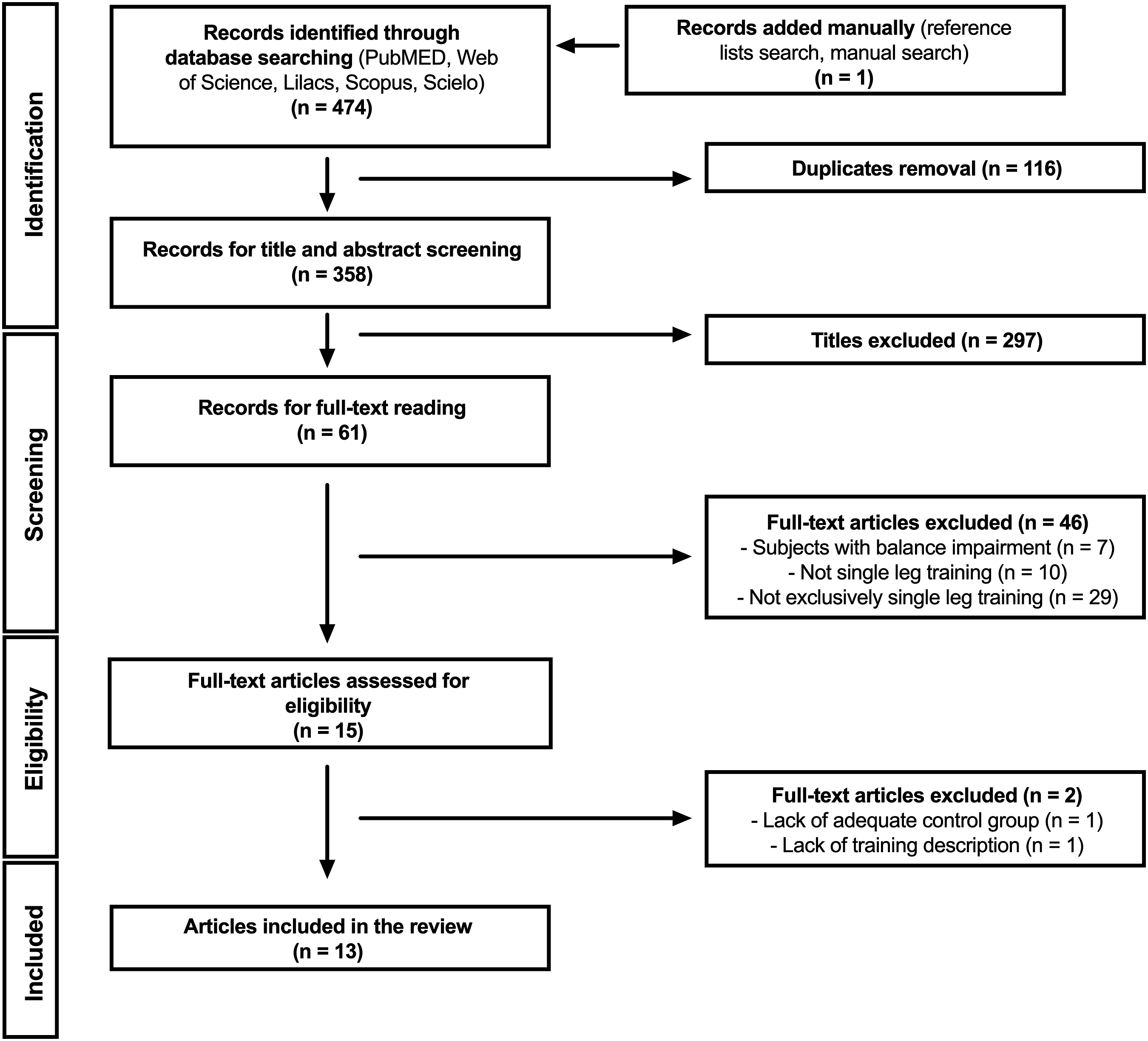
We undertook data extraction and summary according to the author, publication year, sample size, age, sex, training intervention characteristics, methodological protocols, outcome measurements, and main results. We extracted other information regarding calculations of training volume based on the methods section of each article whenever possible. The difference in percentage change from the baseline of the main variable of each study was calculated by the following equation:
Results
We included 13 articles in the present review (Giboin et al., 2018; Kamikura et al., 2018; Laufer, 2008; Li et al., 2016; Marcori et al., 2020; Oliveira et al., 2013; Rothermel et al., 2004; Schlenstedt et al., 2017; Silva, Mrachaez-Kersting et al., 2018; Silva, Oliveira et al., 2018; van Dieën et al., 2015; Vernadakis et al., 2012; Yasuda et al., 2018).
Among selected articles, the median PEDro score was 5 (range: 4–6), indicating experiments of moderate quality within these articles (Cashin & McAuley, 2020). We considered this level of methodological quality sufficient for interpretations of most findings. Specific PEDro scores for each experiment are presented below (see Figure 2). One included article had a single-group experimental design and was not rated with the scale (van Dieën et al., 2015). Cohen’s Kappa coefficient revealed a raters’ agreement score of 0.89 (p < .001), indicating excellent interrater agreement. The most common methodological weakness in these studies was a lack of blind assessors, participants, and therapists (trainers, in this case) when assessing outcomes. An improvement in this methodological aspect of future studies would reduce risk of bias, especially in research designs with more than one group. Outcomes from Physiotherapy Evidence Database Scale Quality Assessment. NA = information not available.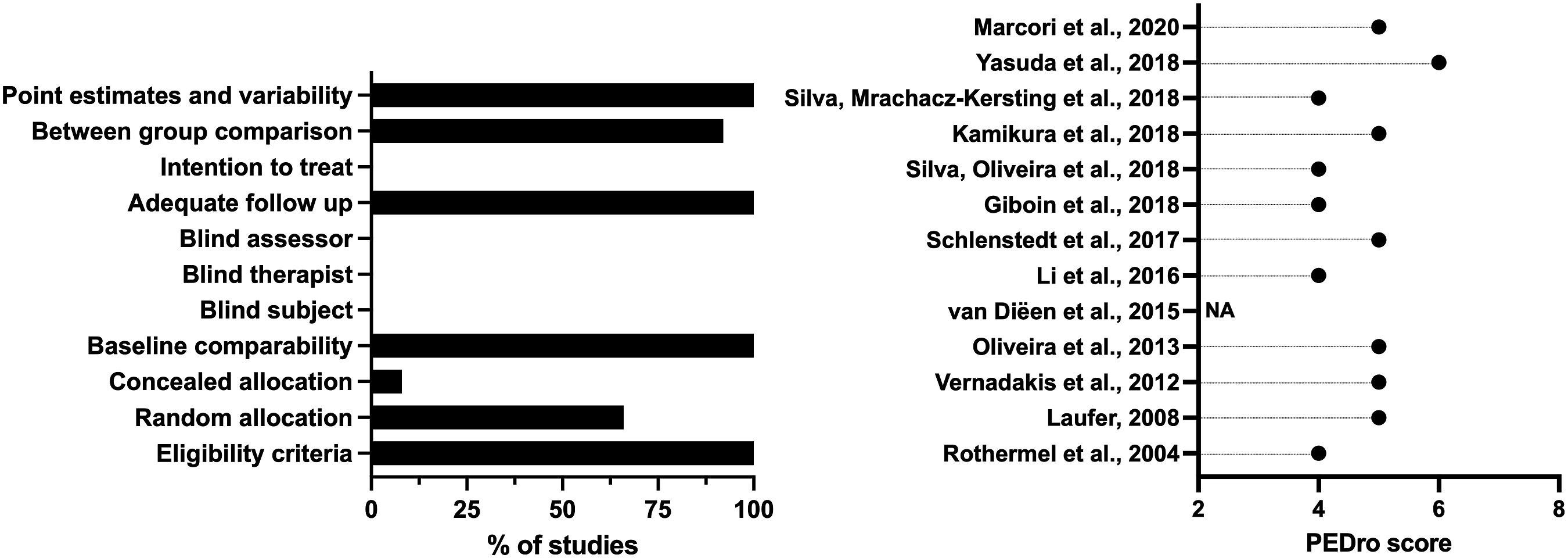
Characteristics and main results of the single leg balance training interventions included in the review.
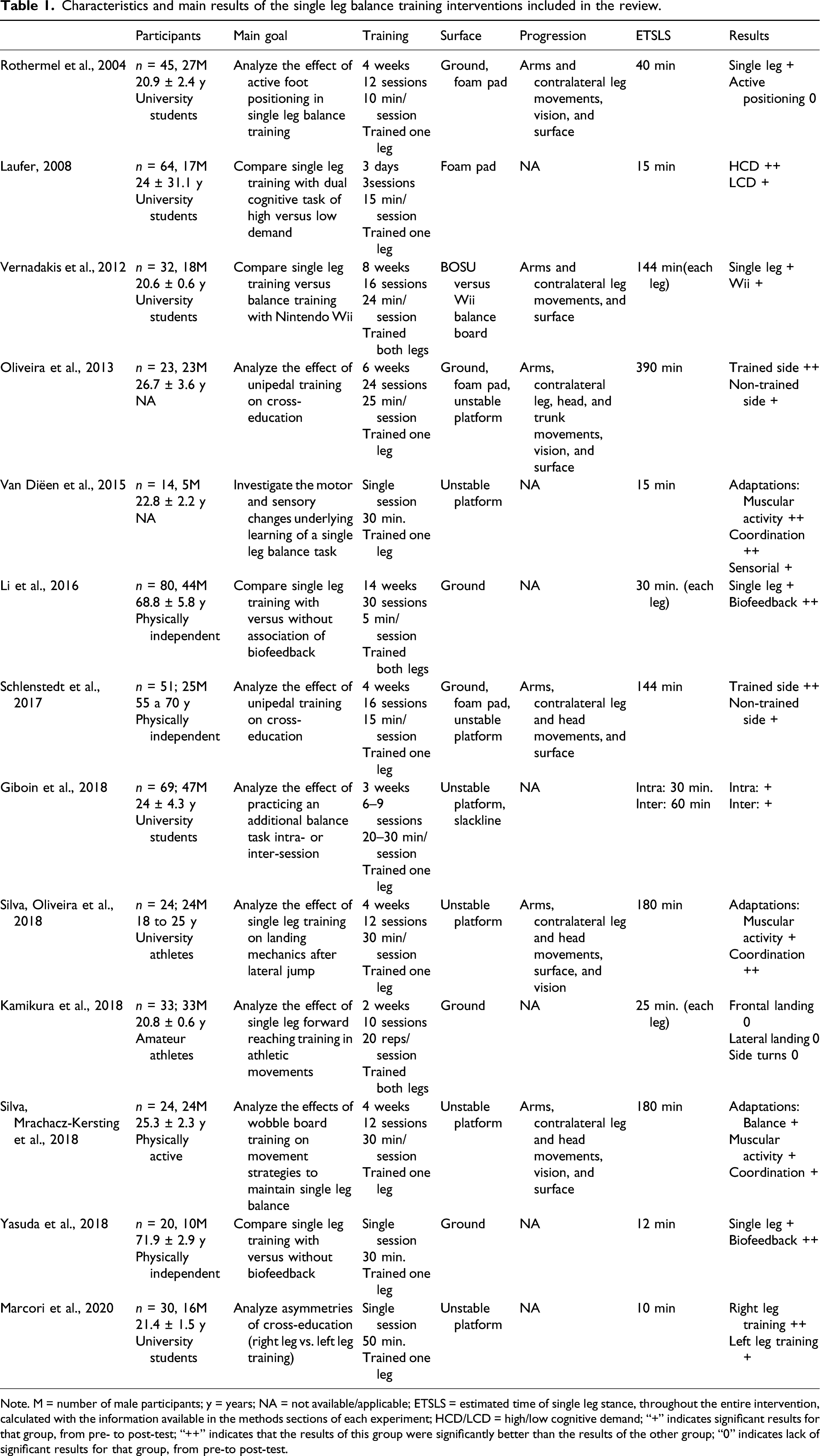
Note. M = number of male participants; y = years; NA = not available/applicable; ETSLS = estimated time of single leg stance, throughout the entire intervention, calculated with the information available in the methods sections of each experiment; HCD/LCD = high/low cognitive demand; “+” indicates significant results for that group, from pre- to post-test; “++” indicates that the results of this group were significantly better than the results of the other group; “0” indicates lack of significant results for that group, from pre-to post-test.
Based on the information provided in the methods section of each study, we estimated the amount of time that participants actually spent in unipedal stance and found that, for single-session experiments, 10–15 min was sufficient to induce adaptations in balance control, such as increments in balance time on a tilt platform (Marcori et al., 2020; van Dieën et al., 2015). In multi-session interventions lasting over two weeks, estimated session times spent in single leg stance ranged from 40–390 min (see Table 1). Based on these results, it seems that a minimum of 40 min of unipedal stance accumulated throughout an intervention was sufficient to improve balance performance. However, a dose–response relationship could not be properly calculated, due to differences across studies in training, measurements, and experimental settings. Thus, it is not possible to estimate how much extra time spent training in multi-session programs affected incremental balance gains.
To suggest a minimal training volume that might elicit positive outcomes, we individually analyzed each experimental protocol and its results. The studies that provided at least 25 min per week of single leg balance over a minimum of four weeks yielded robust and persistent balance gains that were also transferred to different tasks (Gadre et al., 2019; Oliveira et al., 2013; Schlenstedt et al., 2017; Silva, Mrachacz-Kersting et al., 2018; Silva, Oliveira et al., 2018). Hence, this volume of single leg balance training may be the minimal amount required to produce significant improvements in balance, and it represents our recommendation for future studies.
Overall results of the main outcome of each experiment are presented in Figure 3. Twelve of the thirteen studies indicated a significant difference from pre- to post-test for the single leg training group (see Table 1 for more details). As shown in the detailed methodological characteristics of the reviewed experiments in Table 2, significant gains in balance performance were observed in different variables, like CoP length, CoP velocity, balance time on a tilt board, stability index, and muscular activity. While a meta-analysis could not be performed due to high heterogeneity between experiments, these results point toward a shared positive outcome for balance training in distinct analysis, variables, and training settings. Difference in Percentage Change from Baseline for the Main Outcome of Each Experiment. The black square and horizontal bars represent the average and standard deviation across experiments, respectively; NA = information not available. Methodological aspects of the single leg balance training interventions. Note. CoP = Center of pressure; CoM = center of mass.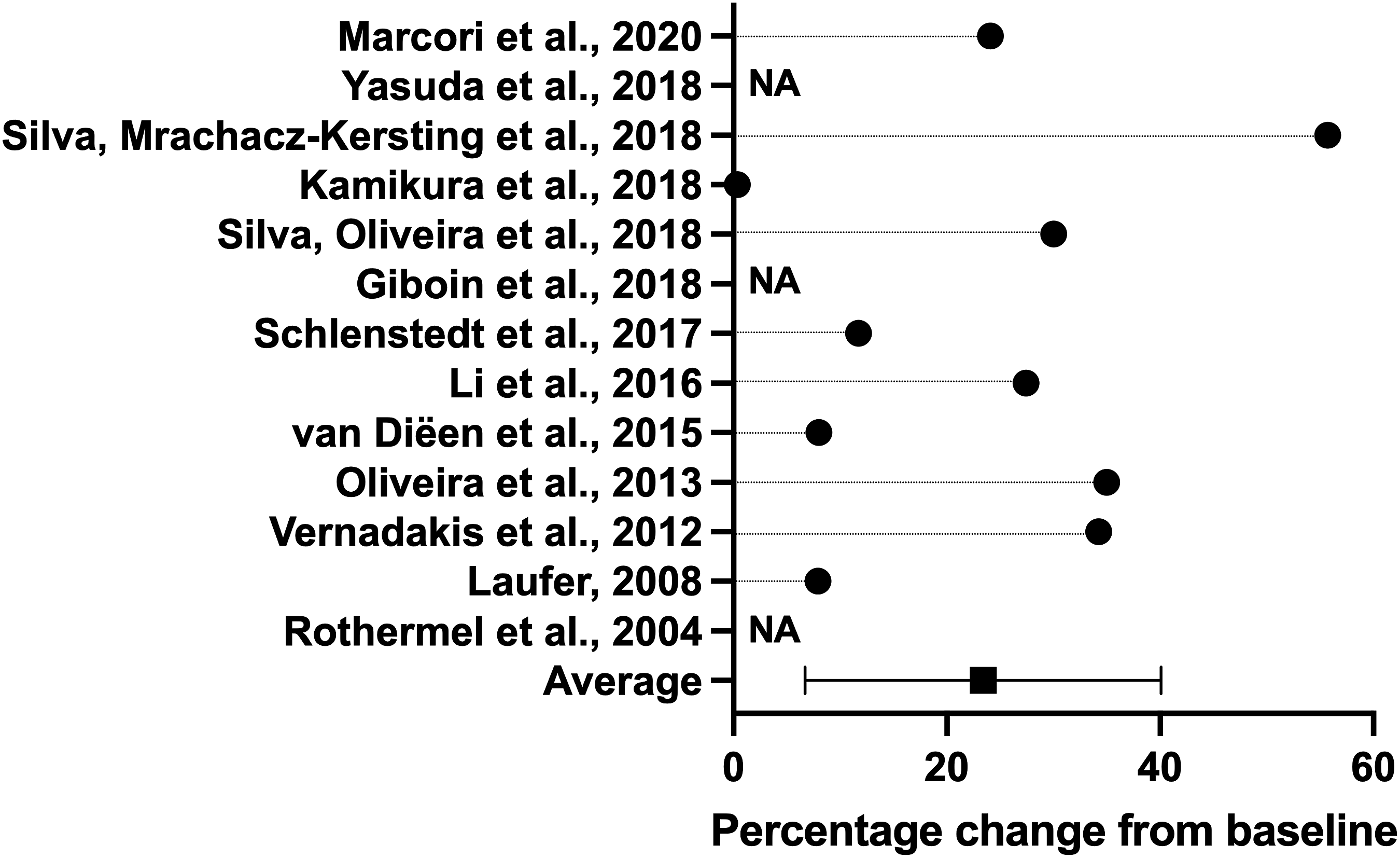
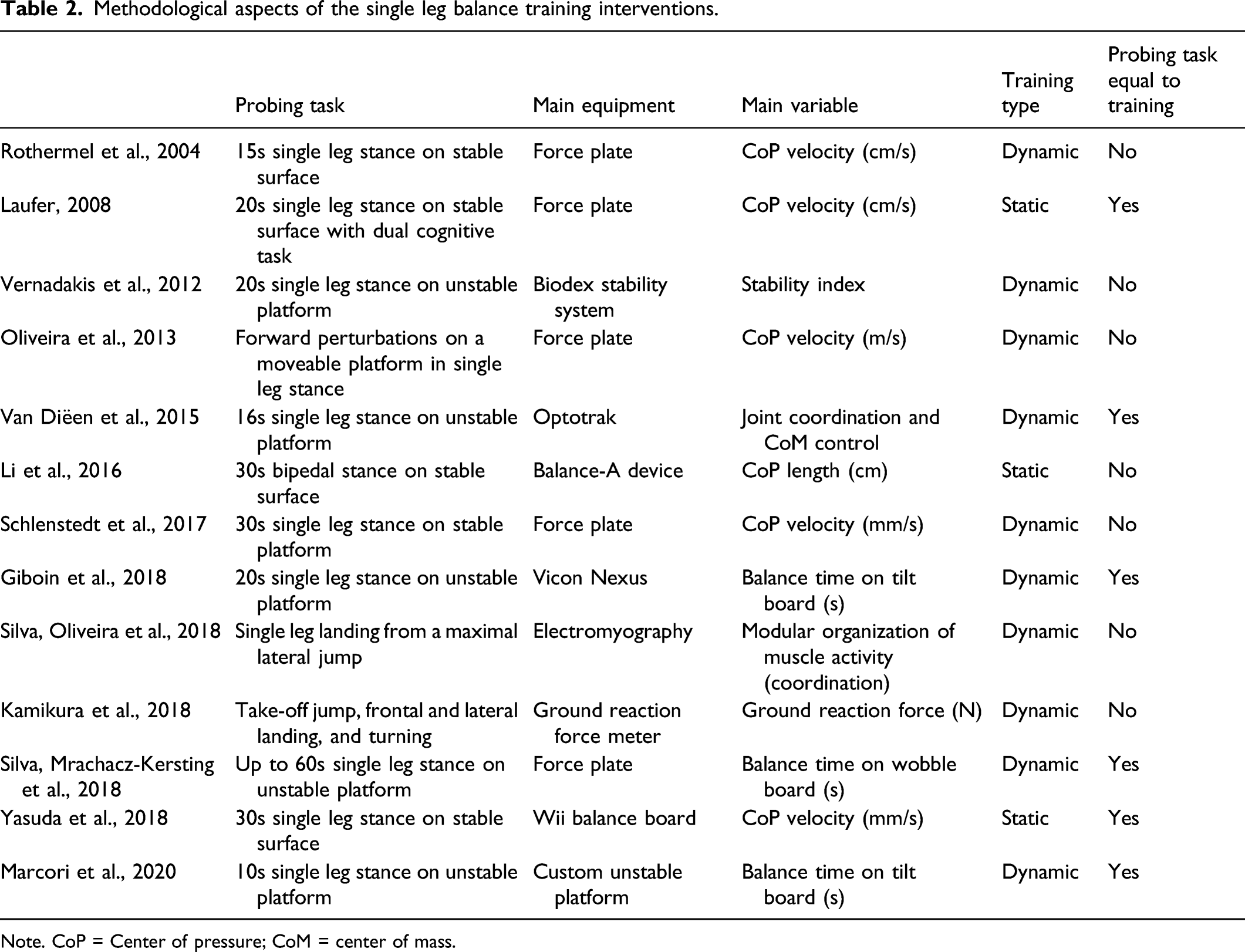
Most investigations used a force plate or equivalent device to evaluate balance stability, based on CoP displacement amplitude or velocity (Laufer, 2008; Li et al., 2016; Oliveira et al., 2013; Rothermel et al., 2004; Schlenstedt et al., 2017; Silva, Mrachacz-Kersting et al., 2018; Vernadakis et al., 2012; Yasuda et al., 2018). The other studies analyzed effects of unipedal balance training through ground reaction forces with a specific device (Kamikura et al., 2018), movement patterns and coordination through kinematic analysis (Giboin et al., 2018; van Dieën et al., 2015), total balance time measured with a custom platform or reflective markers (Marcori et al., 2020; Silva, Mrachacz-Kersting et al., 2018), and muscle activation pattern through electromyography (Silva, Oliveira et al., 2018).
The experimental tasks used for evaluation varied in time, length, and support surface. Evaluation time length was 10–60 sec, with most quiet standing protocols lasting about 30 sec. The support surface for evaluation was either stable, like the surface of a force plate, or unstable like a tilt platform or a wobble board. A single experiment assessed perturbed posture by applying unpredictable translations of the support base while participants stood on a unipedal stance (Oliveira et al., 2013). Other experiments used tasks closer to the sporting context, such as lateral jumping (Silva, Oliveira et al., 2018) and a sequence of athletic movements such as turning, landing and jumping (Kamikura et al., 2018). Only a few of the included studies employed more than one type of equipment in their evaluation protocol, sometimes combining force plate with EMG (Oliveira et al., 2013; Silva, Mrachacz-Kersting et al., 2018) or kinematic analysis (Silva, Oliveira et al., 2018).
Discussion
In the present review, we aimed to analyze experimental research that investigated the outcomes of single leg balance training in healthy younger and older adults. Moreover, we sought to describe the training protocols, progression, structure, main outcomes, and potential implications of these studies. Thus, we will discuss our findings in the context of recent literature regarding balance control, emphasizing the effects of single leg balance training and offering suggestions for future research.
Training Protocols, Progression, and Structure
To promote improvements in balance control, most studies we reviewed employed structured training progressions. Arm, contralateral leg, and trunk movements were sometimes added throughout the training sessions to increase the participants’ challenge during the intervention period (Kamikura et al., 2018; Oliveira et al., 2013; Rothermel et al., 2004; Schlenstedt et al., 2017; Silva, Mrachacz-Kersting et al., 2018; Silva, Oliveira et al., 2018; Vernadakis et al., 2012). Another strategy used to promote training progression was increasing surface instability (Oliveira et al., 2013; Rothermel et al., 2004; Schlenstedt et al., 2017; Silva, Mrachacz-Kersting et al., 2018; Silva, Oliveira et al., 2018; Vernadakis et al., 2012). Some increased task difficulty over training sessions through segmental movements (Kamikura et al., 2018; Oliveira et al., 2013; Rothermel et al., 2004; Schlenstedt et al., 2017; Silva, Mrachacz-Kersting et al., 2018; Silva, Oliveira et al., 2018; Vernadakis et al., 2012), starting by requiring participants to keep a quiet stance, and progressively adding arm, trunk, and free leg movements (e.g., shoulder flexion-extension, hip flexion-extension, reach out movement with trunk flexion, and combination of arm and leg movements). More complex tasks involved using the upper limbs, like for catching and throwing a ball, and bouncing a ball on the floor (Silva, Mrachacz-Kersting et al., 2018; Vernadakis et al., 2012). Head tilts, sideways and back and forth, were also applied to increase balance difficulty (Silva, Oliveira et al., 2018). Each experiment provided their own unique progression structure, while the common point across investigations was complexity, incrementally increasing requirements for coordinative movements with moving limbs. For instance, simple arm movements (such as shoulder flexion) might be performed first, with catching and throwing a ball coming later in the training program. Participants progressed throughout the training sessions, or within a session, based on the criterion of being able to perform a set of required movements. Once those movements could be performed with minor imbalances, progressions were made toward more challenging tasks.
These manipulations of complex multi-limb movements may be optimal for single leg training, as recent evidence has shown that the upper limbs, trunk, and the contralateral leg are consistently used to compensate for balance perturbations (de Souza et al., 2019). These segments have been shown to play a role in maintenance (Teixeira, et al., 2018) and recovery (Lowrey et al., 2017) of dynamic balance control, suggesting that balance control involves whole-body movements. Hence, training multi-limb movements in single leg stance could tackle this precise adaptation of balance control, offering the opportunity to fine-tune this complex motor strategy for maintaining body balance.
Progressions through manipulations of support base malleability were made by using equipment like foam pad, BOSU, and wobble board (Oliveira et al., 2013; Rothermel et al., 2004; Schlenstedt et al., 2017; Silva, Mrachacz-Kersting et al., 2018; Silva, Oliveira et al., 2018; Vernadakis et al., 2012). The most common means of applying this progression was to change from stable (ground) to unstable surfaces once participants were able to perform the required set of movements selected for that phase of the training program. Studies in which training progression was implemented through surface instability were the same studies that employed progressions through multi-limb movements (Oliveira et al., 2013; Rothermel et al., 2004; Schlenstedt et al., 2017; Silva, Mrachacz-Kersting et al., 2018; Silva, Oliveira et al., 2018; Vernadakis et al., 2012). Due to this overlap, it was not possible to separate the contributions of surface instability and multi-limb movements as paths to dynamic balance stability gains. It is worth mentioning, however, that a previous systematic review of balance training in healthy adults suggested that challenging the neuromotor system by either requiring stabilization on unstable surfaces or making other complex body movements might produce equivalent effects (DiStefano, et al., 2009). The question as to which form of progression promotes better outcomes in single leg balance training is still to be answered. Additionally, no investigation directly compared whether adding progressions would produce better results in balance performance. Thus, the question remains open as to whether different types of progressive training (with more challenging progressions vs. protocols with a single exercise) differentially affect balance performance outcomes.
We identified a study that applied multi-limb movements in single leg stance for older adults (Schlenstedt et al., 2017). This study found significant improvements in CoP stability during quiet single leg stance after four weeks of training in which there were progressive increments in balance difficulty through the addition of increasingly complex movements with the free leg, arms, and head. However, the control group in this study was sedentary, leaving unanswered the question of whether training with a less challenging protocol, such as bipedal exercises usually prescribed to older adults, would produce different results. The other studies in this review that assessed older adults applied static single leg balance training without training progression, and these investigators also showed balance performance gains among their participants (Li et al., 2016; Yasuda et al., 2018) (see Table 1). Since training (duration, frequency) and evaluation (experimental task, equipment) protocols differed between these investigations, direct comparisons of these studies’ findings are not possible. We should mention, however, that even with a short intervention time of two minutes per day of single leg stance and without any type of progression in challenge, these researchers observed increased balance stability when participants were evaluated in quiet bipedal stance (Li et al., 2016). Similarly, they observed better balance control, as indicated by decreased CoP velocity, after a single session of single leg balance training for older adults (Yasuda et al., 2018). Results from these two older adult experiments (Li et al., 2016; Yasuda et al., 2018) reveal the efficacy of single leg balance training when used to promote positive adaptations even without difficulty progression in this population.
Training Outcomes
We observed different adaptations among participants in these studies, mainly due to the different measurement protocols, experimental tasks, and equipment used across the experiments. The most common finding among these studies was a reduction in CoP displacement (Laufer, 2008; Rothermel et al., 2004; van Dieën et al., 2015; Vernadakis et al., 2012) and velocity (Oliveira et al., 2013) after training. Older adults also showed reduced CoP displacement and velocity following single leg balance interventions (Li et al., 2016; Schlenstedt et al., 2017; Yasuda et al., 2018). These CoP-related adaptations are postulated as a positive aspect of postural control (Winter, 1995), as they reflect the neuromotor system’s capacity to integrate afferent and efferent inputs to maintain balance (Horak, 2006). Moreover, recent evidence has suggested that reduced CoP displacement assessed in quiet stance can be interpreted as an attempt to minimize sway amplitude to promote safety and a more stable postural position (Borzucka et al., 2020) — an adaptation observed in both younger and older adults (Carpenter et al., 2006). Thus, an important improvement in postural control was provided by single leg balance training.
Two other relevant adaptation features following single leg balance training were (a) reduced lower limb muscle activation (Oliveira et al., 2013; Silva, Mrachacz-Kersting et al., 2018; Silva, Oliveira et al., 2018; van Dieën et al., 2015), and (b) refined whole-body dynamic coordination in using the arms, contralateral leg, and trunk to maintain balance (Silva, Mrachacz-Kersting et al., 2018; van Dieën et al., 2015). These two adaptations suggest an initial suboptimal strategy in which participants focused on increasing muscular activity and co-contraction levels of the ankle and shank muscles to reduce joint oscillations. With training, this strategy was gradually replaced by a more effective and integrated whole-body dynamic control, enhancing balance performance. Even though one of the main strategies used to maintain balance in challenging postures is the hip strategy (Freyler et al., 2015), recent evidence has shown active participation of the contralateral leg, trunk, and arms to maintain balance in perturbed conditions (de Souza et al., 2019). Thus, single leg balance training with multi-limb movements can promote specific adaptations, leading, in turn, to increased dynamic balance stability.
Balance assessment using a tilting or unstable platform revealed increased balance time after training (Giboin et al., 2018; Marcori et al., 2020; Silva, Mrachacz-Kersting et al., 2018). In this scenario, balance gains might be explained by an attenuation of reflex excitability (Keller, et al., 2012) and increased cortical control (McIlroy et al., 2003). Keller and colleagues (2012) suggested that stability gains after balance training are a consequence of suppressed Ia-afferent excitation to the alpha-motoneurons, causing an inhibition of exaggerated reflex responses provoking exaggerated joints’ oscillation and balance instability. This is especially relevant for training using tilt platforms, in which a perturbation in one direction might cause an exaggerated muscular response leading to a perturbation in the opposite direction. Thus, fine-tuning muscle activation is essential to maintain balance in these unstable conditions. As such, reduced muscle activation in the lower limbs found after single leg training on a tilting platform (Silva, Mrachacz-Kersting et al., 2018) is in line with this notion. Parallel to this peripheral adaptation, enhanced cortical processing of sensory afference also occurs with balance training (McIlroy et al., 2003). Since the ability to maintain balance depends on processing and integrating different sensory inputs (Horak, 2006), the accumulated evidence suggests that single leg balance training can induce more efficient processing in the somatosensory cortex due to repeated exposure to challenging balance conditions. This central adaptation, then, suggests the possibility of improving balance performance in tasks that are not specifically trained.
The issue of specificity in balance adaptation has been previously reviewed by Paillard (2017) who suggested that balance training usually does not promote gains in different tasks from those that were trained, except in cases of individuals with low levels of balance performance, like older adults. In our review, balance evaluation tasks were different from the training task in seven of the 13 experiments (Kamikura et al., 2018; Li et al., 2016; Oliveira et al., 2013; Rothermel et al., 2004; Schlenstedt et al., 2017; Silva, Oliveira et al., 2018; Vernadakis et al., 2012). In six, all but Kamikura et al. (2018), there was a transfer of balance gains. Generalization occurred in distinct situations: (a) from static training to static evaluation (Li et al., 2016), (b) from dynamic training to static evaluation (Rothermel et al., 2004; Schlenstedt et al., 2017), and (c) from dynamic training to dynamic evaluation (Oliveira et al., 2013; Silva, Oliveira et al., 2018; Vernadakis et al., 2012). In dynamic training to dynamic evaluation, participants underwent a training program that had a high demand for dynamic balance, by performing single leg stance on unstable surfaces associated with multi-limb movements (see “Training progression” and Table 1 for more details). This leads to the notion that the level of challenge to maintain balance imposed by the tasks applied in training may play a role in the transfer of learning.
Among amateur athletes, both task complexity and training volume seem to mediate generalization of gains. Kamikura et al. (2018) applied a single exercise without progressions and a total exercise volume of 25 minutes over two weeks; their results showed no transfer of learning to sporting tasks. On the other hand, training programs with progressive balance difficulty and high volume (>45 min of single leg stance per week) showed increments in balance performance on tasks not directly trained (Gadre et al., 2019; Silva, Oliveira et al., 2018). Our review points toward the idea that higher training volumes associated with adequate progression of training difficulty and increasing the balance demand throughout the intervention were able to promote gains that were transferred to untrained tasks (Rothermel et al., 2004; Vernadakis et al., 2012), including the challenging sporting context (Gadre et al., 2019; Silva, Oliveira et al., 2018).
We found through this review that, among older adults, two experiments used a probe task that was distinct from the training task, and both showed generalization of balance gains (Li et al., 2016; Schlenstedt et al., 2017). In these interventions, training conditions involved single leg balance, while the evaluation was made in the bipedal stance—again, showing a transfer of gains from a complex to a simpler task. Aside from the issue of task complexity, previous evidence has already suggested an increased possibility of balance gain generalization for older adults due to their initially low levels of balance stability (Paillard, 2017). Thus, findings of generalization agree with both these notions, i.e., increased task complexity during training and initial lower levels of balance, may enhance the transfer of balance gains to untrained tasks.
Another form of generalization of gains is cross-education, observed when performance increases with a limb due to contralateral training. This phenomenon was observed in the studies we reviewed that tested balance gains in the non-trained leg (Kamikura et al., 2018; Laufer, 2008; Marcori et al., 2020; Oliveira et al., 2013; Rothermel et al., 2004; Schlenstedt et al., 2017). Three studies specifically addressed the issue of cross-education, with results documenting improvement in balance stability achieved with the trained leg transferred to the contralateral untrained leg following a single training session (Marcori et al., 2020), and following training programs lasting four weeks (Schlenstedt et al., 2017) and six weeks (Oliveira et al., 2013; see Table 1). Moreover, transfer of learning occurred either with training progression (Oliveira et al., 2013; Schlenstedt et al., 2017) or with constant training difficulty (Marcori et al., 2020), suggesting that inter-lateral transfer of learning can occur independently of increasing balance difficulty during training. This idea seems to apply equally to different forms of evaluation. Cross-education was observed in quiet (Schlenstedt et al., 2017), perturbed (Oliveira et al., 2013), and dynamic (Marcori et al., 2020) balance training (for more details, see Table 2). Therefore, the reviewed results support the notion that cross-education is a consistent effect in single leg balance training.
Limitations and Directions for Further Research
A main limitation of this review was that no article we reviewed directly compared single leg to bipedal balance training. Moreover, there was a lack of consistency across studies in terms of training settings and measurement of balance gains. Another common gap in these studies was the absence of neural/cortical measures that might explain cortical activity associated with balance gains from unipedal training. Finally, while not within the scope of this review, it is important to note that we did not analyze balance training in individuals with any form of balance impairment, meaning that generalization to those populations should be made with caution. These are all appropriate directions for further research.
Conclusion
In the present review, we identified that single leg balance training protocols are effective for promoting balance gains in healthy adults. From the evidence we reviewed, single- or multiple-session training, with or without difficulty progression in the training, induced persistent increments in balance control among both younger and older healthy adults. Additionally, these studies showed generalization of balance gains to untrained tasks and cross-education between legs with single leg balance training. These conclusions from past research may aid trainers, coaches, and practitioners in applying single leg balance in their training routines, and they provide useful information to support science-based exercise prescription.
Footnotes
Authors’ Contributions
AJM and LAT contributed to the Study conception. Literature search and data analysis by AJM, PHMM, JAO. Manuscript draft was writen by AJM, MD, LAT. AJM, MD, PHMM, JAO and LAT Critical review of the draft
Declaration of Conflicting Interests
The author(s) declared no potential conflicts of interest with respect to the research, authorship, and/or publication of this article.
Funding
The author(s) disclosed receipt of the following financial support for the research, authorship, and/or publication of this article: This work was supported by the Brazilian Council of Science and Technology (CNPq) grant number 306323/2019-2 (LAT), São Paulo Research Foundation (FAPESP) grant number 2018/22154-3 (LAT), FAPESP and Queen’s University of Belfast Cooperation Agreement, and Brazilian Federal Agency for the Improvement of Higher Education (CAPES), with scholarships granted to AJM, PHMM, and JAO.
