



Abstract
Conflict adaptation is of particular importance to human information processing, as it assists in efficient responding when confronted with inconsistent information. Past investigators have focused on the role and mechanisms of conflict adaptation effects in cognitive control tasks, but there have been few studies of conflict adaptation effects in numerical inductive reasoning. In this study we adopted identical, perceptual mismatch and rule violation conditions to investigate conflict adaptation in numerical inductive reasoning. Behaviorally, we found shorter response times on trials following our experimental condition, as compared to pre-trials. In our event-related potential (ERP) electroencephalogram (EEG) results, N2 reflected the improvement in processing efficiency of rule violations in numerical inductive reasoning. Thus, these data suggest the presence of a conflict adaptation effect in high-level processing.
Introduction
“A fall into the pit, a gain in your wit” tells us the importance of adapting our behavior according to our experience. This phenomenon of better resolving unexpected conflict information by recalling and drawing from a past experience of similar conflict information is called conflict adaptation (Mayr et al., 2003). Conflict adaptation is very important in human information processing, and past investigators have documented its effects on higher level thinking through such cognitive control tasks as the Stroop, Simon, and flanker tasks (Larson et al., 2009; Nieuwenhuis et al., 2006; Torres-Quesada et al., 2013; Verguts & Notebaert, 2009). However, few past researchers have focused on the role of conflict adaptation in numerical inductive reasoning as measured by event-related potential (ERP).
Cognitive control tasks generally involve both consistent and inconsistent conditions. For example in the flanker task (Kopp et al., 1996), participants must control cognitive conflict by judging whether the directions of peripheral arrowheads pointing to the right or left are congruent (e.g., < < < < <) or incongruent (e.g., < < > < <) with a central (target) arrowhead used for pointing the direction. Researchers found that incongruent trials elicited longer response times than congruent trials, showing that people experienced more cognitive conflict in incongruent versus congruent trials (Notebaert et al., 2006). More importantly, investigators also discovered that, when incongruent trials followed incongruent trials, response times were shorter than when incongruent trials followed congruent trials (Ii < Ci), demonstrating conflict adaptation in that neural processing efficiency improved after first experiencing the conflict (Larson et al., 2009). Conflict monitoring theory explains the mechanism of conflict adaptation, and suggests that when individuals experience congruent trials, they do not need to adjust their cognitive control level and maintain it at a lower level, but, instead, an experience of incongruent trials triggers an adjustment mechanism to increase their level of cognitive control (Botvinick et al., 2004).
Neurofunctional Basis for Conflict Detection and Adaptation
Past research has also suggested that the neural regions involved in underlying conflict adaptation (Botvinick et al., 2001, 2004; Hanslmayr et al., 2008) are the dorsal anterior cingulate cortex (dACC) and the dorsolateral prefrontal cortex (DLPFC) such that the dACC is responsible for conflict detection, and the DLPFC is engaged in conflict resolution. In ERP studies (Forster et al., 2010; Freitas et al., 2009), the N2 component, sourced in the ACC, has been consistently observed in conflict trials, with larger N2 amplitude elicited by incongruent than by congruent trials. Thus, N2 not only represents novelty detection in a perceptual mismatch, but N2 is also an indicator of conflict in the conflict adaptation process, with N2 amplitude varying with the degree of the conflict. For example, Forster et al. (2010) developed a variant of the Eriksen flanker task by manipulating the degree of task-irrelevant input in the trial; ERP then revealed that higher degrees of task-irrelevant input were associated with larger evoked N2 amplitude (Pan et al., 2020; Strobach et al., 2020; Von Gunten et al., 2017).
In addition to conflict detection with N2, conflict adaptation can also be detected by N2 (Clayson & Larson, 2011; Larson et al., 2013). Conflict adaptation occurs in the flanker test when participants are consecutively presented with varied pairs of incongruent (Ii) and congruent (Ci) trials, and participants then produce shorter reaction times (RTs) and smaller N2 amplitude in the Ii versus Ci trials. Thus, initial Ii trials elicited more cognitive control resources, and these additional resources were then available for the later Ii trial, consistent with conflict monitoring theory (Botvinick et al., 2004; Forster et al., 2010).
Conflict detection has been observed not only in the cognitive control task but also in number matching and numerical inductive reasoning tasks Xiao et al., 2018, 2019; Zhou et al., 2006). During performance of matching number pair tasks (i.e., participants were required to judge whether a current number was identical to a previous number), investigators observed that, when the current number was different from the previous number, a larger N2 ERP component emerged than when the current number was the same as the previous number. Thus, N2 was again useful for detecting conflict processing (Zhou et al., 2006) that is evident in higher reasoning, as, for example in numerical reasoning tasks containing both top-down rule violation tasks and bottom-up perceptual mismatching tasks. Rule violations in this context occurred when the value of a current number was inconsistent with an implicit numerical reasoning rule formed by the previous numbers. Perceptual mismatches occurred when the current number, while consistent with the rule established by previous numbers, was inconsistent with its symbol. During these top-down numerical reasoning tasks, a series of numbers were sequentially presented, and the participants were asked to determine whether the current number was consistent with the rule that formed the previous numbers, regardless of any change in the number symbol. There were larger N2 amplitudes in both the rule-violation and perceptual mismatch conditions than in identical number conditions, thus detecting conflict in the rule acquisition process (Xiao et al., 2018, 2019). However, a research question that has not yet been addressed is, “Will repeated presentations of top-down (rule violations) and bottom-up (perceptual mismatches) conflicts in numerical inductive reasoning illustrate conflict adaptation in the same way as in the cognitive control tasks?”
Present Study: Conflict Adaptation in Numerical Reasoning
In the present study, we focused on the top-down and bottom-up conflict adaptations that occur in numerical inductive reasoning. We predicted that, as the number of top-down and bottom-up conflict trials increased, participants would perform better (i.e., show higher accuracy, shorter response time, and smaller N2 amplitude) than they had on initial trials. To address this new question, we re-analyzed previously published data (Xiao et al., 2019), because the earlier study focused on conflict detection and resolution, but not conflict adaptation, in numerical inductive reasoning. In Xiao et al. (2019), the participants were required to judge whether the fourth number in a sequence was consistent with the implicit rule formed by the first three numbers. As the numerical symbol and value might change on the third number, there were three possible conditions in this earlier experiment: (a) an identical condition (no symbol or rule change - e.g., “1, 1, 1”); (b) a rule-violation condition (a rule change, but no symbol change – e.g., “1, 1, 2”); and (c) a perceptual mismatch condition (a perceptual/symbol change, but no-rule change – e.g., “1, 1, 一”). Compared to the identical condition, both the rule-violation and perceptual mismatch conditions elicited larger N2 amplitude, meaning that N2 amplitude was useful for detecting conflict in numerical inductive reasoning.
In the current study, we compared the same participants’ N2 amplitude differences between the first 40 and the last 40 of 80 total numerical reasoning presentations in the three conditions (i.e., identical numbers, rule violations, and perceptual mismatches). For this new analysis, we made the following predictions: (a) in the identical condition, the difference in N2 amplitudes in the early and later trials would not differ significantly, because the identical condition elicited no significant cognitive control; (b) in the perceptual mismatch condition, the difference in N2 amplitudes in the early and later trials would not differ significantly, because the perceptual mismatch condition mainly involves determining whether the numerical value conforms to the rules, and this would elicit only minimal cognitive control; and (c) in the rule violation condition, there would be significantly lower N2 amplitude in later versus earlier trials, since, in this condition, the unexpected change in the numerical value of the third numbers triggers an expectancy conflict that requires rule integration and markedly increased cognitive control resources that would elicit, in turn, processing acclimation over repeated trials (conflict adaptation).
Method
Participants
We recruited 25 participant volunteers (14 male students; M age = 23.76, SD = 2.32) who were paid 40 RMB (about $6.00) for their time and effort. All participants were right-handed, with normal or corrected-vision and no reported history of mental illness. The study was approved by the local ethics committee, and all participants signed informed consent forms.
Stimuli and Procedure
The procedure is shown in Figure 1. We adopted a numerical sequential paradigm in which the participants were shown four successive numbers on a computer screen with a black background. The first three numbers were displayed in white font, and the fourth number, the target stimulus, was displayed in a yellow font. When the fourth number appeared, the participants were asked to judge whether the fourth number was consistent with the rules formed by the first three numbers. The first two numbers in the experiment had the same value and symbolic meaning, while only the third number might change in its perceptual form or rule. According to the relationship between the third number and the first two numbers, the experiment was divided into three conditions: (a) the identical condition, (b) the perceptual mismatch condition, and (c) the rule violation condition. In the identical condition, the third number was completely identical to the first two numbers (e.g., “6, 6, 6, the rule is “+0, and the fourth number should be “6”). In the perceptual mismatch condition, the third number had the same value but a different symbolic meaning with the first three conditions (e.g., “6, 6, 六, the rule is “+0, and the fourth number should be “6”). In the rule violation condition, the third number had the same symbolic meaning but a different value – one that violated the rule (e.g., “6, 6, 7, the rule is “+0, +1, +2”, and the fourth number should be “9”). Of note, the rules included in the rule change conditions were mainly (+0, +1, +2), (+0, +2, +4), (+0, +3, +6), (+0, +4, +8), with subtraction rules in the same pattern as addition rules. We recorded the participants’ electroencephalogram (EEG) readings during all responses when the third number was presented, because the violation in the symbolic presentation and the match to the expected rule, necessitating processing of incongruent information, occurred mainly on the third number. Procedures in the Identical, Perceptual Mismatch and Rule Violation Conditions. Note: After the cross-hair, the four numbers were sequentially presented. After the third number was presented, with a 1300–1700 ms blank period, the probe number was presented, and the participants were then required to indicate whether the rule was correct. The ERP data were recorded at the third number. The behavioral data about accuracy and RTs were recorded at the probe or fourth numbers.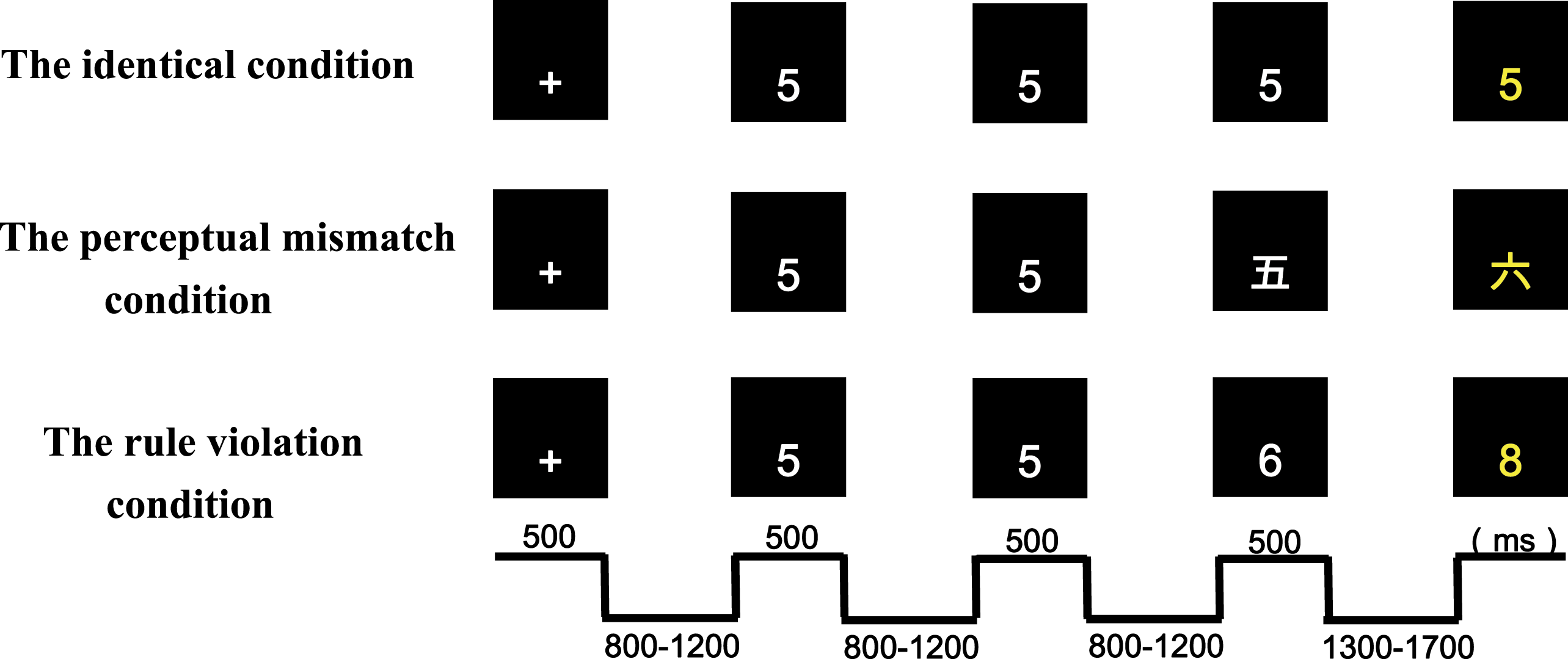
There were 80 trials, divided into three blocks, with the three experimental conditions appearing randomly in each block. Participants had one-minute rest times between the blocks. Before the formal experiment, participants were presented with practice instructions, with each condition practiced five times. The practice procedure was the same as the formal experiment, except that the practice procedure gave feedback to participants letting them know whether their response was correct. The formal experimental procedure is shown in Figure 1. During each trial, a cross-hair was present in the center of the screen for 500 milliseconds (ms), and then followed by the three numbers, each presented for 500 ms, and the interstimuli were 800–1200 ms blank periods; and after a 1300-1700 blank period, the target number was presented. The probe number was presented for 2000 ms, and participants were required to determine whether the target number conformed to the previous rule of the number sequence by pressing the F (or J) key within 2000 ms. The ratio of correct and wrong answers was 1:1, and the response keys were counterbalanced across participants. In terms of behavioral and EEG data, we mainly compared the differences of these three conditions in the first 40 and last 40 trials.
Statistical Analyses for EEG and Behavioral Data
We recorded EEG data using 64 channel, 10-20 system electrode caps (Brain Products GmbH, Germany). We used FCz region for placement of the reference electrode and the electrode on the forehead as the ground electrode. A vertical electrode recorded the upper and lower position of the right eye, while a horizontal electrode recorded the outer corner of the eye. These two electrodes were used to measure artifact from eye movements. The impedance of all electrode points was reduced to less than 5 kΩ. The EEG and electrooculograms (EOGs) were amplified using a 0.01–80 Hz band-pass filter and were digitized with a digitization rate of 500 Hz.
The data were analyzed using Analyzer 2.0 Software (Brain Products GmbH), with averages of mastoid electrodes as a reference. The EEG data were filtered by 0.1–24 Hz. The EOG data were processed by the ICA (Independent Component) method. Epochs of 2000 ms duration with a 200-ms peristimulus interval after presentation of the third numbers in each sequence were analyzed and baseline corrected, using the peristimulus time interval. Amplitudes exceeding ± 80 μV were excluded from the ERP average (Xiao et al., 2019).
Based on previous studies (Xiao et al., 2018, 2019), we selected nine electrodes (at F3, FZ, F4, C3, CZ, C3, P3, PZ, P4) with 260–310 ms time windows to compare N2 amplitude for the first 40 and last 40 trials of the three conditions. We performed a four-factor repeated measures analysis of variance (ANOVA: 3 Conditions × 2 Orders × 3 Frontality × 3 Laterality). The p values were corrected with the Green-house correction method and the multiple comparison adopted LSD (Least-Significant Difference) method.
For behavioral data, we mainly focused on participants’ RTs (means and standard errors). The Kolmogorov-Smirnov test showed that RT data followed a normal distribution; therefore, we used a 2 (order: initial and later) × 3 (condition: identity, perceptual mismatch and rule violation) repeated measures ANOVA to analyze the difference in RTs between the first 40 and last 40 trials of each condition. For EEG analyses, we used the amplitude of the N2 component with a 2 (order: initial and later) × 3 (condition: identity, perceptual mismatch and rule violation) repeated-measures ANOVA to observe amplitude differences between the first 40 and last 40 trials of each condition.
Results
Behavioral Results on the Target Numbers
We focused on the difference between the 40 initial and 40 later trials response times in the three conditions, to determine whether a conflict adaptation effect existed in numerical inductive reasoning, using only accurate trials. The response times for the first 40 trials and the last 40 trials were as follows: (a) in the identical condition, M = 739, Standard Error (SE) = 42 ms and M = 680, SE = 45 ms, respectively; (b) in the perceptual mismatch condition, M = 769, SE = 50 ms and M = 711, SE = 53 ms, respectively; and (c) in the rule violation condition, M = 1667, SE = 233 ms and M = 1121, SE = 128 ms, respectively.
A repeated measure analysis of variance (ANOVA) showed a significant main effect of trial Order, F (1, 24) = 17.522, p < .001, η p 2 = 0.422; and post hoc testing showed that the early trials had longer RTs than the later trials (ps < .001). There was also a significant main effect of Condition, F (2, 48) = 20.250, p < .001, η p 2 = 0.458, with post hoc testing showing longer RTs in the rule-violation condition than in the identical and perceptual mismatch conditions (ps < .001), and a non-significant difference between the identical and perceptual mismatch conditions. There was a significant interaction effect between Order and Condition, F (2, 48) = 12.648, p = 0.001, η p 2 = 0.345, with pair-wise testing showing longer RTs in the early than later trials of the identical condition (ps = .013), and longer RTs in the early than later trials of the rule violation condition (ps = .001), but no significantly different RTs in early and later trials of the perceptual mismatch condition (ps = .081). The rule violation condition elicited longer RTs than the identical and perceptual mismatch conditions for both the first 40 and last 40 trials (ps < .001), but the RT differences between identical and perceptual mismatch conditions for early and later trials were not significantly different, ps = .268 and ps = 0.317, respectively.
Event-Related Potential Data for the Third Numbers
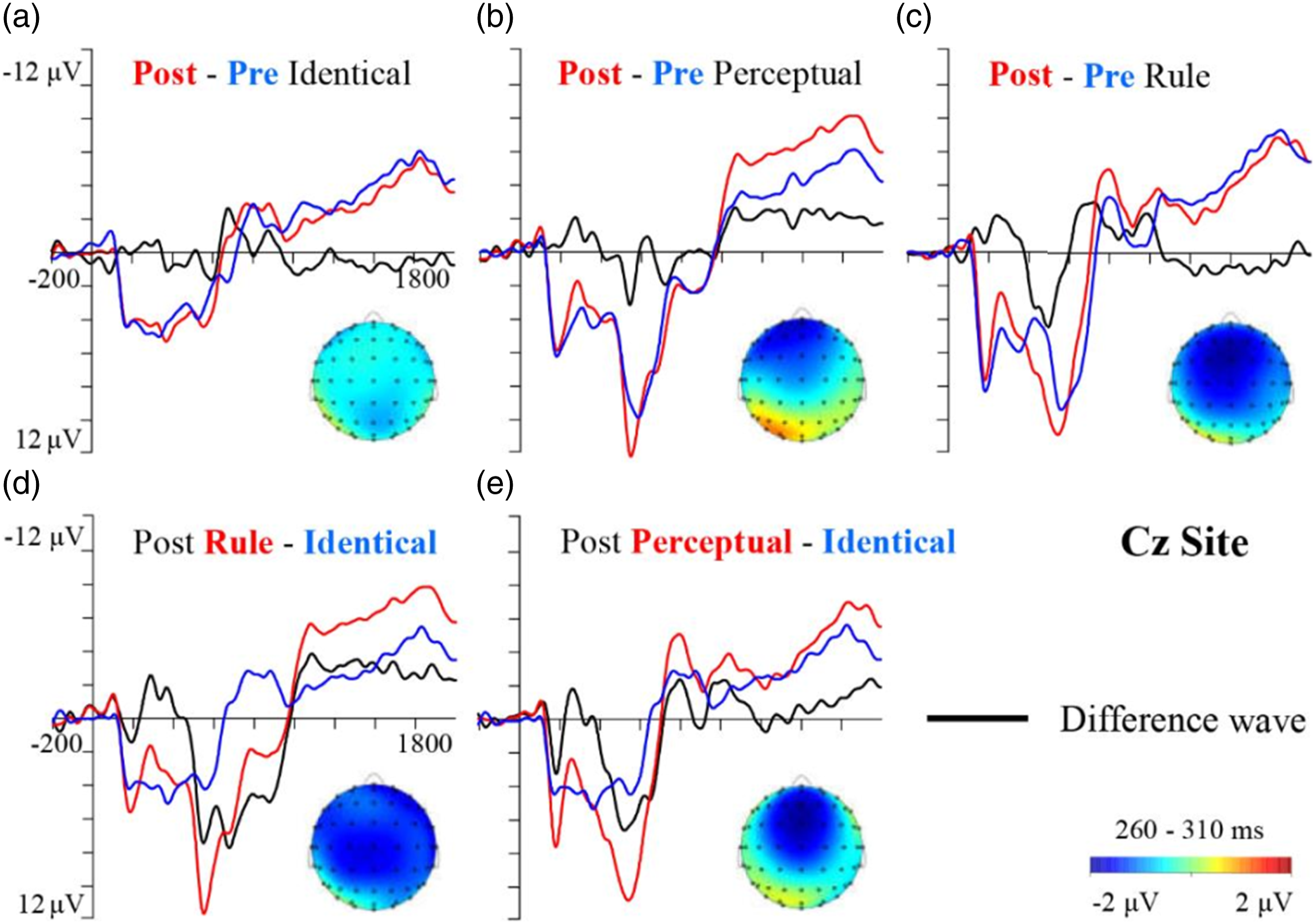
The ERP data and topography are shown in Figure 2. For N2 (26–320 ms), the main effect of Condition was not significant, F (2, 48) = .682, p = .490, η
p
2 = .028), but the following interaction effects were significant: (a) Frontality × Order ERP Data from the Nine Cortical Sites of the Original Wave of Earlier and Later Trials in the Identical, Perceptual Mismatch and Rule Violation Conditions. The Topographies and Difference Waves for Earlier and Later Trials of all Three Conditions at the cz Site. Note: (a) Identical: Last 40 - first 40; (b) perceptual: Last 40-first 40; (c) rule: Last 40-first 40; (d) rule - identical: Last 40; (e) perceptual - identical: Last 40.
Discussion
In the present study, we mainly investigated the conflict adaptation effect on numerical inductive reasoning by comparing the participants’ response times and N2 amplitudes between their performance on the first 40 and last 40 and trials in three conflict adaptation stimulus conditions. Behaviorally, participants’ RTs for the last 40 trials in the three conditions all decreased significantly, compared to their RTs in the first 40 trials. In both the simple identical and complex rule-violation conditions, participants’ performance improved in later versus earlier trials, proving that there was a conflict adaptation effect on numerical inductive reasoning. Neurofunctionally, participants’ N2 amplitudes in the three conditions revealed that, for the last 40 trials, both perceptual mismatch and rule violation conditions triggered larger N2 amplitudes than did identical conditions. This result is consistent with previous studies, such as Forster et al. (2010) who adapted the Eriksen flanker task by parametric manipulation of conflict and found that the N2 amplitude increased with increased degree of stimulus conflict. This trend was also found previously on the number pair task (Zhou et al., 2006) when the current number was incongruent with the previous number and participants showed larger N2 amplitudes that increased with the degree of conflict in the numerical inductive reasoning task. This phenomenon was also found in other numerical inductive reasoning studies when both the rule-violation and perceptual mismatch conditions elicited larger N2 amplitudes than did the identical number conditions (Xiao et al., 2019). Because the first two numbers are always the same, participants formed expectations that the fourth number would have the same value as the first three numbers, and they experienced a rule violation conflict when the third numbers were different. This conflict elicited larger N2 amplitude than in the identical condition. For the perceptual mismatch condition, the symbolic change in the third numbers was a kind of task-irrelevant change, but it elicited the participants’ bottom-up conflict in its requirements to recruit additional cognitive resources to inhibit an automatic response, and that conflict was detected in larger N2 amplitude. Thus, from experiments with the Eriksen flanker task, number pair task and inductive numerical reasoning tasks, we can conclude that N2 amplitude reflects the conflict associated with shifting from basic cognitive function to higher thinking.
However, different from previous studies, we divided our three conditions into two parts, consisting of earlier and later trials, to examine conflict adaptation. We found that the difference in N2 amplitude in the three conditions mainly occurred in the last 40 trials, while there were no significant condition differences in the earlier trials. Most previous studies analyzed data by comparing all trials between different conditions (Forster et al., 2010; Xiao et al., 2019; Zhou et al., 2006), possibly overlooking the initial allocation of cognitive control resources in these different conditions. Our finding of a non-significant difference among the three conditions in earlier trials provides a glimpse of early stage cognitive processing when participants needed to involve more cognitive control resources to ensure their accuracy in information processing of identical, perceptual mismatch or rule-violation conditions. This finding illustrates that just as for riding a bike before driving a car, we must invest more extensive cognitive resources initially, regardless of task difficulty. With increasing practice repetition, we experience a gradual change from completely controlled to more automatic cognitive processing (Hassin et al., 2009). Through our comparisons of N2 amplitude among the three conditions in the later trials, we learned that there was a significantly smaller N2 amplitude in the identical numbers condition than in the perceptual mismatch and rules-violation conditions in this later trial set, mainly because, with increasing practice, participants experienced a conflict adaptation effect over the three conditions. The identical condition, in which the task was simplest, had the fastest adaptation effect, and it triggered a different neural response than the other two conditions.
Comparing the earlier and later trials across the three conditions, the amplitude of N2 for the later trials was larger than for the earlier trials. However, when just comparing earlier and later rule violation trials, there was a different result. As the rule violation is a kind of incongruent stimulus presentation, our findings seem inconsistent with previous flanker and Go-Nogo studies (Thomas et al., 2009). In earlier studies, incongruent trials that followed other incongruent trials (vs. those that followed congruent trials) led to shorter participant RTs and decreased N2 amplitude. Other researchers also obtained these results when the incongruent trials appeared continuously (Clayson & Larson, 2011). Earlier studies showed that, after processing incongruent problems that required more cognitive resources, participants had more resources available and experienced less cognitive conflict for processing subsequent incongruent problems, thus decreasing their N2 amplitude. Perhaps our findings were inconsistent with previous findings because we based ERP data on the presentation of the third numbers – the numbers on which the rule violation occurred - but at a time before the participants needed to make any judgment. In the previous Flanker studies, incongruent trials required participants to make a response, and ERP data were recorded with that response. Thus, previous studies investigating conflict in the go-no-go and flanker tasks usually confused whether conflict adaptation occurred in relation to the conflict stimuli or the conflict responses. As we only recorded EEG at the time participants were processing conflict stimuli and did not find an N2 conflict adaptation, our results may indicate that improved conflict adaptation is delayed from stimuli presentation to response and first depends on conflict detection.
As predicted, we did not find a significant difference in N2 amplitude between earlier and later numerical reasoning trials for either the identical or perceptual mismatch conditions. As there was no conflict in the identical condition, there was no conflict detection or conflict adaptation in this condition. For the perceptual mismatch condition, the symbolic change in the third number, evoked a task-irrelevant conflict and elicited larger N2 amplitude than the identical condition, proving the existence of the participants; conflict detection, but no conflict adaptation was found. However, conflict in the rule-violation condition was task-relevant, and there was conflict adaptation in this condition compared with the other two conditions. Thus, only the rule violation condition elicited a significant difference in N2 in later versus earlier trials. This may suggest that there is a flexible regulatory system that helps individuals adapt to different conflicts, for tasks that require differing amounts of cognitive control resources.
Limitations and Directions for Further Research
There are some potential limitations in the present study. First, because we approximated a cut off point for early and later stages by simply dividing the 80 trials into two equal halves, we cannot know the specific point at which conflict adaptation occurred. Also, since we presented each condition randomly, the varying order of each condition’s appearance may have impacted these results. Thus, future studies might explore these issues with more precision. Secondly, we did not address how conflict adaptation occurs in numerical inductive reasoning. Future investigators might use more sophisticated experimental designs to study the impact of conflict adaptation on different stages of numerical inductive reasoning. Finally, we recruited only 25 participant volunteers, and this small sample size limits the generalization of these findings to other populations. Future studies might increase the sample size with more diverse participants to replicate and improve the generalizability of these findings while also permitting sub-group comparisons of participants of varying sex, age, and/or ethnicity.
Conclusion
By observing N2 amplitude in this numerical inductive reasoning experiment, we found that both top-down (i.e., higher cognitive reasoning) and bottom-up (i.e., simple perceptual comparisons) conflict in numerical inductive reasoning elicited forms of participants’ conflict detection, while conflict adaptation only appeared in the top-down (higher cognitive reasoning) conflict. Although we found a conflict adaptation effect in numerical inductive reasoning only in the latter half of our learning trials after rule changes had occurred repeatedly, we cannot specify from this method precisely when the adaptation effect appeared. Also, as we only observed the conflict adaptation effect in numerical inductive reasoning when the incongruent rule was consecutively presented, we have not addressed whether the conflict adaptation effect is caused by the order of congruent and incongruent occurrences as was done by previous studies using the flanker task (Thomas et al., 2009). Future studies might utilize larger participant samples to compare conflict adaptation in both conflict detection and response judgment stages of numerical inductive reasoning tasks.
Footnotes
Acknowledgments
We are grateful to the anonymous reviewer for thoughtful comments.
Declaration of Conflicting Interests
The author(s) declared no potential conflicts of interest with respect to the research, authorship, and/or publication of this article.
Funding
The author(s) received no financial support for the research, authorship, and/or publication of this article.
