



Abstract
As laterality of the lower limbs is regarded as a relevant influence on soccer performance, we assessed whether a bilateral training program for both the preferred leg (PL) and non-preferred leg (NPL) would improve soccer players’ lateral asymmetry, agility, and accuracy. Sixty right-foot-dominant young soccer players were randomly assigned to either an experimental group (EXP) that underwent bilateral training or a control group (CONT) that performed their usual training schedule without bilateral exercise. We assessed the players’ lateral asymmetries before and after training on four soccer skill tasks: a zigzag test with and without a ball, a receiving and direct volley-shooting accuracy test, and a passing accuracy test. Results showed post-test versus pre-test performance improvements for the EXP group on the index of technical skills and agility (p < .001). A post-hoc analysis further revealed a pre-test to post-test performance improvement on shooting and passing accuracy with both legs only for the EXP group (p < .001). These results support the role of bilateral practice in improving lateral asymmetries, agility, and accuracy.
Introduction
Laterality is a multidimensional construct (Badzakova et al., 2010) referring to the preferential use of one side of the body compared to the other (Petro & Szabo, 2016; Sadeghi et al., 2000). Past motor research has shown that laterality related to cerebral hemispheric dominance for motor control, is also affected by both environmental and genetic factors (Musalek, 2015). Compared to the ability of the non-dominant hemisphere to control the contralateral side of the body, the dominant cerebral hemisphere has a predominant influence on motor control, creating greater motor precision, speed and coordinated actions on that side (Teixeira et al., 2003). Moreover, while being right-handed and right-footed is most common, with only 10% of the general population left-handed (Papadatou-Pastou et al., 2008; Raymond & Pontier, 2004), the prevalence of being left-handed or left-footed is higher among athletes in various sports (e.g., handball, basketball, fencing, and boxing) (Harris, 2010; Petro & Szabo, 2016; Ziyagil et al., 2010). Cerebral hemispheric dominance is more closely related to lower extremity preference than other lateral dominance preferences, (Bryden, 1998). Additionally, various environmental and socio-cultural factors have less influence on lower extremity preference than on hand preference (Maupas et al., 2002).
Left-handed/footed athletes may have advantages over primarily right-handed/footed athletes (Grouios et al., 2000). Loffing et al., (2012), in a longitudinal study, demonstrated that a moderate left-hand (vs. right hand) preference was associated with a better ability to react quickly and effectively in professional tennis players. While this left-hand advantage seems to have been reduced among high-level players (i.e., professionals), it remains an advantageous attribute for lower-level tennis players (Loffing et al., 2012).
Bilateral ability among soccer players (i.e., use of both PL and NPL in game play), has been found to contribute to superior performance in actions requiring motor creativity (Guilherme et al., 2015a), and it has been deemed essential for soccer players (Loffing, et al., 2016). Bilateral ability in soccer has been linked particularly to lower limb proficiency (Stöckel & Weigelt, 2012) such that the most bilaterally skilled players are apt to achieve better performance improvement (Wilson et al., 2017; Wilson, et al., 2020) and win more soccer matches (Ali et al., 2007) when compared to less bilaterally skilled players. Moreover, podal performance is a function of several factors such as strength, precision, speed, and regularity of the task (Rigal, 1992). In considering the important impact of laterality on sport performance, the laterality categorization that best designates superior players has been “bilateral ability” (Tran et al., 2014).
Most previous soccer investigators have been primarily interested in amateur soccer players’ performance with their preferred foot (Barfield, 1995; Patritti & Lees, 1999), and some conducted studies to determine the quality of dominant leg strength (Mognoni et al., 1994). However, other studies showed that bilateral practice may be beneficial, not only for the non-dominant side, but also for the dominant side (Stöckel & Weigelt, 2012). The ability to act bilaterally to evade an opposing player and maintain ball possession is essential for successfully reading and quickly reacting during a match, (Stöckel et al., 2011; Chinta et al., 2020). In terms of specific subskills, agility has been investigated by several investigators (Young et al., 2002; Sheppard & Young, 2006; Barnes et al., 2007; Brughelli et al., 2008; Chaouachi et al., 2012), but less is known about change of direction (Young et al., 2002; Sheppard & Young, 2006). Agility is considered an open skill involving quick, whole-body, change of direction or speed in response to a sport-specific stimulus, and it includes both cognitive and physical ability (Sheppard & Young, 2006). Additionally, agility is an essential quality in talent identification (Reilly et al., 2000a) that distinguishes elite players at all competitive levels (Slimani & Nikolaidis, 2017). Earlier findings have shown that the ability to change direction with speed and efficiency is important when moving with and without the ball (Young et al., 2002). Recently, laterality was determined to be especially important in soccer players’ quick changes of direction (Zouhal et al., 2018).
Previous work has suggested significant training-related speed, but not accuracy, improvements in soccer players’ bilateral transfer of skill from the non-preferred to the preferred side (Kumar & Mandal, 2005). Learning a motor task on one side can improve performance in both the trained and opposite untrained limb, a phenomenon that has been called a bilateral transfer of motor skills (Land et al., 2016). Teixeira et al. (2003) assessed the performance of two young soccer player groups who trained with either an emphasis on the PL or the NPL. After 4 years of training on kicking for force, kicking for accuracy, and speed of dribbling, the asymmetry of accuracy performance was maintained at a constant level in both groups, while only dribbling speed in the NPL group elicited greater pre-test to post-test improvement. Haaland and Hoff (2003) produced contradictory findings by showing that 8 weeks of primary NPL training for young soccer players led to improved passing and shooting accuracy in both the NPL and PL.
While numerous investigators have studied the effect of dominant leg soccer training (Kramer & Balsor, 1990; McLean & Tumilty, 1993; Mognoni et al., 1994) and have evaluated subsequent performance differences in kicks with the PL and NPL (e.g., Bjelica et al., 2013; Nunome et al., 2006; Zago et al., 2014), there have been few studies of ball velocity and ball accuracy as technical outcome measures (Kolman et al., 2019). We aimed to determine whether bilateral (PL and NPL) training would improve soccer players’ (i) asymmetry in PL and NPL podal agility and technical skills performance, and (ii) joint PL and NPL soccer-specific skill performance. We hypothesized that bilateral training for the lower limbs would increase the development of bilateral agility, speed of dribbling, and passing and shooting accuracy. Similarly, we hypothesized that bilateral training would lead to bilateral improvements on the index of technical skills, a measure of ball control. Finally, we hypothesized that changes in accuracy from pre- to post-testing would be significantly correlated with changes in agility, speed, and ball control skills of both legs; and that PL changes would be positively correlated with NPL changes.
Method
Participants
We performed an a priori power analysis using G*Power software (version 3.1.9.4; Kiel University, Kiel, Germany; Faul, et al., 2007) to estimate the required sample size for this study. Based on a study by Arslan et al. (2021) who reported an effect size of 0.18, and our plan to use a two-factor repeated-measures analysis of variance (ANOVA), we determined that 58 participants would be needed to achieve 90% statistical power with statistical significance set at p < 0.05.
After we clearly explained our research procedures, including the risks and benefits of participation, and before any players’ participation in this study, all participating players gave their informed assent, and all players’ parents or legal guardians signed an informed consent form. We conducted this study according to the Declaration of Helsinki, and our research protocol was approved by the local Ethics Committee.
A total of 66 male players volunteered to participate in this study. All participants were right-footed as determined by the classification method used by Dellatolas et al. (1988). Participant inclusion criteria were (a) membership on a soccer team for at least seven years, (b) reporting no surgery in the six months prior to testing that would have affected physical ability, (c) reporting no visual or cognitive problems, and (d) involvement in systematic training managed by qualified coaches for at least seven years (Bjelica, 2008). All participants averaged over eight years of soccer training experience and were training four days a week with 1 session per day, for about 1.20 hours per day. During the study, six players dropped out (4 did not attend regular training, and 2 had injuries), leaving 60 male players with the following anthropometric characteristics: M age = 15.8, SD = 0.6 years; M height = 1.7, SD = 0.1 m; and M body mass = 60.5, SD = 5.7 kg. A pediatrician classified all players as pubertal (stage 5) according to Tanner’s criteria (Tanner, 1962).
Procedure
Participants were randomly assigned to either an experimental group (EXP; n =30) or a control group (CONT; n = 30). Familiarization procedures for testing were performed one week before the beginning of the experiment. During the familiarization session, the participants were provided with brief explanations on how to perform the tests and then allowed to make attempts to ensure full familiarization with the procedures (Kutlu et al., 2017).
All the players were invited to self-assess their podal preference through a foot preference questionnaire. We followed Dellatolas et al. (1988), to classify participants as either right-footed, mixed right-footed, left-footed, and mixed left-footed. Participants engaged in four soccer-specific tests (see below for details): (a) a zigzag test without a ball to assess agility; and (b) a zig-zag test with a ball to assess dribbling speed; (c) a passing accuracy test; and (d) accuracy tests of receiving and shooting direct volleys with both the PL and NPL (Haaland & Hoff, 2003; Malina et al., 2005).
We divided the experiment into three phases: pre-testing, training, and post-testing. For pre-testing and post-testing, we assessed the participants’ performance on the four motor tasks over two days as follows. On the first day, participants arrived one hour before the start of the test and laid down to relax. All players then executed a standardized 10–15-minute warm-up with dynamic stretching, and they then completed a 3-minute rest before starting the tests (Condello et al., 2013). On the zigzag test, the player accelerated from the starting line to the finish line (Figure 1). We used two photo cellules timing gates (Brower Timing Systems, Salt Lake City, UT; accuracy of 0.01 second) - one at the starting line and one at the finish line. The zigzag test was performed without a ball (to assess agility) and with a ball (to assess dribbling speed) with the PL and the NPL to calculate the skill index. On the second day, participants executed the receiving and direct volley-shooting accuracy tests and a passing accuracy-test. There was a 5-minute rest session between tests, and all tests were conducted with the PL then with the NPL. Participants performed two attempts of each test, and we used their best performances for analysis. Experiment Flow from Pre-Testing to Training to Post-Testing.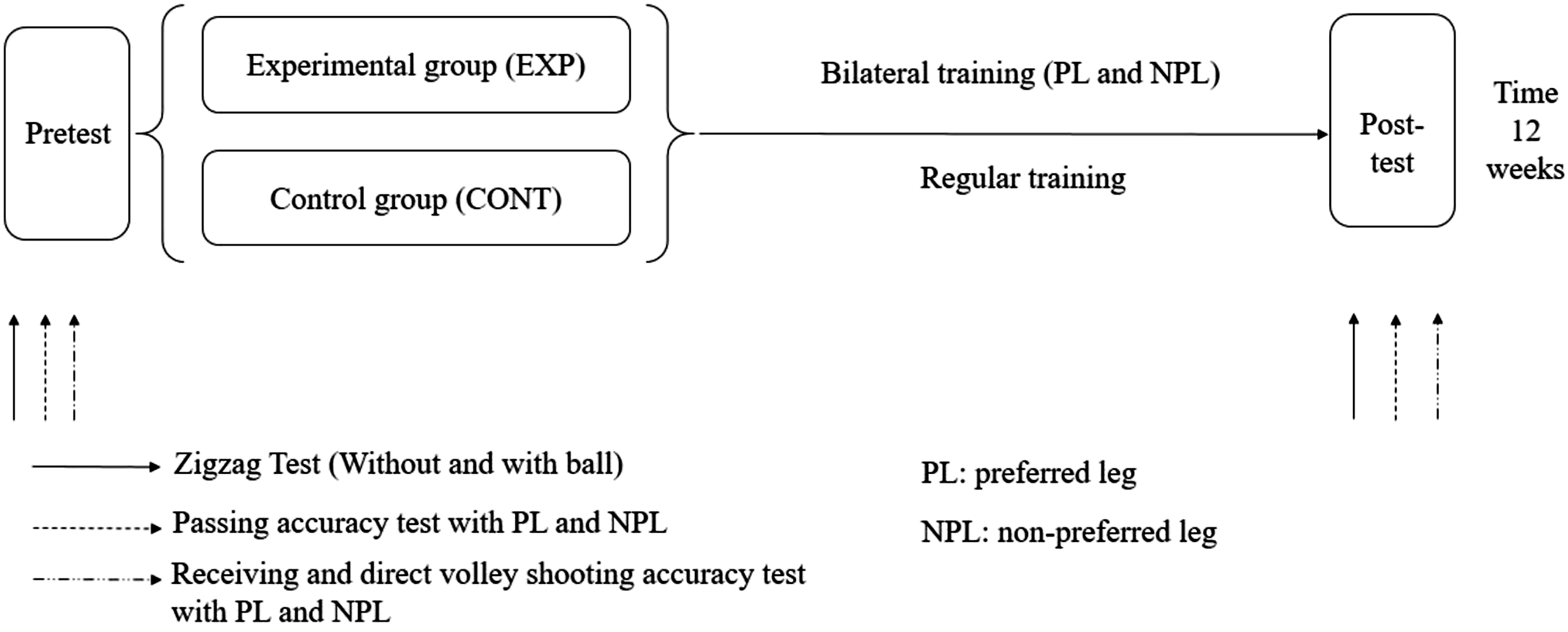
The 12-week training phase of the study is described in detail below (see Training Sessions), for each of the two groups (i.e., experimental group bilateral training and control group regular training). The post-test was conducted the day after the end of the experimental training with the same procedures employed in the pre-test. All tests were conducted on a fourth generation synthetic grass soccer field at the same time of day (9:00 a.m. to 11:00 a.m.) to control for any circadian rhythm effects on participant performance. The ambient temperature varied between 21-23°C, humidity varied between 50-60%, no sessions were held in rainy conditions, and wind speed was always under 10 km/h. We used a standard soccer ball (mass of approximately 430 g with a circumference of 70 cm). Players were invited to wear sports shorts, t-shirts, and the same soccer boots throughout the tests. This study started with the pre-test at the beginning of the season after a 1-month vacation (week 0, pre-test (T1)) in August, and it was followed by the post-test after a 12-week bilateral soccer training program (week 12, post-test (T2)) in November (Figure 1).
Testing Tasks
Zigzag Test (Without Ball)
This test assessed running agility. A zigzag course consisted of 5-m sections set out at 100 angles. The selection of this test was based on rapid acceleration, deceleration, and balance control required for a short running time (Mirkov et al., 2008). Participants performed two attempts, and we used their best performance for analysis. Two-photocell timing gates (Brower Timing Systems, Salt Lake City, UT; accuracy of 0.01 second) were used to capture run times (Figure 1). The reliability, as depicted by the intra-class coefficient (ICC), for the zigzag test exceeded 0.80. The zigzag test without ball revealed a within-subject variation expressed as a coefficient of variation (CV) of 1.2%–3.9%. Based on this CV, the estimated sample size required to detect a 2% change in the assessed variable ranged from 2–30 (Mirkov et al., 2008).
Zigzag Test (With Ball)
We also assessed the ability to control the ball while changing direction. Participants were instructed to run with the ball using their PL and then their NPL as fast as possible along the same zigzag path used in the previous test (Mirkov et al., 2008). Participants performed two attempts with the PL and then two attempts with the NPL, and we used their best performances for each leg for analyses. The times on the Zigzag Test with and without the ball were measured with the two-timing gates (Brower Timing Systems, Salt Lake City, UT; accuracy of 0.01 second) placed at the starting line and at the finish line (Figure 2). The reliability as depicted by the ICC, for the zigzag test with ball exceeded 0.80. The zigzag test with ball revealed within-subject variation expressed as CV of 1.2%–3.9%. Based on this CV, the estimated sample size required to detect a 2% change in the assessed variable ranged from 2–30 (Mirkov et al., 2008). Zigzag Test With and Without Ball.
Zig Zag Skill Index
We calculated the ratio of the results obtained from the two zigzag tests (i.e., without and with the ball) with participants’ PL and NPL. A higher index (i.e., a smaller relative increase in the zigzag running time when the ball had to be controlled) was interpreted as a higher ball control skill (Mirkov et al., 2008).

Passing Accuracy Test
Five targets were placed 2.5 m apart at the end line of the 9×9 m square. The participant was instructed to stand outside the square at the opposite line of the target. The objective was to hit the targets with the kicked ball in succession over five trials. Participants performed two 5-trial attempts (with each leg), and we used the best performances for analysis. The score was the number of successful target hits. The maximum score was 10 points: five with the PL and five with the NPL (Seabra et al., 2001; Malina et al., 2005). The ICC for the passing accuracy test was exceeded 0.70. Validity coefficients ranged from 0.53 to 0.94 between performances (Malina et al., 2005).
Receiving and Direct Volley Shooting Accuracy Test
On the receiving and shooting test, the participant received the ball at chest height 10 m in front of the goal, with his side facing the goal. The participant received the ball and took a volley shot at the second touch of the ball. Points were given for where the shot was placed in the goal. The goal itself and an area 30 cm outside the goal were divided into zones such that six points were given for shots in the top corners, one point was given for a shot where the goalkeeper normally stands, and one point was given for a hit on the ground within 30 cm of the goal (Figure 3). Points were added over the l5 + l5 shots taken (i.e., 15 with each leg). There was a 4-minute rest between trials. The coefficient of variation for the volley shot test was ll.5% (Haaland & Hoff, 2003). Participants performed two attempts (for each leg), and we used their best performances for analysis. Point Matrix for 10-m Shot Against a Soccer Goal.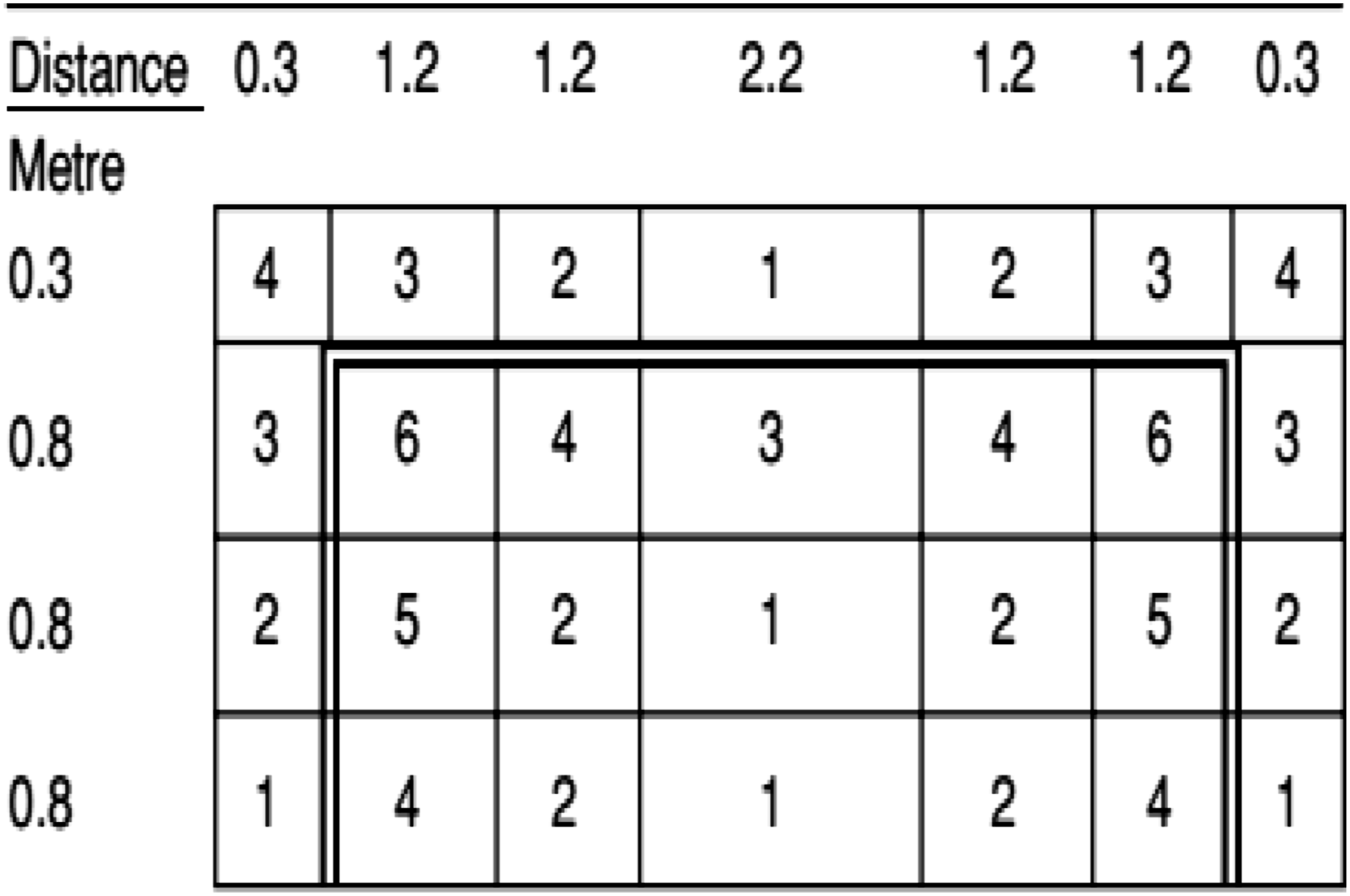
Training Sessions
As noted above, the experiment was divided into three phases: pre-test, training, and post-test. The bilateral training program completed by the EXP group consisted of performing specific motor skills by the participant’s PL and NPL over 12 weeks. During the same 12 weeks, the CONT group performed the same regularly planned exercises as the EXP group (number and period of training), without any guidance or emphasis on the use of both the PL and the NPL (Guilherme et al., 2015b).
Experimental Group
The soccer practice sessions of the Experimental Group took 80 minutes/day for four days/week (using various 4-day blocks from Monday to Friday), with each session consisting of five parts: (a) a 10-minute general warm-up, (b) 20-minute training on all basic skills related to soccer with an emphasis on the use of the preferred and non-preferred legs, (c) 20-minute small-sided games, (d) 20-minute soccer games, and (e) 10-minute cool-down. During the 20-minute training period, players participated in individual drill and with doubles or triplets of players per ball, in which skills such as passing, juggling, shooting, and receiving were practiced intensively with PL and NPL. Then, 20 minutes consisted of small games, with an increasing number of participants in 3 versus 3 and 4 versus 4 game formats, requiring the use of the skills practiced in the previous drills with bilateral practice of the PL and NPL. Afterward, participants had a 20-minute soccer game. During 12 weeks of training, the complexity of the tasks was increased, with a progressive requirement of increased kick accuracy, control, and speed in the juggling tasks that involved a great degree of dynamic bilateral interaction and through different combinations of basic soccer skills into serial motor tasks.
Statistical Analysis
We performed statistical analysis using Statistica software 12 (StatSoft, France). We presented data as means and standard deviations. We checked the normality of the data distributions with the Shapiro-Wilk test, and we analyzed these data using (a) three-way repeated-measures analyses of variance (ANOVA): 2 Leg (PL vs. NPL) × 2 Test Times (before training vs. after training) × 2 Groups (EXP vs. CONT) and (b) two-way repeated measures ANOVAs: 2 Group (EXP vs. CONT) × 2 Test Times (before training vs. after training). When ANOVAs displayed significant main effects, we applied the Bonferroni post-hoc test for pairwise comparisons. To examine associations between variables under study, we used Pearson correlation analyses. We calculated effect sizes as partial eta-squared (ηp2) to estimate the meaningfulness of significant findings. Partial eta squared values of 0.01, 0.06, and 0.14 represented small, moderate, and large effect sizes, respectively (Cohen, 2013). Relative variability was expressed as an ICC (Thomas et al., 2015). Absolute (i.e., within-individual) variability was assessed by typical error of measurement as well as by CVs (Hopkins, 2000). Changes between measures recorded at pre- and post-training program (delta (Δ) scores) were calculated as post- values minus pre-training values. Percent changes were also calculated as follows: Δ (%) = (([post-training value − pre-training value])/(post-training value)) × 100. All differences were considered statistically significant when p < .05.
Results
Effect of Bilateral Training on Running Agility and Skill Index
ANOVA Results of Zigzag Test Without Ball.

ANOVA Results of Skill Index.

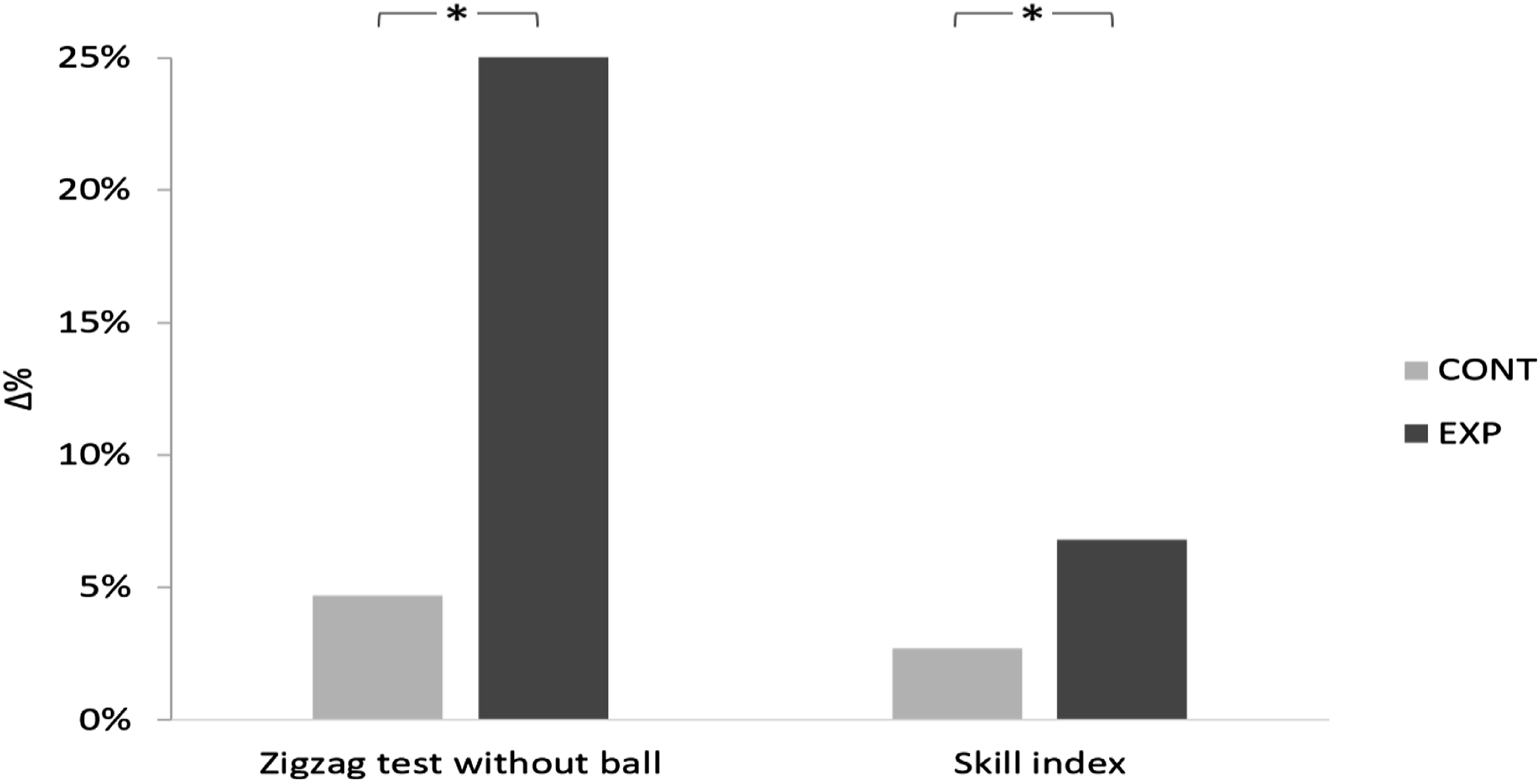
Percentage Changes in Times to Complete the Zigzag Test Without Ball and the Skill Index in the EXP and CONT Groups. Note: *p < .001.
Effect of the Bilateral Training Program on Dribbling, Passing and Shooting Abilities of Both Legs
ANOVA Results of Zigzag Test with the Ball (Dribbling).

ANOVA Results of Passing Accuracy Test.

ANOVA Results of Receiving and Direct Volley-Shooting Accuracy Test.


Change in Time (s) to Complete the Zigzag Test with Ball (A), Passing Accuracy (B), and Receiving and Direct Volley-Shooting Accuracy (C) for the Preferred Leg (PL) and Non-Preferred Leg (NPL) on Pre- and Post-tests of the EXP and CONT Groups. Note: *: p < 0.05; **: p < 0.001.
Regarding passing accuracy, there were significant main effects of Group, Leg, and Training (Table 4). Furthermore, there were significant interaction effects of Group × Training, Group × Leg, and Group × Training × Leg (Table 4). Post-hoc analyses showed enhanced passing accuracy for both legs in EXP group compared to the CONT group (p < .001). Moreover, the EXP group showed greater percentage changes compared to the CONT group for the PL (74.1% vs. 30.9%) and NPL (166.7% vs. 32.3%) (Figure 5).
For the receiving and direct volley shooting test, the repeated measures ANOVA revealed significant main effects of Group, Leg, and Training (Table 5). Additionally, there were significant interaction effects of Group × Training, Group × Leg, and a Group × Training × Leg (p < .001) (Table 5). Post-hoc analyses showed an improvement in receiving and direct volley shooting test for both legs in the EXP group compared to the CONT group (p < .001). The EXP group showed greater percentage changes compared to the CONT groups with PL (271% vs. 48.6%) and with NPL (229.5% vs. 39.5%) (Figure 5).
Correlations Between Variables of Interest
Correlations Between the Percentage Changes on the Zigzag Test without and with Ball the Skill Index, and Scores on the Passing Accuracy and Receiving and Direct Volley-Shooting Accuracy for the Preferred Leg (PL) and Non-Preferred Leg (NPL) of the Experimental Group.

Note: *p <0.05; **p < 0.001.
Discussion
In this study with adolescent soccer players, we investigated the effects of specific bilateral training for the lower limbs (PL and NPL) on the participants’ agility, dribbling, and accuracy of passing and shooting with both legs and on an index of their technical skills. Our main findings were that participants in the bilateral training program significantly improved their agility and technical skills over pre- and post-testing, and improvement with both their PL and the NPL from agility training, with changes of direction without the ball. Additionally, these findings revealed a significant positive correlation between PL and NPL in agility testing with the ball. There was also an improvement in the skill index performance.
Another recent study found that each player had a weak and strong side that, when performing movements such as a 180° rotation, could impact the player’s agility (Zouhal et al., 2018). In Zouhal et al. (2018), training for laterality allowed for more reactive strength, better motor control of push-off actions, and faster turning on the opposite side. Agility has been considered a necessary component of the player’s overall skill development for reaching optimum velocity and altering directions quickly (Fowler & Reilly, 1993). Past behavioral and neurological research has shown that emphasizing the NPL practice yielded an identical performance profile as PL practice, with both allowing a high degree of muscular self-organization (Haaland & Hoff, 2003) and improved agility for change of direction (Teixeira & Paroli, 2000; Wang & Sainburg, 2007). However, the compulsory use of the non-preferred side in bilateral practice also lead the body to create new standards of action (Haaland & Hoff, 2003) and to complete a determinant successful action while on the soccer field (Hansen et al., 1999; Reilly et al., 2000b; Vaeyens et al., 2006). The effectiveness of learning to control the ball with the NPL may be related to the similarity of the technical movement patterns in the practice of both sides of the body (Parrington et al., 2015) and/or to the dominant eye, which permits priority treatment of all information in the visual field to result in faster reaction times (Mapp et al., 2003).
Our findings in this study revealed that a 12-week bilateral technical soccer-training program significantly increased performance during the shooting and passing accuracy tests and in dribbling with PL and NPL. Additionally, there was a significant positive correlation between PL and NPL in the zigzag test with ball, technical skill index, passing accuracy and shooting accuracy. This transfer of learning may be caused by bilateral practice that compensated for differences in accuracy performance between the two sides of the body (Teixeira et al., 2003; Mikheev et al., 2002; Focke et al., 2016). Previous authors recognized that limited amounts of training might not be sufficient for developing changes in lateral preferences (Huijgen et al., 2010; Valente-Dos-Santos et al., 2014). However, our data suggest that after bilateral technical training, the skill level of the NPL was not statistically different from that of the PL (Haaland & Hoff, 2003) on specific tasks might be related to the bilateral training. These authors suggested that the general model of hemispheric specialization depends on visual spatial processing of performance information and suggests that training might initially be practiced with the non-preferred side to involve the specialized hemisphere/limb system (right brain/left side) early in the learning process. This idea has been adopted by several other authors, who further noted that lateral asymmetries of accuracy performance might then be reduced or changed, with emphasis on practice dedicated to both the PL and NPL (Mikheev et al., 2002; Musalek, 2015).
Regarding bilateral training, ambidextrous players - often considered the most successful - have shown greater goal-scoring efficiency in comparison with players who have left or right performance dominance (Kramer & Balsor, 1990; Rahnama et al., 2005). Still debated, however, is the required period of specific technical training. While a period of 8 weeks of specific training leads to a significant difference in passing, shooting, and driving the ball (Junge et al., 2000), previous research has also shown that 10 weeks of soccer-specific training yielded a significant difference in driving the ball (Pienaar & Viljoen, 2010). In contrast, training programs of a shorter duration (6–8 weeks) have not always brought similar levels of progressive change (Maughan et al., 1997). Past literature suggests that youth soccer training programs require a minimum of 8–12 weeks to allow for neuromuscular, coordinative, and physiological adaptations in response to a training stimulus (Boraczynski et al., 2019; Focke et al., 2016; Das & Banerjee, 1992; Viru & Smirnova, 1995). Overall, our data suggest that agility, proficiency, and asymmetry of both preferred and non-preferred lower limbs may be influenced by 12 weeks of bilateral technical training.
Limitations and Directions for Further Research
Although this study provides novel information concerning the effects of bilateral training on the performance of agility and some technical skills, our participant sample was limited to young male soccer players. Future studies with larger numbers of participants of both sexes would permit generalization to female soccer players and, perhaps, comparisons of participant sub-grouped by age and sex. In addition, the effectiveness of bilateral training on game performance should be investigated, and there is much to learn from future investigations about what methods and/or length of training may be optimal for particular game requirements.
Practical Applications/Recommendations
Soccer coaches should consider bilateral training, especially for young players, and they should emphasize tin this training he quality of soccer-specific motor skills in both legs. We also recommend evaluating each young athlete’s asymmetry of specific soccer skills. Regular assessments of soccer skills will help detect the effects of as training program that emphasizes both PL and NPL skills.
Conclusion
In this study, we found a beneficial effect of bilateral practice on agility and speed of dribbling with change of direction and on an index of technical skills and various accuracy tasks during male youth soccer training. Our findings were based on 12 weeks of bilateral practice to create a more harmonious bilateral motor development of the lower limbs. While this type of practice appears beneficial for modifying low limb asymmetries and improving soccer performance, this study should be replicated in larger studies with more diverse participants.
Footnotes
Acknowledgments
We are grateful to all of the students who participated so willingly in the study.
Declaration of conflicting interests
The author(s) declared no potential conflicts of interest with respect to the research, authorship, and/or publication of this article.
Funding
The author(s) received no financial support for the research, authorship, and/or publication of this article.
