




Abstract
Vertical jump is an important skill that influences volleyball performance. In this study, we analyzed the relationship between vertical jump performance and birth quartile of Brazilian male youth volleyball players. We calculated chi-square goodness-of-fit tests to compare the athletes’ birthdate distributions in quarters of their birth years (Q1, Q2, Q3, and Q4) according to player age categories (U17, U18, U19, and U21). We calculated one-way ANOVAs to compare spike jump and block jump heights of players born in different quarters of the same year. Overall, we found a relative age effect (i.e., more players with birth dates early in the birth year) in U17 (p < .001), U18 (p < .001), U19 (p < .001), and U21 (p = .04). Regarding vertical jump performance, U18 athletes born in Q2 reached higher spike jump heights (p = .006) and block jump heights (p = .002) than athletes born in Q4, and U19 athletes born in Q1 reached higher block jump heights than athletes born in Q3 (p = .049). There were no significant differences in vertical jump performance across birth quartiles among U17 and U21 athletes. Thus, a relative age effect was present in all age categories but not always reflected in vertical jump performance. Volleyball coaches and policymakers are still advised to employ strategies to ensure fairer opportunities for players born later in the year of their eligibility dates, as we found RAE to be sometimes, but not always, related to higher spike or block jump heights even among these older adolescents and young adult athletes.
Introduction
In sports, team competition categories are commonly related to athletes’ ages in attempts to make competitions and athlete selection processes more equitable. However, within the same age group, there are month-to-month chronological age differences between players that can relate to their athletic performance and selection for team play, a concept known as the relative age effect (RAE) (Andronikos et al., 2016; Lorenzo-Calvo, 2021). In sports, RAE has often resulted in an asymmetric distribution of athletes’ birth quartiles, such that those in the same age group who were born earlier in the year are overrepresented in elite sports relative to those who were born later in the year (Lidor et al., 2021). These age-related physiological differences between young athletes influence talent recruitment and identification in many sports (Lidoret al., 2021; Rada et al., 2018; Schorer et al., 2009), including volleyball (Rubajczyk & Rokita, 2020).
The most accepted explanation for this effect is one of differential maturation processes, even for youth athletes whose ages differ only by several months. Relatively older athletes are apt to have begun puberty earlier and to show advanced physical characteristics when compared to their slightly younger colleagues (Cobley et al., 2009; Lovell et al., 2015; Musch & Grondin, 2001). In this sense, relatively older athletes within an age category are more likely to present better scores on anthropometric and performance variables such as height, muscle mass and strength, aerobic power, and speed (Malina et al., 2004) compared to relatively younger ones (Romann & Cobley, 2015).
Some investigators have reported that the prevalence of RAE in sports gradually diminishes at older age categories (Brazo-Sayavera et al., 2018; Buekers et al., 2015), and a large number of studies on RAE have focused on young athletes. Several authors have investigated RAE in young volleyball athletes in recent years (Akarçeşme & Aytar, 2018; Papadopoulou et al., 2019; Rubajczyk & Rokita, 2020) and these investigations have revealed the presence of RAE through an overrepresentation of players born in the first and second quartiles of the year relative to those born in the third and fourth quartiles.
Volleyball is played in long matches, characterized by short, explosive, and multidirectional technical movements, many of which involve vertical jumps (Lima et al., 2020; Setuain et al., 2022). In fact, volleyball players perform an average of 83 jumps per training session and 71 jumps per match (Skazalski et al., 2018). A vertical jump is a complex movement that requires the athlete’s coordination and the contraction of various leg, arm, and trunk muscles (Charoenpanicha et al., 2013). Indeed, an athlete’s jump performance has been identified as one of the determining factors for success in high-performance volleyball (Stanganelli et al., 2008). The relevance of vertical jump to game success is due to its direct association with attacking, blocking, and serving actions (Berriel et al., 2021; Pocek et al., 2021; Sattler et al., 2015) which are related, in turn, to force production (Shepard et al., 2008), a physical capacity directly influenced by biological maturation (Gil et al., 2014; Malina et al., 2004). Thus, the vertical jump in volleyball may be a key motor skill to study as it is, perhaps, a motor skill that may be most affected by relatively earlier maturation, due to age-related changes in muscular, neural, and hormonal systems during adolescence (Malina, 1994).
Previous investigators have addressed the relationship between RAE, athletes’ anthropometric characteristics, and performance variables in volleyball. For instance, Papadopoulou et al. (2019) examined the relationship between birth quarters and anthropometric and physiological characteristics. Castro et al. (2022) investigated the RAE in elite volleyball athletes and its association with performance level, considering the number of serves, attacks, and blocking points. Solon Junior and Silva Neto (2020) analyzed the distribution of athletes’ birth dates and whether this phenomenon influenced height, attack, defense ranges, and points scored during the 2016 Olympics. In this case, the authors did not find differences in the average attack and defense range of athletes between quartiles. As far as we know, this is the only study that related RAE to performance on vertical jumps in volleyball. Specifically, we analyzed the relationship between elite athletes’ birthdate quartiles (by age categories) and their vertical jump performance (spike and block jump height).
Method
Ethical Considerations
This study was approved by the Research Ethics Committee of the Federal University of the Federal University of Mato Grosso, Brazil (Protocol: 4.491.765). Participant athletes signed the informed consent document for voluntary participation in the study. At the beginning of each competition, before each athlete’s first match, we collected information on the players’ dates of birth, playing positions, and spike and block jump height.
Participants
We collected data from 1331 young male elite volleyball athletes who participated in the 2019 Brazilian National Team Championship (CBS) U17 and U19, the 2021 Brazilian Interclub Championship (CBI) U17 and U19, the 2022 CBS U18, and the 2022 CBI U19 and U21. These championships represent the two main youth volleyball championships organized by the Brazilian Volleyball Confederation (CBV). Of note, in 2020 there was no championship, due to the COVID-19 pandemic. Whenever an athlete appeared more than once in a championship within the same year, their duplicate data was removed to prevent double counting the athlete’s influence on calculating a relative age effect for the category. This may have occurred due to the transfer of athletes during competitions. Thus, duplicate data from 113 athletes were excluded from the sample for participating in a championship representing more than one club in a given year. After exclusions, our total participant sample consisted of 1218 male young elite volleyball athletes.
Participant Characteristics According to Birth Quarters.
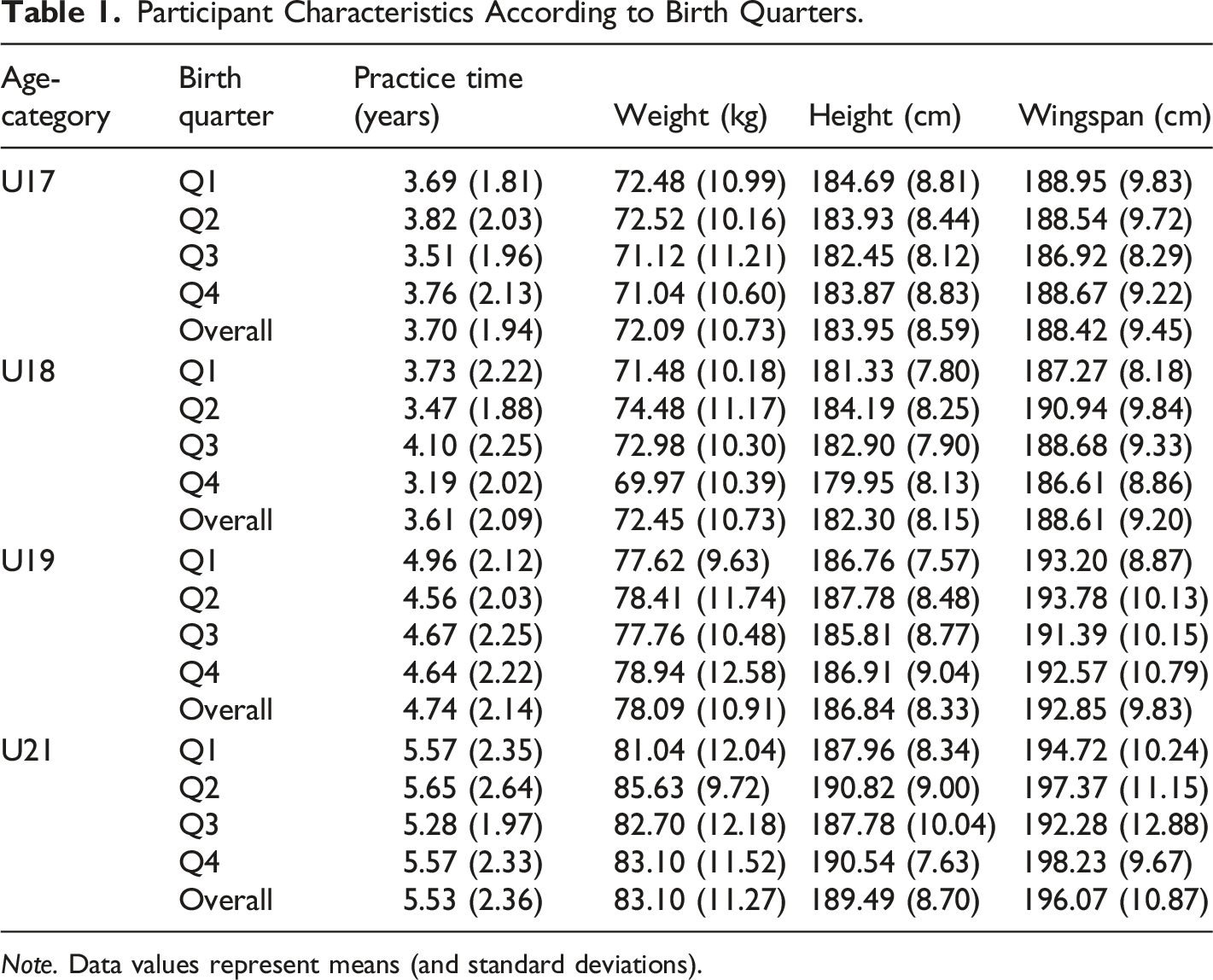
Note. Data values represent means (and standard deviations).
Procedure
The variables we analyzed included the quarters of the year in which athletes were born (Castro et al., 2022, 2023) following these guidelines: quartile 1 = Q1 (January to March 31), quartile 2 = Q2 (April to June 30), quartile 3 = Q3 (July to September 30) and quartile 4 = Q4 (October to December 31). Additionally, players were categorized according to their playing positions (setter, middle, libero, opposite, and outside hitter), age group for competition (U17, U18, U19, and U21), and spike and block jump heights.
The block and spike jump heights were performed within three attempts, with the best attempt used for data analysis. Among the jumping tests, the least complex jump was performed first (block jump height), followed by the more complex one (spike jump height). The jumping tests were performed within 30-s intervals (e.g., Berriel et al., 2020; Oliveira et al., 2018a; Schons et al., 2018), as a 30-s interval does not affect the jump quality as much as the typical 60-s interval used in some other studies (e.g., Oliveira et al., 2018b).
Spike Jump Height
For the analysis of the spike jump height, the players took a three-step approach, running obliquely towards the wall (at approximately 40°) where the ruler was fixed. After the approach run, the players propelled with their lower limbs for a jump. Simultaneously, the upper limbs were used, like in an attack (arms swing), to touch the ruler with the fingertips as stretched out as possible. The players were also instructed to perform the same technique as they did in their regular training and games (Berriel et al., 2020; Sattler et al., 2012). The intra-class coefficient (ICC) and Cronbach`s α coefficient for this measurement for this sample were each 0.99.
Block Jump Height
To measure the block jump height, the player was initially positioned flat-footed on the ground, elbows flexed, with both hands at shoulder height. Following a command, the player propelled upwards using the lower limbs for a jump. In the propulsive phase, the player performed a technique similar to a countermovement jump, with self-determined countermovement. As the technique was self-selected, the amplitude of the countermovement jump was usually incomplete. Simultaneously, elbow extension was performed with shoulder flexion so that the player could touch the ruler with his fingertips extended as high as possible. The players were instructed to perform the same technique they used in their training and games (Berriel et al., 2020; Sattler et al., 2012). The ICC and Cronbach’s α coefficient for this measure within this ample were each 0.99.
Statistical Analysis
The frequencies of athletes’ birth in each quarter of the calendar year were presented in absolute values. For the RAE analysis, we compared the number of athletes born in each quarter and the number that would be expected for the overall Brazilian population, based on official Brazilian reports from 2001 to 2007 (Brazilian Ministry of Health), which comprised the years in which birth quarters were of interest across our entire sample. Therefore, we considered the following expected observations for each quarter: Q1 = 25.46%, Q2 = 26.43%, Q3 = 24.87%, and Q4 = 23.24%. Chi-square goodness-of-fit tests (χ2) were performed to compare the athletes’ birthdate quartile distributions by age categories. The effect sizes for chi-squared tests were reported as Cramer’s V. As a reference, Cramer (1999) indicated that if df = 3 (in all comparisons between birthdate quarters), V values ranging from 0.06 to 0.17 represented a small effect, values ranging from 0.18 to 0.29 represented a medium effect and values above 0.30 represented a large effect. Odds ratios were also calculated for the likelihood of being born in the first versus last quarter of the year and for the first versus second semester of the year. We set the statistical significance level at p < .05, except when multiple comparisons between quarters were carried out as post hoc analyses for chi-squared tests. In these cases, Bonferroni’s corrections were performed, and the significance level was adjusted to 0.0083.
Vertical jump heights were presented as means (and standard deviations). We used one-way analyses of variance (ANOVAs) to compare spike jump heights and block jump heights across birth quarters. We calculated partial eta squared (η2p) effect sizes of the ANOVAs for all analyses. As a reference (Cohen, 1992), partial eta-square values ranging from 0.01 to 0.05 represented a small effect, values ranging from 0.06 to 0.13 represented a moderate effect, and values above 0.14 represented a large effect. The level of statistical significance was p < .05. When necessary, we used the Tukey-Kramer multiple comparison test for post hoc analysis. Statistical analyses were carried out on IBM SPSS v.20.0 (SPSS, Chicago, IL, United States) and GraphPad Prism v. 8.0 (GraphPad Software, San Diego, CA, United States).
Results
Relative Age Effect
Elite Male Volleyball Athletes’ Quarter of Birthdate Distributions by Age Categories.
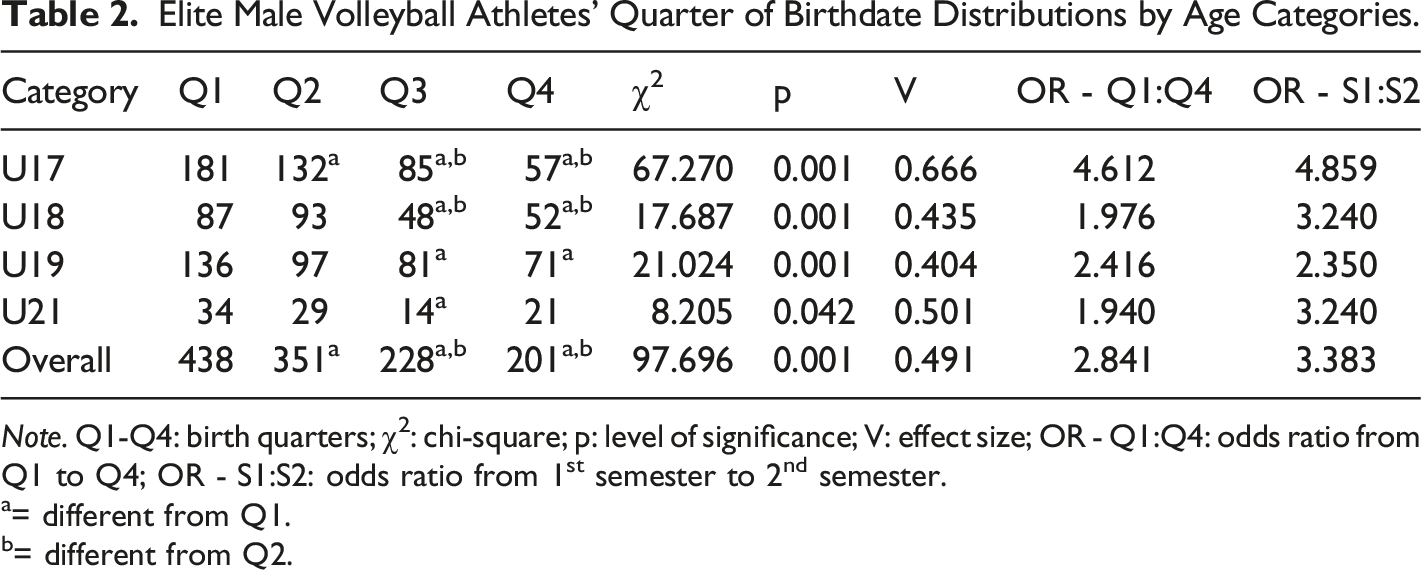
Note. Q1-Q4: birth quarters; χ2: chi-square; p: level of significance; V: effect size; OR - Q1:Q4: odds ratio from Q1 to Q4; OR - S1:S2: odds ratio from 1st semester to 2nd semester.
a= different from Q1.
b= different from Q2.
Vertical Jump Performance
In the U17 category, our analyses indicated that spike jump heights (F (3, 451) = 1.5; p = .214; η2p = .01) and block jump heights (F (3, 451) = 2.037; p = .108; η2p = .013) did not differ according to the quartiles in which athletes’ were born (Figure 1(a)). In the U18 category, spike jump heights (F (3, 276) = 3.737; p = .012; η2p = .039) and block jump heights (F (3, 276) = 4.841; p = .003; η2p = .05) differed significantly among athletes born in different quartiles of their birth year (Figure 1(b)). Athletes born in Q2 reached higher spike jump heights (p = .006) and block jump heights (p = .002) than athletes born in Q4. In the U19 category, spike jump heights (F (3, 381) = 1.912, p = .127; η2p = .015) were not significantly different between athletes born in different birth quartiles (Figure 1(c)). However, differences were found for block jump heights (F (3, 381) = 3.443; p = .017; η2p = .026) in this category, with athletes born in Q1 reaching higher heights than athletes born in Q3 (p = .049). Finally, in the U21 category, there were no significant differences in spike jump heights (F (3, 94) = 0.342; p = .795; n = 0.011) or block jump heights (F (3, 94) = 0.147; p = .932; η2p = .005) across athletes’ birth quartiles (Figure 1(d)). Spike and Block Jump Heights for (a) U17, (b) U18, (c) U19, and (d) U21 Age Categories.
Discussion
Our aim in the present study was to analyze the relationship between these Brazilian elite male volleyball athletes’ birthdate quartiles and their vertical jump performance by age category. We affirmed the prevalence of early quartile birthdates in this sample, suggesting that RAE was evident in talent selection and development. Specifically, in the U17 category, more athletes were born in Q1 than in Q2, Q3, and Q4, and athletes born in Q2 were more frequent than those born in Q3 and Q4. In the U18 category, more athletes were born in Q1 than in Q3 and Q4, and more athletes were born in Q2 than in Q3 and Q4. Regarding the U19 category, more athletes were born in Q1 than in Q3 and Q4. Finally, in the U21 category, more athletes were born in Q1 than in Q3. These results are similar results to findings by Lidor et al. (2021), who analyzed RAE in various sports and by Lupo et al. (2019) who showed that athletes born at the beginning of the year were more likely to reach elite levels in various sports, such as basketball, rugby, soccer, volleyball, and water polo.
Specifically, in volleyball, RAE has been consistently reported among both male and female athletes (Safranyos et al., 2020), similar to the findings of the present study. Castro et al. (2023), reported RAE among Brazilian elite volleyball players, and Castro et al. (2022) found RAE based on gender and playing position, with an overrepresentation of middle blockers, opposites, and outside hitters who were born in Q1 and Q2.
Despite the overrepresentation of volleyball athletes with early quartile birthdates in the present study, our analysis of players’ vertical jump performance (i.e., spike jump heights and block jump heights) indicated no birthdate quartile differences for players in the U17 and U21 age categories. In the U18 category, there were higher spike (296.44 cm) and block (317.72 cm) jump heights for athletes born in Q2 than athletes born in Q4 (spike jump = 289.55 cm; block jump = 307.93 cm). As for the U19 category, athletes born in Q1 reached higher block jump heights (320.34 cm) than athletes born in Q3 (314.77 cm). These results provide only partial support for the idea that an RAE effect would be evident through elite volleyball players’ performances on the specific skill of vertical jumping. Even though we had no access to when athletes underwent biological maturation, most of the athletes who comprised our sample (U17 to U21) are likely to have already undergone their growth spurts (Malina et al., 2004). Yet, vertical jump heights may relate to a presumed RAE for U18 and U19 but not for U17, and U21 age categories.
While maturational differences among athletes are critical to discussions of RAE, it is important to consider that other factors may lead to physical and/or technical/tactical changes in performance. This notion may contribute to an understanding of our discovery that an influence of the birth quartile on vertical jump performance was not evident in certain age groups of these 17–21 year old youth volleyball athletes. Wattie et al. (2015) introduced a model centered on constraints, delineating individual, environmental, and task-related factors to elucidate the RAE. According to this constraints-based framework, individual constraints encompass the distinctive attributes (including factors such as gender, height, body composition, and maturation status); environmental constraints pertain to aspects like the sport’s popularity, policies, and physical surroundings; task constraints involve the sports-specific elements, including the competitive level and crucial physical capabilities for success (such as strength, speed, and power) (Wattie et al., 2015). Of course, we should also acknowledge that an absence of a relationship between birth quartile and jump performance in late adolescence or young adulthood (the age period for participants in this study) does not mean that this relationship was very evident earlier in adolescence when athlete selection decisions were being made. In other words, maturational and associated jump height differences among competing early adolescents may have influenced selection decisions for these athletes earlier in their lives, even if their physiological mediated jump performances are less evidently tied to subtle age differences by late adolescence.
Vertical jump capability should not be considered the only motor skill that may be associated with RAE in this population. Prior research suggests that jumping ability is one of the primary factors in talent identification and selection in youth volleyball (Rubajczyk & Rokita, 2020) and that improving vertical jump in athletes is recommended across different age groups through individualized appropriate strength and conditioning programs matched to the player’s position (Rubajczyk & Rokita, 2020). Even though biological maturation and its relationship with anthropometric variables may play a crucial role in the selection process of sports talent through its effect on a range of motor skills and player abilities (Albaladejo-Saura et al., 2023), other variables more closely related to volleyball skill development must be considered when examining RAE (Wattie et al., 2015), perhaps especially when examining RAE in late adolescence or young adulthood.
Given the unpredictable nature of the volleyball game and its specific technical demands (Denardi et al., 2017), it is likely that coaches also based their selection decisions on other relevant aspects of the game, besides vertical jump performance, including the athletes’ decision-making and technical-tactical performance. Furthermore, athletes born in the last quartiles of the year who are selected for teams may be the most talented in these more cognitive abilities, as these skills may have helped them compete on equal terms with older and more physically developed peers (Fumarco et al., 2017). In other words, although there was a predominance of athletes born early in the year for participants in all age categories of our study, RAE was not always reflected in their vertical jump performance (especially in U17 and U21 groups). Younger athletes may have shown early development of other skills and strategies to overcome potential maturational differences at the time of selection. Additionally, the older players who were selected in part for their relatively earlier physical maturation may have been able to capitalize on sport development training through mid-adolescence that was made available to them through their early selection. Thus, while these players may not now by as advantaged in their physical prowess as when younger, they may now also show elite strengths in other skills and strategies (e.g., decision making) that may not have been as evident when they were younger.
The RAE should be acknowledged as a complex phenomenon by all those involved in the sports domain, since it can differentially advantage slightly older youth and have consequences for the athletic development of younger athletes and contribute to a systematic loss of long-term sporting talents (Figueiredo et al., 2022). Kelly et al. (2020b) employed the Personal Assets Framework to elucidate the immediate, short-term, and long-term outcomes linked to RAE. According to the authors, the immediate effects encompass personal engagement in activities, the appropriate settings and organizational structures, and the quality social dynamics; the short-term effects impact athletes’ competence, confidence, connection, and character (the 4Cs); meanwhile, the long-term effects influence athletes' performance, participation, and personal development (the 3Ps). So, coaches, sports entities, and policymakers are growing more cognizant of the potential biases linked to RAE and are actively working to rectify this by introducing more equitable selection and talent development approaches in sports. These initiatives are designed to give athletes born later in the year more equitable chances to nurture their abilities and achieve their maximum potential.
Some of these initiatives are described in the literature. Barnsley and Thompson (1988) suggested that sports teams and organizations should narrow the range of age groupings, thereby diminishing the relative age advantage of relatively older players. These authors also proposed implementing a quota system for each quarter in competitions to ensure a proportional number of relatively younger players. Mann and Van Ginneken (2017) suggested numbering players’ shirts in an orderly fashion based on athletes' ages during youth sports selection processes to provide recruiters with clarity regarding the athletes’ ages. Kelly et al. (2020a), in turn, propose the adoption of “Birthday-Banding” as a strategy to moderate the RAE, where young athletes move up to their next age group on their birthday, aiming to eliminate specific selection points and fixed chronological bandings.
Limitations and Directions for Further Research
Our study has certain limitations that should be considered. Despite our large sample size, other motor skill variables could have provided more information on the influence of RAE in youth volleyball athletes, such as anthropometric, maturity, and even sport-specific tests. Therefore, future investigators could advance this research by considering technical-tactical performance, playing positions, and athletes’ previous experience in sports in conjunction with a range of anthropometric, maturational, and physical fitness performance measures that may be the basis for the RAE in volleyball and other sports. Perhaps of most importance, future investigators might study these variables in younger athletes to better understand the relationship between birthdate quartiles of the eligibility year and the various athletic abilities that are most and least affected by physical differences between slightly older and younger athletes at the time when team selection decisions are being made.
Conclusion
Athletes born closer to the cut-off date for age category eligibility were more prevalent in all the age categories we analyzed among a large sample of elite male Brazilian volleyball athletes, again confirming the prevalence of RAE in this sport. However, we found only partial support for a relationship between players’ vertical jump heights and their birth quartiles, with this association evident only to some degree in only two of our four youth age categories (i.e., in U18 and U19, but not in U17 and U21). We discuss these findings in depth, noting that physical differences present in early adolescence when selection decisions are made may be less evident by late adolescence when elite status has already been determined. Future RAE investigators should address both physical and cognitive skills of elite athletes and examine differences between findings of this nature for populations of younger and older athlete participants.
Footnotes
Declaration of Conflicting Interests
The authors declared no potential conflicts of interest with respect to the research, authorship, and/or publication of this article.
Funding
The authors received no financial support for the research, authorship, and/or publication of this article.
