




Abstract
In this article, we offer an exhaustive analysis of academic work on psychological flexibility using bibliometric techniques. We identify emerging trends in a dataset of 3535 scholarly articles from the Web of Science database. We highlight key publications, map out the field’s intellectual framework, and anticipate future research avenues through co-citation and co-word analytics. The co-citation assessment revealed five distinct clusters, while the co-word analysis showed three. Although research regarding psychological flexibility has gained recent popularity, there remains a need for more scholarly initiatives to achieve a nuanced understanding of this subject.
Introduction
Acceptance and Commitment Therapy (ACT) is a therapeutic approach grounded in psychological flexibility (Godbee & Kangas, 2020). In ACT, psychological flexibility is a core principle that guides individuals to embrace and adapt to their thoughts and emotions rather than attempting to control or eliminate them (Watts & Luoma, 2020). ACT encourages individuals to be open, accepting, and present in the moment, helping them align with their values despite challenging circumstances (Bahattab & AlHadi, 2021). By fostering psychological flexibility, ACT empowers individuals to respond effectively to life’s difficulties; it promotes mindfulness and values-driven behavior. Through techniques such as mindfulness, acceptance, and commitment to personal values, ACT aims to enhance overall well-being and resilience in adversity (Moens et al., 2022). At its core, the six psychological processes of ACT - acceptance, diffusion, self as context, committed action, values, and living in the present moment - aim to promote and increase an individual’s psychological flexibility in any life situation (Tyndall et al., 2020).
Psychological flexibility is seen as a key personal attribute that underlies the entire storehouse of processes that anchor ACT as a viable therapeutic modality. Doorley et al. (2020) defined psychological flexibility as the inclination to respond to situations in ways that support pursuing valued goals. They emphasized that psychological flexibility is crucial in challenging situations that evoke distress. Psychological flexibility is a multifaceted concept that operates as both a process and an outcome within the context of psychological well-being and therapeutic interventions. As a process, psychological flexibility involves the ability to adapt cognitively, emotionally, and behaviorally to various situations (Cherry et al., 2021). It encompasses mindfulness, acceptance, and the willingness to engage in value-driven actions despite challenging thoughts and emotions. It requires actively cultivating a non-judgmental awareness of one’s internal experiences and making choices that align with personal values.
Psychological flexibility is also an outcome of ACT, because individuals who consistently engage in these adaptive processes tend to exhibit improved mental health, resilience, and overall well-being (Kashdan et al., 2020). As individuals develop and enhance their psychological flexibility through practices like ACT, the positive changes in their responses to stressors and challenges become evident in their emotional regulation, decision-making, and overall quality of life. Therefore, psychological flexibility operates as a dynamic interplay between the ongoing process of adapting to experiences and the positive outcomes that emerge from cultivating such flexibility in one’s psychological repertoire.
A bibliometric analysis of publication trends in psychotherapy showed that ACT is one of the few emerging psychotherapies to have gained popularity through increased publications since 2010 (Soares et al., 2020). Soares et al. (2020) also predicted that novel therapies, such as ACT, will continue to grow, as they are rooted in evidence-based practices. This evidence basis for ACT is reflected in Li et al.’s (2022) bibliometric analysis, which provided deeper insights into the evolution of ACT research. According to their findings, the ten most important keywords, in order of frequency, were: acceptance and commitment therapy (527 records), depression (210 records), mindfulness (183 records), anxiety (165 records), cognitive behavioral therapy (146 records), chronic pain (132 records), psychological flexibility (117 records), psychometric properties (106 records), meta-analysis (100 records), and randomized controlled trials (100 records). Notably, psychological flexibility is 7th on this list, which underscores its significance within ACT research. Importantly, psychological flexibility is one of the central concepts in ACT that distinguishes it from many other therapeutic approaches. Since other aspects of ACT overlap with existing therapies, it is imperative to highlight this specific finding, reinforcing the unique position psychological flexibility holds within ACT literature.
In a way that differs in degree from traditional cognitive-behavioral therapies that aim to change or control thoughts and emotions to alleviate distress, ACT encourages individuals to accept their inner experiences without judgment and to focus on taking meaningful action guided by their values. Hence, following Li et al.’s (2022) discussion on the growing and stable trend of keywords such as “acceptance and commitment therapy,” “depression,” “anxiety,” and “chronic pain,” it is essential to acknowledge the continuing research potential and significance of these topics, especially psychological flexibility, in future research.
An emphasis on psychological flexibility is consistent with Levin et al.’s (2012) meta-analysis, in which psychological flexibility was found to act as both the mechanism of change in ACT and a means of measuring its outcome. The repeated appearance of psychological flexibility in keywords related to ACT and its impact on psychological states, reflects an increasing academic interest in its critical role in enhancing our understanding of the therapeutic process. Such insights underline a growing recognition of psychological flexibility as a fundamental element in psychotherapy that warrants further exploration and theoretical development.
A remaining research gap in bibliometric studies on psychological flexibility lies in a limited exploration of the scholarly landscape, citation patterns, and thematic evolution of this concept. A comprehensive bibliometric analysis of psychological flexibility will offer valuable insights into the identities of key authors, journals, and seminal works, providing a structured overview of the existing knowledge network in this area of research. This analysis could uncover potential interdisciplinary connections, highlight emerging trends, and identify underexplored areas, thus guiding researchers toward uncharted territories. A bibliometric study would help delineate how theories and research methodologies have evolved by mapping a historical research trajectory in psychological flexibility. Ultimately, this effort should aid future scholars to define gaps in research, refine research questions, and foster a cohesive and informed research agenda in this dynamic field. Considering that psychological flexibility is a core target of ACT, it would be worthwhile to examine it as a standalone keyword to explore its specific publication trends and characteristics. Therefore, in this study, we aimed to: (i) assess pivotal past studies and current directions in psychological flexibility through co-citation analysis and (ii) identify future trends in psychological flexibility using co-word analysis.
Method
Bibliometric Approach
A bibliometric approach uses mathematical and statistical methods to analyze and evaluate scientific publications, allowing researchers to investigate the current state and emerging trends in academic literature in a specific research field (Bota-Avram, 2023; Zakaria et al., 2023). Bibliometrics employs statistics to describe publishing trends and to highlight connections between published works (Ninkov et al., 2022).
Data Collection
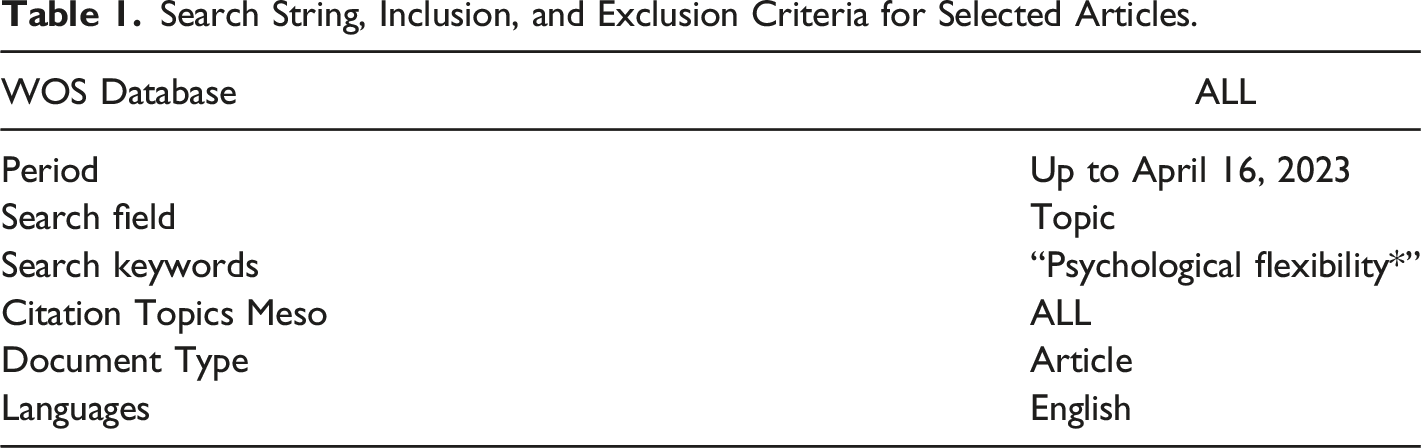
Search String, Inclusion, and Exclusion Criteria for Selected Articles.
Screening Process
We considered only peer-reviewed articles. Even excluding non-peer-reviewed articles, we found ample literature on psychological flexibility. Prior to this bibliometric analysis, we checked all selected publications for any inconsistencies or duplicates to maintain data integrity (Zupic & Čater, 2015). We set a uniform criterion that all articles should be in English for consistency. Our inclusion and exclusion parameters are elaborated in Table 1. After applying these criteria, we retained 3535 articles for this review.
Data Analysis
We divided the process of analyzing data into four main steps. To obtain pertinent descriptive analysis of published articles, we first calculated descriptive statistics using the WoS database, focusing on three aspects: The h-index value, the number of relevant papers, and the number of citations and self-citations. Upon completing this descriptive analysis, we utilized VOSviewer for co-citation and co-word analyses to trace trends within a specific research field (Wider et al., 2023b). These analyses yielded clusters we examined further, which entailed a detailed review of the publications’ abstracts, main findings, and methodologies. The clusters derived from the VOSviewer analysis were refined and labeled through deductive reasoning and a deep qualitative understanding of the content. For a comprehensive analysis, we performed both abstract and full-text reviews. This last step was particularly necessary when abstracts provided insufficient detail for precise categorization.
Co-citation Analysis
Co-citation analysis examines how frequently two documents are cited together in other past publications (Bronk et al., 2023). This information helps determine the relationships between papers and how a research field evolves (Donthu et al., 2021). Co-citation analysis is based on the idea that if two works are frequently cited together, they indicate a strong intellectual connection and probably contribute significantly to the same theme or idea (Fauzi et al., 2023a). By thoroughly examining co-citation networks, researchers can track the development of important concepts or subjects within a field of study. This helps them identify particularly influential publications and authors (Fauzi, 2023; Liu & Pan, 2023).
Co-word Analysis
Co-word analysis examines significant shared words within article discussions of the implications of research and predicted research directions. Thus, co-word analysis is useful for identifying future research trends. Analyzing the frequency and co-occurrence of keywords in a corpus of publications also helps determine emerging topics and themes in a research field (Hsu et al., 2023; Wider et al., 2023c). Thus, researchers can effectively track the development of a specific research topic and identify its past, present, and future trends by combining co-citation analysis (past and present) and co-word analysis (future) (Arici et al., 2022; Wider et al., 2023a).
Results and Discussion
Trends in Publication and Descriptive Analysis
The WOS database yielded 73,713 citations for the 3325 articles we selected, using the criteria listed in Table 1. Excluding self-citations, there were 65,016 citations by other authors. We determined the H-index for these articles to be 110, with an accompanying average citation count of 20.85 per article. We found growing scholarly attention towards the field of psychological flexibility research. After an initial publication in 1979, noteworthy further contributions were not observed until 1991. After 1991, there was exponential growth in the number of publications, such that the number of publications escalated from 6 in 1991 to 574 in 2021 and 549 in 2022. We anticipate an increase in publications pertaining to psychological flexibility in forthcoming years. Figure 1 graphically illustrates the temporal trend of the number of published papers and the corresponding number of associated citations, spanning the period from 1979 to 2023. Quantity of Publications and Citations Between 1979 and 2023.
Co-citation Analysis
In our co-citation analysis, we established a citation threshold of 67, meaning only references cited together at least 67 times were included. This approach resulted in the identification of 60 references that met or exceeded this co-citation frequency, ensuring that our analysis focused on the most significant and relevant themes within the scientific literature. However, only 59 references were linked through co-citation. The decision on the threshold level was based on a series of tests to guarantee that the clusters identified in the analysis were stable and reflected pertinent themes. This threshold was established after experimenting with various levels, including 55, 56, 57, 58, 59. Confirming that the chosen threshold accurately represented an extensive scientific map is vital. Setting a high threshold may lead to excessive filtering, which could exclude important clusters from the analysis. Conversely, too low a threshold might result in insufficient filtering, creating an excess of clusters and potentially leading to repetitive themes, as noted by Geng et al. (2020).
A network analysis produced from the referenced sources is shown in Figure 2. Table 2 showcases the top ten co-cited references, selected for their total link strength (TLS). TLS is a measure reflecting the cumulative intensity of connections between each reference and others within the scholarly network. This metric underscores the references’ important contributions to the research domain, indicating their central roles in shaping the field’s discourse. The high TLS of these works signals their frequent co-citation with numerous other studies, highlighting their foundational importance and relevance to prevailing research trends and methodologies. Notably, this selection surfaces the literature that has profoundly influenced the area, as evidenced by substantial citation counts: Hayes et al. (2004) leads with 740 citations, followed closely by Bond et al. (2011) with 732 citations, and Hayes et al. (2011b) with 532 citations. Co-Citation Analysis. The Top 10 Documents, Based on Co-Citations and Total Link Strength. Note. Source: Author interpretation based on VOSviewer analysis.
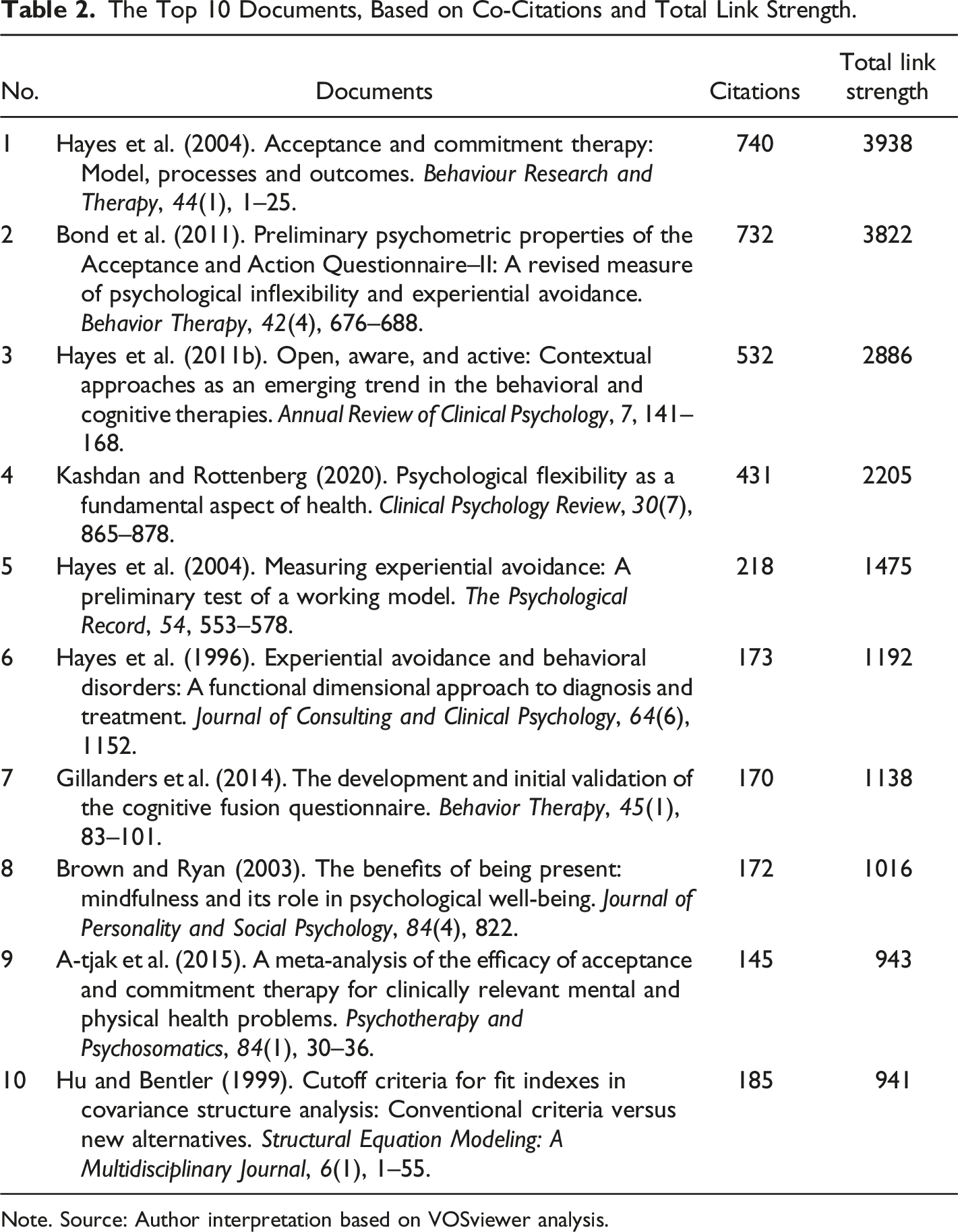
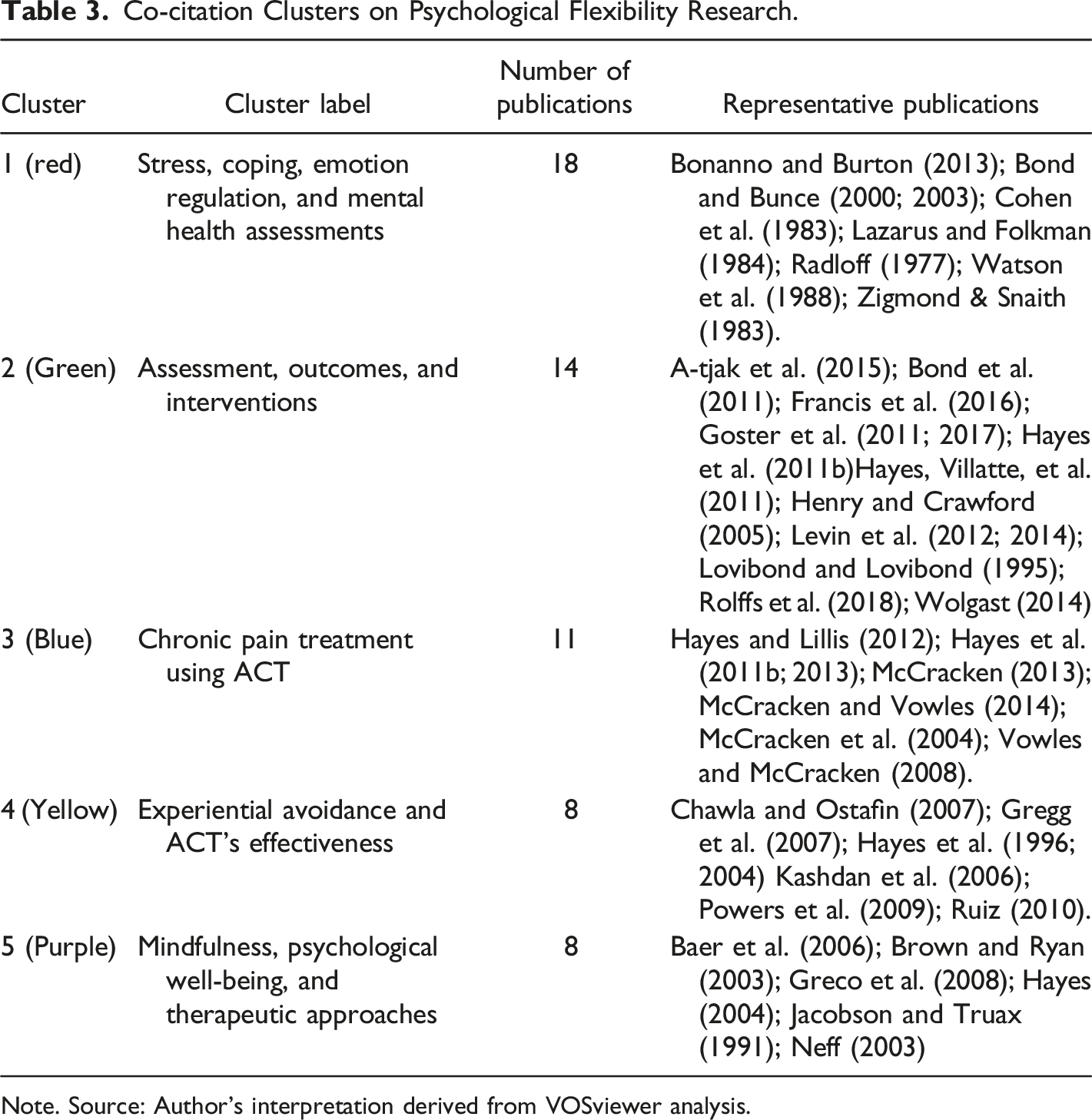
Based on our co-citation analysis, we identified five distinct clusters, each characterized by uniquely connected themes. These clusters are collections of connected publications with a similar theme (Dong et al., 2023). In Figure 2, nodes of the same color indicate the same cluster, with each cluster composed of publications with similar themes, as explained below.
Cluster 1 includes 18 publications focusing on
Cluster 2 (green) has 14 publications that examined
Cluster 3 (blue) includes 11 publications on “
Cluster 4 (yellow) contains eight publications investigating
Co-citation Clusters on Psychological Flexibility Research.
Note. Source: Author’s interpretation derived from VOSviewer analysis.
Co-occurrence of Keywords
The 15 Most Frequently Occurring Keywords.
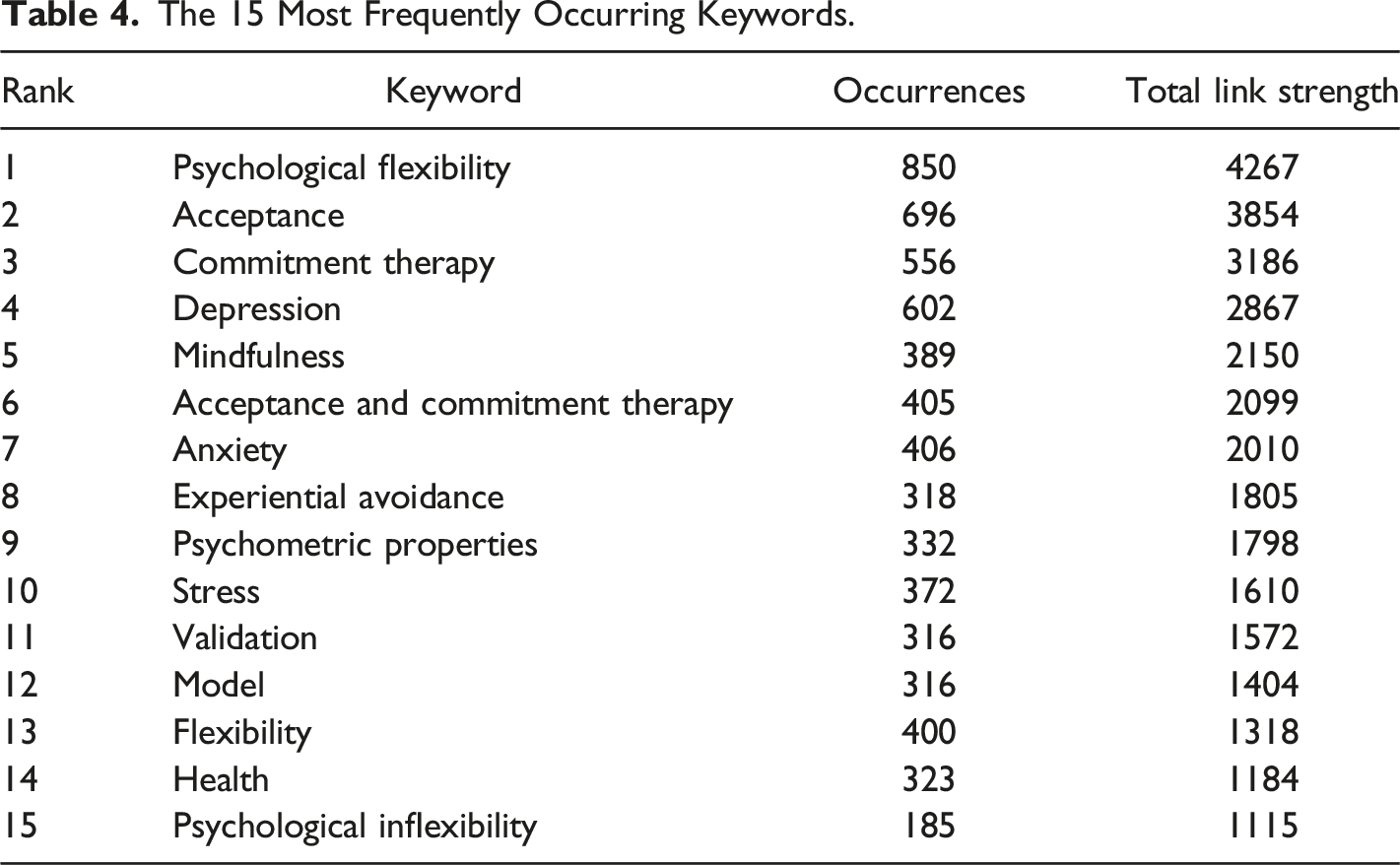

Co-Word Analysis of Psychological Flexibility Research.
Cluster 1 (Red): This cluster includes 34 keywords titled “
Cluster 2 (green): This cluster contains 15 keywords titled “
Cluster 3 (Blue): This cluster, titled “
Co-Word Analysis on Psychological Flexibility Research.
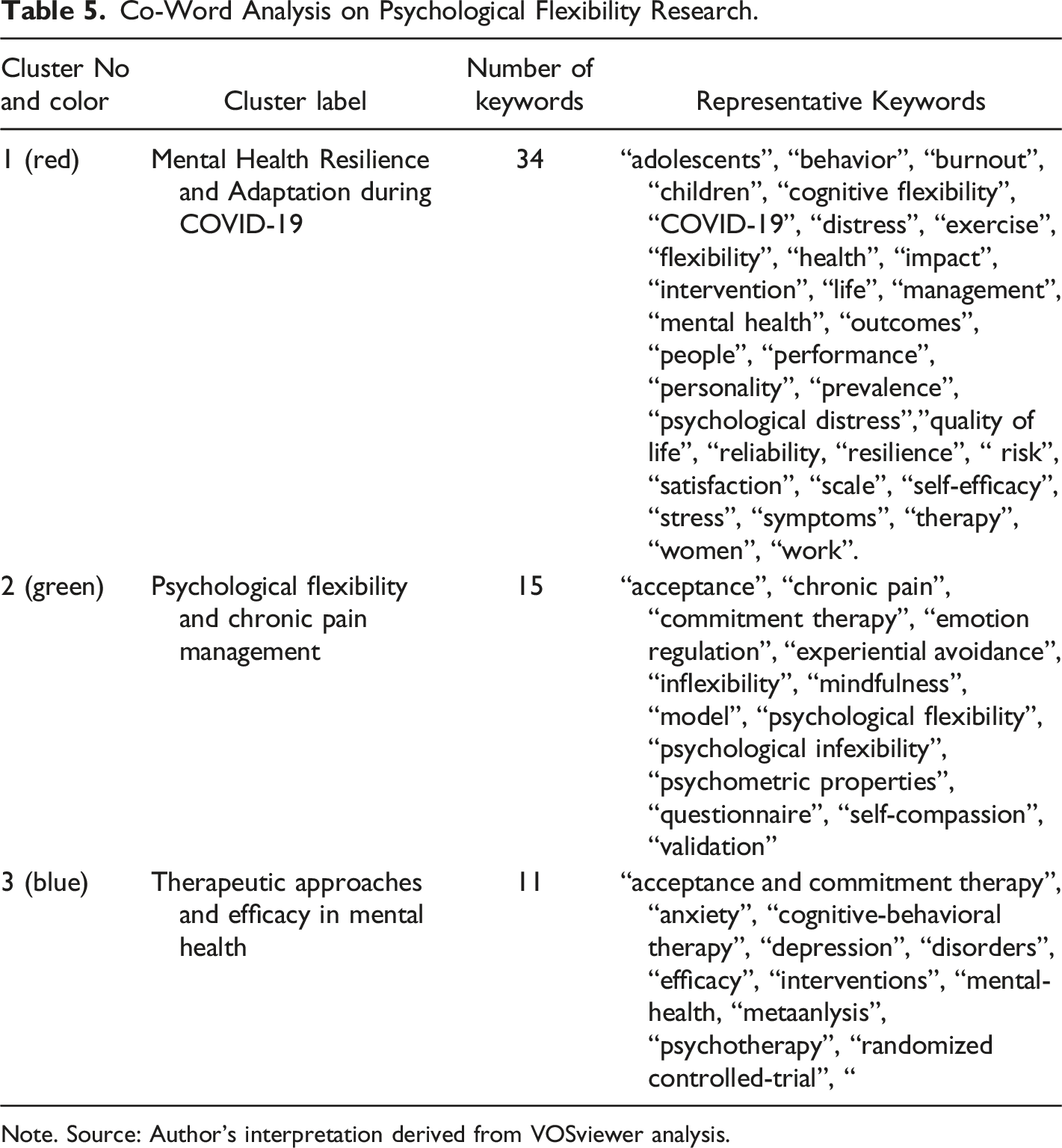
Note. Source: Author’s interpretation derived from VOSviewer analysis.
Theoretical Implications
Implementing ACT improves patients’ psychological flexibility. This bibliometric analysis indicates that ACT is related to mental health through assistance with adapting to a changing environment. There are three psychological flexibility domains based on this bibliometric analysis. First, these data contribute to a comprehensive understanding of the influence of individual differences, workplace factors, and coping strategies on stress, mental health, and well-being (Bonanno & Burton, 2013). Psychological flexibility is highlighted in studying mental health and well-being, and the continued development of assessment instruments and interventions is encouraged to target this fundamental construct (Wąsowicz et al., 2021). Second, as an intervention that promotes acceptance, mindfulness, and value-driven actions to enhance mental health and well-being, ACT considers the significance of understanding experiential avoidance in the context of psychopathology and efficacy (Powers et al., 2009; Ruiz, 2010). Third, mindfulness, psychological adaptability, and self-compassion are highlighted in recognizing and promoting mental health. When receiving ACT intervention, patients first learn to accept unpleasant thoughts and feelings and gradually learn things that conform to their values and have positive changes in behavior. In this process, the individual learns to relinquish control over the mind and distance itself from interfering thoughts to enhance self-observation and work with one’s values (Hayes et al., 2011aHayes, Strosahl, & Wilson, 2011).
Practical Implications
This study has three practical implications. First, based on co-word analysis, the global health crisis has highlighted the importance of addressing mental health concerns and helping people become more resilient, adaptable, and fulfilled in the face of ongoing challenges. Second, as exemplified by ACT, the psychological flexibility model is a promising method for treating chronic pain. Various psychometric instruments, such as questionnaires, have been used to assess and validate the efficacy of ACT interventions in enhancing psychological flexibility and alleviating chronic pain (Barrett et al., 2019; Kibbey et al., 2020). These instruments were designed with robust psychometric properties to ensure their validity and reliability in clinical settings for measuring key components of the therapy. By incorporating these tools into a comprehensive model, researchers and clinicians can better comprehend the intricate relationships between chronic pain, psychological adaptability, and emotion regulation, resulting in more effective therapeutic interventions (McCracken & Vowles, 2014; Troy & Mauss, 2011). Third, our study emphasizes the importance of evidence-based psychotherapy interventions such as Acceptance and Commitment Therapy and Cognitive-Behavioral Therapy in the treatment of mental health disorders such as anxiety and depression. The efficacy of these interventions is supported by rigorous research methodologies, such as meta-analyses and randomized controlled trials, that contribute to the advancement of mental health care and the well-being of individuals with these disorders.
Limitations and Future Research
Our study has several limitations. First, we focused exclusively on peer-reviewed journal publications, ensuring high-quality findings but potentially omitting valuable insights from sources like books, book chapters, editorials, and conference proceedings. Future research of this kind could broaden its scope by including these materials for a more comprehensive review. Second, our analysis was limited to 3535 publications from the WoS database. Using different databases, such as Scopus, Google Scholar, and PubMed might reveal different perspectives on psychological flexibility that we may have missed. Our reliance on WoS, while offering quality assurance, might have limited the diversity and scope of the research pool, as suggested by (Fauzi, 2022; Mongeon & Paul-Hus, 2016). Third, we selected this research theme based on an inductive interpretation of literature related to ACT, but others might have interpreted this literature differently and selected another theme.
Conclusion
The increasing significance of psychological flexibility as both a process and a goal in modern psychotherapy requires continued research attention. This bibliometric review presented a nascent perspective on psychological flexibility, based on the ACT model. Through co-citation analysis and co-word analysis, our review contributes to an interpretation of the network structure for this research topic and enhances the accuracy of predictions of future trends in psychological flexibility and ACT. The 3535 selected publications related to psychological flexibility research were extracted from the WOS database. Our findings described a rapidly growing number of publications related to psychological flexibility since 1991. These articles related to five principal research themes identified through co-citation analysis and three psychological flexibility themes related to mental health and ACT identified through co-word analysis. This review should help scholars understand current research and apply it to the current global health crisis, and it should assist planning and implementation of future research on ACT and psychological flexibility.
Footnotes
Declaration of Conflicting Interests
The author(s) declared no potential conflicts of interest with respect to the research, authorship, and/or publication of this article.
Funding
The author(s) received no financial support for the research, authorship, and/or publication of this article.
