




Abstract
An external focus of attention is widely reported to benefit motor skill acquisition. In the current experiment we asked whether an external focus of attention benefits visuomotor adaptation, a motor learning task in which external (i.e., seen hand position) and internal (i.e., felt hand position) sensory cues conflict. Participants were assigned to one of three groups: external focus (n = 33), internal focus (n = 31), or control (n = 33). The external focus group was instructed to attend to the cursor movement, the internal focus group to their hand movement, and the control group received no attentional focus instructions. All participants trained to reach with cursor feedback that was rotated 40° clockwise relative to their hand motion (rotated cursor reach training). Attentional focus instructions were provided at the start of reach training and after every 40 rotated training trials. After reaching with rotated cursor feedback, explicit (conscious strategy) and implicit (unconscious) adaptation were assessed using the process dissociation procedure. Interestingly, the internal focus group adapted their reaches to a greater extent than the external focus group. Post-training assessments revealed no significant differences in explicit or implicit adaptation between all 3 groups. Together, these results suggest that focussing one’s attention internally benefits visuomotor adaptation, potentially due to enhanced processing of hand proprioceptive information during training.
Keywords
Introduction
Over the past two decades, skill acquisition research has sought to identify how the location of one’s attentional focus influences motor performance and learning (for reviews, see Chua et al., 2021; Wulf & Prinz, 2001). Attentional focus has been manipulated by instructing participants to adopt an external or internal focus. An external focus refers to when an individual focuses on the intended effects of their movement on the environment, while an internal focus arises when an individual focuses on their body movements during task performance (Wulf, 2013). In general, instructions directing attention externally (e.g., to the motion of a dart) result in superior performance compared to instructions directing attention internally (e.g., to the motion of the hand or arm throwing the dart) (e.g., Lohse et al., 2010; Marchant et al., 2007; McKay & Wulf, 2012). The benefits of adopting an external focus of attention have been explained by Wulf and colleagues within their constrained action hypothesis (Wulf et al., 2001), and later their Optimizing Performance Through Intrinsic Motivation and Attention for Learning (OPTIMAL) theory (Wulf & Lewthwaite, 2016). According to these theories, an external focus is proposed to enhance motor performance by strengthening the coupling between intended actions and movement execution. Specifically, strengthened coupling is thought to give rise to self-organization within the motor system, leading to a reduction in conscious movement regulation and more automatic and efficient goal-directed actions. In contrast, an internal focus is suggested to disrupt the coupling between intended actions and movement execution, constraining automatic control processes and degrading motor performance.
The advantage of adopting an external focus of attention over an internal focus has been observed across a wide range of motor skills, including balancing (Kim et al., 2017), jumping (Makaruk et al., 2020), and golf skills (Barzyk & Gruber, 2024). However, recent studies have suggested that the impact of the locus of one’s attentional focus is task dependent, such that adopting an internal focus may be beneficial when task demands emphasize processing of proprioceptive information (e.g., Gottwald et al., 2020; Wähnert & Müller-Plath, 2021). For instance, Gottwald et al. (2020) found that when the pertinence of proprioceptive information was amplified by either removing visual feedback during an aiming task or adding weights in a leg-extension task, errors were reduced when adopting an internal focus of attention. Collectively, these findings suggest that the benefits of adopting a specific focus of attention (i.e., external or internal) may be dependent on the sensory processing requirements within the task.
In the current research we extended this line of inquiry to examine the impact of the locus of one’s attentional focus on motor learning in a task in which sensory cues conflict. Specifically, we asked if visuomotor adaptation benefits from an external focus of attention. In a visuomotor adaptation paradigm, individuals reach to visual targets when there is a systematic mismatch between visual and proprioceptive feedback regarding their hand position. For example, the trajectory of a cursor on a screen may be rotated 40° clockwise relative to the trajectory of one’s hand motion (Heirani Moghaddam et al., 2021; Neville & Cressman, 2018; Werner et al., 2015). The introduction of the cursor rotation leads to initial reach errors, such that the cursor falls to the right of the target (Krakauer et al., 2000; Taylor et al., 2014; Wang & Sainburg, 2005). Participants must therefore adapt their reaches, aiming to the left of the target to compensate for the rotated cursor feedback. In visuomotor adaptation, attention can be directed either toward the trajectory of the cursor (i.e., an external focus of attention) or toward the trajectory of the hand (i.e., an internal focus of attention). Since the task goal is a visually guided reaching task, we hypothesized that an external focus of attention would benefit visuomotor adaptation by prioritizing visual information and supporting error-based reach adaptation.
In addition to determining whether the locus of attentional focus influences visuomotor adaptation, we looked to establish the impact of the locus of attentional focus on the underlying explicit (i.e., conscious strategy) and implicit (i.e., unconscious) contributions to visuomotor adaptation. Traditional skill acquisition research has focussed on implicit, automatic mechanisms underlying motor learning (e.g., see Fitts & Posner, 1967; Masters, 1992; Wulf & Lewthwaite, 2016). In contrast, visuomotor adaptation research has developed methods to dissociate explicit and implicit contributions (Maresch et al., 2021). One such approach is the process dissociation procedure (PDP; Werner et al., 2015). The PDP measures implicit adaptation directly through exclusion or ‘aftereffect’ trials, in which participants are instructed to reach directly to the target in the absence of visual feedback. Explicit adaptation is calculated as the difference between inclusion trials, in which participants again reach in the absence of visual feedback and are instructed to use any reaching strategy they learned during training, and exclusion trials. We hypothesized that the locus of one’s attentional focus would differentially modulate these underlying processes, such that an external focus would preferentially enhance implicit adaptation by promoting more automatic processes, whereas an internal focus would enhance explicit adaptation by increasing strategic engagement. By determining the impact of the locus of one’s attention focus on visuomotor adaptation and underlying mechanisms, this research aims to expand current theoretical accounts of attentional focus effects in motor learning.
Methods
Participants
A total of 147 right-handed participants were recruited from the School of Psychology research participant pool in exchange for course credit. Participants were randomly assigned to one of three groups: an external focus group, an internal focus group and a control group. The external focus group was instructed to “focus on the path of the cursor, in order to get the cursor to the target”, while the internal focus group was instructed to “focus on the path of your hand, in order to get the cursor to the target”. The control group did not receive any attentional focus instructions. All participants were naïve to the purpose of the study and informed that they could withdraw at any time without penalty. Upon arrival at the laboratory, written informed consent was obtained.
Of the data collected, data from 50 participants were excluded from the analyses below due to a variety of reasons. Specifically, 7 participants were excluded as they were unable to complete the experiment (e.g., withdrew or failed to demonstrate visuomotor adaptation). An additional 18 participants failed to follow their attentional focus instructions during training. Specifically, when asked after training, “what did you focus on during training?”, these 18 participants indicated a focus inconsistent with their assigned attentional focus instruction (e.g., reported focussing on their hand when assigned to the external focus group). Finally, 25 participants failed to follow instructions during the PDP assessment trials (see Assessment trials: No cursor feedback).
The final sample included 97 participants (54 females, x̄age = 20.9 years ± 0.4 years), with the following breakdown of participants across groups: external focus (n = 33), internal focus (n = 31) and control (n = 33). All participants were right-handed, as confirmed by the Edinburgh Handedness Inventory (x̄ = 87.7, Oldfield, 1971), had either normal (n = 49) or corrected-to-normal vision (n = 48), and self-reported no history of motor, sensory, or cognitive impairment.
This final sample exceeded the minimum required sample size of 84 participants, as determined by an a priori power analysis using G*Power (Faul et al., 2007, 2009), with the following input parameters: alpha (α) = 0.05, statistical power (1-β) = 0.80, and an estimated effect size of f = 0.35. This estimate of effect size was determined based on effect sizes from prior research involving attentional focus manipulations that used tasks such as dart-throwing (Emanuel et al., 2008) or a tracking task with a visuomotor rotation (Sakurada et al., 2016) and corresponds to a Cohen’s d = 0.7, consistent with the recommendation to assume a medium effect size when prior data are limited (c.f. Lohse et al., 2016).
Experimental Procedures
Testing took place in a quiet room using the Kinarm End-Point Lab (Kinarm, Kingston, ON, Canada; Figure 1(A)). Participants grasped a vertical cylindrical handle with their right hand (elbow ∼90°, forearm neutral). Their hand was occluded by a reflective surface, displaying visual stimuli, and a cloth that was secured around their neck and shoulders and attached to the Kinarm. A magenta cursor (0.5 cm diameter) was displayed on the reflective surface and represented the robot handle’s position, sampled at 1000 Hz with a spatial accuracy of 0.1 mm. Participants performed rapid, ballistic “shooting” movements, whereby they quickly moved their hand though the target rather than stopping directly on the target itself. “Shooting” movements were made through one of four yellow targets (1 cm diameter, 3.8° visual angle) located 15 cm from the central home position (white circle, 1.0 cm diameter) along a target array. Targets, along the array, were located at 45°, 75°, 105°, or 135° from the x-axis (Figure 1(B)). Targets were presented in a pseudo-random order, each appearing once before a target was repeated. Movement onset was determined online as the time when the cursor first exceeded a radial distance of 0.5 cm from the home position. Movements were terminated by an unseen soft wall placed 20 cm from the home position, 5 cm beyond the distance of the targets. This soft wall (spring constant 150 N/m) made the movement feel more natural and encouraged participants to “shoot” rapidly through the target (Maksimovic & Cressman, 2018). Experimental apparatus and visuomotor environment. 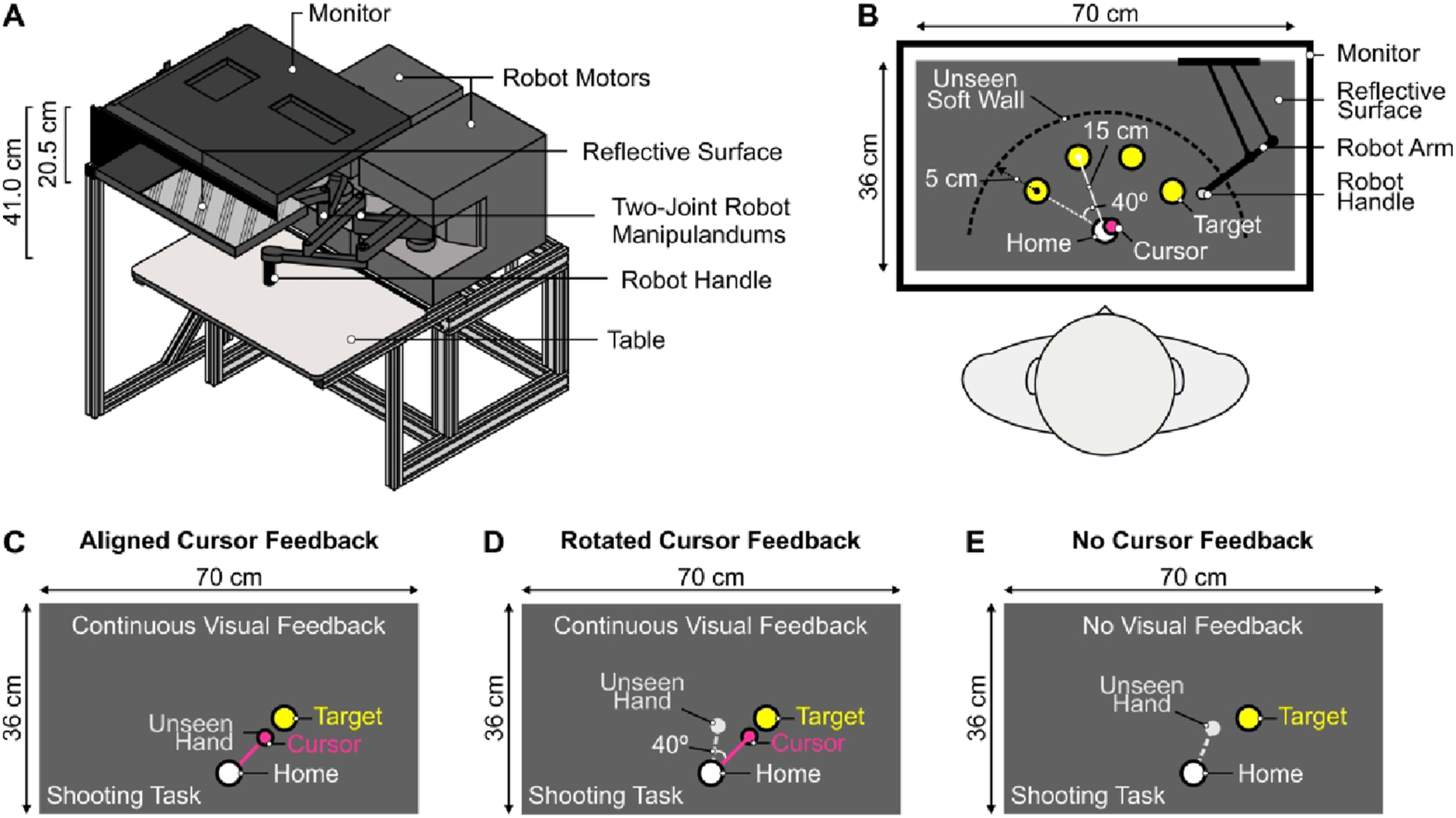
Figure 2(A) provides an overview of the experimental procedure, which consisted of reach training trials (i.e., baseline and adaptation blocks), assessment trials to establish explicit and implicit adaptation and post-training manipulation checks to verify focus of attention. Experimental blocks and a visual timeline of events. 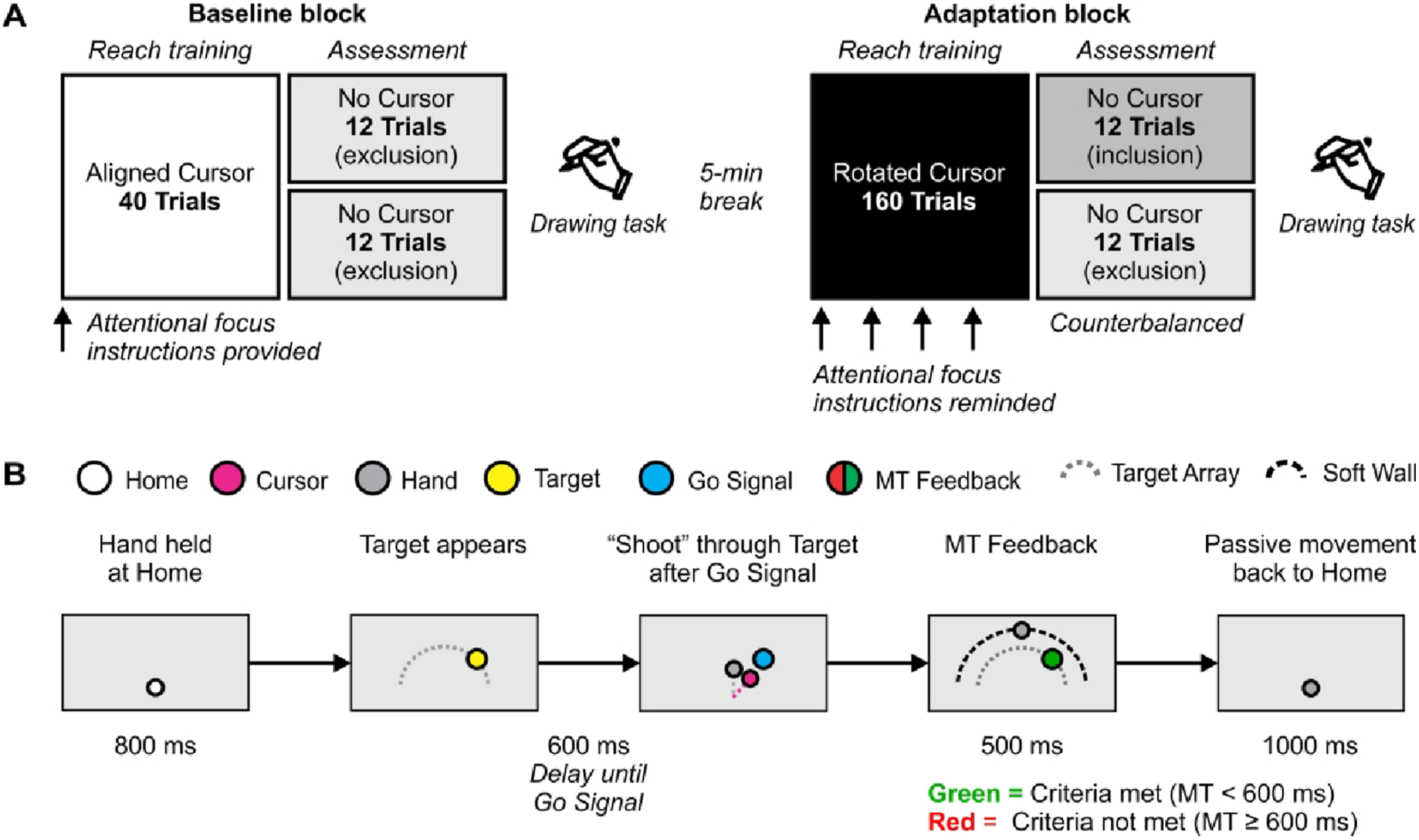
Reach Training Trials: Cursor Feedback
Participants made rapid, ballistic “shooting” movements under two cursor feedback conditions: aligned (Figure 1(C)) and rotated cursor feedback (Figure 1(D)). When reaching with aligned cursor feedback (i.e., baseline block), the cursor on the screen accurately depicted where their hand was in space. When reaching with rotated cursor feedback (i.e., adaptation block), the cursor’s trajectory was rotated 40° clockwise (CW) relative to hand motion, requiring participants to aim counterclockwise (CCW, i.e., left) of the target for the cursor to land on the target. Figure 2(B) provides a visual timeline of events during a rotated reach training trial. Timing of visual events were identical across aligned and rotated reach training trials. A trial began with the hand-cursor in the visible home position for 800 ms. A single yellow target then appeared. Following a 600 ms delay, the target turned blue (the go signal), and participants were to initiate their movement. During the reach, cursor feedback was visible until the hand traveled a radial distance of 15 cm from the home position and crossed the target array. Upon hitting the soft wall (5 cm beyond the target), participants received color-coded feedback that corresponded to their movement time (MT), such that the target turned green if participants reached in the goal MT of less than 600 ms. If MT was greater than 600 ms, the target turned red. At the same time, the cursor reappeared at the position where it had crossed the target array. Following a 500 ms pause, the robot passively returned the participant’s hand to the home position along a linear path in a movement time of 1000 ms. If participants attempted to deviate from this path, a perpendicular resistive force was produced with a stiffness of 2 N/mm and a viscous dampening of 5 N/mm.
Assessment Trials: No Cursor Feedback
Participants also performed reaches in the absence of cursor feedback, such that the cursor disappeared upon movement onset and did not appear again until the start of the next trial (Figure 1(E)). Assessment trials were performed under two instruction conditions (i.e., exclusion and inclusion trials), as described in the process dissociation procedure (PDP; Maresch, Mudrik, et al., 2021; Werner et al., 2015). Within the baseline block of trials, participants completed two sets of 12 exclusion trials. On these trials participants were instructed: “You are now going to reach when you cannot see your hand, as there will be no cursor on the screen. For these trials, aim so that your hand goes straight to the target as you did during baseline.” Within the adaptation block of trials, participants completed 12 inclusion and 12 exclusion trials. The order of inclusion and exclusion trials was counterbalanced across participants. For inclusion trials participants were instructed: “You are now going to reach when you cannot see your hand, as there will be no cursor on the screen. For these trials, use anything you have learned during training to get the cursor to the target. In other words, aim so that the cursor would have gone straight to the target, as in the training trials you just completed.” For the exclusion trials participants were instructed: “You are now going to reach when you cannot see your hand, as there will be no cursor on the screen. For these trials, do not use anything you may have learned to get the cursor to the target. Instead, aim so that your hand goes straight to the target as you did during baseline reaches.”
Manipulation Checks
To verify participants’ locus of attention, we incorporated two manipulation checks. Participants (1) verbally reported what they had focused on and (2) completed two drawing tasks following the PDP assessment trials at the end of the baseline and adaptation blocks (see Figure 2). The drawing tasks consisted of participants drawing trajectories to the four targets that were presented on a piece of paper drawn to scale (see Ong & Hodges, 2010; Wijeyaratnam et al., 2022). Specifically, participants were asked to (1) “draw the path the cursor made in order to get the cursor to the target”, and (2) “draw the path your hand made in order to get the cursor to the target”. During both drawing tasks participants were able to see their hand.
Data Analysis
Reach Training Trials: General Analysis
All trials were analyzed using custom-written MATLAB scripts (2019b, The MathWorks Inc.). Movement start was defined as the time when the participant’s hand exceeded 0.5 cm from the home position, and movement end was defined as the time when the participant’s hand had moved outwards 15 cm from the home position and crossed the target array. These movement indices allowed us to calculate reaction time (RT) and movement time (MT). RT was defined as the time from the onset of the go signal until the start of the movement, while MT was defined as the time from movement start until movement end. We next determined the hand angular error relative to the target at peak velocity (i.e., hand angle) for each trial, where hand angle was equal to the angular difference between a vector from the home position to the desired target and a vector from the home position to the hand’s actual position at peak velocity. Trials were removed from analyses if hand angle was greater than 3 standard deviations from the mean hand angle within a participant’s block of trials. This screening resulted in the removal of 197 trials (0.82% of the data).
Visuomotor Adaptation and Movement Performance
Hand angles within the adaptation block were averaged across 40 consecutive trials to track changes in visuomotor adaptation across reach training (i.e., bin 1 = average of trials 1–40, bin 2 = average of trials 41–80, bin 3 = average of trials 81–120, and bin 4 = average of trials 121–160). These values were normalized relative to baseline (i.e., average of the last 12 reach training trials in the baseline block). Hand angle variability was also determined for each bin of 40 trials within the adaptation block. Mean and variability of hand angle were statistically compared across groups within a 3 group (external, internal, and control) x 4 bin (bins 1–4) mixed analysis of variance (ANOVA) with repeated measures (RM) on the last factor.
Movement performance during reach training was examined by comparing RT and MT between groups across training. Similar to hand angle, RT and MT were averaged over 40 rotated reach training trials and analyzed in a 3 group (external, internal, and control) x 4 bin (bins 1–4) mixed ANOVA with RM on the last factor.
Assessment Trials
We determined the extent of explicit and implicit adaptation at the end of visuomotor adaptation from hand angles in the inclusion and exclusion assessment trials. Explicit and implicit indices of adaptation were calculated according to the following formulas: Explicit index = x̄incluson – x̄exclusion and Implicit index = x̄exclusion. Explicit and implicit indices were normalized relative to the corresponding exclusion trials following the baseline block (i.e., first set of 12 no cursor trials or second set of 12 no cursor trials) to establish explicit and implicit adaptation, respectively (see Neville & Cressman, 2018; Werner et al., 2015). The extent of explicit and implicit adaptation were compared across the 3 groups (external focus, internal focus and control) using separate one-way ANOVAs.
Manipulation Checks
Following verbal confirmation that participants adhered to their respective attentional focus instructions, we examined trajectories in the drawing task (Wijeyaratnam et al., 2022). The greatest angular distance between a reference line drawn from the home position to the target and the participant’s drawn trajectory was first determined. These angular distances were then averaged across the 4 drawn trajectories completed by each participant for each drawing instruction set (i.e., draw the path of the cursor or hand) at the end of the baseline and adaptation blocks. The angular difference following the adaptation block for each participant was normalized by subtracting their corresponding angular difference following the baseline block. These normalized angular differences on both drawing tasks (i.e., draw the path of the cursor or hand) were compared between the external focus and internal focus groups were using separate independent samples t-test. The control group was not included in these analyses as they were not provided with specific attentional focus instructions. Consequently, it is unclear where their attention was allocated during training, making direct comparisons with the focus groups inappropriate for verifying attentional compliance.
General Statistical Analysis
All ANOVA and t-tests were carried out in SPSS (IBM SPSS Statistics 29.0.2.0), following confirmation that data met the assumptions required. When appropriate, the Greenhouse–Geisser correction was applied and corresponding F-values, degrees of freedom, p values and effect sizes are reported. The significance value for all ANOVAs was set at p < 0.05, and Bonferroni post hoc tests corrected for multiple comparisons were used to find the locus of significant effects or interactions for all planned comparisons. All data are reported as mean and standard error.
Results
Adherence to Attentional Focus Instructions
In Figure 3 we display performance on the drawing tasks when participants were instructed to draw the path of the cursor (Figure 3(A)) and their hand (Figure 3(B)). Analyses of the drawn trajectories of the cursor indicated no significant differences between the external focus and internal focus groups (t(62) = −3.48, p = 0.729, d = −0.087), such that participants drew trajectories that went directly to the target (external focus = −2.5° ± 1.8°; internal focus = −1.7° ± 1.6°). In contrast, analyses of drawn trajectories of the hand revealed a significant difference between attentional focus groups (t(62) = 2.157, p = 0.035, d = 0.540). Participants in the internal focus group drew trajectories of the hand that were further left of the target, in the direction that they adapted their reaches, compared to participants in the external focus group (external focus = −11.8° ± 1.9°; internal focus = −16.8° ± 1.3°). This 5° difference in drawn hand trajectories suggests that, at a group level, participants focused their attention as instructed, such that participants in the internal focus group focused their attention more on their hand movements compared to the external focus group. Drawn trajectories separated by target (white circles). Mean drawn trajectories of the 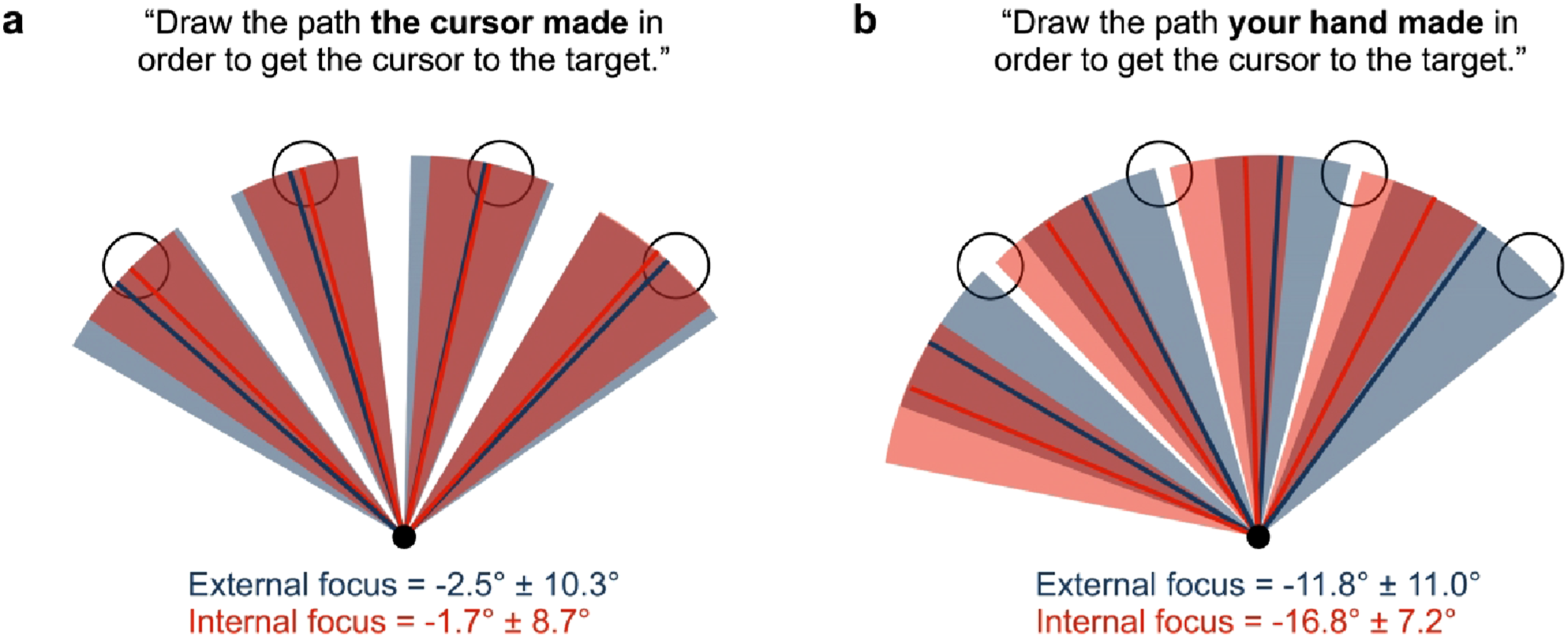
Visuomotor Adaptation and Movement Performance
Figure 4(A) shows the extent of visuomotor adaptation for all groups across rotated reach training. As seen in Figure 4(B), all groups adapted their reaches as rotated training trials progressed (F(2.177,204.594) = 186.999, p < 0.001, ƞp2 = 0.665). Specifically, post hoc analysis indicated that participants compensated for the cursor rotation to a greater extent across consecutive bins (bin 1: 26.3° ± 0.5°; bin 2 = 32.9° ± 0.4°; bin 3 = 34.6° ± 0.4°; bin 4 = 36.2° ± 0.2°, all p < 0.001). While all groups adapted their reaches to the visuomotor rotation, analysis revealed a significant difference between groups (F(2,94) = 3.979, p = 0.022, ƞp2 = 0.078). Participants in the internal focus group adapted their reaches to a greater extent than the external focus group (external focus = 31.4° ± 0.5°; internal focus = 33.4° ± 0.6°, p = 0.021), while visuomotor adaptation in the control group did not differ from either the external or internal focus groups (control = 32.7° ± 0.5°, both p > 0.203). Analysis indicated no significant interaction between group and bin (F(4.354,204.594) = 0.958, p = 0.454, ƞp2 = 0.020). Analyses of hand angle variability (Figure 4(C)) revealed a significant effect of bin (F(1.659,155.903) = 268.835, p < 0.001, ƞp2 = 0.741), such that hand angle variability significantly decreased from bin 1 to bin 4 (bin 1 = 8.0° ± 0.3°; bin 4 = 2.2° ± 0.1°, p < 0.001). Analyses indicated no significant main effect of group (F(2,94) = 2.728, p = 0.071, ƞp2 = 0.055) and no significant interaction between factors (F(3.317,155.903) = 0.532, p = 0.679, ƞp2 = 0.011). A Mean hand angle across training trials. B Mean hand angle and C hand angle variability averaged across 40 training trials for the external focus (blue), internal focus (red), and control (grey) groups. Shaded regions represent the standard error of the mean. Asterisks (*) represent significant differences between the external focus and internal focus groups (p < 0.05). Dagger (†) represents significant differences between the current bin from all other bins (p < 0.05)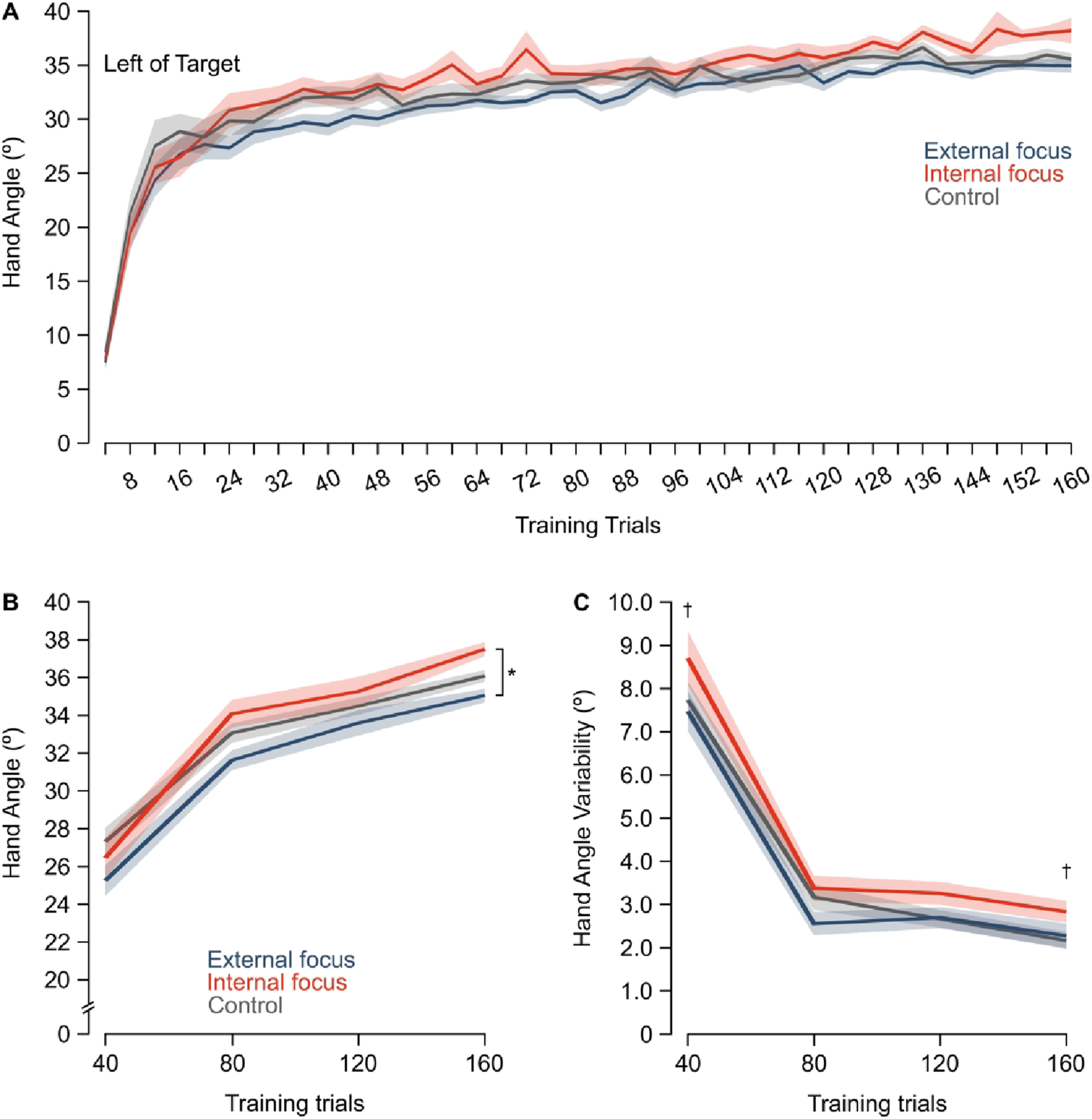
Average RT across rotated reach training trials was 354.6 ms ± 7.7 ms. Analysis of RT revealed a significant effect of bin (F(2.533,238.063) = 4.661, p = 0.006, ƞp2 = 0.047), such that RTs were significantly shorter by the end of rotated reach training (bin 4 = 341.1 ms ± 7.4 ms) compared to the middle two bins of rotated reach training (bin 2 = 359.0 ms ± 8.0 ms, p = 0.001; bin 3 = 362.9 ms ± 10.5 ms, p = 0.014). Analyses indicated no significant main effect of group (F(2,94) = 0.872, p = 0.421, ƞp2 = 0.018) and no significant interaction between factors (F(5.065,238.063) = 2.105, p = 0.065, ƞp2 = 0.043). All participants executed ballistic movements with an average MT of 220.2 ms ± 4.1 ms. Analysis of MT indicated no significant main effects of group (F(2,94) = 2.024, p = 0.138, ƞp2 = 0.041) or bin (F(2.067,194.343) = 1.515, p = 0.222, ƞp2 = 0.016), and no significant interaction between factors (F(4.135,196.819) = 0.666, p = 0.622, ƞp2 = 0.014). The similar RTs and MTs across groups indicate that a speed–accuracy trade-off was not responsible for the group differences observed with respect to the extent of visuomotor adaptation achieved.
Explicit and Implicit Adaptation
In Figure 5 we present the extent of explicit and implicit adaptation. While analysis of explicit adaptation revealed no significant group differences (F(2,96) = 2.945, p = 0.057, ƞ2 = 0.059), explicit adaptation was lowest for the external focus group (external focus = 13.6° ± 1.5°; internal = 16.6° ± 1.7°; control = 19.1° ± 1.7°). With respect to implicit adaptation, analysis indicated no significant differences between groups (F(2,96) = 2.080, p = 0.131, ƞ2 = 0.042; external focus = 14.8° ± 0.9°; internal focus = 15.9° ± 1.0°; control = 13.3° ± 0.8°). Scatterplot and group means of explicit and implicit adaptation as assessed via the process dissociation procedure (PDP; Werner et al., 2015) for the external focus (blue), internal focus (red), and control (grey) groups. 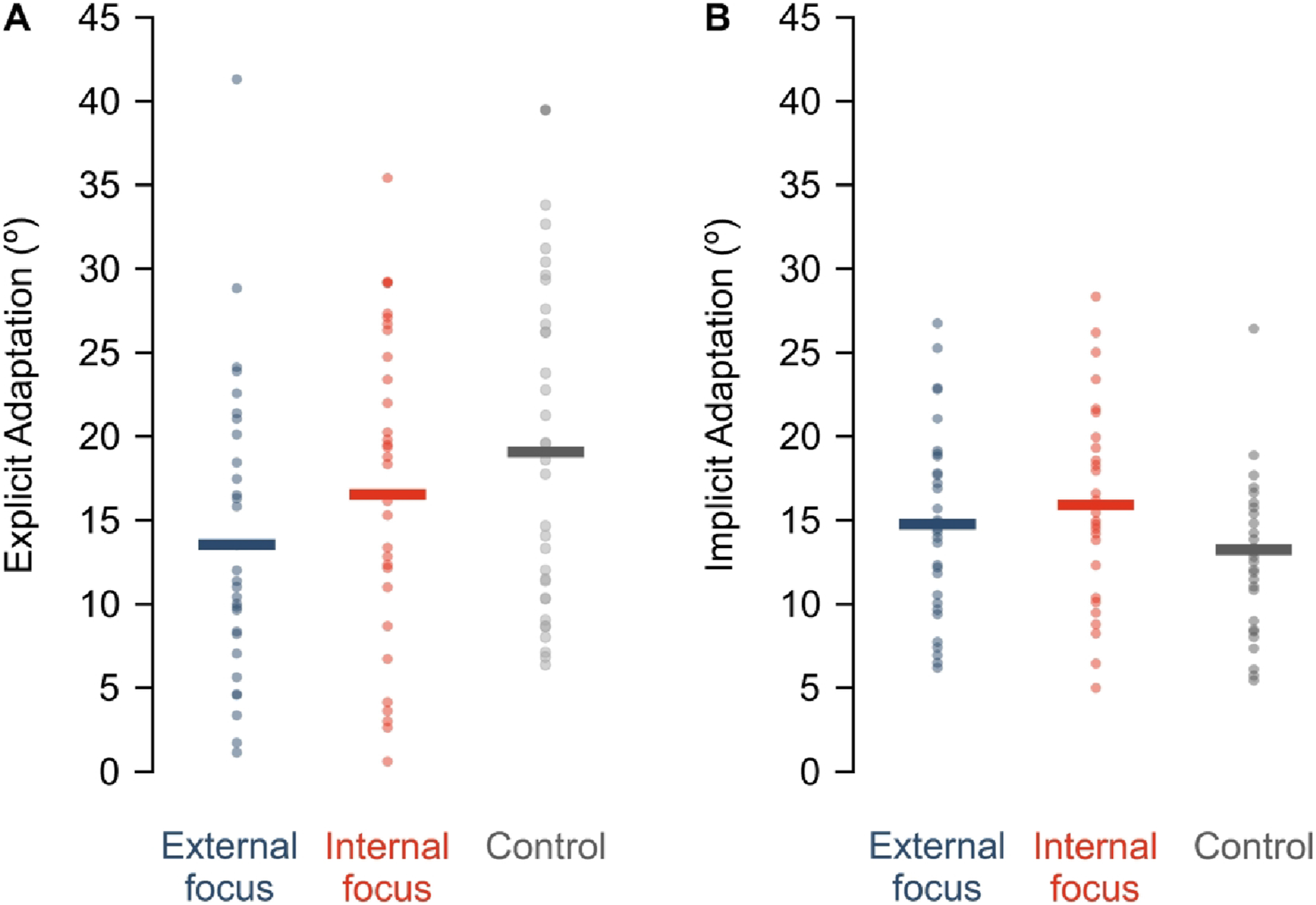
Discussion
In the current experiment we examined whether the locus of attentional focus influences visuomotor adaptation. We found that the extent of visuomotor adaptation observed in our internal and external groups did not differ from the control group. However, participants who had been instructed to adopt an internal focus of attention adapted their reaches to a greater extent than those instructed to adopt an external focus of attention during training. This finding is in disagreement with the OPTIMAL theory (Wulf & Lewthwaite, 2016), which suggests that an external focus of attention benefits motor learning. That said, a growing body of work has demonstrated that the potential benefits of the locus of one’s attentional focus on motor learning are dependent on task demands (Becker et al., 2025; Gottwald et al., 2020; Herrebrøden, 2023; Land et al., 2026; Oliveira et al., 2013; Wähnert & Müller-Plath, 2021). Specifically, an internal focus of attention may be advantageous for tasks that place greater demands on proprioceptive processing (Gottwald et al., 2020; Wähnert & Müller-Plath, 2021).
Our finding of enhanced visuomotor adaptation with an internal focus of attention raises important questions about the nature of our task. Within visuomotor adaptation paradigms, participants complete a visually guided reaching task to a visual target when visual feedback regarding their hand position is misaligned from their actual hand position. Successful task performance requires one to adapt their hand trajectory and recalibrate proprioceptive estimates of their hand position to match the misaligned visual feedback (Cressman & Henriques, 2009, 2010), increasing the salience of proprioceptive information. Thus, an internal focus may promote greater processing related to hand movement and position, thereby strengthening the coupling between motor commands and proprioceptive feedback. This interpretation aligns with the specificity of practice account (Proteau, 1992), which proposes that motor learning is optimized when attentional and informational demands during practice match those required by the task. Since visuomotor adaptation requires proprioceptive signals to be updated to match altered visual feedback, prioritizing proprioceptive cues may better support this recalibration process. The ideomotor theory (Prinz, 1997) also predicts that an internal focus of attention would benefit visuomotor adaptation. According to the ideomotor theory (Prinz, 1997), actions are represented in terms of their anticipated sensory consequences. The locus of one’s attentional focus may thus bias which sensory consequences are emphasized during action planning and execution. An internal focus may strengthen action–proprioceptive representations which are required for visuomotor adaptation, whereas an external focus may preferentially emphasize visual effects that do not benefit visuomotor adaptation. Together, these perspectives suggest that an internal focus would benefit visuomotor adaptation, a task requiring changes in hand trajectory and proprioceptive recalibration. They further support the proposal that the benefits of attentional focus are task specific (Gottwald et al., 2020; Herrebrøden, 2023; Wähnert & Müller-Plath, 2021), challenging the generalized predictions of the OPTIMAL theory (Wulf & Lewthwaite, 2016).
The Influence of Attentional Focus on Explicit Adaptation
Given the increased visuomotor adaptation observed during training by our internal focus group compared to the external focus group, we would not expect to observe significant differences in implicit adaptation between groups. Instead, and in accordance with our hypothesis, we would expect explicit adaptation to be enhanced in the internal focus group in comparison to the external focus group. However, we found no significant group differences with respect to explicit or implicit adaptation between our external focus, internal focus and control groups. The internal focus group did have a larger magnitude of explicit adaptation in comparison to the external focus group (internal focus = 16.6° ± 1.7°; external focus = 13.7° ± 1.5°). This increase in explicit adaptation of 2.9° exceeded the significant between group difference of 1.9° observed with respect to visuomotor adaptation at the end of rotated reach training. The lack of significant group differences may thus be due to the large variability in explicit adaptation observed across participants within groups, as seen in Figure 5.
The large variability observed with respect to explicit adaptation across participants in each group in the current research may be partly attributable to difficulties in adhering to the PDP assessment instructions. A higher-than-expected number of participants were excluded from the current research due to their failure to demonstrate explicit adaptation in the PDP assessment trials. We excluded 25 participants (or 17% of participants). This exclusion percentage exceeds previous reports from our lab (e.g., 10% of participants were excluded in Heirani Moghaddam et al., 2021), and raises the possibility that attentional focus instructions during training may have interfered with the formation and/or recall of any learned reaching strategy. While the PDP has been widely used to dissociate explicit and implicit contributions to visuomotor adaptation, it is characterized by substantial inter-individual variability, particularly with respect to explicit adaptation (Maresch et al., 2021; Hart et al., 2024). Indeed, explicit adaptation has been shown to vary widely even under tightly controlled visuomotor adaptation paradigms (Christou et al., 2016; Taylor et al., 2014). While the present findings do not permit a definitive conclusion regarding whether the advantage of an internal focus was primarily driven by a greater engagement of explicit strategic processes, the data suggest a trend in that direction.
Considerations for Manipulating Focus of Attention in Visuomotor Adaptation
In motor learning research, manipulation checks are critical to confirm that an experimental manipulation was understood and followed as intended (Kearney et al., 2025). Without such confirmation, it becomes difficult to interpret whether observed differences in performance and learning are truly due to the experimental manipulation or to participants’ interpretation and/or application of the instructions in unintended ways. Despite the breadth of attentional focus research in skill acquisition literature, manipulation checks are surprisingly underutilized, with no established standard or recommendation (Kearney et al., 2025; McKay et al., 2024). In the current experiment, we adopted two methods to assess adherence to attentional focus instructions: a subjective report and a motor report. Our initial measure was to ask participants whether they could restate where they had focused their attention. Participants who did not restate the appropriate cue associated with their attentional focus instruction (e.g., internal focus group stated that they focused on the cursor) were not included in further analyses, resulting in the exclusion of 18 of 147 participants (12% of the data). This level of non-adherence suggests that attentional focus instructions may not be as unambiguous or readily adopted as is often assumed in motor learning literature and is in line with Kearney et al. (2025), who report on attentional focus studies in which more than 13% of participants are excluded due to failure to follow attentional focus instructions. Even when instructions are simple and repeatedly reinforced, participants may interpret, implement, or prioritize attentional cues in their own way (Ziv & Lidor, 2021). These findings underscore the importance of incorporating regular manipulation checks, particularly in paradigms where subtle differences in instruction are presumed to drive learning-related effects (Kearney et al., 2025).
As an additional manipulation check, we asked participants to complete two drawing tasks following each block of reach training. In these drawing tasks, participants were asked to draw the perceived path of the cursor and their hand to each target on separate sheets of paper (Figure 3). We reasoned that if the internal focus group attended to their hand, processing of proprioceptive information would be enhanced (Gottwald et al., 2020; Oliveira et al., 2013), and they should draw more leftward trajectories compared to the external focus group, demonstrating increased awareness of where their hand had moved. This prediction was observed in the current experiment, suggesting that such drawing tasks can be used as a proxy to establish where participants focus their attention during training and provide a manipulation check that does not entirely rely on subjective reports.
While the drawing tasks were included as a manipulation check, it is important to acknowledge that participants may have engaged a movement strategy when completing the tasks, specifically when drawing the path the hand made to get the cursor to the target. Thus, the drawing tasks and PDP assessment trials may have engaged overlapping processes. Within the PDP assessment trials, participants reached without visual feedback of either the cursor or hand, requiring them to rely on motor memory and intentionally engage or suppress any learned movement strategy during inclusion and exclusion trials, respectively. In contrast, during the drawing tasks, continuous visual feedback of the hand was provided, such that visual and proprioceptive estimates of hand position were aligned. When comparing the relationship between explicit adaptation as established via the PDP assessment trials and the average drawn trajectories of the cursor and hand in the drawing tasks, no significant correlations were observed for either the external focus or internal focus groups (all p > 0.303). Thus, at this time, we have treated these two tasks as distinct. The PDP assessment trials were used to establish explicit adaptation, while the drawing tasks established participants’ adherence with the focus of attention instructions. Future research is required to determine whether the drawing tasks and PDP assessment trials reflect shared or dissociable underlying mechanisms.
The inclusion of these manipulation checks raises questions on if (and where) participants in the control group allocate their attention. A common practice in attentional focus research is to make comparisons primarily between external and internal focus conditions, and, in some cases, to include a control group that receives no specific attentional focus instructions (like in the present experiment). However, in the absence of instructions, participants in the control group may adopt an internal focus, an external focus, or some combination of attentional strategies. This lack of clarity in knowing where participants in the control group were attending led us to extend our original research question and recruit a neutral focus group, in which participants were instructed to direct their attention to the handle of the Kinarm – a cue that was intentionally unrelated to both the cursor (external focus) and the body (internal focus). This design allowed us to more directly assess whether an internal focus of attention facilitates visuomotor adaptation relative to a neutral cue. Results related to this neutral focus are provided in detail in Supplemental Material A. In general, we observed that the internal focus group exhibited greater visuomotor adaptation during training compared to the neutral focus group, lending further support to our conclusion that an internal focus of attention facilitated visuomotor adaptation. Moreover, our findings highlight the value of including a neutral focus or an instructed control group in attentional focus research designs to better interpret the effects of attentional focus manipulations.
As a final consideration in examining the locus of one’s attention on visuomotor adaptation, we considered participants’ motor imagery preference (see Supplemental Material B). Consistent with previous research (e.g., Sakurada et al., 2016, 2022), we conducted a secondary analysis in which we grouped participants based on their motor imagery ability (i.e., visual imagery dominance or kinesthetic imagery dominance) and attentional focus instructions (i.e., internal versus external focus of attention instructions). Results corroborated our primary findings and further differentiated group-level differences in the extent of visuomotor adaptation observed during training. Specifically, participants in the internal focus group with dominant kinesthetic imagery (i.e., internal-kinesthetic group) demonstrated the greatest extent of visuomotor adaptation, while participants in the external focus group with dominant visual imagery (i.e., external-visual group) demonstrated the least amount of visuomotor adaptation.
Overall, our experimental paradigm and additional analyses align closely with the methodological recommendations outlined by Kearney et al. (2025). By implementing both a subjective verbal report and motor report of attentional focus adherence, we were able to confirm that participants understood and differentially adopted the intended attentional focus instructions. Importantly, these complementary approaches provided converging evidence that the observed effects were attributable to the manipulation itself rather than unintended interpretations of the instructions. The additional collection of a neutral focus group provides insight for future research to better isolate and interpret the effects of attentional focus manipulations. Moreover, our exploratory analyses of motor imagery ability further highlight the value of incorporating individual-level measures to strengthen confidence in attentional focus manipulations. Taken together, these findings emphasize the need for multiple, converging lines of methodological verification when subtle instructional manipulations are presumed to underlie differences in motor learning outcomes.
Conclusion
The present study asked whether the locus of attentional focus (external or internal) influences visuomotor adaptation. We found that the internal focus group adapted their reaches to a greater extent compared to the external focus group, yet neither group differed from a no instruction control group. Manipulation checks confirmed that participants adhered to their assigned attentional focus instructions. Overall, our findings suggest that focusing on one’s hand benefits the extent of visuomotor adaptation achieved and promotes greater perception of one’s hand trajectory following training, potentially through increased processing of proprioceptive information.
Supplemental Material
Supplemental material - The Advantages of Adopting an Internal Focus of Attention in Visuomotor Adaptation
Supplemental material for The Advantages of Adopting an Internal Focus of Attention in Visuomotor Adaptation by Darrin O. Wijeyaratnam, and Erin K. Cressman in Perceptual and Motor Skills
Footnotes
Acknowledgements
The authors thank Amar Ghazi for technical support and help with data processing and Jayden Petrelli for help with data collection (specifically data collection related to the neutral focus of attention group).

Ethical Considerations
The experimental protocol was approved by the University of Ottawa Health Sciences and Science Research Ethics Board.
Consent to Participate
All participants provided written informed consent prior to participating in this study.
Consent for Publication
Not applicable. All data and images are original.
Author Contributions
Conceived and designed research (DOW & EKC), performed experiments (DOW), analyzed data (DOW), interpreted results of experiments (DOW & EKC), prepared figures (DOW), drafted manuscript (DOW), edited and revised manuscript (DOW & EKC), approved final version of manuscript (EKC).
Funding
The authors disclosed receipt of the following financial support for the research, authorship, and/or publication of this article: This research was supported by an Darrin O. Wijeyaratnam – Doctoral from the Natural Sciences and Engineering Research Council of Canada awarded to DOW, as well as a Erin K. Cressman from the Natural Sciences and Engineering Research Council of Canada awarded to EKC.
Declaration of Conflicting Interests
The authors declared no potential conflicts of interest with respect to the research, authorship and/or publication of this article.
Data Availability Statement
Supplemental Material
Supplemental material for this article is available online.
Author Biographies
References
Supplementary Material
Please find the following supplemental material available below.
For Open Access articles published under a Creative Commons License, all supplemental material carries the same license as the article it is associated with.
For non-Open Access articles published, all supplemental material carries a non-exclusive license, and permission requests for re-use of supplemental material or any part of supplemental material shall be sent directly to the copyright owner as specified in the copyright notice associated with the article.
