



Abstract
14 normal subjects were given two tactile-recognition tasks. Subjects were asked to match the factually presented nonsense figures to the visual-recognition display on a Non-rotation task. On the Mental-rotation task subjects matched the tactile figures which were presented in various directions by means of mental rotation to the visual display. A greater superiority of the left hand on the Mental-rotation task was noted while on the Non-rotation task no differences between hands were shown. The right hemisphere may contribute more strongly to higher thought processes especially those which do not need verbal mediation.
Recent studies of effects of cerebral laterality seem to focus on different information-processing systems, especially differences at a higher level of psychological processes, e.g., cognition or thinking, rather than at a lower level of psychological processes, e.g., perceptual or discriminative processes. To what extent does each hemisphere participate in the performance of higher mental processing tasks?
Several studies have dealt with this problem. Hatta (1977) investigated lateral differences with respect to a categorization task. First, a standard stimulus was presented to central vision and then stimuli were presented in the right or left visual fields. Identical stimuli, i.e., apple-apple, dog-dog …, were never paired. Subjects were asked to respond “same” in the case of pairs, apple-orange, dog-sheep, and “no” in the case of pairs such as apple-dog, apple-desk. Thus subjects had to decide whether the standard and comparison fell into the same category utilizing a super-ordinate concept. The results showed superiority of the left hemisphere in both letter and line-drawing stimuli. Hatta (1978) again examined lateral differences on a mental transformation task. He presented watch-figures to the right or left visual field and asked for subjects to read the time in the first experiment. In the second experiment, identical stimuli were presented. However, a signal was added to inform the subjects that the next watch was one hour fast or slow in advance. The subject's task was to read correct time by means of a mental transformation. The results indicated that the tendency toward superiority of the right hemisphere in the first experiment changed to the left hemisphere in the second experiment even though identical stimuli were used. Based upon these results, Hatta concluded that the left hemisphere contributes greatly to performance of higher thought tasks.
However, as Zangwill (1976) suggested, it is plausible to postulate two different kinds of thought, thought processes based on verbal or linguistic mediation and thought processes which have no need of language. Based upon this classification, above studies examined nothing but the former thought processes. Therefore, the purpose of the present experiment was to investigate the differential contribution of the hemispheres to performance on a visual thinking task. As Hayashi and Hatta (1978) indicated it is rather difficult to avoid a silent verbalization in a visual thought task, a tactile thought task was employed in this study.
In this experiment, subjects were asked to match the factually presented nonsense figures to the visual figures in one session and in another session, subjects had to identify the tactile stimuli by means of rotation in mental imagery. If visual thinking were carried out or more efficiently within the right hemisphere as Zangwill (1976) suggested, the superiority of the left hand in the latter case of tactile-visual matching, e.g., upside down form to upright form, by means of rotation in mental imagery should be greater than the superiority of the left hand, if any, in the former case of tactile-visual matching (upright form to upright form).
Method
Subjects
The subjects were 14 right-handed (7 males and 7 females) university students who ranged in age from 18 to 24 yr. old.
Stimulus Materials
The seven figures used, shown in Fig. 1, were all random shapes made by criteria of Kamisasa and Inukai (1972) and constructed from plywood. Each figure had a thickness of 3.0 mm and was glued to the central portion of 10- X 10-cm plywood. The average size of figure was 4.0 X 4.0 cm.
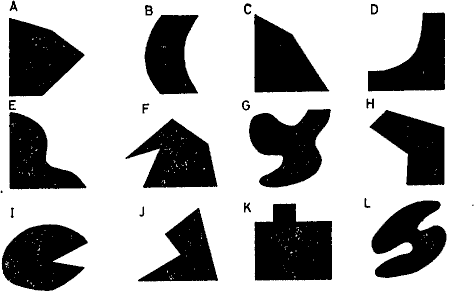
Random figures used for identification. Figures A, C, E, F, H, J, and L were presented factually in various directions.
Procedure
The subject placed a hand inside the screen which hid the test material and the subject's hand from view. Each tactile stimulus was set in the square concavity of the stimulus presentation panel which allowed four different types of presentation. On the test trials, the subject was allowed to feel each stimulus for 10 sec. with his fingers. Following presentation of the stimuli, the subject was requested to point to a figure which he had felt among the items of the visual-recognition display. The recognition display included 12 random figures as shown in Fig. 1 drawn in black which included the test stimuli. The random-shaped figures were arranged non-systematically.
In the Non-rotation task, the subject was asked to feel the stimulus factually and to point to the figure that he had felt. On the other hand, on the Mental-rotation task the original stimuli were presented in one of the three different directions (upside down, rotated 45° to the left or right). The subjects were informed in advance that tactile stimuli were presented in a different direction and asked to seek the original upright in the recognition display by mentally rotating the figures. In both tasks, same recognition display and identical stimuli were used.
No time limits or feedback for the subjects’ responses were given. The subjects were encouraged to guess if they were not sure about their identification. Half the subjects performed the Non-rotation task first and the Mental-rotation second and another half performed in the reverse order. Stimuli were presented to each hand, to the left hand first for half of the subjects and to the right hand first for the other half.
Each subject had 14 identification trials with each hand on the Non-rotation task and 21 identification trials for each hand on the Mental-rotation task.
Results and Discussion
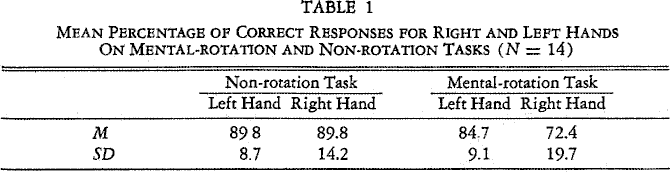
The mean percentages of correct identifications for each hand on both tasks are shown in Table 1. An analysis of variance (Tasks X Hands X Subjects) indicated that both main effects tasks, and hands, were significant (F = 9.01, df = 1/13, p < .025, Tasks; F = 6.21, df = 1/13, p < .05, Hands). Further, the interaction of both main effects was significant (F = 5.25, df = 1/13, p < .05). These results indicate that the performance on the Mental-rotation task was significantly worse than on the Non-rotation task. And on the Non-rotation task, no differences appeared between the hands, while on the Mental-rotation task, the left-hand performance was superior to that of the right-hand. This interaction is displayed in Fig. 2. On the Mental-rotation task, as we expected, that performance of both hands was inferior to that on the Non-rotation task indicates the Mental-rotation task needed some higher cognitive processes in addition to a simple tactile recognition.

Mean percentage of correct responses for each hand in the Non-rotation (N.R.) and Mental-rotation (M.R.)
Mean Percentage of Correct Responses for Right and Left Hands On Mental-rotation and Non-rotation Tasks (N = 14)
To perform the Mental-rotation task successfully, subjects have to recognize the tactile figure first and then rotate the imaged representation mentally to find the figure in the recognition display. The difference in errors between Mental-rotation and Non-rotation tasks is mainly due to those at a higher level of processing, that is, to processes underlying mental rotation.
The significant interaction between hands and tasks as shown in Fig. 2 indicates that performance of the Mental-rotation task by the left hand was far superior to that by the right hand, while on the Non-rotation task, the performance level was not different between the two hands. This suggests a superiority of the right hemisphere for the Mental-rotation task which does not require verbal mediation.
The lack of differences between hands for the Non-rotation task is in accord with the results of previous studies in tactile figure recognition (Myers, 1976; Hatta, 1978).
Hayashi and Hatta (1978) examined lateral differences on a visual mental rotation task. In their experiment, an advance signal of the direction of the comparison Kanji and a standard (upright) Kanji were presented in central vision. Rotated Kanji were presented in the left or the right visual field, and subjects were asked to judge whether the laterally presented Kanji (rotated to various degrees) were identical to the standard. In the case of the Kanji rotated 90° right or left and rotated 180°, superiority of the right visual field was found, while for the Kanji rotated to other degrees, a left visual-field advantage was shown. In the former case they suggested that silent verbalization attenuates the known superiority of the right hemisphere. DeRenzi and Faglioni (1967) reported a similar experiment on tactile recognition. They presented factually the patterns of nine points in three rows to unilateral brain-lesioned patients and asked them to imagine the 180° rotated pattern. The task was to identify the imagined patterns in the visual recognition display. The performances of both the right and left hemisphere-lesioned patients did not differ. And the authors suggested that specialization of the right hemisphere in the detection of spatial orientation attenuates because the task involved intellectual analysis, that is, because the contribution of the left hemisphere increased. The results of DeRenzi and Faglione (1967) might be deemed to be incompatible with the present results, i.e., a greater contribution of the right hemisphere on a mental-rotation task.
However, in their study, subjects knew in advance the degree of rotation needed to reverse the tactile pattern, and the patterns were relatively easy to verbalize, while in the present experiment the subjects could not anticipate the degree of the rotation of the tactile figure and the figures were difficult to describe with language. Therefore, the discrepancy in the results seems to reflect these differences in the nature of the tasks.
Present study indicates that two different kinds of mental rotation should be hypothesized, one involves processes with verbal mediation and the other involves processes with pure imagery without verbal mediation. Second, in the former case, the contribution of the left hemisphere increased performance as Hayashi and Hatta (1978) and DeRenzi and Faglioni (1967) showed. While, in the latter case, the contribution of the right hemisphere increased as the present results showed.
These indications are in accord with Zangwill's (1976) position and suggest a point to be considered in further examination of the lateral differences in higher cognitive processes. It is well known that left-handed and ambidextrous people have different patterns of hemispheric specialization from right-handed people. Further experiments with non-right-handed people now merit consideration.