



Abstract
136 university students participated in a digit-symbol coding task. An analysis of variance of sex, practice (distributed, massed), trial (1 to 10), and neuroticism (3 levels) yielded significant main effects due to trials, i.e., a learning effect, and sex (females performed better). Interactions of anxiety by trial and of anxiety by practice by trial were generally indicative of an inverse U-shaped function relating anxiety to performance under massed practice: subjects high and low in anxiety tended to perform worse than those of medium anxiety on some trials.
Research comparing the effects of massed and distributed practice on learning has abounded both before and since Underwood's (1961) able review of the effects of practice on verbal learning. In general, introductory psychology texts and those dealing with fundamentals of learning (e.g., Houston, 1976) have agreed on the over-all superiority of distributed practice. Neuroticism and anxiety as variables affecting learning and performance have also been extensively studied. In working with a digit-symbol task either similar or identical to that of the WAIS, Matarazzo and Phillips (1955) discuss data suggestive of the inverse U-shaped function where both high and low levels of anxiety lead to decrements in performance. A contradictory linear relationship in a similar task is reported by Boor and Schill (1967), who also identified females as superior performers on a digit-symbol task. Moon and Lair (1970) stressed, in their work, the importance of state as well as trait anxiety in digit-symbol performance. In a study utilizing only female subjects, Gakhar, Joshi, and Passi (1973) report that high anxiety acts detrimentally on digit-symbol performance. They also report a superiority in responding associated with distributed practice. An interaction of anxiety by practice in this study showed girls of average anxiety as performing better under distributed practice.
A problem often attending the discussion of variables such as distributed practice and anxiety is their use as interval (not ratio) measurements. The absence of a zero or basal point allows high anxiety or distributed practice, as used in one study, to be actually equivalent to medium anxiety and massed practice in another context. Although the present study cannot claim to have solved these problems, it does include an attempt to replicate the benefits of distributed practice and the interaction of anxiety with type of practice. Main effects due to neuroticism are foreseen, but the main prediction of this study is an interaction in which the pressures inherent in massed practice are expected to produce the inverse U-shaped function in relation to neuroticism levels (high, medium, and low). The sex differences reported by Boor and Schill (1967) are also expected to appear in the present experiment.
Subjects for the experiment were 136 students from 27 introductory psychology tutorials. Tutorials were randomly assigned to practice conditions, distributed (n = 32 males, 35 females) and massed (n = 33 males, 36 females), and instructions were given via one of two tapes on a tape recorder. Each subject received a random arrangement of 10 different pages where a digit-symbol code (not identical but similar to that of the WAIS) was reproduced on the top of each page. Each page also contained a random arrangement of 72 digits with spaces below each digit for placement of the appropriate symbol. Subjects were allowed 30 sec. to work on each page. Under massed practice, one page followed immediately upon another, while under spaced practice subjects were instructed to lay their heads on their desks during a 30-sec. break. Timing was accomplished by pre-taped 30-sec. segments with appropriate associated instructions also on tape. Thirty-eight subjects who responded “strategically,” i.e., who did not code digits in the order in which they appeared but coded single digits throughout the page, were reserved for separate analysis, since the task they performed was different from the one attempted by the majority of subjects. Ac the end of the task, papers were randomly redistributed to subjects who scored each sheet for the number of digits correctly and wrongly coded. The experimenter rescored all protocols and resolved any scoring disagreements by further scrutiny. The Eysenck Personality Inventory (Eysenck & Eysenck, 1963) had been administered earlier to all subjects who were divided into three groups on the basis of the Neuroticism scale: top 27% (15 and over), middle 46% (10–14), lower 27% (0–9). Although neuroticism, so measured, is not identical to anxiety, it has often been interpreted as reflecting an individual's tendency to “worry,” and anxiety is generally accepted as underlying most cases of neuroticism. The test score was considered to reflect a trait rather than a state variable (Hodges & Spielberger, 1969).
An analysis of errors in digit coding yielded no meaningful results since most subjects made no errors on most trials. Further analyses therefore focused on the total number of completed digits. Analyses of variance were used to identify differences due to sex (male, female), practice (massed, distributed), neuroticism or anxiety (high, low, medium), trial (1—10), and their interactions. A main effect of trials shows a significant trial-by-trial increase in mean digits coded up to Trial 6 (13.89 to 24.65) where responses stabilize and again for Trials 9 (25.71) and 10 (25.65) when these are compared with Trial 6. A dramatic and consistent main effect of sex (of the order of 2.4 more correctly coded digits per trial for female subjects) also appeared. Sex did not interact significantly with any of the remaining experimental variables.
An interaction of practice by trial showed the superiority in mean digits coded of distributed practice for Trials 9 (26.56 versus 24.77) and 10 (27.06 versus 24.40) and an interaction of neuroticism by trial showed differences associated with neuroticism on Trials 4, 5, and 7. A three-way interaction (practice by neuroticism by trial) supported in general predictions of an inverse-U-shaped relationship between anxiety and performance under massed practice only for Trials 5, 7, and 8 (Table 1). Groups high and low in anxiety performed at a lower level than the medium group, though not all differences were significant for all trials.
Means for All Trials Exhibiting a Significant Interaction of Practice By Neuroticism
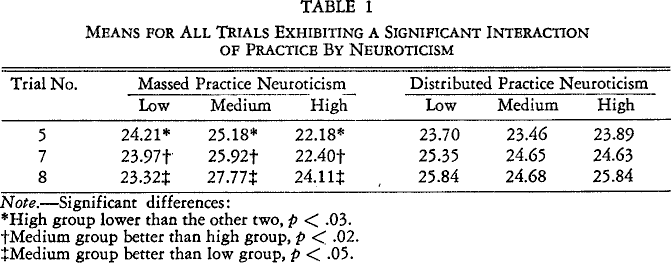
Note.—Significant differences:
High group lower than the other two, p < .03.
Medium group better than high group, p < .02.
Medium group better than low group, p < .05.
Results of the current study are therefore in general agreement with those of Gakhar, Joshi, and Passi (1973) and in partial agreement with those of Boor and Schill (1967) in identifying consistently superior performance by females. They seem to be in disagreement with those of Hodges and Spielberger (1969) who report no differences in digit span performance associated with trait anxiety: these authors, however, did not employ a medium-anxiety group and the operation of an inverse-U-shaped function would allow for a theoretical blending of present and past findings. The general efficacy of distributed practice is supported by results from the later trials. Future experiments could increase the number of trials or introduce more distributed conditions (60-sec. breaks, for example). It is interesting to note that the effects of anxiety disappear in the later trials while those due to practice appear only there. Fatigue effects might thus be over-riding anxiety while magnifying practice effects.