



Abstract
Deficiencies in disabled readers’ short-term memory processing were studied. A deficit in memory capacity versus susceptibility to interference was investigated by examining performance over trials. A mediation versus production deficiency in memory processing was examined by testing the effect of instructions for rehearsal on performance of average and disabled readers in Grades 2 and 5. Contrary to prior research, facilitative effects of rehearsal instructions on second graders’ memory were found only on Trial 1. Fifth graders’ memory was adversely affected by overt rehearsal. Requiring children to rehearse overtly at a set rate may account for the results. A second study examined effects of covert rehearsal on the memory of average and disabled readers in Grade 2 over trials. Facilitative effects of covert rehearsal were shown when data of children who spontaneously rehearsed were removed. A deficiency in production by second graders was supported. Disabled readers who did not rehearse were more susceptible to interference.
During the past decade, short-term memory tasks have been used to study the development of mediation processes in children. For example, Flavell, Beach, and Chinsky (1966) used a serial-order short-term memory task to observe the frequency of overt vocalizations in children. The task required children to point to objects in the same order as the experimenter had previously done. Observations of children in Grades K, 2, and 5 indicated that the incidence of spontaneous, overt rehearsal of objects’ names increased with age, and similarly, serial-order retention increased with age. The results suggest that the age-related increase in short-term memory is due to the use of rehearsal strategies by older children and not by younger children.
To test the hypothesis that rehearsal increases memory performance, Keeney, Cannizzo, and Flavell (1967) observed 7-yr.-old children in a serial-order memory task and then divided the children into two groups, those who rehearsed (producers) and those who did not rehearse (non-producers). The non-producers were then given instructions to rehearse serially the names of the stimuli on each trial, and retention was measured.
Prior to rehearsal instructions, the performance of producers was significantly better than the performance of non-producers. However, when non-producers were given rehearsal instructions, their performance increased and did not differ significantly from that of the producers. The findings that short-term memory of young children can be improved by instructions for rehearsal has indicated that young children are production-deficient, not mediation-deficient (cf. Flavell, Beach, & Chinsky, 1966).
Extensive research into short-term memory processes of average versus disabled readers was conducted by Bakker (1967, 1971). Bakker's task, like that of Flavell, et al. (1966), required recall of the serial order of stimuli. Bakker's research indicated that serial-order memory was influenced by the type of stimuli used, the reading ability, and the age of the children. Bakker (1967) found that the poorer readers in a learning disabilities school retained less of the serial order of meaningful stimuli (letters, digits, and meaningful figures) than the better readers in the same school. Interestingly, memory of the reading groups did not differ when non-meaningful figures were used as stimuli. Bakker (1967) postulated that the results were due to the ability of the better readers to improve their performance through verbal mediation strategies, when meaningful stimuli were used, whereas the poorer readers were unable to do so. It is possible that children with reading problems do not spontaneously mediate as readily as average children, i.e., a production deficiency. On the other hand, disabled readers may not be able to mediate efficiently even if given instructions to do so, i.e., a deficiency in mediation.
Additional memory differences between average and disabled readers were identified by Leslie (1975) who investigated serial-order memory of average and disabled readers in Grades 3 and 4 as a function of trials. The procedure involved repeated presentation of the same stimuli (pictures of common objects) over several trials, followed by the introduction of a new set of stimuli on the last trial. Results showed that performance of the groups was similar on Trial 1 but over trials the memory of disabled readers deteriorated more than that of average readers. When new stimuli were introduced, memory of both groups of children increased to similar levels. The decrease in performance over trials when the same stimuli are repeatedly presented has been referred to by Rosner (1972) as proactive interference. Leslie's (1975) results were interpreted as indicating that the memory capacity of average and disabled readers is similar, but the memory of disabled readers is more susceptible to interference. Fatigue was dismissed as a feasible explanation; were it operating, performance would have continued to decline when the new stimuli were introduced on the last trial.
One hypothesis offered to account for the greater susceptibility to interference in the memory of disabled readers is their use or disuse of verbal mediation strategies. Perhaps, as discussed earlier, disabled readers do not develop the use of mediational strategies at the same rate as average readers, or their use of such strategies is not sufficient enough to prevent the build up of interference. This hypothesis assumes, however, that the use of mediational strategies, e.g., cumulative rehearsal, attenuates interference. No data are presently available as to whether rehearsal increases memory by preventing the accrual of interference.
Experiment I
The purposes of Exp. I were twofold. First, the study was designed to investigate which type of deficiency is present in disabled readers by examining the effect of rehearsal instructions on the memory of average and disabled readers as a function of age and trials. Because differences in the effect of instructions for rehearsal on children of different ages were expected, two age groups (second graders and fifth graders) were tested. If disabled readers do not develop the use of mediational strategies as rapidly as average readers, i.e., a deficiency in production, then instructions for rehearsal should increase the memory of disabled readers and of average readers. If a mediational deficiency is operating, then instructions for rehearsal will not improve the memory of disabled readers, but, as in previous research, should improve the memory of young average readers. The second purpose was to investigate whether rehearsal instructions help deter the decrement in performance over trials found by Leslie (1975). Therefore, given a replication of Leslie's (1975) results, if instructions for rehearsal deter the increase in interference, a triple interaction (instructions X reading group X trials) is predicted.
Method
Sample
One hundred twenty-eight second- and fifth-grade children, 64 at each grade level, were selected from five schools in the Cedar Rapids Community School District, Cedar Rapids, Iowa.
In each grade disabled and average readers were defined according to three indices of reading ability: (a) Gates-McGinitie Reading Test (1965); (b) the teacher's estimate of children's reading level; (c) Standard Reading Inventory, Wordlist Subtest, Form A (McCracken, 1966). Average and disabled readers were matched according to sex and IQs (±3 points) as determined by the Lorge-Thorndike Intelligence Test (1964). For second graders, the index was the Primary Total. For fifth graders, the Non-verbal scores were used to avoid confounding reading ability and IQ.
Children were excluded from the sample if their IQs were below 85 or if they were not of the age represented by second or fifth grade. After the sample of average and disabled readers had been obtained, the groups were matched on IQs (±3 points) and sex. The second graders selected for the study were 19 pairs of boys and 13 pairs of girls with a mean IQ of 101.35 for disabled readers (SD = 9.32) and 101.82 for average readers (SD = 9.16). The fifth graders selected were 16 pairs of boys and 16 pairs of girls. The mean Nonverbal IQ of disabled readers was 98.70 (SD = 9.38) and of average readers was 103.60 (SD = 8.46).
Design
The 32 matched pairs of second-grade average and disabled readers and the 32 matched pairs of fifth-grade average and disabled readers were randomly assigned to one of the instructional conditions: (a) standard instructions (N = 16 pairs at each grade level); (b) rehearsal instructions (N = 16 pairs at each grade level). The experiment manipulated the factors of grade (second vs fifth), reading ability (average and disabled), instructional group (standard and rehearsal), and trials (1–13) on the serial-order memory task.
Stimuli and procedure
A pool of 12 pictures of common objects was used on the first 12 trials of the experiment, each picture being presented six times. On the 13th trial, a new set of six pictures was utilized. The sequence of picture presentation within and between trials was designed so that all 12 pictures were used equally often over the first six and last six trials. Furthermore, each picture occupied a given serial position only once in 12 trials.
On each trial, six pictures were presented, one at a time, then turned face down to form a spatial array (e.g.,— — — — — —). After all pictures were presented, their order was arranged randomly and the pictures were given to the child to reconstruct the original order. Subjects in the rehearsal condition were instructed to name each picture as it was presented and then to rehearse cumulatively the name of each picture which had been presented previously on that trial. If the child did not recall the name of a picture within the 2 sec. allowed, the next stimulus was presented, i.e., a non-correction procedure was used. Subjects in the standard instruction condition were simply told that pictures would be presented and they were to remember the order of presentation. In order to allow children receiving standard instructions time to engage in mediational strategies if they were so inclined, the interstimulus interval for both instructional conditions was equated. After the experiment, each child was asked if he was utilizing a particular strategy to remember the pictures.
Results
Table 1 presents the memory of second- and fifth-grade normal and disabled readers as a function of instructional condition. The data were analyzed utilizing a Type VI mixed-model analysis of variance (Lindquist, 1953) with between-subjects factors of grade (2 and 5) and instructional condition (rehearsal, standard) and within-subjects factors of reading group (average, disabled) and trials (1 to 13). Reading group was analyzed as a within-subjects factor because subjects were matched on IQ and sex. Significant main effects of instruction (F1,60 = 4.73, p < .05), grade (F1,60 = 24.94, p < .001), and trials (F12,720 = 7.67, p < .01) were found. In addition, the inter- actions of instructions X grade (F1,60 = 5.89, p < .025) and trials X instructions (F12,720 = 2.11, p < .025) were significant. All other possible interactions were nonsignificant. Because the analysis showed a significant interaction of instructions X grade, the data were analyzed separately for each grade.
Short-term Memory Performance * of Average and Disabled Readers in Grades 2 and 5 as a Function of Instruction
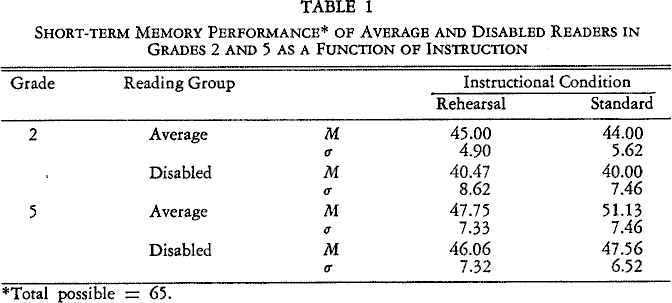
Total possible = 65.
Fig. 1 presents the memory of second grade average and disabled readers as a function of instructional condition and trials. The analysis on the second grade data showed significant main effects of reading group (F1,30 = 5.94, p < .05) and trials (F12,360 = 19.92, p < .001), and an interaction of instructions X trials (F12,360 = 1.75, p < .05). As can be seen in Fig. 1, the interaction was due to superior performance on Trial 1 of children in the rehearsal condition, but similar performance by the two groups on later trials (F1,360 = 4.05, p < .05). Thus, rehearsal instructions facilitated performance of second graders initially, but the effect did not continue over trials.
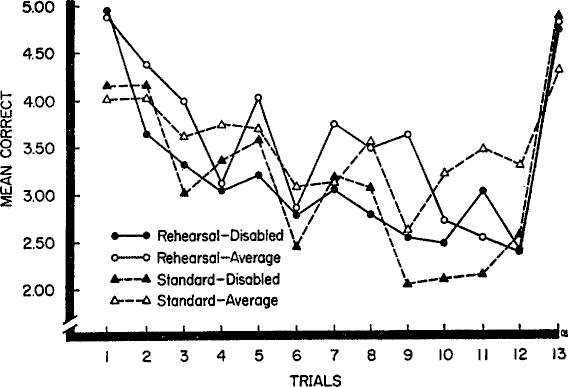
Serial-order short-term memory performance of second grade average and disabled readers as a function of trials and instructional condition (overt rehearsal, standard)
Fig. 2 presents the memory of fifth grade average and disabled readers as a function of instructional condition and trials. The analysis of the fifth graders’ data showed significant main effects of instructions (F1,30 = 10.38, p < .001) and trials (F12,360 = 15.58, p < .001) as well as an interaction of trials X instruction (F1,360 = 1.99, p < .05). The interaction resulted from similar performance of the instructional groups on Trials 1 to 4 but superior performance of children in the standard instructions condition on trials 5 to 12 (F1,360 = 8.57, p < .01). Thus as Fig. 2 illustrates, rehearsal instructions actually resulted in lower memory for fifth graders on the latter trials of the experiment.

Serial-order short-term memory performance of fifth grade average and disabled readers as a function of trials and instructional condition (overt rehearsal, standard)
Self-report data indicated that 11 (7 average readers, 4 disabled readers) of the 32 second graders and 20 (10 average and 10 disabled readers) of the 32 fifth graders in the standard instruction condition reported engaging in covert rehearsal of object names. An examination of the memory of the children who reported covert rehearsal vs those who did not, showed that second- and fifth-grade disabled readers who reported rehearsing retained more than the children who did not report it. Also, fifth graders who reported covert rehearsal retained more than fifth graders required to rehearse covertly. It seems that the children used the same strategies that the experimenter was attempting to teach; however, they rehearsed covertly.
Experiment II
The results of Exp. I provide conflicting evidence regarding a mediation vs production deficiency in disabled readers. A mediation-deficiency is suggested by the finding that instructions to rehearse overtly did not improve over-all performance of disabled readers (although it did on Trial 1). However, because the rehearsal instructions also did not increase the over-all performance of average readers, as found by Keeney, et al. (1967), the lack of facilitation may have been an effect of the instructions per se. Keeney, et al. used instructions to rehearse covertly; whereas children in Exp. I were required to rehearse overtly and at a pace determined by the experimenter. The fifth graders in the standard condition who report covert rehearsal retained more than those instructed to rehearse overtly. These findings suggest that covert rehearsal produces better serial-order memory than overt rehearsal. Thus, one cannot conclude that a deficiency in mediation exists in disabled readers on the basis of the non-facilitative effects of rehearsal found in Exp. I. A deficiency in production is weakly supported by the self-report data; fewer disabled readers in second grade than average readers spontaneously rehearsed. The question of the effect of rehearsal on the accrual of interference could not be answered because rehearsal instructions had no effect.
Exp. II was designed to test the same hypotheses as Exp. I; however, instructions to rehearse covertly were used. Exp. II used only second graders because of the effect of reading group found at second grade and the lack of such an effect for fifth graders.
Method
Subjects
Sixty-four second grade children (32 average readers and 32 disabled readers) from three schools in an integrated school district with a population of 170,833 participated in the study which occurred in the Spring. The average and disabled readers were identified by the following procedures. The second graders whose IQs on the Otis-Lennon Intelligence Test (1968) were within 1 SD of the district mean of 109 (i.e., 94 to 124) were identified. All children whose scores fell within that range and who were in the low or average reading groups in their classrooms were given the Wordlist Subtest of the Standard Reading Inventory (1966); 123 children were tested. Disabled readers were defined as children who read correctly fewer than 72% of the words on any list above 1–2, i.e., the instructional reading level was no higher than 1–2. Average readers were defined as children who read correctly 72% or more of the words on the 3-1 list or above, i.e., the instructional reading level was at least 3-1.
Thirty-nine disabled readers and 47 average readers were identified. Thirty-two children were randomly selected from each group for participation in the study. The mean grade-equivalent scores on the Word Knowledge Subtest of the Metropolitan Achievement Test (1971) which was taken by the children 1 mo. after the study were 2.6 for disabled readers and 3.8 for average readers.
Design
Sixteen average and 16 disabled readers were randomly assigned to each instructional condition, rehearsal and standard. The design involved two between-subjects factors: reading group (average, disabled), instructions (rehearsal, standard) and one within-subjects factor, trials (1 to 10).
Stimuli and procedure
A pool of nine pictures of common objects (same items as in Exp. I) was used on the first nine trials of the experiment, each picture being presented six times, once in each serial position. On the tenth trial, a new set of six pictures was presented. The procedure was the same as in Exp. I; however, children in the rehearsal condition were given instructions to rehearse covertly. During the task the children in each instructional condition were observed and any observance of strategies, e.g., labeling, cumulative rehearsal, was noted. Also, when the task was finished, the children were asked what they did to remember the pictures.
Results
Fig. 3 (left panel) presents performance of second graders who were average and disabled readers as a function of instructional condition and trials. A Type III analysis of variance (Lindquist, 1953) was performed on the data with two between-subjects variables (instructional condition and reading group) and one within-subjects factor (trials). A significant main effect of trials was found (F9,540 = 16.51, p < .01). No other significant main effects or interactions were identified.

Serial-order short-term memory performance of second grade average and disabled readers as a function of trials and instructional condition (covert rehearsal, standard). The left panel illustrates the performance of all children. The right panel presents the results when data of children in the standard condition who spontaneously rehearsed are removed.
As indicated previously, the experimenter observed that the children in all conditions identified the use of strategies. Four average readers and six disabled readers in the standard instructions condition were observed spontaneously to engage in cumulative rehearsal. Thus, they engaged in the same strategy that was taught to the children in the rehearsal condition. To examine the effect of being taught rehearsal strategies on children's memory compared to the memory of children not taught and not spontaneously using the strategy, the data from children who spontaneously rehearsed were removed and the means of the children in the standard conditions who did not rehearse, i.e., 12 average readers and 10 disabled readers, were used in a second analysis. When replacing data in the above manner a degree of freedom was removed from the error term for each subject's data replaced by the mean of the group (Lindquist, 1953, p. 148).
Fig. 3 (right panel) presents second graders’ performance as a function of instructional conditions and trials when subjects in the standard condition who spontaneously rehearsed were replaced by the mean of those not rehearsing. The analysis on these data resulted in significant main effects of instructions (F1,50 = 6.11, p < .05) and trials (F49,530 = 22.54, p < .01) and an interaction of trials X reading groups (F9,530 = 2.93, p < .01). The interaction of trials X reading groups X instructions showed an F9,530 = 1.78 (p < .07). No other main effects or interactions were significant. Preplanned comparisons designed to determine whether rehearsal instructions affected performance differentially as a function of trials and reading group were conducted. Interaction contrasts comparing the four groups on Trial 1 vs 5 (midway through the task) and Trial 1 vs 9 (where interference should be the greatest) resulted in significant (p < .01) differences (Fs1,530 = 12.69 and 32.27, respectively). The triple interaction found when Trials 1 and 5 were compared was the result of the reading groups’ performance in both instructional conditions being more similar on Trial 1 than on Trial 5, where the disabled readers in the standard condition showed marked interference (see Fig. 3, right panel). The triple interaction shown when Trials 1 vs 9 are compared is the result of the superior performance of the average readers in the rehearsal condition on Trial 9 compared to the more similar performances of the reading groups within instructional conditions on Trial 1.
Discussion
The results of Exp. II support the notion of a deficiency in production of young average and disabled readers. That is, second graders who were average and disabled readers benefitted from instructions for rehearsal more than children who were not taught to rehearse and who did not do so spontaneously. It is important to note that of the 16 disabled readers in the standard condition, six spontaneously rehearsed. Thus, one cannot say that all second graders are production-deficient. These observations support Keeney, et al.’s (1967) method for determining the effectiveness of rehearsal instructions, i.e., identify those who spontaneously rehearse and those who do not, then teach rehearsal to those who did not spontaneously do so. The present findings show that some second graders are spontaneously engaging in mediational strategies and who they are cannot be determined by reading group. A comparison of the Otis-Lennon IQs of subjects who rehearsed and those who did not showed that the scores of average and disabled readers who rehearsed were higher (but not significantly) than those who did not rehearse. The most important finding is that instructions to rehearse can improve the memory of average and disabled readers. These results support those of Tarver, Hallahan, Kauffman, and Ball (1967) who found that teaching learning disabled boys to rehearse verbally increased efficiency of selective attention. Results of the present study suggest that disabled readers are not mediationally deficient.
The second purpose of Exp. II was to determine if rehearsal instructions affected the memory of disabled readers by preventing the accrual of interference found by Leslie (1975). Exp. II replicated the interaction of reading group X trials which Leslie (1975) found. Furthermore, the memory of disabled readers who were taught to rehearse did not show the decrease in performance over Trials 3 to 6 observed for disabled readers in the standard condition when they did not rehearse. However, by Trial 9 both groups of disabled readers and the average readers in the standard condition showed similar amounts of interference; the retention of average readers in the rehearsal condition was superior. Thus, it appears that eventually interference accrued in the memory of disabled readers who were taught to rehearse. However, the build-up appears slower than for disabled readers who did not rehearse.
How does rehearsal function to deter a build-up of interference? One possibility is that rehearsal focuses attention to the stimuli being presented on each trial and thus, the child forgets the location of items on previous trials. A second possibility assumes that young children (especially disabled readers) encode the pictures visually and the source of interference is visual-spatial. When taught rehearsal the children recode the visual stimuli into an auditory-sequential code. Perhaps the change of modality serves to decrease effects of interference. The second hypothesis suggests further research to clarify the source(s) of interference. It seems reasonable that children who do not rehearse encode the stimuli visually and would show greater interference effects if the pool of stimuli were visually similar. In contrast, children who rehearse encode the stimuli auditorially and would show greater interference if the visual stimuli had names which were acoustically similar, e.g., pan, fan. This reasoning suggests a study where average and disabled readers would be compared under the stimulus conditions of visual similarity, acoustic similarity and no similarity (replicating the present study) in conditions where rehearsal was taught vs a condition where rehearsal was prevented.
Further research investigating the use of more complex organizational strategies on the retention of ordered information by disabled readers is also recommended. Recent research with normal children cites the use of strategies such as recalling the initial letter of each picture's label (cf. Allik & Siegel, 1976) and constructing a story for a series of unrelated pictures (Brown, 1975). It is likely that, although maintenance rehearsal reduced interference somewhat, elaborative rehearsal (Brown, 1975) would show more powerful and longer lasting effects.