



Abstract
The purpose of the study was to determine whether individuals with high percent body fat can be distinguished on the basis of personality and body-image from those possessing lower levels of body fat. 65 female college students were administered the 16 Personality Factor Questionnaire and the Secord and Jourard Body-cathexis Scale. Measurements of height, weight, and skin folds at the triceps and illiac crest were also taken. On the basis of percent body fat two groups of 20 females each (high and low percent body fat) were identified. From discriminant analyses one personality factor and six body-image items were identified which distinguished between groups. Reclassification of the subjects, based upon derived discriminant functions, resulted in 60.0% of the subjects being correctly reclassified from personality data and 100% of the subjects correctly reclassified from body-image data. Body-image appears to be an important factor that can distinguish between individuals possessing high and low levels of body fat.
Obesity is a health problem of major proportions in the United States. Although estimates vary, some sources indicate that perhaps as many as half of all adults in the United States are overweight and at least one-third are “over-fat” (Corbin, Dowell, Lindsey, & Tolson, 1978). The term “overfat” has been utilized to emphasize that obesity is more than simply excess poundage (overweight); it also refers to body composition. An obese person has a high percentage of body fat while a muscular overweight person may have very little fat.
Obese (high fat) individuals have been characterized as showing disturbances in both personality factors and body-image. Differences in personality traits between obese individuals and those of normal weight have been reported by several researchers (Werkman & Greenberg, 1967; Wunderlich, Johnson, & Ball, 1973; Johnson, Swenson, & Gastineau, 1976; Pomerantz, Greenburg, & Blackburn, 1977). Brantley and Clifford (1976) also reported differences in body-image between obese adolescent subjects and other groups of non-obese adolescents. While in each of these studies differences between obese and non-obese subjects have been found on various personality items, there has been no clear consistency among the research findings.
The focus of this previous work has been upon determining whether differences exist between obese and non-obese individuals on specific personality items. However, Brantley and Clifford's (1976) use of a multivariate procedure to discriminate between groups of obese and non-obese individuals suggests that this may be a more useful approach. In addition, obese subjects in each of the studies cited were selected from hospital or clinic based programs of weight reduction. There is some question as to whether the results obtained in hospital or clinic programs may be generalized to individuals not participating in such programs or to individuals who may not be obese but do have an excess amount of body fat. Thus, it was deemed important to determine whether individuals with high body fat who do not participate in voluntary organized programs of weight loss can be distinguished from individuals possessing lower levels of body fat on the basis of personality and body-image factors. In this study the discriminant analysis procedure was the statistical method used to identify personality and body-image factors which discriminate between females high and low in body fat.
Method
Subjects
Subjects were female students enrolled in required physical activity classes at a small private college.
Testing Instruments
The Secord and Jourard (1953) Body-cathexis Scale was utilized to provide a measure of body-image. The scale measures the degree of satisfaction with 46 different body parts or processes. The subjects rated each item on degree of satisfaction from very dissatisfied to fortunate on a scale of one to five points. Previous research (Young, Reeve, & Elliott, 1978) has indicated that instead of a composite body-cathexis score, a more appropriate approach would be to score each item separately. This scoring method permits identification of specific body-image items which may be associated with high body fat.
The 16 Personality Factor Questionnaire (Cattell & Eber, 1966), utilized in this study to measure personality traits, has been used extensively in personality research. The instrument enables the investigator to evaluate the intensity of 16 major personality source traits or personality factors for an individual rating each on a 10-point scale. Bipolar adjectives, such as reserved-outgoing, submissive-dominant, have been assigned to each factor.
Lange skin-fold calipers were utilized to measure skin-fold thickness at the illiac crest and triceps of each subject. Calculation of percent body fat was accomplished according to the formula suggested by Cundiff (1974).
Procedure
During the first week of the semester data were collected from a total of 65 female students. In a classroom subjects completed the 16 Personality Factor Questionnaire Form C and the Body-cathexis Scale. As the subjects finished these questionnaires they proceeded to a testing area where height, weight, and skin folds were measured and recorded. Height was recorded to the nearest inch and weight to the nearest pound. The skin-fold thickness was measured at the illiac crest and triceps. Three measurements were taken at each site and the average of the three was recorded. The same investigator was responsible for the measurement of all subjects.
On the basis of the percent body fat two groups of females were identified as of high percent body fat and low percent body fat. These two groups were operationally defined as the 20 highest and 20 lowest persons in terms of percent body fat. These served as subjects. Data collected on other females were not included in the analysis.
Results
The means and standard deviations on three physical characteristics, percent body fat, height, and weight are presented in Table 1. Between-group analyses of variances were calculated on the three variables. The F ratios for weight (F1,38 = 54.51) and for percent body fat (F1,38 = 125.78) were significant (p < .05). As would be expected, the subjects in the High Percent Body Fat Group were significantly heavier and had significantly greater percent body fat than did those subjects in the low group. However, the two groups were not significantly different in height (F1,38 = 1.58, p > .05).
Means and Standard Deviations for Height, Weight and Percent Body Fat for Females Classed as Having High or Low Fat

To determine if women classified as having high percent body fat could be differentiated from women classed as low percent body fat on personality factors or on body-image, the discriminant analysis statistical procedure was used. Subjects’ responses to the 16 factors from the personality inventory and the 46 items from the body-image questionnaire were used as two sets of independent variables. Separate discriminant analyses were calculated for personality and body-image variables.
The discriminant program (Wilks’ Lambda stepwise procedure) from the Statistical Package for the Social Sciences (Klecka, 1975) was utilized. This procedure selects variables which maximize the over-all multivariate F ratio and, thus, minimize Wilks’ Lambda. This procedure not only takes into consideration the differences between centroids but also the homogeneity within the groups. Variables are selected according to their ability to contribute to the discriminating power of previously selected variables. The F ratio to be entered presented with each of the selected personality or body-image variables is a test of the significance of the separation between centroids added by that variable. Variable inclusion was based on an alpha level of .05.
Of the 16 personality factors only one was selected by the stepwise procedure. This factor was Factor H. The chi-squared of 5.21 for the Wilks’ Lambda of 0.87 was significant (p < .05), indicating that the personality factor significantly discriminated between the two groups who differed in percent body fat.
Six body-image items were entered into the discriminant analysis (Table 2). The Wilks’ Lambda based on all six items was 0.15. The chi-squared transformation (x2 = 66.49) was significant (p < .01), indicating that body-image also significantly distinguished between the two groups.
Results of Stepwise Selection of Body-image Items
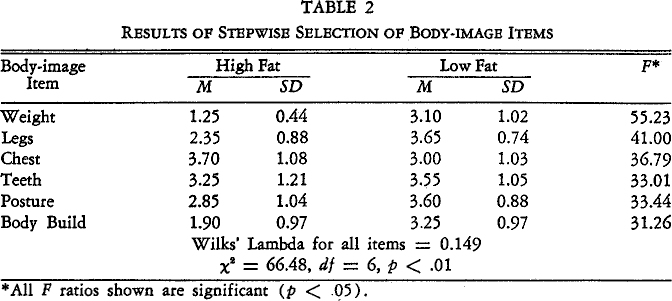
A11 F ratios shown are significant (p < .05).
To determine whether the personality factor and the body-image items accurately distinguished between females high and low in body fat the 40 subjects were reclassified using the derived discriminant function. The reclassification of subjects from the personality factor (Factor H) resulted in 60.0% correctly classified. Reclassification of subjects from body-image data classified all subjects (100%) correctly as either high or low in percent body fat.
As the influence of the item weight was apparently large (F = 55.23), the body-image data were reanalyzed with this item eliminated. The reanalysis indicated body-image items significantly discriminated between groups high and low in fat (χ2 = 41.85, p < .01). A reclassification of subjects based upon the discriminant function resulted in the correct classification of 95% of the females.
Discussion
The purpose of the study was to determine whether personality and body-image factors could be identified which discriminate between college females high and low in body fat. From the analysis one personality factor and six body-image items distinguished between the two groups. Based upon the analysis of the personality data, females high in fat may be characterized as more venturesome than females low in fat.
Little work has been done with the 16 PF as a measure of personality differences between individuals high in body fat and individuals of normal body fat. The present results, however, appear to agree with recent findings of other investigators (Johnson, et al., 1976; Pomerantz, et al., 1977; Wunderlich, et al., 1973). These researchers, using other tests of personality such as the MMPI, Adjective Check List, and Edwards Personal Preference Schedule, did report distinct differences in a univariate sense between obese and normal weight subjects on several personality items. However, in the present study an important finding seems to be that body-image items may play a greater role in distinguishing between subjects high and low in body fat than do other aspects of personality.
In the present study six body-image items were identified as discriminating between groups high and low in body fat. Although these findings are not indicative of a disturbance in body-image, the results do demonstrate that females high and low in body fat can be differentiated on selected body-image items. The fact that all subjects were correctly reclassed as either high or low in body fat based upon body-image data, obviously points to distinct differences in satisfaction about their bodies shown by females high and low in body fat.
In a related study by Brantley and Clifford (1976) differences were found among obese adolescents and other groups of adolescents on both self-concept and body image. Specific body-image measures discriminating among groups included ease of body functioning, appearance, and concern about physical health. Another study by Young, et al. (1978) identified body-image items which discriminated between groups possessing both high and low levels of cardiovascular endurance, a health-related component of physical fitness. Highly fit females differed from those of low fitness on eight body-image items, including satisfaction with body weight. Thus, it may also be that a small core of body-image items can be identified that not only discriminate between groups differing in degree of body fat but also groups that differ on other indices of health or physical fitness.
In conclusion, it appears that individuals high in body fat and those of a more normal weight and body composition can be distinguished on personality factors and body-image. Rather than employing the general concept of body-image or a composite body-image score more specific information may be gained by utilizing individual components of body-image in a multivariate approach. Future research should focus on (1) identification of a common core of body-image items which discriminate between groups who differ on several indices of health or fitness and (2) the effects of changes in percent body fat or other measures of health or fitness on body-image.