



Abstract
The Draw-A-Person Test was individually administered to 120 kindergartners from diverse socioeconomic backgrounds, ranging in age from 4 yr. and 10 mo. to 6 yr. and 4 mo. This study was conducted to validate and expand Goldman and Warren's earlier work (1976) on the development of a rational scale for use as a kindergarten screening measure. Correlational analyses corroborate the earlier findings that body-part omissions are the most predictive items of emotional high risk. Factor analyses of the current data also replicate earlier findings in which two underlying cohesive factors emerged. The first factor has high loadings on peripheral body-part omissions; the second factor has high loadings on central body-part omissions. The results suggest that an interchangeable number of body-part omissions together, rather than any one item, predict high emotional risk. Structural and content characteristics do not contribute significantly to the development of a kindergarten screening measure.
The literature on community mental health is replete with efforts to engage in early identification of children at risk (Caplan, 1961; Bower, 1970; Cowen, Trost, Izzo, Lorion, Dorr, & Isaacson, 1975). Researchers have generally focused on the development of measures based either on direct observation of the youngsters or objective test data collected from them. Projective measures such as the Human Figure Drawing, which provide alternative methods of identifying emotionally disturbed children, have fallen into disrepute because of their generally low validity and reliability (Johnson & Greenberg, 1978; Roback, 1968). Nonetheless, further exploration of the Human Figure Drawing as a screening measure appears warranted since it is easily administered, quickly scored, and readily undertaken by youngsters (Dennis, 1966). In major reviews of the literature on human-figure drawings, Roback (1968) and Swensen (1968) suggest that the future utility of this projective technique most certainly lies in its use as a screening measure. Equally, the work of Vane and Eisen (1962) suggests that the drawings of 5-yr.-olds (kindergartners) are better predictors of both emotional problems and school achievement at the first, second, and third grades, than are those of 6-yr.-olds (first graders). In an earlier study, Goldman and Warren (1976) attempted to evaluate the efficacy of human-figure drawing technique as a screening measure for kindergarten-age youngsters with emotional problems. Their positive preliminary findings led them to conclude that further work should be conducted on the development of a rational scale.
Further impetus was supplied by Swensen's (1968) conclusion that omissions, rather than the structural or content characteristics within human-figure drawings, reliably predicted emotional disturbance. His review of the literature indicated that no one item in itself was a reliable predictor but rather a global assessment of the drawing provided a sound basis for reaching a decision regarding psychological disability. Roback (1968) and Laosa, Swartz, and Holtzman (1973) encouraged the development of standardized and validated scales for the assessment of human-figure drawings. The Goldman and Warren (1976) study concluded that there was a relationship between high emotional risk and body-part omissions deserving further exploration. Both an item analysis and factor analysis of the data suggested that the number and types of body-part omissions formed cohesive underlying factors which were significantly predictive of emotional disturbance. Items which measured distortions of structure or content contributed less to the structure of the factor.
In view of the above conclusions, the present study was undertaken as both an expansion and cross-validation of the Goldman and Warren (1976) exploratory work. Specifically, our aims were: (a) to factor-analyze the same set of test items (on a new sample) to judge whether or not there were any cohesive factors that would predict clinical high risk, (b) to determine which items had significant correlations with independent judgments of clinical high risk, (c) to determine which items had significant correlations with combined total scale scores, and (d) to determine whether or not the above results validated our earlier findings.
Method
Subjects
As part of a larger study, 123 kindergarten children in the San Francisco public schools were individually assessed over a 2-yr. period. The youngsters came from diverse socioeconomic backgrounds and ranged in age from 4 yr. and 10 mo. to 6 yr. and 4 mo. In the sample of 69 males and 51 females were 67 Caucasian, 28 black, 19 Asian, and 9 Spanish-surnamed children. This generally approximates the ethnic balance of the city.
All children were given a No. 2 pencil and a blank sheet of paper measuring 8 ½ X 11 in. and individually were asked to draw the figure of a whole person. Following extensive classroom observation, advanced graduate students in clinical psychology independently assessed each kindergartner according to level of intelligence and emotional risk. Students were first given extensive training and instructions by senior clinical psychology faculty in regard to the behaviors characteristically exhibited by children with emotional problems. All students’ judgments were discussed fully and supervised by clinical faculty as part of the regular ongoing clinical supervision which each student in the program received. Behaviors which were used in reaching the final global assessment consisted mainly of the following: disruptive behavior, withdrawn behavior, general inattentiveness, low frustration tolerance, need to be closely supervised by teacher, poor comprehension of classroom expectations, interpersonal difficulties with peers. Early high risk signs such as those described above have been found to differentiate reliably children at risk (Spivack & Swift, 1977). The graduate student and faculty member together then assessed the degree to which these behaviors placed a child in the high, medium, or low risk category.
In our sample of 123 children, one youngster, regarded as having below normal intelligence, was individually tested, found to be retarded, and subsequently dropped from the study. A second youngster was beyond the age limit for one of the two empirical scales being used to form the item pool, and therefore dropped. One drawing was misplaced, thus reducing the sample to 120 children.
Procedure
To replicate the design of the Goldman and Warren (1976) study, the same test-item pool was selected for use in our scale development. In a review of the literature, the two most comprehensively developed instruments for assessing emotional problems in young children through drawings have proven to be those of Koppitz (1968) and Landsman and Dillard (1967). We therefore combined the items from these two widely used measures in order to encompass as broad a range as possible of items to be studied. Table 1 contains the complete list of items from both scales.
The Koppitz Scale of Emotional Indicators contains 25 items of equal weight. The Evanston Scale contains 10 items which range in weight from one to four. For the Evanston Scale, items were dichotomized according to the following method. All items with weights from one to four were given a score of one (indicating presence of item) while a score of zero was assigned to items which did not appear. Since the Koppitz Scale is unweighted, items were likewise dichotomized according to a score of one if present and a score of zero if absent. Both scales were combined in an unweighted fashion for all statistical analyses. Six of the items appear on both scales; thus a total of 29 items formed the final pool. Whereas the Evanston is based almost solely on presence or absence of body-parts, the Koppitz, in addition, contains items scored according to content and structural characteristics as well. The authors, familiar with the scoring techniques for both the Evanston and the Koppitz scales, independently rated each of the drawings. The interrater reliability was .986 according to the Spearman-Brown formula.
Both the original Goldman and Warren work and the present study employ samples which are acknowledged to be small in size for the factor analyses undertaken. However, since both studies are preliminary in nature, and our second study corroborates the findings of our first, we present the following data as a significant step toward the development of a coherent approach in using the Human Figure Drawing as a kindergarten screening measure.
Results and Discussion
An interitem correlational matrix (based on age, sex, race, global risk, raters’ scores, and combined scale items) was calculated for all scores based on all 120 subjects and yielded the following significant Pearson product-moment correlations between individual items and the combined totals of both scales: (a) .60 no arms, .64 no hands, .50 no hair or hat, .48 no feet, .48 no body, .38 no nose, .35 high risk (p < .0001); (b) .30 no legs (p < .01); (c) .23 poor integration (p < .05). The following small correlations were obtained between individual items and assigned value of clinical high risk: (a) .32 no hair (p < .01); (b) .25 no body, .24 no hands (p < .02); (c) .21 no feet (p < .05).
The correlational matrix was then factored, utilizing the principal components method. Those components having latent roots with values of one or greater were retained, 16 in all, and were analytically rotated using Kaiser's varimax criterion. After rotation, Factors 5 through 16 had no appreciable loadings and were dropped from further consideration. Components 1 through 4 accounted for 32% of the total variance.
To have a more complete understanding of the factor structure underlying the item pool used in scoring the Draw-A-Person, we undertook a second factor analysis using the same responses of the 120 subjects. Only the 29 unweighted combined scale items plus the ratings of clinical risk were included; race and age of child, plus raters’ total scores, were omitted. By this means, we hoped to eliminate the possibility of having factor structure obscured through a dispersion of loadings across several factors. The independent criterion of clinical risk was retained in order to determine whether or not specific factors loaded highly on this dimension. This analysis yielded 14 roots with values of 1 or greater. After rotation, again only the first four factors contained appreciable loadings, and accounted for 31% of the total variance. The rotated factor loadings for the second factor analysis are presented in Table 1.
Rotated Orthogonal Factors from Total Sample Pool
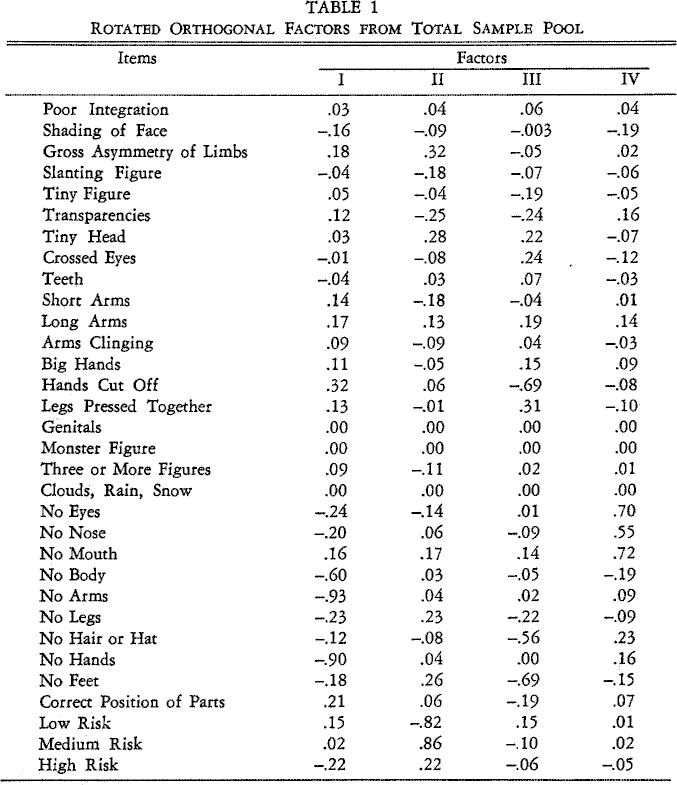
Factor I is the largest of the factors and has high loadings on items which consist of peripheral body-part omissions (no body, no arms, no legs, no hands), coupled with high risk. This factor seems to represent a dimensional aspect of good to poor or complete to incomplete drawings in combination with low to high risk. We further interpret this to mean that Factor I, in part, represents an indicator of poor psychological adjustment as manifested through poor quality drawings which contain numerous omissions of peripheral body parts. The items which cluster in this factor are all developmentally expectable ones in children of this age; therefore, their omission, coupled with clinical high risk, suggests an index of poor emotional adjustment.
Factor II shows high loadings on items such as: gross asymmetry, transparency, tiny head, and a high loading on low and medium clinical risk. This factor appears to be mainly defined by items related to content and structural characteristics of the drawings which occur relatively rarely, e.g., no more frequently than 10% of the time. In addition, omission of legs and feet load to a lesser extent. Since these two items appear in a dispersed manner across the four factors and are also the second most frequently omitted items across the drawings, they do not appear to contribute significantly to the core structure of this factor. Factor II appears to be an index of rare events related significantly to content and structural characteristics of the drawings, which imply a relationship to low or medium clinical risk.
Factor III contains high loadings on both content and structural items such as transparency, crossed eyes, legs pressed together, combined with items of peripheral body-part omissions, such as hands cut off, no feet, and no hair or hat. It is the least clear of the four factors in its underlying structure. There appears to be a subtle or disguised predictor of poor emotional risk evidenced here in the combination of rarely occurring items with unusual content or structure, coupled with frequent omissions which are dispersed across the factors.
Factor IV is defined by three items and has no other high loadings. They all consist of central body-part omissions within the head. They are: no eyes, no nose, no mouth. As in Factor I, there appears to be a cohesive clustering of omission items. In that factor, they are exclusively related to more peripheral body-parts; in this factor, they are exclusively related to omissions which involve only the head.
Both correlational analyses indicate that body-part omissions are the most predictive items of emotional high risk, thus corroborating the earlier findings of Goldman and Warren (1976). In their original study, they reported the results of a factor analysis with high loadings on two factors, differing in their composition according to central and peripheral body-part omissions. As both a cross-validation and an expansion of that study, we undertook an additional factor analysis, in which all variables external to the scale items themselves, except for clinical risk, were omitted. The results of the second factor analysis support the original Goldman and Warren findings that there are two cohesive underlying factors, both of which have high loadings on body-part omissions. The number of omission items clustered together on these two separate factors, plus the comparably high factor loadings of items on each, suggest that no one item is more significant than another in accounting for high emotional risk. Rather, we conclude that it is a grouping of items, interchangeable in their significance, that accounts for high clinical risk. It is number of omissions, rather than specific ones, which contribute to the risk index.
Thus our findings also support the contentions of Swensen (1968) both in regard to the type of items which are the best predictors as well as to their global nature. From a developmental point of view, it is clear that omissions should be more relevant than structure or content in predicting emotional risk, since the drawings of youngsters at this age are not sufficiently differentiated in the latter to use them reliably. Variations in content and structure occur too rarely for them to constitute a major component in a scale predictive of emotional high risk. A global criterion of interchangeable clusters of omission items appears to predict poor adjustment most accurately at this stage of development.