



Abstract
The present study offers a unique comparison of workplace stressors and negative psychosocial outcomes for police officers with and without community conflict directed toward their departments, using identical measures for each sample. Participants included 233 Turkish officers from Istanbul who were presently receiving community conflict targeting their department and 207 officers from the northeastern United States who were not experiencing such community conflict. The two samples differed in age, years of police service and household size, so these variables were used as covariates in ANCOVAs that compared the two samples for four police stressors (Critical Incidents, Departmental Politics, Daily Hassles, Work-Home Conflict) and three negative psychosocial outcomes (police partner conflict, romantic partner conflict, poor self-esteem). Results revealed that the Turkish officers reported less intense stressors from Critical Incidents than did the USA officers, perhaps because the atypical stressor of community conflict directed at their department reduced concerns about more typical Critical Incidents of police work (burglaries, car accidents, barricaded suspects). The impact of this community conflict may have also been evident in the increased Work-Home Conflict, increased police partner conflict and worse self-esteem reported by the Turkish police in comparison to the USA police. A limitation of the present study is that broader cultural differences between the Turkish and USA police samples could have explained differences in their stressors and negative outcomes. Future research could compare departments with and without community conflict, but matched for nationality, size and resources. Future research could also examine whether officer concerns associated with community conflict lead to reduced job performance and decisions to leave the police force.
It is widely acknowledged that workplace stressors are associated with increased psychosocial problems for police officers, such as conflict with police partners, conflict with romantic partners and poor self-esteem (Can and Hendy, 2014; Can et al., 2008; Gershon et al., 2009; Hall et al., 2010; Liberman et al., 2002; Stevens, 2008). Specific sources of police workplace stressors have been found to include critical incidents while out in the field, department politics, daily hassles with technology or equipment and work-home conflicts (Brown and Campbell, 1994; Can et al., 2015; Hart et al., 1994; Kureczka, 1996; Stevens, 2008; Violanti and Aron, 1993; Weiss et al., 2010). The negative psychosocial impact of police workplace stressors may be expected to be worsened when police experience widespread conflict or aggression from the community they have sworn to protect and serve. Such community aggression directed at police may take the form of protest marches, verbal assaults, physical aggression and even murder of police officers (Anderson and Bauer, 1987). Extensive coverage and commentary of any cases of community-police conflict often occurs via both traditional media outlets and social media platforms. Such widespread coverage of their community difficulties may make officers feel targeted, vulnerable and hypervigilant, which not only may affect their perceptions of workplace stressors, but also may produce psychosocial problems such as conflicts with fellow officers, conflicts in their private lives such as with romantic partners and even doubts about their own capabilities and self-esteem.
Purpose of the present study
The present study took advantage of a unique opportunity to compare workplace stressors and negative psychosocial outcomes perceived by officers from police departments presently with and without community conflict directed at their department, with all variables measured using identical instruments. The officers with community conflict were from Istanbul, Turkey, sampled during a period of political unrest, with community conflict and violence directed toward the police department (Body-Gendrot, 2016; Mendonça and Ercan, 2015). The officers without community conflict were from the northeastern United States, sampled two years before the widely publicised incidents of community conflict toward police departments that occurred in New York City, Ferguson, MI; and Baltimore, MD (Body-Gendrot, 2016; Gamson and Sifry, 2013; Schwartz, 2011). Both samples of police officers completed anonymous surveys with the same measures of four types of police stressors and three psychosocial outcomes. The four types of police stressors considered were recently identified in the Law Enforcement Officer Stress Scale-Revised (Can et al., 2015) to include Critical Incidents, Departmental Politics, Daily Hassles and Work-Home Conflict. The three negative psychosocial outcomes measured in both samples were those problems found associated with exposure to police stressors in past research (Can and Hendy, 2014; Can et al., 2008; Gershon et al., 2009; Hall et al., 2010; Liberman et al., 2002: Stevens, 2008): police partner conflict, romantic partner conflict, poor self-esteem. While comparing the Turkish officers (with community conflict) and the USA officers (without community conflict) in their perceptions of these workplace stressors and psychosocial outcomes, we controlled for demographic variables that might differ between the two samples and that might be associated with their perceptions (such as age, gender, marriage, household size, years of police service).
Method
Participants and procedures
Study participants began with 526 police officers from convenience samples in Turkey and the United States (250 from Turkey, 276 for USA; 94.3% male; 47.0% under 30 years of age; 69.6% married; mean household size = 3.1, SD = 1.3; mean years of service = 11.5, SD = 8.3). Of these 526 officers, 440 (83.7%) completed information about their workplace stressors to be included in the present study (233 from Turkey, 207 from USA; 95.7% male; 51.5% under 30 years of age; 69.5% married; mean household size = 3.1, SD = 1.2; mean years of service = 10.7, SD = 7.9).
Participants from Turkey originated with a sample from the large urban Istanbul Police Department, randomly selected from a list of all active-duty officers provided by the Istanbul Police Human Resources Department, and after permission was granted by the Turkish National Police (95.7% male; 87.3% under 30 years of age; 71.2% married; mean household size = 2.9, SD = 1.1; mean years of service = 6.9, SD = 5.3). Participants from the United States originated with a convenience sample of police officers from 18 urban and small-town police departments throughout Pennsylvania (95.7% male; 12.1% under 30 years of age; 67.6% married; mean household size = 3.2, SD = 1.4; mean years of service = 14.9, SD = 8.2).
For both samples from Turkey and USA, anonymous surveys were distributed to officers by their department supervisors as paper copies with large sealable envelopes. Officers completing the surveys were asked to drop them into boxes located at specific locations within the police department, then one of the authors of the present study collected them. The surveys asked for demographic information, reports of workplace stressors and possible psychosocial outcome variables including police partner conflict, romantic partner conflict and self-esteem.
Measurement of police stressors
Police workplace stressors were measured with the Law Enforcement Officer Stress Scale-Revised (LEOSS-R, Can et al., 2015). The LEOSS-R is an 18-item measure of police stressors developed from factor analysis of the original 25-item LEOSS developed by van Hasselt and colleagues (2008). Four subscales of police stressors measured by the LEOSS-R include Critical Incidents, Departmental Politics, Daily Hassles, and Work-Home Conflict. The LEOSS-R presents items for which officers of the present study were asked to use five-point ratings (1 = never, 2 = rarely, 3 = sometimes, 4 = often, 5 = always) to report both the ‘likelihood’ and the ‘difficulty’ of each scenario. These two scenario ratings were multiplied, and then scenario product scores relevant to each subscale were summed to serve as the score for that type of police stressor. Examples of items from Critical Incidents (α = .87 for Turkey, α = .84 for USA) include ‘You are called to a burglary in progress, and the assailant may be armed’ and ‘You respond to a motor vehicle accident with multiple injuries and possible fatalities.’ Examples of items from Departmental Politics (α = .74 for Turkey, α = .75 for USA) include ‘You are engaged in a promotional process’ and ‘You are recruited to investigate a fellow officer’. Examples of items from Daily Hassles (α = .83 for Turkey, α = .74 for USA) include ‘You are on your way to a high emergency call when the radio has interference’ and ‘You are on a high pursuit chase in icy conditions’. Examples of items from Work-Home Conflict (α = .80 for Turkey, α = .70 for USA) include ‘You find work is taking up more time, leaving you with little left for family and recreation’ and ‘Changing shifts has interfered with your sleep patterns’.
Measurement of psychosocial outcomes
Police partner conflict was measured with the six-item Verbal Aggression Subscale from the 12-item Revised Conflict Tactics Scale (CTS-R, Caulfield and Riggs, 1992). Officers were asked to use a five-point rating (1 = never, 2 = rarely, 3 = sometimes, 4 = often, 5 = always) to report how often during the past year they displayed each behaviour during conflict with their present police partner, with the sum of these six ratings used as the score for romantic partner conflict displayed (α = .86 for Turkey, α = .73 for USA). The CTS-R is the most widely used measure of conflict style because it includes displays of aggression that may apply in a variety of types of relationships (Schafer, 1997). Examples of scale items include ‘insulted or swore at the other’, ‘did or said something spiteful’ and ‘threatened to end the relationship’.
Romantic partner conflict was measured with the same six-item Verbal Aggression Subscale from the Revised Conflict Tactics Scale as described above for romantic partner conflict. Officers were again asked to use a five-point rating (1 = never, 2 = rarely, 3 = sometimes, 4 = often, 5 = always) to report how often during the past year they displayed each behaviour during conflict with their present spouse or romantic partner, with the sum of these six ratings used as the score for police partner conflict (α = .87 for Turkey, α = .82 for USA). (NB: The remaining six items that make up the Violence Subscale of CTS-R were not included in the measure of conflict used for police partners or romantic partners because some police departments have a ‘zero-tolerance’ policy concerning domestic violence, which would make officers reluctant to report it even on an anonymous survey.)
Self-esteem was measured using the 10-item Rosenberg Self-Esteem Scale (Rosenberg, 1965). Officers were asked to use a five-point rating (1 = never, 2 = rarely, 3 = sometimes, 4 = often, 5 = always) to report how much they had each thought during the past year, appropriate items were reversed in their ratings, then the sum of the 10 ratings was used as the self-esteem score (α = .72 for Turkey, α = .87 for USA). Examples of scale items include ‘I feel that I have a number of good qualities’, ‘I certainly feel useless at times’ (reversed) and ‘I can do things as well as most people’.
Data analysis
The first goal of data analysis was to identify demographic variables showing significant differences between the police samples from Turkey and the USA so these variables could be statistically controlled in the later ANCOVAs planned to compare the two samples (with and without community conflict) in reported police stressors and negative psychosocial outcomes. Chi-squared analyses were used to compare the Turkish and USA police samples in their percentages of officers who were male, under 30 years of age and married. T-tests were used to compare the Turkish and USA police samples in their household size and years of service.
The second goal of data analysis was to use ANCOVAs to compare the Turkish and USA police samples (with and without community conflict) for their reported police stressors and negative psychosocial outcomes. The ANCOVAs would also include as covariates any of the demographic variables (gender, age group, marital status, household size, service years) found in above analyses to be significantly different between the Turkish and USA samples. One set of dependent variables for these ANCOVAs would include the four police stressors: Critical Incidents, Departmental Politics, Daily Hassles and Work-Home Conflict. Another set of dependent variables for these ANCOVAs would include the three psychosocial outcomes: police partner conflict, romantic partner conflict, self-esteem. (NB: Sample sizes for these ANOVAs were slightly reduced because some officers neglected to complete some of the study variables.)
Results
Demographic differences between Turkey and USA police samples
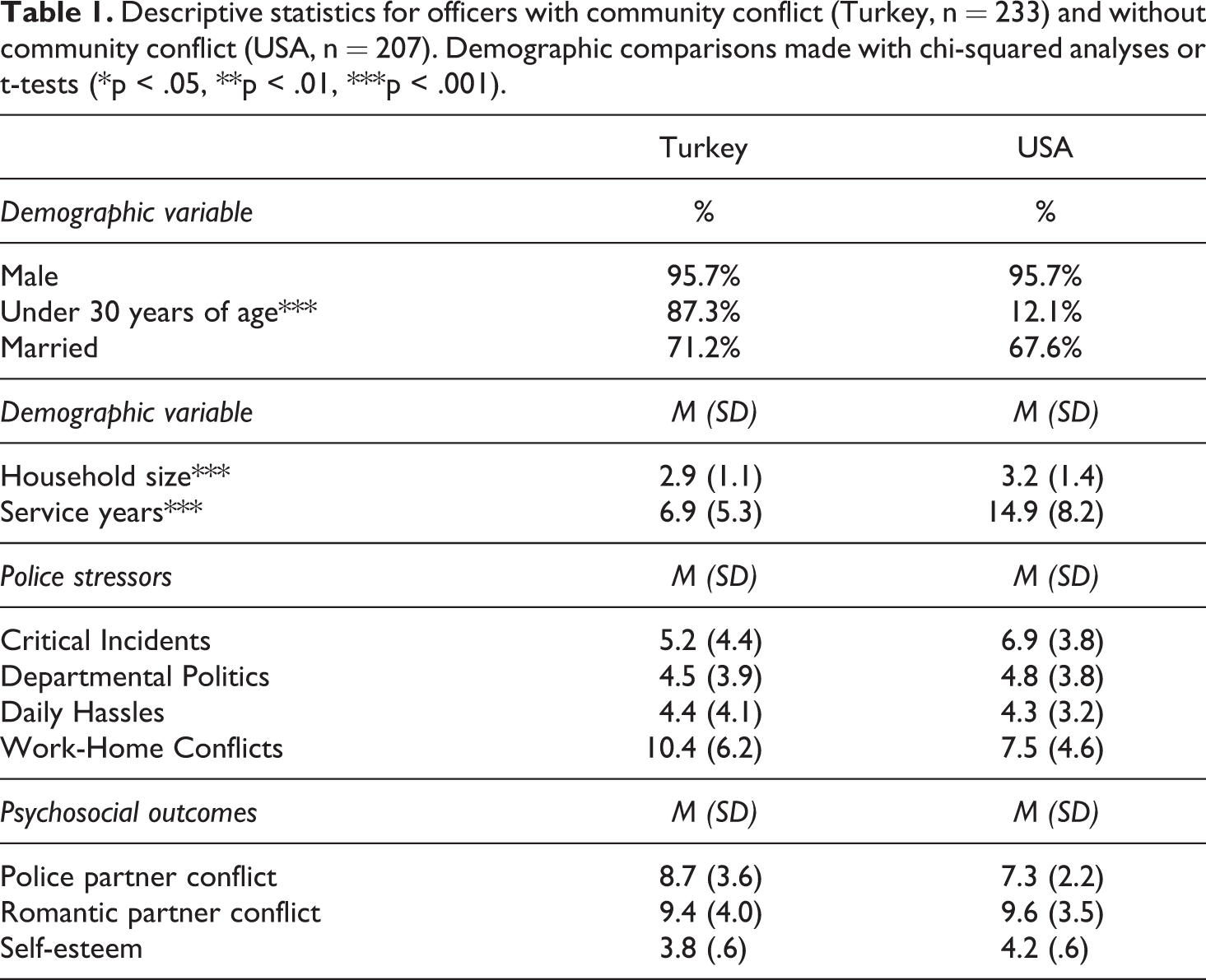
The police samples from Turkey and the USA showed no significant differences in their percentages of males (χ2 = .001, p = .977) or officers who were married (χ2 = .68, p = .411). However, significantly more of the Turkish officers compared to the USA officers were under 30 years of age (χ2 = 245.66, p = .000). Additionally, t-tests revealed that the USA officers had larger households and more years of service than did the Turkish officers (t = 2.76, df = 436, p = .006; t = 12.09, df = 430, p = .000; respectively) (see Table 1).
Descriptive statistics for officers with community conflict (Turkey, n = 233) and without community conflict (USA, n = 207). Demographic comparisons made with chi-squared analyses or t-tests (*p < .05, **p < .01, ***p < .001).
Comparison of Turkey and USA police in reported police stressors
To compare police stressors reported by officers from Turkey (with community conflict) and USA (without community conflict), 2×2 ANCOVAs were used that also considered age group (under 30 years, 30+ years) and household size and service years as covariates because these demographic variables were found in above analyses to be significantly different for the Turkey and USA samples. Results found that Turkish officers reported less intense Critical Incidents stressors (p = .002) and more intense Work-Home stressors (p = .006) than did USA officers, with no significant differences found in their reported Departmental Politics (p = .321) or Daily Hassles stressors (p = .884) after controlling for demographic variables that differed between the two samples. Demographic variables significantly associated with police stressors included less-intense Critical Incidents and Daily Hassles stressors for officers with more service years (p = .008; p = .016; respectively) (see Table 2).
Results from 2×2 ANCOVAs to compare workplace stressors for police with and without community conflict (Turkey, USA, respectively), age groups (under, over 30 years), using household size and service years as covariates.

Comparison of Turkey and USA police in negative psychosocial outcomes
To compare negative psychosocial outcomes reported from Turkey (with community conflict) and USA (without community conflict), 2×2 ANCOVAs were used that again considered age group (under 30 years, 30+ years) and household size and service years as covariates because these demographic variables were found in above analyses to be significantly different for the Turkey and USA samples. Results found that Turkish officers reported more police partner conflict (p = .020) and worse self-esteem (p = .000) than did USA officers, with no significant differences found in their reported romantic partner conflict (p = .539) after controlling for demographic variables that differed between the two samples (see Table 3).
Results from 2×2 ANCOVAs to compare psychosocial outcomes for police with and without community conflict (Turkey, USA, respectively), age groups (under, over 30 years), using household size and service years as covariates.

Discussion
Results from the present study offer a unique opportunity to compare workplace stressors and negative psychosocial outcomes, measured with identical instruments, for two samples of police officers, with one sample presently experiencing community conflict directed toward their department (233 Turkish officers from Istanbul) and one sample presently free of such community conflict (207 USA officers from northeastern USA).
Results revealed that the Turkish officers (with community conflict) reported less intense stressors from Critical Incidents than did the USA officers, perhaps because the atypical stressor of community violence directed at their department reduced their focus and concern about more typical Critical Incidents of police work (burglaries, car accidents, barricaded suspects). Additionally, the disruption caused by the community conflict may have ‘spilled over’ to affect officers’ private lives (Caligiuri et al., 1998), such as in the greater Work-Home Conflict and worse self-esteem reported by the Turkish officers (with community conflict) than by the USA officers (without community conflict). This perception requires further investigation to validate whether the disruption by community conflict has ‘spilt over’ to affect officers’ private lives.
Study limitations and directions for future research
This research is preliminary in nature due to the number of variables that have not been included in the data analysis reported here. One limitation of the present study is that broader cultural differences between the Turkish and USA police samples could have explained differences in their officers’ reported workplace stressors and negative psychosocial outcomes. Especially with the increasing number of USA incidents of widely publicised community violence directed toward police departments, future research needs to clarify whether exposure to such community conflict is the variable most predictive of officer perceptions of workplace stressors and negative psychosocial outcomes. For example, future research could examine whether similar patterns to those of the present results are found in comparisons of police departments matched in nationality, size, urban or rural region, ethnicity and resources. Future research could also examine whether officer stressors and negative outcomes associated with community conflict lead to reductions in job performance, increases in workplace deviance and more decisions to leave the police force.
Footnotes
Authors’ note
D Alper Camlibel is formerly affiliated with Northern Michigan University.
Declaration of Conflicting Interests
The author(s) declared no potential conflicts of interest with respect to the research, authorship, and/or publication of this article.
Funding
The author(s) received no financial support for the research, authorship, and/or publication of this article.