




Abstract
This paper examines and reports on the efficacy of work-based personal resilience training in a provincial police force in the north of UK. Taking a contextual view, data is modelled from an ASSET survey (n = 350) that provides evidence of the manifestations and consequences of providing such input, in comparison with respondents who had no training and were in the same organisation. The findings support the use of such training programmes (Hesketh et al., 2015) for improving employee well-being and resilience by addressing the sources of stress and educating the workforce in how to deal with these stressors. This research provides compelling evidence that resilient individuals are better equipped to deal with the stressful nature of both policing and an uncertain working environment. This paper posits that effective leadership, a working environment congruent with employee well-being, and investment in resilience programmes for the workforce enhance subsequent organisational performance and are a marker of good practice.
Introduction
In a systematic review of workplace resilience training, Robertson et al. (2015) identified that there had been no meaningful synthesis of resilience training efficacy. The research concluded that resilience training could improve employee performance and well-being. This paper seeks to examine the extent to which organisational investment in resilience interventions improves the working life of employees and organisational performance – and is a marker of good professional practice. This is examined through the construct of well-being.
The subject organisation is a provincial police force in the north of UK, where a series of multiple cross-sectional surveys have taken place longitudinally in order to probe the efficacy of resilience interventions in the workplace. These interventions consisted of independent classroom-based training sessions that covered the common themes of resilience. These included the ability to cope with the stressors of everyday life, thinking errors and the ability to bounce back following adverse events in the work environment. Surveys were carried out to establish the extent to which the intervention had been effective in terms of general health, attitudes towards work and employee perceptions of their job. These were subsequently compared to employees that had not undergone resilience training, but were in exactly the same working environment.
‘A Short Stress Evaluation Tool’ (ASSET) was employed to assess sources of stress within respondents. It should be noted that during the course of this research the police force in question was undergoing an unprecedented programme of root and branch reform, involving considerable financial and workforce downsizing. As such, the relevance of these findings can be given further significance, in that operational performance has been maintained throughout. This is documented by HMIC inspections on the subject force, which report high performance levels throughout the research period (HMIC, 2015).
Literature
The literature in this paper seeks to clarify the thinking to date on many of the aspects contained within the findings of this research, beginning with contemporary views on well-being. Literature linking well-being to resilience is then reviewed, covering areas of gender, police culture, mechanisms for measurement and burnout. Finally, the subject of resilience is explored in greater depth, this being the essence of the paper and supporting the notion that it is ‘an idea whose time has come’ (Cooper et al., 2014).
Well-being
Seligman (2012) outlined his view that well-being is more than the absence of illness. This was supported by Rothmann and Cooper (2015: 222), with the notion of well-being going ‘beyond the fixed ideas of health as the absence of illness’. Seligman argues that well-being as a notion has five pillars. These are Positive Emotions, Engagement, Relationships, Meaning and Purpose, and Accomplishment (Seligman, 2011: 24). These five areas, commonly referred to as PERMA, are measured both objectively and subjectively, and are a development of Seligman’s original concept of ‘Authentic Happiness’, which used life satisfaction as both measures and goals and introduced the notion of flourishing (Seligman, 2003).
These broad headings used by Seligman seem to be widely agreed by a number of well-being commentators (Cooper and Robertson, 2012; Kobau et al., 2011; Lyubomirsky, 2010; Ryff, 1989). In terms of measuring these descriptions, Ryff and Keyes (1995) generated a multidimensional model of well-being that included six distinct components of positive psychological functioning, In combination, these dimensions encompass a breadth of wellness that includes positive evaluation of one’s past life (Self-Acceptance), a sense of continued growth and development as a person (Personal Growth), the belief that one’s life is purposeful and meaningful (Purpose in Life), the possession of quality relations with others (Positive Relations With Others), the capacity to manage effectively one’s life and surrounding world (Environmental Mastery), and a sense of self-determination (Autonomy) (Ryff and Keyes, 1995: 720).
Later measures utilised a well-being continuum, ranging from Languishing to Flourishing (Keyes, 2002). Ryff (1989) also opened the debate around well-being and age profiles, arguing that there is a definitive relationship between the two. Ryff’s findings are evident in this research, although some of her work speculated beyond working life: It appears that even well educated, healthy economically comfortable older adults face significant challenges in their efforts to maintain as sense of purpose and self-realization in later life. (Ryff, 1989: 1079)
Gender
Gender has been discussed endlessly within policing culture (Graaf, 1989; Loftus, 2009). Ryff’s (1989) study included some observations regarding gender, and what she refers to as ‘women’s more troubled psychological profiles’. She concluded in her study (n = 321) that females had lower levels of internal control and morale, and higher levels of depression. This is balanced by the trends of higher personal growth in women, along with more positive relations with others (Ryff, 1989). Theories around ‘glass ceiling’ popularised by the Wall Street Journal article ‘The corporate woman’ (Hymowitz and Schellhardt, 1986) seek to develop these arguments.
A further cultural debate in policing centres around long hours working and work-life balance, with a particular focus on childcare responsibilities and issues around trust as potential bars to promotion for women. Although policing purports to have flexible working arrangements available to all staff, it is generally accepted that females remain in the majority when it comes to requesting flexible contracts, such as reduced hours, or ‘fractional’ working, as referred to by Gatrell (2007). Whilst flexible working is available to all, there is some scepticism about the career opportunities available to those on flexible contracts as opposed those on full-time contracts. Guest (2004) questioned to what extent employees working on flexible contracts were disadvantaged, concluding that knowledge workers on contracts of choice ‘pursuing boundaryless careers’ seem to experience positive outcomes, whilst others experienced less favourable outcomes.
Police culture
It should be noted, firstly, that the current culture in policing is not particularly helpful when promoting notions of well-being and resilience. Police, it is said, have an exaggerated sense of mission towards their role and crave work that is crime oriented and promises excitement. They celebrate masculine exploits, show willingness to use force and engage in informal working practices. Officers are continually suspicious, lead socially isolated lives and display defensive solidarity with colleagues. They are mainly conservative in politics and morality, and their culture is marked by cynicism and pessimism (Loftus, 2010: 1).
Burnout
A further challenge to promoting resilience is the culture of burnout, largely associated with long hours of day and night investigations depicted on police television programmes. With its origins as a metaphor used as a colloquial term by poverty lawyers, the term ‘burnout’ has been described as ‘a prolonged response to chronic job stressors’ (Maslach et al., 2001: 405). In this work Maslach et al. propose there are three dimensions to burnout: Exhaustion, Cynicism and Inefficacy.
Later work by Schaufeli (2003) labelled these as Exhaustion, Cynicism or Depersonalisation, and Low Professional Efficacy. The majority of the study concerned jobs that involved caring and services (emotional connections), so is of particular relevance to policing and the associated professionalisation agenda. On the subject of cynicism, the following extract illustrates a policing perspective: Moderating one’s compassion for clients by emotional distance from them (‘detached concern’) was viewed as a way of protecting oneself from intense emotional arousal that could interfere with functioning effectively on the job. However, an imbalance of excessive detachment and little concern seemed to lead staff to respond to clients in negative, callous, and dehumanized ways (Maslach et al., 2001: 400).
As well as burnout, there is a further stressor on the opposing scale, that of ‘rustout’ (Palmer and Cooper, 2010). The theory is that people who become bored by having too little to do or who no longer find the work as challenging as they used to may find themselves experiencing stress, anxiety or depression. This introduces the conundrum for many in a managerial role: how much is too much – or too little? Getting the balance right between challenge and support, and keeping pressure positive for employees is one of the areas contained within the resilience training package. Figure 1 illustrates the relationship.
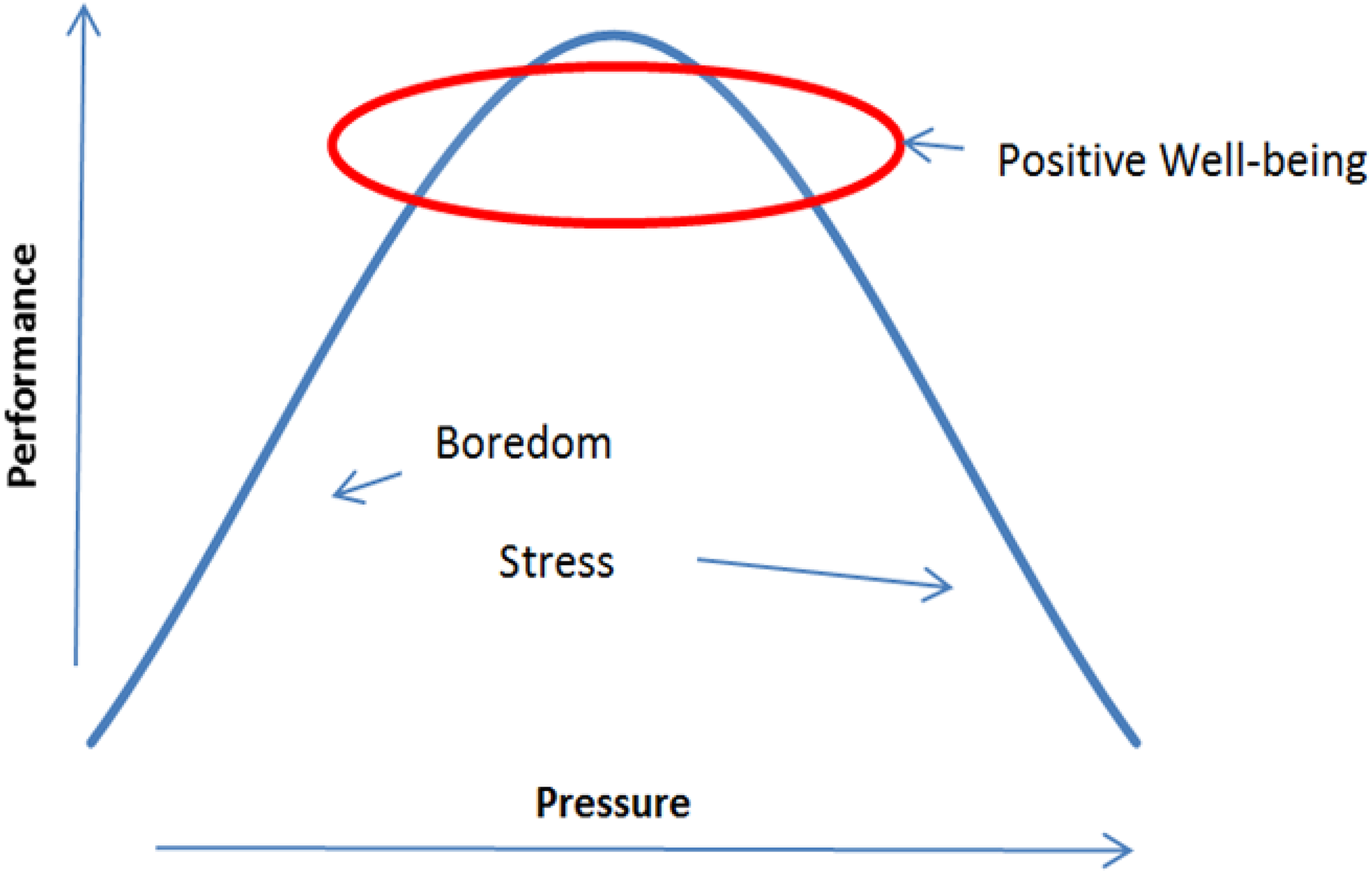
Performance pressure relationship (adapted from Yerkes and Dodson, 1908).
Added to this, of course, is the fact that we are all unique and have different needs and levels at which we peak: ‘One person’s pressure is another person’s stress’ (Palmer and Cooper, 2010: 303).
These factors combine to illustrate how much knowledge and understanding is required to keep a team working at their optimum level.
Resilience
One of the key concepts to understanding where the balance may lie can be explored through the notion of resilience, a critical aspect of well-being. Resilience refers to the ability to successfully adapt to stressors, maintaining psychological well-being in the face of adversity (Haglund et al., 2007: 899). When the individual perceives that the demands made upon them exceed their ability to cope…(Cartwright and Cooper, 2002: 6). Employees who are more hopeful, optimistic, efficacious, and resilient may be more likely to ‘weather the storm’ of the type of dynamic, global environmental contexts confronting most organizations today better than their counterparts with lower PsyCap (Luthans et al., 2007: 568)
Cost of sickness
However, to rely solely on ‘sickness absence’ as the sign of well-being may be flawed, and there are other manifestations such as ‘presenteeism’ (Johns, 2010) and ‘leaveism’ (Hesketh and Cooper, 2014) that may also be indicative of existent workplace problems. In a keynote address to the Good Day at Work Conference 2012, Ann Francke, the CEO of the Chartered Management Institute (CMI), presented the findings of research carried out by the CMI and Penna (McBain et al., 2012) . This revealed that only 1 in 5 managers have any management qualifications, and 64% of organisations reported they had no ‘need’ to train staff in management positions. In the same survey, it is hardly surprising that only 21% of respondents reported that they consider their line managers to be ‘highly effective’, with 43% classing them as ‘ineffective’ or ‘highly ineffective’ (Francke, 2012).
The subject of well-being, and having a resilient workforce, provides fertile ground for cost savings. With sickness absenteeism costing the UK an estimated £8.4bn, and presenteeism £15.1bn per year (Hutchinson, 2011). For many, this is the focus of effort, the metric that drives activity within the organisation. The annual economic costs of sickness absence and worklessness [in the UK] associated with working age ill-health are estimated to be over £100 billion. This is greater than the current annual budget for the UK’s National Health Service and equivalent to the entire GDP of Portugal. (Black, 2008: 10).
Measurement
Well-being instruments such as ASSET (Faragher et al., 2004), Stanford Presenteeism Scale (Koopman et al., 2002), the Life Satisfaction Index (Wallace and Wheeler, 2002) and the Better Life Index (OECD, 2012) can be used to provide supporting evidence to explain sources of stress within the workplace, such as job conditions, job security, attitudes and perceptions, and overall health. Together with absence records, these provide a more ‘reality-based’ picture of workplace stress and what the significant impact factors on this landscape are. They also provide organisations with comparative data, affording them the opportunity to position themselves in relation to others. Some studies have distilled further, focusing on specific conditions that result in presenteeism. In a Dutch study of patients with rheumatoid arthritis (n = 237), a number of different productivity measures were employed to establish the most valid measurement tool. They concluded that: many aspects of presenteeism should be discussed with caution (Braakman-Jansen et al., 2011: 359). to reduce the occurrence of presenteeism and absenteeism, employers should avoid concentrating their health promotion activities exclusively on disease-prevention programs (Gosselin et al., 2013: 84).
Method
A series of group-based resilience training sessions took place within the workplace of a police force in the north of the UK. These were conducted by a professional independent company outside of policing. The sessions were predicated on the assumption that resilience is based on personal characteristics and skills that can be learned and developed through appropriate training. The course covered areas that included building personal levels of resilience and managing well-being in a workplace setting. The objectives were for participants to understand resilience and to learn how to build and maintain resilience, both in themselves and others. Input on how to recognise signs of stress, what areas of personality help or hinder resilience and how social support can play a defining role were all contained within the training programme. The subsequent survey was conducted the following year.
This paper models that data, which was garnered from A Short Stress Assessment Tool (ASSET) (Faragher et al., 2004). This well-being psychometric instrument is used to measure sources of stress in the workplace. The instrument measures Attitudes Towards the Workplace and Perceptions of the Job. Items capture attitudes and perceptions that are known to cause stress in the workplace, these being Resources and Communications, Control, Work Relationships, Balanced Workloads, Job Security and Change, and Job Conditions, known as the ‘six essentials’ (Cooper and Robertson, 2012). The questionnaire was administered electronically via a Sharepoint platform and employed an online self-reporting approach. Questions on perceptions of the job and attitudes towards the organisation were measured using a six-point Likert scale, ranging from ‘strongly disagree’ to ‘strongly agree’. The Cronbach’s alpha reliability score for the 46-item ASSET measure was 0.804 and considered acceptable. The study reports on the responses captured from those who underwent resilience training against those who did not but were in the same working environment.
Findings
Sample description
Three hundred and fifty completed questionnaires were analysed from police officers and staff employed in a provincial police force in the north of the UK: 42% of respondents were female, 20% were employed in staff (non-police) or office-based functions, 20% of respondents were in part-time roles and 48 respondents did not indicate their rank or grade.
Discussion
Where respondents had undertaken resilience training, there were improvements in scores in all but one of the six essential dimensions measured, namely: Resources and Communications Control Work Relationships Balanced Workload Job Conditions
In the case of the Job Security and Change dimension, there was a decline in respondent perceptions towards how safe their jobs were and how detrimental change was in their work (see Figure 2). However, this was not significant.

ASSET scores for resilience training vs no resilience training.
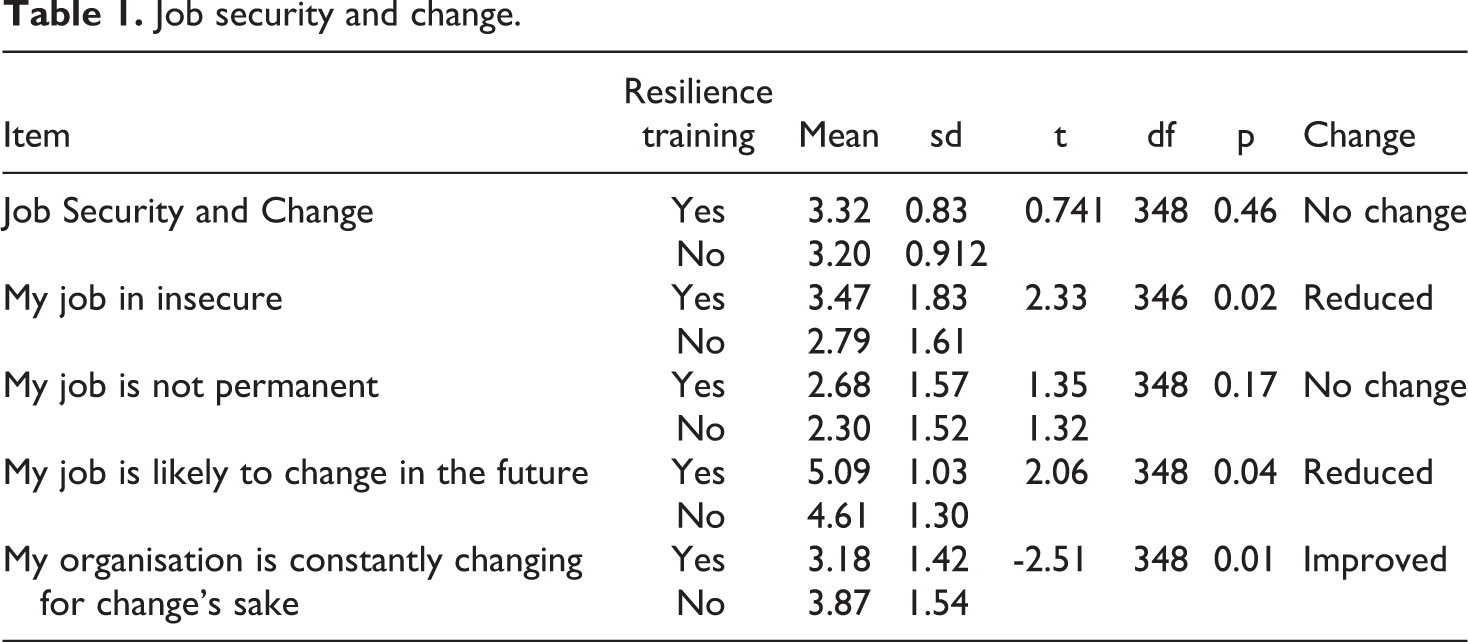
With regard to Job Security and Change, three out of the five items that made up this dimension’s measure showed significant differences, with two items, ‘job security’ and ‘job changing in the future’, declining and ‘the organisation changing for change’s sake’ improving after receiving the resilience training. With these items offsetting each other, resilience training appeared not to have any impact on the essential dimension of Job Security and Change, as illustrated in Table 1. This may be attributable to a realisation that the nature of policing is actually going to change significantly over the coming years, and with further government cuts to policing, job security actually being a realistic worry, especially for police staff. The current projections are for a further 6% reduction in budgets for the majority of forces by 2020/21 (HMICFRS, 2017).
Job security and change.
In the case of Control there was a significant improvement in ASSET scores, with respondents who had attended resilience training having a mean score of 2.87 (sd = 0.967), while those respondents who had not undergone resilience training (mean = 3.40, sd = 1.15) felt they had significantly less control of aspects that affect their work than those that had undergone the training (t = -2.566, df = 348, p = 0.01).
Whilst Work Relationships within the force were considered good for all respondents, these improved further amongst respondents who had undergone resilience training.
Similarly, respondents who had taken part in resilience training felt that their Balanced Workload and their Work-life Balance had improved.
When comparing police staff with police officers, police staff respondents who had undertaken resilience training felt that their Work-life Balance (mean = 2.45, sd = 1.06) was significantly (t = 2.213, df = 32, p = 0.034) better than police officers (mean = 3.32, sd = 1.04).
In respect of respondents who had not undergone resilience training, police officers had significantly (t = 2.315, df = 266, p = 0.021) more concerns regarding Balanced Workload (mean = 3.37, sd = 0.928) than police staff (mean = 2.65; sd = 1.0).
Police officers who had taken part in resilience training felt that they had significantly (t = -2, df = 238, p = 0.43) more Control (mean = 2.9, sd = 1.0) than those officers who had not undergone resilience training (mean = 3.39, sd = 1.08). In a similar vein, officers that had undergone resilience training felt significantly better (t = -2.2, df = 238, p = 0.031) about Job Conditions (mean = 2.88, sd = 0.72) than those that had not (mean = 3.28, sd = 0.86).
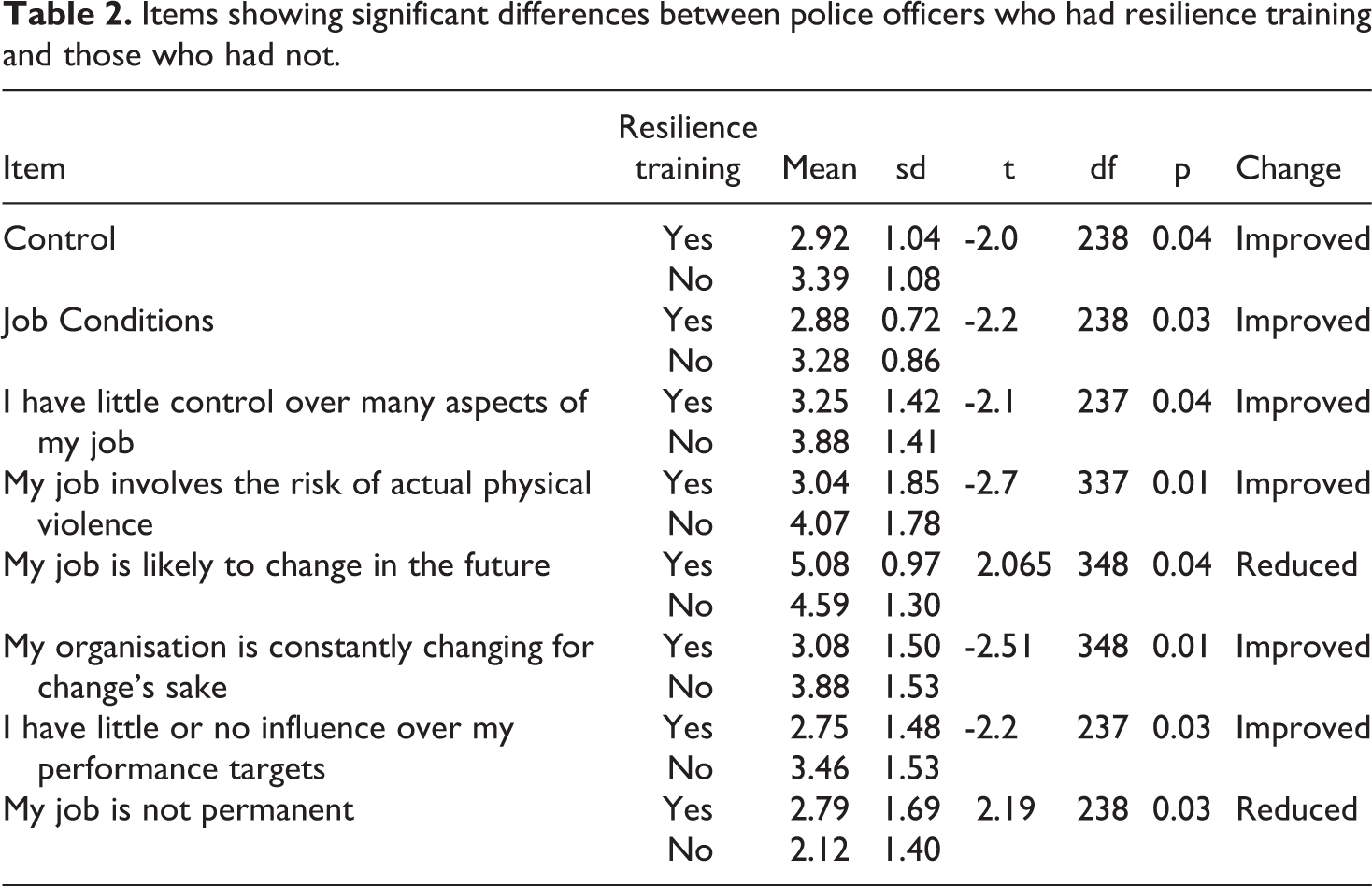
With regard to individual items in ASSET that showed significant differences between police officers that had undergone resilience training and those that had not, the following items illustrated in Table 2 showed significant improvement.
Items showing significant differences between police officers who had resilience training and those who had not.
With regard to police staff, there were no significant differences amongst any of the essential dimensions from ASSET. There were however four individual items that showed significant improvements, namely; control over aspects of their job (Control), their work being dull and repetitive (Job Conditions), not being adequately trained (Resources and Communications) and being more willing to put themselves out for the force (Engagement).
Thirty-three out of the forty-six items measured (72%) in ASSET showed improvement with male respondents who had undertaken resilience training. Of these, two were significant improvements (‘I have little control over many aspects of my job’ and ‘My organisation is changing for change’s sake’).
With ‘My job is likely to change in the future’, this item showed a significant increase (t = 1.60, df = 200, p = 0.002). This, however, need not be a stress inducer, but recognition of the changing roles that exist in policing.
Like their male colleagues, females reported 33 items from ASSET showing improvement after resilience training (72%), with four showing significant differences between respondents that had undergone resilience training and those that had not. ‘My physical working conditions are unpleasant’, ‘I have little or no influence over my performance targets’ and ‘Outside of my particular job, I take an interest in many aspects of the running and success of this organisation’ all showed significant improvements. Job Security showed a significant decline.
However, in terms of resilience, this study noted significantly lower (better) scores for women in stressors such as Work-life Balance – male mean score = 3.5, sd = 1.1; female mean score = 3.2, sd = 1.1 (t = 2.8, df = 346, p = 0.05) – and Job Conditions – male mean score = 3.2, sd = 0.8; female mean score = 3.0, sd = 0.8 (t = 2.5, df = 346, p = 0.015). This is in contrast to Ryff’s (1989) study, which included observations that females had lower levels of internal control. The results of this study, however, model significantly better scores for women in items such as Work-life Balance and Job Conditions. A detailed inventory of all the mean scores is provided at Appendix 1 below.
Conclusions
Robertson et al. (2015) noted that the empirical evidence for resilience training efficacy is tentative. This study clearly shows that, in a policing context, resilience training is highly effective and can contribute towards positive well-being outcomes. Furthermore, we argue that resilience, as measured with ASSET, can provide a good indicator of officer and staff well-being. Well-being, as recognised by the HMICFRS, is a key indicator of operational effectiveness and legitimacy. As such, and congruent with the professionalisation agenda, well-being provides a clear indicator of good professional practice.
As discussed, policing culture seems to contribute to many of the areas that identify sources of stress, almost adding to the issue with the way policing has developed. This is clearly unhelpful, and a recommendation would be that cultural awareness should be included within training programmes, especially in such customer-facing roles that are viewed as confrontational, and as such are high in emotional labour. These considerations highlight further the effectiveness of this intervention.
This research clearly shows improvements in relation to measures of Resources and Communications, Control, Work Relationships, Balanced Workload, Work-life Balance and Job Conditions in respondents who had undertaken resilience training.
A proposal would be that resilience training ought to be incorporated into leadership inputs, with the aim of better preparing leaders for the pressures and challenges of the modern working environment. Within (UK) policing, a period of unprecedented change in almost all aspects of the occupation has amplified the urgency for this to take place.
Further research into police-specific resilience training programmes and links to police leadership is needed to optimise efficacy. However, this research illustrates how resilience training can dramatically improve many aspects of working life for those in policing. To conclude: Concerns about individual and organisational resilience are now centre stage in human resource management and occupational psychology, not only to enhance productivity but also to foster workplace well-being and engagement. (Robertson et al., 2015: 27).
Footnotes
Declaration of conflicting interests
The author(s) declared no potential conflicts of interest with respect to the research, authorship, and/or publication of this article.
Funding
The author(s) received no financial support for the research, authorship, and/or publication of this article.

Mean scores of those who attended resilience training and those who did not.

| Attended a Resilience course | ||
|---|---|---|
| Yes | No | |
|
|
|
|
| I do not feel I am informed about what is going on in this organisation | 2.500 | 2.970 |
| I am never told if I am doing a good job | 2.590 | 3.100 |
| I am not adequately trained to do many aspects of my job | 2.180 | 2.320 |
| I do not have the proper equipment or resources to do my job | 2.560 | 2.890 |
|
|
|
|
| I have little control over many aspects of my job* | 2.940 | 3.890 |
| I am not involved in decisions affecting my job | 3.440 | 3.700 |
| My ideas or suggestions about my job are not taken into account | 2.500 | 2.960 |
| I have little or no influence over my performance targets* | 2.620 | 3.460 |
| Work relationships | 2.240 | 2.274 |
| My boss behaves in an intimidating and bullying way towards me | 1.590 | 1.600 |
| I do not receive the support from others (boss/colleagues) that I would like | 2.470 | 2.680 |
| I feel isolated at work e.g. working on my own or lack of social support from others | 2.150 | 2.410 |
| I am not sure what is expected of me by my boss | 2.000 | 2.070 |
| Other people at work are not pulling their weight | 3.590 | 3.510 |
| My boss is forever finding fault with what I do | 1.590 | 1.620 |
| Others take the credit for what I have achieved | 2.740 | 2.650 |
| My relationships with colleagues are poor | 1.790 | 1.650 |
|
|
|
|
|
|
|
|
| I work longer hours than I choose or want to | 2.910 | 3.340 |
| I work unsociable hours e.g. weekends, shift work etc. | 3.210 | 3.780 |
| I spend too much time travelling in my job | 2.410 | 2.570 |
| My work interferes with my home and personal life | 3.740 | 3.990 |
|
|
|
|
| The technology in my job has overloaded me | 2.180 | 2.460 |
| I am set unrealistic deadlines | 2.470 | 2.610 |
| I am given unmanageable workloads | 2.940 | 2.900 |
| I do not have enough time to do my job as well as I would like | 3.790 | 3.860 |
|
|
|
|
| My job is insecure* | 3.470 | 2.880 |
| My job is not permanent | 2.680 | 2.330 |
| My job is likely to change in the future* | 5.090 | 4.640 |
| My job skills may become redundant in the near future | 2.210 | 2.470 |
| My organisation is constantly changing for change’s sake* | 3.180 | 4.040 |
|
|
|
|
| I may be doing the same job for the next 5 to 10 years | 3.590 | 3.570 |
| My physical working conditions are unpleasant (e.g. noisy, dirty, poorly designed). | 2.290 | 2.750 |
| My job involves the risk of actual physical violence* | 2.880 | 3.840 |
| My performance at work is closely monitored | 3.320 | 3.610 |
| My work is dull and repetitive | 1.880 | 2.300 |
| I have to deal with difficult customers/clients | 4.290 | 4.410 |
| I do not enjoy my job | 1.910 | 2.260 |
| My pay and benefits are not as good as other people doing the same or similar work | 2.850 | 3.230 |
*Significant differences between respondents who attended a resilience course and those that had not.