




Abstract
Historically, police administrators have argued that misconduct occurs among a few bad officers, undermining the notion that deviant acts transcend individual characteristics of officers to incorporate the characteristics of the department. The purpose of this study was to explore the state of police integrity within the Ghana Police Service by qualitatively analysing interview responses obtained from a select group of police officers in two police districts. Findings revealed that police misconduct in Ghana exists in different dimensions, and that officers are willing to engage in open discussions about deviant acts by their colleagues. Policy implication of the findings are discussed.
Introduction
Policing is an occupation that is rife with opportunities for misconduct (Klockars et al., 2000: 1).
Despite the police having the legal mandate to perform these duties, they cannot be effective without help from the community and its members. Therefore, inappropriate behaviour, such as corruption, brutality or misuse of authority will significantly affect the police (Bayley, 2002; Kutnjak Ivković, 2005). For instance, corruption undermines trust and confidence, and being viewed as untrustworthy will be catastrophic to the police. Another reason for the growing concern stems from the nature of police work. As the above quote suggests, policing creates various opportunities for officers to engage in deviant behaviours ranging from accepting free meals to deadly use of force. Much of police work takes place in private locations, without the oversight of supervisors, and at times, with no witnesses. These characteristics of police work could easily make a morally upright officer very corrupt.
Police misconduct and integrity have received much scholarly attention. However, there is a legitimate reason to examine officers’ opinions about misconduct in a police force that has not been well studied, and historically labelled as corrupt and insensitive to public needs. The Ghana police have a long history of abuse, corruption, and misuse of authority (Afro Barometer, 2014; Tankebe, 2008), and this warrants the endeavour to study what officers think about misconduct. The current study therefore supplements previous effort by qualitatively analysing police officers’ perceptions of misconduct. Due to the lack of trust of the police, within the police and of outsiders, it is crucial that researchers take a different approach to study misconduct. To that end, a qualitative approach allows us to better contextualise integrity from the officers’ perspective.
The purpose is to develop a model that explains the dimensions of police misconduct and deviance in a postcolonial society like Ghana. To do so, the following set of objectives were achieved: First, identify behaviours that officers consider to be unethical when committed by their colleagues. Second, identify specific corrupt practices that officers believe their colleagues engage in. Third, assess ways to address police misconduct from the officers’ perspective. Achieving these specific objectives will renew the debate on police integrity and direct scholars to pay attention to the areas that matter most.
Police misconduct and the ‘rotten apple’ perspective
Prior research on police behaviour has deliberately avoided the use of the term ‘misconduct’ (see Kutnjak Ivković and Shelley, 2005), because the researchers believed the term was too sensitive and using it directly would produce unreliable estimates. Rather, these scholars prefer to use the term ‘police integrity’, which, per Klockars et al., is defined as the ‘normative inclination among police to resist temptations to abuse the rights and privileges of their occupation’ (2004: 2). This attitude of scholars partly explains why police misconduct has not been uniquely examined as a concept in the academic literature. Other reasons include the difficulty of defining the concept. Police misconduct is multifaceted, and thus there is no single encompassing definition (Klaver, 2014). Some scholars generally define misconduct as the exercise of an officer’s public authority for private, personal gain (Barker, 2011; Kleinig, 2002). Others, such as Lynch and Diamond (1983), conceptualised police misconduct as violations of formally written rules, standard operating procedures, regulations, and criminal and civil law. The difficulty of gathering data also prevents scientific examination of police misconduct (Chappell and Piquero, 2004; Haarr, 1997). Most misconduct activities are difficult to observe, since they take place in secluded environments where the only witnesses are the parties involved. Due to this secretive nature of misconduct, it is hard to obtain accurate information for any meaningful analysis.
Police misconduct has different dimensions (Barker, 2002; Grant, 2002; Punch, 2000; Roebuck and Barker, 1974) and corruption is one such dimension. According to Kutnjak Ivković, ‘police corruption is an action or omission, a promise of action or omission, or an attempt of action or omission, committed by a police officer or a group of police officers, characterised by the police officer’s misuse of the official position motivated in significant part with the achievement of personal gain’ (2005: 549). Police corruption is particularly problematic because of its potency in undermining police legitimacy, public trust and confidence (Palmiotto, 2001; Punch, 2000; Seron et al., 2004). Additionally, as Ashforth and Anand (2003) suggest, corruption, like misconduct, may become so routine and structurally embedded that it becomes ‘normal’. Citizens require the police to maintain a high degree of integrity and professionalism as they perform their multifaceted duties of protection, service and enforcement. If the police fail to meet this requirement, the citizens lose trust and faith in them.
Use of excessive force, or more force than necessary to gain compliance (Terrill and Mastrofski, 2002; Terrill et al., 2003), is another category of police misconduct, perhaps the most devastating. Excessive use of force is worrisome, and has great power to erode citizens’ trust in the police, mainly because of its direct impact on victims. Research suggests that police officers are worried about their colleagues using unnecessary force to gain compliance. For instance, analysing data on a sample of police officers, Weisburd and Greenspan (2000) found that most officers in the study disagreed about using unnecessary force to control an individual assaulting an officer. Further studies on police opinions of excessive use of force have yielded similar conclusions (see Klockars et al., 2000). This is an indication that many officers do not generally accept such behaviours by their fellows. However, there are some officers who believe that using more force than legally required is necessary to demonstrate authority and enable the police to perform their duties (see Carter, 1985).
The critical question that most people ask is: ‘Why do police officers engage in misconduct or deviant acts?’ In responding to this question, two perspectives have been offered in the literature: the ‘rotten apple’ and the ‘rotten barrel’ hypotheses. The rotten apple perspective, which is an individualistic, human failure model of misconduct, is the one most favoured by police chiefs and administrators (Newburn, 1999; Punch, 2003). According to this perspective, corruption occurs among a few bad officers in an otherwise honest department. This perspective suggests that deviant acts result from a breakdown of morality among a few officers that has the potential to spread through the rest of the department. When allegations of misconduct are made, police chiefs typically respond by arguing that the acts are limited to a few problematic officers, who are isolated and operate alone. Adherence to this individualistic explanation of misconduct serves two purposes. First, police organisations use this approach to curtail public criticism after an act of misconduct has been exposed (Delattre, 1989; O’Connor, 2005). Second, it allows the police agency to address allegations of misconduct by targeting specific bad officers. Strategies such as proactive and reactive integrity testing are put in place to weed out the rotten apples from the barrel. Moreover, police departments are strategic in their recruitment and selection efforts with the aim of weeding out applicants who are predisposed to deviant acts (Butcher et al., 2001; Kane and White, 2009; Sanders, 2008).
Although the rotten apple argument may be reasonable, some experts on police behaviour reject the notion that police misconduct is the work of a few officers in a department, in favour of the rotten barrel hypothesis (Knapp Commission, 1972; Perry, 2001). Per Perry (2001), ‘corrupt police officers are not natural-born criminals, nor morally wicked men, constitutionally different from their honest colleagues’ (2001: 1). Furthermore, several studies and commission inquiries have found that police misconduct transcends individual characteristics of officers to incorporate the characteristics of the department (Kutnjak Ivković, 2009; Knapp Commission, 1972). In investigating allegations of corruption in the New York City Police Department, the Knapp Commission (1972) observed that more than half of the police officers in the department had been involved in corruption. The finding, which opposes the traditional rhetoric that few officers engage in corrupt acts, suggests the need for a critical examination of the department to identify risk factors such as managerial disorganisation, poor supervision, negligent hiring, lack of disciplinary and accountability measures, and organisational culture (Armacost, 2004; Cancino and Enriquez, 2004; Lee and Vaughn, 2010; Prenzler, 2009; Rothwell and Baldwin, 2007).
Ghana Police Service and the problem of misconduct
Structurally, the Ghana Police Service (GPS) is a centralised and hierarchical agency divided into 12 administrative regions, 51 divisions, 179 districts and 651 stations. GPS employs about 23,702 officers, serving a population of approximately 25 million. Police scholars have lamented that the current number of personnel falls short of the United Nations standards for ideal police staffing. Demographically, the force is currently about 79% male and 21% female (GPS, 2016). While GPS inherited its structure and practices from the Gold Coast Constabulary, the service upholds civil police duties as its core functions (Police Force Act, 1970).
GPS is also viewed by many as the most corrupt institution in the country (Afro Barometer, 2014). Boateng (2015a) attributed this corruption and other forms of police misconduct, such as violence and brutality against citizens, to the lack of workable mechanisms for controlling police behaviour in the country. Police violence was routine in Ghana during the colonial era and continues in the contemporary period (Boateng, 2015a). The abusive behaviour of the police, especially during interrogation and citizen encounters, has destroyed the experience that citizens have with the police and the criminal justice system in general; the Commonwealth Human Rights Initiative reported that corruption, illegal arrest and detention, excessive use of force and failure to respond to complaints were widespread practices among police officers in Ghana. These claims were later supported by another human rights report initiated by the US Department of State in 2010, which echoed that police brutality, corruption, negligence, and impunity were problems facing the police. These human rights reports have unmasked the dark side of the Ghana police, further harming their relationship with the public (Boateng, 2015a).
In addition to the numerous reports and surveys on police malpractice, there have been several media accounts of police misconduct ranging from impropriety to failing to perform duties. For example, in July 2006, the Chronicle newspaper reported, ‘When cases are reported at police stations, it often becomes an opportunity to collect bribes. They create the impression that they cannot help much; sometimes advising victims to go home and let sleeping dogs lie. But immediately some few thousand cedis change hands; they come alive with enthusiasm to attend to the work for which they are paid with taxpayers’ money.’ This attitude among members of the Ghana Police Service demonstrates why the relationship between the police and the public is marked by suspicion, hatred, discontent, and distrust (Boateng, 2013, 2015a, 2015b; Boateng and Darko, 2016; Tankebe, 2008). Given the prevalence of misconduct within the Ghana Police Service, the current qualitative analysis aims to assess how officers perceive misconduct by identifying behaviours that officers consider to be unethical when committed by their colleagues, identifying specific corrupt practices that officers believe their colleagues engage in, and finally to examine ways to address police misconduct from the officers’ perspective.
Methods
Data collection
To test the study’s objectives, a non-probability-availability sample of police officers from two districts located within the Accra police region was used. Specifically, we adopted a convenient sampling technique to select officers for participation in the study. In choosing the appropriate method, we considered officers’ schedules and availability; convenient sampling provided us with a better option than random sampling. The data were collected in 2014, between the months of March and May. Initially, 60 officers were targeted for the interview, but 36 officers participated in the study, for an approximately 60% response rate.
Instrument
Recognising the inherent limitations in researching police integrity (misconduct), we utilised a qualitative research methodology. While we realise this will reduce generalisability, we believe it is necessary to understand police integrity within the GPS and will help inform subsequent research on police integrity within the nation. We used interviews as a means of data collection for two reasons. First, we were unable to obtain permission to field the Police Integrity questionnaire from the commissioner of administration, which was not surprising, considering the sensitive nature and potential for negative publicity. Second, interviews provided the opportunity to clarify participant concerns and obtain additional detailed information concerning police integrity. Before conducting interviews, we sought permission from the police administration; because Ghana has a centralised police system, the commissioner of administration at police headquarters in Accra granted permission. Following this, the researchers were given two signed letters to be given to the district commanders of the police districts where the interviews were conducted.
Officers selected for the interviews voluntarily agreed to participate in the process. Before the start of the interview, each participant was informed that his/her responses would be kept confidential, and there would be no access to the responses by any third party. In district 1 A, we selected 30 police officers; 20 officers agreed to be interviewed and 10 declined. In district B, out of the 30 officers selected, 16 officers were interviewed and 14 declined. In all, 36 police officers were interviewed for this study. Most of the officers from both districts were approached in their offices, but a few were approached immediately after their morning briefings. Upon approaching an officer, the lead author who conducted the field work greeted the officer, introduced himself, and offered a detailed introduction of the study. Officers who showed initial interest in the study were asked to suggest a time and place for the actual interview.
To elicit accurate information, reduce the number of participants who withdrew and protect the identity of respondents, we conducted all interviews in secluded locations outside of and away from each respective agency. Interviews lasted approximately 20 minutes. Using both open-ended and closed-ended questions, we explored views on police misconduct by reading the questions to the interviewees and recorded their responses on a hard copy. In total, there were six misconduct-related questions and two officer characteristic questions. The misconduct-related questions were: ‘Do you think some of your fellow officers engage in misconduct of any kind while performing their duties?’, ‘If yes, approximately what percent of officers do you think engage in misconduct?’, ‘In your opinion, what do you think are some of the things police officers do in Ghana which are illegal and unethical? (Try to be as specific as possible.)’ ‘Specifically, do you think some of your fellow officers engage in the following practices? (a) taking bribes from people, including commercial drivers, (b) refusal to arrest or prosecute because of family and friendship ties, (c) offer favours to family and friends, (d) use excessive force against citizens/suspects, (e) sleep while on duty and (f) accept favours from businessmen and women’, ‘Apart from the above, what other corrupt practices do some of your fellow officers engage in, that you know of?’ and ‘What do you think should be done to minimise misconduct perpetrated by some of your fellow officers?’ Officers were also asked to give their age and gender.
Data analysis
The data obtained from the interviews were qualitatively analysed using a content analysis procedure. In the content analysis, responses to open-ended questions were nominally coded into similar groups or categories, based on words or phrases. For example, if many participants mentioned debt collection as an illegal and unethical behaviour, a category entitled ‘debt collection’ was created. Thus, any time a participant mentioned debt collection or any answer that suggested it, his/her response was added to that category in the database. Instances where a participant provided an answer that could not be placed in one of the named categories were placed into a category of their own.
Findings
The interview started by asking officers to indicate whether they believed some of their colleagues engaged in misconduct while performing their duties. Surprisingly, all but one (97%) responded affirmatively, suggesting that their fellow officers engage in misconduct. Of those who agreed that officers engaged in misconduct, more than two thirds (64%) believed that a handful (less than 20%) of the officers were corrupt or engaged in other forms of misconduct, 19% of the officers reported that the corrupt percentage was 20–30%, and 14% of the officers reported a figure more than 40% (results not presented here, available upon request).
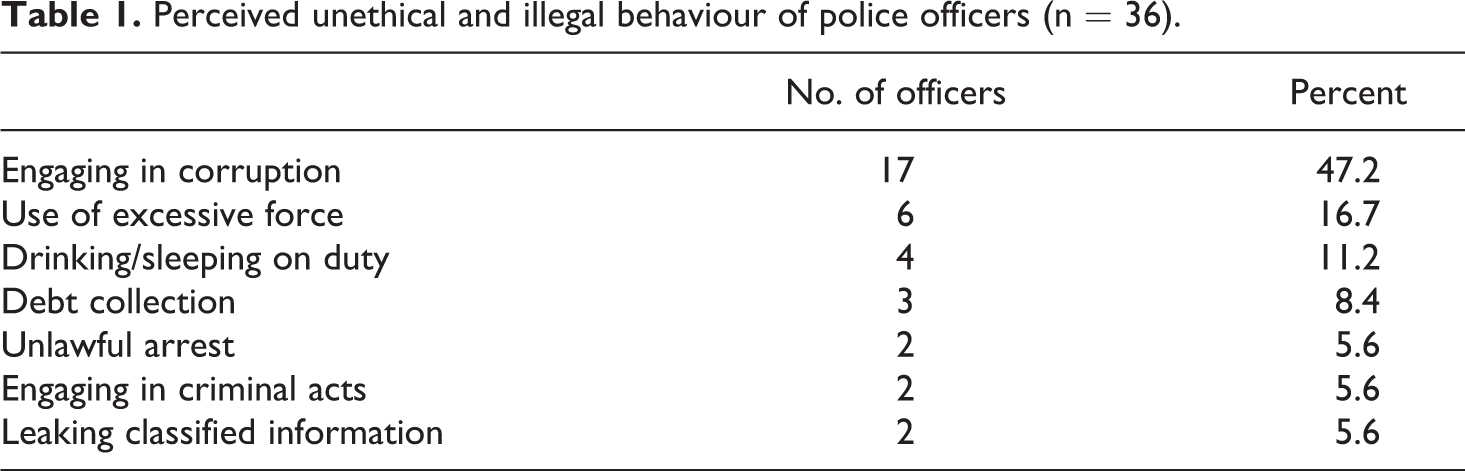
The types of illegal and unethical behaviour that officers reported seeing their fellows engage in were numerous. Seven main themes appeared in their responses about the unethical attitudes of their colleagues (see Table 1). The three most-cited forms of unethical and illegal behaviour perpetrated by police officers were engaging in corruption, use of excessive force, and drinking and sleeping on duty. Others were debt collection, unlawful arrest, engaging in criminal activities and leaking classified information. These behaviours not only negatively affect the police organisation, but also have consequences that transcend the boundaries of individual departments to affect the entire community in which the police operate.
Perceived unethical and illegal behaviour of police officers (n = 36).
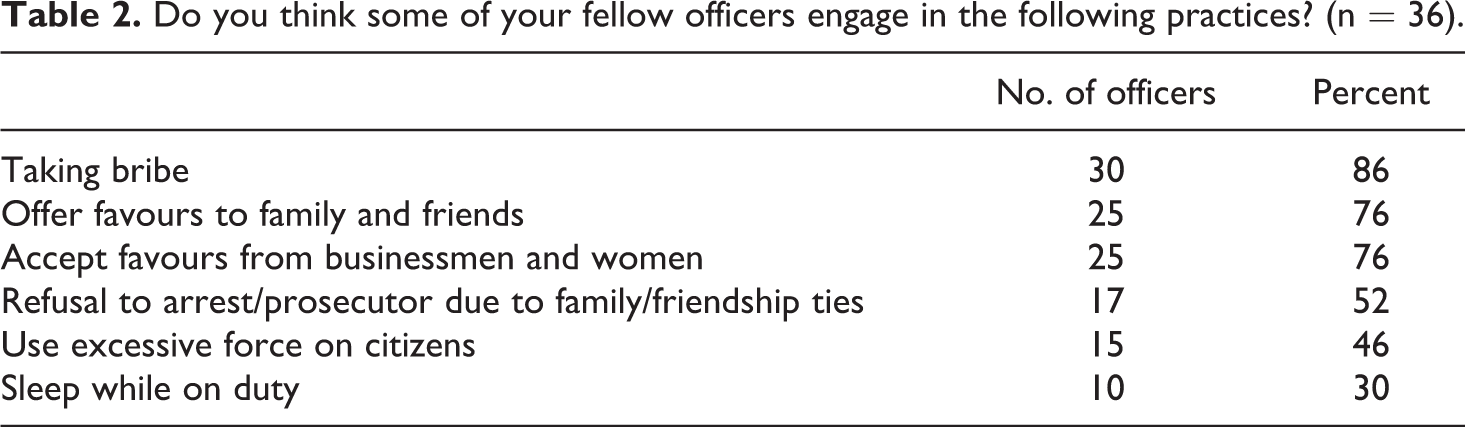
During the interview process, we also presented officers with six specific misconduct-related items and asked them to indicate whether they believed their colleagues engaged in any of those behaviours. The findings from this inquiry are presented in Table 2 below. Most notably, officers overwhelmingly reported that their fellow officers accepted bribes (86%), accepted favours from businesses (76%), offered favours to family and friends (76%) and refused to arrest/prosecute due to family or friendship ties (52%). While the influences of the first two behaviours on policing have been well examined (see Sabet, 2012), the last two have not been adequately investigated. The limited research examining the effects of relational ties on police legitimacy has found no statistically significant difference between the views of families and friends who receive favours from the police and those of ordinary citizens who do not receive favours (Boateng and Lu, 2016). Interestingly, less than half (46%) of officers reported believing their fellow officers used excessive force, and 30% claimed their colleagues slept on duty.
Do you think some of your fellow officers engage in the following practices? (n = 36).
Following this closed-ended question, we asked the officers to mention specific corrupt practices that were not listed. Although nine officers declined to comment on this follow-up question, several patterns emerged from the responses of the officers who addressed the question. These patterns were grouped under five main categories (see Table 3). Specific corrupt behaviours mentioned by the officers included making unlawful arrests, performing unauthorised duties and requiring complainants to pay for taxi fare. In Ghana, it is a common practice that officers will ask a complainant, being a crime victim or a witness to a crime, to pay for the cost of transportation before the officers can accompany the person to the crime scene. These officers will normally tell the complainant that there is no available vehicle at the station and if he/she can pay for a taxi, they can go with him/her. The officers in the study also mentioned collecting money from criminal suspects as well as using official resources (cars and personnel) for personal business.
Other specific corrupt practices some of your fellow officers engage in (n = 36).
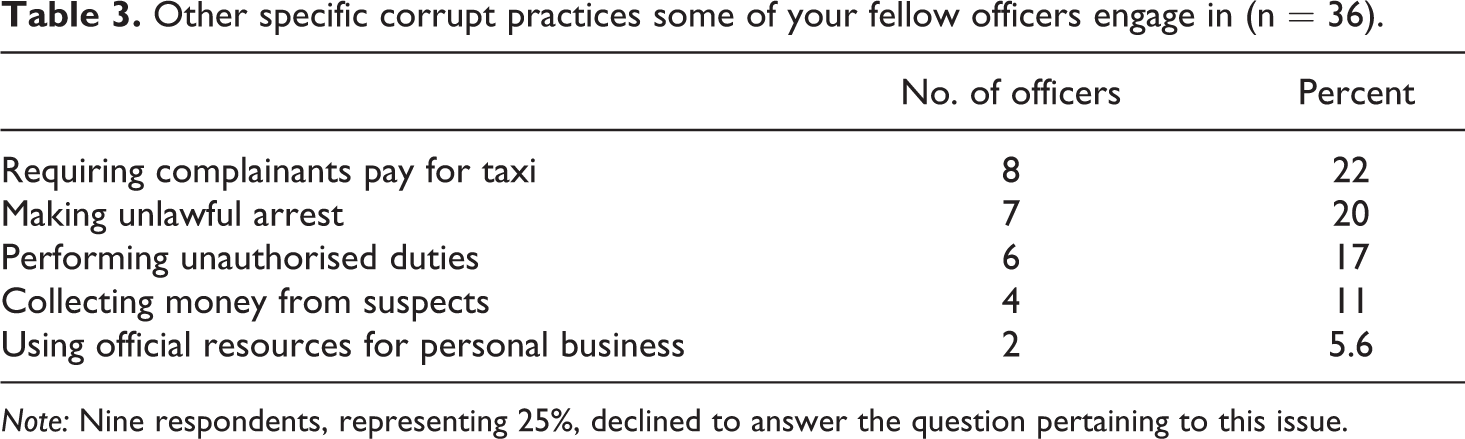
Note: Nine respondents, representing 25%, declined to answer the question pertaining to this issue.
Reducing misconduct: Officers’ view
Table 4 presents the recommendations made by police officers to improve police integrity. Thirty-one percent of the officers believed that regular training and education would help minimise misconduct. Some officers (28%) recommended instituting strict disciplinary mechanisms, suggesting that lax disciplinary rules encourage misconduct. Other suggestions were prosecution of offenders, regular and strict supervision, and good incentive packages such as better salary, accommodation, overtime allowances, bonuses and opportunity for promotion.
Suggestions to reduce police misconduct (n = 36).
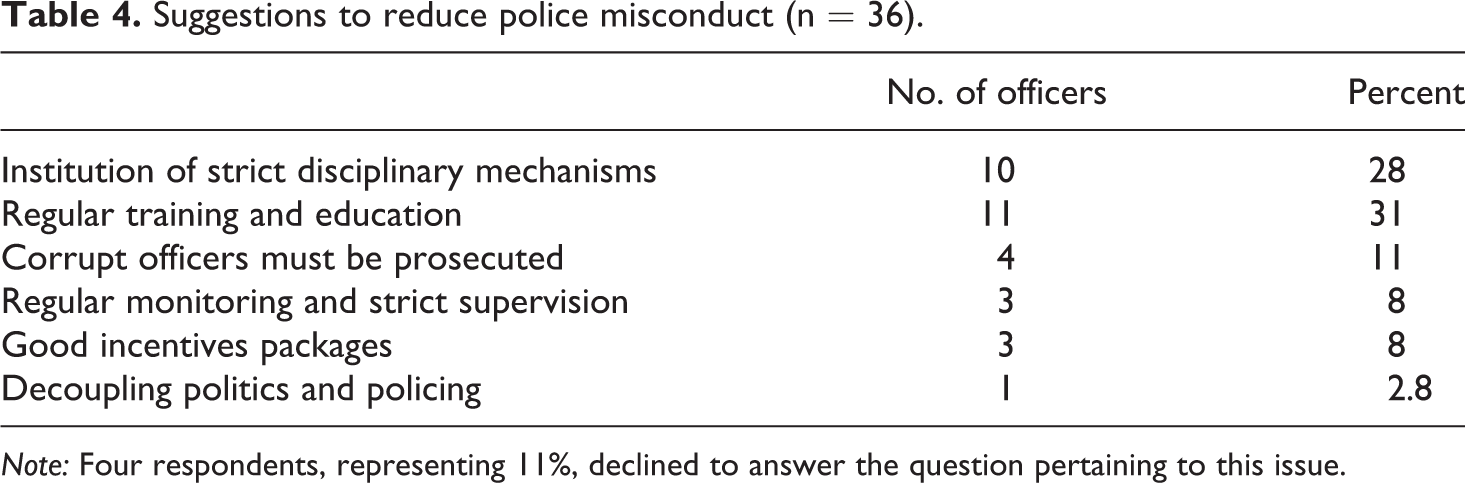
Note: Four respondents, representing 11%, declined to answer the question pertaining to this issue.
Moreover, the officers interviewed called for the decoupling of politics and policing. The marriage between politics and policing has deep roots in Ghana, and officers believed disentangling the two, and making the police an independent agency free from political influence would help improve police integrity.
Discussion and conclusion
The purpose of the study was to explore the state of police integrity within the GPS by qualitatively analysing interview responses obtained from a select group of police officers in two police districts in Ghana. The traditional view of the police, though not pleasant, justifies why studying police integrity in countries like Ghana is an important endeavour. The current study achieved four objectives about police integrity. Overall, two major conclusions can be made from the findings of the study.
First, the findings suggest that when police officers are individually questioned in a secluded location, with the assurance of protecting their identity, they are willing to talk openly and genuinely about some forms of misconduct and deviant acts by their fellow officers. An overwhelming majority of officers interviewed agreed that some of their colleagues engaged in misconduct at work, and were candid about specific misconduct issues. This attitude is significant to the understanding of police integrity because it questions the generally accepted argument about police culture and its related theme, the code of silence. Police researchers and experts have historically blamed the persistence of police misconduct partly on the existence of a code of silence among officers (see Crank and Crank, 2014; Kappeler et al., 2005; Maljevic et al., 2006), which is also called ‘the code of secrecy’, ‘the blue wall of silence’ or ‘the blue curtain’. The code of silence, per Kutnjak Ivković and Sauerman, is the ‘informal prohibition of reporting the misconduct of fellow police officers’ (2013: 179). The rationale is that officers fear that reporting misconduct by colleagues might trigger extensive investigation of all officers. However, our results further support why qualitative research is vital to a comprehensive understanding of police integrity. As the interviewees came to trust the researchers, they became more willing to divulge incidents of misconduct and overall deficiencies in police integrity.
Another major observation to be drawn from the current analysis is that police misconduct in Ghana exists in different dimensions and forms. This observation is particularly important because of the lack of systematic efforts to study the nature and extent of police integrity violations in the country. Conceptually, integrity violations involve practices and behaviours that are antagonistic to the prevailing moral norms, values and rules (Lasthuizen et al., 2011). Although Boateng and colleagues (Boateng, 2014; Boateng et al., 2014) have made empirical attempts to further the discussion of police behaviour in Ghana, the issue of misconduct has not received much scrutiny, at least from mixed methods point of view.
The analysis presented in this study revealed six broad types of police misconduct in Ghana. The first was officers using their official position for personal gain, which includes practices such as solicitation of bribe money from both ordinary citizens and suspects; offering favours to family and friends, such as refusing to arrest and prosecute them; and accepting favours from business owners, including free items, discounted prices and dubious gifts (gifts with a promise to do something in return). Another corrupt behaviour among police officers in Ghana is the habit of requiring victims of criminal acts to pay for taxi fares before they agree to go to the crime scene. The popular Ghanaian phrase ‘Ɛhyεn biara nni aha’ literally means ‘There is no car here at the police station’ and is mostly used by the police to coerce victims to pay for taxi fares. An officer at the station will simply tell the victim that there is no police car at the station, so the victim must either look for a taxi for the officers, or wait at the station for an unspecified amount of time.
Police use of excessive force and police crime are two other broad categories of misconduct. GPS policies and regulations require officers to use minimum force required to do their work, and prohibit the use of excessive force against citizens (GPS, 2010). Despite this legal regulation, some police officers in the country delight in using unnecessary force on citizens during arrests, traffic stops and interrogations. Similarly, some officers engage in criminal activities in their private time. There have been stories about officers in uniform directly participating in robbery attacks, burglary and theft. Moreover, as shown by the results of this study, police officers are often believed to leak confidential information to both citizens and people suspected of committing crimes. This behaviour enables suspects to elude criminal apprehension because they are always steps ahead of the police.
Abuse of authority is another major form of police misconduct in Ghana, as it is in most countries. Ghana police officers misuse their authority by performing unauthorised duties. Illegal roadblocks are a common practice in the country, with very severe consequences. In explaining low public ratings for the police, Boateng (2015a) mentioned that some police officers in Ghana mount road barricades to extort money from law-abiding commercial drivers. In addition to engaging in unauthorised duties, unlawful arrest and debt collection are other avenues where the police abuse their authority. Though illegal, collecting debts owed by individuals to other citizens has become a common practice for most officers, because of its rewarding nature. Officers who collect debts negotiate on how much they should be paid, and sometimes payments come in other forms. This behaviour makes people view the police more as debt collectors than officers of the law. Finally, the sixth major category of misconduct that an officer can engage in is sleeping and drinking on duty.
As one of the first qualitative attempts to examine police misconduct in Ghana, this study has some limitations worth discussing. The analysis used a sample of officers from two police districts located in the Accra police region. We acknowledge that the sample is too small to make meaningful generalisations about police misconduct and deviant activities in Ghana overall, and therefore recommend that further qualitative and mixed-method research be conducted to examine this issue using a much larger sample. Additionally, since the current study did not use a probability-sampling technique, we ask that interpretations of the findings be made with caution.
However, the findings could be useful to police administrators who want to understand misconduct in police organisations. As recommended by the officers themselves, police administrators can reduce unethical behaviour through strict disciplinary and accountability mechanisms, prosecution of culprits, regular ethical training and education, and having good incentive packages for officers – better salaries, overtime allowances, bonuses, and merit-based promotion. Most policing activities are done in private settings where there are no eyewitnesses; this characteristic of policing, according to Klockars et al. (2000), offers a platform for misconduct to occur. However, the findings of this study further suggest that effective supervision of rank-and-file officers, in addition to supervisors, will help reduce misconduct.
In conclusion, the current study examined officers’ perceptions of misconduct perpetrated by their fellow officers while performing their legal duties. As discussed, officers are more willing to talk about police deviance when they are isolated, placed in a private setting and assured of maximum confidentiality. Police misconduct is not a monolithic concept; as demonstrated by this study, there are six broad categories of misconduct that a police officer in Ghana can participate in. Therefore, it is essential that researchers and police administrators collaborate to not merely identify misconduct, but understand its contours within their respective agencies. Only by contextualising misconduct within the agency will observable improvements emerge in the overall delivery of services to the community.
Footnotes
Author's Note
Guangzhen Wu is now affiliated with Department of Sociology, University of Utah, Salt Lake City, Utah, USA.
Declaration of conflicting interests
The author(s) declared no potential conflicts of interest with respect to the research, authorship, and/or publication of this article.
Funding
The author(s) received no financial support for the research, authorship, and/or publication of this article.