




Abstract
Although the influence of procedural justice on citizens’ satisfaction and cooperation with police has been tested in several geopolitical contexts, this is the first study to examine the relationship between procedural justice and satisfaction with Kenya’s police and Kenya’s criminal justice system on a Kenyan college campus. Using a sample of 523 students from a prominent Kenyan university, we found that procedural justice and officer integrity predicted satisfaction with both Kenya’s police and criminal justice system. Also, more highly educated students (sophomores, juniors, and seniors, compared to freshmen) were more satisfied with both the Kenyan police and criminal justice system. Conversely, victims of crime in the community were less satisfied with Kenyan police, and students who had a negative personal experience with police were less satisfied with the country’s criminal justice system. Although instrumental factors of policing (e.g., police effectiveness) were not tested in this study, thus precluding a comparative assessment of normative and instrumental models of policing, this study contributes to the extant literature by pointing out the salience of procedural justice and officer integrity for improving the relationship between the police and the communities they are sworn to serve. The study’s implications for policy are discussed.
Keywords
Introduction
This paper adds to the extant literature by examining the effects of procedural justice and police officer integrity on Kenyan college students’ satisfaction with Kenya’s police and criminal justice system. The effect of procedural justice on satisfaction and cooperation with police has been tested in a number of studies, and extending these studies to additional geopolitical contexts would provide a firm foundation for procedural justice as an influential theory for improving police–public relations (Pryce, 2016; Sunshine and Tyler, 2003; Tankebe, 2009). Although deterrence approaches continue to be a part of law enforcement operations (Harcourt, 2001), criminologists, sociologists and other behavioural scientists have continued to promote normative concepts, such as procedural justice and legitimacy, as the answer to improving the relationship between the police and the communities they have taken an oath to serve. Indeed, the process-based model of policing has gained wide acceptance because multiple studies have confirmed its usefulness in improving law and order in communities across the globe (Karakus, 2017; Sunshine and Tyler, 2003). For the process-based model to reach the threshold of broad acceptance, however, it must be studied in different geopolitical contexts, and this paper adds to the small number of studies that have taken place in sub-Saharan Africa (Boateng, 2016; Tankebe, 2009).
Literature review
Satisfaction with police officers and the criminal justice system
Police–public relations are important to police agencies, prompting research efforts to continually understand the antecedents of citizen satisfaction with police agencies and the criminal justice system (Hinds and Murphy, 2007; Pryce, 2016; Reisig and Parks, 2000; Tyler and Folger, 1980; Weitzer and Tuch, 2005). Research on satisfaction with police is not limited to the United States alone; it has taken place in many geopolitical contexts as well. This stream of comparative research allows researchers and practitioners to ‘expand knowledge about the applicability of findings in other jurisdictions, and also to expand U.S.-based knowledge by confirming existing findings, or modifying existing knowledge and suggesting new or modified areas for research’ (Hinds and Murphy, 2007: 30).
As Pryce has argued, ‘[m]easuring public satisfaction with the police is important because, on the one hand, police services are not really subject to the principles of a market economy’ (2016: 2). In other words, any citizen or community member seeking police services cannot choose between competing agencies – the services the police provide must be accepted for what they are, whether satisfactory or not (Cheurprakobkit and Bartsch, 2001). On the other hand, consumers’ satisfaction with service delivery is important to both police agencies and for-profit businesses (Brown and Swartz, 1989; Butler, 1992). Nonetheless, while businesses may suffer an economic loss if service delivery suffers, the police would not suffer a similar loss, which makes research studies designed to improve police–public relations even more important.
Although the police may be interested in satisfying their ‘customer base’ – that is, citizens and community members – the former do not lose profits if service suffers, because police work is not subject to the dictates of supply and demand (and hence profits and losses). Stojkovic et al. (2008) have argued that the rules of supply and demand do not apply to police agencies; instead, these agencies’ success is directly tied to how well they discharge their duties, with justice for all community members a paramount objective. Thus, studies that attempt to engender improved police–public relations become salient, as a result. Using variables employed in prior research, the current study examines the effects of procedural justice and other predictor variables on satisfaction with Kenya’s police and Kenya’s criminal justice system.
The criminal justice system consists largely of three components: (1) law-enforcement agencies responsible for investigating criminal conduct and arresting law violators; (2) the court system, which indicts and sentences law violators; and (3) the correctional system responsible for incapacitating law violators found guilty by a court of competent jurisdiction. Thus, the police are an essential part of the criminal justice system. It can be argued, then, that Kenyan students’ understanding of the country’s police agencies may reflect their understanding of the country’s criminal justice system as well.
Procedural justice
Procedural justice theory suggests that police-public interactions are influenced by the fairness of the procedures employed by the police (Tyler et al., 2010). If the police treat community members in a fair and just manner, the latter are more likely to respond by viewing the police as more legitimate (Johnson et al., 2014; Maguire et al., 2016). The role of procedural justice in enhancing police–community relations was developed in large part by Tyler and colleagues (Sunshine and Tyler, 2003; Tyler and Huo, 2002), although the policing literature is now replete with studies linking procedural justice with other elements of the process-based model of policing (Sunshine and Tyler, 2003; Tyler et al., 2010). When community members receive fair and respectful treatment from the police, they are more likely to both cooperate with the police (Sunshine and Tyler, 2003) and be more satisfied with the police (Hinds and Murphy, 2007; Pryce, 2016).
Procedural justice is considered a normative factor of policing because ‘it is invoked through self-motivated beliefs about the role of authority figures and legal institutions in society’ (Pryce, 2016: 3). Community members’ behaviour may be intricately tied to the values they share with one another and with authority figures, so the former are more likely to obey the law and be satisfied with the police and the criminal justice system if they believe that the actions of their government and agents of social control are lawful and legitimate (Tyler et al., 2010). Indeed, prior research has shown that if the police engage in procedural-justice policing, police–citizen encounters would be more successful, leading to higher marks for and greater satisfaction with the police by citizens (Mastrofski et al., 1996; Mazerolle et al., 2013).
The influence of procedural justice in improving relations between the police and local communities has been well documented in many studies across the globe. Whether in cross-sectional or experimental studies, the importance of procedural justice in effecting improved relations between the police and the public has been studied extensively. This study thus adds to the burgeoning procedural-justice literature (Boateng, 2016; Bradford et al., 2015; Johnson et al., 2014; Johnson et al., 2017; Jonathan-Zamir et al., 2015; Mazerolle et al., 2013; Murphy and Mazerolle, 2016; Murphy et al., 2008; Pryce et al., 2017; Tankebe, 2009, 2013; Tsushima and Hamai, 2015; Tyler and Wakslak, 2004; Tyler et al., 2010).
Police officer integrity
Integrity, the quality of being honest, is one of three important concepts of policing in functional democracies, the other two concepts being legitimacy and trust (Wu et al., 2017). Thus, it is important to measure officer integrity in contemporary policing studies, as it affects citizens’ evaluations of police fairness and legitimacy. While some scholars have focused on police integrity through the lens of officers (Klockars et al., 2004; Wu et al., 2017), others have studied the concept through the eyes of citizens and students, including students aiming to join the law-enforcement profession (Coston and Jenks, 1998; Gray, 2011). The current study is important because it adds to the literature on student assessments of officer integrity (Gray, 2011). Because citizens’ trust in police officers in sub-Saharan Africa is generally low (see, for example, Tankebe, 2008, 2009), it is important to gauge Kenyan citizens’ expectations of police officer integrity and how it affects attitudes toward the police.
Police officers and agencies are central to the functioning of the criminal justice system, therefore officer integrity is crucial for improving relations between the police and local communities (Boateng et al., 2018). As Boateng et al. (2018) aptly observed, ‘Much of police work takes place in private locations, without the oversight of supervisors, and at times, with no witnesses. These characteristics of police work could easily make a morally upright officer very corrupt’ (2018: 2). Thus, officer integrity affects how officers are perceived in the community, which also affects citizens’ satisfaction with police officers and agencies. It behoves officers and agencies, then, to critically examine citizens’ perceptions of officer integrity, in order to improve citizens’ satisfaction with the police.
Crime victimisation–satisfaction with police nexus
Prior research studies have pointed to a strong relationship between crime victimisation and satisfaction with police: ‘Citizens who are satisfied with the police are less likely to fear victimization, and more likely to share information about crimes in their neighborhood’ (Bouranta et al., 2015; see also Rogge and Verschelde, 2013). Dukes et al. (2009) noted, among other things, that citizens’ victimisation experiences influenced how well they rated their satisfaction with local police. These findings thus lead to the argument that citizens who have been crime victims may be less likely to be satisfied with the police. Using crime statistics and/or clearance rates is an important measure of police effectiveness, but that is not a complete ‘panacea’ for understanding citizens’ satisfaction with police: gauging citizens’ satisfaction with police via surveys is another important measure of police service quality and effectiveness in local communities (Bouranta et al., 2015). Karakus et al. (2011) added that being a victim of crime had a negative impact on citizens’ attitudes toward the police, because it symbolised ‘police failure in dealing with crime and in protecting/engaging with the community’ (2011: 307; see also Jackson and Sunshine, 2007). This study thus examines, among other things, Kenyan college students’ levels of satisfaction with the police and the criminal justice system by asking questions about their victimisation at school and in the community. Importantly, we test separately in the current study the effects of crime victimisation at school and crime victimisation in the community 1 on satisfaction with Kenyan police and the Kenyan criminal justice system.
Experiences with police–satisfaction with police nexus
Contact with police affects community members’ satisfaction with police officers and agencies (Furstenberg and Wellford, 1973; Scaglion and Condon, 1980; Tyler et al., 2015). As would be expected, negative experiences with police lower community members’ satisfaction with police. Thus, we include negative personal experience with police as a predictor variable in the current study. Still, negative feelings toward the police can occur, or linger, even after having positive contact with police (Smith, 1991). As a result, ‘personal experiences alone may not provide the full picture when assessing citizens’ satisfaction with the police’ (Pryce, 2016: 5). Mazerolle et al. (2013) noted that the narratives people share with family members and friends affect the latter’s own interpretation of their encounters with the police. Because not all Kenyans, or Kenyan college students, have experienced a personal – or direct – encounter with the police, we argue that our research participants’ perceptions of Kenyan police may be tied to vicarious experiences as well (Weitzer and Tuch, 2005). Thus, in the current study we test, together with other correlates, the relationship between vicarious experiences and satisfaction with Kenya’s police and Kenya’s criminal justice system.
Research also points to the role of the media in either heightening or diminishing vicarious experiences with police. And because police in sub-Saharan Africa are known for brutalising their own citizens (Osse, 2016; Ruteere and Pomerolle, 2003; Tankebe, 2008), Kenyan college students’ satisfaction with Kenyan police may diminish once a negative story about the police is disseminated to the public via the media, although the media’s influence on satisfaction with police was not tested in the current study. Because prior studies of satisfaction with police have included distinct questions about personal and vicarious experiences with police (Pryce, 2016; Weitzer and Tuch, 2005), we include these two measures as independent variables in the present study.
Kenya: Constitution, society and policing
Although Kenya has a functioning democracy, presidential elections have not always gone smoothly, with accusations of vote-rigging and the attendant violence undermining Kenyan citizens’ collective faith in the viability of their nation’s presidential elections. Kenya’s presidential elections have always been fiercely disputed, and the most recent presidential election that took place in October 2017 was no different: there were widespread accusations of vote-rigging in favour of the incumbent, President Uhuru Kenyatta. Despite the Kenyan people’s approving a new Constitution in 2010 to effectuate policing reform, nothing consequential has been achieved up to now. In fact, the poor performance of the country’s police is a microcosm of Kenyan leaders’ inability to run the country effectively. This ineffectual leadership, in turn, has translated into the police’s inability to provide adequate safety and security for the Kenyan people.
Kenyans’ low levels of satisfaction with their police force are closely connected to the police’s inability to tame the ‘notorious gangs in Nairobi’s sprawling, dense slums’ (Klopp and Kamungi, 2008: 12). Named variously as the Taliban, Baghdad Boys and Mungiki, these vicious gangs exploit ethnic and tribal divisions to stay relevant and to attract followers (Klopp and Kamungi, 2008). With a high spate of crime in Kenya, including the capital city of Nairobi, it is understandable that Kenyans, including college students, would hold strong opinions about the country’s police. For example, an empirical study involving 20 African nations revealed that Kenyans were the most fearful of crime (Sulemana, 2015). With marauding gangs, such as the Baghdad Boys and Mungiki, wreaking havoc on the Kenyan populace, Sulemana’s (2015) findings were not surprising. This fear for personal safety thus erodes Kenyan citizens’ satisfaction with the country’s police force (Ruteere and Pommerolle, 2003).
Notwithstanding their good intentions to reduce crime and disorder in the nation, Kenya’s police are bedevilled by a plethora of problems, including reports of rising crime (Akech, 2005; Gastrow, 2011; Osse, 2016; Ruteere and Pommerolle, 2003). In addition, Kenya’s police continually fail to answer citizens’ calls for assistance in a professionally acceptable manner, botch criminal investigations, mishandle city traffic and undermine citizen protests protected under the Kenyan Constitution (Osse, 2016). The Kenyan police, like their counterparts in other parts of sub-Saharan Africa (Tankebe, 2008), brutalise their citizens, engage in extrajudicial killings and employ torture to elicit confessions from persons in custody (Osse, 2016; Ruteere and Pommerolle, 2003; Ruteere, 2011). All of these ‘indictments’ affect Kenyans’ attitudes toward the country’s police. Severe underfunding of the country’s police (Osse, 2016) also means that officers are unable to adequately secure local communities, which may lead to lower levels of satisfaction with the police.
Furthermore, poor police preparations hamper the force’s readiness to combat crime and disorder (Akech, 2005; Osse, 2007, 2016). Osse (2016) articulated the problems found within Kenya’s police force when she suggested that, instead of examining cases of police misconduct and preventing such incidents in the future, the abusers were simply transferred to a different police station. And police supervisors largely engage in the same corrupt practices as their subordinates. These problems mean that Kenyan citizens are fearful of reporting police misconduct, because they do not believe that such complaints would be taken seriously by police supervisors. These trends thus influence Kenyans’ satisfaction with their country’s police force.
The current study
The current study fills the gap in the extant literature in three important ways: (a) it is the first study to examine the effects of procedural justice on satisfaction with police in a sample of Kenyan college students; (b) it adds to the growing procedural-justice literature in sub-Saharan Africa; and (c) it addresses the importance of officer integrity in enhancing police-public relations. The following specific research questions are addressed: (1) What is the impact of procedural justice on satisfaction with Kenya’s police and Kenya’s criminal justice system in this sample of Kenyan college students? (2) Does officer integrity predict satisfaction with Kenya’s police and Kenya’s criminal justice system? (3) Is there a relationship between crime victimisation and satisfaction with Kenya’s police and criminal justice system in this sample of college students? (4) Do personal and vicarious experiences influence satisfaction with Kenya’s police and criminal justice system? Answers to these questions would have important policy implications for police-citizen relations in Kenya and other sub-Saharan African nations.
Data and methods
Participants and procedures
The data for this study come from a survey of college students who attend a leading public university located in the nation’s capital, Nairobi. The cross-sectional data were obtained from a sample of 523 students who were at least 18 years of age. One of the authors, who served as a Fulbright Scholar at this Kenyan university in 2013, administered the survey questionnaire to pre-law students over several days. Official permission to conduct the survey was granted by the Dean of the Law School as well as by professors whose students participated in the study. Paper surveys were distributed to the students at the end of their class sessions, and the surveys were completed voluntarily by the students, who were assured confidentiality as part of the survey protocol. The survey took approximately 20 minutes to complete. Out of 581 surveys distributed, 523 were completed and returned for the current study, resulting in an overall response rate of 90%.
Sample
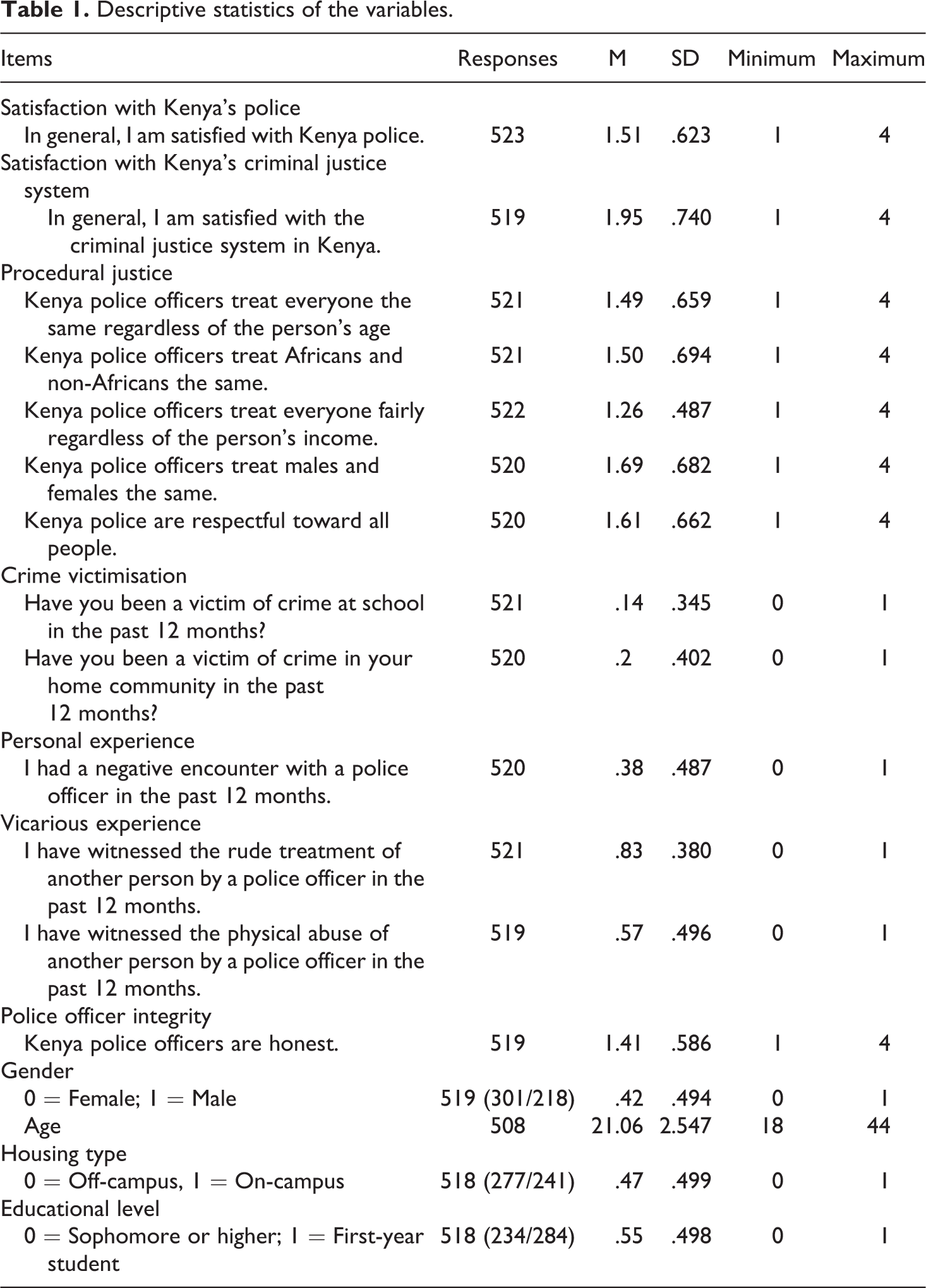
The sample was 58% (n = 301) female and 42% (n = 218) male. The survey respondents ranged in age from 18 to 44 years (mean = 21.04; standard deviation [SD] = 2.6). In terms of educational level, there were 284 first-year, 86 second-year, 145 third-year and 3 fourth-year students. This variable was then recoded into first year (n = 284) and sophomore or higher (n = 234). Finally, 277 students lived off-campus, whereas 241 lived on-campus. Table 1 displays descriptive statistics for the study’s variables.
Descriptive statistics of the variables.
Dependent variables
Satisfaction with Kenya’s police
The first dependent variable, satisfaction with Kenya’s police, was measured using one item. A four-point Likert-type scale – (1) strongly disagree, (2) disagree, (3) agree and (4) strongly agree – was employed to measure satisfaction with Kenya’s police. The scale was coded so that higher scores reflected higher levels of satisfaction with Kenya’s police. The lone survey item was: (1) In general, I am satisfied with Kenya police (mean = 1.51; SD = .623).
Satisfaction with Kenya’s criminal justice system
The second dependent variable, satisfaction with Kenya’s criminal justice system, was measured using one item. A four-point Likert-type scale – (1) strongly disagree, (2) disagree, (3) agree and (4) strongly agree – was employed to measure satisfaction with Kenya’s criminal justice system. The scale was coded so that higher scores reflected higher levels of satisfaction with Kenya’s criminal justice system. The survey item was: (1) In general, I am satisfied with the criminal justice system in Kenya (mean = 1.95; SD = .740).
Independent variables
Procedural justice
Procedural justice was measured using five items. A four-point Likert-type scale – (1) strongly disagree, (2) disagree, (3) agree and (4) strongly agree – was employed to measure procedural justice. The scale was coded so that higher scores reflected higher levels of procedural justice. The survey items were: (1) Kenya police officers treat everyone the same regardless of the person’s age; (2) Kenya police officers treat Africans and non-Africans the same; (3) Kenya police officers treat everyone fairly regardless of the person’s income; (4) Kenya police officers treat males and females the same; and (5) Kenya police officers are respectful toward all people. These items were then combined into a composite index (Cronbach’s Alpha = .7; mean = 1.51; SD = .415).
Police officer integrity
Police officer integrity was measured using one item. A four-point Likert-type scale – (1) strongly disagree, (2) disagree, (3) agree and (4) strongly agree – was employed to measure police integrity. The scale was coded so that higher scores reflected higher levels of officer integrity. The single survey item was: Kenya police officers are honest (mean = 1.41; SD = .586).
Crime victimisation
The two items denoting crime victimisation were measured as a dichotomous variable: Yes = 1; No = 0. (Cronbach’s Alpha value = .371 2 ; mean = .34; SD = .586). The two survey items were: (1) Have you been a victim of crime in your home community in the past 12 months? (2) Have you been a victim of crime at school in the past 12 months?
Personal experience
Personal experience was measured as a dichotomous variable: Yes = 1; No = 0. The single survey item was: I had a negative encounter with a police officer in the past 12 months (mean = .38; SD = .487).
Vicarious experience
Vicarious experience was measured as a dichotomous variable: Yes = 1; No = 0. The two survey items were: (1) I have witnessed the rude treatment of another person by a police officer in the past 12 months; and (2) I have witnessed the physical abuse of another person by a police officer in the past 12 months. The two items were then combined into a composite index (Cronbach’s Alpha = .6; mean = .7; SD = .372).
Control variables
The following control variables – gender, age, housing type, and educational level – were employed in the current study, as demographic variables are important to the study of the police (Boateng, 2016; Pryce et al., 2017).
Gender: Gender was measured as: Male = 1; Female = 0.
Age: Age was measured as a continuous variable.
Housing type: This variable was measured as: On-campus = 1; Off-campus = 0. We hypothesise that housing type – off-campus or on-campus – would influence satisfaction with police because of the high levels of gang and other criminal activity in Nairobi. We posit that students living on-campus would be more satisfied with police because college campuses may ‘shield’ students from inner-city crime.
Educational level: This variable was recoded into first-year = 1; sophomore or higher = 0.
Appropriate tests and analytic strategy
Preliminary analyses were conducted to ensure that there was no violation of the assumptions of normality, linearity, and homoscedasticity. The absence of outliers was also checked by inspecting the Mahalanobis distances. Tolerance and VIF values, for example, were all within acceptable ranges (Pallant, 2010). Finally, from Table 2, none of the correlations between the dependent and independent variables, and between any two independent variables exceeded .70 (Pallant, 2010), so all of the independent and dependent variables were retained for analysis. For example, the highest correlation of .448 was between procedural justice and satisfaction with Kenya police. Hierarchical multivariate regression was employed to test the relationships among the variables. The use of regression analyses to test all models accomplished two goals: (1) to help determine the relative influence that each independent variable had on each dependent variable; and (2) to help reach the conclusion that the influence of any one independent variable was independent of the influence of the other independent variables in the equations (Sunshine and Tyler, 2003).
Bivariate correlation results.
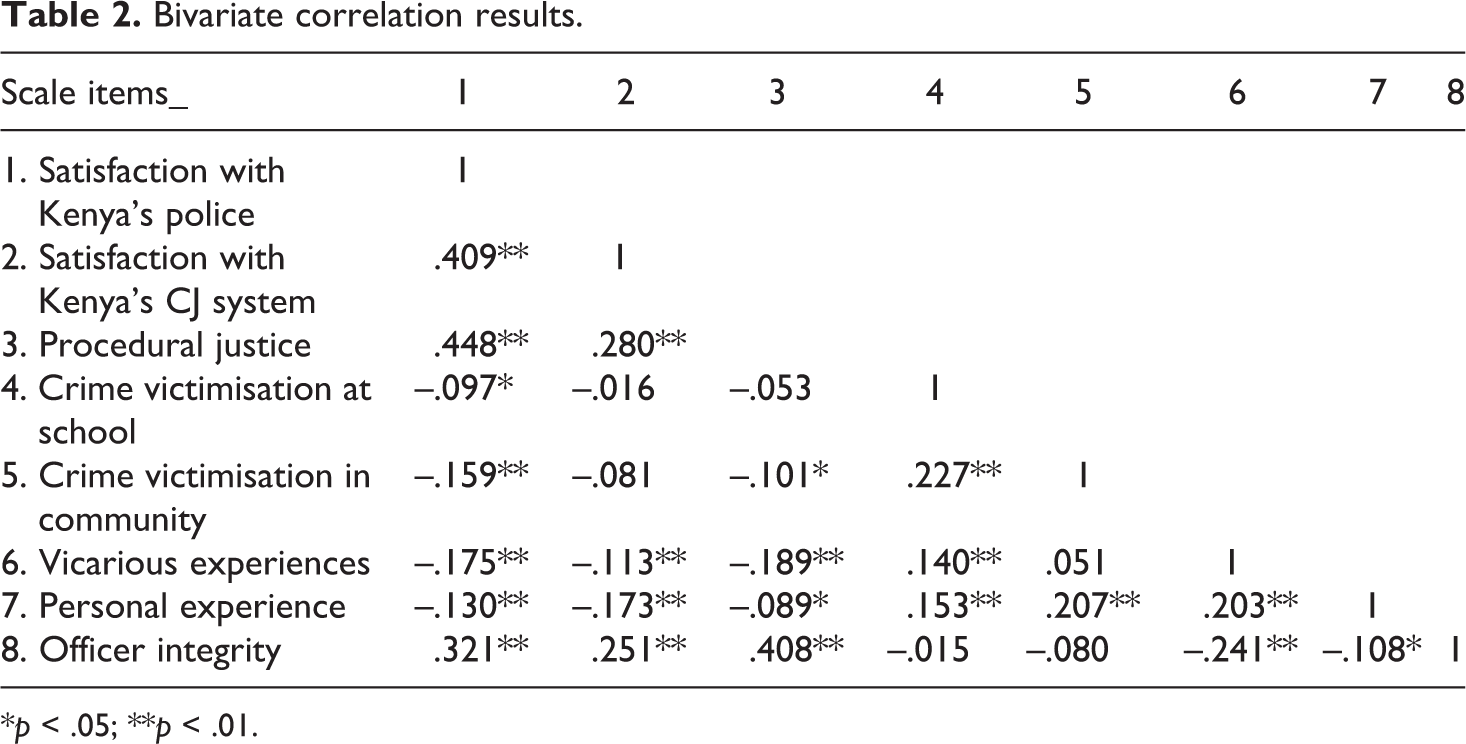
*p < .05; **p < .01.
Results of regression analyses
Table 3 presents results from four Ordinary Least-Squares (OLS) regression models. In this table, the individual item, satisfaction with Kenya’s police, is the dependent variable. In Model 1, the effects of the control variables (age, educational level, sex, and housing type) and procedural justice on satisfaction with Kenya’s police were tested. In other words, Model 1 regressed satisfaction with Kenya’s police on age, educational level, sex, housing type and procedural justice. Procedural justice was statistically significantly related to satisfaction with Kenya’s police (β = .424, p < .001). Thus, when the respondents perceive the police as more procedurally fair, they were more likely to be satisfied with the Kenyan police. Also, sophomores, juniors and seniors were more likely than first-year students to be more satisfied with the Kenyan police (β = .10, p < .05). The model is statistically significant and explains 22% of the variation in satisfaction with Kenya’s police.
Predictors of satisfaction with Kenya’s police.

N = 519.
Entries are standardised coefficients, and standard errors are in parentheses.
* p < .05, **p < .001.
In Model 2, all the variables in Model 1 were retained and crime victimisation at school and crime victimisation in the community were added to the regression model. Once again, procedural justice was statistically significantly related to satisfaction with Kenya’s police (β = .415, p < .001). Thus, when the respondents perceive the police as more procedurally fair, they were more likely to be satisfied with the Kenyan police. Also, victims of crime in the community were less likely to be satisfied with Kenya’s police (β = –.094, p < .05). The model is statistically significant and explains 23% of the variation in satisfaction with Kenya’s police. Crime victimisation at school was not statistically significant in the regression model, although the relationship was in the expected direction.
In Model 3, all the variables in Model 2 were retained and personal experience and vicarious experience were added to the regression equation. Procedural justice was statistically significantly related to satisfaction with Kenya’s police (β = .400, p < .001). Thus, when the respondents perceive the police as more procedurally fair, they were more likely to be satisfied with the Kenyan police. Also, victims of crime in the community were less likely to be satisfied with Kenya’s police (β = –.089, p < .05). The model is statistically significant and explains 24% of the variation in satisfaction with Kenya’s police. Personal experience, vicarious experience, and crime victimisation at school were not statistically significantly related to satisfaction with Kenyan police, although the relationships were in the expected directions.
In Model 4, all the variables in Model 3 were retained and officer integrity was added to the regression model. Once again, procedural justice was statistically significantly related to satisfaction with Kenya’s police (β = .345, p < .001). Thus, when the respondents perceive the police as more procedurally fair, they were more likely to be satisfied with the Kenyan police. Officer integrity was also significant (β = .147, p < .05). In other words, respondents who perceive the Kenya police as possessing integrity were more likely to be satisfied with the Kenyan police. Victims of crime in the community were less likely to be satisfied with Kenya’s police (β = –.083, p < .05). The model is statistically significant and explains 27% of the variation in satisfaction with Kenya’s police. Personal experience, vicarious experience and crime victimisation at school were not statistically significantly related to satisfaction with Kenyan police, although the relationships were in the expected directions.
Table 4 presents results from four OLS regression models. In this table, the individual item, satisfaction with Kenya's criminal justice system, is the dependent variable. In Model 1, the effects of the control variables (age, educational level, sex and housing type) and procedural justice on satisfaction with Kenya’s criminal justice system were tested. In other words, Model 1 regressed satisfaction with Kenya’s criminal justice system on age, educational level, sex, housing type and procedural justice. Procedural justice was statistically significantly related to satisfaction with Kenya’s criminal justice system (β = .249, p < .001). Thus, when the respondents perceive the police as more procedurally fair, they were more likely to be satisfied with Kenya’s criminal justice system. Also, sophomores, juniors, and seniors were more likely than first-year students to be more satisfied with the country’s criminal justice system (β = .104, p < .05). Lastly, females were more likely than males to be more satisfied with Kenya’s criminal justice system (β = .102, p < .05). The model is statistically significant and explains 10% of the variation in satisfaction with Kenya’s criminal justice system.
Predictors of satisfaction with Kenya’s criminal justice system.
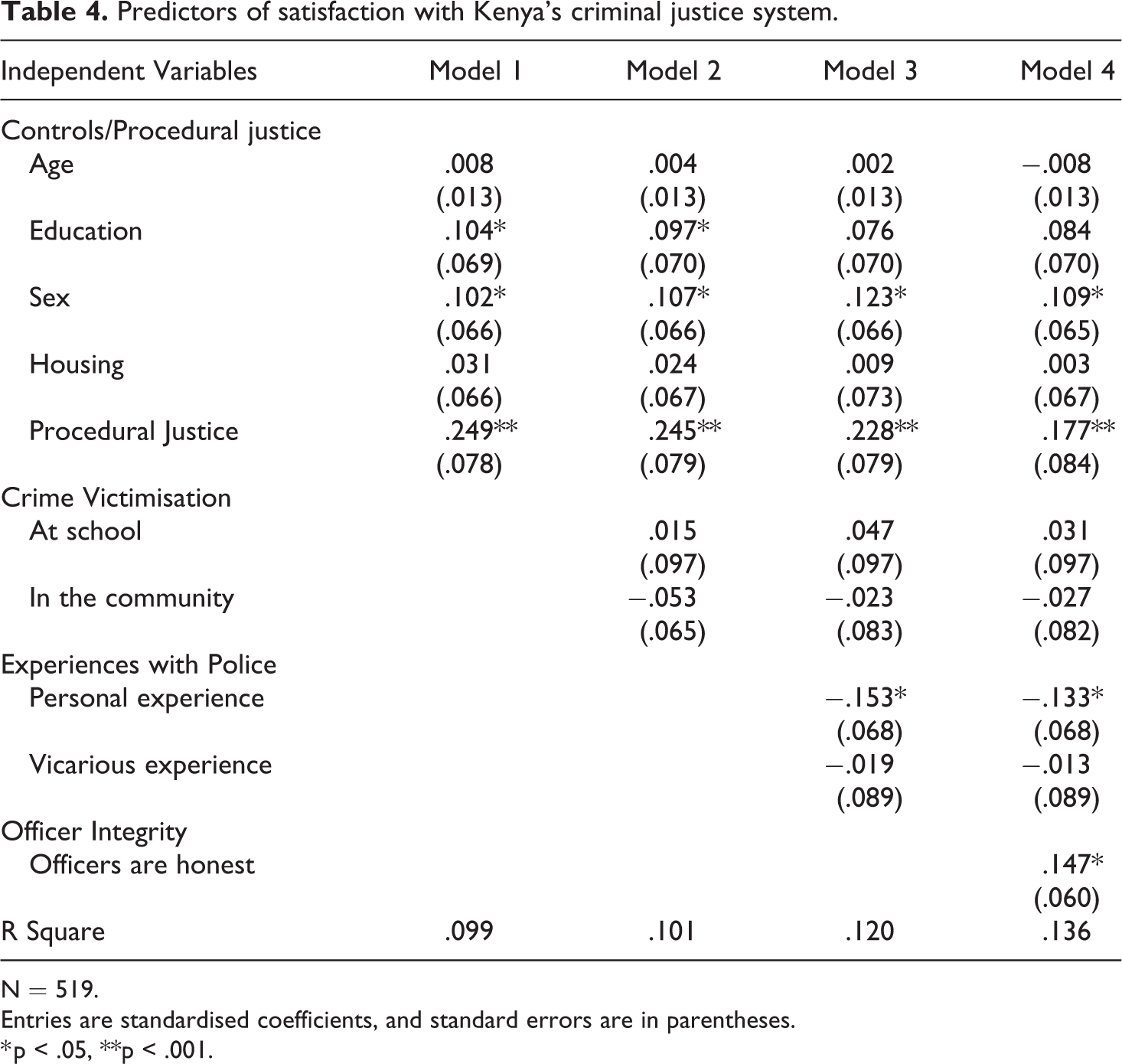
N = 519.
Entries are standardised coefficients, and standard errors are in parentheses.
* p < .05, **p < .001.
In Model 2, all the variables in Model 1 were retained and crime victimisation at school and crime victimisation in the community were added to the regression model. Once again, procedural justice was statistically significantly related to satisfaction with Kenya’s criminal justice system (β = .245, p < .001). Thus, when the respondents perceive the police as more procedurally fair, they were more likely to be satisfied with Kenya’s criminal justice system. Also, sophomores, juniors and seniors were more likely than first-year students to be more satisfied with the country’s criminal justice system (β = .097, p < .05). Lastly, females were more likely than males to be more satisfied with Kenya’s criminal justice system (β = .107, p < .05). The model is statistically significant and explains 10% of the variation in satisfaction with Kenya’s criminal justice system. Both forms of crime victimisation were not significantly related to satisfaction with Kenya’s criminal justice system.
In Model 3, all the variables in Model 2 were retained and personal experience and vicarious experience were added to the regression equation. Procedural justice was statistically significantly related to satisfaction with Kenya’s criminal justice system (β = .228, p < .001). Thus, when the respondents perceive the police as more procedurally fair, they were more likely to be satisfied with Kenya’s criminal justice system. Also, females were more likely than males to be more satisfied with Kenya’s criminal justice system (β = .123, p < .05). Lastly, respondents who had a negative personal experience with the police were less likely to be satisfied with the country’s criminal justice system (β = –.153, p < .05). The model is statistically significant and explains 12% of the variation in satisfaction with Kenya’s criminal justice system. Vicarious experience and both forms of crime victimisation were not significantly related to satisfaction with Kenya’s criminal justice system.
In Model 4, all the variables in Model 3 were retained and officer integrity was added to the regression model. Once again, procedural justice was statistically significantly related to satisfaction with Kenya’s criminal justice system (β = .177, p < .001). Thus, when the respondents perceive the police as more procedurally fair, they were more likely to be satisfied with Kenya’s criminal justice system. Officer integrity was also significant (β = .147, p < .05). In other words, respondents who perceive the Kenya police as possessing integrity were more likely to be satisfied with Kenya’s criminal justice system. Also, females were more likely than males to be more satisfied with Kenya’s criminal justice system (β = .109, p < .05). Lastly, respondents who had a negative personal experience with the police were less likely to be satisfied with the country’s criminal justice system (β = –.133, p < .05). The model is statistically significant and explains 14% of the variation in satisfaction with Kenya’s criminal justice system. Vicarious experience and both forms of crime victimisation were not significantly related to satisfaction with Kenya’s criminal justice system.
Discussion and conclusion
The role of procedural justice in engendering improved relations between the police and community members has been established in many geopolitical contexts, and this study adds to the literature on the power of procedural justice to produce positive feelings toward police officers and the criminal justice system. In fact, procedural justice was the strongest antecedent of satisfaction with police in the current study, which mirrors results of other studies in the extant literature (Hinds and Murphy, 2007; Pryce, 2016; Wells, 2007).
Wells (2007), for example, observed that procedural justice was the strongest predictor of citizens’ satisfaction with police in his study. Pryce (2016), in his study of US-based Ghanaian immigrants who are themselves sub-Saharan Africans, noted that ‘normative considerations trump instrumental considerations as far as Ghanaian immigrants’ perceptions of satisfaction with the police are concerned’ (2016: 13). Moreover, Hinds and Murphy (2007), in their study in an Australian jurisdiction, noted that procedural justice had a greater influence on police legitimacy than police performance did. Although police effectiveness was not measured in the current study, thus precluding a comparative assessment of normative and instrumental factors of policing, the aforementioned Pryce (2016), Wells (2007) and Hinds and Murphy (2007) studies all point to a stronger influence of procedural justice, compared to instrumental factors of policing. At any rate, the limitation of not having police effectiveness as a variable in the current study has been duly acknowledged.
Furthermore, procedural justice has been found to positively influence evaluations of the police either independently or in conjunction with other antecedents of attitudes toward the police (Sunshine and Tyler, 2003; Tyler and Huo, 2002; Tyler and Folger, 1980). These and other studies have confirmed the importance of procedural justice in improving relations between the police and citizens. In line with our first research question, we argue that Kenyan college students appear to endorse the power and importance of procedural justice, which we suggest would improve policing efforts in Kenya.
To answer our second research question, we argue that officer integrity is vital to increasing Kenyan students’ satisfaction with both the police and the larger criminal justice system. This result is not surprising, as Wu et al. (2017) observed that officer integrity was one of three salient concepts of policing in functional democracies. With trust in officers generally low in sub-Saharan African countries (Tankebe, 2008, 2009), officer integrity becomes an important yardstick for this sample of Kenyan college students to be more satisfied with the country’s police.
To answer our third research question, the current study found that crime victimisation in the community, but not crime victimisation at school, attenuates support for the Kenyan police, which is in line with studies from the extant literature (Cao et al., 1996; Dowler and Sparks, 2008). Crime victimisation in the community may lead to fear of crime, and fear of crime may then lead to negative attitudes toward the police, who are tasked with maintaining law and order in the community. Although crime victimisation in the community was not statistically significantly related to satisfaction with Kenya’s criminal justice system, the relationship was in the expected direction.
We note that negative personal experience with Kenyan police was significantly related to satisfaction with Kenya’s criminal justice system in this sample of Kenyan college students. This finding, which mirrors other findings in the extant literature (Jackson and Sunshine, 2007; Pryce, 2016), helps us to answer our fourth research question. The vicarious experience variable was, however, not statistically significantly related to satisfaction with Kenya’s criminal justice system, even after the personal experience variable was withdrawn from the regression analysis. We argue, therefore, that for this group of Kenyan students, ‘vicarious experiences, which can be subjectively pleasant or distasteful, simply do not hold the same power of conviction as personal experiences’ (Pryce, 2016: 14). Pryce (2016), whose study examined sub-Saharan African immigrants’ satisfaction with US police, added that, while vicarious experiences could be unpleasant, a negative personal experience (e.g., a traffic stop or an illegal car search) could be far more traumatising for the victim of police overreach than a vicarious experience; this may explain why personal experience was statistically significantly related to satisfaction with the criminal justice system in this sample of Kenyan students. If Kenyan students are going to have higher levels of satisfaction with their country’s criminal justice system, then Kenyan police, who are an integral part of the larger criminal justice system, must follow the rule of law in their dealings with criminal suspects and other accused persons.
As with empirical research generally, this study has limitations. First, employing student data means that the findings cannot be generalised to the larger population, as university students may possess an elevated awareness of social-justice issues compared to ordinary citizens. And while university students’ values and concerns may mirror those of other community members, future research would benefit greatly from employing a representative sample to study satisfaction with police in Kenya. Second, because this study examined the correlates of satisfaction with Kenya’s police and satisfaction with Kenya’s criminal justice system on a single university campus, caution is required before generalising the findings to all university campuses in Kenya. Third, we employed cross-sectional data, which means that we cannot infer causal relationships from the regression results. Future research that measures the same concepts in the same Kenyan student population should employ a longitudinal study, if the goal is to determine causality. Fourth, instrumental factors of policing (e.g., police effectiveness) were not tested in this study, which precludes a comparative assessment of normative and instrumental models of policing. Finally, our survey research was limited by the types of questions posed to the survey respondents. For example, the use of a number of single-item measures may have affected the robustness of our results, although we believe that this study’s findings contribute immensely to knowledge about the relationship between procedural justice and satisfaction with police in sub-Saharan Africa. To strengthen the validity and reliability of measures, we recommend that future research studies on satisfaction with police in sub-Saharan Africa employ more robust, multidimensional measures.
The results of the current study hold important policy implications for policing in Kenya. One policy implication is the need for Kenyan police to be procedurally fair in their dealings with the Kenyan populace. The current study, like other scholarly studies, points to the importance of procedural justice in engendering better relations between the police and community members. As Kenyan police adopt more procedurally fair attitudes toward citizens, they are more likely to enjoy greater support from the public, which may increase citizens’ satisfaction with the police. A second policy implication stemming from our research is the need for greater officer integrity in Kenya. If the Kenyan police would display greater integrity in their dealings with the citizenry, they are more likely to be held in more positive light by the latter, which should lead to greater satisfaction with the Kenyan police. Lastly, we suggest that lessons on procedural justice and officer integrity be incorporated into the curriculum in Kenya’s police academies. These efforts would formalise the training received by officers, and thus lead to improved relations between the police and community members.
We thank the journal’s editor and the anonymous reviewers for their tremendously helpful comments, which helped to strengthen the arguments proffered in this paper.
Footnotes
Declaration of conflicting interests
The author(s) declared no potential conflicts of interest with respect to the research, authorship, and/or publication of this article.
Funding
The author(s) received no financial support for the research, authorship, and/or publication of this article.
