




Abstract
This paper reports the findings of an evaluation of a police training program on procedural justice. The evaluation focused on the short- and long-term effects of the training on officers’ attitudes toward four principles of procedural justice (i.e., trustworthiness, neutrality, voice, and respect). The evaluation also assessed officers’ behaviors on the street and citizens’ interactions such as citizen demeanor and compliance with police requests. Finally, it assessed how the interacting citizens perceived the police. Taken together, the comprehensive data suggested that the procedural justice training was effective both immediately and in the long run. Policy implications are discussed.
Introduction
The extensive body of scholarship has suggested that procedural justice plays a significant role in improving the public’s perception about police legitimacy (Dai et al., 2011; Mazerolle et al., 2013b; Sunshine and Tyler, 2003; Tyler, 2004). In addition, contemporary community standards have increasingly demanded that police departments make fairness one of their highest priorities (President’s Task Force on the 21st Century Policing, 2015). While the concept of procedural justice could be operationalized differently (Jonathan-Zamir et al., 2015), the theory of procedural justice specifically emphasizes the importance of four defined elements during police-citizen interactions: (1) respect (i.e., community members want to be treated with respect), (2) voice (i.e., the public wants to be able to voice their concerns), (3) neutrality (i.e., people want the police to act as a neutral third party); and (4) trustworthiness (i.e., the public expects the police motives to be trustworthy) (Dai et al., 2011; Mazerolle et al., 2013a; Mazerolle and Terrill, 2018; Skogan et al., 2015).
Recently, a growing number of police departments have conducted police training on procedural justice for better police-citizen interactions and greater citizen satisfaction (Mazerolle et al., 2012, 2013a; Skogan et al., 2015; Wheller et al., 2013; Wood et al., 2020). However, only one formal classroom procedural justice training program has been evaluated in terms of its short-term and long-term effects (Skogan et al., 2015; Wood et al., 2020). In addition, there remains a paucity of empirical work on officers’ attitudes and behavior involving procedural justice.
This article contributes to this body of research by evaluating the short-term and long-term effects of the procedural justice training program that took place in Norfolk, Virginia, U.S. Comprehensive data from two waves of officer surveys, systematic social observations of police-citizen encounters recorded by body-worn cameras, and a survey of interacting citizens all suggested that the procedural justice training had positive effects on both officers’ and citizens’ perceptions about procedural justice and their behavioral interactions during encounters.
Research on procedural justice training
There is an increasing body of empirical research that focuses on the importance of procedural justice in influencing the public’s perceptions of police legitimacy (Sunshine and Tyler, 2003; Tyler, 2004; Worden and McLean, 2017). This body of literature suggests that to enhance police legitimacy, the police need to promote procedural justice by improving the quality of police decision-making and the quality of interpersonal treatment (Dai et al., 2011). When the public perceives the police as legitimate, people are more likely to feel obligated to comply with the law, and, as police legitimacy increases, so does public cooperation with the police (Sunshine and Tyler, 2003). Procedural justice is especially important when working with the minority and marginalized groups, as they are less likely to express positive feelings, have less trust, and see the police as less legitimate than do their white counterparts (Dai and Johnson, 2009; Reisig and Parks, 2000). A systematic review of the intervention programs related to police legitimacy from 1980 to 2007 found that it was the procedural justice feature in these interventions that had led to positive outcomes (e.g., citizen compliance, cooperation, confidence in or satisfaction with the police) (Mazerolle et al., 2013b).
Limited research has been done on procedural justice training, despite this being a necessary precursor to running the theory into practice. This small body of research suggests that proper training of officers can significantly improve procedural justice in policing, leading to possible positive outcomes during police-citizen interactions (e.g., Wood et al., 2020). Examples of procedural justice training in the global context are reviewed below.
Training in Chicago, Illinois, United States
The Chicago Police Department (CPD) pioneered the efforts to bridge the gap between procedural justice theory and training. During the training period from mid-2012 to September 2013, the CPD trained almost 8,700 officers and 230 new recruits along with many civilian employees and some members of the community (Skogan et al., 2015). This formal procedural justice training aimed to increase officer safety by encouraging the public to recognize the CPD as a legitimate source of authority. Skogan et al. (2015) conducted both short-term and long-term evaluations of the training to measure its effectiveness on officers’ attitudes toward four key elements of procedural justice (i.e., respect, trust, neutrality and voice). The short-term evaluation suggested that officers embraced all four elements of procedural justice with significant training effects immediately after the training. The results of the long-term evaluation over 6 months were similar, and officers continued to be more supportive of three of four procedural justice elements (with the effects on trust being nonsignificant) (Skogan et al., 2015). It was suggested that, in addition to patrol officers, police managers should also embrace procedural justice and promote it within the agency when interacting with their subordinates. It was further suggested that as the level of internal procedural justice increased, so would the level of external procedural justice (Skogan et al., 2015).
A more recent study also evaluated the long-term impacts of the Chicago training. Wood et al. (2020) examined a longer period time from January 2011 to March 2016 to evaluate two phases of the CPD training program. They conducted a broad assessment of the changes in officers’ field behavior with a focus on citizen complaints regarding officer conduct, settlement payouts following civil litigation, and mandatory officer-filed use of force reports. The findings showed that the training reduced complaints by 10% and the use of force by 6.4% over 2 years (Wood et al., 2020).
Training in Manchester, England, United Kingdom
Compared with the above Chicago training, the training in Manchester was designed to be more broadly centered on the concept of procedural justice (Wheller et al., 2013). In addition, the training concentrated its efforts around communication skills and building rapport without specifically linking the training to the four elements of procedural justice. This generalized approach was adopted in response to the concern that officers would react negatively to anything other than a generalized skill-building approach (Wheller et al., 2013).
To evaluate the Manchester training, Wheller et al. (2013) chose a randomized control trial design in which 339 officers were randomly assigned to treatment group that received the training and 237 officers to the control group that did not. The results suggested that the training did make a significant difference. For example, officers who received the training were more likely than those in the group to have positive views about delivering quality of service, building empathy and rapport with victims, and involving victims in the decision-making process. These results were consistent with the analysis of officers’ behavior during realistic role-play exercises (Wheller et al., 2013).
Training in Queensland, Australia
The Queensland Community Engagement Trial (QCET) involved the random distribution of 60 planned roadblocks for police-initiated random breath testing operations (Mazerolle et al., 2013a). In the experimental condition, the traffic police used a script that operationalized four key elements of procedural justice, while officers in the control group conducted the tests in a ‘business-as-usual’ style. Each roadblock operation involved stopping between 300 and 400 cars, and, at the conclusion of the interaction, each driver was given an envelope containing a survey (Mazerolle et al., 2013a). This experiment can be viewed as an implementation of procedure justice when officers were trained on how to do so.
The results of this experiment suggested that drivers who encountered police in the experimental group perceived the interaction to be more procedurally just than those drivers in the control group (Mazerolle et al., 2013a). Not only did these citizens perceive the specific interaction to be more procedurally just, but they also had a better opinion of the police service in a general sense. This study has suggested that procedural justice during encounters can lead to more desirable outcomes including improved perceptions about police legitimacy, higher levels of citizen satisfaction, and willingness to cooperate with the police. As shown, ‘a little bit of being nice goes a long way’ (Mazerolle et al., 2013a: 55).
In summary, empirical findings on the effectiveness of procedural justice training have been positive (Mazerolle et al., 2012, 2013a; Skogan et al., 2015; Wheller et al., 2013; Wood et al., 2020). Research conducted in Australia, the United Kingdom, and the United States suggests that formal discussions, and even reading from a script that incorporates the elements of procedural justice, could produce positive effects in the short term (Mazerolle et al., 2012, 2013a; Owens et al., 2018; Skogan et al., 2015; Wheller et al., 2013). The Chicago project was a formal classroom training on procedural justice and has produced statistically significant results in both the short- and long-term with regard to officer attitudes (Skogan et al., 2015) and behavior (Wood et al., 2020). This small body of research supports the conclusion that officers respond positively to the concepts after receiving the training. However, existing evidence is very limited about whether officers would retain the same attitudes toward the procedural justice concepts in the long run. Further, it is less clear whether officers will perform everyday duty on the street in accordance with the procedural justice principals. The current study adds to the literature a comprehensive evaluation of both the short-term and long-term effects of a formal classroom training program on procedural justice. This study offers a broader understanding of procedural justice in policing with data from two waves of officer surveys, systematic social observations of police-citizen interactions captured by the police body-worn cameras, and a citizen survey of those who interacted with the police on the street.
The Norfolk training model
The procedural justice training in Norfolk, Virginia, U.S. was an 8-hour formal classroom training developed by a researcher-practitioner partnership as part of a larger research project on procedural justice during police-citizen encounters. All sworn officers in the Norfolk Police Department (NPD) were required to attend the training, from the deputy chief to the newest officers on the street. To ensure a lively dialogue, the sessions were attended by a mix of ranks who were in business casual attire to reduce the tendency of officers to acquiesce to management’s viewpoint. During discussions, instructors made it clear that everyone’s opinion would be received equally, regardless of rank or tenure. The four core instructors were hand-picked by the police department, represented diverse backgrounds, had extensive credible experience, and were respected by the rank and file. Classes were given from May 2017 to November 2017 and generally consisted of 30–35 officers in each class.
The NPD training curriculum consisted of five learning modules that officers must complete within a day. The main structure was adapted from the Chicago training program (Skogan et al., 2015), but in an effort to tailor it specifically to the needs of Norfolk police officers, a section was devoted to the history of race relations in the city (Kenter and Dai, 2017). In addition, the training was designed to be delivered at a more theoretical level than most standard police lesson plans. This was done to challenge officers to expand their viewpoint of what routine police work could entail. As described by Kenter and Dai (2017), the five modules are summarized below.
Module 1 was an introduction to the theory of procedural justice and police legitimacy and discussed how procedural justice was related to the goals of everyday policing and officer safety. The theory was also linked to other topics that officers were familiar with, such as crisis intervention team techniques, implicit bias, de-escalation, and the guardian culture of policing. The idea that ‘you can’t arrest your way to lower crime’, engaged participants and served its intended purpose to ‘break the ice’ and draw officers into further discussion on the desirable outcomes of procedural justice.
Module 2 featured a discussion of the history of race relations in Norfolk, Virginia, U.S. This block of instruction was meant to highlight the history of race relations in Norfolk and its impacts on the degree of legitimacy that NPD officers had in historically African American neighborhoods. After a brief introduction to the concept of U.S. southern politics, this module discussed the 1954 U.S. Supreme Court decision in Brown v. Board of Education with a focus on Norfolk’s reaction to it. To further personalize how traumatic this was, the NPD training staff filmed an interview with one of the Norfolk 17 describing her experiences (Kenter and Dai, 2017). This video was the highlight of this block of instruction.
Module 3 included a more in-depth discussion of procedural justice theory and featured research findings from Chicago, Manchester, and Queensland to illustrate the importance of the four elements of procedural justice (Mazerolle et al., 2012; Skogan et al., 2015; Wheller et al., 2013). It was emphasized that procedural justice could lead to more citizen cooperation and greater officer safety.
Module 4 was designed for officers to view videos of actual police-citizen interactions and rate the interactions in terms of the four previously discussed elements of procedural justice. The videos were purposely chosen because they were either examples of procedural justice or injustice. As part of the discussion, officers were asked to provide input on how the officer could have done better during the interactions.
Module 5 included a full discussion on internal procedural justice (i.e., the treatment of officers by the command level). This demonstrated how the department as a whole had embraced the concept of procedural justice. Module 5 also served as a wrap-up of the day’s training, allowing all officers an opportunity to give their opinions of the training and provide feedback for future training.
Evaluation with the officer surveys, systematic social observations, and the citizen survey
The evaluation of the procedural justice training in Norfolk, Virginia consisted of three components. The first component was to conduct two waves of officer surveys to assess officers’ attitudes toward procedural justice before and after the training. The second component was to conduct systematic social observations of police-citizen interactions recorded by police body-worn cameras after the training. This component provided objective observations of the actual behavior of officers on the street as well as citizen behavior. The third component was to conduct the citizen survey to assess citizens’ perceptions about their interactions with the police after the training.
First, the department-wide procedural justice training conducted from June 2017 to November 2017 in Norfolk, Virginia, U.S. provided the opportunity to evaluate officers’ perceptions about procedural justice with a pretest-posttest design. This method was able to evaluate the effectiveness of the training on officers’ attitudes toward procedural justice and analyze the short-term changes in officers’ perceptions right after the training. In total, 668 sworn employees completed the training, among whom 547 training participants completed the pretest, and 552 completed the posttest, resulting in a response rate of approximately 82%. In addition, a second wave of the officer survey was conducted in March 2019 to follow up the training effects. This follow-up survey (i.e., the second posttest) used the same questionnaire as in the posttest survey of the first wave and had a response rate of 78%, suggesting that 531 out of 677 officers completed the second wave of the officer survey. About 290 officers could be matched between the two waves.
Second, during the project, trained observers coded body-worn camera videos from 656 randomly selected shifts (including both day shifts and night shifts) from all three patrol precincts (consisting of 28 patrol zones) in the City of Norfolk, Virginia. This component of the evaluation complemented the officer surveys by providing additional information about officers’ actual behavior on the street after training. Specifically, the research team employed a random selection method that randomly selected one day shift and one night shift from each patrol zone each month from December 2017 to March 2019 for observation. The total length of the videos observed was about 1194 hours, and 2861 encounters were coded during the project. The observation protocol was formulated based on the platform of more than 40 years of systematic social observations of the police in the field (Worden and McLean, 2014, 2017). The observers coded information about the characteristics of the encounter and the behaviors of the police and the interacting citizens.
Third, the citizen survey was conducted in correspondence with the observations to assess the interacting citizens’ perceptions about the police during their encounters. This citizen survey as an important component of the evaluation also complemented the officer survey by providing information about some desired outcomes of procedural justice-based policing, such as citizen satisfaction and positive views about the police. During the observational period, randomly selected patrol officers (including those selected for observations) were required to encourage citizen participation in the survey by completing and distributing survey information cards. The random selection method was similar to that in the observational study and the sample size was doubled so that more citizens could be invited to do the survey. In total, officers returned 597 completed citizen cards. The research team conducted phone interviews with those citizens who agreed to participate. In addition, an online version of the survey was available as an alternative to the phone interview. By the end of data collection, a total of 221 citizens completed the survey, resulting in a response rate of 37%. The citizen survey questions tapped citizens’ subjective experiences with the police regarding their specific encounters along with their general perceptions about the local police in terms of procedural justice and legitimacy.
Taken together, the three components of this study were able to examine the short-term and long-term effects of the police procedural justice training on a number of desired outcomes and offer a comprehensive understanding of procedural justice during police-citizen encounters, including officers’ perceptions about procedural justice, officers’ procedurally fair behavior during interactions, citizens’ behavioral responses, and citizens’ subjective evaluations of their encounters.
Results
Officer surveys
The officer surveys were designed to assess the officers’ attitudes toward four key elements of procedural justice: trustworthiness, voice, neutrality, and respect. The survey questionnaires used in this study were adapted from the questionnaire validated by Skogan et al. (2015) in their evaluation of the Chicago police procedural justice training. In the survey, there were four statements to reflect each of the four elements of procedural justice. These statements were designed to capture the extent to which officers accepted the tenets of procedural justice, and each statement was rated using a five-point scale ranging from ‘strongly disagree’ to ‘strongly agree’. The statements in the pretest and posttests are presented in Appendix 1.
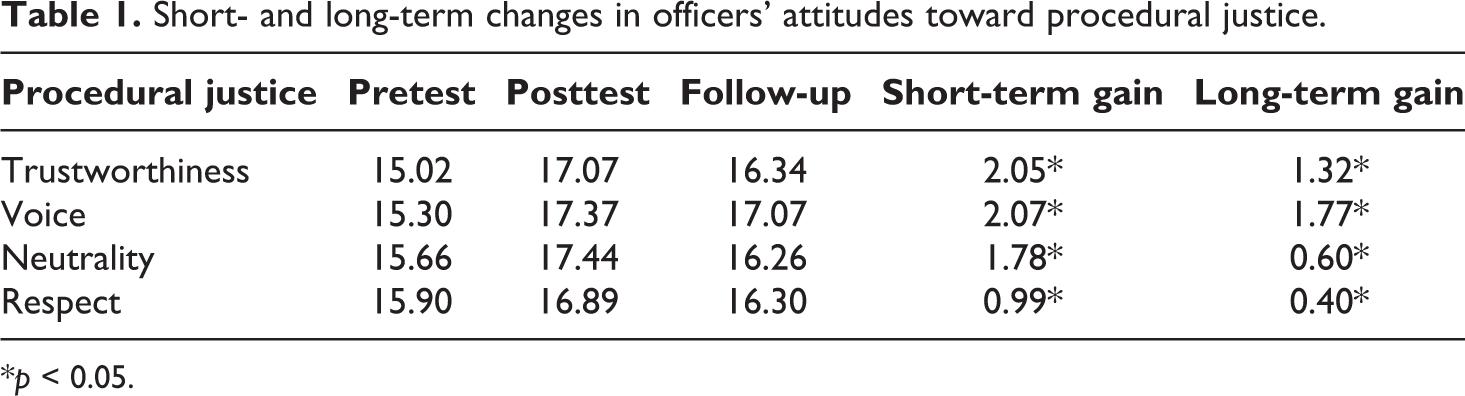
Table 1 below shows the findings regarding the short-term and long-term effects of the training on officers’ attitudes toward procedural justice. Specifically, officers’ attitudes toward each element were measured by an additive scale of four five-point items with a possible range of 4–20. According to the measurement of each item (some of which were reversed coded when necessary), higher scores indicated stronger preferences for procedural justice. Statistical analyses were conducted to examine the changes in the scores of those officers in the first-wave sample, and the results indicated that all short-term effects were positive and significant across all four elements of procedural justice, with the highest gain obtained for the concepts of trustworthiness and voice.
Short- and long-term changes in officers’ attitudes toward procedural justice.
*p < 0.05.
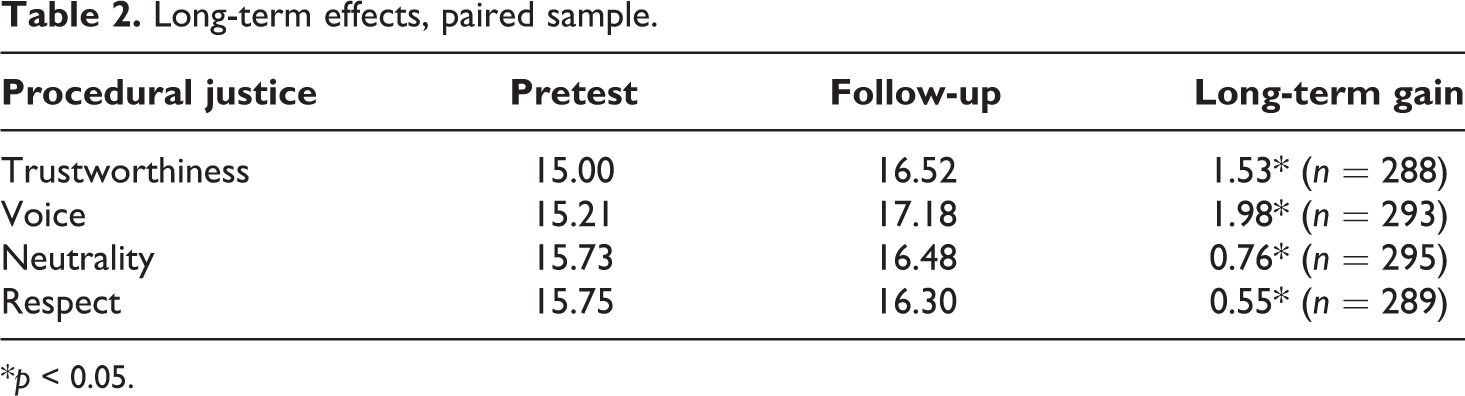
When examining the long-term effects, the first step was to look at the entire second-wave sample (as shown in Table 1). This preliminary analysis showed consistent positive long-term effects, although the scores were slightly lower than those in the posttest of the first wave. The second step was to take a closer look at those who participated in both waves of officer surveys. When considering the identified respondents in both the first wave and second wave, the analysis of this paired sample (in Table 2) showed the same significant results. Overall, the training was effective in achieving the desired ‘buy in’ from officers and their supervisors during the evaluation period.
Long-term effects, paired sample.
*p < 0.05.
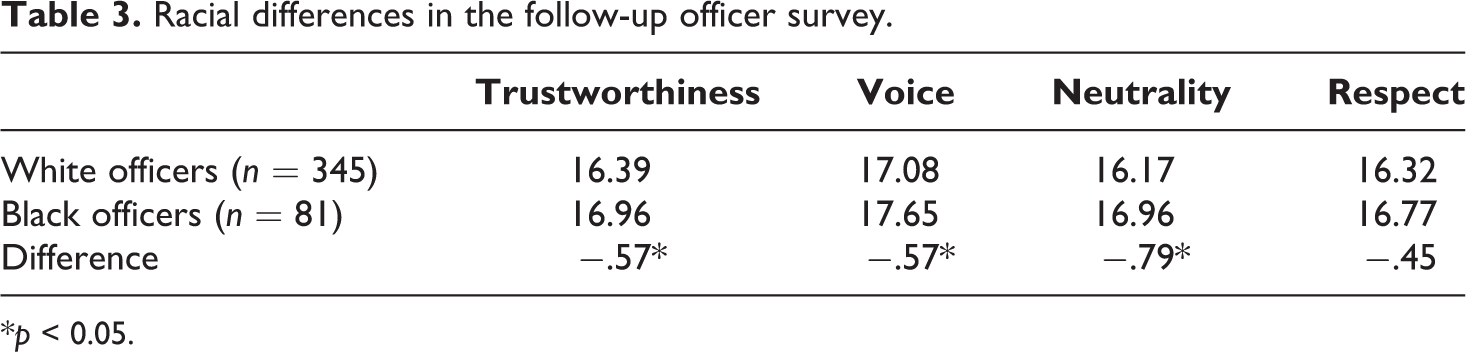
Further analysis showed that there were racial differences at the end of the project evaluation. Black officers tended to have stronger preferences for all elements of procedural justice. In addition, the racial differences were significant for trustworthiness, voice, and neutrality. These findings were consistent with prior research on attitudinal differences between white and black officers in the U.S. (Weisburd et al., 2000). Table 3 presents the second wave results between white officers and black officers.
Racial differences in the follow-up officer survey.
*p < 0.05.
Finally, analysis has been conducted to examine the overall perceptions about applying procedural justice. The findings showed that after training, the majority of respondents agreed or strongly agreed with the following statements: ‘I believe emphasizing procedural justice is a personal priority for me’, ‘I believe emphasizing procedural justice is a personal priority for my immediate supervisor’, and ‘In my shift, I generally have enough time to promote procedural justice during interactions with citizens’. In contrast, officers tended to be neutral or agreeable about the following statement, ‘Officers are recognized and rewarded for following procedural justice principles during interactions with citizens’, which might help explain the slight decrease in the training effects over time.
Systematic social observations
During the project, trained observers coded Body-worn camera videos from 659 randomly selected shifts. The 2861 observed encounters in these shifts encompassed a wide range of situations including service, order maintenance, and law enforcement situations. In these encounters, the problems that officers handled included problems with persons (36%), problems with property (19%), traffic (22%), service (10%), and legal processes such as serving a warrant (12%).
In general, patrol officers in the observed encounters displayed a noticeable level of procedural justice related to the four elements (trustworthiness, voice, neutrality, and respect) emphasized in the training, as suggested by the following statistics. Observers noted that in 83% of the encounters, officers greeted the primary citizen at the beginning; in 49% of the encounters, officers comforted or reassured the citizens; in 62% of the encounters, officers explained to the primary citizen about legal standards; in 73% of the encounters, officers asked the primary interacting citizens to tell or explain their situations; in 92% of the encounters, officers paid careful attention to what the citizen had to say; and in 59% of the encounters, officers used polite terms during interactions.
In contrast, officers’ level of procedural injustice was relatively low. Specifically, in 15% of the encounters, officers cut off the citizen when he/she was speaking; in 2.8% of the encounters, officers showed disrespect to interacting citizen; and in 1% of the encounters, officers made derogatory remarks to the interacting citizen. When examining police disrespect further, the analysis showed that citizens showed disrespect first in about 90% of the encounters where both the officer and the citizen showed disrespect toward each other.
Further analysis was conducted to assess the changes in officers’ manner during interactions with citizens. The results suggested that officers maintained their positive manner toward citizens with a slight improvement throughout the observed encounters. Specifically, the manner of officers was friendly, neutral/businesslike, and hostile at the beginning of 43.6%, 51.6% and 1.6% of the encounters, respectively, while at the end, the manner became friendly, neutral/businesslike, and hostile in 50%, 46.7%, and 1.4% of the encounters.
The desired outcomes of procedural justice during encounters may include citizens’ positive demeanor, cooperation, and compliance (Dai et al., 2011; Engel, 2003; Reisig et al., 2004). Therefore, the analyses of citizen interactions with the police focused on two types of citizen behavior: citizen disrespect toward the police and citizen noncompliance with police requests. The results suggested that in 5.4% of the encounters, citizens showed disrespect to the police. In addition, in 16% of the encounters where police made requests to cease disorderly behavior, citizens did not comply with police requests. Similarly, the percentages of noncompliance with police requests to leave another person alone, to discontinue illegal behavior, and to provide information about the identification or location of a suspected wrongdoer were 13%, 19%, and 6%, respectively. Taken together, the analyses suggested that police officers did a good job improving their relationships with citizens through procedural justice, especially when compared with the findings from previous observational studies in which officers received no training of procedural justice and experienced higher rates of disrespect and noncompliance (Dai et al., 2011; Mastrofski et al., 1996; Reisig et al., 2004).
Evidence also showed that citizens’ manner toward the police was slightly improved throughout the encounter, consistent with the analysis above about officers’ manner. Specifically, the percentages of citizens being friendly, neutral/businesslike, and hostile at the beginning were 42.4%, 49.7%, and 4.5%, respectively, while at the end of the encounters, the percentages of citizens who became friendly, neutral/businesslike; and hostile were 48.1%, 46.6%, and 3.4%, respectively.
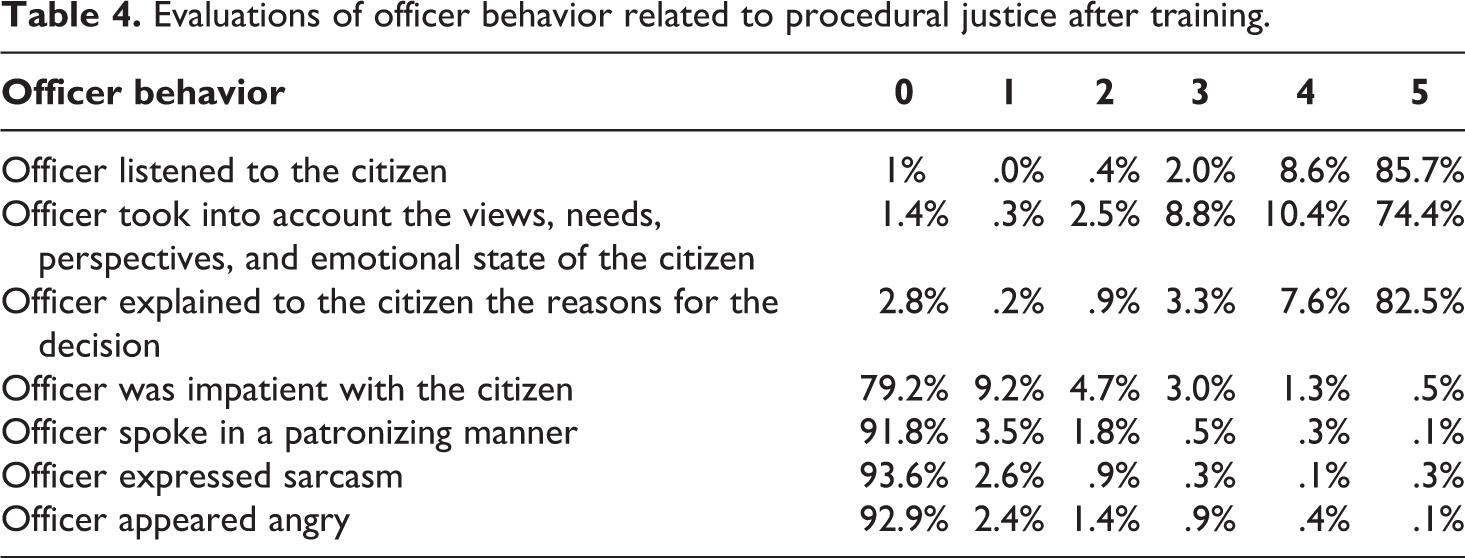
Finally, the trained observers rated various types of police behaviors related to procedural justice on a scale of 0–5, with 5 indicating the highest level of the described behavior. Table 4 presents the findings. In the observed encounters, the majority of the officers received a rating of 5 for procedurally just behavior and a rating of 0 for procedurally unjust behavior.
Evaluations of officer behavior related to procedural justice after training.
Citizen survey
The citizen survey was designed to correspond with the systematic social observations after the training, so that the research team could assess how the interacting citizens evaluated the level of procedural justice demonstrated by the police during their encounters. According to the survey design, the citizens in the randomly selected shifts including observed shifts were invited to participate in the survey. However, given the response rate of 37%, this citizen sample might not represent all the citizens who had contacts with the police during the observation period. Specifically, there may be overrepresentation of white citizens in the sample, as the sample composition suggested that 38.2% of the citizen sample were white, 34.6% were black, 6% were Hispanic, 1.8% were Asian, 5.1% were multiracial, and the remaining were other or unidentified. In contrast, the observational data showed that about 61% of the interacting citizens in the coded encounters were black. This discrepancy indicated the selection bias problem resulting from how the cards were distributed by the police and how much the citizens were willing to participate in the survey.
Although the citizen survey might provide a partial picture of how citizens evaluated their interactions with the police, the citizens who completed the survey provided detailed information about a variety of encounters including traffic stops (10.4%), field stops (7.7%), crime reporting (41.6%), asking for assistance or information (18.6%), and other unidentified types of encounters (19.9%).
In general, the citizen survey respondents were positive about their experiences with the police. Only 6 out of 221 citizens were dissatisfied with their encounter. Furthermore, 94.5% of the citizens were confident that the Norfolk police department could do its job well, and 90% of the citizens were proud of the work of the Norfolk police. In addition, the majority of the citizens agreed that the officers with whom they interacted demonstrated procedural justice as trained in the classroom. Specifically, 94.4% of the citizens agreed with the statement that ‘the police treated me with dignity and respect’, 87% of the citizens agreed with the statement that ‘I was treated the same way that others would be treated in a similar situation’, and 92.5% of the citizens believed that ‘the police made their decision based on facts’. In addition, the percentages of citizens who agreed with ‘the police considered my views’, ‘the police tried hard to do the right thing’, ‘the police respected my rights’, and ‘I willingly accepted the decisions the police made’ were 92.1%, 93.9%, 96.3%, and 96.7%, respectively. In contrast, 19.6% of the citizens believed that the interacting officer could have handled the situation better than she/he actually did.
Conclusion and discussion
In summary, this study evaluated the effectiveness of the police training program on procedural justice in Norfolk, Virginia, U.S. with three data collection methods. First, the results of officer surveys showed that the training program significantly improved officers’ attitudes toward procedural justice. It had not only an immediate effect on officers’ attitudes, but also a long-term significant effect for all four elements of procedural justice (including respect, trustworthiness, neutrality, and voice), which was new compared to the Chicago training (Skogan et al., 2015). In addition, the systematic social observations of the police-citizen interactions suggested that the Norfolk procedural justice training had positive effects on officers’ behavior and citizens’ interactions on the street. Finally, results from the survey of citizens who interacted with the police found that the interacting citizens evaluated the police positively in terms of procedural justice. Taken together, the comprehensive evaluation of the training program suggested that the training program maintained its effectiveness during the entire project period.
It should be noted that the comparison between the current study and the Chicago training evaluation (Skogan et al., 2015) should be made with caution. The Norfolk training program was similar to that in Chicago, but the evaluation methods were different. When examining officers’ attitudes toward procedural justice, the Chicago training program was evaluated with a quasi-experiment at the training class level for short-term effects and a statistical analysis of individual officers for the long-term effects. In contrast, the statistically analyses of officers’ attitudes reported in the current study were based on the pretest-posttest single group design with t-tests at the individual officer level. Moreover, the current study also differed from the Chicago evaluation due to the use of citizen survey and systematic social observations of police-citizen encounters to examine a broader range of attitudinal and behavioral outcomes.
Two factors may help explain the significant training effects in the present study. First, its effectiveness may be attributable to the tailored approach in the development of the training materials. The training was tailored specifically to the jurisdiction with a special focus on the relationship between procedural justice and race relations in Norfolk, Virginia, U.S. By placing police legitimacy issues in the city’s historical context, the training further emphasized how the tools suggested by the procedural justice theory could improve relations with local communities, especially the minority communities. It is possible that when applying procedural justice on the street after the training, officers had personal experiences with better cooperation from community members. These positive interactions, in turn, reinforced what the officers had learned from the training about the effects of procedural justice, and, therefore, maintained the effects of the training in the long run. Second, the supportive organizational contexts within the police department may have helped to maintain its effects over time. The Norfolk Police Department created a systematic community policing plan that at the organizational level actively supported officers who illustrated the elements of procedural justice in their work. For example, the police chief incorporated community engagement events into his monthly CompStat meetings, in which each commander presenting crime statistics must also present his or her team’s community engagement efforts. The chief also made participation in community engagement events a criterion in the promotion process. It was made clear that the police department must be engaged with the community and must treat all community members in a just, fair manner. As a result, this top-down approach had snowballed into numerous grassroot efforts that officers authentically made as part of their everyday mission to serve the needs of local communities.
The findings of this study have policy implications for police administrators with regarding to procedural justice training. When implementing a training program to promote procedural justice and police legitimacy, police departments should identify their own issues that can be addressed by applying procedural justice and then integrate the issues into the training curriculum. Simultaneously, police departments should take a systematic approach and create a culture of support for officers to utilize the procedural justice elements during their interactions with citizens. In this way, police departments can enhance police legitimacy in the long run and achieve a higher level of citizen cooperation and support.
In conclusion, the comprehensive data collected in this study with officer surveys, systematic social observations, and citizen surveys has provided a bigger picture about the effects of the police training on procedural justice. Future research needs to address the limitations of the current study and incorporate robust research methods such as random control trials and multivariate analyses to contribute additional evidence about procedural justice training and practices. In addition, future research needs to further examine the factors that can help explain the findings of the present study. For example, the officer surveys in this study found that black officers expressed a stronger preference for all elements of procedural justice than their white counterparts. Further research is needed to find out why there was such as a discrepancy and how the diverse subcultures within the police department could affect the training effects. Moreover, although the observational data found that officers exercised procedural justice in the majority of encounters observed, further research is needed to assess in what situations officers had higher or lower levels of procedural justice and what factors could explain the behavioral differences among officers. Similarly, this study found that 19.6% of the citizens believed that the interacting officers could have handled the situation differently. Further research is needed to find out why the citizens felt this way and what could have been done differently. The development of such knowledge will provide more detailed insights and can be extremely useful for scholars and police managers.
Footnotes
Appendix 1
Declaration of conflicting interests
The author(s) declared no potential conflicts of interest with respect to the research, authorship, and/or publication of this article.
Funding
The author(s) disclosed receipt of the following financial support for the research, authorship, and/or publication of this article: This project was supported by Award No. 2016-IJ-CX-0020, awarded by the National Institute of Justice, Office of Justice Programs, U.S. Department of Justice. The opinions, findings, and conclusions or recommendations expressed in this publication are those of the author and do not necessarily reflect those of the Department of Justice.
