



Abstract
Active shooter events have driven police to change how they respond to events where an attacker is actively engaged in killing civilians. This paper examines these changes through the lenses of Normal Accident Theory (NAT) and Resilience Engineering (RE). Our results show a police officer is shot in one out of every six active shooter events in the United States. We then apply RE to better understand how these shootings occur so that police can improve their ability to anticipate, monitor, and respond during these attacks. Implications for police training are discussed.
Engineering resilience for police during active shooter events
Since the 1999 Columbine High School shooting in Littleton, Colorado, USA, American police response to active shooter events (referred to as marauding terrorist attacks in the United Kingdom) has changed dramatically (Martaindale and Blair, 2019). Before the Columbine High School shooting, police officers were expected to contain the shooter in the attack location, control access to the location, and call for the Special Weapons and Tactics (SWAT) team to deal with the problem. Now police officers are expected to enter the location quickly (even alone) and stop the attacker from killing more people.
This shift from containment to engagement is undoubtedly dangerous, but to date, no research has attempted to assess how dangerous. This paper attempts to fill this void. We begin by discussing active shooter events in the United States and current response training. Next, we evaluate the current response in terms of Normal Accident Theory (Perrow, 1984). Finally, we utilize the tenets of Resilience Engineering (Hollnagel et al., 2006) as a framework to mitigate the danger inherent in current active shooter response.
Literature review
Active shooter events
The U.S. Department of Homeland Security defines an active shooter event as an individual killing or attempting to kill people in a confined and populated area (U.S. Department of Homeland Security, 2008). The Federal Bureau of Investigation (FBI) regularly publishes data that are considered the official United States data on these events (ALERRT and FBI, 2018a, 2018b; Blair and Schweit, 2014; Schweit, 2016). The rate of occurrence of these events appears to be increasing, but some have criticized the data set as missing cases, particularly cases that occurred in the early 2000s (see, for example, Blair and Martaindale, 2015; Fox and Levin, 2015; Lott, 2015).
While still a relatively new area of research, there is a growing body of literature dealing with various aspects of active shooter events and police response. Some research has explored the development and effectiveness of specific response tactics (Blair et al., 2011; Blair and Martaindale, 2013, 2014, 2017; Martaindale and Blair, 2019) and police perceptions of acceptable responses (Phillips, 2020). Qualitative research has examined how first responders can provide a more effective response to active shooter events (Duron, 2021). Researchers have published descriptive studies of active shooter events in schools and businesses (Blair et al., 2014; Martaindale et al., 2017; Majeed et al., 2019; Schildkraut et al., 2017; Schildkraut and Muschert, 2014). Other descriptive research has examined the correlates of the number of people shot and killed in these events (Blair et al., 2021b). Some research has examined media coverage of these events (Majeed et al., 2019; Schildkraut et al., 2017; Schildkraut and Muschert, 2014) and the possibility of contagion effects (Kissner, 2016; Lankford and Madfis, 2017; Meindl and Ivy, 2017; Towers et al., 2015). Researchers have additionally examined the impact of these shootings on survivors and communities (Jordan, 2003; Richardson et al., 1996; Shultz et al., 2014; Smith et al., 2019). The FBI Behavioral Analysis Unit has also examined the characteristics of the shooters (Silver et al., 2018).
Police response to active shooter events
Police response to these events has shifted dramatically since the Columbine High School shooting in 1999 with officers now expected to quickly engage the shooter to limit the number of casualties (Martaindale and Blair, 2019). In response to this expectation, most police officers in the United States now receive some form of active shooter training. In this paper, we will use the Active Shooter Response—Level I class developed by the Advanced Law Enforcement Rapid Response Training (ALERRT) Center at Texas State University to discuss current training. While numerous other training programs exist, we use the ALERRT program as the model for two primary reasons. First, ALERRT was recognized as the national standard in active shooter training by the FBI in 2013. Second, ALERRT has provided training to more than 130,000 law enforcement officers from more than 9,000 law enforcement agencies in the United States (Martaindale and Blair, 2019).
ALERRT’s basic active shooter response class is a 2-day (16 h) course. The class divides response into two phases: Stop the Killing and Stop the Dying (ALERRT and FBI, 2020). The morning of the first day consists of lecture material. In the afternoon, students participate in a variety of skills training blocks. During the second day, these skills blocks continue, but most of this day consists of participants completing a series of reality-based training scenarios designed to reinforce the core concepts and principles that were taught in the lectures and skills training blocks.
During the Stop the Killing phase, officers focus on preventing the attacker from creating more victims. Officers are taught to move quickly to the sounds of gunfire and bypass any innocent civilians they encounter in order to focus on distracting, isolating, and neutralizing the attacker (ALERRT and FBI, 2020). It is during this phase, when the attacker is still actively seeking victims, that police officers are shot.
The Stop the Killing phase further divides the response into two general areas: actions outside of structures and actions inside. The outside response is further broken down to enroute, arrival, moving to the structure, and breaching into the structure. Inside response training includes interior movements (e.g., moving through hallways) and entry into rooms. ALERRT teaches concepts, principles, and specific tactics for dealing with the risk of each specific area. We will use this general outside/inside and relevant sub area breakdown in our analysis.
The course material is more focused on interior response than exterior response both in terms of manual pages devoted to explaining relevant concerns and tactics (33 interior vs. 19 exterior) and in training time specifically dedicated to skills used in these areas (180 min interior vs. 60 min exterior; ALERRT and FBI, 2020). Additionally, in all eight of the reality-based scenarios that are used to reinforce the core concepts and principles of the training, the participant officers encounter the active shooter inside of a building.
After the shooter has been stopped, the Stop the Dying phase of response begins (ALERRT and FBI, 2020). This phase has two subcomponents. The first involves providing point of wounding care that is aimed at preventing the injured from dying on the scene. This primarily involves stopping heavy bleeding using tourniquets and wound packing, some airway management to prevent the wounded from suffocating or choking on aspirated material, preventing tension pneumothorax (caused by sucking chest wounds) using chest seals, and preventing hypothermia by using various warming methods. After police provide care to prevent immediate death at the scene, the focus is on rapidly transporting the injured to a location where they can receive definitive medical care (e.g., trauma center). This is because officers (or paramedics) cannot definitively treat most victim injuries (e.g., gunshots) in the field. We now turn to discussing officers being shot during response as normal accidents.
Normal Accident Theory
Perrow (1984) developed Normal Accident Theory (NAT) when seeking to understand how accidents happened in high-tech systems. The theory is simple in that it predicts accidents will occur when high-tech systems exhibit two traits: high complexity and tight coupling. As a system becomes more complex (e.g., has more interacting parts), there is an ever-increasing possibility something will go wrong in some part of the system. Coupling refers to how tightly connected the parts of the system are to each other. In a system that is tightly coupled, a problem in one part of the system passes into other parts of the system and can cascade through the entire system to create system-wide failure. This framework has been used to study diverse topics, such as petroleum refineries (Wolf, 2001; Wolf and Sampson, 2007), steel processing plants (Marley et al., 2014), and oncology (Chera et al., 2015a, 2015).
Klinger (2005) applied the NAT framework to explain force used by and against the police. He posited that many police shootings are normal accidents that occurred in highly complex situations where the officers and civilian had become tightly coupled. Because NAT assumes accidents will happen in complex situations with tight coupling, Klinger suggested that police shootings, and the shootings of police, could be reduced by using tactics that either reduce complexity and/or coupling. Klinger argued that while a barricaded suspect situation was highly complex, deploying a specialized team (e.g., SWAT) that had training and experience dealing with barricaded suspects would reduce complexity, and therefore, reduce the likelihood of a normal accident. In a similar way, Klinger argued that the police tactic of maintaining distance from potentially dangerous suspects reduced coupling and could therefore help avoid normal accidents. For example, staying away from a suspect armed with a knife decouples the officer from the suspect and gives the officer more options to deal with the situation. Klinger provided several other examples of how police tactics can reduce complexity and/or coupling and argued that these tactics can therefore reduce police shootings of civilians and shootings of police by civilians.
Klinger (2020) revisited NAT to clarify his original work and suggest ways in which NAT could be used to enhance our understanding of how violent interactions between police and civilians occur, how the number of police–civilian interactions where police use deadly force can be reduced, and how serious injuries and deaths of police officers can be reduced. In this work, Klinger emphasized that not all police shootings are normal accidents. Some police uses of deadly force are intentional and necessary. Klinger used police shootings of suspects actively engaged in deadly violence (e.g., active shooter events) as shootings that are not normal accidents; however, when police responding to an active shooter event are shot, this can be a normal accident. He also emphasized that in addition to reducing the number of encounters where police use deadly force against civilians, the NAT concepts of complexity and coupling can be used to reduce serious injuries and deaths of police officers.
NAT and active shooter response
From a NAT perspective, the police response to the Columbine High School shooting can be seen as an attempt to reduce complexity (by calling on a specialized unit) and coupling (by having patrol officers stay away from the attackers) in order to avoid a normal accident that results in police officers being injured or killed; however, this focus on officer safety left civilians exposed to attackers for a substantial period of time.
The current response intentionally inserts officers into a very complex situation and tightly couples the officers with the attacker to stop the attacker from injuring or killing more civilians. Given that violence is already occurring in these events and officers are entering a complex situation that tightly couples them with attackers, we predict police officers will frequently be shot during active shooter events. This leads to our first research question: RQ1: how often are police officers shot during active shooter events?
Assuming police officers are frequently shot and the expectation for officers to quickly enter locations where an active shooting is occurring and stop the attacker is unlikely to change (i.e., officers will be expected to continue to enter complex situations and tightly couple with attackers), we use the Resilience Engineering (RE) framework to examine how officer resilience during these responses might be increased.
Resilience Engineering
Resilience Engineering was originally developed for the industrial safety setting but has since been applied to a variety of fields (Dekker, 2019). While definitions vary, Hollnagel (2011) defined resilience as, “the intrinsic ability of a system to adjust its functioning prior to, during, or following changes and disturbances, so that it can sustain required operations under both expected and unexpected conditions” (p. xxxvi). Resilience defined this way seeks to avoid accidents, when possible, but also acknowledges that accidents will occur, and seeks to limit the damage caused by these accidents. This is quite similar to the prevention of shootings and harm reduction suggestions made by researchers examining shootings by the police in the United States (see, for example, Sherman, 2018; Zimring, 2017).
Under the RE framework, people’s ability to understand the situation and adjust becomes a critical element in maintaining resilient operations. Hollnagel (2011) suggests that people must have four key abilities to be resilient. The first ability is responding. The person must know what to do. This can be prepared responses for regular and irregular situations or adjusting as needed to deal with novel situations. The second ability is monitoring. Resilient people must know what is critical to maintaining operations. They must pay attention to both their own system and the environment for things that can become disturbances (i.e., threats) in the near term. Third, resilient people must anticipate. This is the ability to look further into the future than monitoring to see potential threats and opportunities before they materialize. Finally, resilient people must learn from experience. They must examine both mistakes and successes to improve on their ability to respond, monitor, and anticipate.
The RE framework has already been explicitly used to address police shootings by Taylor (2021). He found that when officers keep their firearms in a low ready position (as opposed to a high ready or aimed position), they made substantially fewer errors in a shoot/do not shoot simulator. Keeping the firearm in a low ready position also modestly slowed the speed with which the officers fired, but this slight slowing (i.e., decoupling) may have been what led to more accurate decisions. Teaching police officers to keep their guns in a low ready position when confronting potential threats to reduce the likelihood of an incorrect shoot/do not shoot decision is an example of improving the ability of a person to respond.
Additionally, Blair et al. (2021a) utilized RE to examine the impact of officer flashlight position on the accuracy of a suspect shooting at the officer. They found that when officers positioned their flashlights so that the flashlight was not aligned with the officers’ bodies, the accuracy of the suspects was reduced. Something as simple as how officers hold their flashlights when searching for a suspect can impact their resilience.
RE and active shooter response
Assuming that responding to active shooter events is dangerous, we apply the RE framework to address two additional research questions: RQ2: how can officers avoid being shot when responding to active shooter events? RQ3: how can the survivability of officers who are shot be increased?
We believe that both questions can be addressed by examining the specific circumstances of officers being shot during active shooter events. Our analysis of these circumstances is an explicit attempt to learn from these events so that officers will be better able to anticipate, monitor, and respond during these events. We believe that this information may both reduce the frequency of police officers shot during active shooter events and increase the survivability of officers who are shot.
Methodology
Data
We identified cases where police officers were shot from the active shooter reports published by the FBI (ALERRT and FBI, 2018a, 2018b; Blair and Schweit, 2014; Schweit, 2016). As we mentioned before, they represent the U.S. government’s official data on these events. After identifying the cases, we sought additional information on the circumstances of the shooting(s). This information came from news outlets, official police reports, and other official reports prepared following major incidents (e.g., Straub et al., 2017).
Coding
After identifying events with officers shot, we then coded several variables. These were:
Ambush
A dichotomous nominal variable coded one if the officer was shot in an ambush that was the beginning of the active shooter event. This included situations where the officer was responding to a non-active shooter call or standing a post to provide security. The event was coded zero if the officer was aware that an active shooter event was occurring at the time of the shooting.
Outside
A dichotomous variable coded one if the officer was outside at the time they were shot or zero if inside.
Details
A nominal variable providing more specific information about an officer’s location when the shooting occurred. Levels were hallway, room, arrival (in or next to the officer’s vehicle), moving outside (the officer was outside, but not next to or in their vehicle), and pursuit (the officer was shot while pursuing the suspect in a vehicle or immediately after the pursuit ended).
Shot multiple
A dichotomous variable indicating whether the officer was hit by gunfire once or multiple times. A one indicated that the officer was shot multiple times. A zero indicated that the officer was shot a single time. It was also not possible to code how many shotgun pellets struck an officer for officers hit by shotgun blasts. We coded all officers hit by shotgun blasts as being shot multiple times. The range of the number of times an officer was shot was between 1 and 15. As can be seen in Table 1, almost two-thirds (62.2%) of officers were shot a single time and about 1 in 3 (30.5%) were shot more than once.
Most severe hit location
An ordinal variable indicating the most dangerous area of the body where the officers were hit by gunfire. Levels were head, torso, extremities, or unknown.
Weapon
A nominal variable showing the type of weapon used to shoot the officer. Levels were pistol, rifle, shotgun, or unknown.
Killed
A dichotomous variable coded one if the officer died because of the gunshot wound(s) and zero if the officer survived.
Descriptive statistics.

Analysis plan
Our analysis is largely descriptive and exploratory. We have structured it around the three research questions identified above. We first present relevant results for each question. Then, we discuss the results considering the relevant theories and current training.
Results
How often are police officers shot during active shooter events?
We identified 43 events from 2000 to 2018 with at least one police officer shot. Eighty-two officers were shot in these 43 incidents. This distribution was positively skewed (mean = 1.9, SD = 1.8, median = 1, mode = 1) with a range of 1–10 officers shot during the events. Of the 82 officers that were shot, 25 (30%) died. During the 2000–2018 timeframe, there were 277 active shooter events. This means that an officer was shot in about one out of every six active shooter events.
When examining the events, we identified two distinct ways that officers were shot. In 15 events, the active shooter event began with the attacker shooting one or more police officers. These officers did not know that an active shooter event was occurring, and they were not responding. In 28 events, officers were shot when responding to the active shooter event. In five events, officers were shot both at the start of the event and when responding to the event.
Officers who were shot at the outset of an active shooter event were ambushed while performing their normal duties. Often, they were providing security at a fixed post. Research examining homicides of law enforcement officers in the United States has identified ambushes as being particularly deadly (Blair et al., 2016; Crifasi et al., 2016; The International Association of Chiefs of Police, 2020; White, 2020). The International Association of Chiefs of Police (IACP), for example, reported that officers were killed about 54% of the time when they were ambushed.
From the RE perspective, we predict ambushes to be deadly because they happen by surprise. In short, officers are not adjusting their behavior to deal with a potential threat. We expect the opposite to be true for officers who know they are responding to an active shooter event. They anticipate the situation is dangerous and are therefore adjusting their behaviors accordingly (e.g., monitoring and responding).
To test this supposition, we examined the deadliness of shootings in ambush situations versus response situations during active shooter events (see, Figure 1). Of the 55 officers that were shot when responding to an active shooter event, 9 (16%) died. Of the 27 officers shot in an ambush type situation at the outset of an active shooter event, 16 (60%) died. Officers were 7.4 times more likely to die when they were shot during an ambush type situation at the beginning of an active shooter event than when they were shot while responding to an event. This difference in fatality rates suggests that ambushes are distinct from response. Because of this, and because active shooter training is specifically designed to prepare officers to respond to an event, we will focus on officers who were shot when responding to an active shooter event for the rest of the analysis Lethality by response or ambush.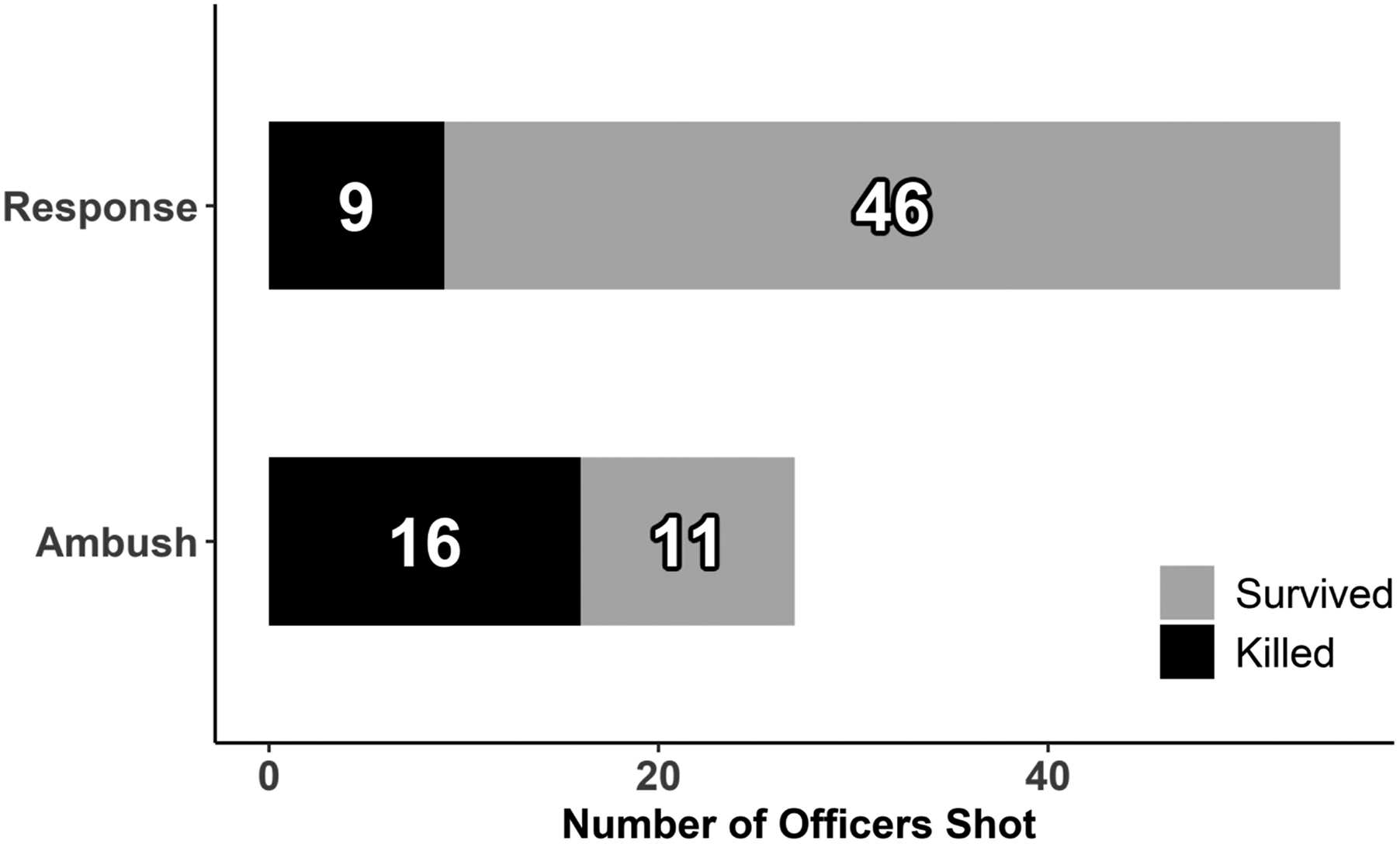
Even when considering only those events where officers were shot responding to an active shooter event, there were 33 events where 55 officers were shot. An officer was shot responding to an active shooter in about 12% of the events (or about 1 out of every 8 events).
How can officers avoid being shot during active shooter response?
In the RE framework, avoiding an accident (i.e., being shot) requires an understanding of how accidents unfold. To provide this understanding, we considered the specifics of the shootings. Consistent with police training, we divided response into two primary areas: outside of buildings and inside of buildings (ALERRT and FBI, 2020; Blair et al., 2013). Thirty-seven (67%) officers were shot outside and 18 (33%) were shot inside buildings during response. Figure 2 provides details regarding the specifics of where officers were at the time of the shooting. Fourteen officers were shot on arrival at the scene of the attack (in or immediately next to their vehicle), 10 moving somewhere between their car and the building, 10 in hallways, and five in rooms. In examining situations of the shootings, we discovered that we needed to add a category reflecting officers shot during (or at the conclusion of) vehicular pursuits. These were generally cases where mobile active shooters began their attack at one location and then got in a vehicle to continue attacking other locations. At some point during this continued attack, the police began to pursue the attacker. Eleven officers were shot during or immediately following these pursuits. Location of shooting details.
The officers shot in rooms were already in the room at the time of the shooting. An attacker shot one officer in a large lobby-like area of a courthouse. Two officers were shot while searching a cubicle area, and one officer was shot inside a bar. None of the officers shot inside of rooms were performing a room entry when the attacker shot the officer. We note this because room entries are a focus of indoor training.
How can the survivability of officers who are shot be increased?
We began by assessing if officers were killed while they were inside or outside when they were shot. Of the 37 officers shot outside of structures, 7 (19%) died. Of the 18 officers who were shot inside, 2 (11%) died. Officers who were shot outside of structures were about 1.9 times more likely to die.
Next, we explored where officers were hit, with what weapons, and their likelihood of death. These data are depicted in Figure 3. These data represent the most severe location where the officers were shot with head being considered the most severe, torso next, and extremities least. As shown by the data, eight of the most severe hit locations were in the head, 13 in the torso, and 20 in the extremities. We were missing hit location information for 14 officers. Lethality by most serious hit location and weapon.
Figure 3 also displays lethality by weapon used and most severe hit location. We draw the reader’s attention to the difference in lethality when the officer’s most severe hit location was in the torso. Eighty-six percent of the officers whose most severe hit was in the torso with a pistol or shotgun survived; whereas only 33% of those whose most severe injury was in the torso with a rifle survived. Officers who were shot in the torso with a rifle were 12 times more likely to die than those shot with a pistol or shotgun.
Another way to prevent death is to provide effective medical care to officers who are shot. Unfortunately, our data cannot directly assess the effectiveness of the medical interventions that are currently taught to police officers during active shooter training; however, we note that none of the 20 officers in our data whose most severe hit was in an extremity died.
Discussion
How often are police officers shot during active shooter events?
Consistent with the predictions of NAT, we found that responding to active shooter calls is dangerous for police officers. To place how dangerous active shooter events are in context, consider the rate of injury during domestic violence calls, which are widely considered to be dangerous (Buchanan and Perry, 1985; Buzawa and Buzawa, 2003; Ventura and Davis, 2005). Hirschel et al. (1994), for example, found that the Charlotte Police Department received 1,078,571 calls for service during a 3-year period. Approximately 84,250 (7.8%) of these calls were domestic disturbance calls. In 122 (0.1%) of these calls, an officer was assaulted. In 48 (0.05%) domestic disturbance calls, the officer was injured. In other words, domestic disturbance calls led to one assault per 690 calls and one officer injury per 1,754 calls. While domestic calls can be dangerous, officers are more likely to be injured when responding to an active shooter call (1 in 8 calls) than when responding to a domestic disturbance call (1 out of 1,754 calls).
The current response model tightly couples police with attackers in complex situations. We believe that the public and police leadership will continue to expect police officers to utilize this model; therefore, we expect that officers will continue to be shot during these events. We turn to the RE framework to assess how we can improve the ability of police to avoid being shot and their survivability when shot.
How can officers avoid being shot during active shooter response?
Under the RE framework, avoiding accidents requires that people be able to anticipate the problems that may occur, monitor the situation for signs that a problem is occurring, and utilize effective responses. Effective training should enhance these abilities.
Our data suggest that there is a mismatch between where most response training focuses and where the risk is highest during response to active shooter events. Responding officers are about twice as likely to be shot outside of a structure as inside, yet active shooter response training is more focused on interior operations than exterior (e.g., ALERRT and FBI, 2020). This lack of focus on exterior training may create a miscalibration in a responding officer’s anticipation of where they are likely to encounter the attacker. As a result, the officer may not be carefully monitoring the exterior environment as they approach the scene. Increasing the amount of time spent on training in exterior environments and including scenarios where officers encounter the attacker outside may adjust a trainee’s understanding of the situation. In turn, their anticipation and monitoring may more closely align with the threats that they are facing. Additionally, simply informing trainees that most officers are shot outside during active shooter events may help officers more accurately anticipate the dangers they face when responding.
Knowing how to effectively respond is also key in RE. In police training, this often means being taught specific tactics. Tactics that could improve response when outdoors can already be found in both military training manuals (Department of the Army, 2016) and specialized outdoor response to active shooter training manuals (ALERRT, 2017). Among these responses are: donning any special active shooter gear (e.g., increased body armor, go-bags, and rifles) before responding, choosing an approach route that minimizes the opportunity of the attacker to engage the officer, parking in a location that shields the officer from potential gunfire, immediately exiting the vehicle and moving to cover, moving from the vehicle to the building using short rushes from cover to cover, and using bounding overwatch (i.e., one officer provides cover as another officer moves). While some current training and training manuals cover some of these exterior tactics, providing more focus and training time on these tactics may help better prepare officers to respond to exterior threats.
How can the survivability of officers who are shot be increased?
Our finding that responding officers who were shot outside were more likely to die was somewhat surprising. Engagement distances would generally be longer and accuracies lower when they happen outside as opposed to inside. Additionally, it should be easier for other officers to reach a fallen officer that is outside to provide both point of wounding care and rapid transport to definitive care. RE provides a potential explanation for this finding and support for our contention that current training miscalibrates officers to the danger they face. We noted in the results that 60% of officers who were shot at the outset of an active shooter event died and we used RE as an explanation. This RE explanation would also apply if current training miscalibrates the trainee’s anticipation of danger. It is possible that officers are more likely to die when they are shot outside because the current focus on interior training causes officers to incorrectly anticipate the danger that is present during the exterior part of the response.
In RE, responding can also involve the use of equipment. Police officers in the United States commonly wear Level IIIa body armor to protect their chests and backs. This body armor is designed to stop most pistol bullets and shotgun blasts. Some researchers have suggested officers should wear ballistic plates capable of stopping rifle rounds (Level III or IV body armor) during active shooter events because about a quarter of all attackers use rifles (Blair et al., 2013, 2014). The data in Figure 3 support this contention. It appears that the standard Level IIIa body armor worn by police stops most torso hits with pistols or shotguns from being lethal but does not generally stop hits with rifle rounds from being lethal.
We also note that helmets rated at Level III and IIIa are available and issued by some police departments. While we cannot assess the overall effectiveness of these helmets for protecting officers during response, there were two officers in our data who were shot in the head while wearing ballistic helmets. Both officers survived. One of these was shot with a rifle and we were unable to determine the weapon used in the other case. Taken as a whole, wearing upgraded body armor when responding to active shooter events can increase the survivability of officers.
Responding under RE also involves responding to being shot. Medical training is now commonly included in active shooter training in the United States. Our data only allowed us to indirectly assess the impact of this training. The training focuses primarily on stopping serious extremity bleeding using tourniquets. None of the officers in our study whose most severe wounds were in the extremities died. Additionally, at least one officer had a tourniquet applied to his arm after being shot, and this tourniquet was attributed with saving the officer’s life (Becker, 2019; Kennedy, 2018). It may be that the medical skills taught in active shooter training saved the lives of some of the other 19 officers with extremity wounds. Our data at least suggest that this medical training is useful.
Conclusion
A
Using RE, we assessed how officers could avoid being shot when responding to these events. While the majority of active shooter response training focuses on operations inside of buildings, officers were more likely to be shot when outside. In RE, a key factor in avoiding accidents is the ability of people to understand situations and adjust. Key to these adjustments is the ability of people to anticipate where problems may occur, monitor the environment for indications that these problems are emerging, and respond appropriately. Current active shooter training may give officers an incorrect perception of the risk that they face when outside because substantially less training and scenario time is spent outside. As a result, the training may reduce the effectiveness of officers to anticipate, monitor, and respond. We identified a variety of tactics that could mitigate danger and suggested that spending more training time outside may produce not only better outside skills but also create a more accurate perception of the danger that officers face when they are outside.
We also utilized RE to assess how officers might improve their resilience when shot. RE acknowledges that adjusting can involve using specialized equipment in dangerous situations. Our analysis of the weapons used to shoot officers, hit locations, and survivability suggested that equipping officers with upgraded body armor could substantially increase the survivability of officers who are shot when responding to these events.
While we did not have data that spoke directly to the effectiveness of the medical procedures that are applied to injured officers, our observation that none of the officers whose most serious injury was in the extremities died and the case of one officer’s survival being attributed to the application of a tourniquet at least suggest that the medical skills officers are being taught may have helped save lives. Future research should explore the effectiveness of the medical techniques that are now being taught to officers.
Our paper also demonstrated that the principles of NAT and RE can be applied successfully in yet another policing context (active shooter events). NAT had already been applied to understanding police shootings (Klinger, 2005, 2020). RE has been applied to assess the impact of weapon position on correct shoot/do not shoot decisions (Taylor, 2021), and flashlight positioning on hostile suspect accuracy (Blair et al., 2021). It is our belief that the NAT and RE principles can be used in a variety of policing contexts to both avoid errors and reduce the damage caused by errors when they occur. We hope that future research will explore this possibility.
Limitations
Like any study, our data had limitations. While we believe we identified all the cases where officers were shot during active shooter events because these cases receive more attention, we could not always get all the information regarding the shootings that we sought. As a result, we are missing information for some variables for some cases (for more information, see Table 1). Given the relatively small number of officers included in the study, this missing data could sway our results.
Additionally, the 7 July 2016, Dallas, TX, USA shooting, that occurred while police were providing security at a protest march, is the largest targeting of police officers during an active shooter event that has occurred in the United States; yet, no official report has been produced, the department will not share information on the shooting, and media accounts conflict (see for example Bruton et al., 2016; CBSDFW, 2021). Where there was conflict, we chose the more conservative estimates. We believe that we have accurate information on the officers killed in this case, but information on many of the officers who were wounded is missing. We do not believe that this substantially swayed our results because these cases simply drop out of our analysis. Despite these limitations, we believe that our analysis provides important insight into the risks that police officers face during these events, which can be used to improve officer safety and increase officer effectiveness when responding to these events.
Footnotes
Acknowledgments
Thanks to Jacob Fisher for sending us some of the training materials used in this study. Also thanks to Kim Rossmo and Thor Eells for their helpful comments on earlier drafts of this paper.
Declaration of conflicting interests
The author(s) declared no potential conflicts of interest with respect to the research, authorship, and/or publication of this article.
Funding
The author(s) disclosed receipt of the following financial support for the research, authorship, and/or publication of this article: This work was supported by the Partial funding for this project was provided by COPS Office grant numbers 2019ASWXK001 & 2020ASWXK001. COPS does not endorse the views or opinions expressed by the authors.
