




Abstract
This article examines the state of the political science discipline in New Zealand, focusing on the numbers of women in the profession, the representation of women in the discipline’s journal, and the place of gender in the political science curriculum. While women in New Zealand political science have been active as a community for at least 30 years, there has been no systematic review documenting the status of women in the profession. This article provides an analytical starting point through a review of the data that does exist on New Zealand and comparable countries. It discusses the factors that may account for current trends and concludes with some recommendations for the future. It is clear that women have made visible gains in terms of numbers, but continued progress is precarious and dependent on both institutional and individual initiatives.
Introduction
Almost ten years ago, Marian Sawer wrote that the discipline of political science, to a much greater extent than cognate disciplines such as history or sociology, remained male-dominated in most parts of the world. 1 More recently, an International Political Science Association publication demonstrates that women’s participation in the discipline at an international level, and in governance positions within their associations, has progressed, although there is still some way to go before parity is reached. 2 Alongside this, there has been an increasing focus on documenting the presence of women within political science departments nationally, 3 on the inclusion of gender as an analytical category in the political science curriculum, and on the challenges made to traditional research within the discipline by feminist political scientists, political theorists and international relations scholars. 4 Thus, reviewing the ‘state of the discipline’ can be thought of as more than just how many women political scientists are present at any one time. It includes understanding the gendered nature of research norms and practices, the culture of the profession, and questioning whether there still exists a hidden gendered curriculum that operates according to masculine norms – one that implicitly signals to female students whether they can expect to ‘find themselves’ in political science courses. 5
Drawing on this broad definition, this article examines the state of the discipline in New Zealand, focusing on the numbers of women in the profession, the representation of women in the national journal Political Science, and the place of gender in the political science curriculum. While women in New Zealand political science have been active as a community for at least 30 years, there has not been a systematic review of the status of women in the profession. This is in stark contrast to Political Science Associations in the United Kingdom, Australia, Canada and the United States, where Status of Women Committees and Women’s Sections have conducted reviews from the 1970s onwards. Although the New Zealand political science community is comparatively small, such reviews are important. A gender-monitoring process will help to raise awareness of the under-representation of women at all levels of the profession, facilitating further cross-national comparisons and enabling the identification of better institutional practices to ensure the discipline remains inclusive and attractive to a diverse range of future students and staff.
As this is the first formal review of the status of women in the discipline, it is not possible to offer a comprehensive analysis of changes over time, as there has been no systematic collection of demographic data broken down by gender, race or ethnicity. Instead the article provides an analytical starting point through a review of the data that does exist on New Zealand and comparable countries. It also assesses the gendered dimensions of research and curriculum content in New Zealand, discusses the factors that may account for current trends, and concludes with some recommendations for the future. Women have made visible gains in terms of the numbers of women in the profession, but continued progress is precarious and dependent on both institutional and individual initiatives if the profession is to become more inclusive of women political scientists and the contributions they make to the discipline and the broader intellectual community.
Representation of women in the profession
The first department of political science was established at Victoria University College in 1939, with courses offered in the areas of history of political thought, comparative political institutions and modern democracies. As staff numbers grew, courses were expanded to cover the study of parliament, New Zealand politics and international relations and, over the next 30 years, political science departments were established in other universities around the country. Although the nature of the discipline in New Zealand has not been fixed over time, there have been some general trends evident: from the 1950s a growing scholarly interest in elections, government formation and voting behaviour both in New Zealand and in comparative perspective appeared. Political theory and the history of political thought has an established presence, and the journal Political Science offers a wide sample of the development of this scholarship over time. Comparative politics, media politics, Māori politics and international relations (and its varied theoretical traditions) have also been well represented. It is probably fair to characterize political science in New Zealand as informed by an eclectic range of epistemological, theoretical and methodological traditions, although feminist research and scholarship did not assume a place in mainstream teaching and research until the 1980s. 6 Unlike its American counterpart, and despite the presence of a number of sophisticated psephologists in New Zealand universities, there has not been a heavy emphasis on large ‘n’ studies and game theoretic approaches, and the ‘science’ in political science has sometimes been the subject of hot debate. 7 Indeed, only three departments currently include the term ‘science’ in their title.
Nevertheless, reflections by women in the profession indicate that women in the discipline in New Zealand have long been aware of their minority status. In the mid 1980s, several women established an informal women’s caucus, which met during the New Zealand Political Studies Association annual conference. The caucus helped to build a sense of solidarity among the few women political science scholars employed in New Zealand at the time, and prompted the establishment of the Women Talking Politics newsletter, launched in 1988, and which continues to this day. 8 New Zealand women were also active within the women’s caucus of the Australasian Political Science Association (APSA) and other senior women led by example through their encouragement of young women scholars.
This activism by women in New Zealand reflects work by women in the discipline elsewhere. 9 In April−May 1979, Carol Pateman and Marian Sawer undertook a review of the status of women in the discipline in Australia, sending questionnaires to the heads of political science departments in all Australian and New Zealand universities, although not all responded. That New Zealand was included in the study reflects the commitment to inclusivity by the fledgling APSA Women’s Caucus (established in August 1979), and the representation accorded to New Zealand in the APSA Constitution at that time. While the results were not delineated by country, the story makes for grim reading: of the 19 responses received, six departments had no tenured female staff, and overall women held only 11 per cent of tenured positions. These findings underpinned the equal opportunity resolutions later carried at the 1979 APSA General Meeting including that heads of department seek out and invite applications from qualified women for job vacancies. 10
Within New Zealand, Juliet Lodge conducted what appears to be the first report on the status of women in 1974. She found that the political science profession consisted of 44 men and only three (6.8 per cent) women at the level of lecturer or above. 11 She also discovered that: in their first appointment, men were more likely than women to be hired above the first step on the lecturer scale; women academics undertook more years’ service between promotions and were better qualified; women felt their (male) heads of department deterred them from applying for promotion; and failure to research or publish could not explain the differences between men’s and women’s career progression. No systematic study of women’s status in the discipline in New Zealand has been undertaken since then. Research by Nicholl and Cousins indicated that by 1996 there were only around 10 women political scientists employed full-time, compared to around 70 men (12.5 per cent). 12
The data in Table 1 gives a contemporary view of where women are located in the discipline. A survey of departmental and school websites was undertaken in an attempt to locate political scientists in both disciplinary and interdisciplinary programmes. 13
New Zealand political scientists by position and gender (2012).

Note: The Professor/Associate Professor categories are combined here to enable comparisons with national figures as per footnote 11. The figures included here do not count new staff who started in 2013. The cut-off date for data in this article is December 2012.
It is evident that women have substantially increased their presence in the profession since 1996, growing in number from 10 to 29 and constituting 32.6 per cent of academic staff in 2012. Table 1 also demonstrates that women are currently spread relatively evenly across the levels, making up around one-third of those at the lecturer, senior lecturer and associate/professor positions. The proportion of 31.4 per cent at associate/professor level is significantly higher than the overall proportion of women holding these positions nationally (24.4 per cent). 14 However, it is sobering to note that at the time of writing there were only two women full professors in political science (at Massey University and Auckland University of Technology), and prior to this there have been only three women appointed to the level of full professor in the discipline in New Zealand.
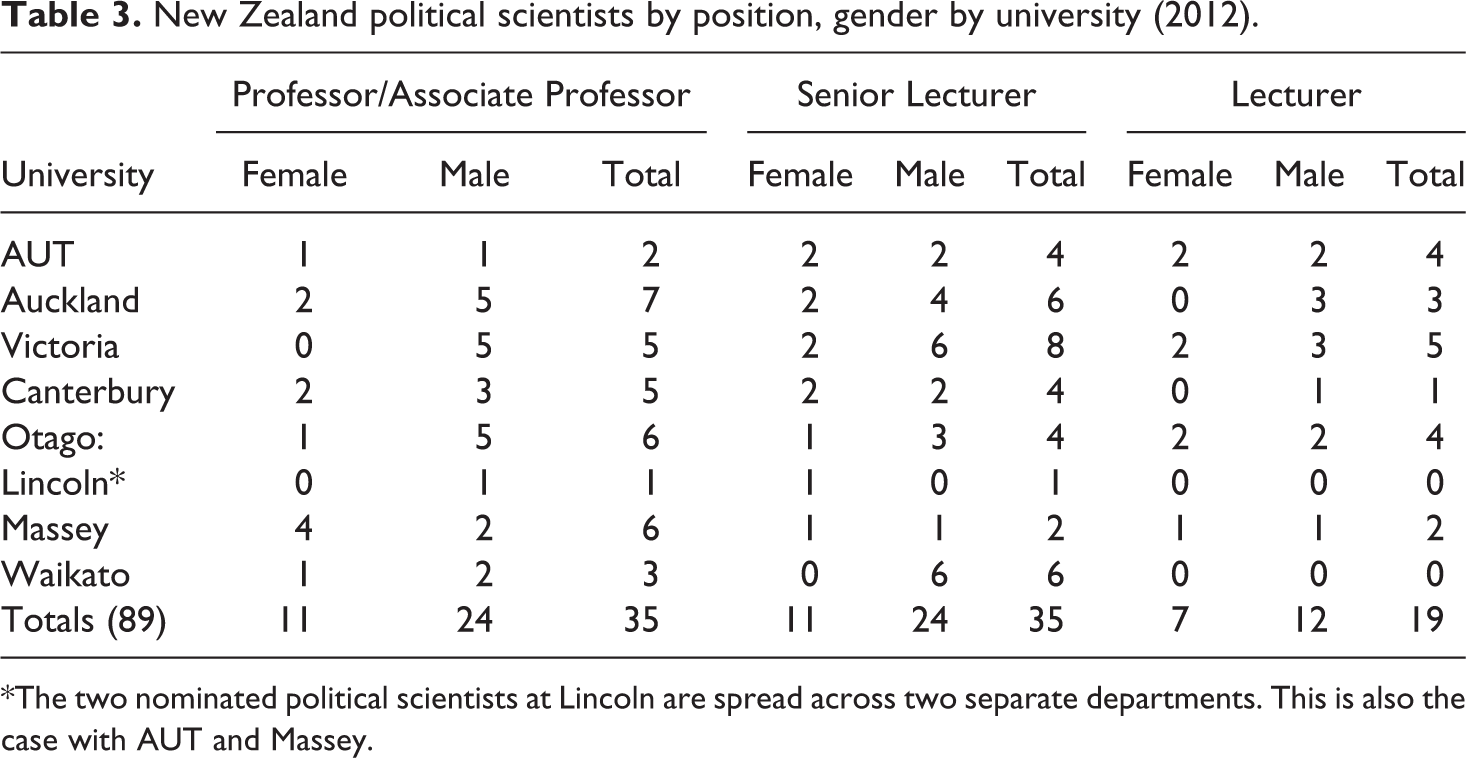
In terms of the distribution of women across departments, Tables 2 and 3 demonstrate that Auckland University of Technology (AUT) and Massey University have been the most successful in achieving gender parity (Lincoln University also fares well, but has only two political scientists). The University of Canterbury is also well above average, while University of Otago, The University of Auckland and Victoria University of Wellington (VUW) do less well. The University of Waikato currently boasts only one woman (11 per cent).
New Zealand universities ranked by percentage of female academics in political/social sciences (2012).

New Zealand political scientists by position, gender by university (2012).
*The two nominated political scientists at Lincoln are spread across two separate departments. This is also the case with AUT and Massey.
It is evident that Massey University, AUT and Lincoln University help to inflate the overall average for women in the discipline. Interestingly, the study of politics sits within broader interdisciplinary-oriented faculties in these three institutions. This location may provide a more female-friendly organizational culture because the disciplines they are housed with tend to have proportionally more women (sociology being the most obvious), 15 thereby diluting what has been referred to as an institutionally ‘chilly’ climate. 16 Massey University is also a leader in terms of the number of women employed at the level of professor and associate professor. By contrast, VUW and Lincoln had no women political scientists at these levels.
There are also mixed signs of progress at the rank of senior lecturer. For example, at the Universities of Auckland, Waikato and VUW there are significantly larger numbers of men than women located at the level of senior lecturer, meaning the pool of those eligible for promotion is not evenly distributed within or across institutions. This suggests it will take some time before a significant increase in the number of women professors via incremental promotion eventuates.
Tables 1 –3 offer a snapshot of the status of women in the profession in 2012, thus limiting what can be said about the progress of women in the discipline over time. Nevertheless, there are several points worth noting that offer an interesting context to the current picture. First, just as is the case with real politics and parliamentary representation, turnover matters. Several departments, such as those at VUW and The University of Auckland, have experienced considerable turnover in recent years, providing these departments with opportunities to hire more women. By contrast, there has been lower staff turnover at the University of Waikato, particularly at the senior levels. In this sense, low turnover can offer both possibilities and constraints. In departments where there is a significant proportion of women and low turnover, these women may be promoted to higher levels over time. However, in departments where there are few women and low turnover, the opportunities to hire new women are limited.
Second, different universities have responded in different ways to the Performance Based Research Fund exercise (PBRF) established by the government in 2002. The purpose of the PBRF evaluation is to assess the research performance of tertiary educational organizations in New Zealand by measuring the quality of individual researchers, the number of research degree completions and the generation of external research income. Research funding is then allocated to the institution according to the quality score they receive. In response, some departments have made strategic appointments at the upper levels to boost their discipline scores, while others have invested in their existing staff over the course of the six-year period between audits. While both strategies can be seen as institutionally viable, and are not mutually exclusive, overseas evidence suggests that strategic appointments at the level of professor are more likely to be awarded to men. This is in part because male academics are a larger proportion of those already at associate professor level, and tend to be more likely to move cities or countries to take up promotion. By contrast, female academics, especially those with children, may be less mobile and so more likely to seek promotion internally. 17 Women’s known lack of mobility could also prevent them from using external job possibilities to accelerate their career trajectory within their home institution.
Third, New Zealand universities are currently experiencing a period of limited staff growth; there is inadequate government funding to offset salary costs, meaning exiting staff may be replaced, but new positions may not be created. A lean economic environment reduces turnover and can stall the ‘pipeline effect’, identified as a key factor affecting women’s presence in the discipline, although again this will affect the employment of both men and women. 18
Indeed, the metaphor of the pipeline has been a common feature in studies seeking to explain the gender gap in academic appointments, particularly in the science and engineering disciplines. The argument is that institutional obstacles exist at multiple points along the pipeline leading to an academic position, causing the pipeline to ‘leak’ potential women doctoral graduates. It is thought that once these obstacles are removed, more women will complete doctorates and expand the female professoriate. 19 Data on the percentage of women undertaking doctoral studies in political studies and international relations is not uniformly available, but figures from the websites of The University of Auckland, VUW and The Universities of Otago, Canterbury and Waikato suggest women made up 37.2 per cent of doctoral scholars in 2012. 20
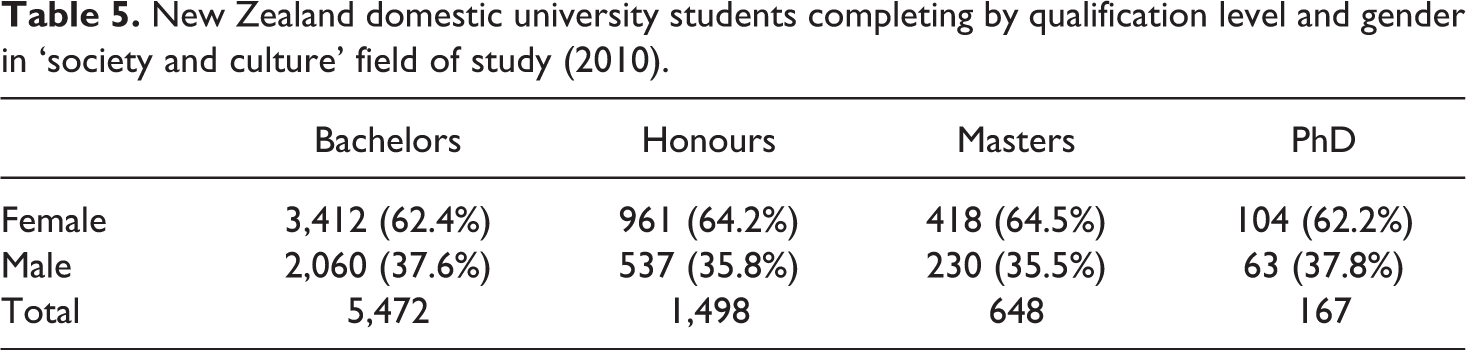
More generally, government statistics reported in Tables 4 and 5 indicate that in terms of domestic enrolments, women outnumber men at all levels of higher education, including PhD. This applies across all disciplines, and within the field of study categorized as ‘Society and Culture’. From this we could infer that political science and international relations do not appear to be as attractive to female PhD students as other doctoral subjects, which may in turn reflect a lack of inclusivity or diversity within the discipline’s research culture and curriculum (more on this below).
New Zealand domestic university students completing qualification by level and gender (all subjects, 2010).
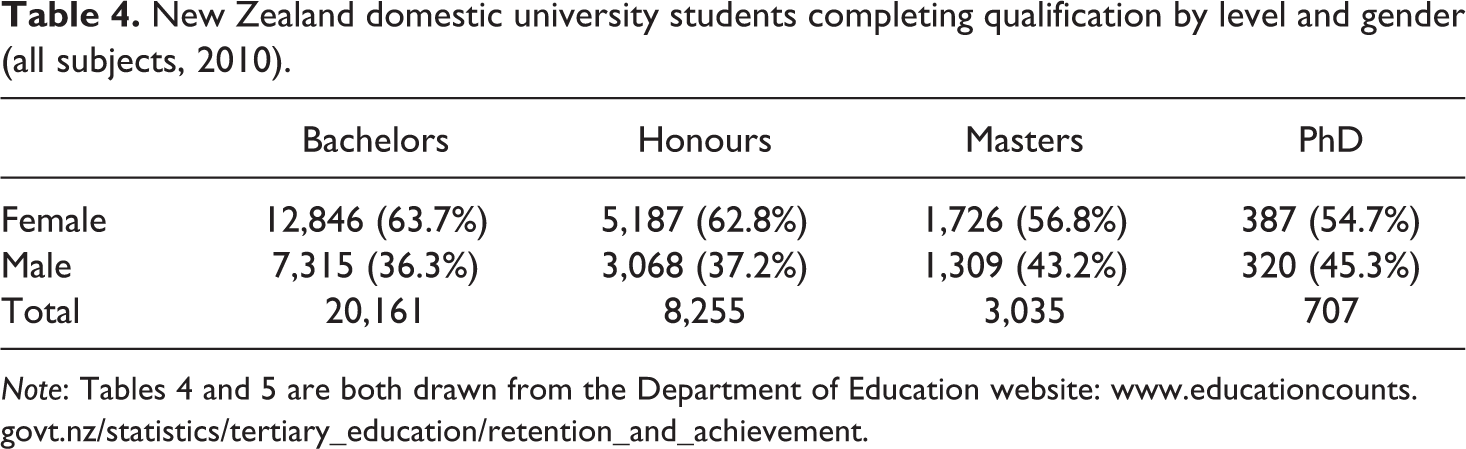
Note: Tables 4 and 5 are both drawn from the Department of Education website: www.educationcounts.govt.nz/statistics/tertiary_education/retention_and_achievement.
New Zealand domestic university students completing by qualification level and gender in ‘society and culture’ field of study (2010).
However, the number of domestic PhD graduates being produced in New Zealand may not necessarily be a strong indicator of a ‘leaky’ pipeline. The increasing recruitment of international PhD students in New Zealand means that a significant proportion of PhD graduates may return to employment in their home country (see Table 6). Moreover, the academic labour market has become increasingly global, while the number of available positions has shrunk worldwide. This means that open positions advertised at entry level attract applications from around the world, potentially preventing ‘home-grown’ doctoral graduates from finding their first academic position within New Zealand. Thus, to better understand the initial pipeline effect, future research will need to focus on pooling cross-national data to explore the extent to which this indicator is a key factor in explaining the status of women in the discipline.
Percentage of women enrolled as PhD students in political science by country, 2005−12.

Notes: These figures are a snapshot only, and are not fully comparable, as not all departments supplied data, and in the case of the United States the figure represents women graduating compared to the other cases where the figure represents women currently enrolled.
Data taken from: Plumb, ‘The Present Status of Women’; Bates et al., ‘Women in the Profession’; American Political Science Association, Women’s Advancement.
In comparative terms, New Zealand does appear to be slightly less successful in attracting female doctoral candidates than the UK, for example, and sits far behind Australia. However, it may be that our top women students are taking doctoral study opportunities overseas, with a view to returning to New Zealand at the post-doctoral level.
One recent UK study suggests that academic professions may be institutionally resilient to gender equality and inclusiveness, affecting PhD enrolments and retention. A study of chemistry PhD candidates indicates that women are choosing to leave academia because the characteristics of academic careers are unappealing (for example, women students feel isolated and believe future jobs will not be easily reconcilable with family commitments). Second, female PhD students are more likely than their male counterparts to lack self-confidence, in part because senior colleagues have told them to expect impediments because they are women. Finally, there are too few senior women available to act as mentors to counter these perceptions, symbolically or in practice. 21 These findings are consistent with similar studies undertaken in political science. For example, Kantola found in her study of a Finnish political science department that women PhD students felt invisible to male academic staff, less likely than male students to be supported by their (male) supervisors, and that feminist scholarship was not taken seriously. 22 There was also a sense that if they were to raise the issue of gender equality within the department they would be perceived as difficult, and so they tended to stay silent. Ten years earlier, a survey conducted for the Canadian Political Science Association revealed similar beliefs amongst women at junior levels. 23 Such findings are a reminder that the profession is not always perceived to be open and inclusive.
Making comparisons
The incremental increase of women in the profession in New Zealand is not dissimilar to patterns evident elsewhere (Table 7). Data from the United States reveal that there has been a 25-point increase over the past 30 years, most of which occurred between 1980 and 2000. Since that time there has been a smaller increase, with gains described as ‘glacial’ in their pace of improvement. 24 This replicates similar trends in Australia, Canada and the UK, where progress has slowed over the past ten years. By contrast, New Zealand began from a much lower base and took longer to address the hiring of women, but since the mid 1990s has made significant progress. Further research into the ‘invisible’ activism of existing women on staff would help to better understand this outcome. Research suggests that having women involved in the process of staff appointments is critical to ensuring gender is discussed and considered. 25 Similarly, the growth in women’s networks within the political science community in the region and internationally coincides with this increase in women’s presence and thus may be a contributory factor. 26
Percentage of women in the discipline by country (1975−2012).
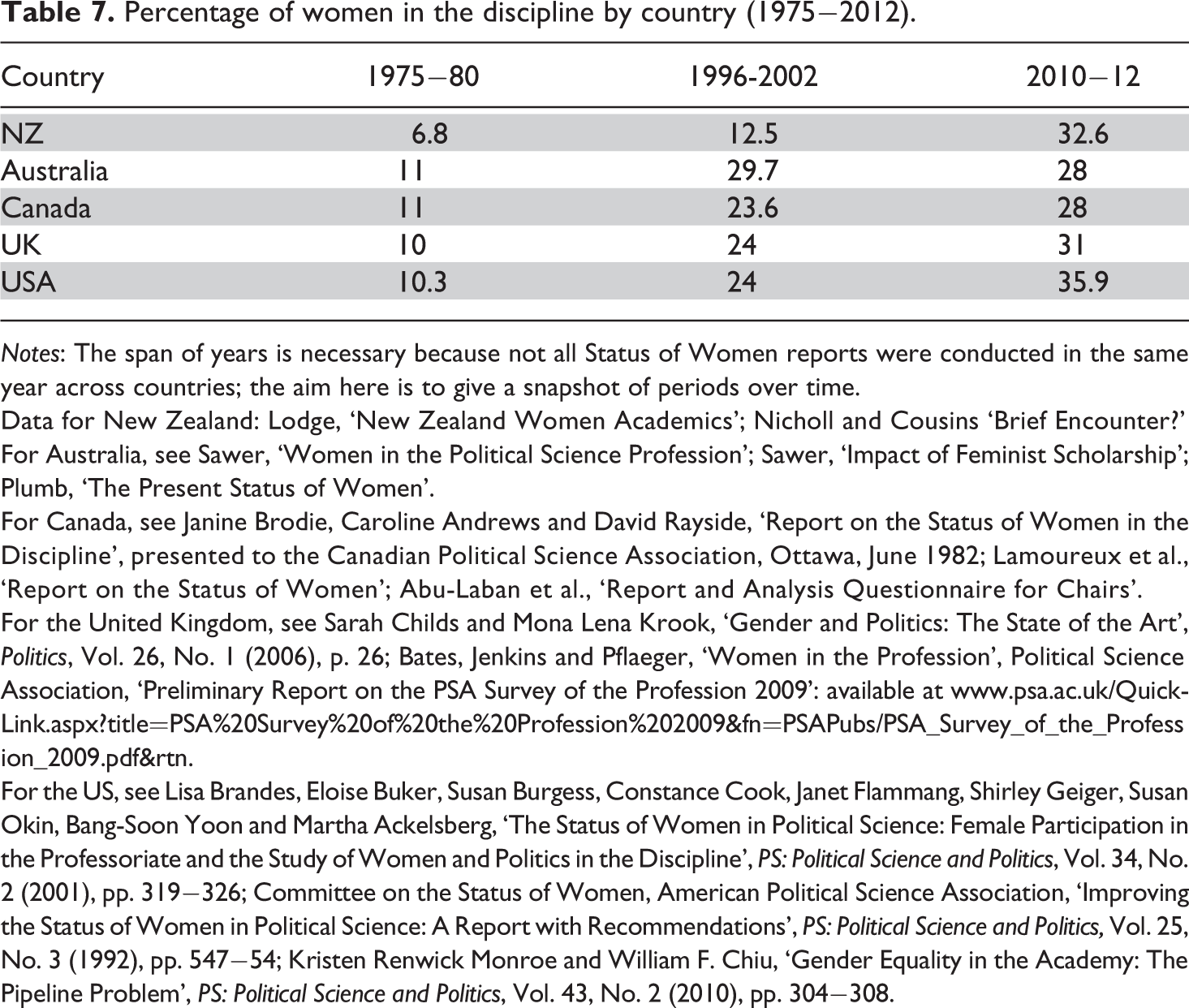
Notes: The span of years is necessary because not all Status of Women reports were conducted in the same year across countries; the aim here is to give a snapshot of periods over time.
Data for New Zealand: Lodge, ‘New Zealand Women Academics’; Nicholl and Cousins ‘Brief Encounter?’
For Australia, see Sawer, ‘Women in the Political Science Profession’; Sawer, ‘Impact of Feminist Scholarship’; Plumb, ‘The Present Status of Women’.
For Canada, see Janine Brodie, Caroline Andrews and David Rayside, ‘Report on the Status of Women in the Discipline’, presented to the Canadian Political Science Association, Ottawa, June 1982; Lamoureux et al., ‘Report on the Status of Women’; Abu-Laban et al., ‘Report and Analysis Questionnaire for Chairs’.
For the United Kingdom, see Sarah Childs and Mona Lena Krook, ‘Gender and Politics: The State of the Art’, Politics, Vol. 26, No. 1 (2006), p. 26; Bates, Jenkins and Pflaeger, ‘Women in the Profession’, Political Science Association, ‘Preliminary Report on the PSA Survey of the Profession 2009’: available at www.psa.ac.uk/QuickLink.aspx?title=PSA%20Survey%20of%20the%20Profession%202009&fn=PSAPubs/PSA_Survey_of_the_Profession_2009.pdf&rtn.
For the US, see Lisa Brandes, Eloise Buker, Susan Burgess, Constance Cook, Janet Flammang, Shirley Geiger, Susan Okin, Bang-Soon Yoon and Martha Ackelsberg, ‘The Status of Women in Political Science: Female Participation in the Professoriate and the Study of Women and Politics in the Discipline’, PS: Political Science and Politics, Vol. 34, No. 2 (2001), pp. 319−326; Committee on the Status of Women, American Political Science Association, ‘Improving the Status of Women in Political Science: A Report with Recommendations’, PS: Political Science and Politics, Vol. 25, No. 3 (1992), pp. 547−54; Kristen Renwick Monroe and William F. Chiu, ‘Gender Equality in the Academy: The Pipeline Problem’, PS: Political Science and Politics, Vol. 43, No. 2 (2010), pp. 304−308.
Table 8 presents the percentage of women at each level as a proportion of the whole profession (rather than as a proportion of their level), thereby demonstrating where the glass ceilings are evident. In making cross-national comparisons, the ‘American’ categories have been applied and associate professors and senior lecturers combined to enable an international comparison, with several points worthy of note. First, at no level is there gender parity, although the gaps are smallest at the entry-level positions, and only in the United States is the gender gap less than 5 percentage points. Second, the gender gap widens as the ranks rise – in New Zealand, Australia and the UK there is at least an 11 percentage point gender gap at the associate professor/senior lecturer level, although in New Zealand the proportion of both men and women in these positions is comparatively high. Third, and most glaring, however, is the significant gender gap at the most senior level, a feature of all four countries. Such a gap is troubling, given that the overall pool of possible professors has grown cross-nationally since the 1980s (Table 7). This suggests that feeding more female doctoral graduates into the ‘pipeline’ will not necessary solve women’s under-representation at the upper levels.
Political scientists by level and gender (%).

Notes:
*Totals are not 100%; the remainder incorporates graduate teaching assistants or the equivalent. It worth noting that in this category the numbers of women and men are about even, suggesting that it is at the point of accessing tenured positions that the gender gap begins.
**Australian associate professors are included in the professor category here and not the senior lecturer category as the raw numbers are delineated in this way by Plumb, ‘The Present Status of Women’.
***Doctoral (research) institutions only. Women are better represented at less highly ranked universities and colleges at all academic levels (see Monroe and Chiu, ‘Gender Equality in the Academy’).
In order to make comparisons with available data from the US and the UK, the three levels of professor, associate professor and assistant professor have been used here. Plumb, ‘The Present Status of Women’; Bates et al., ‘Women in the Profession’; Monroe and Chiu, ‘Gender Equality in the Academy’.
International research suggests that women are more likely to experience a ‘chronological crunch’ that can impede their progression through the ranks to full professor. 27 The nature of an academic career means the most intense demands for research, publications and administrative service to achieve tenure (in the US system), or to progress consistently within each grade in order to be promoted, overlap with the years of heaviest family responsibilities. Research suggests that these family responsibilities will impact more heavily on women than men in the profession. 28 In response, it is argued that organizational heads need to be cognizant of the impact of this ‘chronological crunch’ and provide mentoring and support, and ensure negative perceptions are not tied to those who take family leave and are having to juggle other family responsibilities. Otherwise women will be more likely than men to leave the profession, to opt for less research-intense (and thus less prestigious) institutions, or forfeit an ambition for promotion. 29
In conclusion, there is visible progress in terms of the percentage of women within the profession in New Zealand – there has been a significant increase over time, particularly over the past 15 years, and the proportion of women political scientists is similar to rates in comparable countries. Less promising is the rather minuscule rise of women to professor in New Zealand, although as a country we are not alone in this. While we cannot say anything about gendered trends in promotion in New Zealand because we lack data over time, the number of women who have become full professors here is paltry, at best. Evidence from the American and Canadian Political Science Association reports previously cited suggest that while there might be pipeline leaks, women who choose to stay continue to face implicit discrimination and gender-specific barriers to progression through the ranks. The New Zealand data in this article provide a useful baseline from which future studies can measure whether the profession here reflects trends elsewhere. Finally, it is important to recognize that women are a heterogeneous group, and to date we have focused primarily on gender equity in departments. Both the American and the Canadian PSAs have expanded their focus to include tracking the careers of visible minorities and those with disabilities. In the case of New Zealand political science, while there is a strong desire among some in department hierarchies to hire more international staff, attention also needs to be given to the representation of Māori and Pacifica scholars within departments.
Women’s contribution to disciplinary research
Research productivity and impact has always been a significant component of career promotion in New Zealand, although the demand for research outputs has intensified with the PBRF exercise. The research productivity of an individual researcher is the largest component of this exercise, and while the scores of individual academics are released to the institutions, they are officially anonymous, thereby precluding a gender analysis of results. 30 The individual quality score is measured primarily by research outputs (publications), with smaller weightings given to peer esteem and contributions to the research environment. A section labelled ‘special circumstances’ allows staff who have been on extended leave or who are working part-time to have this taken into consideration in relation to the quantity of outputs produced. However, no ‘stop the clock’ policy exists for those who are juggling caring responsibilities with working full-time, and the limited research that exists on the gendered effects of the PBRF suggest women scholars find it a daunting regime. 31
The quality of research outputs is measured by citation levels and/or the relative rankings of the discipline’s journals (and assessed through peer review). In political science, it is the quantitatively oriented American journals that feature at the top of the international impact factor lists, while regional and thematically oriented journals are less highly ranked. Research demonstrates that women have increased their representation over time in the top American discipline journals. For example, in the American Political Science Review, just over 2 per cent of the authors were female between 1954 and 1973, while between 1974 and 1994 11 per cent of contributions were authored by women. 32 This had increased to 26.4 per cent by 2009, indicating that in the United States at least, women’s publication rates were commensurate with their representation within the discipline. 33 However, across the four top journals, men were still significantly more likely to appear as lead author (83 per cent of the 54 per cent of articles with multiple authors); male-only collaborations remained most common, and men were still more likely than women to publish independently.
While New Zealand scholars are pressed to publish their work internationally, the journal Political Science remains a key regional journal offering quality research and review essays. In addition to these important functions, journals such as Political Science convey an image of the profession, identifying to readers what constitutes ‘good’ political science, and in helping to form new fields of enquiry and new communities of researchers. 34 Although the journal was credited with having done an excellent job at enabling the publication of ‘coal-face’ scholarly and scientific research, particularly on New Zealand, it was the subfields most aligned with the editor’s academic interests that dominated the journal’s content during its formational decades. 35
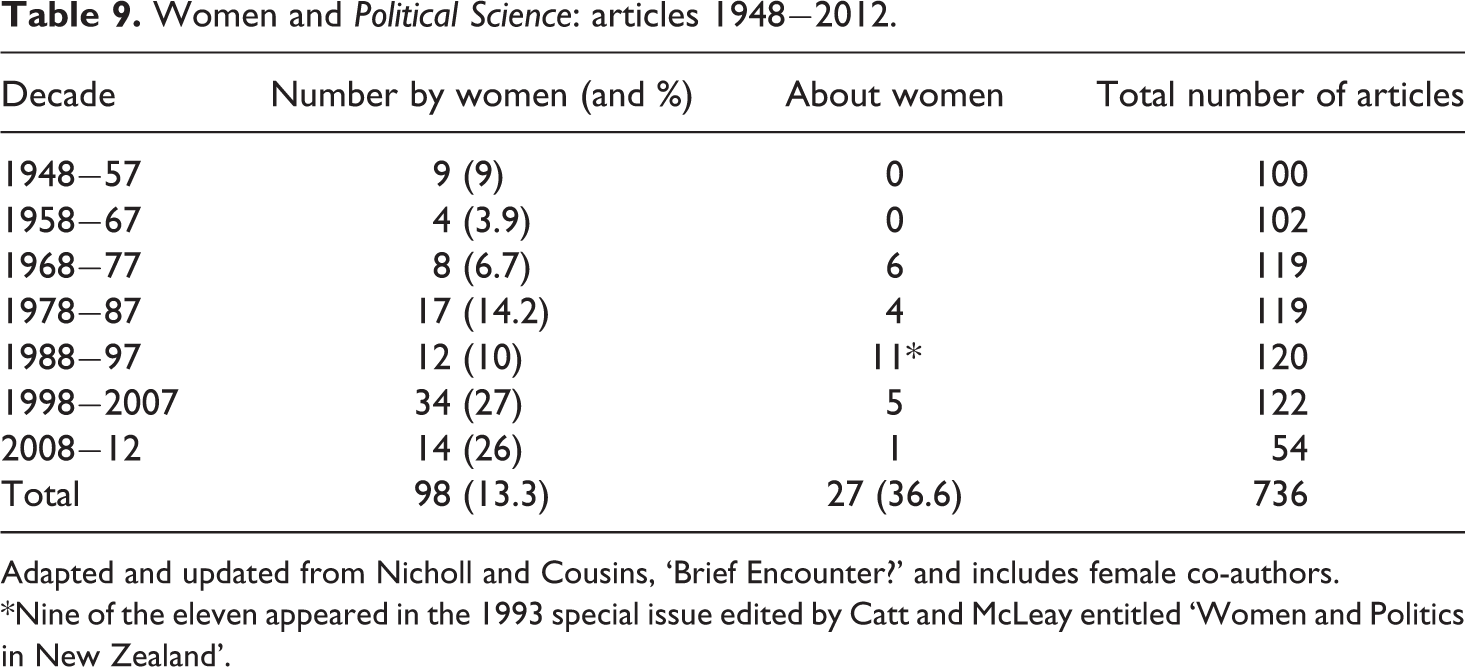
As part of the journal’s fiftieth anniversary in 1998, Nicholl and Cousins published an audit of Political Science and concluded that women had been treated badly by the journal, particularly prior to the 1980s. Women constituted a small percentage of authors (on average around 6 per cent prior to 1979) and numerous seminal works by and about women were overlooked in the book review section. Indeed, prior to 1988, only eight books about women had been reviewed by the journal (see Table 10).
Women were only 6.8 per cent of political scientists at that time and the journal solicited manuscripts from outside the discipline, drawing on a much wider pool of scholars, students and practitioners. Yet few were women, commissioned manuscripts for special issues rarely featured women authors, and no women were appointed to the first Editorial Advisory Board established in 1975, despite it being International Women’s Year. 36 Thus, from its inception, the journal reflected and reinforced the perception of New Zealand political science as a predominantly male community. 37
However, since the 1980s there has been an overall, albeit stuttering, increase in the number of women authors published – although this is partly a result of three special issues edited by women: the suffrage celebration issue edited by Helena Catt and Elizabeth McLeay (five of the nine articles were authored by women); the issue on local government edited by Jean Drage in 1999 in which five of the seven articles were authored by women; and Kate McMillan’s special issue on politics and the media (2005) in which six of the ten articles were authored by women (Table 9). Recent developments are promising – while the percentage of women authors is now at 26 per cent and so is not yet comparable to the proportion of women in the profession (32.6 per cent), there is an upward trend in the women’s publication rates since 1998. Similar developments are evident in terms of book reviews (Table 10). Women have become increasingly visible as reviewers, there has been a steady upturn in the reviews of books written and edited by women, and a significant increase in the number of books about women is also evident. However, it is worth noting that 75 per cent (25 out of 33) of these reviews were authored by women. 38
Women and Political Science: articles 1948−2012.
Adapted and updated from Nicholl and Cousins, ‘Brief Encounter?’ and includes female co-authors.
*Nine of the eleven appeared in the 1993 special issue edited by Catt and McLeay entitled ‘Women and Politics in New Zealand’.
Women and Political Science: book reviews 1948−2012.
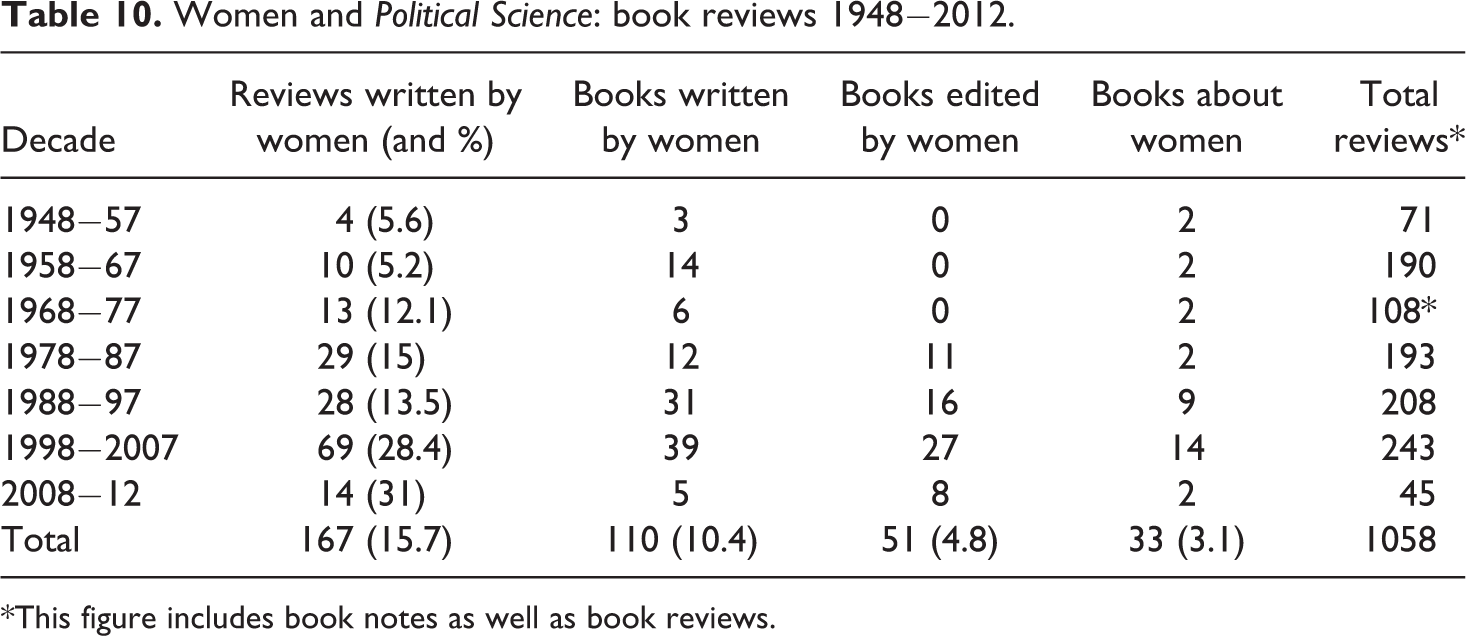
*This figure includes book notes as well as book reviews.
Nicholl and Cousins credit increases in women's publication rates to the commitment of the editors generally, 39 to the publication of work by graduate students, 40 and to the work of Margaret Clark (who was on the Editorial Advisory Board from 1977) and Elizabeth McLeay, who was the first woman to edit the journal (with Dr Paul Harris in 1992). 41 The issue of gender-inclusive editorial boards and the openness of editors themselves to gendered analyses is an important one given the latter’s influence on the direction of a field or subfield, as both gatekeepers and as role models. ‘Shoulder-tapping’ on current issues or for special issues is not an uncommon experience, 42 and editors are often in a position to give scholars a ‘critical nudge’ to submit papers for publication. However, this process of informal selection is most often directed to those within the editors’ social and professional networks. 43 So while it is often the case that contributors self-select, their decisions about where to submit an article (beyond the obvious factors of prestige and specialization of journals) can also be influenced by the knowledge of, or acquaintance with, the journals’ editors or its board members (if the latter have more than an honorific role). 44 Thus, unbalanced or under-utilized editorial boards, may favour certain groups over others and prevent the publication of a full range of research topics and methodological approaches. In 2011, the new co-editors, Kate McMillan and David Capie from VUW, established a rejuvenated editorial board, which includes seven women out of 16. 45
Political Science’s record on publishing and reviewing works on women, however, has proved less positive (Tables 9 and 10). Since the 1970s, research on the women’s movement, feminist political theory and methodologies, gendered institutions, and gender as a central analytical construct in understanding political power (as opposed to sex as a variable in electoral behaviour) has become increasingly relevant to a large number of, primarily, women political scientists. For example, in 2009 the European Consortium for Political Research’s Standing Group on Gender and Politics held its inaugural biennial European Conference on Politics and Gender, attracting 300 scholars from around the world; the third such conference in 2013 had 500 participants registered. At the International Political Science Association Congress in 2012, the three dedicated research committees working on aspects of feminist politics 46 had the second-highest number of panels after the Public Policy Research Committee. In addition, the journal Politics and Gender, launched in 2005 and endorsed by the American Political Science Association, was ranked sixth among the 139 political science journals included in the Institute for Scientific Information (ISI) ranking of journals by impact factor in 2010. This suggests that research scholarship on feminist politics, theory and international relations is thriving as a subfield. Less clear is the extent to which mainstream political science engages with this research and recognizes its value in research audit exercises. 47
Although feminist journals or gender-specific special issues (such as this one) may be an example of ‘compartmentalization’ of the subfield of feminist political science, and bemoaned as such by some scholars, these volumes remain an important avenue for the promotion of scholarship on women and by women. This is particularly so if such scholarship is seen by traditional political scientists as marginal to the discipline. Yet, in the New Zealand case, such volumes have been few and far between. Indeed Moloney was being optimistic when he noted that the special issue on women and politics edited by Catt and McLeay in 1993 signalled the importance with which ‘gender’ is regarded in the academy in New Zealand. 48 For example, the visual representation of the journal’s contents produced by Tan, Buck and Schrader ten years later underscores this point – while the term ‘women’ appears in the word cloud portraits between 1980 and 1989, and again, alongside the word ‘gender’ between 1990 and 1999 (periods that featured special issues), neither ‘women’ nor ‘gender’ appeared in the cloud portrait for the period 2000−2008. 49 Table 9 reveals that only 5 per cent of the journal articles published between 1968 and 2012 have been on the topic of women and politics, and there has been little change in the absolute number that have appeared in each ten-year period.
In addition, there are still very few books about women, gender or feminism being reviewed. Nicholl and Cousins noted some glaring omissions between 1963 and 1996 and although 14 books about women were reviewed in the decade between 1998 and 2008 (Table 10), only four on the topics of women/gender/feminism received a review in Political Science between 2002 and 2012. While a cursory overview of the types of books reviewed in Political Science suggests that New Zealand topics may be favoured, this is not uniform. Books published on feminist political theory, the descriptive and substantive representation of women, the advent of gender quotas, gender and development, and gendered institutional analysis also warrant review, signalling to scholars and graduates in New Zealand and elsewhere that Political Science is inclusive in its brief. Journals are often limited by what publishers choose to distribute, but this does not prevent the journal soliciting feminist works to review.
Elsewhere audits of discipline journals indicate a tendency to separate out research on women from ‘core’ political science research, labelling it ‘women’s studies’ or categorizing the subject as ‘miscellaneous’. 50 Thus, the categorization of political science into traditional subfields, perhaps unwittingly, has reinforced the trend for mainstream political scientists to ignore the contribution of feminist political science. 51 It also conveys a negative message to scholars working on politics and gender or feminism, and the associated methodological and epistemological analysis they offer, that such scholarship is marginal to the broader direction and development of the discipline.
Gender and the political science curriculum
How best to incorporate gender politics and feminism into the teaching of core political science and international relations for undergraduate students has long been an important focus for feminist political scholars. In Australia, the APSA Women’s Caucus was pioneering in its efforts to ‘mainstream’ gender content, sponsoring a resolution at the Association’s annual general meeting in 1981 that the study of women should be incorporated into all politics courses. The motion was passed, and various audits of course guides and textbooks followed, demonstrating mixed results. 52
Similar initiatives were also evident elsewhere. In 1991, the pedagogical practice of gender mainstreaming was recognized by the American Political Science Association as one of 11 recommendations for reforming the undergraduate political science curriculum. However, while the intention was admirable, no systematic data have been collected on its implementation, making it difficult to assess whether departments have developed mechanisms and guidelines to support the integration of gendered content. 53 Papers presented at a one-day International Political Science Association World Congress workshop in 2012 indicated that there had been little progress in terms of ‘mainstreaming’ gender in teaching across the discipline. Rather, the integration of gendered content appears to be undertaken primarily by academic staff who themselves have gender research interests. A further review of this topic was discussed at the European Conference on Politics and Gender in March 2013.
There are several reasons why New Zealand scholars should consider gender mainstreaming in curriculum development. The American Political Science Association Taskforce on Political Science in the twenty-first century argues that the discipline’s pedagogical practices and content need to diversify and become more comprehensive, given the increasing diversity of the student body. Otherwise, political science courses that focus solely on ‘great men’, leaders or thinkers, without recognizing the gendered dimensions associated with the interpretation of such ‘greatness’ may reinforce a sense of marginality already experienced by female political science majors, and potentially harm recruitment. In addition, the relevance to the discipline of gender as an analytical construct (rather than simply sex as a variable in electoral behaviour) is intellectually important in its own right. Incorporating gender asks students to consider that institutions and policies are seldom constructed as gender-neutral, that gender may inform the distribution of political power, and that theoretical and empirical questions are asked from a particular standpoint that is informed by one’s subjective (and gendered) position.
In New Zealand, there appears to have been little discussion of gendering curriculum content beyond individual initiatives by academic staff. A website survey of the first-year course summaries in political science and international relations was undertaken by the author in June 2012. (Full course syllabus audits were not available online.) Of the 25 first-year courses on offer across eight New Zealand universities, only three made any mention of gender, sexuality or women: two of these were courses taught by women, and two were political theory courses. No mention of gender as an analytical construct or feminism as a social movement or ideology appeared in any of the summaries outlining the introductory courses on New Zealand politics or political science generally as a field. 54
Textbooks are also an indicator of the ‘state of the discipline’, and important in that they convey to students, particularly those in the first year, what key ideas, evidence and methods will matter in their future studies and research decisions. While no comprehensive gender analysis of New Zealand textbooks exists, two texts were included in the Australasian textbook review undertaken by Elizabeth Harman and Janice Dudley in 1996. 55 Generally no books were rated highly in terms of their discussion of the women’s movement, feminist theory and women’s political representation. Mulgan’s book Politics in New Zealand did fare better than most (and was used by three of the six NZ departments surveyed), with his chapter on the composition of New Zealand society including some discussion of gender as a distinctive and significant cleavage. He also identified competing feminist perspectives and made reference to women’s issues and political interests. Since that time, the presence of chapters on women, gender and feminism have fluctuated. Early editions of Raymond Miller’s New Zealand Government and Politics featured a range of chapters on the women’s movement, feminist ideology and women and politics, authored by women, but over time these have disappeared. 56 Indeed the index to the 2010 edition of the textbook features fewer references to feminism, gender or women than Mulgan’s book. By contrast, as the subject of gender politics has decreased in visibility, the number of women contributors to the Miller edition has trended upwards. This has ensured that students are exposed to a wider range of women political scientists than in earlier years. 57 However, this does not justify ignoring reputable feminist scholarship in the study of political institutions and political power. New Zealand is not alone in this regard. In the introductory texts used to teach American politics it is recognized that race, ethnicity and gender are treated as marginal rather than woven aspects of the political system. Thus the research and strategies currently being considered by American political scientists on how best to integrate gender into the core curriculum (beyond individual lecturer initiatives) warrant consideration. 58
Reflections on future action
New Zealand has made considerable progress in increasing women’s presence in the political science profession over the past 20 years. Women make up a third of tenured staff across the country, and have begun to reach senior levels within the discipline, although promotion to full professor remains rare. The New Zealand Political Studies Association has long since welcomed women, with its own caucus and guaranteed representation on the executive, and women presidents have become a regular feature. In 2012, the Association approved the establishment of a formal gender politics section and helped to fund the 2012 ‘Women’s Advancement in the Discipline’ workshop. 59 This suggests that the profession (as represented by the Association) does not feature a ‘chilly climate’, but nor does it mean that individual departments or schools are female-friendly environments. Moreover, in terms of recognizing the contribution of feminist political science and international relations scholars, transformation remains a long way off. The teaching of gender, feminism and intersectionality should not be left to sociology, especially given the burgeoning and highly respected feminist political science scholarship available internationally in both books and journals. And while Political Science is a journal to which women scholars are choosing to send their work, it is not yet considered a ‘natural’ outlet for research on gender politics and policy. Securing solutions to these issues are tasks that women in the discipline are working on, but ultimately it will be the responsibility of the whole profession. By revealing the current ‘state of the discipline’, this article provides a benchmark for the future gender monitoring of women’s employment, research and teaching, but also aims to prompt further debate on how best to (re-)gender our disciplinary culture and practices.
Footnotes
Acknowledgement
My thanks go to Stacey Berquist for her assistance with data collection and to Yasmeen Abu-Laban, Elizabeth Evans, Mona Lena Krook, Fiona Mackay and Linda Trimble for their assistance in tracking down international data. Thanks also to the New Zealand Political Studies Association for funding some of the primary research.