



Abstract
The literature on political participation lacks a baseline model of electoral turnout. Various studies, which employ different sample sizes, time periods, cases and operationalisations of relevant independent variables, produce contradictory results. To shed light on these diverse findings, I evaluate whether different levels of development trigger different turnout functions. Not only do I find that highly developed countries have the highest levels of citizen participation in elections, but my results also illustrate that the turnout functions in high-income and low/medium-income countries are quite dissimilar. Compulsory voting and decisive elections have a different impact in the two universes of cases.
Introduction
Elections are instruments of democracy. Arguably, more than any other feature (e.g. political rights and human rights), competitive, free and fair elections are a clear reflection of a state’s commitment to democracy. 1 Through elections, citizens can choose and oust policymakers, thereby influencing political outcomes. High voter participation gives legitimacy to those in power, increases the authority of the democratic system as a whole and leads to less violence and instability. 2 In contrast, the presence of large amounts of citizens who do not fulfil their civic duty by casting ballots is generally viewed as a sign of apathy towards the democratic system. 3 This apathy can give momentum to extremist forces (e.g. radical rightist or leftist groups) that might try to undermine the democratic consensus in a given nation. 4 In addition, low voter turnout decreases the representativeness of a political system because those cohorts of the population that do not turn out are typically not represented. 5 This further implies that their preferences are not considered in the political debate. 6
The effects of turnout for the health and well-functioning of a democracy have triggered a large body of literature in both US politics 7 and Comparative Politics. 8 These studies link turnout to institutional variables, such as compulsory voting laws or the electoral system type, party system characteristics (e.g. the number of parties that win seats), socio-economic variables like gross domestic product (GDP) per capita, and contextual factors (e.g. the decisiveness of the electoral race). However, despite the fact that many studies point towards the importance of institutions in explaining and predicting macro-level trends in political participation, there is no baseline model of voter turnout that functions regardless of time and space. 9
Why do studies focusing on one particular context (e.g. one region) or on one particular time frame (e.g. a cross-sectional analysis of one year) sometimes produce different results pertaining to the relative and absolute importance of institutional, socio-economic and contextual factors? One reason might lie in the various developmental levels of states. In the aggregate, citizens in rather less developed countries tend to be less educated, have lower material security and may embrace different goals and beliefs than citizens in rich or highly developed countries. It is probable that these variations in wealth, education and cultural values yield different dynamics that, in turn, might affect turnout.
Equipped with a data set that covers turnout rates, as well as eight theoretically informed covariates for all parliamentary elections in all countries that have held legislative elections between January 1970 and December 2012 for which data are available, I determine whether developed countries have a different turnout function than less developed states. In conducting this study, I have two goals. First, and more practically, I want to disentangle whether the indicators that drive turnout are similar or dissimilar across various levels of development. Second, and more methodologically, I aim to evaluate whether building turnout models by pooling across all space and time periods or subdividing our universe of cases produces more accurate models.
The article proceeds as follows. The second section situates this study within the broad turnout literature and offers some descriptive statistics on turnout in the developed and developing world. In the third part, I introduce the data set used for this study and present the predictor variables that undergird the analysis. The fourth section focuses on the statistical procedures employed for the panel data analysis. In the penultimate part, I explain the results of the article. In addition to the fact that wealthier nations tend to have higher levels of citizen participation during elections, I find that the impact of various independent variables (e.g. compulsory voting and decisiveness) on turnout differs between high-income and low/medium-income states. Finally, I summarise the main results of the article and provide some future avenues for research.
Existing studies on turnout
Powell’s contribution has laid the groundwork for the comparative study of macro-level turnout. 10 Focusing on 20 industrialised nations between 1960 and 1980, Powell finds three institutional variables – compulsory voting, a proportional electoral system type and more registered citizens – to be positively related to turnout. Subsequent studies by Jackman as well as Jackman and Miller, which also focus on Western industrialised countries, mostly confirm the aforementioned institutional factors, but add that close races and unicameral systems also entice citizens to cast ballots. 11 Blais and Dobrzynska are the first two scholars to broaden their analysis beyond wealthy industrialised nations. 12 Focusing on 324 elections in democracies around the globe between 1972 and 1995, these two scholars find turnout to be highest in small, densely populated countries, in which the national lower house election is decisive and close, as well as held under a proportional representation (PR) system with relatively few parties, where voting is compulsory and the minimum voting age is 21.
Since Blais and Dobrzynsk’s study, a host of macro-level analyses have attempted to determine the factors that drive macro-level turnout. Some of these studies have taken a global perspective. 13 Others have endorsed a regional point of view, focusing on Eastern Europe, 14 South East Asia, 15 Latin America 16 or, more traditionally, on Western industrialised countries. 17 These cross-national studies find rather solid evidence that compulsory voting is a key determinant for high turnout. 18 Although it is hardly surprising that mandatory voting laws increase electoral participation, there is no scholarly consensus on the relative and absolute salience of other institutional, social or contextual variables. For example, debates centre on whether turnout is higher in list proportional systems than in majoritarian systems or mixed electoral system types, 19 or whether the decisiveness and competiveness of the electoral race boost turnout. 20
The distinct findings that characterise turnout studies conducted in different parts of the world with different subsamples of countries suggest that election dynamics are embedded in a given region’s specific economic environment. It is possible that economic development influences the context in which voting occurs. For example, classical sociological approaches maintain that turnout should increase as a country modernises. 21 This theory sees higher levels of education and wealth to be positively correlated with increased support for democracy. These engrained democratic values should, in turn, lead to higher levels of political participation, both at the polls and through unconventional forms. 22
Conversely, value change theorists argue that the aforementioned theory only holds for developing countries. 23 According to Inglehart, the dynamics that link a state’s material wealth and its citizens’ likelihood to cast ballots in elections are different in wealthy industrialised nations as compared to industrialising countries. According to his value change approach or post-materialist thesis, economic development in wealthy countries is accompanied by social and cultural change, which causes an intergenerational shift in values from material ‘survival’ values to post-material ‘quality of life’ values. In such a post-materialist world, citizens ‘are more likely to demand participation in major decision making, not just a voice of selecting the decision-makers … mass politics are increasingly apt to be elite-challenging rather than elite directed’. 24 Implicit in this argument is that the change from material goals to self-realisation values might encourage people to abandon the polls and search for other, possibly non-conventional, forms of participation.
If the post-materialist thesis holds, electoral participation should actually increase with development and the maturation of democracy in less affluent countries. However, in affluent countries, the aforementioned post-materialist turn is likely to decrease conventional forms of political engagement, such as voting in elections. While these two theoretical arguments constitute two solid pillars in the political participation literature, scholars have failed to test the potentially different dynamics of the variable ‘development’ on turnout. Rather, most studies include the variable ‘GDP per capita’ as a proxy for development, either in its raw form or in the log transformation, in their models. Yet, these two ways of operationalising the variable, material wealth, do not take into consideration that the effects of the variable might actually change at a certain developmental level. Theoretically, this could explain why most studies find no impact of development on turnout. It might be the case that the positive impact that development has in rather low-income nations and the negative influence that the variable has in high-income nations cancel each other out, rendering the non-effect spurious. 25
To test the precise effect of the variable ‘development’ on turnout, I have developed a large-scale data set on turnout, development and eight theoretically informed control variables. I hypothesise that development might not only have a different influence on turnout in wealthier countries than in rather poor countries, but also interact with some other variables in the turnout function. In the following section, I present the data set, dependent, independent and control variables and explain how these might have a different impact on turnout in more affluent than in less affluent countries.
The data set and the variables
To gain some robust evidence both on the impact of development on turnout and on whether the same factors affect turnout in developed and developing countries, this study draws on the largest possible data set, comprised of all legislative elections between January 1970 and December 2010. The data set contains more than 1000 observations from more than 160 countries for which data were available. There are approximately 250 observations with missing data on any of the independent variables discussed in the article. The cases for which I could not collect data (on all indicators) include some of the smaller states, such as the Pacific Islands (e.g. Marshall Islands, Federated Micronesia, Palau or Tuvalu), or small African, Asian or Latin American states, such as Guinea. Contrary to many other studies, 26 the data set used for this study also does not over-represent developed or Western countries. 27 In line with the empirical distribution of developed and developing countries, less than 33% of the data actually come from high-income states.
Following most of the literature on electoral turnout, 28 this study includes the dependent variable ‘turnout’ and the independent variable ‘development’, as well as eight controls commonly found in previous studies on turnout. These controls are organised into three categories: institutional, socio-economic and contextual. For each control variable, I describe the reason for its inclusion and explain the possible interactive relationships with development.
The dependent variable
Turnout, the dependent variable, is measured in the standard way as the percentage of registered voters that cast ballots in the national legislative elections of a country. 29
The independent variable
To measure the impact of development on turnout, I include two specifications. First, I include the log-transformed GDP per capita variable in the equation. 30 Second, and more importantly, I include a dummy variable coded 1 for developed countries and 0 otherwise. To code a country as developed, I use the World Bank’s classification. The World Bank sets the benchmark to define a country as developed at USD12,196. I adopt this standard and code all countries where the average citizen makes less than USD12,196 as of 2012 as 0 and all other countries as 1. The inclusion of this dummy variable has three purposes. First, it allows me to detect whether there is a difference in turnout between developed and developing countries. Second, through an interaction with the log-transformed GDP per capita variable, I can decode how increases in development relate to electoral participation in developed and developing countries. Third, I can interact this dummy variable with all other variables in the turnout function to find out whether the impact of these control variables changes for the two universes of cases, affluent and less affluent countries.
The control variables
Institutional factors
I include three institutional factors in the model: compulsory voting laws, electoral system type and the decisiveness of the election. Following the literature’s treatment of the first variable, ‘compulsory voting’, I hypothesise that in countries where voters are required by law to cast their ballots, political participation will be higher than in countries where no such laws exist. 31 I also conjecture that compulsory voting might have a stronger impact in developed countries because developing countries might not have the means and logistics to track down the people who failed to vote. Consequently, these countries might not be able to effectively punish non-voters. 32 To code a country as having compulsory voting laws, I have created an ordinal variable. 33 I code countries with mandatory voting and credible sanctions for non-compliance as 1, countries with compulsory voting laws, but no sanctions as 0.5 and countries with no mandatory voting as 0. 34
Electoral system type is the second institutional factor included in this analysis. As the number of votes a party receives roughly translates into the number of seats, I expect to see a positive relationship between PR and higher turnout. For one, citizens have few incentives to vote in a majoritarian system if they believe that their vote will be wasted on a candidate with little chance of winning or if they believe that there will be a predetermined winner. 35 In contrast, under PR systems, citizens frequently have more political alternatives from which to choose and know that their vote might matter because votes more directly translate into seats than under the majoritarian rule. 36
Moreover, based on previous research, I expect the relationship between PR and turnout to be stronger in developed countries. 37 For example, Blais and Aarts report that research dealing with established Western democracies has consistently shown a positive impact between a proportional system and higher turnout. 38 However, these two scholars add that the same robust relationship between the two concepts does not exist in a wide universe of democracies, including many developing countries. Rather, they reason that in the developing world, it is possible that the influence of electoral system type might be trumped by other conditions, such as local concentrations of specific ethnic groups, non-institutionalised party structures or patronage. 39 To support this claim Brusco, Nazareno and Stokes, as well as Fox, demonstrate that the prevalence of clientelistic networks in certain developing countries, including Angola and Benin, shapes political behaviour, such as voting. 40 Based on these research findings, I hypothesise that electoral system type should have a stronger influence in developed countries than in less developed countries, wherein citizens may be more reliant on political actors for goods or services and more inclined to trade votes in exchange for various services and ‘pork’. 41 To capture the three main existing electoral system types, I distinguish between PR (including mixed-member proportional (MMP)), mixed-member systems and plurality/majority systems, creating two dummy variables. First, I code all PR systems as 1 and all other systems as 0. 42 Second, I code all mixed systems as 1 and the remaining systems as 0.
As a third factor, I include the decisiveness of the electoral race in the equation. I hypothesise that high-stakes elections should increase turnout. 43 Stated simply, if all legislative and executive positions are filled at once, the stakes of the elections are higher than if they are not. Supporting this hypothesis, several studies, by relying on rational choice theory, have shown that decisive elections promote higher levels of turnout in industrialised countries. 44 The reason is that individuals may be aware of how their votes may impact political arrangements. This higher voter sophistication might stem from longer experiences with elections, more intensive campaigning and stronger media coverage in wealthy industrialised nations. However, these forms of outreach are less pervasive in developing countries, where voting might depend more on ethnicity and clientelistic networks.
As a measure of decisiveness, I use two proxy variables. First, I label any election as decisive (coded 1) if all executive and legislative seats are filled simultaneously. For example, all countries with parliamentary systems (e.g. Germany or Spain), as well as presidential systems (e.g. Venezuela), in which the parliamentary and presidential elections occur on the same day, fit this category. Second, I label an election as indecisive (coded 0), if part of the legislature and executive are chosen at different elections on different days. For example, the French president is selected at a different day than are the deputies of the National Assembly, so France’s legislative elections are coded as less decisive (or 0). 45 In addition, I include a dummy variable for unicameralism (coded 1). Contrary to bicameral systems, the legislature in a unicameral system does not have to share legislative powers with an upper house, which renders the lower house parliamentary election more decisive.
Socio-economic factors
The model also controls for country size. Despite the fact that the exact mechanisms connecting this factor with voter turnout remain disputed, I include this variable in the model because it might also interact with development. 46 I hypothesise that less developed large countries could especially suffer from low turnout. Industrialising states are frequently characterised by weak economic and political infrastructure and poor media coverage of political events; this should apply all the more the larger the distance from the capital. In addition, because of a lack of funds, it will probably be more difficult for parties in non-institutionalised party systems to do outreach and campaigning in regions that are far away from the centre of power. These two features could contribute to lower turnout overall in large developing countries. I operationalise the variable ‘population’ by the population size (i.e. the number of citizens living in that country) and transform the variable into its natural log. 47
Contextual factors
The first contextual factor that I include in the equation is the competitiveness of the electoral race. As a rule, races in which the expected margin of success between two contenders or parties is small trigger more campaign activity and media attention. 48 Voters are also more likely to be engaged through party outreach and media coverage during closely contested elections. In addition, voters see a higher intrinsic value of casting their ballots if they know that their vote could make a difference. 49 I hypothesise that competitive elections will have a greater positive influence on citizens’ likelihood to vote in industrialised countries as compared to less developed countries. For one, parties in less developed countries have fewer resources to reach voters throughout the country. Citizens also have less media access, which might imply that they do not even know whether or not the election is close. In addition, voting in developing countries might not be an act of rational behaviour, but rather depend on the aforementioned connections and networks. 50 The empirical analysis will show whether, and the degree to which, my hypothesis on a stronger influence of close elections on turnout in developed countries holds. The ‘closeness’ variable measures the vote difference between the winning party and the runner-up party. 51
Finally, I add a control variable for regime type and expect to see a positive relationship between a democratic form of government and turnout. A democracy allows citizens to choose their representatives and influence the policy direction of their country – two factors that should increase turnout. 52 I further hypothesise that turnout should be especially high in affluent democracies. A participatory climate should be most encouraged in rich democracies not only in relation to wealthy non-democracies, but also in relation to wealthy hybrid regimes or autocracies. For example, encouragements to vote, such as civic education classes, and the concept of civic duty are typically more present in Western democracies than in, for instance, wealthy Middle Eastern rentier states. The empirical analysis will show whether these participatory credentials will lead to higher turnout in the industrialised world. To classify different regime types, I follow the standard typology and differentiate between democracies, hybrid regimes and autocracies. 53 In more detail, I create two dummy variables with autocracies serving as the reference category.
Statistical procedures
To determine the influence of development on turnout, as well as whether the turnout function differs in developed and developing states, I engage in a three-step process. First, I run an independent samples t-test between turnout as the dependent variable and the development dummy as the grouping variable. This test provides an initial crude picture of the impact of development on turnout. Second, I graph the influence of the log GDP per capita variable on turnout separately for developed and developing countries to see whether material wealth’s influence on turnout changes between more affluent and less affluent countries. Third, and most importantly, I run two regression models with all of the aforementioned independent variables and with turnout as the dependent variable.
The first model is the pooled model and contains all data. In the second model, I aim to detect whether or not the turnout function is similar or dissimilar for developed countries with a GDP per capita of USD12,196 or more and all other countries. To this end, I interact this dummy variable for development with all of the other elements in the regression model. Any independent variable has a different impact in developed countries as compared to developing countries if the respective interaction term is statistically different. This entails that if many interaction terms display a statistically significant result, then the two turnout functions are distinct. In contrast, if none or few of these interactions display some variation, then it is safe to conclude that the turnout function is very similar between developed and developing countries. In this case, pooling across all observations is a viable option. If not, it is probably a viable option to see developed and developing countries as two universes of cases with distinct turnout functions.
The equation for the first model is as follows:

To ensure some proper modelling procedure of the pooled time-series data, I undertake several tests. First, I test the order of integration of the dependent variable. A Fisher Test illustrates that the dependent variable in all three models is stationary, which signifies that I can continue the analysis at the unit level (i.e. stationarity implies that the dependent variable does not explode, but is rather clustered more or less around the same mean). 54 In a second step, I test for two further violations of the classical linear regression model, namely, autocorrelation and heteroscedasticity. A Durbin’s ‘m’ test reveals serial correlation in the disturbance term for all regressions. 55 To eliminate this first-order serial correlation in all models, I employ a first-order autoregressive model (the Prais Winsten transformation). 56 Finally, I detect the presence of heteroscedasticity with the help of the White Test, which indicates that the null hypothesis that the variance across all observations is similar or homoscedastic must be rejected for all the four equations. 57 To eliminate heteroscedasticity, I proceed with robust Huber–White standard errors, which I cluster per country. 58
Results
Some rather straightforward empirical evidence suggests the possibility that the turnout function might actually differ between affluent and less affluent countries. First, I find turnout to be lower in less developed countries than in developed countries. From the period between January 1970 and December 2010, turnout rates in 774 elections in medium- or low-developed countries averaged 68.5%, whereas the mean participation rate in 462 elections in highly developed countries during the same time period stood at 76.3%. 59 An independent samples t-test indicates that this difference in means is statistically different (the t-value is 8.34 and the significance level > .001). This argument falls in line with recent evidence. For instance, Karp and Banducci claim that compared to rich countries, citizens in poorer states are less likely to be contacted by parties and candidates and are consequently less likely to be engaged in the political process. 60
In addition to the higher numbers of citizens who turn out on election day in more prosperous countries, development appears to have a different impact in the two subsets of countries. Figure 1 illustrates the impact of the log-transformed GDP per capita variable on turnout for both developed and developing countries. We see that there is a statistically significant negative relationship for all countries whose GDP per capita exceeds USD12,196 (Figure 1A) and a slightly positive, but non-significant, relationship for states that are deemed as ‘developing’ by the World Bank (Figure 1B).

The relationship between log GDP per capita and turnout in developed and developing countries.
The distinct empirical relationships between material wealth and citizen participation in the two subsets of countries imply that there might be distinct dynamics at stake when it comes to explaining and predicting turnout. The results of the multivariate regression models (see Table 1) confirm that this is the case. First, Model 1 indicates that development by itself leads to higher turnout: the first equation predicts that developed countries have approximately nine points higher citizen participation at elections than developing countries if we hold all other variables constant. However, the models also indicate that while in low- and medium-developed countries, log GDP per capita’s impact is basically nil, the indicator has a strong negative impact in developed countries. The interactive model predicts that in wealthy states, a one-unit increase in the log of the GDP per capita leads to a four-point decrease in turnout. In particular, this latter finding indicates that modernisation has a sizable positive effect in developing countries. However, the same positive relationship is not present in affluent states. It seems that if rich countries continue to increase their wealth, some citizens in search of post-materialist and self-realisation values (e.g. gender equality and the protection of the environment) might abandon the electoral booth and possibly engage in more direct forms of political action, such as boycotts and demonstrations. 61
Regression results for national turnout.
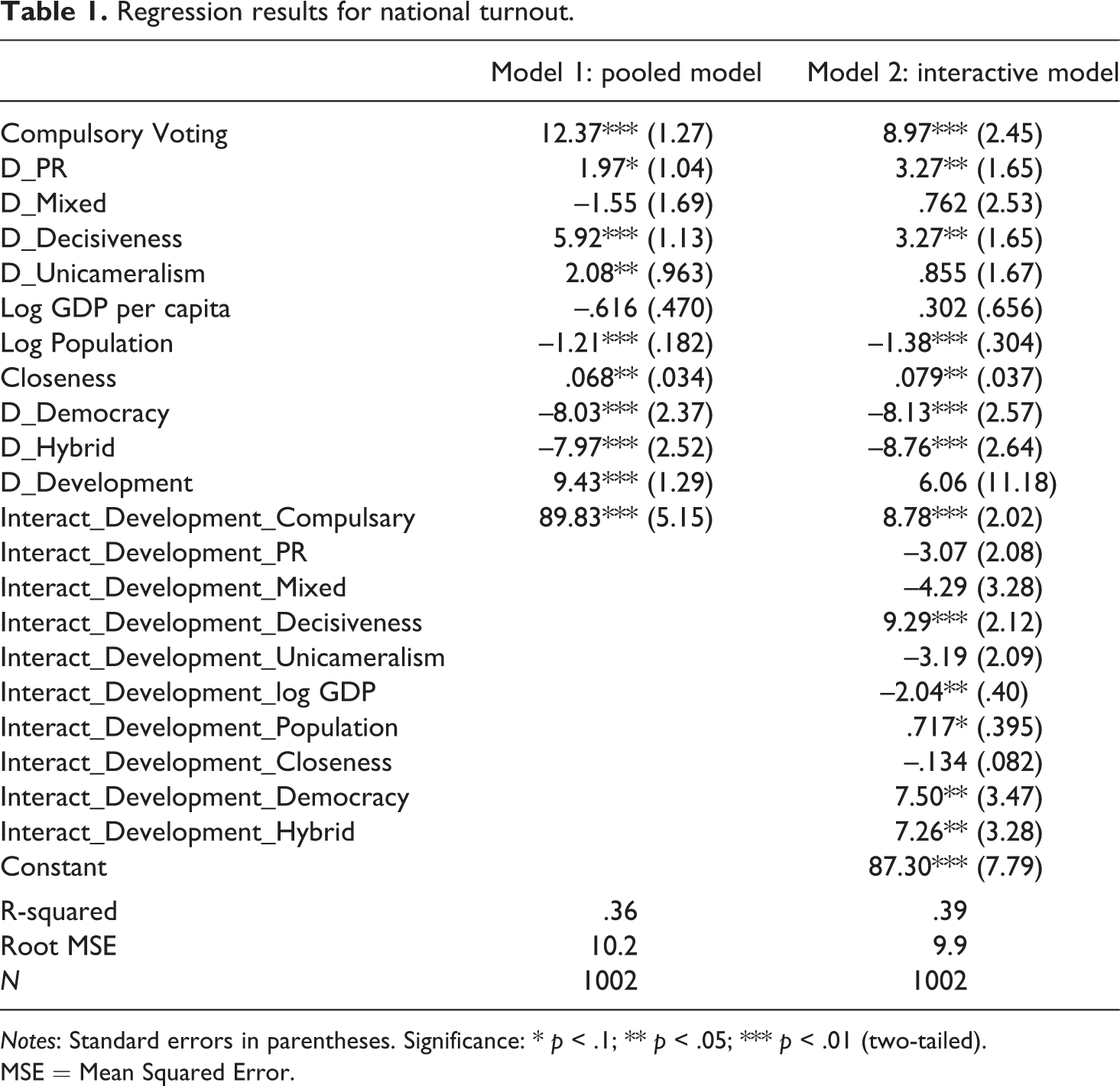
Notes: Standard errors in parentheses. Significance: * p < .1; ** p < .05; *** p < .01 (two-tailed). MSE = Mean Squared Error.
With some exceptions, the other independent variables mainly behave as expected in Model 1. On the one hand, PR, unicameralism and a small population size boost turnout. On the other hand, and rather surprisingly, this study does not find democracies and hybrid regimes to have higher turnout than autocracies. This might stem from the fact that some autocracies ‘unofficially’ force their populations to cast their ballots or rig turnout numbers. For example, the former communist states of the Warsaw Bloc before 1990 (e.g. Poland or Bulgaria) or current less developed autocracies, such as Cuba and Laos, have officially reported turnout figures that surpass 95%. It is likely that these cases somewhat drive the results of the variable ‘regime type’. 62 The final variable, ‘electoral closeness’, has an opposite than expected sign. However, the factor’s substantive influence is negligible. The model predicts that for each 10 percentage points by which the gap between the winner and the runner-up increases, turnout decreases by a mere 0.7 percentage points.
Second, and equally importantly, there are fundamental differences in the two turnout functions. The interactive model indicates that compulsory voting and decisive elections have a significantly different impact in the two universes of cases. Pertaining to the first of these two indicators – compulsory voting – the interactive term predicts that turnout is nearly nine points higher in developed countries that have mandatory voting clauses as compared to developing countries with the same stipulation. As hypothesised, it might well be the case that poorer countries such as Egypt or Ecuador lack the financial means to enforce and control their mandatory voting legislation. Moreover, the impact of the indicator ‘decisiveness’ nearly triples in developed countries. In those countries where GDP per capita is below USD12,196, decisive elections lead to a mere three-point increase in citizens’ electoral participation. However, scheduling decisive elections in wealthy states triggers a more than 12-point jump in turnout. This result implies that the stakes of the election matter more in the developed world.
I also find that turnout is higher in developed democracies and hybrid regimes. In fact, the interaction terms for both of these variables indicate that turnout increases by more than seven points in industrialised countries in either hybrid regimes or democracies in contrast to autocracies. More indirectly, the higher involvement of the citizenry in the democratic process in wealthy democracies as compared to poorer democracies might explain why the former are more likely to consolidate than the latter. 63 Furthermore, Model 2 gives some credence to our hypothesis that a large population should depress turnout more in developing countries than in developed countries. The remaining interaction terms are neither statistically significantly nor substantively relevantly related to turnout. The influence of electoral system type, unicameralism and electoral closeness does not differ fundamentally in the two universes of cases, that is, some of the mechanical influence of institutions remains similar in developed and developing countries. (These results are robust with regards to some alternative specification, see Appendix 1).
Conclusion
Supported by some descriptive statistics (such as different turnout levels between the developed and developing world), a sound theoretical argument, modernisation theory and robust empirical evidence from two multivariate analyses, I find some evidence that development has a distinct impact on turnout in the developed and developing world. While states whose GDP per capita surpasses USD12,196 have more citizens turning out on election day, I also show that as wealthy countries become even wealthier, turnout declines. Such a relationship between increases in material wealth and turnout does not exist for developing countries. My results also indicate that compulsory voting and decisive elections have a distinct impact in the two subsamples: they both influence turnout stronger in developed states than in developing states. This latter finding could possibly explain why previous analyses 64 that have focused on different samples of countries from different regions have sometimes produced contradictory findings.
More broadly, the results of this study indicate that researchers should be more modest in reporting their results. I find that relationships found in one universe of cases (i.e. developed countries) might not translate on a one-to-one basis to another universe (developing countries). For the example at hand, this suggests that future research could further subdivide the universe of cases into regions (e.g. Latin America, Asia or Eastern Europe) in order to analyse whether specific geographical areas, which are frequently culturally distinct, have distinct turnout functions. More generally, and going beyond this research, my results strongly suggest that a more finely grained subdivision of countries in empirical large N research might lead to more refined results.
Footnotes
Notes
Appendix 1: Robustness checks
To highlight the robustness of the findings, I have conducted several robustness checks. First, and as a way to confirm the results of the interactive model and to illustrate the different dynamics that are at stake in developed and developing countries, I have added two separate models for each of the two universes of cases, respectively. Pertaining to the influence of the eight covariates or independent variables, these two separate models confirm the results from the interactive model, with one difference: the two models indicate that the eight theoretically informed covariates explain turnout considerably better in the developed world as compared to developing countries. The model that only includes Western countries has an R-squared of .67, a figure that is more than three times as high as that of the model that only comprises developing countries. This second model only has an R-squared of .27. In addition, the average error between predicted and real values is half the size in the developed sample. This implies that the eight independent variables chosen for this study allow for a rather precise explanation and prediction of turnout within the sample. However, the same cannot be said for developing countries. In fact, the poor fit in the model that only includes developing countries hints that there might be additional variables that explain and predict turnout in countries with a GDP per capita of USD12,196 or below. 65
Second, I have run the two models before and after 1990. Except for fact that the influence of development on democracy is even stronger before 1990 than after the fall of the Iran Curtain, the four models yield identical results to the main models presented in the body of the text. Third, to make sure that the electoral autocracies included in the data set do not skew the results, I have run all models again but restricted the sample to only democracies. With regard to the variables ‘development’, ‘log GDP per capita’, the interactive term between both developmental indicators and the distinct influence of compulsory voting and decisive elections, this second set of models confirms the results of the main specifications. In a forth robustness check, I exclude compulsory voting countries from all equations and find the effect size and significance of the other variables to be analogous to the coefficients reported in Models 1 and 2.