



Abstract
In this article, I outline the existing legislative options available and rationale for Māori representation in local government. I suggest that the arguments and rationale against Māori representation have been exacerbated by a lack of clarity around local government’s duties and obligations stemming from the principles of the Treaty of Waitangi. In the second part of this article, I explore more recent arguments by Māori for representation and involvement in local government decision-making on the basis of being mana whenua, which means to have territorial authority and power associated with the possession and occupation of tribal land. This argument foregrounds specific iwi (tribes) as holding territorial authority and therefore rights to representation and involvement in decision-making sourced in tikanga Māori (Māori law), over and above other Māori who live in that area. I examine in detail the Rotorua District Council’s establishment of the Te Arawa Partnership Board in 2015 and argue that this Board and its first election results provide unique insights into the relationship between Te Arawa people living in and outside the district and has implications for broader conversations about the rights of Māori living away from their tribal areas.
Introduction
Since the Bay of Plenty Regional Council (Māori Constituency Empowering) Act 2001, the Local Electoral Act 2001 and the Local Government Act 2002, Māori have had legislation to reinforce their calls for the creation of Māori wards and constituencies in local government. These legislative changes followed the Resource Management Act 1991, which specified that those exercising functions and powers under that Act had to take into account the principles of the Treaty of Waitangi. The legislative options available indicate the need for local government to involve Māori in decision-making and engage with Māori regarding decisions relevant to Māori resources, and give local government the opportunity to establish Māori wards and constituencies.
One of the most significant limitations of these legislative provisions is that their rationale is not clearly set out in legislation. The rationale is largely implied – that Māori need to be represented and involved in decision-making at a local level because all branches of government have a duty to actively protect the interests of Māori and to balance the tino rangatiratanga (self-determination) of Māori with their kāwanatanga (governance). 1 This lack of clarity is one of the biggest difficulties that Māori have faced in arguing for guaranteed representation. 2
As a result of the lack of clarity in legislation, at a local government level, the arguments challenging Māori involvement have been particularly vocal from politicians and ‘pro-democracy’/‘anti-Treaty’ groups who do not understand or who disagree with the Treaty obligations, making it extremely difficult for Māori. In contrast, at a national level, although opposition to guaranteed Māori representation exists, the Treaty obligations on the Crown are much more clearly acknowledged in numerous pieces of legislation, in policy and by key politicians and public servants.
The lack of clarity in legislation about local government’s Treaty obligations and the extreme opposition has led Māori to advocate for the options that are available in legislation but also to remain attentive to potentially more appropriate models. In most districts where polls have been taken on Māori wards and constituencies, local Māori groups have supported those options. In the Far North, for example, Ngai Takoto participated in the Better Local Government Working Group and supported the proposal of three Māori seats. 3 Rangitane o Wairarapa and Kahungunu ki Wairarapa provide other examples where these iwi sought and achieved representation and voting rights on two council Committees at the Masterton District Council in August 2016. 4
In this article, I outline the existing legislative options available for Māori representation and the rationale for their creation. I also examine the arguments and rationale against Māori representation, which have resulted from a lack of clarity around local government’s duties and obligations stemming from the principles of the Treaty.
In the second part of this article, I examine a more recent rationale articulated by Māori for representation and involvement in local government decision-making on the basis of being mana whenua, having territorial authority and power associated with the possession and occupation of tribal land. This argument foregrounds the holding of traditional authority under tikanga Māori as a source of rights for representation in decision-making and local governance, over and above the rights of other Māori who live in that area. Tikanga Māori is ‘the body of rules developed by Māori to govern themselves’ 5 and is based on principles including mana (authority).
Traditionally, Māori who lived outside their own tribal area did so largely at the grace of the host iwi community. 6 After the urbanisation of the 1950s, many Māori who came to live in urban settings established groups called taura here, which included members of the same tribal group living away from their traditional areas. Many of these taura here have endured and some have become recognised hapū (sub-tribes) of their iwi (such as Ngāti Awa ki Poneke). Since the Local Government (Auckland Council) Act 2009, the term ‘mātaawaka’ has come to mean Māori who live in urban towns or cities (such as Auckland), but who are not of the mana whenua group. Different opinions exist among Māori regarding the extent and nature of the rights held by mana whenua, taura here and mātaawaka. 7
In 2015, the Rotorua District Council supported the establishment of the Te Arawa Partnership Board to reflect the mana whenua authority of Te Arawa and I will examine this model in detail, including considering the possible implications for Māori people who live away from their tribal areas.
Existing legislative options
Existing legislative options and avenues for Māori representation have been introduced with some reference to the principles of the Treaty of Waitangi, but with the main emphasis being on a rationale that relates to population, and this has led to ongoing debate about the extent of Māori rights. When the Bay of Plenty Regional Council (Māori Constituency Empowering) Bill was introduced, the main rationale provided related to the high Māori population relative to the low level of representation in the Bay of Plenty area. 8 A review by the Council of representation in the mid-1990s found that while Māori comprised approximately 28% of the population in the Bay of Plenty, there were no Māori representatives on the Council. 9
The amendments to the Local Electoral Act 2001 provided all councils with the opportunity to establish Māori wards and constituencies. These provisions occurred alongside the enactment of the Local Government Act 2002. The Local Government Act states that: In order to recognise and respect the Crown’s responsibility to take appropriate account of the principles of the Treaty of Waitangi and to maintain and improve opportunities for Māori to contribute to local government decision-making processes, Parts 2 and 6 provide principles and requirements for local authorities that are intended to facilitate participation by Māori in local authority decision-making processes.
The phrasing in this Act has produced some confusion. The distinction made between the ‘Crown’ and ‘local government’ obfuscates the reality that local government has been devolved powers and responsibilities by central government and, like central government, therefore holds obligations under the Treaty. 10 Some local government councillors and central government politicians do not interpret the Treaty reference in the preamble to the Local Government Act in the same way however. 11 They suggested that the reference implied that central government, even more specifically, ‘the Crown’, holds Treaty obligations rather than local government. 12 Many of these people have a particular understanding of New Zealand history, which often conflicts with the understandings of many Māori and the findings of successive Waitangi Tribunal reports about New Zealand history. 13
There have been two legislative attempts since 2002 to have further clarification of the rationale for Māori local government representation, from opposite ends of the political spectrum. In 2006, Tony Ryall of the National Party introduced the Local Electoral (Repeal of Race-Based Representation) Amendment Bill.
14
Many of the arguments that he put forward for his Bill echo those heard by variously named ‘pro-democracy’ groups who, at a local level, oppose guaranteed Māori representation. It is worthwhile addressing those arguments. One of the main complaints by ‘pro-democracy’ groups is that guaranteed Māori representation would give Māori as a ‘race’ rights over and above others.
15
First, guaranteed Māori representation is not an issue of ‘race’, as Coote and Ryall suggest, but a Treaty of Waitangi issue. Janine Hayward has addressed this point with reference to Will Kymlicka’s notion that a minority group can claim a right to group representation on the basis of systemic disadvantage in the political system, suggesting that there is evidence of Māori disadvantage.
16
In extending Kymlicka’s notion, Hayward argues: Māori are also a ‘community of interest’ by virtue of the guarantees the Crown made to Māori in the Treaty of Waitangi in 1840. These guarantees distinguish Māori from other communities of interest in local politics and establish a permanent obligation on the Crown to ensure that Māori communities have representation in local government…the Treaty established Māori as a community of interest in New Zealand with rights over and above those rights enjoyed by all British subjects (or New Zealand citizens in a contemporary context.)…It is appropriate, therefore, that electoral boundaries recognize Māori as a community of interest, and ensure representation for those communities in local government.
17
Addressing the further arguments put forward by Ryall in his Bill, Māori requests for guaranteed representation are made on the basis of rights, including political rights and the right to self-determination, that pre-date the Treaty of Waitangi but that were also reaffirmed in the Treaty in Article Two and the United Nations Declaration on the Rights of Indigenous Peoples 2006. Third, the courts have indicated that the Crown, and those exercising functions on behalf of the Crown, have the legal duty to actively protect Māori rights, such as in relation to taonga (treasures), lands and waters. 18 Fourth, the failure of councils to introduce Māori wards and constituencies may reflect views and opinions of a majority of the local population but does not remove the obligations of the Crown to Māori under the Treaty and does not need to be condoned by further breaches of Treaty rights. Fifth, a simplistic correlation, such as the one made by Ryall, between the low level of turnout in Māori constituencies and Māori lack of interest in representation cannot be adequately substantiated. There are many varied reasons why peoples, particularly indigenous peoples, might not participate in electoral systems created by colonial powers or in the image of colonial structures. 19 This Bill was negated on completion of its First Reading in June 2007. 20
While Ryall’s proposal sought to remove options for Māori, in 2010, Te Ururoa Flavell, for the Māori Party, introduced the Local Government (Māori Representation) Amendment Bill, which aimed to require local government to establish Māori wards and constituencies. As he introduced the Bill, Flavell raised the rationale for representation as both protecting a minority population and stemming from the Treaty. Flavell argued: The Bill goes back to the original intention of the Local Electoral Act 2001 to replace voluntary Māori representation in local government with a requirement for territorial and regional authorities to establish one or more Māori wards. The number of Māori seats would be in proportion to the total Māori population of the relevant territory or region.
21
Speaking further, he stated that: As agents of the Crown, all local authorities are required to take into account the principles of Te Tiriti o Waitangi. Indeed, the Treaty provides the ultimate guarantee to tangata whenua [indigenous peoples] that self-determination and authority can be best expressed in local government decision-making.
22
He went on to add that: What we are talking about here is the Treaty partner, the indigenous people of this land, being marginalised by limited representation and participation. When we talk about tangata whenua, we are not just talking about a community of interest or key stakeholders; we are talking about signatories to Te Tiriti o Waitangi.
23
David Clendon of the Green Party spoke in support of Flavell’s Bill and also referred to the Treaty: There is no reason that we ought not to carry that through to local governance, both on the basis of strengthening Treaty relationships and for the very practical, positive benefits that Māori representation could bring to local governance in this country.
24
Since the 2002 amendments to the Electoral Act 2001, only the Waikato Regional Council has introduced Māori constituencies (two constituencies in 2011), with 15 other territorial authorities or their electors voting against introducing Māori wards and constituencies. 26 The New Plymouth District Council was one of the councils where the council decision to establish a Māori ward was overturned by a referendum of voters after a petition signed by 5% of electors. The mayor of the day, Andrew Judd, subsequently organised a petition that Te Ururoa Flavell agreed to present to Parliament. 27 Judd’s petition requested that all district councils be required to have Māori wards. Judd argued that the existing features of the Local Electoral Act that enable a council decision regarding a Māori ward or constituency to be overturned by a referendum (after a petition of 5% or more of electors in that area) are unfair and discriminatory given that other council decisions relating to wards and constituencies are not able to be overturned in the same way. 28 Judd announced his decision not to stand for re-election as mayor in May 2016 as a result of extreme pressure from some residents of the New Plymouth district who disagreed with his support for Māori representation. 29
The debates about the exact obligations of local government and the extent of Māori rights are ongoing. These debates and the limitations of the local government legislative framework have led Māori to look for other alternatives. For some Māori, independent boards with a strong emphasis on the role of mana whenua are seen as providing opportunities.
Independent boards and mana whenua
While there are many councils that have established Māori advisory boards, in Auckland and Rotorua, the independent boards that have been created were the products of entirely different circumstances and have created a new and distinct focus on mana whenua representation. When the Auckland Council was transformed in 2009 into a new ‘supercity’, there was no inclusion of specific wards or constituencies for guaranteed Māori representation. The Royal Commission on Auckland Governance had recommended specific representation for Māori but this was strongly opposed by the then Local Government Minister Rodney Hide from the ACT Party. His coalition partner, the National Party, brokered a political compromise, mainly for the other members of their coalition, the Māori Party, and the Independent Māori Statutory Board was established.
The Independent Māori Statutory Board has the same geographical jurisdiction as the Auckland Council and the Independent Māori Statutory Board members share many of the same kinds of roles and responsibilities as other councillors elected in local body elections. However, the Independent Māori Statutory Board has its own unique method for selecting representatives. The Board has a Selection Body with 19 members, who are each nominated by, and represent, mana whenua groups in the Auckland area. The Selection Body selects nine representatives – two mātaawaka representatives and seven mana whenua group representatives – every three years. 30 For most Auckland Council committees (such as the Budget Committee or the Finance and Organisational Performance Committee), there are two Independent Māori Statutory Board representatives with voting rights.
The Royal Commission’s report on Auckland governance and the development of the Independent Māori Statutory Board have expanded conversations about the role of mana whenua in local government and the distinction between mana whenua rights as opposed to mātaawaka rights or Māori Treaty rights generally, and I will return to this point in the following.
Rotorua
I will now turn to focus in detail on the example in Rotorua as it is more recent and there are election data available that can be considered. When the Rotorua District Council discussed and subsequently approved the creation of the Te Arawa Partnership Board/Te Tatau o Te Arawa, the rationale was firmly based around the rights of Te Arawa as mana whenua and the obligations on the Council to include mana whenua in decision-making. 31 In the Fenton Agreement of 1880, Te Arawa gifted land for the township of Rotorua and were guaranteed one of three seats on the town board of the time. 32 In subsequent years, the town board was restructured and that representation was removed; however, Te Arawa have continued to play active roles in local governance and resource matters and finally had the ownership of the Te Arawa Lakes returned in 2006. 33 The Rotorua District Council established a Te Arawa Standing Committee in 1993 to provide advice from Te Arawa on local issues. However, after many years of Te Arawa concerns about the effectiveness of the Te Arawa Standing Committee, a ruling in the Environment Court in 2012 highlighted significant deficiencies with the relationship between the Council and Te Arawa and prompted the Council to review arrangements. 34 The Council then began to explore options for more appropriate forms of fulfilling its obligations under the Local Government Act 2002.
The Rotorua District Council considered the issue of Māori wards in 2011 as part of a review of representation arrangements and decided against introducing them. 35 However, the Council acknowledged that the existing mechanism for Te Arawa to contribute to council decision-making, through the Te Arawa Standing Committee, was not functioning. An Environment Court decision in 2012 indicated that the Council had to improve its processes for engaging and consulting with Te Arawa. 36 The Council then asked a Te Arawa Working Group to present options for the Council to consider. Māori wards were considered in October 2014 but, again, the Council decided against introducing them, partly because, by that time, the Te Arawa Partnership model was being consulted on. 37 The Te Arawa Partnership Board was approved in principle by the Council at a meeting in December 2014, and in December 2015, an agreement was finally signed and the Partnership Board was elected.
The Te Arawa Partnership Board has 14 members: one seat for koeke (an elder); six seats for Te Arawa hapū; two seats for Ngāti Whakaue; two seats to represent Māori Land Trust and Incorporations in the area; one seat for a pan-Te Arawa entity; and two seats for rangatahi (youth). The Rotorua District Council has agreed to pay NZ$250,000 annually towards the costs of the Board and NZ$290,000 in election years.
The Te Arawa Lakes Trust (formed after the Te Arawa Lakes Settlement 2006) was asked to provide their database of members as an initial ‘Te Arawa electoral roll’. Out of all databases held by pan-Te Arawa organisations, the Te Arawa Lakes Trust database is considered to hold the largest number of Te Arawa people and to have the most reliable contact information. This feature, where Te Arawa members vote directly for the Board representatives, is one of the aspects that distinguishes it from the Independent Māori Statutory Board in Auckland, where the Selection Body selects representatives. It also possibly has implications for the level of interest that these members are likely to show in voting for the Partnership Board. If Te Arawa members have already taken the step to register themselves with the Te Arawa Lakes Trust, they have indicated to a certain extent willingness and interest in being involved in local resource and governance matters. Questions still remain, however, about Te Arawa members that are not registered with the Trust and what avenues are available for them to be engaged.
From the Board of 14 members, two representatives are nominated to each of two key committees on the Rotorua District Council: the Strategy, Policy and Finance Committee and the Operations and Monitoring Committee. The representatives have voting rights on these committees; however, the powers of these two committees was altered during debates on the Te Arawa Partnership model so that they no longer make decisions, but rather just recommendations to the full Council. The Partnership model also allows for one Te Arawa representative to be nominated to act as one commissioner of three on statutory hearing panels for resource consents and for one Te Arawa representative to be nominated to working groups and steering committees as required.
At this stage, the Te Arawa Partnership Board does not include mātaawaka representation, but it has indicated that it will in the future. 38 The exact rationale for not including mātaawaka at the beginning is unclear, as is the rationale for including them in the future.
Implications of a mana whenua approach
Acknowledging the rights of mana whenua in particular regions is a fundamental feature of Māori law and Māori political organisation. To maintain their territorial authority, mana whenua needed to live on and stay in control of their lands. 39 Those who lived on the land held their tenure through ahi kaa (keeping the fires of occupation burning), and were acknowledged to have a greater right to decision-making authority than those tribal members who moved away to other regions. 40
In the current context, where the majority of Māori live away from their traditional lands, iwi are enacting their mana whenua rights in a variety of ways and each is responding differently to the social, political and geographical situations of their tribal members. 41 Some iwi seek to maintain links with those tribal members who reside overseas, particularly in Australia. Numerous iwi, such as Ngāti Kahungunu and Ngā Puhi, visit their members in Australia to keep them informed of Treaty settlements and other tribal issues. 42 When it comes to voting however, most iwi organisations continue to have requirements for representatives to either be resident in a particular area or nominated by a hapū that is based in the traditional area. Ngāti Awa is one of the exceptions, with people that are members of the hapū based in Wellington and Auckland also having representation on the main tribal organisation (Rūnanga) alongside those who live in the Bay of Plenty.
When the Royal Commission on Auckland Governance made their recommendations about representation for mana whenua and mātaawaka, it was after hearing advice and perspectives on the appropriate roles for mana whenua and taura here in Auckland. 43 Many submissions urged the Commission to ‘remember the rightful place of Māori in Auckland as mana whenua, iwi and tangata whenua’. 44
For Māori, ‘mana whenua’ includes the authority to make all decisions over resources in a particular area and to be the kaitiaki, guardians of the environment in that area. For many Māori, therefore, the matters of environmental guardianship and decision-making authority and governance are intertwined. Ngāti Whatua, in their submission to the Royal Commission, noted their concern about ‘the assumed right of decision making by councils over reserves, coastlines, and seabeds, without consultation and inclusion of mana whenua and acknowledgment of their partnership role under the Treaty of Waitangi, or of their kaitiakitanga role as mana whenua’. 45
One of the arguments that challenges a framework with a strong emphasis on mana whenua governance is that there are many Māori who may not know where their mana whenua is and therefore may not have the opportunity to be appropriately involved in deciding on or participating in representation or governance decisions. Willie Jackson initiated legal action in 2015 relating to what he argued was an inappropriate process used for appointing mātaawaka representatives for the Independent Māori Statutory Board by the mana whenua Selection Body. 46 As previously mentioned, the Selection Body is formed by mana whenua hapū/iwi in the Auckland area to decide upon the seven mana whenua and two mātaawaka representatives for the Independent Māori Statutory Board. Part of Jackson’s argument reflected the tension between the dominance of mana whenua in relation to mātaawaka. In other court action in 2016, the Waipareira Trust and National Urban Māori Authority have suggested that the Māori Fisheries Commission’s Te Pūtea Whaktupu Trust has not been adequately supporting the urban Māori people that it was established to benefit. 47 Both of these cases raise questions and highlight tension between iwi and mana whenua authority and decision-making bodies in relation to those Māori who, through many different circumstances, may not be connected to iwi organisations. These are not completely new questions for Māori. The litigation following the Fisheries Settlement 1992 and the establishment of the Māori Fisheries Commission interrogated these questions, including the extent of rights that mātaawaka and ‘urban’ Māori have, for more than 10 years. 48 In relation to local government representation, however, they are still being untangled.
The nature and complexities of mana whenua involvement: The case of the Te Arawa Partnership Board
To delve into these issues in a more specific way, I will now examine in detail the results of the Te Arawa Partnership Board’s inaugural elections, which provide a number of insights and important implications. As previously indicated, the nature of the selection process in Auckland, where individual voting is not a method used, makes it very difficult to access data or information about the way in which decisions are made or the ways that the perspectives of members are incorporated in selection decisions. In contrast, the Te Arawa Partnership Board’s inaugural election was carried out by the company ElectioNZ, and I have been provided access to the election data with the permission of the Te Arawa Lakes Trust.
The results of the first election deserve careful attention as they suggest an interest in the Partnership Board from many Te Arawa living outside of the area and indicate possible emerging trends in the method of voting. A total number of 2,839 voted out of a list of 11,153. 49 The total population of Te Arawa is 43,377. 50 The 2015 election allowed for all of those on the Te Arawa Lakes Trust membership database to vote – no matter where they lived at the time they voted. Votes therefore came from around the country. As can be seen in Figure 1, the majority of votes still came from the Bay of Plenty area, followed by Auckland and the Waikato region.
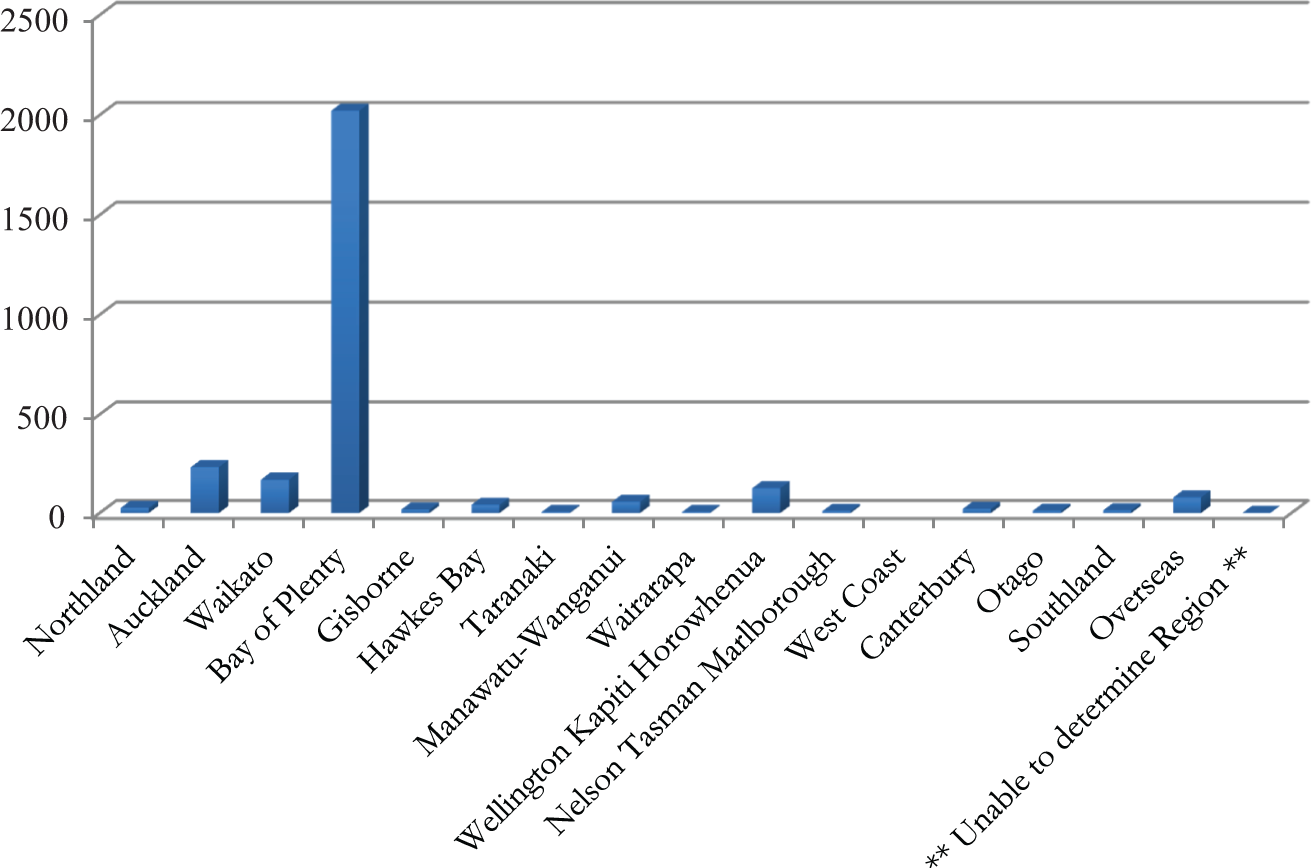
Valid votes by region, 2015 election.
A significant 817 votes (28.7%) came from those living outside the Bay of Plenty area. Having nearly a third of all votes coming from outside the region suggests that Te Arawa members who are outside the Bay of Plenty remain connected with, and interested in, Te Arawa matters. It may also indicate that a dedicated representative for those living outside the region should be considered in future for the Trust or the Board to reflect the lived realities of Te Arawa members.
Specific attention should be paid to the number of people who voted from overseas, which constituted 2.78% of all votes. This may not appear significant, but given that the election is for trustees who have a specific focus on activities in the Rotorua area, it indicates that although members are overseas, they do continue to remain interested in the area and iwi. Statistics from a 2012 Kiwi Expats Abroad study indicate that 21.5% of Māori living overseas in 2012 owned shares in Māori land or a Māori business, which suggests that in the broader Māori population, although some people are based overseas, they maintain clear economic and cultural links to Aotearoa New Zealand. 51
One of the tentative comparisons that could be made here is with Māori voting from overseas in general elections. Research by Paul Hamer indicates that since 1996, there has been a ‘200.6% rise in the total number of valid overseas party votes’ from those on the Māori electoral roll. 52 In 1996, there was 1.6% of such votes, and in the 2014 election, 3.6%. The exact reasons for the increase in votes from Māori overseas on the Māori electoral roll are unclear but may present a trend that should be considered in regard to the Te Arawa elections and for other iwi considering independent boards.
Local government elections are difficult to compare these results against because voting is generally limited to residents, except for non-resident ratepayers. In that instance, for the Bay of Plenty Regional Council in the 2013 elections, there were seven voters enrolled as non-resident ratepayers (out of 30,083 total Māori enrolled in the Bay of Plenty Regional Council Māori constituencies). For the Waikato Regional Council 2013 elections, there were eight voters enrolled as non-resident ratepayers (out of 31,741 total Māori enrolled in the Waikato Regional Council Māori constituencies).
Turnout
The voter turnout from the Te Arawa Lakes Trust 2015 election was 25.46%. As can be seen in Figure 2, the region with the highest percentage of voter turnout was Southland, followed by the Bay of Plenty. It is important to note, however, that this is the percentage of turnout rather than the actual number of votes. Overall, the Bay of Plenty had, numerically, the highest number of people that voted – at a total of 2,022 votes, compared to Southland, with a total number of 14 votes. The region with the lowest percentage turnout was the Wairarapa.
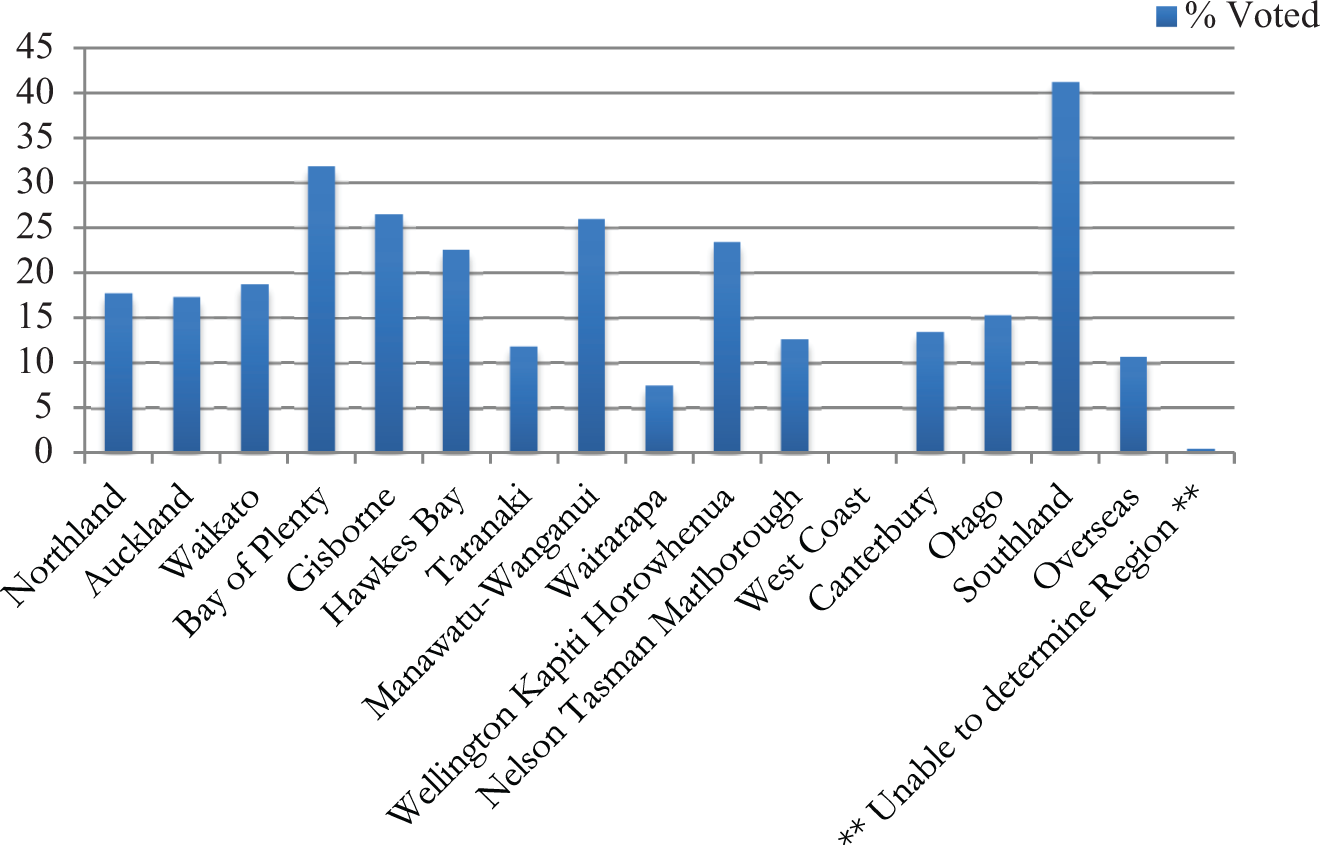
Percentage of voter turnout by region, Te Arawa Lakes Trust election 2015.
The voter turnout for the 2015 election is in a similar realm to the turnout for Māori constituencies in the Bay of Plenty Regional Council and Waikato Regional Council. Before comparing, it should be noted that there are slightly lower turnout rates for the Māori constituencies than there are for general constituencies. The overall turnout for local government was 41% in the 2013 elections. 53 For the Māori constituencies for the Waikato Regional Council, turnout in 2013 was 20.6% (6,560 total valid votes of 31,741 Māori enrolled in the Māori constituencies); for the Bay of Plenty Regional Council, turnout in 2013 was 25.9% (7,812 total valid votes of 30,083 enrolled in the Māori constituencies). When compared, as can be seen in Figure 3, the turnout for the Te Arawa Lakes Trust and Partnership Board in 2015 is similar, at 25.46% (2,839 votes cast of 11,153 Te Arawa people enrolled with Te Arawa Lakes Trust).

Comparison of percentage turnout for local government Māori constituencies (2013) and Te Arawa Lakes Trust election (2015).
Type of voting
Having statistics on which kinds of voters use online voting or postal voting is important for future analysis and options. From the 2015 results, the postal vote appears to remain as the dominant form of voting. This may suggest an older age group of voters; however, without the data about the demographics of voters, it is difficult to determine. Local government and district health board voting remains primarily by postal vote and it is possible that this may continue to be the method that many people are familiar with, particularly as recent proposals for trialling online voting have been postponed by the government. 54 In contrast, many iwi rūnanga or other forms of tribal governance entities have been using online voting for many years. As can be seen in Figure 4, the only area that was an exception to the prevalence of postal voting was the voting from overseas, where, as might be expected because of their location, the level of online voting was higher.

Type of valid votes, 2015 election.
Further analysis of the demographics for those voting using the online option would provide insights into which voters are more likely to prefer that method. Anecdotal evidence suggests that younger people are likely to be more familiar and at ease with online technologies and therefore online voting. With young people also being a demographic that is often perceived as at risk of not voting, those statistics may, again, help with designing appropriate information packs to raise awareness and increase turnout rates in future Partnership Board elections. 55
The Te Arawa Partnership Board elections indicate that a significant minority of iwi members who live away from their tribal areas still maintain an interest in the representatives and decisions made in that area. This has implications for whether they require specific representation on boards representing mana whenua. If mātaawaka are incorporated into the Te Arawa Partnership Board in future, their voting behaviour could also provide insights into where their interests might lie and therefore appropriate mechanisms for ensuring their participation and representation. The broader question is also: what similarities or patterns might there be for Māori voting in Māori wards and constituencies compared with Māori voting for independent boards? What form of guaranteed representation do Māori electorates prefer? Much more research is needed.
Conclusion
The existing legislative options available to Māori for representation and involvement in decision-making at a local level do not provide enough clarity for local government regarding their Treaty of Waitangi duties and obligations. This has had two main consequences: vocal opposition to Māori representation and a situation where it is virtually impossible for Māori to realise the legislative opportunities that exist. In parallel with the ongoing attempts by Māori to have Māori wards and constituencies established have been Māori creating new opportunities.
Māori are creating new opportunities by articulating aspirations in terms that reflect long-standing Māori tikanga around mana whenua territorial authority. The arguments for representation on the basis of mana whenua rights were evident in the submissions, debates and recommendations of the Royal Commission on Local Governance in Auckland for distinct mana whenua and mātaawaka representation and those that occurred in Rotorua regarding the Te Arawa Partnership Board.
While it is not possible to examine details relating to the election of mana whenua representatives in Auckland, it is possible to examine those from Rotorua and the Te Arawa Partnership Board inaugural elections. While trends cannot be ascertained from one election, a detailed examination of the 2015 results suggests that the interest between tribal members who live away from their areas and the governance of the resources in their home tribal areas remains. This suggests that for Māori, there continue to be strong connections and interests to vote in places where they have a tribal connection and possibly more of an interest than in places where they simply reside and work.
The broader implications for local government legislation are significant. If there is an opportunity for legislative change to implement a more effective and mandatory system for Māori wards and constituencies, legislators must consider the appropriateness of distinguishing between mana whenua and mātaawaka and whether an independent board model better enables local government to uphold their Treaty duties and better enables Māori to exercise their tino rangatiratanga by utilising forms of representation sourced in tikanga Māori.
Footnotes
Acknowledgements
I would like to thank Janine Hayward for her comments on this article and the Te Arawa Lakes Trust for permission to access the 2015 election data.
Declaration of Conflicting Interests
The author(s) declared no potential conflicts of interest with respect to the research, authorship and/or publication of this article.
Funding
The author(s) received no financial support for the research, authorship and/or publication of this article.