




Abstract
While anti-immigrant parties have been electorally successful in European parliaments, it is still unclear whether they have influenced policies. This article contributes by investigating the anti-immigrant party policy impact on a previously unexplored welfare policy area, that concerning the mobility of vulnerable European Union/European Economic Area citizens. In Sweden, the aid offered to these citizens varies a great deal in different municipalities. Furthermore, the largest anti-immigrant party (Sweden Democrats) has, unlike the mainstream political parties, preferences for a strict policy in line with so-called welfare chauvinism. Taking advantage of this subnational variation, our data give us a unique opportunity to investigate whether anti-immigrant party representation impacts welfare policy outcomes. The empirical findings show a negative correlation between Sweden Democrats’ representation and the aid offered and indicates that municipalities where Sweden Democrats holds a pivotal position offer less aid to vulnerable European Union/European Economic Area citizens. The hypothesis that these effects are conditional upon the ideology of the ruling coalition is, however, not supported.
Keywords
Introduction
Support for anti-immigrant parties (AIPs) has increased in Europe during the last decades and is now a feature of most European party systems. They have also entered governing coalitions in several European countries, starting at the end of the 1990s (Goodwin, 2011; Hale Williams, 2006). While the presence of these parties is clear, it is still uncertain whether they have had an effect on policies. Comparative research has mainly focused on immigration and integration policies when exploring anti-immigrant party impact, with inconsistent empirical findings, indicating that there might be context-specific factors or conditional effects. Some argue that AIPs’ policy preferences have influenced mainstream parties (De Lange, 2012; Van Spanje, 2010), while others claim that the impact is overstated (Akkerman, 2012b; Mudde, 2013). Policies related to immigration are, however, not the only focus of AIPs; they often also take on a so-called welfare chauvinist approach, arguing for exclusive redistributive solidarity for the nations’ ‘own people’ (i.e. the natives), thus linking immigration and integration issues with redistributive politics (Betz and Johnson, 2004; Lefkofridi and Michel, 2014; Rydgren, 2003). Scholars have therefore recently extended the discussion to include welfare policies as well (Afonso, 2015), with findings showing some support for anti-immigrant party policy impact on welfare politics (Careja et al., 2016; Schumacher and Van Kersbergen, 2016)
This article adds to this literature, exploring the potential welfare policy impact of AIPs further by focusing on a previously uncharted area: the issue of vulnerable European Union/European Economic Area (EU/EEA) 1 citizens. The study is conducted on the subnational level in Sweden, where local governments have capabilities similar to those of national governments (Dahlström and Sundell, 2012). Hence, we manage to keep institutional settings constant while including a larger number of units of analysis than what is possible in a cross-country study. Beyond these methodological advantages, Sweden is a useful case for several reasons. The country is known for its general welfare system and was long an exception to the anti-immigrant attitudes and success of AIPs present in other European countries (Brochman and Hagelund, 2011; Erlingsson et al., 2014; Lefkofridi and Horvath, 2012). Support for the Sweden Democrats (SD) – the largest anti-immigrant party in Sweden – has increased since 2010, and the party is now represented in both national and local parliaments. The mainstream parties still officially distance themselves from SD (Aylott and Bolin, 2015), which indicates that there is a potential difficulty for SD to influence policies. This makes Sweden a hard case on which to test the theory of AIP policy impact.
Regarding the chosen area of policy, there has been an increase in vulnerable European citizens travelling abroad to make an income in recent years. A large proportion is Roma people, who are poor and often discriminated against in their countries of origin (SALAR, 2014b). The citizens’ exposed position and often vague legislation have caused debates across Europe concerning the responsibilities of the state for temporary migrants, and the practical problems are often pushed down to the local level. In Sweden, there is a large variation between municipalities, where some provide much assistance to vulnerable EU/EEA citizens, while others do nothing at all (Delling, 2014; Johansson and Hans-Ers, 2015; SALAR, 2014a). The reason behind these different approaches is as yet unclear.
Given the relative independence of Swedish municipalities, the variation could be caused by the political composition at the local level. SD has preferences unlike those of the other political parties in this policy area. While the issue of vulnerable EU/EEA citizens is currently debated among most political parties, SD has held a stricter stance. Up to the 2014 election, SD was in sole opposition to begging among all the political parties, which is an important source of income in the group of vulnerable EU/EEA citizens (SALAR, 2014a). Moreover, the policy area highly relates to a chauvinistic welfare approach, framing immigrants as a problem in terms of abusing the generosity of the welfare state (Rydgren, 2003).
Despite its growing presence, it is uncertain whether SD has had policy influence. While not included in any coalitions, the party is represented in a majority of the municipalities and holds the balance of power in some of them, and there are arguments in comparative research that indicate that mainstream parties adjust their policy positions in an attempt to decrease the influence of AIPs (Schain, 2006). The clear policy preference of the SD party and its municipal representation thus give us a good opportunity to develop the discussion of AIPs’ policy impact. What is more, although this study suffers from the same limitations of causal identification as all cross-sectional studies, the data available to us have made it possible to include a large number of relevant controls, such as social, demographic, economic and attitudinal factors.
The overall research question is whether an anti-immigrant party has an impact on welfare policies. The aim of this article is thus twofold. It makes a further test of theories of anti-immigrant party policy impact on welfare politics, and it studies the unexplained variation in the municipal approach to vulnerable EU/EEA citizens in Sweden. On the basis of previous studies on the impact of AIPs, the article suggests three hypotheses (Afonso, 2015; Akkerman, 2012b; Bolin et al., 2014; Careja et al., 2016; Downs, 1957; Folke, 2014; Meguid, 2005; Mudde, 2013; Schumacher and Van Kersbergen, 2016; Van Spanje, 2010). First, we hypothesize that the parliamentary presence of an AIP will restrict welfare politics aimed for immigrants. Second, we expect the restriction to be more prominent when an AIP is in a pivotal position. Third, we test whether the policy restriction is conditioned on the ideology of the ruling coalition.
To test our hypotheses, we have collected new and unique data on the level of SD representation and aid to vulnerable EU/EEA citizens in Swedish municipalities.
The empirical findings give some support for the hypotheses of AIPs’ impact. While in some specifications falling below the standard threshold of statistical significance, there is indeed a negative correlation between SD representation and the level of aid offered to vulnerable EU/EEA citizens. The study also indicates that municipalities where SD holds a pivotal position offer less aid, with robust and statistically significant negative correlations in all specifications. Regarding the final hypothesis, we do not find empirical support for conditional effects.
The article is organized as follows: first, we discuss previous research and our hypotheses. Second, we treat the research design and discuss methodological choices and describe data collection and an operationalization of variables. Third, we present the results of the statistical analysis and discuss these in relation to our expectations and findings from comparative research. The fourth and final section concludes the work.
Theory
There are various labels in the literature that describe the parties in focus here, but we follow Van der Brug et al. (2005: 537) and use the term anti-immigrant parties. The reasons for AIPs’ electoral success are widely discussed and include theories of individual and institutional factors, as well as the characteristics of the AIPs (Arzheimer, 2009; Carter, 2002; Hale Williams, 2006; Norris, 2005; Rydgren, 2007; Van der Brug et al., 2005). However, of late, there has been an increased interest in potential policy effects of AIPs’ presence in the political arena (Akkerman, 2012b; Bolin et al., 2014; Folke, 2014; Mudde, 2013; Van Spanje, 2010). As immigration and integration are the main areas of concern for AIPs, most studies have focused on these issues when studying policy effects. More recently, scholars have also included redistributive politics to test the potential policy impact of AIPs, related to the welfare chauvinist approach often taken by these parties (Afonso, 2015; Careja et al., 2016; Schumacher and Van Kersbergen, 2016). This article adds to this literature and investigates the impact on a previously unexplored welfare policy area where there are distinct AIP policy preferences: policies towards vulnerable EU/EEA citizens.
We see policy impact as ‘the ability to promote a particular outcome that would not be observed in the absence of the agency of the challenger party’ (Carvalho, 2014: 2) and acknowledge that there are both direct and indirect forms of policy impact. A party is said to have direct impact if it has policy-making capacities and indirect impact if it influences the policy position of another political party (Schain, 2006; Van Spanje, 2010). These two forms of impact are not contradictory in any way, but rather indicate that there are several ways in which a party can have influence. While we are unable to empirically separate between the different types in this article, they both need to be taken into consideration if we wish to evaluate the full impact of AIPs.
Starting with direct policy influence, it is rather straightforward and should occur, for example, when an AIP is in coalition, has a pivotal position in the parliament or holds seats in a decision-making assembly. This form of impact is not limited to national parliaments, which is important to highlight since AIPs often experience their first (and sometimes only) government participation on the local level (Mudde, 2007: 279).
Moving over to the idea of indirect effects, it originates from the spatial theory developed in Downs’ (1957) seminal work, which makes the assumption that parties are vote maximizing. Accordingly, indirect policy impact occurs when rational parties respond to new parties by choosing policy positions close to the new party, if they can, or otherwise taking an opposite stance. The aim is under all circumstances to minimize the distance between themselves and the voters. Mainstream parties thus react to the success of a new party by either moving away from it or adopting their position in order to maximize votes.
The spatial theory of Downs (1957) has been criticized for being too simplistic (Van Spanje, 2010), and other scholars have developed the theoretical perspective further. For example, Meguid (2005) argues that the theory lacks an important aspect, namely, issue salience. According to Meguid, the strategies available to mainstream parties are not only to move away from or towards the issue, as argued by Downs (1957). They can also take over ownership of the new issue raised and thus influence its salience. Mudde (2007: 291) also mentions this aspect as important with regard to AIPs, arguing it is reasonable to assume that their effect is noticeable on the salience of attitudes, rather than the content of them. An advantage of Meguid’s (2005) modified spatial theory is thus the theoretical possibility for political parties to target all opponents, not just the neighbouring parties. This differs from Downs’ (1957) version, according to which political parties can only affect the electoral support of those in ideological proximity (Meguid, 2005).
Another example of a similar critique comes from Bale et al. (2010), who argue that established parties have three strategic options when faced with the risk of losing votes due to the emergence of a new party or political issue: they can hold on to their position and argue for their view, try to defuse the impact of the new issue or change their position.
In the case of AIPs, their indirect influence on policy-making is often described in the literature as ‘contagion effects’ (Van Spanje, 2010), which include two different kinds of effects. First, established parties have made a shift to the right. Second, restrictive immigration policies have been co-opted by the mainstream parties (Van Spanje, 2010). Related to redistributive politics, the shift is rather towards restricted welfare, distinguishing between the deserving (natives) and the undeserving (immigrants) recipients (Banting and Kymlicka, 2015; Schumacher and Van Kersbergen, 2016). Applied to the Swedish context, the theoretical assumption of indirect and direct impact thus suggests that SD could influence policy-making in the municipalities in several ways, with or without holding a balance of power position.
Regarding previous research on AIPs’ policy impact, the empirical findings are inconclusive. This is potentially due to country variation and the difficulty in isolating the specific impact on policy-making (Bolin et al., 2014). According to Afonso (2015), the AIP policy impact on welfare state reforms depends on whether the parties prioritize office or votes. Centring on those parties with positions in government, Afonso argues that AIPs face a trade-off between potential coalition partners and the preferences of the electorate. Considering that AIPs are usually junior partners to liberal or conservative parties, who are more likely to retrench general welfare programmes, the office seeking interest conflicts with that of the electorates, which is often constituted of social groups supporting the (exclusive) welfare state. Adding to this conclusion, Careja et al. (2016) argue that this trade-off can be mitigated if the AIP uses a strategy of indirect welfare chauvinism, for instance, proposing cutbacks in programmes where migrants are over-represented among benefit applicants. According to the authors, direct welfare chauvinism is more difficult to introduce owing to exogenous constraints, such as antidiscrimination laws. An indication of an indirect approach was found in Denmark, where the AIP Danish People’s Party (DPP) held a pivotal position (Careja et al., 2016). Taking this into consideration, the policy area used in our study is beneficial in that it resembles indirect welfare chauvinism. Restricting aid to vulnerable EU/EEA migrants does not discriminate within the population since these people are neither citizens of nor permanent residents in Sweden. Hence, it is a strategic area for AIPs to centre on. Moreover, since SD is not facing potential coalition partners, their main focus can be the welfare restrictive preferences of the electorate.
Moving over to immigration-related issues, Zaslove (2004) claims that AIPs have had direct effects on policy-making in Italy and Austria, whereas Duncan (2010) presents opposite findings from Austria. Mudde (2013) and Akkerman (2012a) follow a similar line, arguing that the direct impact of AIPs is overstated, and Van Heerden et al. (2014) suggest that the changes towards restrictive immigration policies were already set in motion by mainstream parties, before AIPs had their electoral breakthrough.
Regarding empirical findings of indirect effects, Hale Williams (2006) shows that AIPs have had a strong impact on the agenda and institutional levels, and a moderate impact on the policy level, in Western European countries. Similarly, Van Spanje (2010) and De Lange (2012) argue that established parties in Western Europe have co-opted aspects of AIP immigration policy preference. The results of these studies thus support the theory of contagion effects, indicating a turn to the right in policy-making due to AIPs’ indirect influence. According to others, AIPs have only had limited indirect impact on the policy programmes of the established parties (Akkerman, 2012b; Alonso and Da Fonseca, 2011), while Carvalho (2014) argues that the contagion effect is contingent upon two premises: a salient electoral threat towards the mainstream parties posed by the AIP and the engagement of mainstream elites. Similarly, results of Schumacher and Van Kersbergen (2016) indicate that mainstream parties in the Netherlands and Denmark adjusted their redistributive policies towards welfare chauvinism when at risk of losing votes to an AIP. In the Swedish context, Folke (2014) finds that local representation of the anti-immigrant party New Democracy (ND) had a negative impact on the size of immigration to the municipality. Similarly, Lidén and Nyhlén (2013) argue that SD has influenced municipalities’ willingness to receive refugees, and in slight contrast, Bolin et al. (2014) claim that the effect of SD only occurs when the party holds a balance of power.
Following arguments about AIPs’ influence, scholars also discuss whether the impact is conditioned on the ideology of the mainstream parties. Related to welfare policies, Schumacher and Van Kersbergen (2016) expect mainstream parties to respond to AIPs’ welfare chauvinistic approach on the issue with which they are mainly associated. Hence, left-wing parties would increase their attention to welfare, whereas right-wing parties are expected to become more sceptical towards immigration. Regarding immigration issues, it is commonly argued that parties on the political right generally have policy positions more in line with a strict approach towards immigration than those on the left side of the spectrum. Hence, centre-right parties are said to be more likely to adopt the position of AIPs (Green-Pedersen and Krogstrup, 2008).
Results are also mixed when it comes to the influence of mainstream party ideology. The results reported by Schumacher and Van Kersbergen (2016) indicate that right-wing parties accommodated welfare chauvinism to some extent and left-wing parties became more sceptical of multiculturalism, albeit not more pro-welfare. Focusing on immigration, De Lange (2012) concludes that the electoral success of AIPs created incentives for the mainstream right-wing parties to move further to the right in immigration and integration issues in order to facilitate forming coalitions. The left-leaning centre and social democratic parties were supposedly opposed to a government participation of AIPs (De Lange, 2012: 914). Other scholars find no result of conditional influence (Bolin et al., 2014; Van Spanje, 2010). According to Van Spanje (2010), parties in opposition are most influenced, regardless of their ideological position. Still, others suggest it is the already existing strict stance among centre-right parties towards immigration that leads to stricter policies, not AIP influence (Akkerman, 2012a; Mudde, 2013). Alonso and Da Fonseca (2011) conclude that it is in fact centre-left parties that are most likely to be influenced by AIPs, not the right. This is potentially due to the mixed preferences of the mainstream left constituency, consisting of both high-income/educated voters and working-class voters. The impact of AIPs on centre-left parties is otherwise less commonly discussed than that on right-wing parties, but there are exceptions. According to Hinnfors et al. (2012), the Social Democrats in Sweden have continuously initiated and backed strict immigration policies. On a similar note, Bale et al. (2010) argue that social democratic parties have, under certain circumstances, introduced more restricted migration policies as a result of AIPs’ electoral success.
All in all, we derive three hypotheses based on previous findings, following a similar theoretical and methodological set-up as in the previous contribution by Bolin et al. (2014). First, we expect that the parliamentary presence of an AIP will restrict welfare politics aimed for immigrants. This hypothesis tests whether SD has any form of policy impact on the municipal level and attempts to clarify the previously inconclusive results regarding the policy impact of AIP representation.
Second, we hypothesize the restriction to be more prominent when an AIP holds a balance of power. This expectation follows the findings of Careja et al. (2016), who showed that DPP had an influence on welfare politics when in a pivotal position, and Bolin et al. (2014), who only found an impact of SD insofar as they hold the balance of power. As a clarification, the party system in Sweden can be divided into two blocs: the centre-right (or ‘bourgeois’) bloc and the centre-left (or ‘red-green’) bloc. The former consists of the Liberals, the Centre Party, the Moderate Party and the Christian Democrats. The latter consists of the Left party, the Social Democrats and the Green Party (Aylott and Bolin, 2007). If none of the ideological blocs are in majority, they may depend on SD support, thus giving SD a hold on the ruling minority.
The third hypothesis investigates whether the policy restriction is conditioned on the ideology of the ruling coalition. Considering the inconsistent empirical findings regarding both welfare policies and immigration-related issues, it is relevant to test whether there is a difference in policy influence between centre-right and centre-left parties.
While influence on policy positions can take place among parties both in power and opposition, we only focus on the potential impact on the ruling coalitions since our main interest is the variation in actual policy outcome. It is also relevant to note, as mentioned previously, that we cannot empirically distinguish between the indirect and direct forms of impact. Including the municipal representation and balance of power positions, however, enables us to capture policy influence in a broader sense, which is important in order to fully estimate the impact.
Research Strategy
The purpose of this study is to investigate AIPs’ influence on welfare policies by means of a within-country comparison in Sweden. As discussed, Sweden makes for a suitable case considering its generous welfare state, the increased parliamentary presence of an AIP and the mainstream parties’ official distancing from them. The welfare policy area chosen is aid to vulnerable EU/EEA citizens, which is suitable since it highly relates to the welfare chauvinistic approach taken by AIPs, restricting welfare for immigrants. The method is straightforward, using a multivariate linear regression with ordinary least squares (OLS) estimations as the statistical tool. The units of analysis are Swedish municipalities, which are the bodies mainly responsible for vulnerable EU/EEA citizens. The national political parties, including SD, are represented in the municipal council (the highest political authority on the local level). There are 290 municipalities in Sweden, and there are several advantages of using municipalities as units of analysis when studying AIP impact. Sweden’s local governments have capabilities similar to those of national governments and can thus be used to study questions that have previously been raised on the national level (Dahlström and Sundell, 2012). Furthermore, studies of the local level enable us to keep institutional settings constant, thus limiting the risk of context-specific factors influencing the results, and to compare a larger number of units than is normally the case in cross-country comparisons.
On the dependent side of our analysis, we try to capture aid to vulnerable EU/EEA citizens on the municipal level. The free movement of persons guarantees EU/EEA citizens the possibility to travel to other member states and the right to stay for up to 3 months (The EU Information Centre (EUIC), 2014; The European Parliament (EP), 2014). Those with rights of residence can stay longer and have the same rights as Swedish citizens to social welfare and other social security benefits. However, certain obligations must be fulfilled in order to achieve rights of residence. A person who is not self-sufficient and lacks realistic possibilities to enter the Swedish labour market does not qualify for rights of residence and can appeal for aid only if there is an emergency situation. The most common forms consist of shelter, food or travel expenses to the home country. Each request for aid must be individually evaluated (The National Board of Health and Welfare (NBHW), 2016), but it is not entirely clear whether there are also legal possibilities to take general precautions in order to aid these vulnerable EU/EEA citizens (SALAR, 2016). Considering that the Social Services Act is only a legal framework, it gives municipalities some freedom to adjust their work depending on local conditions. The vagueness of the regulation thus comes with both pros and cons. It gives the municipalities the possibility to solve issues as they see fit but does not provide any clear guidance (Petersson, 2006). Following appeals to establish national directives (SALAR, 2014b), the Swedish government launched an inquiry into the matter in April 2015. The final account was presented in February 2016; among other things, it suggested increased regional collaboration. According to the investigation, there were about 4700 vulnerable EU/EEA citizens in Sweden in 2015 (SOU, 2016: 6).
Data on aid to vulnerable EU/EEA citizens were gathered through a web survey distributed to representatives of the Social Services Administration in the Swedish municipalities. The data used for the analysis are thus unique. The survey was kept brief in order to achieve the highest possible response rate and was designed so that only those questions relevant for each informant were displayed. Hence, not all questions were posed to all informants. For the complete questionnaire, see Appendix 1. The survey was sent out in several rounds in order to enable adjustments. The information was gathered from January to April 2015. Of the 290 municipalities, 192 responded. The response rate is thus over 66%. Of the 192 responses, 13 informants reported that they have no vulnerable EU/EEA citizens in their municipality. These were excluded from the analysis, thus resulting in a total sample of 179 units.
While we can only speculate as to why some municipalities chose not to respond to the survey, it is possible they have not received individuals in this group to the same extent as others. Hence, they might not have perceived the study as being relevant for their participation. To test the generalizability of the results, an analysis was made where the municipalities included were compared to those that did not respond to the survey. There do not seem to be any systematic differences that correlate with the focal independent and dependent variables; both groups show similar patterns in municipal characteristics. In regard to the political composition, there is an even spread of SD seat share, but the ideology of the ruling coalitions differs slightly. The group that did not respond has a higher share of centre-left coalitions than the other group. This should not affect the study to any great extent, however. As discussed further below, the regression analyses include ruling coalition as a controlling factor. The results could thus be considered generalizable for the Swedish municipalities.
The dependent variable – aiding vulnerable EU/EEA citizens – is operationalized through questions regarding municipalities’ handling of the issue. These questions were compiled into an index, presented in Table 2, Appendix 2. The scale ranges from 0 to 7, where 0 = no aid offered and 7 = several forms of aid offered, capturing the number of aspects covered to help the beggars. The most common forms of aid reported are journeys to the country of origin, counselling and acute shelter, which resemble the findings of the national investigation (SOU, 2016: 6). While we cannot further clarify the share of the total budget spent on this specific group, the percent of the municipal population receiving general financial aid from the Social Services Administration ranges from 0 to 11, with a mean of 4% (see Table 3, Appendix 2). Considering that the Social Services Administration has specific responsibilities regarding children (NBHW, 2016), questions were asked in order to rule out the possibility that those who offer aid do so only when children are included. The responses show no signs of such a correlation.
The municipal council is the highest political authority on the local level and is elected directly every fourth year, on the same day as the national election. The parties represented in the municipal councils are mainly the same as in the national government, and voter turnout in the municipal elections is similar to that in the national election, albeit a few percentages lower (Petersson, 2006: 103). 2 For social services, the municipalities have social welfare committees or the equivalent that deal with related issues. The committees act according to the guidelines of the municipal assembly and the legal framework regulating the specific area, in this case the Social Services Act (Montin and Granberg, 2013: 41). The committees consist of politicians designated by the municipal assembly, and the seats are allocated in relation to the size of the party in the municipal assembly, often through agreements between the parties (Petersson, 2006). The political decisions of the social welfare committees are implemented by the Social Services Administration (Socialförvaltningen). Hence, it is SD’s representation in these committees that is most relevant to our study.
To retrieve data for the focal independent variable in hypothesis 1 – SD representation – we contacted the municipalities and asked for a list of the permanent representatives in the social welfare committee or equivalent decision-making committee. An alternative to this approach would be to use the seat share in the municipal assembly, but the previous measurement is preferable for several reasons. First and foremost, political decision-making regarding issues related to social services mainly takes place in the social welfare committee. While the municipal assembly could be used as a proxy, the political composition of the social welfare committee does not always mirror that of the municipal assembly. Depending on the size of the committee, small parties are sometimes left out. This is especially the case for SD, which has occasionally intentionally been kept out of municipal committees (Samuelsson, 2006). The seats in the municipal assembly are therefore not necessarily equally represented in the committees, making the latter more suitable for the analyses.
A drawback of our strategy is that it restricts the possibility of using regression discontinuity design (see Folke, 2014) due to the clear risk of selection bias; those municipalities taking precautions to keep SD out are presumably also less likely to cooperate with the party. While this methodological disadvantage is caused by our focus on the social committees rather than the municipal assembly, we believe this is outweighed by the consideration that it is the most accurate measurement for the purposes of this article.
The focal independent variable in hypothesis 2 – SD in a position of balance of power – is operationalized using a dichotomous variable where 0 = other political majority and 1 = SD in balance of power. The operationalization follows Loxbo (2010), who defines a position of balance of power as a situation where neither of the ideological blocs holds a majority of the seats and SD holds a pivotal position. To measure this, we used data on ruling party coalitions in the municipal assemblies and applied it to the social welfare committees (SALAR, 2014c). SD is considered to have a pivotal position in the social welfare committee in those cases where the ruling coalition is in need of SD votes in order to achieve a majority. While there is a risk that this measurement does not capture potential informal coalitions, this aspect is difficult to avoid.
The ideology of the political coalition – one constituent variable in hypothesis 3 – is measured using dummy variables, indicating which ideological blocs are in a position of power in the municipal assembly, and thus also in the social welfare committee.
The biggest challenge to a cross-sectional study like this is omitted variable bias, and there are several factors that could potentially explain the various approaches taken by the Swedish municipalities. We try to control for all factors that can correlate with the focal independent variable – SD representation – and the dependent variable – aid to vulnerable EU/EEA citizens. The number of vulnerable EU/EEA citizens in the municipalities and the number of years they have been present there are clearly such factors that are likely to influence the political party’s incentive to provide more or less aid. Survey responses are divided into categories, showing that the mean number of vulnerable EU/EEA citizens in the municipalities ranges between 1 and 20, where they have been present in the municipality for 1–2 years (see Table 3, Appendix 2).
Another very important factor to take into account is public opinion towards vulnerable EU/EEA citizens because negative public opinion could affect both SD’s electoral support and mainstream parties’ policy. However, we lack information about attitudes towards this group and therefore use attitudes towards immigration as a proxy since it is reasonable to assume that these two areas are highly correlated. The question is gathered from a pooled, high-quality national survey, the so-called Riks-SOM survey (Weibull et al., 2014).The measurement is not perfect since it covers the period 1986–2012. As expected, however, it is highly correlated with support for SD (0.63), and we have also tried pooling other, shorter, time periods, which increases the correlation with SD support (0.67) but does not alter the results.
A further potential explanatory factor is the financial state of the municipality. It is suggested that more affluent societies have better possibilities for receiving refugees (Bolin et al., 2014), which could also be the case with vulnerable EU/EEA citizens. There is no good direct measure of the financial state, so we tried several strategies. We include the gross regional product in order to capture the prosperity of the municipality together with the population growth. This should tap into the more dynamic aspects of the municipal economy as it shows the ability to attract new citizens and expand the tax base; it is therefore commonly discussed as a measure of economic success in municipalities (Fjertorp, 2013; Nilsson, 2012). As none of these measures are perfect and to further test the robustness of the results, we also included citizen mean income and a measure of the municipal tax revenue, which did not alter the results.
The capacity of the Social Services Administration, which is responsible for providing aid to several socially marginalized groups in society, is also related to municipal finances. Municipalities with a greater number of socially vulnerable citizens might be less able to prioritize the issue. This factor can also correlate with the independent variable; social marginalization is often discussed as a potential explanation of AIP support (Rydgren and Ruth, 2011). Demand for social services is therefore included and operationalized using the percentage of the municipal population receiving financial aid from the Social Services Administration.
Municipality size, including population and area, is a common factor that is controlled for when studying municipal politics and public administration (Karlsson, 2007) and is hence included in the analysis. This aspect could potentially have an impact on both variables. Support for SD is higher in rural areas than in the larger cities (Sannerstedt, 2014). The size of the municipality may also affect its ability to aid vulnerable EU/EEA citizens.
As discussed previously, the ideology of the ruling coalition is one of the constituent variables in hypothesis 3. It is also included as a control variable in testing hypotheses 1 and 2. Left-wing parties are considered to be more prone to aid in general, thus potentially causing a difference in approach. In addition, municipalities with a centre-right majority in the municipal assembly might also have higher electoral support for SD due to their ideological proximity.
Summary statistics are presented in Table 3, Appendix 2. The variables measuring area and population size are transformed by means of logarithmic transformation because of a skewed distribution.
Results
This section outlines the empirical analyses. The first regression aims to test whether there is a negative relationship between SD representation and aid, that is, whether SD has a restrictive influence on welfare policies aimed at immigrants, as suggested in hypothesis 1. The results are presented in Table 1, models 1–2, showing a negative correlation with SD seat share and the aid offered to vulnerable EU/EEA citizens. The coefficient is statistically significant in model 1. In model 2, it is below the standard threshold of statistical significance but above 0.9. This change has to do with the inclusion of the variables measuring number of vulnerable EU/EEA citizens and years they have been present in the municipality. There are at least two possible explanations for this change in result. First, because of missing data, the second model includes fewer units of analysis, which could influence the statistical significance. To test this, we carried out a new regression analysis that excluded these units from all models. The variation in non-significance, however, remained, indicating that this aspect does not explain the change. A second possible explanation is simply that the variables measuring the extent of vulnerable EU/EEA citizens reduce the correlation with SD seat share, suggesting that this aspect is more important than the impact of SD.
Effects on the Level of Aid Offered to Vulnerable EU/EEA Citizens.

SD: Sweden Democrats; EU/EEA: European Union/European Economic Area; OLS: ordinary least squares.
OLS regression, unstandardized b-coefficients and standard errors in parentheses.
Comment: Ruling coalition is divided into three categories: centre-right, centre-left and bloc exceeding/other.
Levels of significance: *p < 0.1; ** p < 0.05; ***p < 0.01.
The results are thus ambiguous. There seems to be a negative relationship between SD representation and the level of aid offered, but the variation in statistical significance suggests that the results are not completely robust and should therefore be interpreted carefully.
Our second hypothesis concerns the potential policy impact of SD when they hold the balance of power. Here, we expect the restriction to be more prominent in municipalities where none of the ruling blocs holds a majority of the seats, and SD is in a pivotal position. The results presented in models 3–4 support the hypothesized correlation; the level of aid offered is lower in municipalities where SD holds a balance of power, with a statistically significant relationship. The size of the coefficient is rather large and indicates that when SD is in a pivotal position, between 1.3 and 1.5 steps less aid is offered to vulnerable EU/EEA citizens, which equals 69%–79% of 1 standard deviation.
To capture whether it is indeed SD’s pivotal position or whether the pivotal position picks up some omitted variable correlated with SD’s seat share, we include the interaction term between SD’s balance of power and SD’s seat share. If SD’s seat share contributes, the interaction term should be negative and statistically significant, but it is not (model not shown).
These results support the hypothesis that SD’s policy impact is stronger when holding a pivotal position, with more robust findings than in the previous analysis. In this study, we cannot get closer to identifying whether the actual effect is causal and if, in such a case, it is a direct or an indirect effect, but it seems probable that SD’s policy preferences become clearer in a position where they are able to put direct pressure on the policy area.
The final hypothesis aims to test whether the policy restriction is conditioned on the ideology of the ruling coalition. There are weak tendencies towards an ideological association when measuring the impact of ruling coalition, excluding interaction variables, which is positive for centre-left and negative for centre-right (model not shown). The results of the analysis of conditional effects are presented in models 5–6. Although this is perhaps counterintuitive, the results show a negative interaction between centre-left coalitions and SD’s seat share, while the interaction with centre-right is positive. Theoretically, this could indicate that centre-left parties adapt more in order to appeal to the welfare chauvinist constituency. The coefficients are statistically non-significant, however, and, while the table only shows the final step of the analysis (including all controls), results are basically the same throughout more parsimonious specifications.
To further test the theory of conditional impact, we re-ran the analysis with SD’s seat share replaced with SD’s balance of power in order to see whether the previously shown association of the latter varied depending on the ruling coalition. Again, the results were statistically non-significant, indicating that this is not the case. Finally, we tested the individual correlation of each political party to see whether they differed. This would have indicated that distinct preferences among political parties were suppressed when coalitions were used as the measurement. The results showed only minor differences compared to the results in models 6–7. Hypothesis 3 is thus rejected; the association with SD is not conditioned on political coalition. Hence, we find no empirical support for the theoretical argument that AIPs influence parties in close ideological proximity to a greater extent than others.
Turning to the control variables, there is initially a positive and significant relationship with the variable measuring social aid to citizens, but it then falls below significant levels when the variables measuring the years and numbers of vulnerable EU/EEA citizens are included. Another significant control, lasting throughout all the models, is population size, indicating that larger municipalities offer more aid than others. Gross regional product also shows a consistent positive and significant correlation throughout the model, suggesting that financially prosperous municipalities offer more aid than others. Finally, none of the coefficients of the variables controlling for population growth, area size, ruling coalition and public opinion reach significant levels. 3
While it is not shown in the table, the adjusted R2 increases a great deal when population and area size are included, indicating that the larger municipalities provide significantly more aid to vulnerable EU/EEA citizens, which is important to take into account, as we do here.
Finally, additional tests were made (see Appendix 3) to test the robustness of all the analyses presented in Table 1, confirming the results above.
Conclusion
On a general level, the aim of this article is twofold. It tests theories of AIP policy impact and studies the variation in the municipal approach towards vulnerable EU/EEA citizens in Sweden. The overall question posed is whether an AIP (SD) has an impact on welfare policies. The study thus develops the research field by exploring the scope of influence and adds to recent studies focusing on so-called welfare chauvinism (Afonso, 2015; Careja et al., 2016; Schumacher and Van Kersbergen, 2016). On the basis of previous research, we make three suggestions that are tested empirically in the article. We hypothesize that (1) the parliamentary presence of an AIP will restrict welfare politics aimed for immigrants, (2) that the restriction is more prominent when an AIP is in a pivotal position and (3) that the policy restriction is conditioned on the ideology of the ruling coalition. In order to answer the research question, we collected unique data covering the municipal handling of the situation of vulnerable EU/EEA citizens and the representation of SD in Swedish municipalities’ social welfare committees. While we cannot establish the form of impact in regard to indirect or direct effects, including both municipal representation and pivotal positions enables us to test several ways in which SD may influence policies.
In regard to the research field of AIP policy impact, the first analysis shows a consistently negative correlation with SD seat share, which is in line with the argument that AIPs have influenced the established parties to move further to the right in order to decrease their electoral success (De Lange, 2012; Van Spanje, 2010). The variation in statistical significance, however, indicates that the results are not robust, corresponding with studies that find weak support for the theory of ‘contagion effects’ (Akkerman, 2012b; Alonso and Da Fonseca, 2011). The negative association with SD in the case it holds a balance of power is much more robust, suggesting that SD’s impact is more prominent when in pivotal position. While we cannot make causal claims or be certain of the form of impact, it appears as though SD’s policy preferences become clearer when the ruling coalition lacks majority and potentially depends on SD support, enabling SD to put direct pressure on the other parties in this policy area. Following this theoretical interpretation, the result contradicts studies arguing that the direct impact of AIPs is overrated (Akkerman, 2012a; Mudde, 2013) but corresponds with the findings of Careja et al. (2016) and Bolin et al. (2014), where the latter traced a relationship with SD only insofar as they hold the balance of power.
Finally, we find no signs of AIPs’ influence being dependent on the ideology of the ruling coalition. There is initially an independent positive correlation with left-wing parties, indicating that they offer more aid than others, but there are no significant interaction effects between SD seat share and the ruling coalition. The notion that AIPs impact parties in close ideological proximity more than others is thus not supported.
The study contributes to recent research highlighting the welfare chauvinistic approach of AIPs, indicating that the policy impact can stretch to other areas of political preference than just immigration. This is an important finding, considering the increased salience of redistributive issues among AIPs (Lefkofridi and Michel, 2014), as well as their participation in ruling coalitions in European parliaments. As argued by Afonso (2015), AIPs may have problems gaining credibility if they are perceived as one-issue parties. Hence, the focus on an exclusive welfare state may rise as an important issue in terms of securing governmental positions. Considering the generous welfare system in Sweden and the mainstream parties’ official distancing from SD, the study can be considered a conservative test of AIP policy influence. There are, however, limitations as to how far we can draw conclusions based on the cross-sectional analyses. Further research is needed to test whether the influence on redistributive policies suggested in this study can be found among AIPs in other countries and whether it expands also to other forms of welfare politics. Moreover, we cannot rule out the possibility that the mainstream parties adapt to anti-immigrant attitudes within the municipality rather than the presence of an AIP. While we try to control for this, future studies need to clarify whether the observed restriction in welfare politics is due to AIP influence or whether the mainstream parties instead adjust to the preferences of the electorate.
Footnotes
Appendix 1
Appendix 2
Summary Statistics.
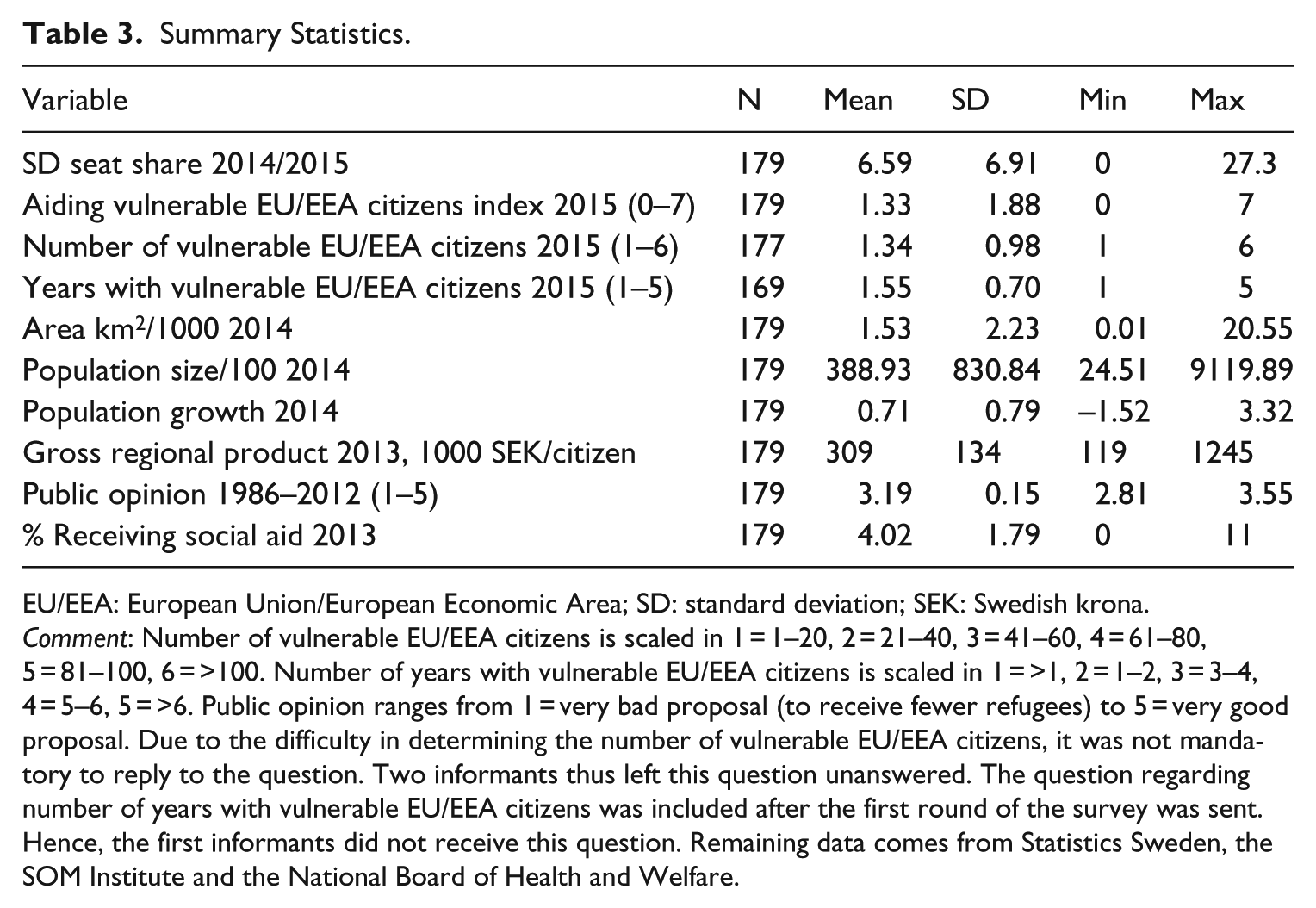
| Variable | N | Mean | SD | Min | Max |
|---|---|---|---|---|---|
| SD seat share 2014/2015 | 179 | 6.59 | 6.91 | 0 | 27.3 |
| Aiding vulnerable EU/EEA citizens index 2015 (0–7) | 179 | 1.33 | 1.88 | 0 | 7 |
| Number of vulnerable EU/EEA citizens 2015 (1–6) | 177 | 1.34 | 0.98 | 1 | 6 |
| Years with vulnerable EU/EEA citizens 2015 (1–5) | 169 | 1.55 | 0.70 | 1 | 5 |
| Area km2/1000 2014 | 179 | 1.53 | 2.23 | 0.01 | 20.55 |
| Population size/100 2014 | 179 | 388.93 | 830.84 | 24.51 | 9119.89 |
| Population growth 2014 | 179 | 0.71 | 0.79 | –1.52 | 3.32 |
| Gross regional product 2013, 1000 SEK/citizen | 179 | 309 | 134 | 119 | 1245 |
| Public opinion 1986–2012 (1–5) | 179 | 3.19 | 0.15 | 2.81 | 3.55 |
| % Receiving social aid 2013 | 179 | 4.02 | 1.79 | 0 | 11 |
EU/EEA: European Union/European Economic Area; SD: standard deviation; SEK: Swedish krona.
Comment: Number of vulnerable EU/EEA citizens is scaled in 1 = 1–20, 2 = 21–40, 3 = 41–60, 4 = 61–80, 5 = 81–100, 6 = >100. Number of years with vulnerable EU/EEA citizens is scaled in 1 = >1, 2 = 1–2, 3 = 3–4, 4 = 5–6, 5 = >6. Public opinion ranges from 1 = very bad proposal (to receive fewer refugees) to 5 = very good proposal. Due to the difficulty in determining the number of vulnerable EU/EEA citizens, it was not mandatory to reply to the question. Two informants thus left this question unanswered. The question regarding number of years with vulnerable EU/EEA citizens was included after the first round of the survey was sent. Hence, the first informants did not receive this question. Remaining data comes from Statistics Sweden, the SOM Institute and the National Board of Health and Welfare.
Appendix 3
Funding
The author(s) received no financial support for the research, authorship and/or publication of this article.