




Abstract
Previous studies of voter turnout in Latin America have found weak and inconsistent evidence for the link between political institutions and electoral participation. In this article, I use data from an expanded dataset of voter turnout in Latin America (1980–2016) to show that institutions do have an impact on citizens’ decisions on whether or not to participate in concurrent elections. Whereas previous studies analyzed the effect of legislative institutions on voter turnout, this article estimates a series of models that demonstrate the impact of presidential institutions and the political context surrounding presidential elections on electoral participation. The findings suggest that when first-order (presidential) and second-order (legislative) elections take place concurrently, electoral participation is influenced primarily by presidential institutions (term length, presidential powers, and electoral rules) and the electoral context in which the presidential elections take place (effective number of presidential candidates).
Keywords
What is the impact of political institutions on voter turnout in Latin America? Previous studies (Fornos et al., 2004; Kostadinova and Power, 2007; Pérez-Liñán, 2001) have addressed this question by replicating a “classic” model (Jackman, 1987). This mainstream model evaluates the impact of a series of legislative institutions—district magnitude, the number of parties in the legislature, and unicameralism—on electoral participation.
These papers have overlooked a glaring reality: Latin American countries have presidential systems of government. In presidential systems, the presidency is the dominant branch of government. Therefore, presidential elections can be described as first-order elections and legislative elections as second-order elections (Reif and Schmitt, 1980). The key argument in this article is that in concurrent elections (i.e. when presidential and legislative elections are held on the same day), first-order factors and first-order (i.e. presidential) institutions should have a stronger impact on electoral participation than second-order (i.e. legislative) institutions.
Previous research has neglected the fact that most elections in the region are not exclusively presidential or legislative in nature. The majority of elections in Latin America are concurrent—60% of national elections in the region between 1980 and 2016 were concurrent. Instead of proposing a model that explains turnout only in presidential or in legislative elections, I focus on concurrent elections, which allows me to test competing explanations regarding the impact of presidential and legislative institutions on electoral participation in the same model.
Investigating the causes of electoral participation is crucial because low voter turnout is often considered to be a problem for democracy. First, low electoral participation may lead to the underrepresentation of certain social groups. Several studies have shown that there is a class bias in turnout. Citizens with higher incomes, greater wealth, and better education tend to vote more than less advantaged citizens. The class bias in electoral participation increases when turnout decreases. Second, this class bias in voter turnout leads to an unequal influence over the content of public policies. Incumbent politicians pay less attention to citizens who do not vote (Lijphart, 1997). Moreover, low turnout may be a sign of citizens’ disaffection with political institutions and the functioning of democracy (Norris, 1999; Teixeira, 1992).
This article will proceed as follows. First, I will introduce the concepts of “first-order” and “second-order” elections and present evidence, suggesting that presidential elections are first-order elections in presidential systems. In light of this discussion, the second section will critically review the previous literature studying the impact of political institutions on voter turnout in Latin America. Then, I will present an alternative theoretical framework, focusing on presidential institutions and the political context surrounding presidential elections as determinants of electoral participation in concurrent elections in Latin America. From this discussion, I will derive a set of hypotheses that will be tested in the empirical section using data from an original database on voter turnout in Latin America. The final section concludes and suggests avenues for further research.
First-order and Second-order Elections in Presidential Systems
Previous studies demonstrate that not all elections are created equal. In particular, there is a standard distinction between first- and second-order elections (Reif and Schmitt, 1980). According to Reif (1997: 117): all elections (except the one that fills the most important political office of the entire system and therefore is the first-order election) are national second-order elections, irrespective of whether they take place in the entire, or only in part of, the country.
First-order elections are more salient in the eyes of political parties and the voters because they influence government formation and have direct policy consequences. On the other hand, second-order elections are characterized as having “less at stake” because executive power is not an issue (Van Der Eijk et al., 1996). This conceptual framework has been dominant in the study of elections to the European Parliament (Marsh, 1998; Van der Eijk et al., 1996; Weber, 2007) and has also been used to analyze subnational elections in Europe (Lefevere and Van Aelst, 2014; Marien et al., 2015). Although in their original 1980 article, Reif and Schmitt argued that this conceptual framework could be applied to presidential systems to distinguish between first-order (presidential) and second-order (legislative) elections, this conceptual distinction has not been exploited to study patterns of electoral participation in presidential systems. 1
In this section, I argue that in the presidential systems of Latin America, presidential elections are first order, whereas legislative elections are second order. This has important implications for explanations of electoral participation in concurrent elections (i.e. when presidential and legislative elections take place on the same day). I contend that when first-order and second-order elections occur simultaneously, first-order factors and first-order institutions have more influence on electoral participation than second-order institutions.
Presidential elections in Latin America are more salient than legislative elections, even when they are concurrent. Voters know that most of the power lies in the hands of the president and adjust their voting behavior accordingly. Undoubtedly, there is a significant variation in the amount of legislative and nonlegislative power that presidents have in the region (Payne et al., 2007: 81–112; Samuels and Shugart, 2003), but the fact remains that Latin American executives tend to enjoy discretionary prerogatives in several domains. Presidents can issue decree laws, they attempt to manipulate the budget and spending priorities, and they control appointments to several positions of authority in public administration (Rose-Ackerman et al., 2011). In sum, presidential elections in Latin America (and in presidential systems, in general) are simply more consequential than legislative elections because of the policymaking prerogatives delegated to the president. In other words, presidential elections are first-order elections under presidentialism.
Several pieces of evidence confirm that presidential elections are significantly more salient than legislative elections in presidential systems. First, electoral participation tends to increase when presidential elections are held, as compared to elections that are only legislative in nature. In the United States, it is well known that turnout is much lower—by 15–20 points on average—in mid-term elections compared to presidential years (Panagopoulos, 2011). Although most elections in Latin America are concurrent, some countries regularly hold (or have held at some point in the recent past) separate legislative elections. Table 1 shows the average turnout levels for different types of elections in these countries.
Turnout in Latin America (Comparison of First-order and Second-order Elections).
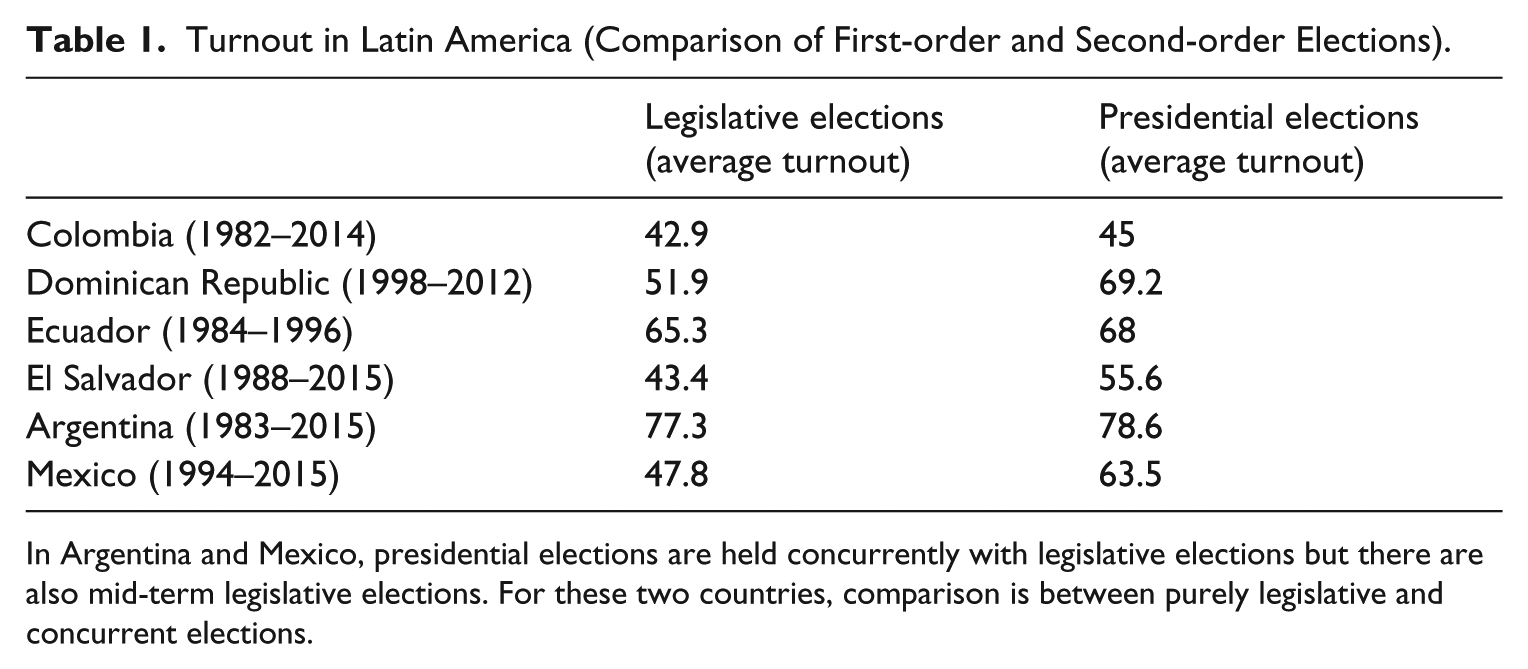
In Argentina and Mexico, presidential elections are held concurrently with legislative elections but there are also mid-term legislative elections. For these two countries, comparison is between purely legislative and concurrent elections.
The table clearly shows that electoral participation tends to be higher (in some cases significantly higher) when the election of the next president is at stake, as compared with elections that are only legislative. This suggests that voters perceive presidential elections as more salient and more consequential than congressional elections in Latin American countries.
Another indicator of the first-order nature of presidential elections in presidential systems is that in cases of divided government—that is, when the president belongs to one party and the legislative majority to another party—incumbent presidents tend to be held responsible for policy failures (e.g. economic hardships), whereas the parties dominating the legislature are absolved (Norpoth, 2001). If the main motivation of the voters in concurrent elections in presidential systems is to punish or reward incumbent presidents, legislative institutions are likely to be poor predictors of electoral participation. On the contrary, turnout will tend to increase when presidential institutions facilitate the expression of citizens’ grievances.
Another characteristic of first-order elections is that they receive more attention from the media and political elites, which generates higher voter mobilization (Tóka, 2007; Weber, 2007). It makes little doubt that presidential contests receive more media attention than legislative elections in presidential systems even when elections take place on the same day. Studies of campaign coverage in the United States demonstrate that the focus of the media gradually shifted in the last 50 years from an in-depth coverage of the issues of the day to a “horserace” news coverage of presidential contests—discussing who’s ahead, campaign events, scandals, and political marketing (Graber, 2009; Iyengar et al., 2004). A side effect of this change is that potential voters receive much more information in the national media about the presidential campaign than about other elections taking place simultaneously. Evidence on the distribution of media coverage between presidential and legislative elections during campaigns in Latin America points to the same direction. Porto (2009) conducted a content analysis of the airtime devoted to different elections in the news in the last 3 weeks preceding the first round of Brazilian elections. 2 The results of his analysis show that presidential campaigns receive a disproportionate share of the media coverage compared to other elections taking place simultaneously. In Brazil, presidential elections receive more media attention than all the other elections combined—elections for Congress, governorships, and state assemblies. The focus of the media on presidential elections makes presidential elections more salient. Hence, citizens are likely to pay special attention to presidential institutions (i.e. first-order institutions) and to the political context of presidential elections (closeness and number of candidates) when deciding if they will participate in the elections.
Finally, many studies of electoral behavior in the United States have shown that legislators tend to ride on the coattails of presidential candidates when elections are concurrent (Campbell, 1986; Campbell and Sumners, 1990). Presidential candidates receive much more media coverage than candidates for legislative bodies (Senate, House of Representatives, and State legislatures), and it is easier for voters to identify the presidential candidate that best represents their interests. Once they have chosen one presidential candidate, they use that candidate as a heuristic for casting votes in legislative elections. If citizens decide which legislative candidate to support only after they choose a presidential candidate, it stands to reason that citizens’ decision to turn out on Election Day will not be dictated by legislative institutions. Since the choice of a presidential candidate drives the other decisions made by the voters on the ballot box, voters are likely to pay more attention to presidential institutions (electoral rules and presidential powers) instead.
Previous Research on the Effects of Institutions on Turnout in Latin America
Scholars interested in explaining electoral participation in Latin America have used models that were developed to explain turnout in “industrial democracies” (Jackman, 1987), most of which are also parliamentary systems. Both Pérez-Liñán (2001) and Fornos et al. (2004) replicate the “Jackman model” to analyze the impact of nationally competitive districts, electoral disproportionality, multipartyism, unicameralism, and compulsory voting on voter turnout. These factors are found to be poor predictors of electoral participation in Latin America. One of these earlier studies concludes that “the classic model provides a weak explanation for turnout in the region” (Pérez-Liñán, 2001: 286). According to Blais and Aarts (2006: 190), “if we confine ourselves to research pertaining to contemporary advanced democracies, there seems to be a consistent pattern: turnout is higher in more proportional systems with higher district magnitude. However, no such pattern appears to emerge in Latin America.” They conclude that the outlier status of the Latin American region casts doubts on previous findings relating some aspects of the electoral system to electoral participation.
I contend that the findings from previous studies of turnout in Latin America show that the model is of limited value when it is applied to non-parliamentary systems. In presidential systems, legislative elections are second-order elections so legislative elections should have a weak effect on electoral participation. When first- and second-order elections occur simultaneously, first-order factors should have a stronger impact on citizens’ turnout decision than second-order factors (e.g. number of legislative chambers and proportionality of the electoral system). To sum up, although most elections in Latin America are concurrent, existing models replicate a classic model that has been shown to correctly predict turnout only in parliamentary elections. This article proposes a new and fully specified institutional model of turnout in Latin America.
This study builds on the pathbreaking contribution made by Dettrey and Schwindt-Bayer (2009). These scholars analyzed, for the first time, the link between presidential institutions and turnout in presidential systems. They find that electoral participation tends to be lower in runoff elections but higher in elections in which the incumbent runs for reelection. Other variables included in their model—closeness of the presidential election and presidential powers—have no impact on turnout. My examination of voter turnout in Latin America differs from that of Dettrey and Schwindt-Bayer (2009) in important ways. Whereas these scholars only include presidential institutions in their statistical analysis, my model of turnout in Latin America is the first one to include both the presidential and the legislative institutions that have been shown to influence turnout in previous research. The main contribution of this study is to test established hypotheses regarding legislative and presidential institutions at the same time on a more appropriate dataset that includes only concurrent elections. Moreover, this article introduces new variables not considered by Dettrey and Schwindt-Bayer (i.e. presidential term length) and proposes a different operationalization of one of the key variables (i.e. presidential strength). Interestingly, the results presented below differ significantly from the findings of Dettrey and Schwindt-Bayer (2009), which suggests that it is important to continue studying the impact of presidential institutions on electoral participation in presidential systems.
Institutional and Contextual Determinants of Turnout in Latin America
In this section, I identify a series of institutional and contextual factors that could have an impact on turnout in concurrent elections in Latin America. Since presidential elections are first-order elections in Latin America, I expect that presidential institutions will be better predictors of turnout in the region than legislative institutions.
Presidential Institutions and Turnout
The first important factor to consider is the electoral system. Electoral systems regulating the election of the president must determine a threshold of legitimacy considered sufficient for the chief executive to form an authoritative government. Under plurality systems, the candidate that obtains the greater quantity of votes is automatically elected regardless of the share of votes obtained by the other candidates. Under majority-runoff systems, a second round is organized if the threshold of legitimacy is not achieved by the leading candidate (Shugart and Taagepera, 1994). Turnout may increase under majority-runoff systems for two reasons. First, voters who support minor or mid-sized parties and realize that their vote will be “lost” may prefer to abstain in plurality systems. Second, under majority-runoff systems, minor parties have more incentives to activate their bases so as to obtain a large share of votes that could be used as an exchange value in the second round (Shugart and Carey, 1992). The first hypothesis of this article follows from this discussion:
Hypothesis 1: Turnout is likely to be higher in majority-runoff systems than in plurality systems.
A second institutional characteristic that may be related to electoral participation is term length. All other things being equal, I expect turnout to be higher in countries where the presidential term length is longer for three main reasons. First, the relative costs of voting decrease as the time between elections increases. In a recent contribution, Tavits (2009) has shown that multiplying the number of elections may fatigue voters and depress turnout. Second, the longer the term length, the more likely it is that citizens will become disenchanted with the incumbent administration. 3 Since dissatisfaction with the political and economic performance of the incumbent government drives electoral participation in developing countries (Aguilar and Pacek, 2000; Pacek and Radcliff, 1995), a longer tenure may lead to higher levels of electoral participation by disenchanted citizens who want to punish the president in power. Third, longer presidential terms increase the clarity of responsibility. 4 It becomes harder for incumbents to blame (or take credit for) their predecessors’ policies the longer they are in office. As a result, it is easier for voters to determine whom to punish or reward for the country’s performance. This discussion yields the following hypothesis:
Hypothesis 2: Turnout is likely to increase as the presidential term length increases.
The prerogatives vested on the president may also be related to turnout in the region. In fact, concurrent elections in Latin America become more salient when the powers of the president increase. When presidents are more powerful, they are more likely than their weak counterparts in other countries to influence the direction of policymaking and avoid an executive–legislative gridlock. In line with Franklin (1999), I argue that citizens living in countries where the outcome of the elections has fewer discernible policy implications will be less motivated to vote. Moreover, when the institution of the presidency carries more powers and prerogatives, presidential elections are more salient to political elites, who are likely to focus efforts on voter mobilization. In Latin America, the prerogatives of the presidents vary widely from one country to another, so this theoretical expectation can be straightforwardly tested. While in some countries (e.g. Nicaragua and Paraguay) presidents have limited legislative powers, in other countries presidents are invested with significant veto, decree, and agenda powers (Payne et al., 2007; Samuels and Shugart, 2003).
Hypothesis 3: Turnout is likely to increase as the legislative powers of the presidents increase.
Political Context and Turnout in Latin American Elections
Political institutions affect the costs of participation and create incentives for citizens to turn out. But these institutional characteristics cannot explain why turnout varies within countries between elections. Previous research has shown that two variables related to the political context in which elections take place have an impact on electoral participation: electoral competition and the number of competing parties (Blais, 2006). Surprisingly, previous studies of turnout in Latin America (Fornos et al., 2004; Kostadinova and Power, 2007) find that competitiveness and the number of parties are unrelated to voter turnout in the region. In fact, the Latin American region appears to be an exception to two of the most robust findings of the voter turnout literature. The Latin American exceptionalism may also result from the fact that previous studies have analyzed electoral competition and the number of parties in second-order (i.e. legislative) elections. This article hypothesizes that citizens’ decision to participate in concurrent elections is driven by the political context in which first-order (i.e. presidential) elections take place (closeness of the presidential race, and effective number of presidential candidates). In sum, this study reevaluates the null findings of the literature, applying two well-known hypotheses of the electoral behavior literature to the first-order rather than to the second-order institution.
Previous research on electoral competition has shown that turnout is higher when the result is close because citizens perceive that “every vote counts” (Blais and Dobrzynska, 1998; Caldeira and Patterson, 1982; Franklin and Hirczy, 1998). Voters can have a fairly accurate view of the competitiveness of the elections by paying minimal attention to the polls published in the media. In addition to the mass electoral response, close elections elicit an elite-level response. In fact, political actors respond to tight races with greater efforts at mobilization (Cox and Munger, 1989). In line with these previous studies, I expect that closer presidential races will increase electoral participation.
Hypothesis 4: Turnout is likely to be higher when the presidential election is close.
The effective number of candidates measures the number of viable candidates in the presidential race. According to Dettrey and Schwindt-Bayer (2009: 1327), the presence of many presidential candidates makes it “more difficult for voters to discern the policy implications of their vote, given that a larger number of candidates means more overlap in the policy agendas promoted in the race and, thus, an indiscernible outcome.” Therefore, the number of viable presidential candidates should be negatively related with electoral participation in concurrent elections in Latin America.
Hypothesis 5: Turnout is likely to be lower when the effective number of candidates increases.
Legislative Institutions, Compulsory Voting, and Turnout
Although I expect legislative institutions to have a smaller effect on electoral participation in Latin American concurrent elections, simply excluding these variables could create an omitted variable bias in the estimation of the model, similar to the one this article is trying to overcome. Since most elections are concurrent, both presidential and legislative institutions may have an impact on turnout. My theory predicts that, given the first-order nature of presidential elections, presidential institutions matter more than legislative institutions, but this has to be demonstrated rather than assumed. For these reasons, I include in the statistical model a series of variables measuring different institutional characteristics of the legislature, which have been associated with turnout in previous research (Blais and Dobrzynska, 1998; Franklin, 1996; Jackman, 1987; Jackman and Miller, 1995; Radcliff and Davis, 2000).
The classic model (Jackman, 1987) provides evidence for the impact of institutional factors on voter turnout in industrialized democracies. According to this model, political leaders take into account the structure of political competition in their decisions to mobilize voters. The size of the district weighs high in this decision. When legislators are elected by a proportional system from large districts political parties have incentives to mobilize voters in all the regions. On the contrary, in electoral systems with a low district magnitude, political leaders may prefer not to waste resources mobilizing voters in districts where the likelihood of success is very low (see also Powell, 1986). The number of parties might also have an impact on voter turnout. As the number of parties increases, the likelihood that elections will be decisive in government formation decreases because of the need to form coalitions, and the outcome of the negotiations that leads to the formation of these coalitions is uncertain. Since elections are less decisive, citizens have fewer incentives to vote in multiparty systems. The Jackman model also expects unicameralism to increase turnout since voters have less incentives to participate when the policymaking powers of the lower house they elect are checked by another institution (which is often the case under bicameralism). Although all these variables make sense as predictors of electoral participation in parliamentary systems, I do not expect any of these explanations to be strong predictors of electoral participation in concurrent elections in Latin America. Legislative institutions determine the policy implications of electoral outcomes in parliamentary systems, but the characteristics of these second-order institutions should not affect the saliency of elections in presidential systems.
The only variable of the classic model that should still be significant in a fully specified model is compulsory voting. One of the most robust findings of the voter turnout literature is that electoral participation increases when voting is mandatory. Previous research estimates the impact between 10 and 15 points (Carreras and İrepoğlu, 2013; Fornos et al., 2004; Franklin, 2004). Unlike the other institutional factors of the Jackman model, compulsory voting is likely to boost electoral participation regardless of the type of political system.
Research Design
Data
To test the five hypotheses, this study uses a new cross-national, pooled time series dataset of electoral participation in 102 concurrent elections in 17 Latin American countries between 1980 and 2016. 5 The rationale for performing the statistical analysis with data from concurrent elections is that this strategy allows us to test in one fully specified model the importance of both first-order (presidential) and second-order (legislative) institutions as predictors of voter turnout in the region. Sixty percent of elections in Latin America in the period 1980–2016 (102 out of 173) were concurrent. Even though previous studies have tested an institutional model that is useful to explain turnout in parliamentary systems, non-concurrent legislative elections represent only 26% of elections in Latin America. A list of the elections included in the analysis is provided in Appendix S1 in the online Appendix.
The dependent variable in all of the models presented in this article is turnout as a percentage of voting age population. Using the alternative measure of turnout (turnout as a percentage of registered voters) is very problematic in Latin America because registration rates vary significantly across the region. In some countries, registration is optional (e.g. Chile until 2012) while in others (e.g. Argentina) registration is automatic. In countries where registration is optional, the act of registering and the act of voting are likely to be highly correlated because citizens who are sufficiently motivated to register are also more prone to vote. In other words, individuals self-select into the pool of registered citizens in countries where registration is optional, but they are “forced” into this group in countries where registration is automatic. Hence, the level of turnout would appear to be artificially higher in the former than in the latter countries if I used the ratio of voters to registered voters as the measure of electoral participation (Endersby and Krieckhaus, 2008).
What I want to measure in this article is the percentage of people who prefer to go to the polls rather than to stay at home on Election Day. By definition, there cannot be two participation rates on the same day. In some cases, official statistics report a slightly different turnout level for legislative and presidential elections when these elections are held concurrently. It is possible that some voters go to the polls but cast a ballot for the legislative candidate but not for the president, or vice versa. When a slight difference was reported in the turnout rate between presidential and legislative elections, I adopted the highest rate as the turnout level in the statistical analysis.
The main independent variables included in the model come from different sources. The data concerning the type of rules in place for the election of the president (plurality vs. majority/runoff) were obtained through a database built by Pérez-Liñán for his study on this issue (Pérez-Liñán, 2006), which I updated for the present analysis. The data on presidential term length come from a database of presidential institutions in Payne et al. (2007), which was updated by the author for the present analysis. The distribution of these two institutional variables (electoral rules and term length) across Latin American countries is detailed in Appendix S2 in the online Appendix.
The information on the number of presidential candidates comes from official electoral statistics made available in the website of the different electoral management bodies in Latin America. When official data were not available, I used the electoral data handbooks edited by Nohlen (2005a, 2005b). The effective number of presidential candidates was calculated using the standard Laakso and Taagepera index (Jones, 1999; Laakso and Taagepera, 1979). 6 Electoral competition in presidential elections was measured by the percentage gap between the winner and the second most-voted candidate. For presidential powers, I draw on a new set of mean normalized presidential powers scores generated by Doyle and Elgie (2016) based on 28 existing measures of presidential power that were used in published work in the past. This procedure results in a more reliable cross-national measure of presidential power. This measure ranges from 0 to 1, but I re-scaled it for the present analysis so that it ranges from 0 to 10. 7
In order to test the competing Jackman model, I add measures of different legislative institutions that could have an impact on electoral participation (district magnitude, effective number of parties, and unicameralism). The data on district magnitude and the effective number of parties come from Carey and Hix’s Electoral System Design Project (Carey and Hix, 2011). The constitutions of the different Latin American countries were consulted to determine whether the system was unicameral or bicameral.
My model also controls for compulsory voting. Comparative research has established that voter turnout increases considerably when the vote is mandatory (Blais and Dobrzynska, 1998; Franklin, 2004; Jackman, 1987). However, more recent research has shown that the effect of compulsory voting rules is stronger when sanctions exist and are enforced (Panagopoulos, 2008: 466). In Latin America, voting is mandatory in many countries but the level of enforcement varies significantly across cases (Fornos et al., 2004; Power and Garand, 2007). Hence, I measure this variable using a three-point scale (0 = voluntary voting, 1 = non-enforced compulsory voting, and 2 = enforced compulsory voting). The countries were classified into different categories using information coming from the Institute for Democracy and Electoral Assistance (IDEA) compulsory voting database.
In addition to these institutional variables, the analysis will include a series of control variables that have been associated with the level of electoral participation in previous research. One of the main predictors of turnout in comparative analysis is economic development. Powell (1982) argues that economic development tends to increase turnout because it makes people more politically informed and more interested in the political process. This argument receives support in many cross-national studies of voter turnout (Blais and Dobrzynska, 1998; Norris, 2004). In the statistical analysis that follows, I use gross domestic product (GDP) per capita as a measure of economic development.
Previous studies suggest that the countries’ economic performance is related to electoral participation. Specifically, it has been shown that economic decline tends to increase the level of turnout in developing countries (Aguilar and Pacek, 2000; Pacek and Radcliff, 1995). These studies propose that economic hardships provide incentives for disgruntled individuals to vote in order to express frustration over the governments’ economic policies. I use a measure of GDP growth in the year of the election in order to control for the possible impact of economic performance on electoral participation. 8
Although I only include democratic elections in the analysis, there is a wide variation across Latin America in the level and robustness of democracy (i.e. the level of electoral competition and political freedoms). According to Fornos et al. (2004: 921), in more democratic countries “citizens should be both free to participate in electoral politics and well acquainted with the rituals and traditions of voting.” Previous studies of turnout in Latin America have found a positive relationship between the level of democracy and electoral participation (Fornos et al., 2004; Kostadinova and Power, 2007). I control for this relationship by using the Polity IV measure of the level of democracy.
Finally, some studies show that electoral participation declines sharply after the founding elections and continues to decline in the following elections, as citizens become disenchanted with the unfulfilled promises of democracy (Fornos et al., 2004; Kostadinova and Power, 2007). I use age of democracy (i.e. number of years since Polity IV score is >6) as a proxy for this democratization effect.
Model Estimation
The data structure is multilevel because there are several observations per country. In other words, election years are clustered within countries. Ignoring the hierarchical nature of the data would result in underestimated standard errors which might lead to Type I errors (Steenbergen and Jones, 2002). I therefore specify a multilevel model with random intercept coefficients to take into account the hierarchical nature of the data (level 1: country, level 2: election year). Hierarchical models are useful to correct for the within-country dependence of observations (intra-class correlation) and adjust both within- and between-parameter estimates in relation to the clustered nature of the data (Gelman and Hill, 2006; Snijders and Bosker, 1999). 9
Findings
I estimated the impact of presidential institutions and the context of the presidential election on voter turnout in concurrent elections in Latin America with a multilevel model, including data from an original dataset on electoral participation in Latin America. Table 2 presents the results.
Determinants of Voter Turnout in Concurrent Elections in Latin America (1980–2016).

GDP: gross domestic product.
Standard errors in parentheses.
p < 0.01, **p < 0.05, *p < 0.1.
The results provide strong support for my theoretical expectations. In particular, presidential institutions are good predictors of electoral participation in concurrent elections in Latin America. In the same vein, the number of viable candidates in presidential elections has an impact on turnout. On the contrary, in a fully specified institutional model, legislative institutions have a weaker effect on citizens’ decision to turn out on Election Day.
The electoral system in place to elect the president has an impact on electoral participation in concurrent elections in Latin America. As expected, the coefficient is positive and statistically significant. Other things being equal, electoral participation is almost nine percentage points higher in concurrent elections in which there is a majority-runoff system in place for the election of presidents. This certainly reflects the fact that majority-runoff elections elicit greater mobilization efforts from political parties, since the score obtained in the first round of presidential elections might be used as an exchange value in the second round. For instance, a party that obtains 10% of the vote in the first round of the presidential elections might throw its support behind one of the two frontrunners in exchange for some cabinet positions after the election. Voters of mid-sized parties should also be more motivated to vote in majority-runoff systems because these parties are more likely to make it to the second round than to win an outright victory in the first round (Carreras, 2012: 1458).
The other presidential institutions are also related to voter turnout in Latin America, in the direction expected by the theory. Term length is positively associated with electoral participation, and the coefficient is statistically significant. An additional year of presidential tenure is likely to increase electoral participation by 4.2 percentage points. This result may be due to two different sets of factors. First, longer presidential tenures increase the proportion of voters that will be dissatisfied with the incumbent government at the end of the term. These disenchanted voters are more likely to turn out on Election Day in order to express frustration with the incumbent administration and the policies it adopted. Second, assuming citizens are minimally concerned by the outcome of the contest, they have more incentives to participate in the elections when the electoral term is longer simply because they know they will have to bear with the policy consequences of the election for a longer period of time.
The prerogatives invested in the institution of the presidency are also positively related to electoral participation. The results demonstrate that turnout increases when the legislative powers of the president increase. A 1-point increase in the 10-point presidential power score created by Doyle and Elgie (2016) leads to an increase in electoral participation by 3.2 percentage points. In order to visualize how substantively important these effects are, I estimated the marginal effects of presidential powers on electoral participation, which are presented in Figure 1.
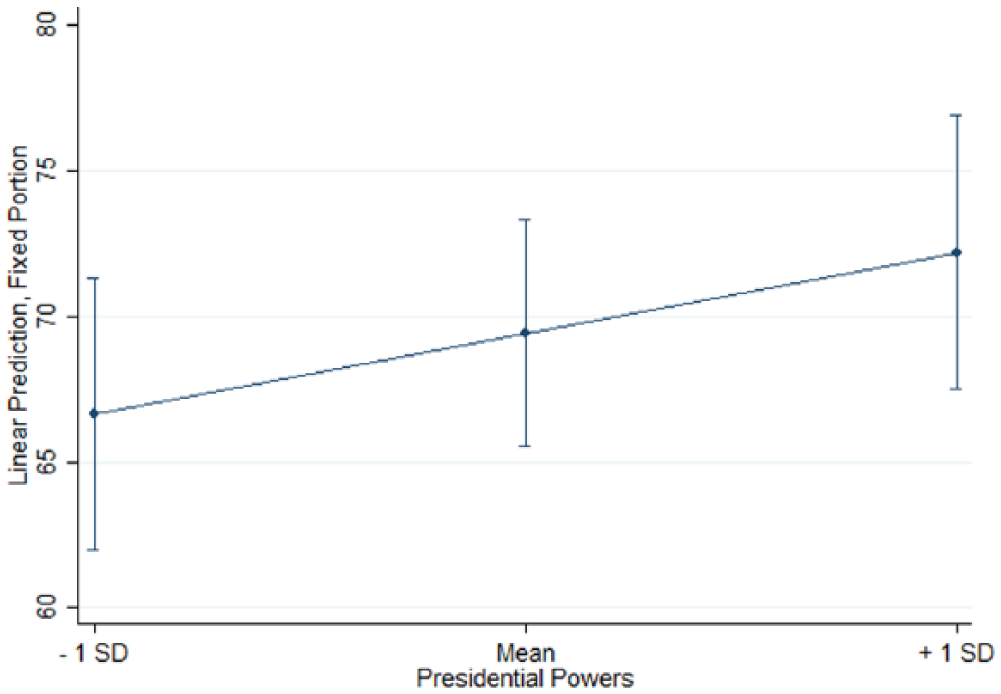
Predictive Margins of Presidential Powers on Turnout.
Figure 1 shows that turnout increases from 66.6% when presidential powers are low (1 standard deviation below the mean) to 72.2% when presidential powers are high (1 standard deviation above the mean), a 5.6 percentage points difference. 10 This finding supports my theoretical claim that citizens care more about the elections when they have discernible policy implications. In countries where institutions allow presidents to govern in a “delegative” fashion (O’Donnell, 1994) with few efficient mechanisms for horizontal accountability, the presidential election becomes more salient and consequential. As a result, citizens tend to participate more. This article is the first to establish a link between the powers vested on the president in presidential systems and electoral participation. 11 Dettrey and Schwindt-Bayer (2009) tested a similar relationship but the authors found that presidential powers and turnout were unrelated. The most likely reason for this divergent finding is that Dettrey and Schwindt-Bayer (2009: 1324) included in their dataset a series of presidents that are “mere figureheads, with separate and popular elections but no real legislative or nonlegislative powers (e.g., Bulgaria, Ireland, and Macedonia).” According to the theory proposed in this article, citizens’ decision to participate is determined mainly by the characteristics of the first-order institutions. If presidents are “mere figureheads,” they are probably “dominated” by the legislature, and presidential institutions weight lower in the choice made by citizens on whether to participate in the elections or not. In Latin America, all presidents are in a dominant position vis-à-vis the legislature, but the degree of domination differs. My article suggests that citizens perceive that their vote is more consequential when presidential powers are high. As a result, they tend to participate more than citizens living in countries where the distribution of power between the president and the legislature is more balanced.
The political context in which the presidential election takes place is also related to turnout in concurrent elections in Latin America. As expected, the effective number of candidates is negatively associated with electoral participation. An increase in one viable candidate in the presidential elections leads to a decrease in turnout in concurrent elections by three percentage points. As argued above, an election with many viable candidates is bound to generate significant overlap in the proposals of the different candidates. As a result, voters may find it harder to decide which candidate represents their interests and, in some cases, may prefer to abstain. The only hypothesis of this article that is not confirmed by the present analysis is the one regarding electoral competition (Hypothesis 4). However, the coefficient is in the expected direction and is fairly close to standard levels of statistical significance (p = 0.11). 12 While we cannot be as certain about this finding, the results suggest that electoral participation increases slightly when the presidential contest is close.
Another theoretical expectation driving this article is that second-order (legislative) institutions are more weakly associated with electoral participation in concurrent elections in Latin America than first-order (presidential) institutions. Overall, the statistical analysis provides support for this claim. Turnout is not associated with the size of legislative districts or the number of legislative chambers. The classic Jackman model works poorly to explain the level of electoral participation in concurrent elections in Latin America. The only legislative variable that influences turnout is the effective number of parties in the legislature. The statistical analysis reveals that an increase in one effective party in the legislature leads to a decrease in turnout in concurrent elections by 1.3 percentage points. Note, however, that this effect is much weaker than that of the effective number of presidential candidates in line with our expectation that first-order institutions matter more than second-order institutions when first- and second-order elections take place simultaneously.
The only control variable that is associated with electoral participation in concurrent elections in Latin America is compulsory voting. Our statistical analysis provides additional support for the finding that compulsory voting has a strong positive effect on turnout in Latin America, especially when it is enforced (Carreras and Castañeda-Angarita, 2014; Fornos et al., 2004).
Presidential Institutions and Turnout in Presidential Elections
The main goal of this article is to show that when first-order (presidential) and second-order (parliamentary) elections take place concurrently, first-order factors have a stronger impact on electoral participation than second-order factors. The empirical analysis presented above provides strong support for this argument.
However, the arguments about the effects of presidential institutions on turnout should hold for presidential elections more generally (i.e. concurrent and non-concurrent presidential elections). Therefore, in this section, I present an additional model that tests the generalizability of my arguments about the importance of presidential institutions to explain turnout in presidential elections. In order to conduct this analysis, I expanded the dataset to all Latin American presidential elections (concurrent and non-concurrent), and I estimated a multilevel model. In this presidential model, I dropped all the variables measuring legislative institutions. Table 3 presents the results.
Determinants of Voter Turnout in Presidential Elections in Latin America (1980–2016).
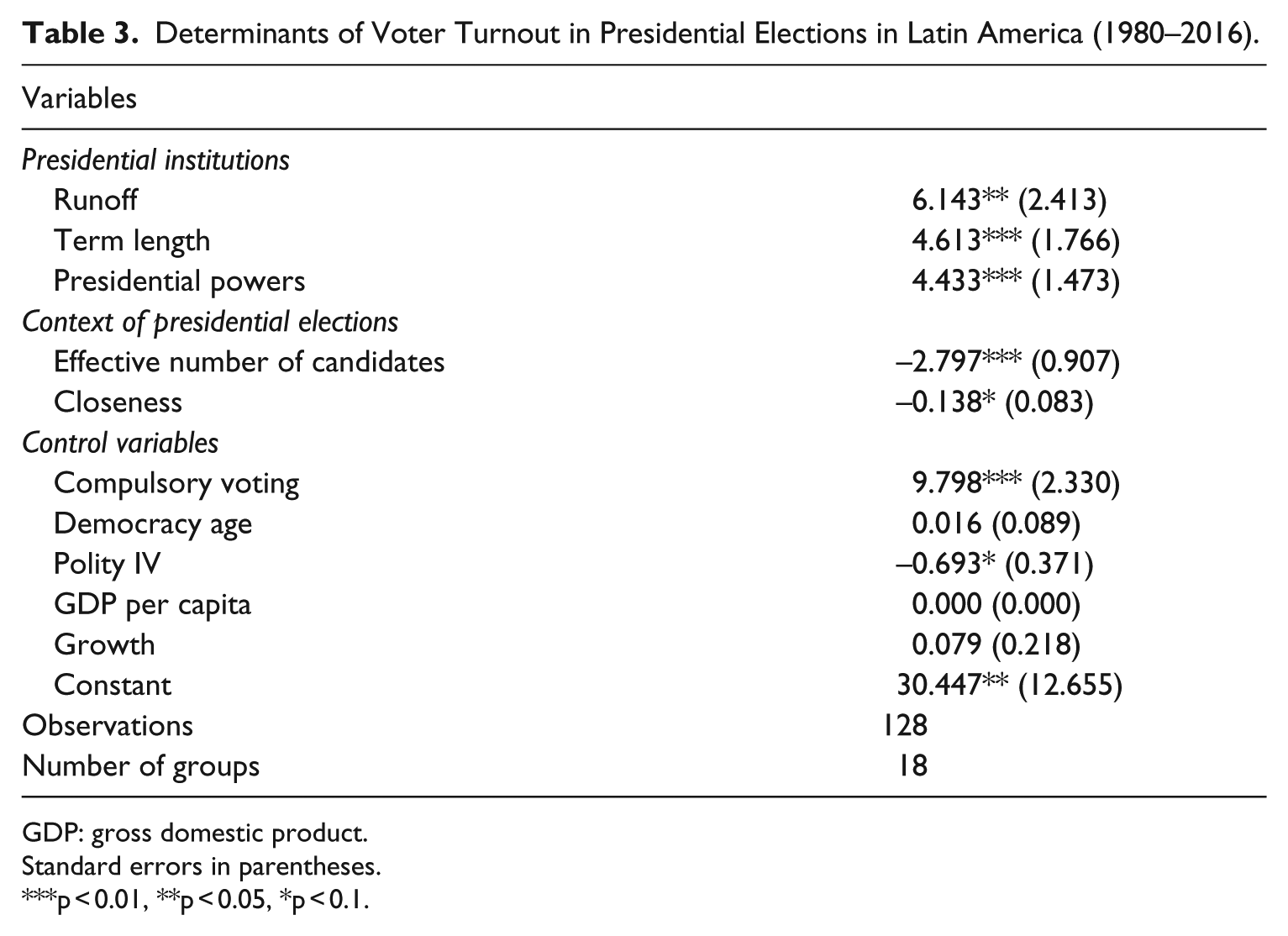
GDP: gross domestic product.
Standard errors in parentheses.
p < 0.01, **p < 0.05, *p < 0.1.
The results again show strong support for my theoretical expectations. Presidential institutions are important predictors of electoral participation in Latin American presidential elections. The size of the coefficients is very similar to the ones reported above. The closeness of presidential elections, which was just short of statistical significance in the previous model, reaches statistical significance in this larger sample of presidential elections.
In sum, this additional model suggests that the arguments presented above offer a useful framework for explaining electoral participation in presidential elections more generally. While previous studies have looked at the impact of legislative institutions on turnout in Latin America, both of the models presented in this article suggest that institutional models of electoral participation in presidential elections in the region should also include variables measuring theoretically relevant presidential institutions.
Conclusion
In this article, I apply to the Latin American context a conceptual framework that was developed to explain electoral patterns in European elections, that is, the concepts of first- and second-order elections. According to this framework, the election that determines who occupies the most important political office in any system is the first-order election, and all other elections are second-order elections. I argued that in the presidential systems of Latin America, presidential elections are always first-order elections and are treated as such by citizens, politicians, and the media. Legislative elections, on the other hand, are second-order elections. This distinction is not merely semantic; it has many theoretical implications. In this study, I show that when first- and second-order elections take place on the same day—which is the case for 60% of Latin American elections—electoral participation is much more closely associated with the incentives and constraints generated by first-order (presidential) institutions.
My findings challenge the conventional wisdom regarding the impact of institutional factors on electoral participation in Latin America. Previous studies of turnout in Latin American elections replicated an institutional model (the “Jackman model”) that is better suited to explain electoral participation in parliamentary systems. By estimating a fully specified model of turnout in concurrent elections in Latin America which includes both first-order (presidential) and second-order (legislative) institutions, I provide the strongest and clearest evidence, to date, of the impact of presidential institutions and the context of presidential elections on turnout in concurrent elections in the region. Specifically, I show four effects to be at work. First, turnout tends to be higher in countries with majority-runoff systems for the election of presidents. Second, citizens in Latin American countries tend to vote more when the tenure of the president is longer. Third, electoral participation tends to increase as the legislative powers of the president increase. Finally, electoral participation decreases when the number of viable candidates in the presidential elections increases. My empirical results also demonstrate that legislative institutions have minimal effects on voter turnout in concurrent elections in Latin America.
This article does not analyze the impact of institutions on non-concurrent legislative elections (26% of all national elections in Latin America during the period 1980–2016). It is possible that legislative institutions do affect electoral participation when legislative institutions are not held at the same time as presidential elections. Another possibility is that presidential institutions affect the baseline of electoral participation in each country, and that they continue to have an effect on cross-national differences in electoral participation even in non-presidential elections. This would be an interesting avenue for further research.
Footnotes
Funding
The author(s) received no financial support for the research, authorship, and/or publication of this article.
Supplementary Material
Supplementary material for this article is available online.
Notes
Author Biography
References
Supplementary Material
Please find the following supplemental material available below.
For Open Access articles published under a Creative Commons License, all supplemental material carries the same license as the article it is associated with.
For non-Open Access articles published, all supplemental material carries a non-exclusive license, and permission requests for re-use of supplemental material or any part of supplemental material shall be sent directly to the copyright owner as specified in the copyright notice associated with the article.
