



Abstract
This article investigates how changes in immigration policies affect migration as a vote-defining issue at upcoming elections. So far, the literature on issue voting has mostly focused on the role of issue entrepreneurs in politicizing new issues. In this article, however, we introduce policy change as a new potential determinant in the process of issue evolution. Moreover, in contrast to most of the literature that investigates the role of policy outcomes (such as economic growth or unemployment) on voting decisions, we analyze the effect of laws which can be directly attributed to governments and political parties. We focus on within-country variation and analyze national election surveys from the Netherlands, Denmark, and Germany between 1994 and 2011. These surveys include information on both self- and party-placements regarding immigration issues. To measure policy changes, we use data on immigration policies from the newly built Immigration Policies in Comparison dataset. While we expect a general reform effect, we investigate in more detail whether liberal and restrictive reforms have a similar effect on votes for left/right, government/opposition parties. It is shown that both liberal and restrictive reforms lead to increasing issue voting. While we show that government parties are not more affected than opposition parties, we see that party ideology partly plays a role.
Introduction
Understanding how party positions affect individual voting behavior has become of utmost importance as it has been shown that socio-structural factors have lost in explanatory power over the past decades (Alvarez et al., 2000; Dalton, 2002; Franklin, 1985). In other words, the role that issue voting and issue competition more generally play for electoral democracy has increased over the past years (Green-Pedersen, 2007) and to a large extent has replaced other mechanisms of representation, such as class-voting. So far, the literature on issue and retrospective voting has mostly focused on the roles of issue entrepreneurs and policy outcomes, such as the state of the economy (De Vries, 2007; De Vries and Giger, 2014; Duch and Stevenson, 2008; Powell and Whitten, 1993). We argue in this article that policy reforms (i.e. concrete policies passed by a legislature) constitute another and maybe even more relevant determinant in the process of issue evolution. Contrary to policy outcomes, policy outputs can more clearly be attributed to political actors that run for office. 1 And contrary to policy entrepreneurs, policy outcomes do not simply reflect what politicians argue but what has concretely been decided (Berry and Howell, 2007; Seeberg et al., 2017: 351). This is particularly relevant as studies have shown that citizens might not be aware of parties’ policy shifts (Green-Pedersen and Mortensen, 2015).
We elaborate and empirically investigate three potential mechanisms for why and how policy reforms should affect issue voting. First, reforms should affect issue voting because they increase the overall salience and visibility of the specific issue. In the context of political decisions and the implementation of policies, issues are widely debated among political actors and the public arena. Accordingly, new regulations can more easily be perceived and in turn shape individual voting decisions. Following from this logic, we should expect reforms to affect all parties alike. Second, policy changes could affect issue voting through a mechanism of accountability attribution. If this is the case, then issue voting after reforms should be stronger for government than for opposition parties. Third, the relationship between policies and issue voting could work through a partisan and issue ownership mechanism. For this mechanism, we should expect to see differences between parties based on their ideology or party family.
For a long time, migration issues have been debated behind closed doors mainly within the bureaucracy (Guiraudon, 1998). Over the past two decades, however, there have been increasing debates in the public arena and a growing interest in political solutions to current problems associated with immigration. It has been shown that in many Western countries, concerns over immigration have had an increasing effect on vote choices especially of right-wing populist parties (Ivarsflaten, 2007; Norris, 2005). Immigration has thus become a crucial part of the new integration–demarcation cleavage in Western European nation-states (Kriesi et al., 2008, 2012).
We should thus expect that voters have relatively clear expectations of how immigration issues should be regulated and that their vote choices depend on how these problems are resolved as migration is often considered as one of the most pressing social problems. While several studies assume that governments fear the wrath of voters when it comes to liberalizing citizenship and immigration policies (Breunig et al., 2012; Howard, 2009), we do not know whether government reforms do affect the role that immigration issues play for vote choice. We thus investigate how liberal as well as restrictive changes in two areas of immigration policy (labor market and family-related policies) affect issue voting at the subsequent election.
To investigate the effect of policy reforms on immigration as a vote-determining issue, we focus on within-country variation and analyze national election surveys from the Netherlands, Denmark, and Germany between 1994 and 2011. These surveys include information on both self- and party-placements regarding immigration issues. To measure policy changes, we use data on immigration policy changes from the Immigration Policies in Comparison (IMPIC) dataset (Helbling et al., 2017). It is shown that both liberal and restrictive reforms lead to increasing issue voting. We do not find any differences for government and opposition parties. While the effects are generally somewhat stronger for left-of-center parties, we cannot confirm a robust pattern of partisan differences. These findings thus indicate that immigration policy reforms mainly affect issue voting by increasing issue salience and visibility of the issue.
Policy Reforms and Issue Voting
According to the spatial model of voting, voters select parties whose positions are closest to their own positions on an ideological dimension (Downs, 1957). Considering that voters care about multiple issues that do not necessarily need to fall into one dimension, the now standard models of voters’ utility functions include a salience parameter that determines how strongly the distance on this issue or dimension affects the overall utility of voting (Adams et al., 2005; Thurner, 2000). This process can be understood as issue voting. 2
The literature on issue voting assigns issue entrepreneurs a central role in politicizing new issues (De Vries, 2007). According to Carmines and Stimson (1989), it is the party elites that initiate processes that make issues more salient and attract the attention of voters—previously non-salient issues become contentious. Parties make voters care about an issue and make them aware of differences in party positions with the idea that voters will follow their parties (Carmines and Stimson, 1986: 902–903). It is especially in situations of high polarization that people become aware of the importance of an issue. In other words, political issues gain political relevance for voting decisions when there is political conflict and when voters care about the issue (Carmines and Stimson, 1989). Mauerer et al. (2015) have, among others, shown that it is mostly polarizing parties that attract higher issue effects. It thus appears that issue entrepreneurs constitute driving forces of these processes in multi-party competition (Hobolt and De Vries, 2015).
However, as Green-Pedersen (2012) argues, the existence of an issue entrepreneur such as an anti–European Union or radical right party might not be enough to politicize an issue, as, for example, mainstream parties may still decide to ignore an issue despite the presence of an issue entrepreneur (see also Abou-Chadi, 2016a). On the other hand, there should be other causes of changes in issue voting. In this article, we argue that policy reforms are such a factor and develop and empirically test this argument for the case of immigration policies.
A large literature on feedback effects of public policies has demonstrated how public policies can affect people’s attitudes and behavior (Campbell, 2012). Accounts of economic and retrospective voting demonstrate that vote choices depend on how voters evaluate incumbent performance and the extent to which they hold the government responsible for certain policy outcomes (De Vries and Giger, 2014; Duch and Stevenson, 2008; Powell and Whitten, 1993). New laws and regulations can be directly attributed to governments, and the extent to which voters agree with policy reforms affects their voting decisions.
It might even be argued that policy outputs should have a bigger impact on voting decisions than policy outcomes, such as economic growth and unemployment that are only partly affected by government decisions (Berry and Howell, 2007). This is also true for the migration field. Investigating the effects of immigration rates as output measures would be highly problematic as migration flows are first and foremost triggered by the situation in the countries of origins. Moreover, it is still highly contested to what extent nation-states are able to control migration flows. While Castles (2004) and Sassen (1996: 63–105) argue that state immigration policies failed and sovereignty in this field eroded, Messina (2007: 244) concludes that “the declining sovereignty thesis is largely exaggerated and unsubstantiated by the facts.”
Several studies have already shown how much influence party decisions have on individual perceptions. Seeberg et al. (2017: 351) observe that it is especially those studies investigating party behavior that find an impact on voter perception (Adams et al., 2012a, 2012b), whereas studies looking at what parties say do not find such effects. This seems to suggest that “while citizens may not be listening, they are watching” (Seeberg et al., 2017: 351). Adams et al. (2014) come to similar conclusions when they show that voters do not respond to party positions in party manifestos but weigh the wider informational environment of what parties do.
These findings also provide an answer to the question on whether ordinary citizens are able at all to follow what political parties do. It has been debated for a long time to what extent voters behave rationally and responsibly and are able to differentiate between different policy solutions (Key, 1966). Recently, several studies came to the conclusion that voters take informed decisions especially in the context of a favorable informational environment and when parties have a clear profile on the respective issue (Gerber et al., 2015; Kuklinski et al. 2001). In our view, this is especially the case for highly salient and polarizing issues such as migration. Migration policy decisions can therefore be considered as a most likely policy issue which allows us to explore whether such effects are plausible at all (see Eckstein, 1975).
Having argued that voters follow policy decisions, the question remains why and in what way changes in immigration policy affect issue voting. In this article, we explore three mechanisms that lead to different empirical expectations about which parties are affected by changes in issue voting resulting from immigration reforms. First, as already mentioned, changes in immigration policies will usually happen in the context of a bigger public debate and under the scrutiny of high media attention and interest group involvement. Especially for a highly contentious and polarizing issue such as immigration, we should thus expect that the process and outcome of policy change will lead to an increase in perceived salience of an issue and thus to higher levels of issue voting (Kriesi and Sciarini, 2004).
In addition, policy change should lead to an increase in visibility of this policy area. This increased visibility should in turn lead to higher levels of issue voting as voters will be better able to attribute their political preferences to the political process (Gingrich, 2014). Several studies have already investigated how the politicization of immigration issues affects individual attitudes (Boomgarden and Vliegenthart, 2009; Hopkins, 2010, 2011; Walgrave and Swert, 2004). In these studies, it is argued that the increasing salience of debates has an impact on how people think about these issues. Salient political rhetoric serves as priming role, creates common knowledge, and emphasizes what is important (Hopkins, 2011). If increased salience and visibility are the mechanisms that lead to more issue voting, then we should expect that (a) both restrictive and liberal reforms affect issue voting and that (b) we should not necessarily observe differences between parties as increases in salience should affect all of them alike:
H1. Immigration policy reforms increase immigration issue voting at the subsequent election.
Hypothesis 1 is thus based on the idea that policy change affects the demand side salience of issue voting as we argue that policy decisions increase the saliency voters attribute to migration issues (Mauerer et al., 2015). However, it could also be argued that such decisions decrease saliency. Policy decisions are sometimes taken to silence critical voices and thus to end public debates and take a topic off the political agenda. This happens, for example, when an agreement is reached with opposition parties that might otherwise continue to criticize the government’s positions or inactivity (Christiansen and Seeberg, 2016). In the migration field, it has, for example, been discussed to what extent mainstream parties move to the right when they take decisions to dampen opposition blame from right-wing populist parties (Mudde, 2007: 278–282). While it might indeed be true for certain policy fields that policy decisions decrease saliency, we do not expect such effects for migration issues. They belong to the most polarizing topics in Western countries that are part of the new demarcation-integration cleavage (Kriesi, 2012). It is hardly imaginable that individual policy decisions make such a salient policy issue disappear from the political agenda, and we are not aware of any policy decisions that have silenced right-wing populist parties.
The next question is whether political parties are affected equally by the changes resulting from policy reforms. Immigration reforms might not only determine how visible and important policy issues are to voters, but they should also affect which parties are associated with a particular issue—thus supply side salience (Mauerer et al., 2015). 3 As Wagner (2014) argues, different parties might be evaluated on the basis of different criteria. As party-specific vote functions, he discusses among others government participation, issue ownership, and ideological positions. On the basis of these functions, we can formulate more specific expectations. For obvious reasons, it is easier to judge the performance of governing parties than opposition parties as the latter have not taken any binding decisions. It has also been shown that retrospective voting mainly affects parties of the incumbent government (Berry and Howell, 2007; Fiorina, 1981; Green and Jennings, 2012). Even if parties with different positions on migration issues have formed a coalition, these parties are perceived as ideologically relatively similar (Fortunato and Stevenson, 2013). For Fortunato and Stevenson (2013), cabinet membership is therefore a very good heuristic substitute for party ideologies that are more difficult to find. Thus, irrespective of concrete policy positions, one could expect that parties in government are made more responsible for policy changes. Issue voting should thus increase more strongly for the government parties that were in power when immigration reforms were passed:
H2. Immigration policy reforms affect immigration issue voting more for government parties than for opposition parties.
It might, however, also be that policy reforms are linked to the parties whose ideologies are in line with these changes irrespective of whether or not they have been in government. Policy reforms are not necessarily simple decisions by the current government but are the results of sometimes very long decision-making processes that have involved various political parties at different stages inside and outside of the government. According to the issue ownership approach, voters believe that certain parties are better able and more competent to solve certain problems and because of that vote for one party or another (Petrocik, 1996; Walgrave et al., 2012). It has been shown that issues that are owned by a party lead to stronger issue voting effects (see, for example, De Vries, 2010; Van der Brug, 2004). This relationship, however, is conditional on voters perceiving the issue at hand as salient (Bélanger and Meguid, 2008). Hence, immigration reforms should increase voting for the perceived issue owner. While some scholars regard mainstream or radical right parties as issue owners of the immigration issue (Mudde, 1999; Pardos-Prado et al., 2014; Thränhardt, 1995), others present empirical evidence that speaks against this assumption (Abou-Chadi, 2016a) and show how issue ownership varies cross-sectionally and over time (Seeberg, 2016). Especially in countries such as the Netherlands and Denmark (which constitute a large share of our empirical analysis), parties of the mainstream left have started to adopt a strong stance on immigration policies (Bale et al., 2010). Hence, from issue ownership theory alone, we cannot make a clear prediction about how immigration reforms should affect issue voting.
If we differentiate between liberal and restrictive reforms, however, one type of party is clearly associated with each type of reform. Left-wing parties show more liberal positions on immigration, while right-wing parties push for restrictive policies (Abou-Chadi, 2016b). It is exactly the multicultural and liberal element of immigration policies that has been shown to mobilize and polarize the electorate (Citrin et al., 2014). Hence, what we should expect in terms of partisan differences is that liberal immigration policies will affect issue voting for parties of the left and restrictive policies will affect issue voting for the right:
H3a. Restrictive immigration policy reforms mostly affect immigration issue voting for right-wing parties.
H3b. Liberal immigration policy reforms mostly affect immigration issue voting for left-wing parties.
Data Operationalization and Method
To test these expectations, we combine data from national election studies in the Netherlands, Germany, and Denmark with a new dataset on immigration reform. The national election studies are all post-election surveys and span a time period from 1994 until 2011. 4 All these studies include items that ask respondents to place parties and themselves on a scale to determine their position toward immigrants or refugees. These items are crucial to estimate the issue voting coefficients. Unfortunately, these three countries constitute the only European countries where this item has been asked sufficiently often in post-election surveys.
Despite these practical constraints, the three cases can be considered typical European immigration countries that also vary with regard to some of our key variables. In all three countries, the foreign population is very heterogeneous with important migrant groups from Muslim countries. In the year 2000, the foreign population made up around 4% in the Netherlands, 7% in Denmark, and 9% in Germany (Gieler and Fricke, 2004). They all had several policy changes in the policy fields and the period under investigation (Geddes, 2003; Gieler and Fricke, 2004). Especially since the late 1990s, several new migration regulations have been introduced also because these countries (and especially Germany) have begun to recognize themselves as immigration countries.
Moreover, in all three cases, both left- and right-wing governments have been in power during this period. The Netherlands had left-right coalitions in power until 2002 and after this several right-wing coalitions. In Denmark, left-wing governments have been in power until 2001 before right-wing coalitions gained power. In Germany, right-wing governments were in power until 1998 and again in 2009. In between, the left was in power until 2005 and was succeeded by a left-right coalition. While right-wing populist parties played no role in Germany during that time, Gert Wilders’ Party for Freedom became the fifth largest party in the Netherlands in 2006 and later the third largest party. The Danish People’s Party became the third largest party in 2001 in Denmark and collaborated with the right-wing government.
Since we are interested in how immigration reforms affect issue voting on the immigration issue, we apply a two-stage strategy for our empirical analysis. In a first stage, we analyze individual-level voting models to determine the size of the issue voting coefficient for the immigration issue. The second stage analysis then regresses the coefficients of our first stage on immigration reforms.
For the first stage, we use individual-level conditional logit models to estimate the effect of issue distances on voting decisions. These models by now constitute the standard approach to empirically assess the magnitude of issue voting (Adams et al., 2005; Thurner, 2000). However, in contrast to most of the literature, we do not estimate a generic coefficient for all parties but party-specific coefficients (Mauerer et al., 2015). Hence, what we look at is the effect of an individual’s issue distance on voting decisions for each specific party. Since we find considerable variation for these coefficients, this procedure is preferable to estimating generic coefficients.
Immigration issue distance is operationalized using voters’ self-placement as well as their individual placements of the major political parties on an item that refers to letting more or less immigrants or refugees into the country. 5 Distances are calculated as absolute distances. As individual specific control variables we include education, gender, income, and religiousness. We also control for party identification and left-right distance. In order to make the individual-level effects meaningfully comparable, we calculate changes in predicted probabilities for a 1 standard deviation change in distance on the immigration issue. This means that our regression coefficient will indicate how moving 1 standard deviation away from a party’s position on the immigration issue will affect the likelihood of voting for this party. Hence, the more negative a coefficient, the higher is the degree of issue voting as being further away from a party on an issue has a stronger negative effect on the likelihood of voting for this party.
To test the effect of immigration reforms, in a second stage we regress the predicted probabilities from the first stage on different types of immigration reforms in the legislative period before the election. We include a lagged dependent variable in our models. Using a lagged dependent variable follows from our substantive interest in the effect of an immigration reform on the change in issue voting for a party. In addition, including a lagged dependent variable allows us to largely exclude party- and country-specific level effects.
To measure the effect of immigration policy reforms on issue voting, we use data that have been collected in the framework of the IMPIC project (Helbling et al., 2017). This dataset includes information on the degree of restrictiveness of immigration policies in all Organization for Economic Co-operation and Development (OECD) countries for the period 1980–2010. The IMPIC dataset is the first dataset that allows us to investigate immigration policies in a comprehensive way. Earlier datasets most often only cover individual policy fields and/or a limited number of countries and years (Bjerre et al., 2015).
We define immigration as “people moving from one nation-state to another and thereby taking up residence in the destination country” (Helbling et al., 2017) and immigration policy as “government’s statements of what it intends to do or not to do (incl. laws, regulations, decisions, or orders) in regards to the selection, admission, settlement, and deportation of foreign citizens residing in the country” (Helbling et al., 2017). Immigration policies are therefore clearly distinct from integration policies that deal with migrants that have already crossed national borders and taken up residence. Moreover, our data only cover legal regulations and thereby exclude information on implementation, which might differ considerably from policy outputs.
Within the IMPIC project, data have been collected for different policy dimensions and policy fields which allow researchers to disaggregate migration policies and to investigate specific policy aspects. For this study, we rely on two policy fields that are based on different reasons for states to accept migrants. We look at (a) labor migration policies, which reflect states economic interests for accepting migration, and (b) family reunification policies, which reflect social reasons. Besides regulations regarding asylum seekers and refugees, these two policy fields concern the most relevant migration groups in terms of numbers and policy controversies (Mau et al., 2007; Messina, 2007; Schain, 2008: ch.1). We have left out the field of asylum seekers and refugees as regulations in this field are very much shaped by international regulations. For member states of the European Union, this is the most Europeanized field in the domain of migration and migrant integration (Lavenex, 2001; Toshkov and Haan, 2013). Reforms in this field can therefore only partly be attributed to national political actors. 6
Following the lead of established projects in the citizenship literature, namely, the EUDO citizenship project (Vink and Bauböck, 2013) and the project of the Indices of Citizenship Rights for Immigrants (ICRI; Koopmans et al., 2012), data have been collected with the help of national migration experts (mostly legal scholars). Contrary to other projects in this field, experts did not evaluate the restrictiveness of certain measures. Rather, the concrete legal regulations were coded to avoid any subjective interpretations. Validity tests with the only other database that provides comprehensive information on immigration policy reforms and covers similar regulations, countries, and time period, namely, the DEMIG Database (Haas et al., 2015), have shown that the general trends in policy evolution are the same in both datasets (Schmid and Helbling, 2016: 8–12).
Figure 2 in Appendix 1 displays the evolution of regulations in the field of family reunification and labor migration in the three countries under investigation here. All indices vary between 0 (open) and 1 (restrictive). The degree of restrictiveness indicates to what extent a regulation limits or liberalizes the rights and freedoms of immigrants (for more information on the dataset, see Bjerre et al., 2016; Helbling et al., 2017). As we discuss in Appendix 1, the quantitative data are largely confirmed by qualitative case studies or overview reports.
For our analysis, we use variables for liberal change and restrictive change which are coded 1 if this type of change occurred in the legislative term before the election and 0 otherwise. 7 We dichotomize the change variables because our hypotheses do not imply that a more restrictive or more liberal change should necessarily lead to more issue voting. 8 Our mechanism is based on the occurrence of the event of a reform and much less implies that the degree of policy change should matter for issue voting.
Our second stage model additionally controls for the size of foreign population inflow per capita in the year of the election. 9 We think it is crucial to control for this outcome variable in order to identify an effect of our policy change output variable. One could argue that what should matter more for changes in issue voting is not the level of immigration but its derivative, that is, the current level divided by the previous level. In Table 6 (Appendix 1), we thus demonstrate that our main findings hold using the derivative of the level of immigration at election t divided by the level at t − 1 instead of just the absolute level. We also control for the change of salience of immigration issues on the party system agenda between election t − 1 and t. 10 Including the change in the party system agenda allows us to control changes in issue salience (see Green-Pedersen and Mortensen, 2015) which could have possibly caused immigration reforms as well as an increase in issue voting. In order to test our hypotheses on party-specific effects and differences for government and opposition parties, we run additional analyses interacting restrictive and liberal change with a dummy for government participation and dummies for being a left, center, or right party. A list of party type codings as well as summary statistics of all our variables can be found in Tables 4 and 5 in Appendix 1. Since our dependent variable (the issue voting coefficient from the first stage) is estimated with uncertainty, our second stage model uses weighted least squares with weights incorporating the standard errors of the first stage as proposed by Lewis and Linzer (2005). 11
Results
For our first stage analysis, we run conditional logit models for every election study in our sample to obtain an issue voting coefficient. In Appendix 1, we show the regression tables for all election studies (Tables 7–10). Figure 1 presents the obtained issue voting coefficients for the Danish elections in 1994, 1998, and 2001 and helps us illustrate our procedure. Similar figures for all other elections can be found in Appendix 1 (Figures 5–7).
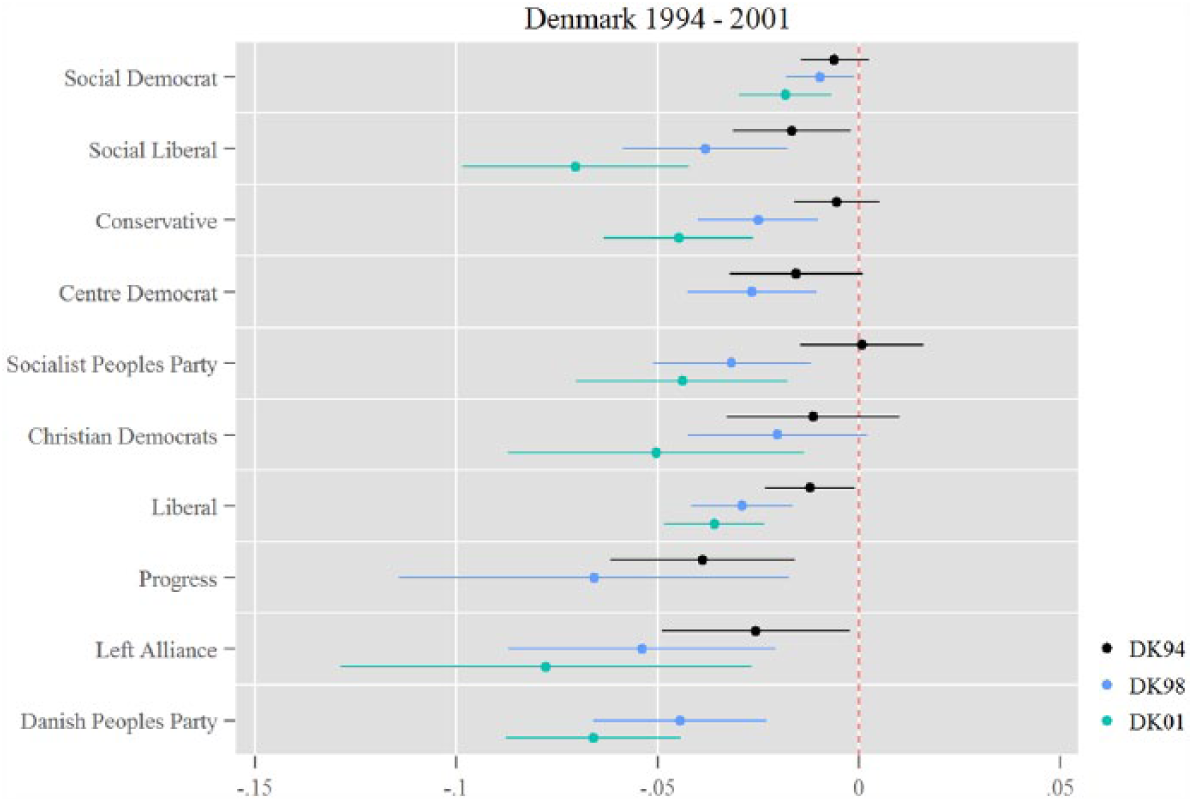
Party-Specific Coefficients for Immigration Issue Voting in Denmark, 1994–2001.
For the 10 relevant parties in this period, we can see the point prediction for the issue voting coefficient and the respective confidence interval. A value of −0.1 indicates that a 1 standard deviation change in the issue distance on immigration reduces the likelihood of voting for a specific party by 10%. Hence, the more negative the coefficient, the stronger is the degree of issue voting. Generally, we can see considerable variation between parties and over time. In addition, we find an increase in immigration issue voting for all parties between 1994 and 2001. This is consistent with the observation that in the 2001 Danish election, immigration became the dominant issue of the political campaign and the political discourse more generally (Green-Pedersen and Krogstrup, 2008: 619). In terms of party differences, we can see that the left-libertarian Social Liberals and the radical right Danish People’s Party show consistently high values in the degree of issue voting. The same is true for other radical rights parties such as the Dutch LPF and PVV (see Appendix 1). Hence, consistent with the findings of De Vries (2010) for issues of European integration, we find that immigration issue voting increases for parties that strongly campaign on this issue.
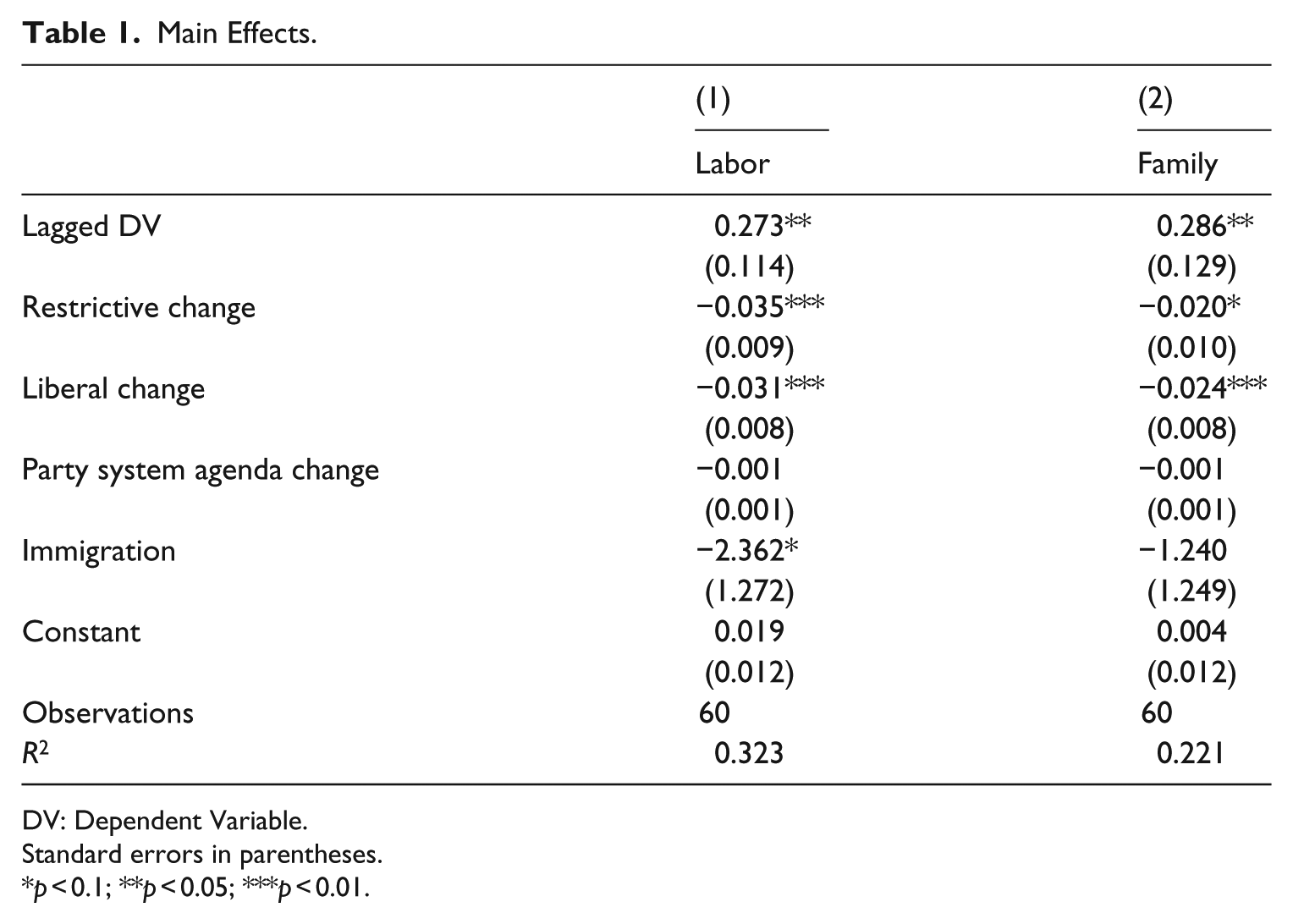
To evaluate our hypotheses, we use these coefficients of our first stage model as dependent variables in a second stage analysis and regress them on immigration policy change. As mentioned before, we incorporate the uncertainty associated with these measures through weighted least squares (Lewis and Linzer, 2005). The results for both areas of immigration policy change are found in Table 1.
Main Effects.
DV: Dependent Variable.
Standard errors in parentheses.
p < 0.1; **p < 0.05; ***p < 0.01.
In terms of control variables, we find that all coefficients show a sign in the expected direction. The degree of issue voting at the previous election is positively correlated with issue voting at the current one. The effect is statistically significant. The relatively small coefficient of 0.2 indicates, however, that serial dependence is limited. Higher immigration levels and an increase in immigration salience on the party system agenda lead to an increase in issue voting. These effects are not consistently significant, however. The fact that changes in the party system agenda do not significantly affect issue voting underscores the idea outlined in the theory section that what parties do might be more important than what they say.
For our main variables of interest, we can see that restrictive and liberal change show a negative significant effect, indicating that if a reform occurred in the period prior to the election, we see higher levels of issue voting. Substantively, if, for example, a liberal labor immigration reform occurred in the legislative period before the election, then issue voting increases by 0.03 points. Taking into account that the standard deviation of our dependent variable is 0.02, these effects are not only statistically significant but also substantively meaningful. Looking at the substantive effect size differently and coming back to our earlier example, the difference in the issue voting coefficient for the Danish Social Democrats between 1994 and 2001 and thus between an election where immigration only played a small role versus one where it played a central role is about 0.012. Hence, these findings support Hypothesis 1. When governments pass reforms in the area of immigration, this issue becomes more meaningful for voters in subsequent elections and determines their vote choice. This effect is present for both liberal and restrictive reforms, which speaks for a saliency mechanism surrounding these reforms.
To assure that our findings are not driven by a single party, we run a jackknife type analysis and exclude one party at a time for our analysis. As Figures 3 and 4 in Appendix 1 demonstrate, our main findings hold for this procedure. In contrast, if we exclude all German or all Danish cases, our findings are not statistically significant anymore—they are robust against the exclusion of the Netherlands.
In a next step, we want to investigate whether these effects are similar for all parties or differ depending on a party’s government participation or its ideology. Since we calculated party-specific issue voting coefficients, our design allows us to do precisely that.
In the models in Table 2, we interact our variables for change of immigration policy with a dummy that takes on the value of 1 if a party was in government prior to the election. In models 1 and 2, we interact government participation with restrictive change in the areas of labor and family reunification, respectively; in models 3 and 4, we do the same for liberal change. According to Hypothesis 2, the effect of immigration reforms on issue voting should be stronger for government than for opposition parties. We should thus expect to see a statistically significant and negative coefficient of the interaction term. Looking at the results in Table 2, we can immediately see that this is not the case. None of the interaction terms reaches a conventional level of statistical significance, and the substantive difference between government and opposition party is rather negligible. We thus cannot confirm Hypothesis 2. There do not seem to be differences in how issue voting for government and opposition parties is affected by immigration reforms.
Interaction Government.

DV: dependent variable.
Standard errors in parentheses.
p < 0.1; **p < 0.05; ***p < 0.01.
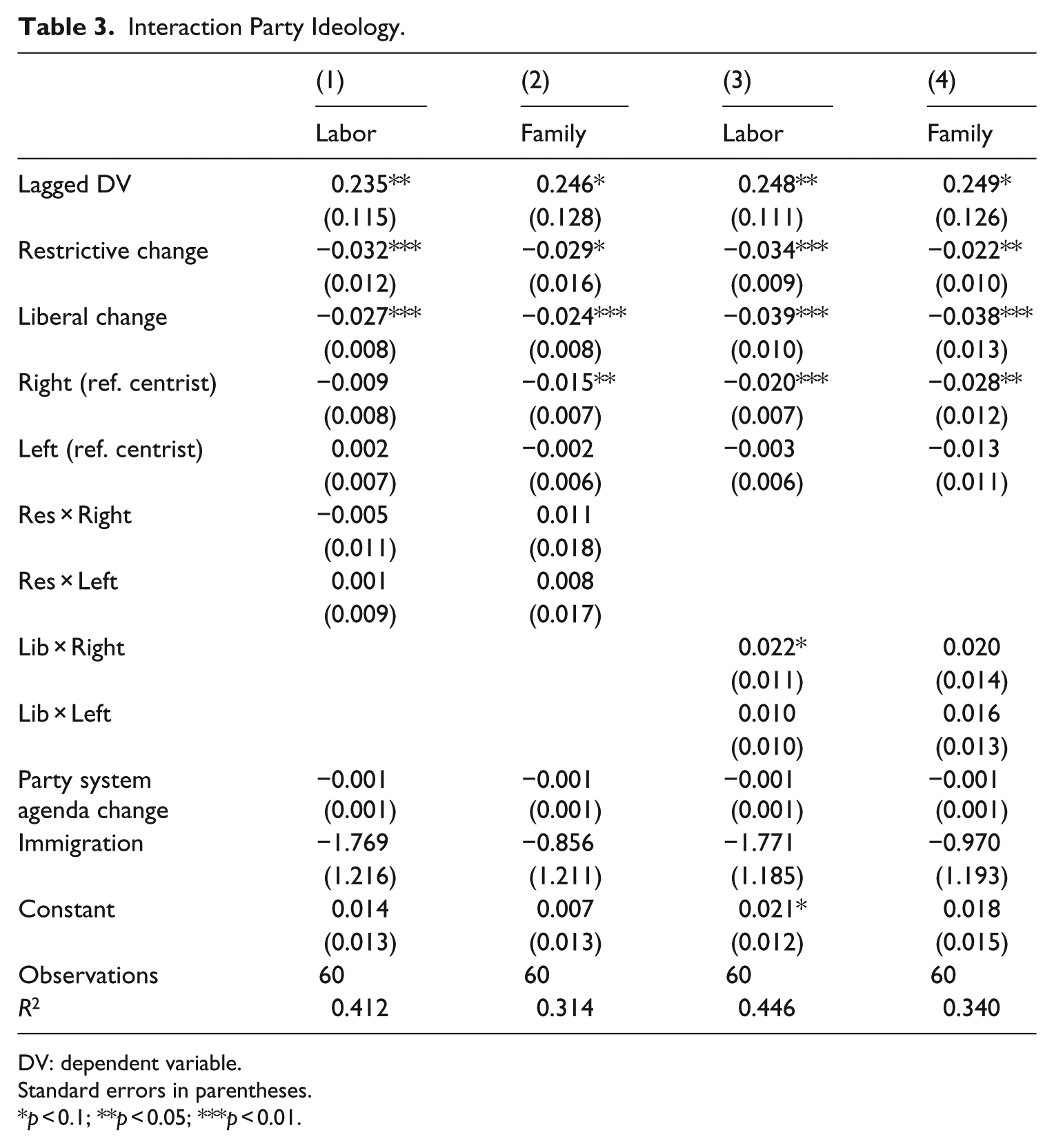
A final question that we want to investigate is whether we can observe partisan differences in how immigration reforms affect issue voting. The models in Table 3, thus, include an interaction of immigration policy change with dummy variables representing a party’s ideology, taking on the value of 1 if a party belongs to the Left or the Right (centrist parties serve as the reference category).
Interaction Party Ideology.
DV: dependent variable.
Standard errors in parentheses.
p < 0.1; **p < 0.05; ***p < 0.01.
In models 1 and 2, we interact the party ideology dummies with restrictive change in the areas of labor and family reunification, respectively; in models 3 and 4, we do the same for liberal change. In models 1 and 2, the coefficient for restrictive change now gives us the marginal effect for center parties. We can see that the marginal effects for both areas and for left as well as right parties are very similar to the overall effects in Table 1. The interaction terms do not reach a conventional level of significance and the differences in magnitude are rather negligible. Hence, changes in restrictive policies seem to affect issue voting for parties independent of their general ideology. As models 3 and 4 demonstrate, this, however, is somewhat different for liberal changes. Again, we find a statistically significant effect of liberal changes on issue voting, but it is limited to left and center parties. While the main effect for liberal change (representing the marginal effect for center parties) is statistically significant for both policy areas, we can see a positive interaction term for right parties, which is statistically significant for model 3 only, however. The resulting marginal effect for right-of-center parties fails to reach a level of statistical significance at a conventional level for both policy areas. Hence, liberal immigration reforms seem to disproportionately affect left (and centrist) rather than right-wing parties. We can thus at least partly confirm hypothesis 3. When a liberal reform takes place, then immigration becomes a more important issue for voting for or against a left-of-center party. While our analysis does not allow us to investigate this mechanism in detail, taking into account a general latent anti-immigrant predisposition in the electorate, it seems reasonable to argue that left-of-center parties get punished in the context of liberal reforms. This is not the case for right-of-center parties.
Conclusion
Taken together, our findings demonstrate that restrictive and liberal reforms of immigration policies affect issue voting. We have also seen that, against our expectation, government parties are not more affected than opposition parties. However, and in line with our hypothesis, we have seen that party ideology partly plays a role.
While our findings provide some insights into these potential mechanisms, our analysis, of course, does not constitute a rigorous test of them but more an exploratory analysis that allows to set these ideas up as hypotheses for further analysis. More detailed analyses of the mechanisms that are behind the effects we found would allow to also better understand the causal link between policy reforms and issue voting. We cannot completely rule out that increasing issue voting puts pressure on political parties and governments to undertake reforms. Such effects would, however, be the result of earlier votes or debates that are not directly related to the votes we investigate here. Our claims are further made plausible by measuring our independent variable prior to our dependent variable and by controlling for confounding factors at the individual and contextual level, most importantly issue salience.
In any case, we have been able to show that policy reforms matter. Voting decisions are not only affected by policy outcomes such as economic developments or migration flows or by how politicians mobilize certain issues. The concrete outputs of political decision-making processes are under close scrutiny especially in a highly politicized field such as migration. For the first time, we have been able to show that voters reward or punish governments and political parties for the decisions they have taken. This approach is a more valid way to study retrospective voting as political actors can clearly be related to the decisions that have been taken contrary to more general social or political developments that depend on other factors as well.
Our study also makes an important contribution to the field of integration and immigration policy effects. There are several studies that have investigated the effects of integration policies on attitudes, identities, and the integration of migrants. In the field of immigration regulation, such questions have hardly been studied so far as no dataset existed that would have allowed systematic analyses of these questions. More importantly, all studies on policy effects in these fields have focused on attitudes and left out political behavior. While the findings on attitudes have been rather mixed so far, we show that voting behavior is clearly affected by migration reforms.
The literature on issue entrepreneurs argues that these actors trigger debates on political issues for strategic reasons (Carmines and Stimson, 1986, 1989). Political decisions might help calm the voters who so much worry about migration issues nowadays. Mobilizing especially controversial issues can, however, be very risky as it may put off certain voters or party fractions and make coalition negotiations difficult (Hobolt and de Vries, 2015). Given the fact that elites often have different opinions about migration than the general population, the question is thus whether political parties really want voting decisions to be affected by their reforms. Although we do not know whether the increasing salience we observe leads people to vote in favor or against certain parties, we see that they are clearly concerned by these reforms. Is it therefore a good strategy for political parties (especially on the left) to introduce new reforms and especially liberal ones?
It is beyond the scope of this study to investigate the reasoning of political actors. We, however, think that strategic considerations to regulate or not migration flows are less relevant in this domain than in others. Given the increasing migration flows to Western Europe, concerns expressed by the national populations and the pressure from the political (far) right, governments are exposed to reform pressure whether they like it or not. Nonetheless, further research should investigate parties’ views on migration policy reforms and how they might help them gain votes (see Hobolt and De Vries, 2015). It would also be interesting to explore the effects of policy regulations in other fields and compare fields that are more or less salient for the average voter. Especially, given the fact that immigration is a highly salient and emotional issue, it might be that voters are more aware and sensitive to policy changes in this field than in fields where issues are perceived as more technical and/or less important. Finally, a larger number of country cases would be necessary to account for especially time invariant factors that might affect issue voting in certain policy fields.
Footnotes
Appendix 1
The developments of migration policies that we observe in Figure 2 as measured with the Immigration Policies in Comparison (IMPIC) data are largely confirmed by qualitative case studies or overview reports. Germany has hardly seen important reforms between the recruitment stop in 1973 and 2005 when a new, more liberal immigration law was implemented (SVR, 2014: 72). Among others, the group of third country nationals that are allowed to work in Germany has been increased and the rights of labor migrants have been improved. After 2 years, further liberalization measures have been implemented among others for researchers and self-employed persons (SVR, 2014: 73). In contrast to labor migration regulations, family reunification policies have become more restrictive in the second half of the 2000s. In 2007, age and language requirements have been introduced and income requirements increased (Block and Bonjour, 2013: 207; SVR, 2014: 90).
For Denmark, Green-Pedersen and Odmalm (2008: 371) describe the liberalization process, among others, for family reunification in the mid-1980s that we also observe in our data (not shown in Figure 2). Around the year 2000, regulations started to become restrictive again already under the Social Democrats and even more with the new right-wing government in 2001. Among others, Green-Pedersen and Krogstrup (2008: 623) point out that achieving family reunification became much more difficult (see also Meliss and Sund, 2004: 20).
For the Netherlands, Tudyka (2004: 126) observes hardly any changes between the early 1980s and the early 2000s. There were some small restrictions in the mid-1990s in the labor migration field that concerned among others requirements for employers to hire migrants (Geddes, 2003: 106). In the field of family reunification policies, the year 1993 saw the first restrictive reforms after a long period of liberal regulations (Bonjour, 2008: 13–14). The new regulations concerned among others financial requirements and minimum residence period. Further requirements were introduced throughout the second half of the 1990s regarding the prevention of marriages of convenience, identification documents, and pre-departure requirements (Bonjour, 2008: 14–15). In the mid-2000s, family reunification policies became more restrictive again when minimum wage and age requirements increased in 2004 and language requirements in 2005 (Block and Bonjour, 2013: 207).
Funding
The author(s) disclosed receipt of the following financial support for the research, authorship, and/or publication of this article: German Research Foundation (DFG).