



Abstract
Many of the recent methodological debates within political theory have focused on the ideal/non-ideal theory distinction. While ideal theorists recognise the need to develop an account of the transition between the two levels of theorising, no general proposal has been advanced thus far. In this article, I aim to bridge this conceptual gap. Towards this end, I first reconstruct the ideal/non-ideal theory distinction within a simplified two-dimensional framework, which captures the primary meanings usually attributed to it. Subsequently, I use this framework to provide an algorithm for the bidirectional transition between ideal and non-ideal theory, based on the incremental derivation of normative models. The approach outlined illuminates the various ways in which principles derived under highly idealised assumptions might be distorted by the circumstances of our current world and illustrates the various paths which we can pursue in moving from our current state of the world to an ideal one.
Introduction
Discussions on the methodology of political philosophy have in recent years been primarily focused on the ideal/non-ideal theory debate, which encompasses a variety of questions related to the degree to which normative theories are built on the basis of actual empirical facts rather than counterfactuals, the feasibility of implementing normative principles derived from such theories and, more generally, the overall goal of normative theorising. While the debate may extend to the full range of values considered desirable in political philosophy, it has, for the most part, specifically addressed the value of justice, a practice to which I will also adhere in this article. The positions adopted by various philosophers in this debate are much too numerous to be discussed in this introductory section, but they can be broadly grouped in two camps. On one hand, authors such as Mills (2005), Farrelly (2007), Sen (2009) or Anderson (2010) are deeply critical of ideal theory and claim that normative theorising should exclusively take place at the level of non-ideal theory, with a focus on the mitigation of severe present injustices. On the other hand, defenders of ideal theory, such as Robeyns (2008), Stemplowska (2008), Swift (2008), Valentini (2009) or Simmons (2010), do not take a fully opposite position, which would be to claim that normative theories should be exclusively built at the level of ideal theory, but instead support the claim that both ideal and non-ideal theory are important for pursuing inquiries in political philosophy. In this article, I will support the latter position, seeking to outline a methodological approach for bridging ideal and non-ideal theory, which emphasises the importance of both levels of theorising, neutralises some of their shortcomings and offers key insights into the transition between ideal and non-ideal theory, in both directions.
The article is structured as follows: in section ‘Institutional Design and the Structure of Normative Models’, I describe the structure of normative models built at what Hamlin and Stemplowska (2012) have termed the level of institutional design and I argue in favour of a particular evaluative space for such models. In section ‘On the Ideal/Non-Ideal Theory Distinction. A Two-Dimensional Reconstruction’, I discuss the main issues in contention in the ideal/non-ideal theory debate and argue that they are reducible to a two-dimensional framework, which takes into account idealisations in inputs and outputs. I then discuss some of the drawbacks of normative models with a high level of idealisation in inputs/outputs and of normative models with a low level of idealisation in inputs/outputs. Finally, in section ‘A Framework for the Transition between Ideal and Non-Ideal Theory’, I describe a method for operationalising the bidirectional transition between ideal and non-ideal theory and illustrate its usefulness in mitigating the problems raised by theorising exclusively at the ideal or the non-ideal level.
Institutional Design and the Structure of Normative Models
Hamlin and Stemplowska (2012) delineate two different ways of engaging in normative theorising: (1) working at the level of the theory of ideals, which seeks to identify and specify the content of values and study their interplay, and (2) working at the level of institutional design, which seeks to identify and specify the content of social arrangements (in a wide sense, which also includes guiding individual behaviour, not just institutions). Call any fully developed proposal built at the level of institutional design a normative model. 1 A normative model seeks to bring about a specific state of the world by prescribing normative principles 2 that guide the action of the individual or collective agents in order to reach that state of the world. In order to describe the structure of a normative model, we can appeal to Stemplowska’s (2008) distinction between inputs (assumptions), rules of derivation and outputs (normative principles). Normative model-building therefore consists of three steps: (1) selecting assumptions, (2) constructing rules of derivation and/or deciding on what values the model seeks to instantiate 3 and (3) formulating normative principles. Consider the theory of justice as fairness as an illustrative example. Among the set of inputs (assumptions) employed, we find (1) moderate scarcity, (2) strict compliance, (3) favourable conditions, (4) maximising rationality, (5) mutual disinterest and so forth. The rule of derivation consists in parties unanimously choosing principles of justice behind the veil of ignorance. The outputs generated are the two principles of justice as fairness, arranged in serial order.
The strength of a normative model can be assessed in several ways. One of the most common methods employed in contemporary political philosophy is to examine specific aspects of the state of the world to which normative principles give rise to and contrasting these implications with one’s own moral intuitions. A second way of assessing a normative model is by examining the consistency between the principles generated and other principles or values which may be thought to be more fundamental (see Sen, 1979: 197–198). Since both of these approaches involve substantive moral judgements about the outputs of a model, let us collectively call them desirability evaluations. A further way to assess a normative model is by examining the feasibility of normative principles, with the term, as employed here, referring to either the difficulty of implementing normative principles or to the difficulty of moving from the status quo to state of the world prescribed by these principles. Call this a feasibility evaluation. The difficulty of moving to a new state of the world through the instantiation of particular normative principles is connected to a key distinction advanced by Gilabert and Lawford-Smith (2012: 813), that is, between hard constraints (e.g. logical, nomological, biological or many types of psychological constraints), which are not liable to being changed in the foreseeable future, and soft constraints (e.g. economic, institutional or cultural), which ‘place limits on what people are comparatively more likely to do, but the limits are neither permanent nor absolute’. Thus, if hard constraints prevent the move to a much more desirable state of the world, we might need to look for different principles that produce only a somewhat better state of the world, even if it not the most desirable one overall. By contrast, if soft constraints prevent this move, normative principles can be designed in order to phase them out and allow for the move to occur. Surely some hard cases exist, where feasibility constraints will not easily fit into one particular category. However, a more in-depth exploration of this problem falls outside the scope of this article (see Lawford-Smith (2013) and Wiens (2015b) for two detailed accounts of how feasibility analyses could be conducted).
The previously described methods of evaluating a normative model concern its outputs. Naturally, it might be argued that the second method of evaluation would concern the inputs of the model. Call a model which has as input an assumption X that is empirically true, fact-sensitive with respect to X, and one which has as input an assumption X that is empirically false, fact-insensitive with respect to X. Note that the type of assumptions with which I am concerned here are descriptive assumptions, as they make some form of empirical claims (factual or counterfactual) about the state of the world, not normative ones. 4 As Farrelly (2007: 847) and Hamlin and Stemplowska (2012: 51) suggest, normative models can be represented on a fact-sensitivity continuum, with complete fact-insensitivity at one end and complete fact-sensitivity at the other one. While Farrelly places Cohen (2003) and Mason (2004) on the extreme end of fact-insensitivity and no model on the extreme end of fact-sensitivity, a more appropriate claim would be that all models belong to intermediate positions on this continuum, since no model would normally rely, for instance, on metaphysically impossible assumptions. Furthermore, no model is fact-sensitive for every assumption, since at the very least it needs to make some abstractions or idealisations in order to be operational.
Some political theorists argue that fact-sensitivity can be directly employed as a criterion in distinguishing good normative models from bad ones. One of the advocates of this position is Farrelly (2007: 846–848), who claims that political theorists occupying a moderately ideal position, by which he means that they only adopt a fairly narrow range of empirically true assumptions, are too fact-insensitive and should move towards non-ideal theory, where a wide range of assumptions are empirically true. This view is questionable. While it might sometimes be the case that a model which is more fact-sensitive is better than one which is less fact-sensitive, this conclusion cannot be drawn simply on the basis of looking at the sensitivity to empirical facts of inputs. Rather, inputs play an instrumental role, to the extent that the ultimate aim of a normative model is to bring about a more desirable state of the world than the current one, via the instantiation of its normative principles. Thus, the evaluative space for a normative model is better understood as exclusively concerning its outputs, 5 with models being hierarchically ranked according to the combination of desirability and feasibility yielded. 6 When properly construed, Farrelly’s own objections to Rawls (1971) and Dworkin (1981) do not actually challenge this instrumentalist view, since his claim is that when we are making the Rawlsian and Dworkinian models incrementally more fact-sensitive, the outputs of these models change. But, assuming that he has correctly judged the impact which his assumption modifications have on the outputs, then the evaluative space used is still exclusively that of outputs. At least, in part, the disagreement may arise from a conflation of the idea of fact-sensitivity and feasibility, which seems to be present in Farrelly (2007). The two aspects are distinct and applicable to different components of a normative model, with fact-sensitivity being a property of inputs and feasibility a property of outputs. It might sometimes be the case that a higher degree of fact-sensitivity indeed leads to a more feasible output. For instance, take a normative model that seeks to instantiate a sufficientarian policy through institutions that constrain individuals to give a fair share of their income for poverty eradication. Also, assume non-strict compliance and that individuals are egoists. Weakening the assumption of egoism and conceptually allowing for individuals to also be influenced by altruistic considerations (an assumption which is more fact-sensitive than that of strict egoism) might make the proposed outputs more feasible, in that there is a higher likelihood that the prescribed state of the world would be achieved. However, it might also be the case that increasing fact-sensitivity leads to a decrease in the feasibility of the outputs. Take Roemer’s (1993) luck egalitarian normative model and his lung cancer example. Assuming that only occupation matters in the process of developing a smoking behaviour would yield a fairly straightforward implementation of the proposed policy. But as we incorporate more fact-sensitive assumptions (parental attitudes towards smoking, environmental conditions during childhood, etc.), which are to some extent relevant for the development of smoking behaviour, the policy becomes less feasible, since the resulting normative principles are harder to implement. Finally, there may be other assumptions which play no part in influencing the feasibility of a model. Thus, fact-sensitivity and feasibility come apart, and while they do interact in some cases, the type of interaction is neither necessary, nor does it always point in the same direction.
Still, even if fact-sensitivity is not directly usable for evaluating normative models, there are a number of ways in which fact-sensitivity might prove to be of considerable, albeit indirect, importance, through its interaction with the outputs of the model. At least three such possibilities immediately come to mind. First, it might be the case that modifying an assumption by incrementally making it more fact-sensitive than in the original model might generate different normative principles than the ones that had initially resulted from the model. Second, it might be the case that under certain assumptions, the state of the world which the model tries to bring about through its outputs is highly desirable, but when we modify the status of one of the assumptions by making the model more fact-sensitive, we notice that the state of the world brought about by the model is much less desirable. Third, it might be the case that modifying an assumption by incrementally making it more fact-sensitive than in the original model might make the normative principles generated less feasible. Thus, understanding the exact way in which fact-sensitivity, as a property of the set of inputs, affects the outputs of a normative model is of paramount importance for the ideal/non-ideal theory debate and, as further explained in section ‘A framework for the transition between ideal and non-ideal theory’, represents a strong reason in favour of the methodological approach advanced in this article. In the subsequent section, I set the background for the approach by reformulating the ideal/non-ideal theory distinction and presenting some of the shortcomings of each type of view.
On the Ideal/Non-Ideal Theory Distinction: A Two-Dimensional Reconstruction
The distinction between ideal and non-ideal theory, like many other on-going debates in political philosophy, can be traced back to Rawls (1971). In its initial formulation, ideal theory starts from an assumption of ‘strict compliance and works out the principles that characterise a well-ordered society under favorable circumstances’ (Rawls, 1971: 216), while non-ideal theory takes into account both partial compliance and unfavourable circumstances, opening up discussions pertaining to civil disobedience, just wars and so on. Although the Rawlsian cut has often been seen as being fairly clear and straightforward, it has recently been critically appraised and expanded upon by Estlund (2008), Simmons (2010), Arvan (2014) and Chabhoun (2015). However, in the current landscape of political philosophy, the meaning of ideal and non-ideal theory does not necessarily refer to the original one, as introduced by Rawls.
By contrast, Hamlin and Stemplowska (2012: 48–52) identify four dimensions (interpreted as continuums) on which this distinction has been standardly construed. The first of these dimensions is the classical Rawlsian one, which distinguishes between full and partial compliance, and has been briefly discussed above. This distinction has been used, for instance, by Eddy (2008) in her analysis of ideal rights. The second dimension distinguishes between idealisations and abstractions. This cut has been proposed by O’Neill (1987) and concerns the difference between bracketing some features of the state of the world in order to engage in normative theorising (abstractions) and assuming falsehoods about these features (idealisations). This distinction has been used, for instance, by Mills (2005) in his critique of the ideological charge of ideal theory and by Erman and Moller (2013) in their defence of ideal theory against various objections levied against it. A third dimension distinguishes between fact-sensitivity and fact-insensitivity. This distinction is usually traced to Cohen (2003), 7 and while Cohen himself uses it to delineate fundamental normative principles (which are fact-insensitive) from principles of social regulation (which are fact-sensitive), in the context of the ideal/non-ideal debate, it usually refers to the degree to which theories incorporate factually accurate or counterfactual assumptions. This distinction has been used, for instance, by Farrelly (2007) in his critique of Rawlsian and Dworkinian theories of justice. Finally, the fourth dimension distinguishes between transcendental and comparative theories. 8 The distinction is attributed to Sen (2009) and concerns the goals of normative theories, which can be either to focus on the achievement of the perfect instantiation of justice or to focus on remediating the most egregious instances of injustice. This distinction has been used, for instance, by Schmidtz (2011), Freeman (2012), and Robeyns (2012).
How does the ideal-non/ideal theory debate, outlined above, map unto the framework presented in the previous section? Using the structural elements of a normative model, it is possible to reduce the various dimensions identified earlier to just two, namely, (1) input idealisation and (2) output idealisation. 9 More specifically, the first three dimensions outlined above belong to the category of input idealisation, while the fourth one belongs to the category of output idealisation. Let us examine each of them in turn. First, the Rawlsian delineation of ideal from non-ideal theory centrally relies on the presence of a specific assumption, namely that individuals are fully compliant with the principles of justice. In Simmons’ (2010: 8) words, ‘the defense of the ideal theory of justice is […] to proceed against one straightforwardly unrealistic background assumption: that of “strict compliance”’. Whatever special place this assumption may have for the ideal/non-ideal theory continuum, it is formally still only an assumption about the state of the world, akin to other assumptions which together constitute the set of inputs of a normative model (for instance, the assumption that individuals are utility maximisers). Second, the idealisation/abstraction dimension can be drawn in two different ways, starting from O’Neill’s original definition. The first interpretation, which is most faithful to O’Neill (1987), is that idealisations involve making false assumptions about a fact while abstractions involve not assuming anything about a fact. The second, and I think more interesting way of drawing it, is suggested by Hamlin and Stemplowska (2012: 50), and refers to the significance which the assumption has on the conclusions of the theory. While Hamlin and Stemplowska do not themselves suggest that the two interpretations may pull in different directions, we can use various examples to show that this is the case. First, note that a false assumption can conceivably play no part in the outputs of a model. For instance, Rawlsian justice as fairness is fully robust to a change from the neoclassical account of rationality employed by Rawls to Levi’s (2006 [1984]) conception, as shown by Angner (2004). In this case, it would be an idealisation in the first sense but an abstraction in the second sense, if we accept the premise that Levi’s generalised conception of rationality is more empirically plausible than the neoclassical account. Conversely, a fact about which the model makes no assumptions might be significant for the outputs, since taking it into account might prove to change the normative principles generated or increase/decrease its desirability or feasibility. Dworkin (1981) makes no explicit assumption about the computational capacities of individuals when defending resource egalitarianism, but if we are to take into account the empirically plausible idea that they can make various types of reasoning errors, his ideal principle of justice faces a feasibility problem and his non-ideal principle of justice faces a desirability problem, as shown by Volacu (2017b). This would therefore be an abstraction in the first sense, but an idealisation in the second sense. If we follow the interpretation suggested by Hamlin and Stemplowska then, the idealisation/abstraction distinction can also be captured in the framework of fact-sensitivity, with idealised assumptions being significantly fact-insensitive and abstractions being insignificantly fact-insensitive, while non-idealised assumptions are simply fact-sensitive ones. Once again, under this interpretation of the idealisation/abstraction dimension, the object of concern is the idealisation of the set of inputs of the normative model. Third, the distinction between fact-sensitivity and fact-insensitivity falls in this category in a direct way, since fact-sensitivity is a property of inputs. Finally, the transcendental/comparative distinction can be understood to refer to the outputs of a normative model, with models that place a greater weight on desirability than on feasibility being located closer to the ideal theory extreme and models that place a greater weight on feasibility being located closer to the non-ideal extreme. While this interpretation is not undisputable, it is supported by the claim that the transcendental approach ‘tries only to identify social characteristics that cannot be transcended in terms of justice, and its focus is thus not on comparing feasible societies’ (Sen, 2009: 6) coupled with an interpretation of both the idea of desirability and that of feasibility as gradual concepts, rather than categorical ones.
Thus, as I illustrate in Figure 1, the ideal/non-ideal distinction can be mapped on to a two-dimensional continuum, with input idealisation as one dimension, in which the extreme points are represented by fact-sensitivity or insignificant fact-insensitivity for non-ideal theory and significant fact-insensitivity for ideal theory and output idealisation as another dimension, in which the extreme points are represented by the absolute priority 10 of feasibility over desirability for non-ideal theory and the absolute priority of desirability over feasibility for ideal theory. 11
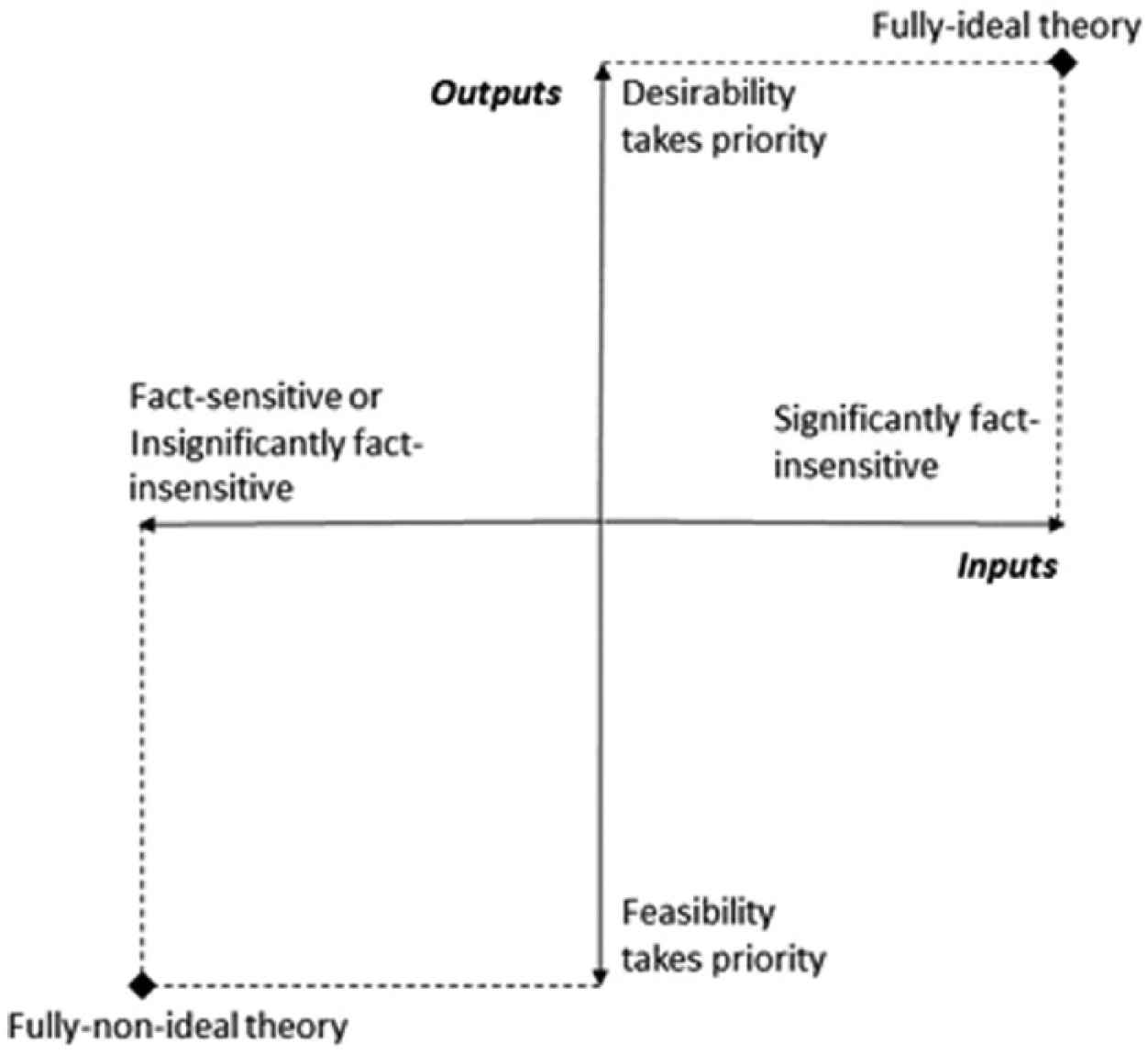
Two-Dimensional Characterisation of the Ideal/Non-Ideal Distinction.
While normative models built at the level of both ideal theory and non-ideal theory 12 are important on their own, they suffer from various shortcomings when looked at in isolation from one another. In order to see that this is the case, let us first look at ideal theory, and more specifically at normative models which maintain a high degree of idealisation in outputs. The main advantage of models of this type is that they are able to offer normative principles that can bring about highly desirable states of the world and with which we seem to be ultimately concerned when engaging in normative theorising. The main drawback of such models, however, comes in the form of a standard critique raised against ideal theory, namely that it fails to be action-guiding for the real world (see Valentini (2009) and Wiens (2015a) for an overview of several strands of this critique). This objection loses some of its force under the view assumed here however, which follows Hamlin and Stemplowska (2012) in distinguishing between the theory of ideals and institutional design, since in this interpretation, normative models (even ideal ones) built at the level of institutional design are by definition action guiding. Still, to the extent that they are relatively unconcerned with questions of feasibility, it may be possible that the models are action-guiding only under very particular states of the world, and will prove unable to tell us how to mitigate injustices in the ‘real’ world, or otherwise stated, about moves that we might take from the current state of the world to a less unjust, but feasible, state of the world. A different problem afflicts normative models that maintain high levels of input idealisation. The usefulness of such models relies on the fact that they are able to offer guiding principles in cases where the status quo is characterised by a set of counterfactual assumptions which can be presumed to be more conducive in instantiating the value considered important in the model, for example, the assumption of strict compliance in normative models concerning justice. The main drawback, however, is that such models may not have much to say about moves from current states of the world, since altering the set of inputs may lead to alterations in the set of outputs in (at the very least) all the ways described at the end of section ‘Institutional Design and the Structure of Normative Models’. Thus, knowing that under a highly idealised set of assumptions a normative model will generate a particular account of principles of justice may turn out to be useless for realising present improvements of justice, since the normative principles resulting under a high level of input idealisation might not be the same as the ones resulting under lower levels of input idealisation, might be unfeasible in the current state of the world or may turn out to be much less desirable for our current world.
Non-ideal theory escapes the problems previously underlined, but pays a non-trivial price in order to do so. First, theories that maintain a low degree of idealisation in outputs are vulnerable to the important objection raised by Simmons (2010: 34), who claims that ‘we, as theorists of justice, simply should not care which policies are politically possible (etcetera) unless those policies are also on an acceptable path to a just institutional structure’. Thus, without having a conception of the most desirable accounts of justice, which are developed at the level of ideal theory, non-ideal normative models might mitigate some particular injustices occurring in the current state of the world but lead us away from achieving a more just state of the world in the long run. Furthermore, the more normative models move to the extreme where feasibility takes absolute priority over desirability, the more vulnerable they become to the possibility of failing to seek the remediation of more severe injustices, if the remediation of less severe injustices is somewhat more feasible. Normative models that maintain a low degree of idealisation in inputs are also met with a different type of problem. Since such models avoid (as far as possible) to include significantly fact-insensitive assumptions in their set of inputs, they will regularly be unable to detect what soft constraints might make a more desirable state of the world less feasible and might be themselves removed if acted upon. Thus, non-ideal normative models are bound to treat some features of the current state of the world as fixed, even though they are amenable to change, and therefore fail to recognise opportunities to move to more just outcomes, if these features simply embody soft constraints.
A Framework for the Transition between Ideal and Non-Ideal Theory
If the issues raised at the end of the last section are genuinely worrisome, they imply that neither ideal theory nor non-ideal theory alone is sufficient for meeting the overall goals of institutional design. Rather, we need non-ideal theory in order to assess how we can move from our current state of the world to a comparatively more just one, and we need ideal theory in order to assess what a perfectly just state of the world looks like, in order to set it as a target for our ultimate normative aims. But even if work is to be conducted at both the level of ideal and non-ideal theory simultaneously, some of the outstanding problems identified earlier still remain. For one, if ideal-theoretical normative models are to be of some relevance for action-guiding purposes in our present world, as ideal theorists normally suggest they are, we need to know more about how desirable and feasible they would be under a more empirically sensitive configuration of assumptions than the one under which they were derived. For another, if our normative aims are not limited to moves which incrementally improve justice in a state of the world and we are concerned with the ultimate achievement of perfect justice, we need to know more about the various paths which we might take from our current state of the world to a perfectly (or nearly perfect) just state of the world. Mitigating these latter problems requires purging normative models from their relative isolation, which can be realised through the provision of a bridge 13 between ideal and non-ideal theory, or, more specifically, of an algorithm for the transition between these two levels of institutional design.
But while the ideal/non-ideal theory debate has been a major focal point in contemporary disputes on the methodology of political theory, the transition between ideal and non-ideal theory has received much less attention. Still, two general accounts of this transition, which are not mutually exclusive, have been standardly offered. The first one concerns the transition from ideal to non-ideal theory and has been discussed, with sometimes slightly different meanings, by Phillips (1985), Robeyns (2008), Herzog (2012) or Arvan (2014). Phillips (1985: 551) defines it as ‘a method for bridging the gap between a set of political principles and morality appropriate to ideal conditions and a set of political principles and a morality appropriate to the imperfect circumstances within which we live out our lives’, Herzog (2012: 273) connects it to the idea of ‘relaxing idealising assumptions’, while Robeyns (2008) argues that even though the precise meaning of a transition from ideal to non-ideal theory is far from clear, some plausible candidates would be that
perhaps we need to interpret the ideal-theoretical principles in a context with nonideal circumstances. Perhaps we need to develop a new set of nonideal principles of justice, which are developed by adding layers of relevant facts from the nonideal world to the ideal theory, using the ‘theoretical resources’ that are available in the ideal theory. (Robeyns, 2008: 348)
A general view on the transition from ideal to non-ideal theory can therefore be said to concern the way in which we may use normative principles derived at the level of ideal theory to guide our attempts at assessing and improving our current state of the world, which is bound to be characterised by different circumstances than the ones we stipulated in order to generate our normative principles. The second account concerns the transition from non-ideal to ideal theory and has been discussed (even if not necessarily in these particular terms) by Rawls (1999), Buchanan (2004), Simmons (2010) or Fuller (2012). This account is somewhat more straightforward, referring to the moves that are required in order to get from our current non-ideal state of the world to an ideal state of the world, with some principles such as (1) moral permissibility, (2) political possibility and (3) effectiveness (Rawls, 1999: 89) or the acceptability of moral costs (Buchanan, 2004: 61–62) being sometimes defended as constraints on the permissible moves allowed in the transition
While the general conception of a transition between ideal and non-ideal theory has therefore been specified in both directions, a comprehensive framework for how the transition in both directions can be conducted has yet to be put on the table. Still, several proposals, that are more restricted in scope but relevant, nonetheless, as forerunners to my view, have been offered. One of these proposals is Arvan’s (2014) attempt to move Rawls’ justice as fairness from the level of ideal theory to non-ideal theory. To this end, Arvan employs several normative assumptions defended by Rawls, for example, that justice is fairness and that the original position represents a perfectly fair setting to deliberate on principles of justice, together with a set of implicit and explicit descriptive assumptions. The key point stressed by Arvan is that in order to non-idealize justice as fairness, we need to change some of these descriptive assumptions so that they reflect the actual circumstances of our contemporary societies. Consequently, Arvan identifies three such assumptions, namely, strict compliance, reasonably favourable conditions and the circumstances of justice, proceeding then to build a ‘non-ideal’ original position by departing from the strict compliance assumption to one of partial compliance. Fuller (2012), by contrast, offers an account of the reverse transition, that is, from non-ideal theory to ideal theory. She also starts from a key Rawlsian premise, namely that theories of justice should give special weight to the worse-off group in a society. Fuller then proceeds to deploy this idea in order to show how the transition from burdened societies to decent, or liberal democratic societies, can be done. In her view, the moves required to achieve a more just state of affairs are to be undertaken in a successive manner, with policies designed in order to alleviate the plight of the worst-off group at each stage. When the worst-off group has been brought to the level of the group immediately above it, then policies should be designed in order to tackle the ‘vectors of injustice’ (Fuller, 2012: 381) affecting that group, and the move should be reiterated in a similar manner until the ideally just society would be realized. 14
Both Arvan (2014) and Fuller (2012) offer important methodological contributions, but they are particular to the Rawlsian framework and only address one respective part of the transition between ideal and non-ideal theory. In the following part, I sketch a more general account of how this transition can be done, in both directions and independent of the Rawlsian view of justice. The formal algorithm which I have in mind is represented by a procedure that I will subsequently call incremental derivation and which is inspired from the idea of derivational robustness analysis, used in the philosophy of economics. In its original economic usage (see Wimsatt, 1981), the method of robustness analysis sought to build confidence in theoretical results by deriving them through different and independent ways. Derivational robustness analysis, in particular, is used to figure out whether a theoretical result is dependent on a particular assumption, or, stated otherwise, it inquires whether a specific assumption figures in the derivation of theoretical results (Woodward, 2006: 231–233). Applied to economics theories, this method has two particularly useful functions: first, it ‘guards against error by showing that the conclusions do not depend on particular falsehoods. Secondly, it confirms claims about the relative importance of various components of the model by identifying which ones are really crucial to the conclusions’ (Kuorikoski et al., 2010: 543). The incrementalist approach, which I will defend here, mirrors derivational robustness analysis in that it uses the same procedure whereby we are concerned with the results that a model yields when we make a single assumption more or less fact-sensitive and keep all other assumptions fixed. While in the case of economic models, derivational robustness analysis tells us something about the way in which the predictions generated are dependent upon particular assumptions, in the case of normative models, the incremental derivation procedure allows us to understand the way in which normative principles are dependent upon particular assumptions, in a number of different ways; for example, they can be more or less desirable, more or less feasible or the principles yielded may be different altogether.
A sketch of the incremental derivation procedure that I propose is composed of the following steps: 15 (1) the values sought to be instantiated, which can be conceived as the normative assumptions of a model, and/or the rules of derivation in use are fixed at the level of the theory of ideals; 16 (2) an account (which is to be as extensive as reasonably possible) of the set of descriptive assumptions considered significant for the purposes of a normative model is offered; (3) a normative model, which starts from a particular combination of idealised and non-idealised assumptions in the set of inputs, is constructed, with a particular set of outputs generated; 17 (4) the original model is incrementally altered by changing a single descriptive assumption, thereby making it slightly more or less fact-sensitive; (5) the procedure is repeated either for the original model, meaning that a different assumption from the initial set is changed while keeping all the other ones intact, or for the newer model, meaning that a single assumption from the new set of assumptions is changed. A substantial amount of repetitions would yield a comprehensive landscape of normative models, with some highly idealised models, some highly non-idealised models and many other models between the two extremes; and (6) with a relatively well-developed landscape of models, comparative assessments of models in terms of desirability/feasibility are performed, as well as assessments of the paths from current feasible alternatives to the most desirable ones through incremental changes in facts about states of the world.
Without adopting my specific terminology or the proposal which I set out in the previous paragraph, we can already find plenty of instances in contemporary political theory that resemble the pattern of incremental derivation suggested here. 18 Take, for instance, the case of Rawlsian justice as fairness, which will serve both the purpose of illustrating how the incremental derivation procedure works and the purpose of highlighting that many philosophical works have already implicitly followed the method proposed here. Rawls’ model uses a set of normative assumptions (e.g. theories of justice should be selected in an impartial setting), together with a set of descriptive assumptions (e.g. decision-makers are mutually disinterested), a particular rule of derivation (i.e. agreement behind the veil of ignorance), and it generates the two principles of justice as fairness as outputs. Various authors have then departed from this original model by changing one particular descriptive assumption. For instance, regarding the assumption of strict compliance, Simmons (2010: 17) has notoriously mapped out six different ways in which it could be altered in a non-ideal way, by combining the distinction between deliberate and unfortunate non-compliance with that of non-compliance concerning nations, individuals and the basic structure of society. Similarly, Arvan (2014) has specifically shown how non-compliance can work within the Rawlsian framework. Others, such as Farrelly (2007), alter the assumption of reasonably favourable circumstances, arguing (not uncontroversially) that if we move from this assumption to one of unfavourable circumstances, which is more adequate for many of our contemporary societies, parties should favour average utilitarianism over justice as fairness in the original position. An even better example of incremental derivation is provided by the work of several authors who target the assumptions related to the reasoning processes of parties in the original position. Some of them, such as Agarwala (1986) or Angner (2004) alter the assumption that parties reason according to the standard conception of rationality drawn from neoclassical economics, claiming that the conclusion that maximin is a rational decision-making principle in the original position is robust to such changes. By contrast, authors such as Harsanyi (1975) or Moehler (2010) claim that parties in the original position would not give absolute weight to the possibility of ending up in the worst-off position and that other conceptions of justice, such as average utilitarianism or a variation of the Nash bargaining solution, would consequently be selected by parties. Volacu (2017a) then moves the discussion one step further into the realm of non-ideal theory, claiming that, actually, parties in the original position permissibly hold different conceptions of rationality and that, in light of this fact, the whole contractualist project should be reconstructed, in order to retain its viability. It is also important to underline that not all moves captured by this framework need to be towards non-idealisation but can sometimes run in the opposite direction. A notorious example in this regard, which also concerns the Rawlsian account, is that of Cohen (1991), who moves towards a more idealised state of the world when arguing in favour of assuming an egalitarian ethos in market behaviour, rather than individual pursuit of self-regarding maximising behaviour.
The framework set out here thus provides an algorithm for the transition between ideal and non-ideal theory in both directions. First, it allows us to see precisely how normative principles built at the level of ideal theory could guide action in our present world. Since each model constructed yields certain normative principles, characterised by a particular combination of desirability/feasibility, the incremental derivation procedure exposes the extent to which principles built at the ideal level, as well as their desirability and feasibility, are dependent on specific assumptions. If these assumptions are idealised 19 and more empirically sensitive assumptions yield either different principles or a different combination of desirability/feasibility, the incremental derivation procedure will highlight this and, in response, we may decide to implement normative principles that appeared to be less desirable/feasible in the ideal world but are better, on this account, in our current world. Second, the incrementalist approach allows us to describe the different intermediate states of the world which might be arrived at between our current one and the one which instantiates perfect (or nearly perfect) justice through the implementation of various normative principles. Consequently, the different paths which may be taken from the present world to the ideal one are at once illuminated and can be comparatively evaluated in terms of desirability/feasibility, with the path that generates the best overall combination being selected.
Conclusion
Conflicting claims about the best interpretation of the ideal/non-ideal distinction as well as the shortcomings of both ideal and non-ideal theory have occupied much of the space of methodological discussions within contemporary political theory. Furthermore, while most theorists who are sympathetic to ideal theory recognise the importance of some form of transition between the two levels, a general proposal for how to operationalise this transition has yet to be advanced. In this article, I sought to address both of these outstanding issues. I first examined the structure of normative models and used the input/output distinction to reconstruct the ideal/non-ideal distinction in a two-dimensional framework, which is able to unify the various meanings that the distinction has recently taken. I then used this distinction to expose and systematize some of the problems which are raised by theorising exclusively at either the level of ideal or non-ideal theory and the problems implied by isolating the two categories of views. Finally, I offered a methodological framework for bridging the two views, in the sense of providing an algorithm for the bidirectional transition between ideal and non-ideal theory.
One immediate objection to my proposal is that it would be too complex and ultimately unworkable on pragmatic grounds, since it would require a remarkable convergence between a significant number of political theorists, employed within a common project that yields relatively few disaggregated benefits. This objection is important but is not ultimately decisive. First, the project of incrementally deriving models can be less burdensome if we can offer a method of carving out only a particular set of descriptive assumptions that would be fundamentally relevant for normative models. Second, even if we will not be able to give a complete account of the landscape of normative models that might be constructed starting from a particular rule of derivation or from the instantiation of a particular value or set of values, the procedure would still be valuable. For one, the approach takes note of the urgency of building models which possess a high degree of feasibility, in order to move from current states of the world to more desirable ones. Even if the list of possible models (and, consequently, moves) will be incomplete, it would still be able to offer principles for guiding action here and now. In addition, even if we will not be able to map out the whole range of ways in which highly idealised models would fare under the circumstances of the current state of the world, the various intermediate models which are incrementally derived from more ideal ones will still be able to tell us important things about the robustness of these models and about the desirability or feasibility of applying idealised normative principles under present circumstances. Finally, even though we will not be able to map out the complete set of paths on which we could theoretically set out from our current state of affairs towards perfect justice, we will still be able to draw at least a partial picture of such paths and perform comparative assessments between them. While, admittedly, this will result in an imperfect evaluation of the various ways in which we could pursue the instantiation of gradually more just states of the world, it would no doubt constitute an improvement over theorising without any consideration whatsoever of the overall consequences (on both the short and long term) that implementing certain normative principles may have and, ultimately, might be the best we could hope for in this regard.
Footnotes
Acknowledgements
I am especially grateful to Zofia Stemplowska for her support and for fruitful discussions on an earlier version of the manuscript. I would also like to thank Esma Baycan, Oana Dervis, Nicolae Dobrei, Adelin Dumitru, Mircea Dumitru, Laurentiu Gheorghe, Adrian Miroiu, Mihaela Miroiu, Tom Parr, Emanuel Socaciu, Valentin Stoian, Mihai Ungureanu, three anonymous reviewers, as well as audiences at the 10th ECPR General Conference, the University of Bucharest, and SNSPA Bucharest for valuable comments on previous drafts of this article.
Funding
The author(s) received no financial support for the research, authorship and/or publication of this article.