



Abstract
When casting a split-ticket ballot, voters in established democracies have strong political predispositions and electoral experience that influence their decision. However, voters in a new democracy, lacking long-term party attachment and experience with democracy, may instead be informed and motivated by their social networks. Using the 1990 Cross-National Election Project German Unification study, I examine which factors predict split-ticket voting for East and West Germans. I find that political disagreement within a social network is more influential for East Germans, while partisan predispositions, particularly party supporter type, play a greater role for West Germans. These findings indicate that, in absence of competition between long-term partisanship and democratic experience, network characteristics may have a profound impact on political decision-making.
Although it varies cross-nationally and over time, most voters cast a unified party ballot (Burden and Helmke, 2009; Gschwend and Van der Kolk, 2006; Schoen, 1999). And yet a significant minority do divide their vote across multiple parties, that is, engage in split-ticket voting (Burden and Helmke, 2009). While some voters may split their tickets randomly (Schoen, 1999), most theories of split-ticket voting require either higher levels of political information or different motivations from straight-ticket voting (Gschwend and Van der Kolk, 2006). Given the relative rarity and the distinct motivations of the decision, examining split-ticket voters in different political contexts may reveal something important about voter decision-making.
Voters in new and established democracies face different political realities. In established democracies, voters are influenced by their political predispositions—which motivate them to support multiple parties or specific candidates—and their political experience—which provides information about the relative support and positions of parties, and the likelihood of certain coalitions—when deciding to cast a split-ticket ballot. Yet, these factors are generally unavailable to voters in new democracies, as they have no political history with the new system (Riera, 2013). However, voters in both established and new democracies can discuss political preferences with their friends, neighbors, and colleagues, and these interactions influence their attitudes and voting decisions (e.g. Huckfeldt et al., 2005; Pietryka, 2015; Ryan, 2011; Smith, 2016). And in comparison to established democracies, since network influence does not compete with predispositions and experience—which have yet to fully develop—we should see social influence via networks plays a more pronounced role in shaping split-ticket voting.
Using the 1990 Cooperative Cross-National Electoral Survey in East and West Germany, I examine what factors increase the probability that a citizen will split her ticket across the candidate and party ballot of the national parliamentary election. As East Germany entered into the existing institutions and party system of West Germany, we can focus on political experience as a critical distinction between the two populations in examining the relative influence of political predispositions and experience versus networks.
I find that, when deciding to cast a split-ticket ballot, West and East Germans are influenced by predispositions and network characteristics. However, East Germans are much more influenced by disagreement in their networks than their West German counterparts, while party supporter type plays a greater role for West Germans. These findings suggest that that the importance of social networks is magnified when it does not compete with predispositions; as such, for voters in new democracies, social communication may play a profound role in political decision-making.
This research has important implications for the study of voter decision-making in old and new democracies. By isolating voter, and not party, inexperience as the main distinction, we can see how voters respond to complex calculations absent a history with the system, in this case by being more readily influenced by those around them. This reflects something important both about how voters learn and how networks function—replacing, enhancing, or competing with pre-existing preferences. For voters with weak or uninformative predispositions and experience, networks can drastically influence decision-making. Since early political decisions tend to have a life-long influence, by understanding how networks shape nascent preferences and complex political calculations, we may have a better understanding of how they evolve over time.
Additionally, of course, this article proposes another answer to the question of how voters in new democracies can and do engage in complex action—through cooperative learning and influence of those around them. Thus, in studying behavior in new democracies, paying attention to the social context is critical in understanding voter preference development and, with it, system consolidation. Since early voter behavior massively affects how the system consolidates and functions (Moser and Scheiner, 2009), and since these voters operate with an informational deficit, by studying how networks shape complex action like split-ticket voting, an action associated with support for third-party growth and coalitional stability, we can see how the social, and not just institutional or economic, context of new democracies shapes their consolidation.
Split-ticket voting also proves a unique case in which to study the influence of political disagreement in a social network. The literature has not reached on a consensus on the degree to which political disagreement in social networks affects political decision-making (see Klofstad et al. (2013) for an excellent discussion). However, most studies of voter decision-making focus on a single decision at a time and, in doing so, overlook that voters have the opportunity to express multiple preferences on the same ballot (Mulligan, 2011). By examining split-ticket voting, we may be able to see how disagreement within a network might influence overall political decision-making, through voting for different parties across multiple ballots.
Split-Ticket Voting in Mixed Electoral Systems
Split-ticket voting is generally defined as any case where a voter casts his ballot for two different parties across different electoral competitions (Burden and Helmke, 2009). Mixed electoral systems provide a unique institutional context for the examination of split-ticket voting, in that voters cast two ballots for the same political institution. In Germany, the foundational mixed electoral system (Saalfeld, 2005; Scheiner, 2008), the first ballot is cast for an candidate in a single member district plurality (SMDP) election, while the second ballot is cast for a party using proportional representation (PR) (Saalfeld, 2005). The German system links the two tiers of the mixed system, meaning that the second ballot determines the overall distribution of seats in the Bundestag (Saalfeld, 2005). Although voters cast two ballots simultaneously, a relatively small number of Germans split their ticket—even in the upheaval of 1990, only about 16.4% of Germans split their ticket (Schoen, 1999). 1
Partisan Predispositions, Political Experience, and Contextual Factors
As most voters cast straight-tickets, split-ticket voters are considered to require distinct information and incentives (Gschwend and Van der Kolk, 2006). In casting a split-ticket, individuals may be motivated by both partisan and strategic/contextual considerations. 2 Voters may consider the characteristics of their political system when casting strategic or coalitional-oriented ballots, or may vote in a way to support multiple political parties, specific coalitions, or individual candidates (Gschwend and Van der Kolk, 2006; Huber, 2017; Kedar, 2009).
Partisan predispositions play an important role in the decision to cast a split-ticket. As strength of partisanship increases, the likelihood of split-ticket voting decreases (Ames et al., 2009; Carman and Johns, 2010; Mulligan, 2011). Even contextual considerations tend to fare poorly against the strong pull of partisanship in casting a unified ballot, and partisan strength is one of the most consistently negative predictors of split-ticket voting (Carman and Johns, 2010). Not only do partisans prefer casting consistent ballots, but they are more likely to reject positive information about other political parties (Taber and Lodge, 2006) and engage in wishful thinking about the likelihood of their party’s electoral success (Meffert et al., 2011). As both an instrumental decision and an expressive act of identity, strong partisanship thus plays a critical role in constraining split-ticketing (Schuessler, 2000).
Yet, strength is not the only element of partisanship that affects the likelihood of split-ticket voting. Voters with multiple partisanships, who have high partisan ambivalence, or who support specific coalitions are more likely to split their tickets (Carman and Johns, 2010; Davis and Mason, 2016; Huber, 2017; Mulligan, 2011). Split-ticket voting allows those voters who support multiple parties or have specific coalitional preferences the opportunity to cast a sincere vote for the parties/coalitions that they support, as an element of expressive choice (Huber, 2017). And for ambivalent voters, split-ticket voting offers the opportunity to ease cognitive discontent by supporting multiple parties (Mulligan, 2011). Thus, partisan predispositions can be expected to play an important role in predicting split-ticket voting.
While these partisan factors may be expected to strongly influence voters in established democracies, voters in new democracies are less likely to be influenced by these partisan predispositions. Voters in new democracies tend to have weak or underdeveloped partisanship (Dalton and Weldon, 2007). Absent socialization from parents and experience with party policy positions or coalitions (Dalton and Weldon, 2007), voters in brand new democracies do not have the same type of affective and incentive-based ties to political parties, and partisan and electoral volatility tends to be higher in new democracies as a result (Mainwaring, 1998). Given this weak and underdeveloped partisanship, voters in new democracies are less likely to be influenced by party heuristics and partisan information, and more likely to be influenced by contextual information, candidate characteristics, and election-specific information (Baker et al., 2006; Greene, 2011). As such, we might expect partisan preferences to be less influential to new voters than established voters.
Contextual and strategic factors also play a motivational role for split-ticket voting, and political experience and sophistication are highly associated with these calculations. The candidate ballot in mixed member proportional (MMP) encourages supporters of minor parties to split their ticket for strategic grounds, that is, vote for one of the two larger parties in the candidate ballot, in order to avoid a wasted vote, or to send a signal of discontent (Gschwend, 2007; Gschwend et al., 2003; Karp et al., 2002; Moser and Scheiner, 2009; Riera, 2016). The primary way in which voters are able to engage in this type of strategic voting is through an “electoral history heuristic,” using previous election results to gauge the probable success of parties on each ballot (Gschwend, 2007: 3). Alternatively, citizens may decide to split their ticket in order to ensure that their preferred coalition wins control of the legislature (Gschwend, 2007; Huber, 2017; Kedar, 2009; Pappi and Hurner, 2002). Similar to strategic voting, instrumental coalition voting requires clear expectations about the likelihood of certain coalitions forming, along with understanding how the combination of parties is likely to affect policy outcomes, which requires political knowledge and political experience. Given the complexity of this information, and its reliance on experience, we would expect older, more educated, and more interested voters to be able to more effectively gather the information necessary to split their ticket.
Once again, we might expect that the factors that help voter respond strategically to be less effective for voters in new democracies. Both strategic voting and coalitional voting require electoral history, which voters in new democracies do not have (Riera, 2013). East Germans, as new voters in new districts, were unable to rely on a political history to engage in the same type of strategic behavior as their Western counterparts, and thus age and political interest may not inform or incentivize split-ticket voting (Moser and Scheiner, 2009; but see Duch and Palmer, 2002). And while East Germans may have observed previous government coalitions over the border (Kern and Hainmueller, 2009; Schmitt, 1998), they had limited experience in participating in elections where these coalitions formed, or experiencing the policy associated with these governing coalitions. In 1990, contextual information would have been less helpful as well; in comparison to previous elections, where parties had encouraged certain types of rational ticket splitting in their campaigns (Roberts, 1988), small parties did not campaign for second ballot voting as actively in 1990, so political interest and attention to party-based messages would not increase ticket splitting (Pulzer, 1991; Schoen, 1999).
The story of the 1990 election is that West Germans faced relatively little electoral or party-system change, and thus had ready access to the information necessary to enable split-ticket voting, and consistent partisan predispositions to encourage it. East Germans, on the other hand, faced major institutional upheaval. There was simply no time for East Germans to develop the same type of partisan ties or electoral history heuristics available to those in West Germany. So, while election specific and network-based influences competed with partisan predispositions and information accrued from political experience for West Germans, East Germans, with less time to develop strong party attachment and limited experience with the new political system, were potentially more open to influence from alternative forms of information, particularly, as I argue below, those of networks.
Social Networks as Sources of Motivation and Information
Social networks—the interpersonal connections of individuals—play a substantial role in shaping attitudes and behaviors. The beliefs and preferences of conversation partners influence individual’s political preferences, along with providing information about parties and candidates. The composition of a network can influence turnout, vote choice, and other forms of political participation (Campus et al., 2008; Nieuwbeerta and Flap, 2000; Schmitt-Beck and Mackenrodt, 2010; Schmitt-Beck and Partheymüller, 2014), and in new democracies can increase affect for democracy and understanding of democratic institutions (Finkel and Smith, 2011; Gibson, 2001).
Networks’ characteristics may directly and indirectly provide the motivation and information associated with split-ticket voting. As noted by Thomas Gschwend and Henk Van der Kolk (2006: 169), split-ticket voting is more cognitively taxing than casting a single-party ticket, and therefore, voters must be “motivated and able to make elaborate decisions.” Networks can provide the necessary information to increase the ability of voters to cast a split-ticket, along with increasing their motivation to do so.
Networks act as a source of political information, and individuals seek out both expertise and political communication even faced with individuals who do not share their preferences; this information, in turn, can shape their political behavior (Ahn et al., 2010, 2013; Huckfeldt, 2001; Huckfeldt et al., 2005; Huckfeldt and Mendez, 2008), although the strength of this effect varies (Campus et al., 2008; Nieuwbeerta and Flap, 2000). Network size and frequency of discussion are strongly associated with increased accuracy of political knowledge, as voters use the political experts in their networks as heuristics (Eveland, 2004; Eveland et al., 2013; Eveland and Hively, 2009; Huckfeldt and Sprague, 1995). If split-ticket voting requires greater information to engage in, and voters themselves are less politically interested or knowledgeable, they may turn to the politically informed in their networks to help them (Huckfeldt et al., 2004, 2014; Pietryka, 2015; Schmitt-Beck and Partheymüller, 2014). An interested and engaged network, that is, one with a large number of experts and high levels of discussion frequency, may provide the voter sufficient information—such as the likelihood of success of certain candidates, how electoral system incentives work, or the likelihood of certain coalitions—to enable a split-ticket vote.
The partisan composition of a political network may also increase the likelihood of split-ticket voting. Voters with political disagreement in their networks, that is, those networks where discussion partners do not share the same partisanship or political beliefs, provide both information and motivation to cast a split-ticket ballot. When voters’ networks consist only of fellow partisans, they are unlikely to receive information about other parties and are given little motivation to form multiple partisan attachments; in addition, these homogeneous networks may lead to an intensifying of partisanship (Campus et al., 2008; Klofstad et al., 2013).
However, voters in heterogeneous networks learn about other parties, and face cognitive pressure to re-evaluate their attitudes toward their erstwhile rivals (Huckfeldt et al., 2004; Schmitt-Beck and Partheymüller, 2014), especially among networks with high frequency of political discussion (Huckfeldt et al., 2004). Additionally, heterogeneous networks may increase partisan ambivalence (Huckfeldt et al., 2004; Mutz, 2002), particularly among parties in the same ideological family (Schmitt-Beck and Partheymüller, 2014), which in turn may increase their likelihood of splitting a ticket (Mulligan, 2011), especially if this partisan ambivalence in turn leads to an increased support for a specific coalition (Huber, 2016). As such, disagreement within a network provides motivation to a voter to consider splitting their ticket.
In addition, similar to the way that voters who support ethnic parties may determine the level of support for their party by “counting heads” of co-ethnics (Chandra, 2009: 24), voters may use their social context to make inferences about the likely success of any given party (Baybeck and McClurg, 2005; Leiter et al., 2018), and the heterogeneity of a network may encourage the voter to split his ticket for electoral insurance. While this information may provide for less certainty (Chandra, 2009; Ryan, 2011), absent other forms of information, the partisan distribution of networks provides voters with some way of ascertaining the likelihood of success of their preferred party (Leiter et al., 2018).
Network Influence in New and Old Democracies
While networks may play a role in influencing split-ticket decisions, it is unclear whether this influence will be consistent across contexts. In established democracies, long-term predispositions and electoral experience compete with and frequently trump network sources in influencing vote choice (Ryan, 2010). An experienced voter, for example, knows how well a party is likely to perform in an election, and does not need to use his network to make inferences about the likely levels of support of a political party; moreover, if the network information conflicts with an individual’s experience, he is likely to rely on his experiential information (Ryan, 2011). Voters in established democracies thus act in a competitive information environment, where network characteristics are but one source, which may mute their overall influence in decision-making (Huckfeldt et al., 2014; Ryan, 2010).
But for voters in new democracies, there is no prior history or experience to rely on, and as such, they may rely on or be more influenced by networks (Baker et al., 2006; Finkel and Smith, 2011). Previous research has consistently demonstrated that less experienced, less partisan voters are more likely to be influenced by their networks (Ryan, 2011), and as noted above, this largely characterizes voters in new democracies. In fact, voters with limited political knowledge, particularly in states with weakly developed parties and partisanship, benefit much more from information accrued from their networks (Smith, 2016). This is why social networks, particularly when network disagreement is high, can also help to induce electoral stability states with weak parties or partisanship (Ames et al., 2012). Absent developed partisan attachment, information about how well parties have done in the past, the likelihood of coalitional formations, and experience with the political system, voters turn to networks to fill the gaps. As such, the network characteristics that influence split-ticket voting for voters in established democracies will be much more influential to voters in new democracies. Essentially, in new democracies, network-based information and motivations are amplified by the absence of competing predispositions and experience.
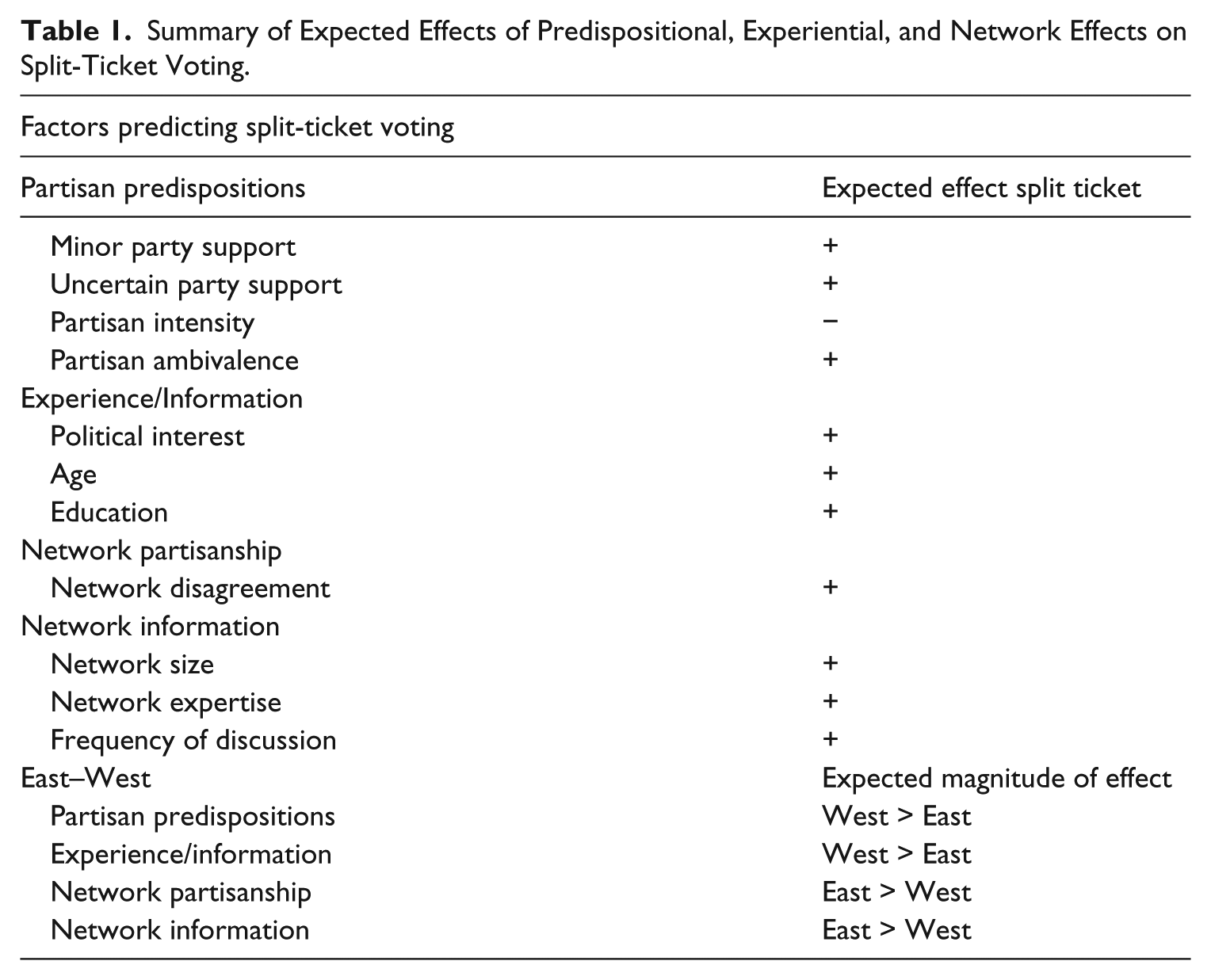
The general expectation is that partisan predispositions and political experience influence decisions to cast a split-ticket, and networks provide either supporting or contradicting information or motivations. Yet, these motivations may not be equal across all types of voters—comparatively, voters in new democracies have weaker and less consistent expectation and partisan attachments, meaning that these factors should matter less. In their place, network characteristics, in less competition with the predispositions, should thus matter more. Table 1 summarizes the expectations highlighted above.
Summary of Expected Effects of Predispositional, Experiential, and Network Effects on Split-Ticket Voting.
The 1990 German Unification Elections
The momentous change surrounding the collapse of the German Democratic Republic (GDR) and the reunification of Germany has been extensively covered, so I will only provide a brief overview. The process of regime transition for the GDR, which had existed as a stable second German state for 50 years, happened very quickly. The exodus of Hoenecker in October and the fall of the Berlin Wall in November of 1989 signaled the end of the GDR’s single-party authoritarian regime. In March 1990, the GDR held its first, and last, democratic election. By September 1990, the GDR ceased to exist, voting to dissolve and join the Federal Republic of Germany. By December 1990, a reunited Federal Republic held its first elections. Thus, the GDR’s democratization occurred through their absorption into the existing democratic institutions of the Federal Republic (Conradt, 2008; Pulzer, 1991).
The unique nature of the East German experience with democratization means that we must be cautious making inferences to democratic transitions. By absorbing the East into Western institutional and political party system, East Germany’s transition did not face one of the major barriers to coordinated political behavior: the lack of an established party system. For East Germans, perhaps uniquely among new democracies, the parties were not new or inexperienced. Well-established West German parties quickly entered the East, and the Party of Democratic Socialism (PDS), as the successor to the Socialist Unity Party of Germany (SED), had experience and connections with the electorate. Many explanations of the failure of voters to behave in rational patterns in new democracies are based not on voter irrationality, but on poor party-system consolidation (Duch and Palmer, 2002; Moser, 2001; Riera, 2013); in fact, as noted by Gunther et al. (2015), party systems and elites drive much of the distinctions in behaviors across new and old democracies. Of course, since party-system consolidation and voter experience develop contemporaneously, it is challenging to separate out the effect of “supply side” explanations for split-ticket voting in new and old democracies (Gschwend and Van der Kolk, 2006). By examining East and West Germany in the 1990 election, however, we can isolate voter inexperience, and not the lack of party-system consolidation, as one of the critical distinctions between East and West Germans. Thus, the 1990 unification election offers a unique advantage in investigating the micro-level experience deficit that voters in new democracies face, in comparison to their established counterparts.
Data and Measurement
To measure split-ticket voting, I rely on the 1990 German section of the Comparative National Election Project (CNEP), a cross-national survey project that collects survey data on individual, media, and social network information on individuals from 24 different countries (Gunther et al., 2007, 2015). The 1990 German Unification element of the CNEP relies on a unique data set that samples both West and East Germans before the first unification election. The survey relies on face-to-face interviews and includes a network battery (Huckfeldt et al., 2005). 3 (See Appendix 1 for question wording.)
For the dependent variable, split-ticket voting, I create a dummy variable that denotes whether the respondent intended to vote for two different parties across the two ballots.
About 15% of West Germans and 25% of East German respondents split their ticket, which matches previous examinations of this behavior. 4
To capture partisan predispositional characteristics, I measure party voter type, partisan intensity, and ambivalence. In order to capture party preference in the way that is most comparable for East and West Germans, I rely on vote choice in previous elections. 5 For West Germans, this is based on the party they supported in the 1987 national election. For East Germans, I use East German’s reported vote in the final election of the East German Volkskammer, which had one fully democratic election in March 1990. Although there were both party-system and institutional changes between these elections, this election does capture initial ties to parties and offered some information to East Germans about the relative support of parties. I create two party choice variables, minor party voter and uncertain voter. For minor party supporter, for West Germans, I treat the Christian Democratic Union (CDU) and SPD as the major parties, and all others as minor parties. For East Germans, those respondents who reported voting for the CDU (or its established political allies, the Democratic Awakening (DA) and the German Social Union (DSU)), the SPD, or the PDS, the three largest parties in the Volkskammer, are treated as major parties. In order to capture voter uncertainty about party support, I also create a dummy variable for all respondents who cannot recall how they voted in the previous election, were uncertain about their previous vote choice, or did not vote in the last election. Partisan intensity is measured as how strongly a respondent supports their preferred party. To measure partisan ambivalence, the cross-pressure to support multiple parties (Mutz, 2002; Nir, 2005), I create a Griffin ambivalence index for a multiparty context based on Schmitt-Beck and Partheymüller (2012) model. 6 Based on party evaluation measures for the five major parties, a positive value indicates strong partisan ambivalence.
To measure political experience and information, I code for political interest, education, and age. Political interest is based on self-reported scale of interest in politics. Education is separated into three categories and set for the educational distinctions between East and West. Low education indicates elementary or less, and high education indicates extended or university education. Age is calculated based on the respondents’ reported birth year.
In order to measure the influence of political networks, I rely on the embedded network battery in the CNEP, which asks respondents to name up to five discussion partners and answer a series of questions about their characteristics. I focus on four network characteristics that capture the size, expertise, interest, and disagreement in the network. Network size ranges from zero to five, based on how many discussants the respondent named when prompted. Frequency of discussion captures how often the discussants and respondent talk about political matters. Network expertise is based on respondent’s average evaluation of how much expertise his respondents have on political matters. 7 Finally, to test the relationship between network disagreements on split-ticket voting, I create a measure of political disagreement, which measures the proportion of the discussants who do not support the same party as the respondent.8,9 I also create a dummy variable for those respondents who did not report network discussants (Zero Network).
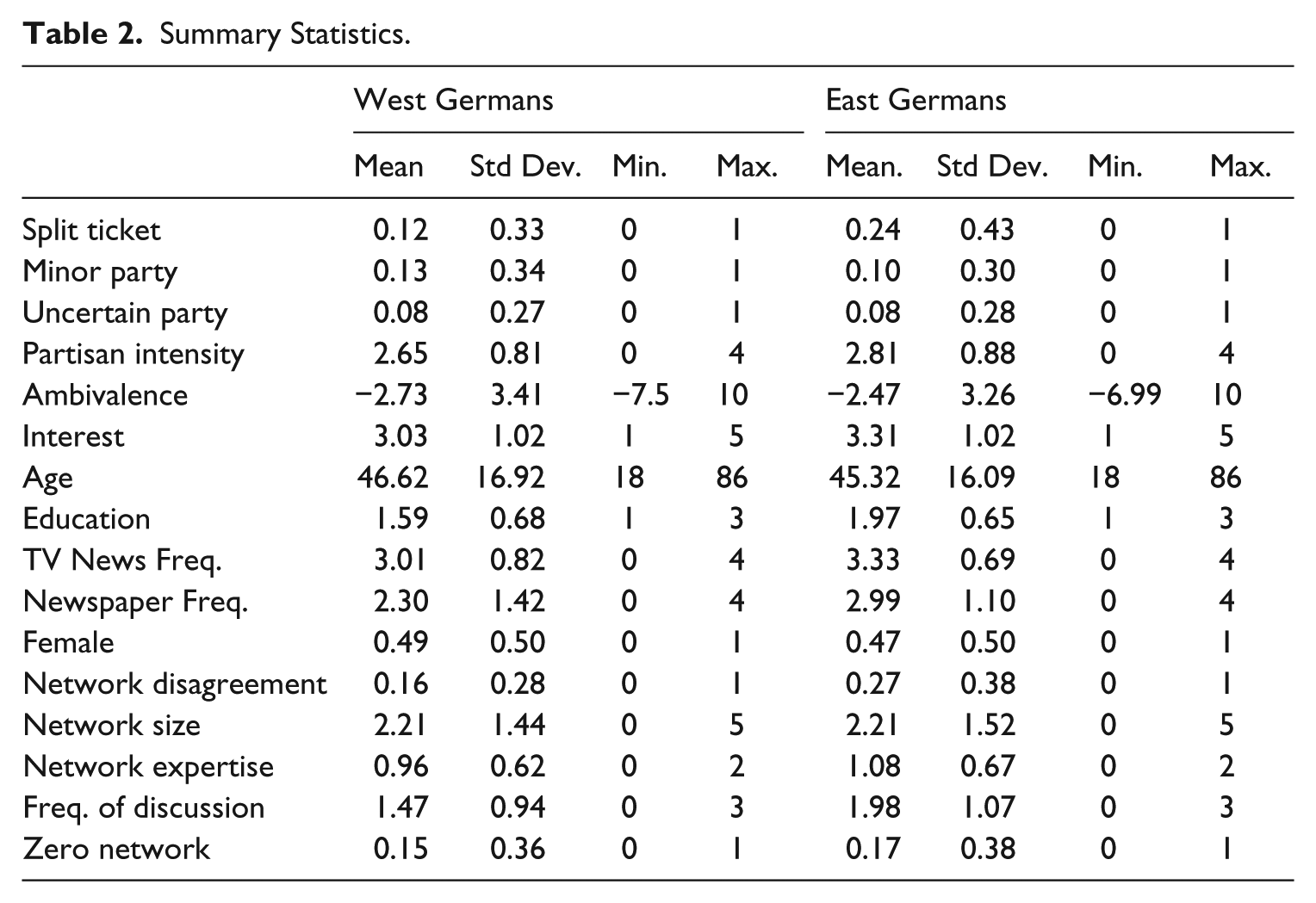
I also include a number of standard control variables that might be expected to influence split-ticket voting, including television and newspaper readership and gender. The descriptive statistics for my variables are reported in Table 2.
Summary Statistics.
Results
In Table 3, I present a logit analysis predicting split-ticket voting based on respondent and network-level characteristics. In column 1 of Table 3, I present a basic pooled model of East and West Germans. 10 Partisan predispositions, specifically minor party support and intensity, strongly influence split-ticket voting, with minor party voters being significantly more likely to cast a split-ticket vote than large party voters, and intense supporters being much less likely to cast a split-ticket ballot than those with weak partisan attachment (p < 0.05). Countering expectations, however, partisan ambivalence was not a significant predictor of split-ticket voting. Also contrary to expectations, older and more politically interested voters were less likely to split their ticket (p < 0.05), although education had minor effect in increasing its likelihood (p < 0.1). Gender appeared to have no effect on split-ticket voting. As to the media, while watching TV news had a positive effect on split-ticket voting, there was not a significant effect for newspapers.
Logit Analysis of Split-Ticket Voting by East and West Germans.
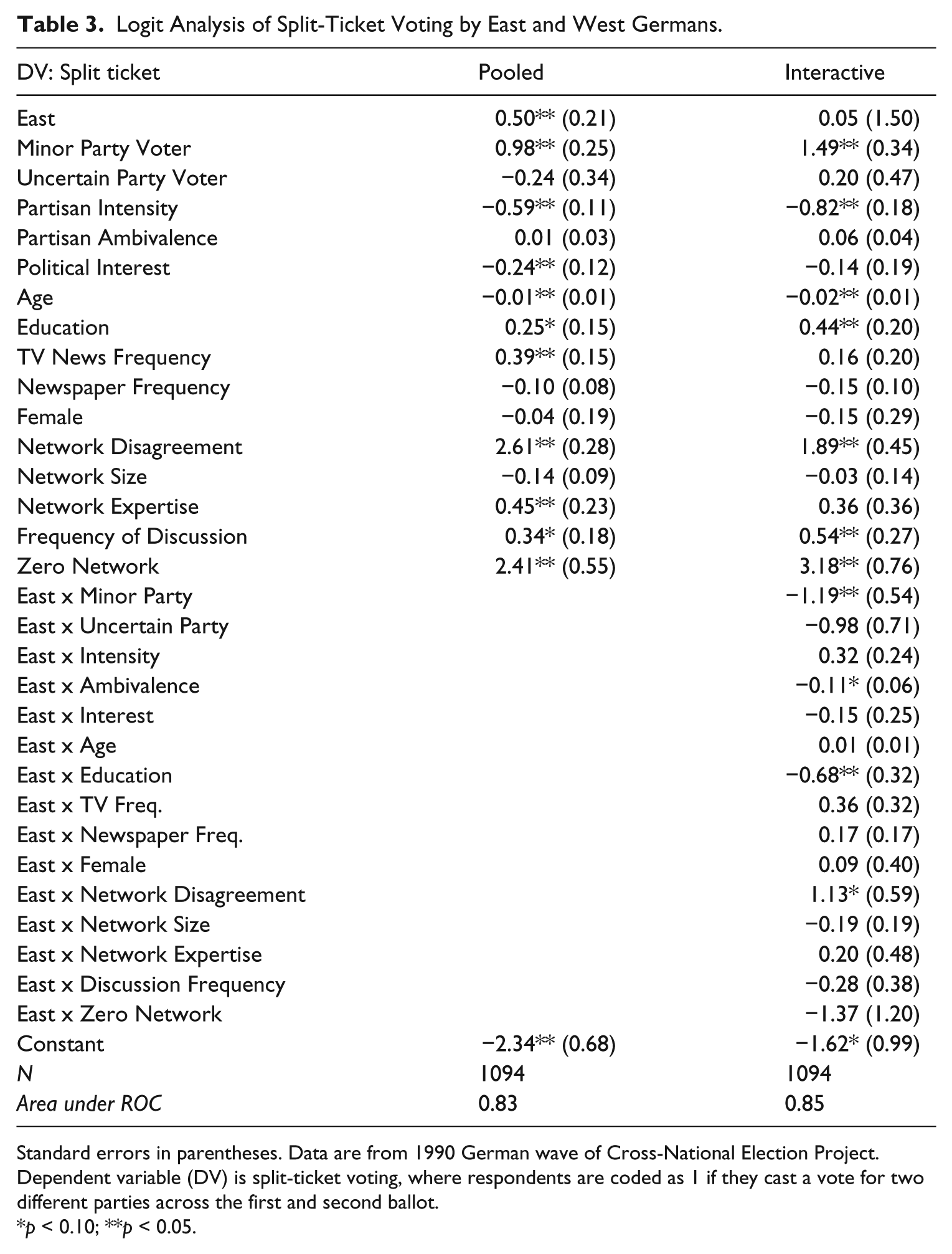
Standard errors in parentheses. Data are from 1990 German wave of Cross-National Election Project. Dependent variable (DV) is split-ticket voting, where respondents are coded as 1 if they cast a vote for two different parties across the first and second ballot.
p < 0.10; **p < 0.05.
Networks are also important in the pooled model, as those with high levels of partisan disagreement in their networks are more likely to cast a split-ticket ballot than those in homogeneous political networks. Expertise and frequency of discussion also positively predict split-ticket voting (p < 0.1). Social isolates were also significantly more likely to split their ticket. The pooled results provide moderate, if inconsistent, support of my expectations that partisan predispositions, political experience and knowledge, and networks influence split-ticket voting. Yet, by pooling East and West Germany, we mask important variation across the two regions.
In column 2 of Table 3, I interact all covariates of interest with the dummy variable East to capture the distinction between East and West Germans. These results show important differences between East and West German respondents across networks and predispositions. The average marginal effects of each coefficient are presented in Figure 1. The predicted probabilities of predispositional and experiential factors are presented in Figure 2, and those of network characteristics in Figure 3.
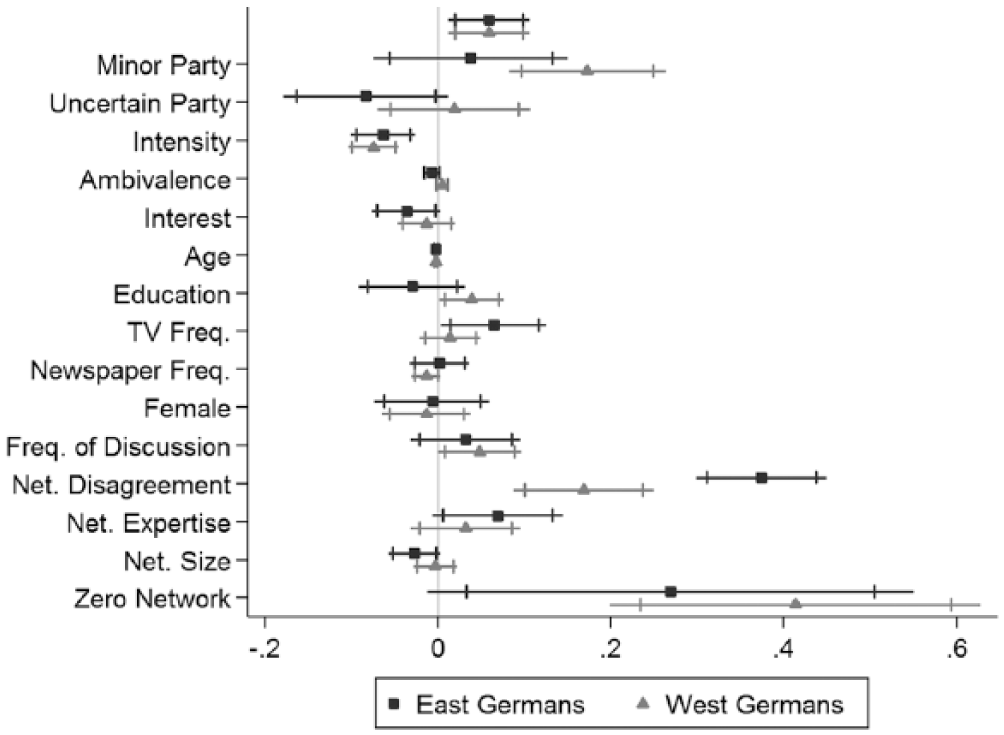
Average Marginal Effects of Partisan, Informational, and Network effects on Split-Ticket Voting.

Predicted Probability of East versus West Germans Splitting Their Ticket over Predispositions and Experience.

Predicted Probability of East versus West Germans Splitting Their Ticket over Network Characteristics.
Party supporter type plays an important role in influencing West German split-ticket vote. The average marginal effect of minor party voter increases the probability of a split ticket by about 20%; however, this effect is not significant among East Germans. Western supporters of the CDU and Social Democratic Party of Germany (SPD) have only a 3% probability of splitting their ticket, while an Eastern supporter of the CDU, SPD, and PDS is four times as likely to do. Eastern major party and minor party supporters and Western minor party supporters are all about equally likely to split their ticket, showing that Western party voters respond more to partisan incentives to split or not split their ticket than those in the East.
While voter type distinguishes East and West voters, partisan attitudes do not do so as clearly. The effect of partisan intensity is not significantly different between East and West Germans; moving from the lowest to the highest level of intensity decreases the probability of split-ticket voting by almost 30% for both. Even in early elections, those who express intense party preferences are unlikely to split their ticket. Similar to the pooled model, partisan ambivalence does not appear to play a significant role in the 1990 election. However, while insignificant, ambivalence appears to have countervailing effects in the two regions, as ambivalence modestly increases the probability of a split ticket for West Germans, and moderately decreases it for East Germans.
As in the pooled model, experiential/informational factors tended to have the opposite effect as hypothesized, or were non-significant. Political interest was not a significant predictor of split-ticket voting in the West, but the marginal effect of interest in the East decreased the likelihood of splitting by about 5% (p < 0.1). Similar to ambivalence, education had the opposite effect in East and West Germany, with more educated voters in the West about 10% more likely to split their tickets, and a negative and insignificant effect in the East. Finally, age plays a mild but significant role in decreasing the probability of splitting a ticket in the West, but not the East. However, the difference between East and West voters is distinguishable only between the ages of 40 and 60 (p < 0.1). Overall, informational/experential factors neither clearly drive nor distinguish split ticket voting in East and West Germany. 11
Turning to networks, we see that for both East and West, political disagreement has a positive effect on the likelihood of split-ticket voting, but these effects are significantly more pronounced for East Germans. For a West German, switching from a network entirely made up of co-partisans to one where none of the members share the respondent’s party preferences increases the probability of a split-ticket vote by about 16% (p < 0.05). However, the same change in network characteristics for an East German increases the probability of casting a split-ticket vote by 57% (p < 0.05). Even when a West German’s entire network disagrees with him politically, his probability of splitting a ticket is relatively low (22%), but for an East German, this level of disagreement increases his probability of ticket splitting by 44%.
Compared to network disagreement, the effect of network-informational characteristics is less pronounced. Network size significantly if moderately decreases the probability of split-ticket voting in the East, and is insignificant for the West. The effects of network expertise and frequency of discussion, are not significantly different across East and West Germans. While frequency of discussion has a slightly positive effect on the probability of splitting a ticket, the difference between East and West Germans is only at moderate levels of communication frequency. These results suggest that networks provide primarily motivation, rather than information, to increase the likelihood of split-ticket voting, similar to the predispositional variables.
Looking at partisan preference and network characteristics together additionally illuminates their distinct roles for East and West Germans. Examining Figure 4, which presents the probability of a split ticket for East and West German major and minor party supporters as network disagreement increases, a clear story emerges; for West German major party supporters, even high levels of network disagreement have a minimal impact on the probability of splitting their ticket. However, major party supporters in the East are strongly influenced by disagreement in their networks. At the highest levels of network disagreement, an East German major party supporter has almost the same probability of splitting his ticket as a minor party supporter. For West German minor party supporters, network disagreement appears to reinforce their predisposition to ticket splitting; even with a homogeneous network, West German minor party supporters have the highest probability of splitting a ticket of all four groups, and this only increases as network disagreement increases.
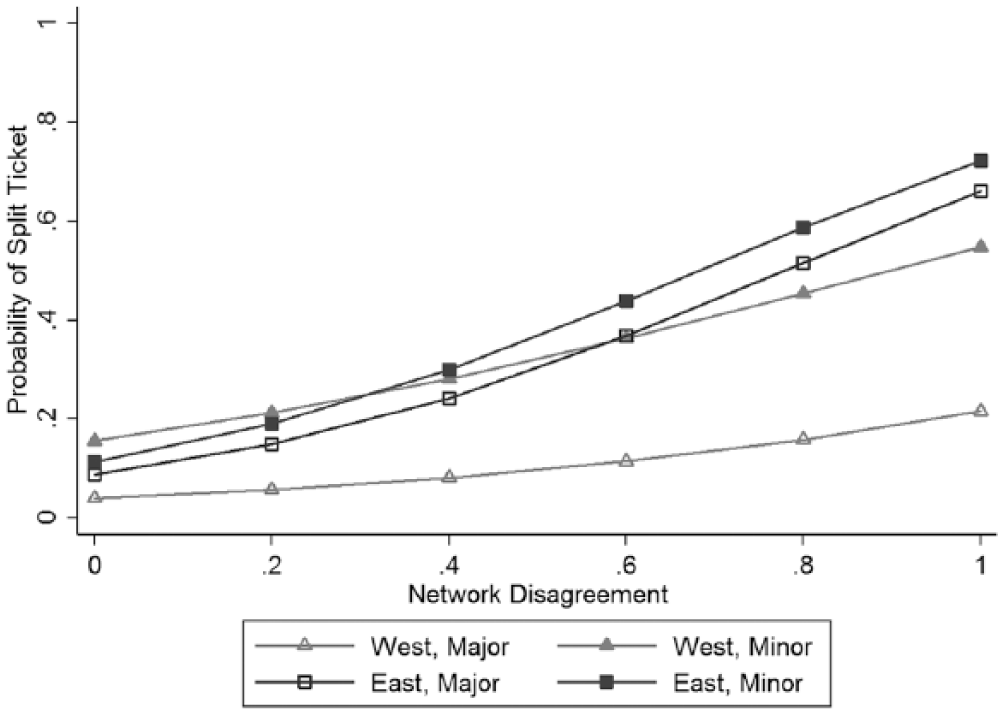
Predicted Probability of East versus West Germans Splitting Their Ticket by Party Supporter Type over Network Disagreement.
The results of these analyses indicate that, especially in regards to network disagreement, network-based motivations play a greater role for East Germans than for West Germans, while party preferences are a stronger predictor of behavior for those in the West. East German voters alter their political decisions based on their discussions with others. The more muted effect of networks for West Germans indicates either that West Germans are either less influenced by those with whom they speak with frequently, or that networks are but one of many competing signals that experienced voters use when deciding how to cast their ballots.
Implications for New Democracies
It is worth restating that, given the unique nature of the German Reunification elections, one should be cautious in generalizing too far outside of the context of this study. The established political party system in West Germany and the massive influx of resources provided by the West certainly contributed to informational environment that East Germans operated in, which likely contributed to their electoral behavior (Allen et al., 2001; Yoder, 1999). In most new democracies, the party system itself develops along with the new political system, and this can lead to a breakdown in both supply- and demand-side explanations for split-ticket voting (Moser and Scheiner, 2012). Voters may lack political experience, but so do parties and candidates, and thus, supply-side decisions for strategic party entry, party consolidation, and so on may fall away. Absent this behavior from parties, we may expect that split-ticket voting is likely to be motivated less by strategic calculations and more by either expressive concerns, which voters in new democracies certainly have, or by voter irrationality.
Yet, the uniqueness of the 1990 German reunification, which adopted the established party system of the West, allows us to focus more on voter, rather than party, inexperience, as one of the main distinctions between new and established democracies. While East and West Germans are certainly different in the way in which partisan predispositions, political experience, and networks influence their behavior, it is primarily a difference in degree, rather than in kind. The implication of this study is that for voters with less political experience, contextual information matters more. And it has been demonstrated by previous research that in new democracies utilizing existing networks to inform and engage voters is critical, especially if the party system is weak (Ames et al., 2012; Finkel and Smith, 2011).
Conclusion
Split-ticket ballots, particularly in mixed member electoral systems, are a relatively uncommon phenomenon, and as such require some additional motivation and information. In new democracies, citizens are at an informational disadvantage, in that they cannot rely on their experience with the political system or established partisanship. However, voters in new democracies are not without resources; through their social networks, voters may use the preferences of their discussion partners to learn about the various merits of different parties and candidates, or to make inferences about relative levels of support for various parties in the electorate. While voters in established democracies are informed and motivated by networks as well, their influence is not as substantial, since networks compete with their political experience and partisanship.
For West Germans in 1990, a combination of partisan and network characteristics influences their decision to cast a split-ticket ballot, with political information and sophistication playing an insubstantial role. For voters in a first election, here East Germans in the same election, partisan predispositions play a more muted role, as type of supporter does not significantly predict split-ticket voting. Instead, political disagreement in their networks is the strongest predictor of split-ticket voting, and is a substantially better predictor of split-ticket voting in the East than the West.
These findings imply that voters with minimal amounts of political experience and knowledge can make complex political decisions even in early elections, although they may be influenced by different sources than those more experienced with democracy. However, research calls the accuracy of network-sourced information into question (Chandra, 2009; Ryan, 2011), and as such, it is perhaps unsurprising that the impact of the less reliable information is diminished as voters develop experience and knowledge independently (Ryan, 2010). This project suggests that as voters develop their own motivations and experience, network-based information may decline in influence, and future research should investigate this process.
Footnotes
Appendix 1
Funding
The author(s) received no financial support for the research, authorship, and/or publication of this article.