




Abstract
Protracted conflicts are also termed “intractable” in part because they are perceived as irresolvable by those mired in the prolonged dispute. The conflict’s perceived irreconcilability leaves little reason for citizens to strive for peace which, in turn, might further exacerbate the conflict. The central question posed in this study is whether hopelessness regarding the possibility for peace can be alleviated among citizens embroiled in protracted conflicts. Results from an experimental study administered in Israel show that hope can be instilled, even among those most skeptical, when an outgroup member claims that peace is possible but not when an ingroup member claims the same. A follow-up study revealed that hope induced by the experimental interventions withstood a period of conflict escalation and elicited active support for peacebuilding. The study demonstrates that hope inducement is a useful tool for carving a pathway out of detrimental structures of intractability.
The most enduring international disputes are often defined as protracted conflicts. Protracted conflicts are violent, persist for at least a generation, and are perceived to revolve around existential issues (Azar, 1990; Bar-Tal, 2013; Kriesberg, 1998). The violent nature of the conflict, along with its resilience to subside, generates a common perception that the conflict will never be resolved (Rouhana and Bar-Tal, 1998). This lack of hope, in turn, keeps the conflict prolonged as it leads parties to invest resources in preparation for expected confrontations rather than to the attainment of an “unattainable” resolution (Bar-Tal, 2007). The lack of hope for peace further discourages the adversaries to negotiate, even after they reach a hurting stalemate (Pruitt, 1997). At least theoretically, hopelessness regarding the feasibility of peace should not be considered only as an obvious outcome of protracted conflicts but also as one of their sources.
This article explores the connection between citizens’ hope for peace and the conditions for conflict resolution. As such, this work seeks to contribute to the literature in political psychology and the microfoundations of international conflicts. Although distinct in their approach, both subfields aim to explain political processes by looking at micro-level phenomena such as citizens’ perceptions, opinions, and political behavior. Micro-level research is particularly relevant in protracted conflicts such as the one in Israel–Palestine, where both societies are fully and deeply involved in the conflict.
The conflict between Israelis and the Palestinians illustrates the typical features of protracted conflicts (Azar et al., 1978; Kriesberg, 1998). It is a long-standing and violent conflict that demands enormous investment from the rival parties and has a significant influence on both regional and international stability (Brecher, 2017; Dowty, 1999; Kelman, 2010). As in other protracted conflicts, its severity is also expressed in the pervasiveness of detrimental belief systems the parties have created to validate their understanding of the conflict’s nature (Bar-Tal et al., 2012). Although the conflict is asymmetrical, with Israel being the main powerholder, both societies strongly adhere to detrimental beliefs regarding the ingroup, the outgroup, and the conflict (Canetti et al., 2015). One of these beliefs is the conflict’s innate irreconcilability (Bar-Tal, 2007; Coleman, 2003). It seems that neither Palestinians nor Israelis believe that a negotiated peace deal is possible (Shikaki, 2002). The prevalence of hopelessness regarding the feasibility of peace is demonstrated in public polls that show that half of the Israeli and Palestinian publics believe that the conflict will go on forever (Telhami and Kull, 2013).
Theory
The literature on the sources of protracted conflicts has focused on external, institutional, and domestic causes on one hand (e.g. Azar, 1990; Brecher, 2017; Zartman, 2005) and socio-psychological sources on the other hand (e.g. Bar-Tal, 2013; Coleman, 2003; Kriesberg, 1998). Socio-psychological factors that perpetuate conflict, including citizens’ perceptions about the conflict, the ingroup, and the outgroup, have been studied extensively (see: Halperin et al., 2011; Kudish et al., 2015; Zeitzoff, 2016). Looking at the Palestinian–Israeli conflict as a case study, scholars have begun to explore how citizens’ expectations for peace facilitate or hinder conflict resolution. Public option research has found, for example, that Palestinians’ and Israelis’ expectations for peace was a robust predictor of their support for conciliation and political compromise (Shamir and Shikaki, 2002). In experimental studies, researchers tested whether increased hope for peace elicits attitudes that are more conducive to conflict resolution (Cohen-Chen et al., 2015; Leshem et al., 2016). Results demonstrate that when citizens embroiled in intractable conflicts are exposed to cues that question irreconcilability, their support for compromise increases.
These experimental designs, however, were limited in several ways. First, the researchers did not test whether induced hope elicits behavioral outcomes, such as active support for peacebuilding. Although support for compromise intensified after hope for peace was increased (Cohen-Chen et al., 2015), no evidence has yet been provided on whether increased hope affects political behavior. Second, past studies did not account for the potential effects created by the sources of the hope-inducing cues. In other words, it is unclear whether successful hope inducement depends on the source communicating the hope-inducing information. Third, hope was measured immediately after participants were exposed to the hope-inducing interventions. However, because reoccurring surges of violence are typical in protracted conflicts (Zartman, 2005), it is imperative to test whether induced hope withstands conflict escalation.
The current study addresses these gaps by posing three questions: (1) Can increased hope for peace elicit active support for peacebuilding? (2) Does the source of the hope-inducing information affect the capacity to induce hope for peace? and (3) Can induced hope withstand conflict escalation? The first two questions were examined in an experimental study conducted in Israel. An unexpected surge of violent confrontations, which began one day after the data were collected, enabled the examination of the third question concerning the durability of hope-inducing interventions.
The remainder of the theoretical introduction will include a brief description of hope’s components followed by an attempt to place hope and hopelessness within the context of protracted conflict. Last, hope inducement and the role of group membership in political persuasion will be discussed.
Hope and Hopelessness in Protracted Conflicts
Hope is composed of two distinct, though interdependent, factors: a wish to attain a goal and an expectation (though not a certainty) that the goal can be attained (Carver and Scheier, 2005; Stotland, 1969). Similarly, Webster’s dictionary defines hope as “a desire accompanied by expectation of or belief in fulfillment” and so recognizes both wish and expectations as innate components of hope. However, the colloquial use of hope can be confusing. Sometimes hope is used to represent only wishes, without referring to expectations (e.g. “I hope you have a nice day”). On other occasions, hope represents expectations as when discovering interesting findings increases one’s “hopes” for journal publication. Hope, unlike optimism, must contain another component, an active commitment to attain the desired goal (Breznitz, 1986; Carver and Scheier, 2005; Snyder, 1994). Indeed, we often critically judge people who make no effort to achieve their hoped-for goal. The additional requirement of actively pursuing one’s goal resonates with the work of thinkers and political figures who understood hope as an activity and a tool for political mobilization (Barber, 2016; Bloch, 1959; Fromm, 1968; Tillich, 1965). According to their approach, hope for social change can only be judged in the context of commitment and action. As Fromm notes, if one wishes for social and political change but does nothing but wait for it to come, one is not genuinely hoping (Fromm, 1968). In line with this approach, some willingness to act for peace is expected of those who hope for the conflict’s resolution.
As stated, one of the most common beliefs in protracted conflicts is the belief in the conflict’s innate irreconcilability (Rouhana and Bar-Tal, 1998). Understandably, hopelessness concerning the possibility of peace is grounded in the conflict’s extreme protraction and the repeated failures to achieve peace. However, hopelessness about the likelihood of peace can also stem from the psychological need for predictability and certainty, (Thórisdóttir and Jost, 2011; Zartman, 2005). The need for predictability might make citizens embroiled in decades of conflict prefer to perceive the conflict and its dire consequences as a “given” than to engage in the burdensome and often frustrating tasks of hoping for peace and committing to its materialization. The overall lack of hope discourages change and thus may contribute to the conflict’s persistence which will, in turn, feed back and deepen the sense of hopelessness among group members.
The reinforcing relationship between conflict and hopelessness is one of the detrimental phenomena of protracted conflict and one of the reasons why hope, and its absence, attracted the attention of scholars (Dowty, 2006; Halperin et al., 2008; Leshem et al., 2016; Rosler et al., 2017; Stone, 1982). Yet, scrutinizing the empirical studies on hope for peace reveals that hope was defined, operationalized, and reported in fundamentally different ways. For example, Antonovsky and Arian (1972) reported high “hopes for peace” in Israel but were measuring only participants’ wishes for peace, not their (potentially low) assessment of its likelihood. Others reported “low hopes for peace” in Israel but measured only participants’ expectations for peace. Hope’s behavioral manifestation, namely, the willingness to act to attain the hoped-for goal, was not yet studied in the context of conflict.
This article seeks to rectify the somewhat confusing approach to hope by conceptualizing hope as a construct comprising three interdependent but distinct components: wish, expectation, and action. Operationalizing hope based on these three elements contributes to the theoretical explorations of hope during conflict and is in line with recent studies that showed, for example, that citizens’ wishes and expectations for peace are only moderately correlated (Leshem, 2017).
As mentioned, another proposed contribution is to investigate the influence of the source of information on the effectivity of hope inducement. As widely demonstrated, the source of information has a substantial effect on recipients’ acceptance or rejection of a message (e.g. Brock, 1965; Nelson and Garst, 2005; Silvia, 2005), particularly in the context of conflicts (Kahn et al., 2016; Maoz, 2006; Maoz et al., 2002). In the present study, the potential effects of the source of hope-inducing information were explored by comparing two sources endogenous to the context of protracted conflicts: a lay ingroup member and a lay outgroup member. Due to the rise in popularity of web-based social media, millions of viewers are exposed to opinions made by lay sources. A growing body of research on the role of social media in protracted conflict shows that social media can be a space for both destructive (John and Dvir-Gvirsman, 2015) and constructive (Mor et al., 2016) dialogues. More specifically, Mor and colleagues showed how social media posts could increase sympathy and acceptance between Jewish–Israelis and Palestinians. Contributing to this emerging line of research, the current study uses video messages like the ones frequently found online, to compare the capacity of lay ingroup members and outgroup members to induce hope for peace.
Group Membership and Hope Inducement
Who will be more efficient in inducing hope for peace among citizens mired in protracted conflicts, an ingroup member or an outgroup member? The large body of work on persuasion demonstrates our strong favoritism toward messages conveyed by ingroup members (e.g. Brock, 1965; Nelson and Garst, 2005). In contrast, ideas expressed by non-group members are often ignored (MacKie et al., 1992; Silvia, 2005). Rejection of opinions or information will be even more pronounced when the views are communicated by a member of a disliked outgroup (see Bohner and Dickel, 2011). In this case, negative attitudes toward the disliked communicator bias the processing of the message resulting in the rejection of the advocated ideas (Kahn et al., 2016).
If group members are reluctant to be persuaded by a message conveyed by a disliked outgroup member, there is little reason to believe that Jewish–Israelis will heed to ideas conveyed by Palestinians. Recent polls show that 79% of Jewish–Israelis think Palestinians are untrustworthy and dishonest (Oren, in press). In another survey, 50% of Jewish–Israeli respondents rated their trust in Palestinians, on a scale of 0 to 10, as 0 (Peace Index Poll, December 2013). It is therefore not surprising that Jewish–Israelis devaluated an actual Israeli-authored peace proposal when they thought it was authored by Palestinians (Maoz et al., 2002) and deprecated an Israeli proposal for compromise when they learned that Palestinians accepted it (Maoz, 2006). Kahn et al. (2016) further demonstrated that the rejection of a peace proposal ostensibly authored by Palestinians was influenced by the high levels of hate and anger centrist and rightist participants had toward Palestinians. This “rejection effect” might also manifest itself in the present study where negative emotions and stereotypes toward Palestinians will lead Jewish–Israelis to label the hopeful Palestinian communicator as “anti-Israeli” or suspect that the communicator has hidden or malicious intentions for conveying an optimistic message (Maoz, 2006). In turn, these negative perceptions will lead Israeli Jews to reject the hopeful message altogether.
However, work in the field of conflict resolution and the literature on ascribed epistemic authority (Kruglanski, 1989; Raviv et al., 1993) offers good reasons why the literature cited above may be inadequate in the case of hope for peace. As argued by Deutsch et al. (2006), a common fallacy held by those entrapped in conflict is that the outgroup holds the key to resolution (conveniently exonerating the ingroup for its responsibility for the trajectory of the conflict). Based on this fallacy, the escalation or de-escalation of the conflict lies entirely in the hands of the enemy. It follows that when the feasibility of future peace is discussed, opinions expressed by outgroup members will be perceived by ingroups as epistemically superior to opinions made by “one of their own.” After all, if the enemy is assumed to be responsible for the conflict’s escalation or resolution, the enemy should know better where the conflict is heading.
Ascribing epistemic authority to a source of information increases the value of the information (Bar-Tal et al., 1991; Kruglanski, 1989). If the enemy is believed to hold the key to resolution, it is possible for Israelis to perceive Palestinians as unreliable and at the same time regard them as superior epistemic sources when it comes to assessing the possibility of future peace. Likewise, an ingroup member, which is typically regarded as more credible, may be deemed as an inferior epistemic source in predicting the outcome of the conflict. As noted by Kruglanski et al. (2005: 352), when it comes to persuasion, ascribed epistemic authority “may override all else and exert a determinative influence on individual’s judgment and correspondent behavior.”
The Present Research
To test the capacity of outgroup and ingroup members to instill hope for peace, a two-wave experiment embedded in a survey was administered to a Jewish–Israeli sample (N = 508). 1 The design was based on Leshem et al. (2016), who used optimistic messages conveyed by lay group members to explore hope inducement in protracted conflicts. Addressing shortcomings of past studies, the present design enabled to compare two sources of information intrinsic to the public discourse in protracted conflict: lay ingroup and outgroup members. The design also allowed measuring the outcomes on all three components of hope: wishes for peace, expectations for peace, and commitment to act for peace. Overall, it was anticipated that the fallacy that the “enemy” has superior epistemic authority to predict the likelihood of peace would override group members’ common rejection of messages conveyed by the “enemy.” Therefore, it was hypothesized that a Palestinian communicator would be able to increase hope for peace among Jewish–Israeli participants on all three components, but that a Jewish–Israeli communicator would be mostly ineffective in inducing hope for peace among his own ingroup.
Methods
The survey experiment was administered to a panel of adult Jewish–Israelis, who represented the Jewish–Israeli population in terms of political orientation. Political orientation was chosen as the primary criterion for representativeness as it is a robust predictor for a host of attitudes and behaviors related to conflict (e.g. Halperin et al., 2008; Hameiri et al., 2016). In addition, obtaining a sample representing the population’s political orientation strengthens the external validity of experiments, which usually do not necessitate representative samples (Shelef and Zeira, 2015). Participants were randomly assigned to one of five conditions (four treatment groups and one baseline group that was not exposed to any treatment) and were subsequently asked about their beliefs regarding the future of conflict and peace in Israel–Palestine. The treatments were 2-minute videos made to look like self-shot monologues frequently found on the Internet. Each video featured either a Palestinian communicator or a Jewish–Israeli communicator both conveying the same message: either that the Israeli–Palestinian conflict is resolvable or that it is irresolvable. This setup created a 2 (communicator’s outlook: skeptic/optimistic) × 2 (communicator’s nationality: ingroup/outgroup) factorial design.
Experimental Manipulation
Each of the four videos was filmed to look like a home video made by a 30-year-old man (see supplementary material for screenshots). A Jewish–Israeli actor performed his versions in Hebrew, while a Palestinian actor performed his versions in Arabic (later subtitled to Hebrew).
At the beginning of the clip, the communicator introduces himself as a Palestinian/Israeli named Suleiman/Shlomi. He then shares his insights about the future of the region. The communicator says he is convinced that achieving peace is hard but possible/and thus impossible and that an agreed upon solution is feasible/infeasible because the bitterness, animosity, and disagreements can/cannot be bridged. He adds arguments to support his belief and concludes that the two peoples will eventually/will never share the land because the conflict is inherently resolvable/irresolvable.
Although both communicators were delivering the same texts, two steps were taken to ensure that epistemic authority could not be derived from the content of the message or other confounding factors. First, communicators did not base their opinions on “facts” or claimed they had access to special information. Second, the “formal expertise” of both communicators was made identical, as both were said to have uploaded the video after participating in a seminar on peace and conflict. To ensure that the only variable manipulated was the communicator’s opinion about the possibility of peace, the communicator did not express their opinions about the outgroup, the ingroup, or toward other conflict-related issues including the types of solutions they favored.
Sample
Randomly selected panelists from an online panel operated by an Israeli polling center (Panel HaMidgam) were invited to participate in the study in return for monetary compensation. Quota sampling was used to obtain representativeness in terms of political orientation. The second criterion was gender, so an equal number of women and men was maintained in the sample. The total number of completed questionnaires was 508.
Excluded Participants
In total, 32 participants failed a multiple-choice question devised to test their attentiveness to the video and were consequently excluded from the analysis. An additional 22 respondents were excluded from the analysis for completing the survey in less than the minimum time required to read the instructions and the questions. Participants’ attentiveness was not associated with the videos, χ2(3, N = 388) = 1.73, p = 0.63. In addition, 27 participants expressed their doubts about the communicator’s authenticity and were thus excluded from the analysis. Doubts about the authenticity of the communicator were distributed equally across treatments, χ2(3, N = 388) = 4.2, p = 0.24, indicating that respondents were not more likely to doubt the authenticity of specific videos. 2
The final sample (N = 427, 316 in the treatment groups and 111 in baseline group) consisted of 49% females, ages 18 to 81 (M = 42.2, SD = 14.9). Among the sample, 56% identified as right-wingers, 25.5% as centrists, and 18.5% as left-wingers. This distribution corresponds with the distribution of political orientation among Jewish–Israelis (Hameiri et al., 2016; Kudish et al., 2015) and with Jewish–Israelis’ voting patterns in the elections that took place that year (Rahat et al., 2016). Robustness of treatment randomization indicates that treatments were evenly distributed within the sample (political orientation: χ2(8, N = 427) = 6.1, p = 0.64; gender: χ2(4, N = 427) = 2.7, p = 0.61; age: F(4, 422) = 1.5, p = 0.2).
Procedure
After accepting the informed consent, respondents in the four treatment conditions were asked to “watch a short clip downloaded from the Internet and answer the questions that followed.” After watching the video, the attention and authenticity checks were administered. Baseline group, serving as control, was not exposed to any video and was simply instructed to answer the survey questions. 3 All participants answered questions gauging their wishes and expectations for peace, were asked to report their political orientation, and, upon conclusion, were directed to exit the survey. However, instead of being directed back to the polling center’s home page, participants landed on a mock website containing a request to support a social media campaign initiated by an Israeli–Palestinian soccer team (see supplementary material for screenshot). Participants could choose whether or not to support the team’s campaign or simply close the page. The item, designed to tap participants’ commitment to act for peace, was located “outside” the survey to overcome a common problem in survey methodology where participants self-report their support for what they clearly know is a hypothetical request (Fiske, 2010). When the request is hypothetical, participants’ answers are likely to deviate from their real-world behavior. In this study, all effort was made to make participants believe the request is not hypothetical and that their decision influenced the chances of an actual Palestinian–Israeli team to win the campaign. Regardless of their decision, participants were directed back to the polling center’s website to receive compensation.
As previously noted, low hopes for change is one of the reasons people do not act to alter political situations (Greenaway et al., 2016). Because the belief in the likelihood of peace among Jewish–Israelis is low (Leshem, 2017; Telhami and Kull, 2013), it was predicted that without effective hope inducement, most participants would not support the binational initiative. However, if wishes and expectations for peace are instilled, group members’ commitment to act (the behavioral component of hope) was anticipated to rise as well.
Measures
Hope for peace was measured on the three discrete but associated factors mentioned previously: the wish for peace, the expectation that peace can materialize, and the commitment to act for peace.
Wish and Expectation for Peace
Two separate scales gauged the intensity of participants’ wish for peace and their expectations that peace will materialize. Each scale contained the same three propositions constructed to capture a range of general definitions of peace without referencing specific solutions. The three propositions were as follows: (1) “Achieving peace as you define and understand it,” (2) “Achieving a mutually agreed upon accord that ensures the interests of both peoples,” and (3) “Achieving a mutually agreed upon accord ensuring independence and freedom for Palestinians and security and safety for Israelis.” For each proposition, participants were asked to rate the intensity of their wish (0 = no wish at all, 5 = wish very much) and expectation that the proposition will materialize (0 = no expectation at all, 5 = expect very much). To minimize order effect, the order of the blocks was randomized with half of the participants answering the wish items first and half answering the expectation items first. Collapsing each scale separately, two indices were devised to indicate participants’ overall wish for peace (α = 0.84, M = 3.79, SD = 1.37) and overall expectations for peace (α = 0.88, M = 1.4, SD = 1.25). 4
Active Support for Peacebuilding
As noted, a webpage of a fictitious Palestinian–Israeli soccer team “popped-up” when participants completed the questionnaire. The webpage stated that the binational team was chosen, along with binational teams from other conflict zones, to enter a social media contest initiated by the United Nations (UN). The team receiving the greatest online public support (measured by virtual “stars” which could be allocated to the team) would receive funding from the UN and fly to visit the UN headquarters. The campaign urged the viewers to increase the chances of the Israeli–Palestinian team to win the online competition by allocating stars to the team. Participants could choose how many stars (0–5), to give. Those who opted out or closed the browser were recorded as allocating no stars. Importantly, Israeli participants were inclined to think their choices affected the success of a real-world Israel–Palestinian peace initiative and, most likely, weighed their decision accordingly. 5 The mean number of stars allocated to the team was below the midpoint (M = 1.84, SD = 2.25), with most participants (56%) allocating no stars at all.
Finally, participants’ self-reported political orientation was collected. Scores ranged from 1 (extreme right) to 7 (extreme left) (M = 3.34, SD = 1.26). Three categories were then created. Those identifying as extreme-rightist, rightists, or slightly rightist were categorized as rightists; those identifying as extreme-leftist, leftists, or slightly leftist were categorized as leftists; and those identifying as centrists were categorized as such.
Results
Main measures and correlations are presented in Table 1. As anticipated, left-wing political orientation is associated with high hopes for peace on all three components (wish for peace, r = 0.45; expectation for peace, r = 0.42; and active support for peacebuilding, r = 0.22). Interestingly, wishes and expectations are only moderately correlated (r = 0.35). Table 2 presents the mean scores of the three hope components in each cell. The substantial gap between the means of wishes and expectations in all five conditions and the moderate correlation between the two components support the decision to gauge wishes and expectations separately.
Means, Standard Deviations, and Pearson Correlations among Variables (Entire Sample).
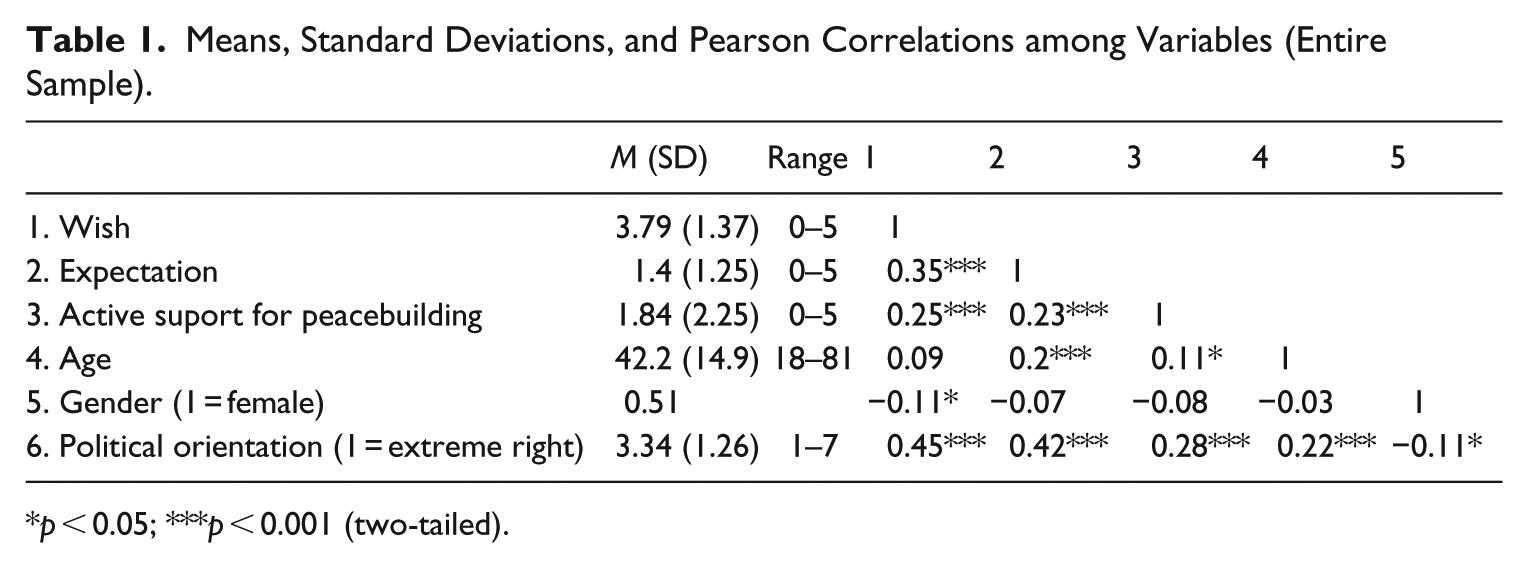
p < 0.05; ***p < 0.001 (two-tailed).
Means and Standard Deviations of Hope’s Components by Conditions.
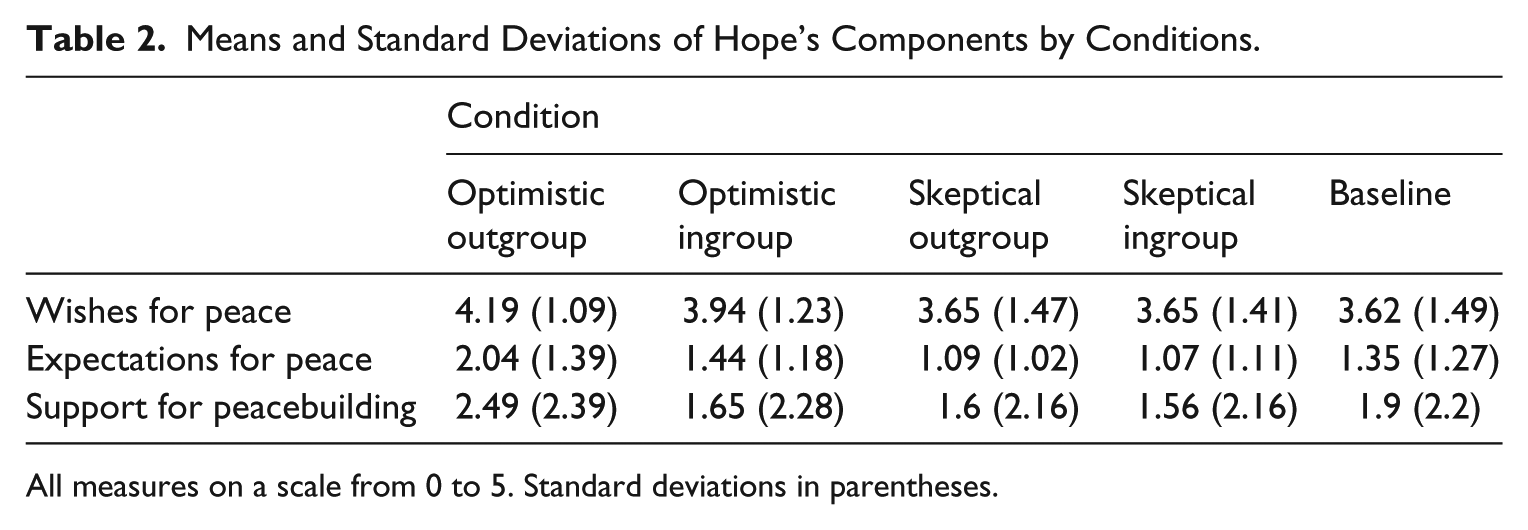
All measures on a scale from 0 to 5. Standard deviations in parentheses.
Effects of Treatments
To assess whether communicator’s nationality, communicator’s outlook, or their interaction affected participants’ hope for peace, average treatment effects (ATEs) and interaction effects were explored for each of the dependent variables (Table 3). As a second step, hope for peace in each of the four treatment groups was compared to levels of hope in the baseline group who did not watch any treatment. 6 Effects of treatments on wishes and expectations for peace are presented first, followed by effects on active support for peacebuilding.
Average Treatment Effects and Interaction Effect on Main Measures.

Average Treatment Effect and ordinary least squares coefficients with robust standard errors in parentheses.
p < 0.05; **p < 0.01; ***p < 0.001.
Wish and Expectation for Peace
As seen in Table 3 (left and middle columns), both wishes and expectations for peace were affected by the communicator’s outlook (wish: b = 0.41, p = 0.005; expectation: b = 0.65, p < 0.001) such that those who saw an optimistic outlook had higher wishes (M = 4.07, SD = 1.12) and higher expectations (M = 1.74, SD = 1.3) for peace than those exposed to a skeptical outlook (wish: M = 3.65, SD = 1.43; expectation: M = 1.74, SD = 1.3). Communicator’s nationality did not impact wishes for peace (p = 0.4) but did affect participants’ expectations (b = 0.3, p = 0.03). This effect was qualified by a significant interaction (b = 0.57, p = 0.03) such that the Palestinian’s outlook had a large effect on participants’ expectations (b = 0.9, SE = 0.19, p < 0.001), but the effect of the Israeli’s outlook was not as large (b = 0.37, SE = 0.18, p = 0.5). 7 This finding indicates that the Palestinian communicator was more effective that the Israeli communicator in increasing the expectations for peace.
The superiority of the Palestinian communicator over the Israeli communicator in inducing Jewish–Israelis’ hopes is further demonstrated when comparing each of the treatment groups to the baseline group (Figure 1). Compared to the baseline group, those exposed to the optimistic Palestinian communicator had higher wishes (b = 0.58, SE = 0.19, p = 0.002) and expectations (b = 0.69, SE = 0.2, p < 0.001) for peace. Wishes and expectations for peace among the other three treatment groups did not differ significantly from baseline levels (see supplementary material for full report).
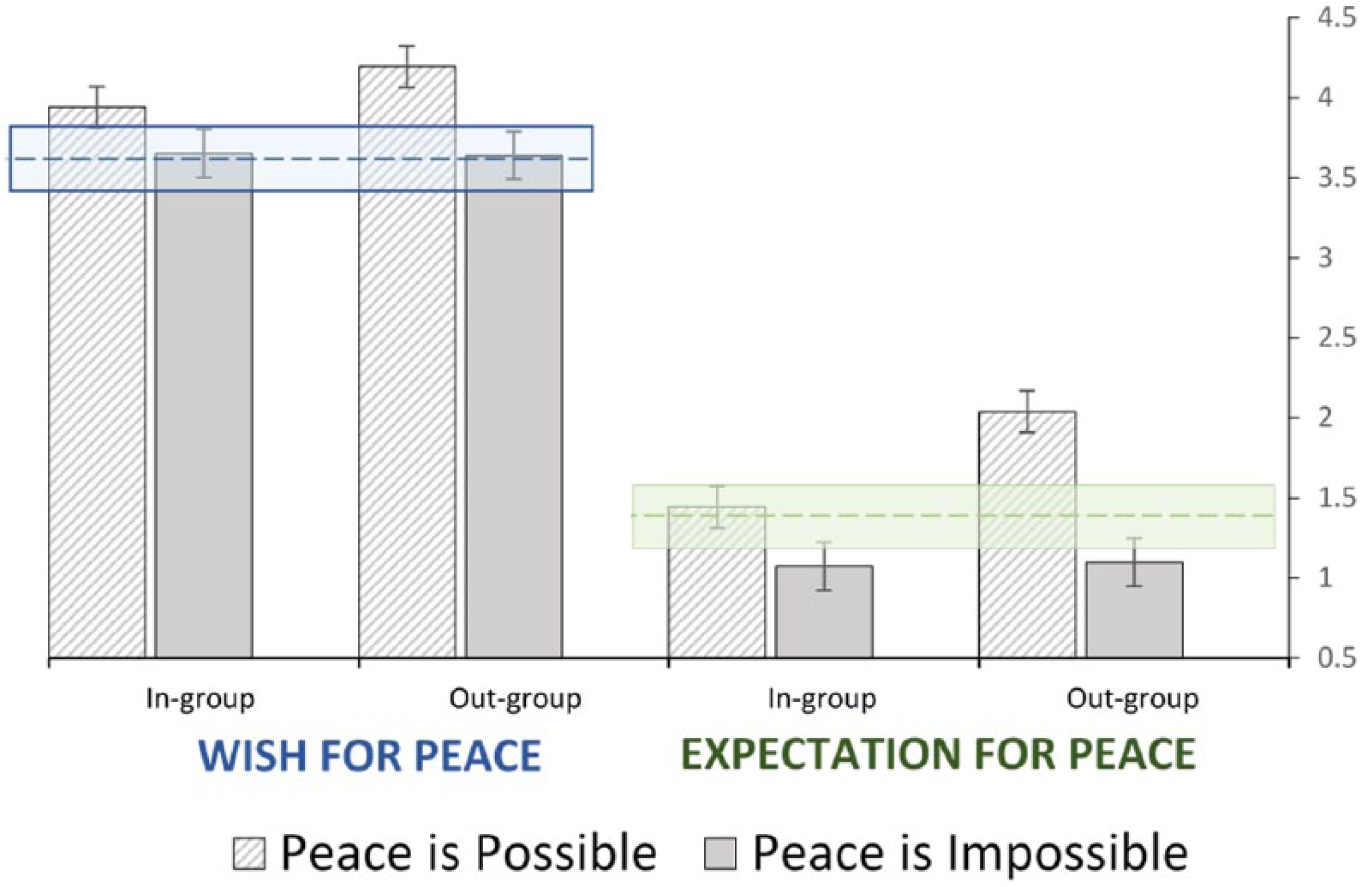
Effects of Treatments on Wishes and Expectation for Peace.
Active Support for Peacebuilding
Participants’ active support for peacebuilding (Table 3, right column) was only marginally affected by the treatments (outlook: b = 0.47, p = 0.08; nationality: b = 0.42, p = 0.12), while the interaction effect was not significant (b = 0.8, p = 0.14). 8 The marginal-to-null effects on support for peacebuilding are also observed when looking at each treatment group vis-à-vis the baseline group (Figure 2). The number of stars allocated to the peacebuilding initiative in each treatment group was not statistically different from the mean number of stars allocated in the baseline group (all comparisons, p > 0.13). A chi-square test using a binary variable coded 0 if no stars were allocated to the team and 1 if any number of stars were allocated supports this finding by yielding only a marginal association between the treatments and the general tendency to support the team, χ2(3, N = 283) = 6.3, p = 0.1.
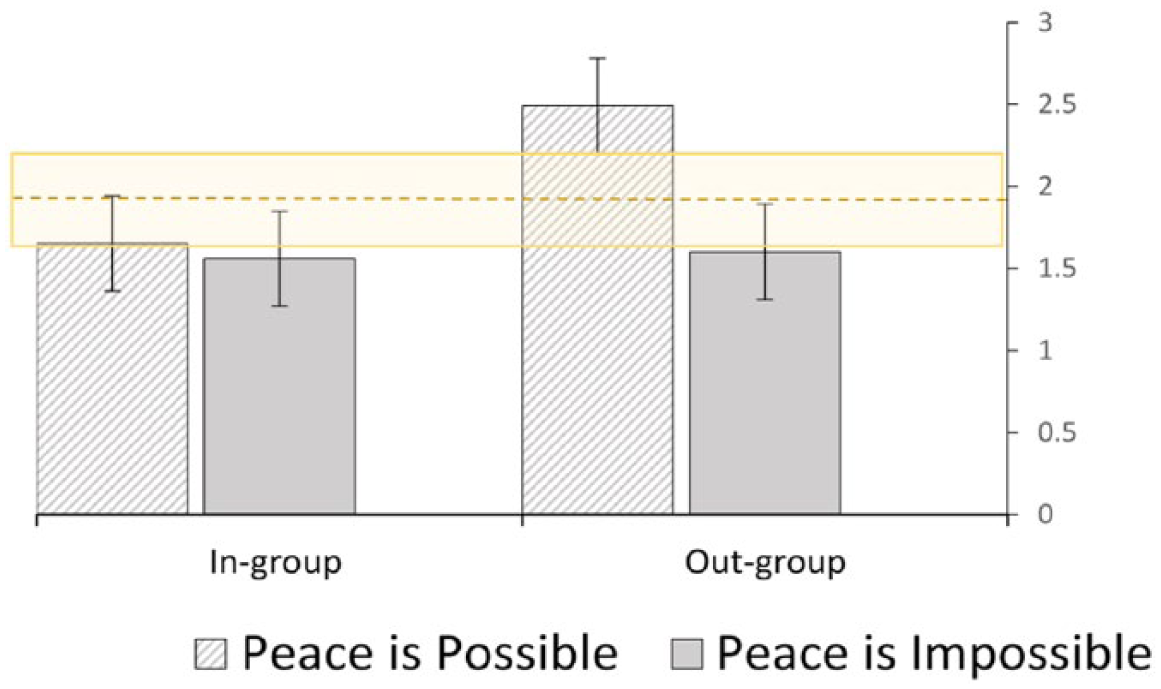
Effects of Treatments on Active Support for Peacebuilding.
Overall, results indicate that lay opinions about the feasibility of future peace can affect citizens’ wishes for peace and expectations for peace in support of the main hypothesis. When conveyed by an outgroup member, hope-inducing messages increase wishes and expectations for peace well above baseline levels. When an ingroup communicator conveys precisely the same outlook, effects are smaller or not significant, and scores remain close to the baseline. These findings could be explained by the superior epistemic authority ascribed to the Palestinian communicator, granting him an advantage over the Israeli communicator when it comes to predicting the future of the conflict. Contrary to the hypothesis, effects of the treatments on active support for peacebuilding did not reach statistical significance. The enormous challenges of changing political behavior are well documented (Fiske, 2010). Yet, for conflict resolution theory and practice, influencing behaviors in support for peacebuilding is of the highest importance. This goal was not achieved in the first wave.
Follow-Up Study: Durability of Interventions
A frequent question raised when investigating the effects of conflict resolution interventions is the question of durability. It is one thing to make attitudes more amenable to conflict resolution immediately after citizens are exposed to a message advocating conciliation, empathy, or hope. It is much more challenging to sustain this influence during conflict escalation when the harsh reality is pulling beliefs in the opposite direction. The challenge is even greater in protracted conflicts where reoccurring surges of violence reinforce the conflict’s perceived irreconcilability. However, it is imperative for both theory and practice to test whether conflict interventions can endure escalations of conflict. A surge of violence that commenced several hours after completing data collection gave me the tragic opportunity to investigate the durability of the interventions.
To test the durability of effects, panelists who completed the first survey were invited to participate in an ostensibly unrelated survey after a week marked by intense violent confrontations in Israel–Palestine. The escalation was sparked by a deadly arson attack in the Palestinian village of Duma in the West Bank carried out by Jewish–Israeli settlers. Violent collisions between Palestinians and Israeli forces broke out when the reprehensive attack was reported in the news. The regrettable incident and the intense violence that lasted for about a week allowed to test whether the effects observed in the main study can withstand conflict escalation.
Methods
Procedures
Panelists whose responses were included in the first survey were invited to complete another survey in return for monetary compensation. As standard in longitudinal survey experiments, invitations were sent by an automated system that manages the online pool of panelists. Panelists were invited to participate in a survey about their “political attitudes” and were unaware that the system invited only those who completed the main study. In addition, all effort was made to disassociate between the two surveys; the graphic interface was altered, and, of course, no reference was made to the original survey or the videos. In all, 349 panelists accepted the invitation (response rate = 81.7%). There was no association between attrition and the different treatments: χ2(4) = 4.95, p = 0.29.
Sample
In total, 26 participants completed the questionnaire in less than the bare minimum time needed to read and answer the questions, and so were left out of the analysis. The total number of valid responses was 323, of whom 243 were initially assigned to the treatment groups and 80 were initially assigned to the baseline group. The t-tests and chi-square tests indicate that the natural attrition of participants and purposeful exclusion of responses did not change the demographic makeup of the sample (see supplementary material). Robustness of randomization test shows that demographic measures were distributed equally across conditions (political orientation: χ2(8, N = 323) = 6.3, p = 0.61; gender: χ2(4, N = 323) = 3.2, p = 0.53; age: F(4, 318) = 1.1, p = 0.37).
Results
Change in Baseline Scores
Dependent-sample t-tests conducted on the baseline group show that there was no change across the two timepoints regarding active support for peacebuilding, t(79) = 0.79, p = 0.43. Baseline expectation for peace was also stable across timepoints, although a marginal increase was found, t(79) = 1.85, p = 0.07. Also, no difference was found in baseline groups’ self-reported political orientation, t(79) = 1, p = 0.32. The only significant change observed in the baseline group was the increase in one item from the Wish for Peace scale: “wish for peace as you understand and define it,” t(79) = 2.5, p = 0.014. 9 Overall, findings indicate that though the conflict escalated between the timepoints, baseline measures were relatively stable. Stability across the timepoints is also observed when looking at the entire sample (wish for peace: t = 1, p = 0.32; expectation for peace: t = 1.35, p = 0.18; active support for peacebuilding: t = 1.25, p = 0.21). These findings lend empirical support to theories on intractability, which postulate that the socio-psychological foundations of protracted conflicts are relatively stable, even during fluctuating levels of violence (Bar-Tal, 2007).
Effects of Treatments
Regression models assessing ATEs and interaction effects were utilized to determine whether the treatments still affected participants’ hope after a week marked by violent confrontations. The models were estimated for each of the three dependent variables measured in the follow-up study.
Results indicate that even after a week of violent confrontations, those exposed to an optimistic outlook had greater wishes for peace (b = 0.35, SE = 0.18, p = 0.05) and higher expectations that peace will materialize (b = 0.32, SE = 0.16, p = 0.05) compared to those exposed to a skeptical outlook. As expected, effects were smaller compared to the effects observed in the main study. Looking separately at each communicator, trends replicate the findings from the main study. When the communicator was Palestinian, the effects were significant (expectations: b = 0.51, SE = 0.24, p = 0.04) or marginally significant (wish for peace: b = 0.43, SE = 0.23, p = 0.68). However, effects were not significant when the communicator was Israeli (expectations: b = 0.15, SE = 0.22, p = 0.51; wishes: b = 0.29. SE = 0.27, p = 0.28). Overall, results indicate that the effects of the intervention diminished but withstood the escalation of violence.
Active Support for Peacebuilding
Surprisingly, participants’ active support for peacebuilding was affected by the video treatments seen before the conflict escalated. The number of stars allocated to the binational team was higher among participants who saw an optimistic outlook compared to those exposed to a skeptical outlook (b = 0.9, SE = 0.29, p = 0.003). Effect of nationality was not significant (b = 0.17, SE = 0.3, p = 0.56). A marginal interaction effect occurred (b = 1.1, SE = 0.58, p = 0.07) such that a Palestinian’s outlook about the feasibility of peace had a large effect on participants’ active support for peacebuilding (b = 1.4, SE = 0.41, p = 0.001), while the Israeli’s outlook had no significant effect (b = 0.35, SE = 0.42, p = 0.4). In other words, after a week of hostilities, Jewish–Israelis’ support for peacebuilding increased only for those who saw an optimistic Palestinian communicator.
These trends were replicated using a binary variable tracking whether participants allocated any number of stars to the team (coded as 1) or no stars at all (coded as 0). Chi-square test shows a significant association between the treatments and participants’ support for the team in the follow-up survey, χ2(3, N = 228) = 11.3, p = 0.01. Comparing active support for peacebuilding in each of the four treatment groups with the baseline group further demonstrates the considerable influence of the optimistic outgroup communicator. Those exposed to the optimistic Palestinian exhibited significantly higher support for the peace initiative vis-à-vis the baseline group (b = 0.85, SE = 0.14, p = 0.037), while active support for peacebuilding among the three other treatment groups did not differ from baseline scores (Figure 3).
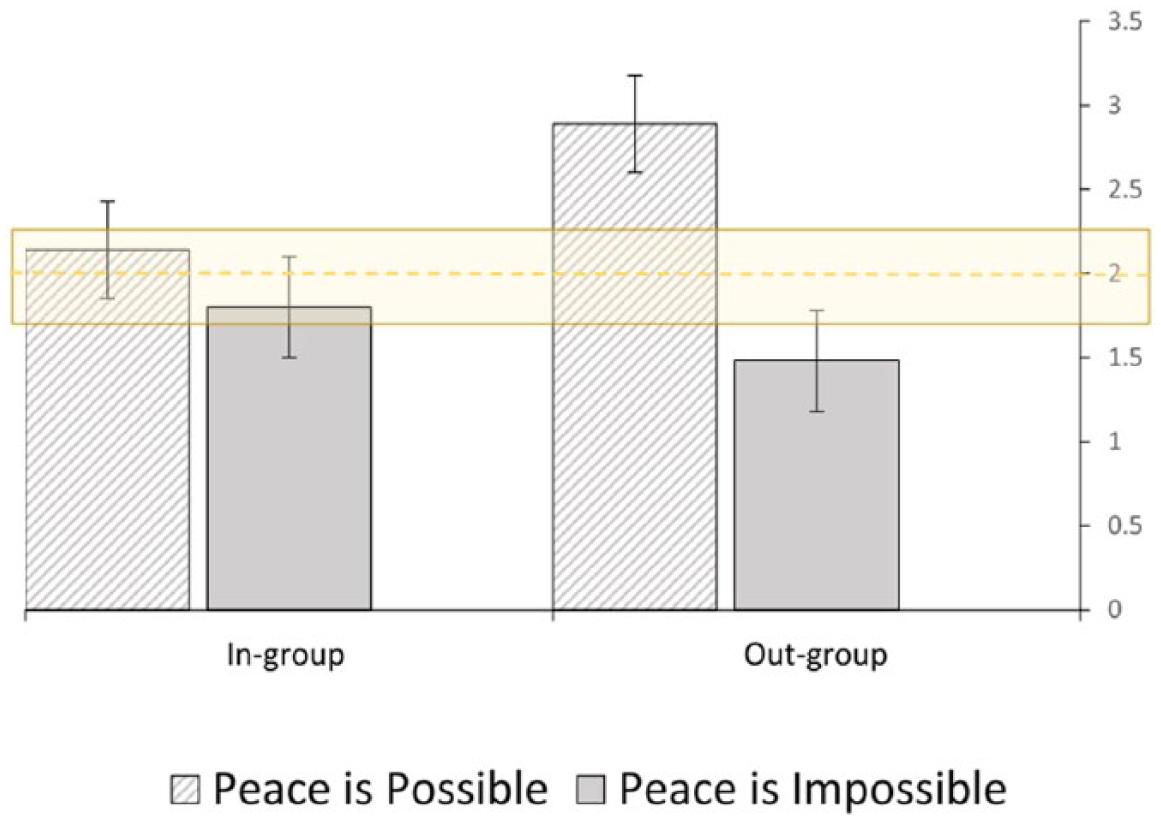
Effects of Treatments on Active Support for Peacebuilding in the Follow-Up Survey.
Discussion
This study demonstrates the pivotal role of the perceived enemy in instilling hope for peace. As mentioned, messages are often disregarded when conveyed by outgroup members, especially if the outgroup is disliked (Bohner and Dickel, 2011; MacKie et al., 1992; Maoz et al., 2002). Note that in the videos, Suleiman, the outgroup communicator, identified as a Palestinian, spoke in Arabic, and did not express empathy toward Jews or Israelis. There is thus no reason to believe that the Jewish–Israeli participants were in any way sympathetic toward Suleiman. However, contrary to the common rejection of offers and opinions expressed by the “enemy” (Maoz, 2006), an optimistic outlook about the future had more impact when conveyed by Suleiman than when conveyed by Shlomi, the ingroup communicator. The “enemy” may be hated or distrusted, but when it comes to predicting the future outcome of the conflict, the “enemy” enjoys epistemic superiority. Thus, in the particular case of inducing hope for peace, the outgroup communicator was more effective than the ingroup.
It is also worth noting that participants might have rejected the message conveyed by the optimistic ingroup communicator because they labeled the communicator as a deviant (Wood, 2000). Discrediting the optimistic ingroup messenger is especially likely in protracted conflicts where expressing an opinion (“peace is possible”) which diverges from the hegemonic view (“peace is impossible”) may be regarded as disloyal and unpatriotic (Saguy and Halperin, 2014).
Interestingly, across all dependent variables, the difference between communicators was not observed in the skeptical conditions. The Israeli and the Palestinian skeptic communicators generated similar levels of wishes for peace, expectations for peace, and support for the binational team, which were also not different from the levels in the baseline group. It may be the case that pessimistic outlooks about the feasibility of peace are so common that additional skeptical outlooks have no further impact.
The follow-up survey, designed to test the durability of the hope-inducing interventions, revealed that under certain conditions, induced hope could withstand conflict escalation. Participants’ wishes and expectations for peace were still affected by the messages conveyed before the conflict escalated, though, understandably, the effects decreased between timepoints. Maybe the most illuminating result is that effects of the interventions on active support for peacebuilding, that were, at best, marginal in the main study, emerged in the follow-up survey. It may be argued that some participants sought to support the peacebuilding effort to compensate for the violence afflicted on Palestinian civilians by Israeli Jews. Feelings of guilt, supposedly evoked by the Duma incident, might have increased Jewish–Israelis’ tendency to allocate stars to the binational team. However, this supposition is not supported by the data because, across the two timepoints, there was no change in baseline group’s and overall sample’s tendency to support the team.
A tentative explanation for the delayed effect of the treatments could be offered by reactance theory (Brehm, 1966). According to reactance theory, people may be reluctant to act upon persuasive messages immediately after being persuaded because they feel they were not free to act (Dillard and Shen, 2005). It could be the case that in the main study the request to support the team was too proximate to the persuasive messages and thus elicited reactance. After a week, when the video messages were not readily available in their minds, hopeful participants felt freer to choose to support the binational team.
Conclusion
Two main conclusions can be made when looking at the overall results. First, in protracted conflicts, an optimistic message conveyed by a lay outgroup member can have a substantial and, to some extent, lasting effect on group members’ hope for peace. Although the communicator’s identification as the Palestinian Other was explicit, his optimistic outlook increased hopes for peace even among skeptical rightists and eventually elicited an action in support for peacebuilding. Second, it seems that induced hope can withstand a week of intense escalation. As the results point out, participants who saw an optimistic message still had higher hopes for peace after a week of heated confrontations. It could be postulated that the Duma incident generated some wish for conciliation among Jewish–Israelis. Yet, the subsequent escalation, so typical to the conflict in Israel-Palestine, might have overshadowed these feelings by the end of the week. In protracted conflict, extreme violence and death are regrettably frequent and so might be perceived by those immersed in the conflict as inevitable manifestations of an irresolvable dispute. It is thus no surprise that 7 days into the escalation, hopes for peace were low among most participants. The only exception was observed among those who saw an optimistic outgroup member a week earlier. Their hopes for peace remained intact despite the violence and turmoil.
Two additional points are worth noting. First, one of the central problems of past studies on citizens’ hope for peace was the conceptual and operational merger of wishes and expectations (Antonovsky and Arian, 1972; Dowty, 2006; Halperin et al., 2008). 10 The current study disentangles the two components by establishing that wish and expectations, though correlated, are distinct components of hope that function independently. Second, this study illustrates, perhaps not surprisingly, that lay opinions conveyed by ordinary people affect political attitudes and behaviors of their audience. Although not directly tested vis-à-vis an authoritative communicator, findings provide evidence that lay group members have a significant role in shaping beliefs and opinions of those enmeshed in prolonged conflicts. These findings are in line with recent research that points to the significant impact of lay opinions distributed on social media (De Vries et al., 2017; John and Dvir-Gvirsman, 2015; Mor et al., 2016).
Theoretical and Applied Implications
A main theoretical contribution of this study is its focus on hope as a potential facilitator of conflict resolution. Indeed, this study is only a small step in revealing the broader connection between citizens’ hope for peace and the possibility to resolve protracted conflicts. However, the experimental design is an important addition to empirical and theoretical research on hope for peace that has established the importance of hope for conflict resolution (e.g. Greenaway et al., 2016; Pruitt, 1997; Shamir and Shikaki, 2002). The study also introduces ascribed epistemic authority as a means for conflict resolution by suggesting that under certain conditions, epistemic authority can be ascribed to the enemy. In potential, superior epistemic authority attributed to the rival party can be constructively translated into effective conflict management strategies. As this study shows, epistemic authority could also be ascribed to the weaker party and, as a result, contribute to the much-needed change in attitudes and behaviors among powerholders. As for applicable implications, practitioners and policymakers are constantly looking for pathways that challenge the destructive cycle of intractability. Hope-inducing messages can be incorporated into conflict intervention campaigns and policymaking strategies to boost citizens’ active support for peace and facilitate attempts to reach an agreement. This is applicable in Palestine–Israel as well as in other conflict-ridden areas where hope is a scarce resource.
Limitations and Further Directions
Several improvements can be suggested to advance inquiry into the role of citizens’ hope during conflict. First, to fully understand the effects observed in this study, it would be crucial to replicate the research with a Palestinian sample. Within this framework, it will be instructive to test how optimistic messages conveyed by the powerholders affect hopes for peace among the less powerful. As a variable, power asymmetry might have a significant effect on political persuasion and hope inducement and as such should be incorporated in future research. Second, in protracted conflicts, surges of violence can undoubtedly last more than a week. The relatively short period of escalation witnessed in the current study can offer limited inference on the durability of the hope. Further research should test the durability of induced hope across a more extended period of violent turmoil.
Notwithstanding these limitations, results validate findings from a growing line of research that demonstrates the unique role of hope as a catalyzer of constructive change. Moving beyond existing research, this study identifies optimistic outlooks made by the perceived enemy as effective conflict interventions that can withstand escalation and elicit behaviors conducive to conflict resolution.
Supplemental Material
PSX797920_supplemental_material – Supplemental material for The Pivotal Role of the Enemy in Inducing Hope for Peace
Supplemental material, PSX797920_supplemental_material for The Pivotal Role of the Enemy in Inducing Hope for Peace by Oded Adomi Leshem in Political Studies
Footnotes
Acknowledgements
Thanks go to the editor and the anonymous reviewers for their insightful comments and to Boaz Hameiri, Eden King, Thomas Obrian, Neta Oren, Keren Sharvit, Nir Halevy, Sandra Tombe, and Deborah Ann-Kermer for their valuable feedback. Special thanks go to Thomas E. Flores for his insights and support.
Funding
The author(s) received no financial support for the research, authorship, and/or publication of this article.
Supplementary Information
Additional supplementary information may be found with the online version of this article. Captions from the video treatments Caption from the mock webpage Demographics of excluded vs. included participants Average Treatment Effect (ATE) and interaction effects controlling for Gender, Age, and Political Orientation Effects of treatments vis a vis baseline group (OLS regression) Political Orientation as a Moderator Comparing demographics of main and follow up samples Stability of main measures between time points – entire sample (paired t-tests).
Notes

Author biography
References
Supplementary Material
Please find the following supplemental material available below.
For Open Access articles published under a Creative Commons License, all supplemental material carries the same license as the article it is associated with.
For non-Open Access articles published, all supplemental material carries a non-exclusive license, and permission requests for re-use of supplemental material or any part of supplemental material shall be sent directly to the copyright owner as specified in the copyright notice associated with the article.
