




Abstract
Using the 2014 Scottish independence referendum as a case study, this article asks first, to what extent is the use of digital communications technologies, in particular social media, associated with fundamental changes to campaign organizations, specifically to the command and control model? Second, under what conditions are challenges to the model more likely to emerge? Using mixed methods, our analysis of the case demonstrates that radical organizational or strategic change is not inevitable, nor is there a one-size-fits-all approach. Technologies are not ‘just tools’ that any campaign with enough resources will adopt in similar ways. Instead, depending on a number of interdependent factors (i.e. context, resources, strategy, organizational structure and culture), some campaigns – like Better Together – selectively adopt digital tools that fit with the command and control model; in other cases – like Yes Scotland – the application of digital communications technologies and the dynamics created by linking to other (digital-enabled) grassroots organizations can have transformative effects.
Ever since digital communication technologies (DCTs) became widely available, they have raised great expectations for not only their democratizing potential against authoritarian regimes but also the bread and butter of democracy: electoral campaigns. They have raised hopes of information abundance, better conditions for deliberation, and greater and more inclusive grassroots participation. Lately, social media and its networked peer-to-peer interactivity have added to the enthusiasm, potentially opening the door for individuals and groups to participate in ways that are neither controlled by conventional media gatekeepers nor by official campaign organizations. On the other hand, there are acute concerns about information overload, echo chambers, ‘fake news’ and incivility, the reinforcement of existing power inequalities and digital rocket fuel being provided for exclusionary populist actors. As the academic debate matured, it has become clearer that technology per se does not cause change. As our study demonstrates, technologies are not ‘just tools’; instead, technological affordances are leveraged, to different degrees and in different ways, by actors in context, thus providing differential constraints and opportunities to campaigns. Change is taking place, but it is not inevitable or uniform. There is no one-size-fits-all approach to how actors differently adopt, and adapt to, technology (Chadwick and Stromer-Galley, 2016; Earl and Kimport, 2011; Flanagin et al., 2006).
Thus, and given that the use of DTCs is now a mainstay of electioneering, we must ask not if, but how and why they are used the way they are by competing campaign organizations, and with what impact on power dynamics. This article uses the 2014 Scottish independence referendum as a case study to answer the following question: to what extent is the use of digital tools, and particularly social media, associated with fundamental changes in the nature and practices of electoral campaign organizations? More precisely, are electoral campaign organizations changing from the traditional professional model, focused on command and control, towards a more hybrid model that blends this with greater bottom-up, decentralized participation from a range of loosely connected non-elite actors, as is more typically associated with some social movements? Second, under what conditions are these different models more likely to emerge?
We were particularly interested in how in 2014 the two opposing campaigns navigated the tensions between using technology to foster enthusiasm and participation, while maintaining control of their key messages and resources, and how this relates to the context, to the respective campaign strategies, and to their organizational structure and culture. The focus is on use of social media by the campaigns but in the context of their broader use of DCTs – from blogs to email, to SMS, crowd-sourcing sites and membership management systems – and the hybrid media system (Chadwick, 2013).
Despite the massive interest in all-things-Internet, research of this kind is relatively scarce, especially outside the US. Moreover, most research has studied primaries or general election campaigns, notably Howard Dean’s and Barack Obama’s (e.g. Bimber, 2014; Kreiss, 2012; Stromer-Galley, 2014). In contrast, the organizational impact of the use of DCTs during referendum campaigns has seldom been explored. However, as this article shows, referenda provide rich research territory; as in the Scottish case, they are inherently interesting hybrids, in that they combine characteristics of general election campaigns with those of advocacy campaigns.
On one hand, the campaigns were not party- or candidate-centred but short-term coalitions. On the other, the main parties – and to some extent governments (UK and Scottish) – were at the core of both campaigns, and both coalitions relied on the parties’ organizational resources and campaign expertise, as well as some of their best-known figures. At the same time, political parties on both sides were obliged to campaign alongside other parties with whom they are normally in competition. On the No side (Better Together), differences in policy and political values between Labour and the Conservatives made them uneasy bed-fellows and affected the level of enthusiasm among party members and supporters for joint activity. On the pro-independence side (Yes Scotland), the SNP and its supporters appeared more willing to work with other parties and a number of vibrant grassroots advocacy organizations, in pursuit of the common goal of independence. These complex and varied interactions between the official campaigns, established parties and many highly engaged grassroots groups of different kinds contributed to set different constraints and opportunities for the use of DCTs by each campaign and makes this case especially interesting.
At the same time, the referendum had much in common with key features of many contemporary general election campaigns. Processes of political realignment and the weakening of traditional partisan affiliations in many Western democracies have been accompanied by the eruption in number and importance of vibrant digitally enabled grassroots groups, such as Indignados in Spain, Momentum in the UK and Occupy in the USA. These groups are increasingly playing key roles alongside (and often within) established parties in which, with ‘multi-speed memberships’ (Scarrow, 2014), boundaries between insiders and outsiders are becoming increasingly fluid. This makes the case of the Scottish independence campaign relevant not only to referenda, which are increasingly important, but also to electoral campaigns more generally.
The distinctiveness of our study resides not only in the characteristics of its subject – the referendum – but also our mixed methodology, which combines the use of computational techniques to analyse the differences in the pattern of Twitter activity between the rival campaigns and groups, and in-depth interviews with key campaign stakeholders. This provides a rich and innovative empirical analysis of how and why DCTs – and especially social media – are used by, and affect, competing campaigns.
The article will first discuss the impact of DCTs on parties and campaign organizations, with emphasis on the concept of organizational hybridity. The second section explains our methodology. The final sections focus on the analysis first of the Twitter data and then of the interviews. We conclude by highlighting the significance of our findings for the study of electoral campaigns and the impact of social media, and DCTs more broadly, in politics.
Electioneering and DCTs: Change and Continuity
Since the 1980s, political communication research has analysed changing models of campaigning and how these have been greatly influenced – and for some driven – by technological developments. Election campaigns in the modern or ‘third era of political communication’ have been characterized by a heavy focus on mediated communication (especially TV), professionalization, tightly centralized control of campaign messages, emphasis on targeting of undecided voters aided by public opinion research, and escalating costs (Blumler and Kavanagh, 1999; Norris et al., 1999; Swanson and Mancini, 1996). This is accompanied by a ‘top-down’ centralized command and control organization, emphasizing agenda setting, staying ‘on message’ and rapid rebuttal. In this model, most citizens have a limited role as spectators, and those party supporters who continue to actively engage are tightly managed by the professional campaign hierarchy.
This model has continued to evolve alongside developments in technology and data science into the so-called ‘post-modern’ era (Norris et al., 1999). On one hand, digital tools have enabled even more sophisticated message discipline, micro-targeting and use of data (Kreiss, 2016b), while on the other hand, technology has contributed to the creation of a fragmented, high speed and rapidly changing communication environment (Chadwick, 2013). These challenges are played out against a background of widespread concern at crises of participation, especially disengagement from traditional political parties and decreasing turnout (Van Biezen et al., 2012).
In this context, DCTs offer great opportunities for campaign organizations but, equally, they present challenges to the traditional model of professional command and control. Because of their technological affordances, DCTs – and most especially social media – offer the possibility of greater and more diverse forms of participation, more easily and with greater two-way interaction with, as well as autonomy from, the campaign. However, the practice is less simple: technological affordances do not automatically translate into change, still less democratizing change. Moreover, they are adopted and adapted by campaigns in different ways. Research has shown that DCTs are most often used by campaigns to instrumentally harness citizens’ enthusiasm and labour, using data-assisted guidance (Vaccari, 2010) or ‘computational management’ (Kreiss, 2012) to manage participation, with the emphasis on ‘controlled interactivity’ (Stromer-Galley, 2014). Supporters become message multipliers and even ‘brand advocates’, but generally have little input over policy or strategy. Thus, much research has argued that DCT use often falls well short of the higher ideals of deliberative and participatory democracy, even if they have some success at mobilization (Howard, 2006; Stromer-Galley, 2014). On the other hand, the more optimistic accounts of DCTs and citizenship have stressed their potential to fit with ‘actualizing’ (Bennett et al., 2011) or ‘engaged’ (Dalton, 2008) modes of participation, although more for civic than party organizations (Wells, 2015).
Ultimately, as Chadwick and Stromer-Galley (2016: 285) argue, the degree and kind of participation associated with digital tools depends upon how they ‘are assembled and organizationally enacted’. But how is this manifested in practice and how can it be explained? In other words, how do different campaign organizations react to these possibilities and challenges and which factors help to explain why they do so?
A large body of literature has demonstrated the impact of changes associated with the digital revolution on policy-advocacy arenas and especially social movements (e.g. Bennett and Segerberg, 2013; Bimber et al., 2005; Chadwick and Dennis, 2017; Earl and Kimport, 2011; Karpf, 2012). Research about the impact on electoral campaign organizations is less common but it is clear nonetheless that the adoption of digital tools is now commonplace and that they are used in a range of both back-end and public-facing functions (Kreiss, 2012; Lilleker and Jackson, 2011; Nielsen, 2012; Vaccari, 2010). Much of the election campaign research has focused on testing the normalization versus equalization hypotheses (see Gibson and McAllister, 2015) and thus on the effects of party size, funding and incumbency on the differential use of DCTs. However, aside of the impact of resources, less is known about how and why campaign organizations differentially adopt and adapt to the use of DTCs, and the ‘micro-incentives’ (Vaccari, 2010) and constraints for doing so. Moreover, existing studies have tended to focus on analysis of content such as websites or tweets (e.g. Gibson, 2015; Graham et al., 2016; Lilleker and Jackson, 2011), while research incorporating the input from campaign actors themselves is rare (for some insightful exceptions see Baldwin-Philippi, 2015; Kreiss, 2012; Nielsen, 2012; Stromer-Galley, 2014; Vaccari, 2010), as are studies that integrate the analysis of the role of actors outside the official campaigns. This paucity is especially marked outside the US, which both technologically and institutionally is a rather exceptional case (Anstead and Chadwick, 2008; Bimber, 2014).
It is clear, however, that it cannot be assumed that the use of DCTs leads to far-reaching nor one size-fits-all changes to the command and control model of campaigning. There are two key arguments at the core of our analysis. First, it is not just a matter of access to technology; how it is used, and thus the challenges to the command and control model, are conditional on a number of other interdependent factors. Second, change results in hybridity rather than replacing the ‘old’ with the ‘new’. The beauty of the concept of hybridity is that it avoids unhelpful dichotomies, and leads us to ‘not only, but also’ patterns of thought (Chadwick, 2013). A hybrid campaign organization is one in which there is a blend of organizational structures and strategies found in electoral politics with characteristics more typically associated with some social movements, especially digitally networked ones with ‘post-bureaucratic’ characteristics that emerged in the late 1990s and 2000s. Drawing specially on Chadwick (2007, 2013), Flanagin et al. (2006), Kreiss (2009), and Vaccari (2010), we understand the concept in two dimensions. First, it is about how campaigns engage with citizens, especially individual supporters and volunteers as well as groups, and hence how they construct citizenship (Baldwin-Philippi, 2015; Wells, 2015). Second, it refers to the organizational arrangements that enable this and also enhance it, in a two-way dynamic between modes of engagement and organizational structure.
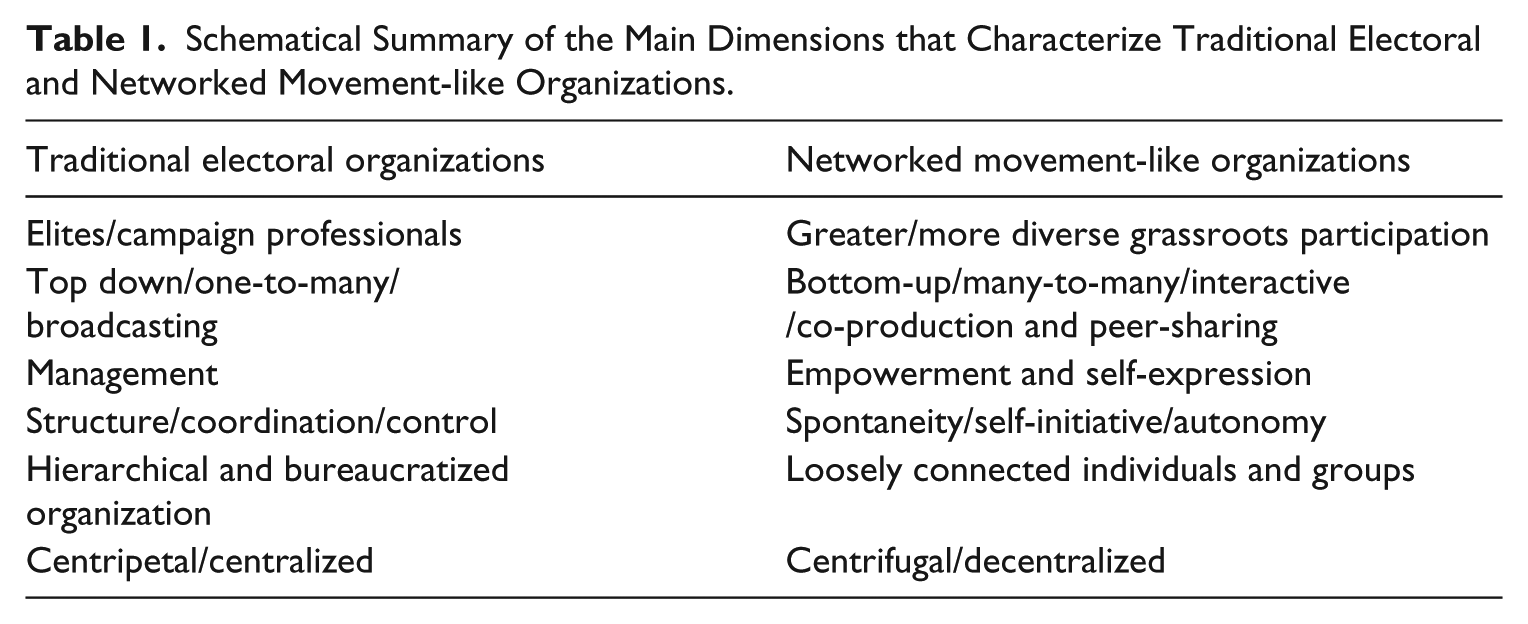
In Table 1, we schematically summarize the main dimensions that characterize traditional electoral and networked movement-like organizations. There is a degree of overlap between some categories, but each pair emphasizes a different dimension. Moreover, these categories are a matter of degree with most campaigns falling somewhere along the continuum. Furthermore, movement from one type to the other is as an adaption that represents a shift along the spectrum, rather than replacement of one type of organization with another.
Schematical Summary of the Main Dimensions that Characterize Traditional Electoral and Networked Movement-like Organizations.
According to US research, the most successful electoral campaigns increasingly combine elements of both types, albeit to different extents (Bimber, 2014; Chadwick, 2013; Kreiss, 2009, 2012; Vaccari, 2010). Moreover, how much and how they do so is mediated by the interplay of a number of factors. We will demonstrate that in addition to resources, which as explained above has been the focus of much of the previous research, one must consider contextual, strategic, organizational and cultural factors. Furthermore, our research contributes towards understanding how these processes work outside the US – where previous research has focused – and how specifically they work in the context of a heated constitutional referendum.
Thus, drawing on the analytical framework above, we analyse to what extent, how and why the two campaigns in the 2014 Scottish independence referendum blended the two types of organization and practices in their use of DCTs, focusing on social media. As with any single case study, we are not able to generalize. Nonetheless, we offer a detailed exploration that enables us to better understand the dynamics at play and the range of factors involved. Before we proceed to our analysis, the next section explains our methodology.
Methodology
We employed a mixed-methods approach: in-depth interviews alongside a network analysis of posts in the social media platform Twitter. 1 The focus is not on the content of the tweets, nor on the use of Twitter specifically; instead we analyse Twitter data to provide a window into the characteristics of the two campaigns and their wider network of relations (Segerberg and Bennett, 2011: 201). This ‘window’ has its limitations and provides only one way of examining the campaigns’ structure and strategies, which might be different from what we might learn from other platforms, given differences in affordances, norms and reach (Gerbaudo, 2012; Kreiss et al., 2018); nonetheless, it is highly insightful in combination with the interview data.
We collected tweets using the public search application programming interface (API). 2 This was queried three times per day for the hashtag ‘#indyref’ between January and September 2014. 3 This method provided over 2.8 million tweets, drawn from c.146,000 unique user accounts. To construct the dataset for network analysis, we extracted user interactions, that is, ‘retweets’, ‘@mentions’ and ‘@replies’. These interactions (c.1.4 million) provided the nodes (the Twitter user accounts) and edges (interactions between two users) for the network analysis. 4
We subsequently conducted 12 in-depth interviews asking how and why the two sides in the referendum used social media and DCTs more generally, and how this connected to strategies, actors and context. The rich insights from the interviews enabled us to ‘reconstruct the operating philosophies of elite political actors’ (Vaccari, 2010: 335), exploring how and why they believe they used technology as they did, while the analysis of the twitter networks helps reveal some of the ways that the campaigns and other actors actually used it. The interviewees were four key staffers from each of the official campaigns, and three leading members of groups that were highly active in the digital sphere during the referendum but were not, at least formally, part of the umbrella organizations. In addition, we interviewed one journalist focused on digital issues, who was mentioned several times in the interviews as someone with useful insights into both campaigns. From the official campaigns, we selected those responsible for leading on digital, but included also the managers they reported to, and key staff working in other aspects of the campaign, such as message or community. The second group of interviewees was from unofficial pro-independence groups. The imbalance between Yes and No reflected the heavy preponderance of groups on the Yes side in the digital conversation about the referendum. The interviews were semi-structured and were conducted between November 2014 and March 2015. On average, they were an hour long, mostly conducted face-to-face, and recorded and later transcribed. They were then thematically coded and analysed following the framework in Table 1. As agreed in our ethics consent procedures, quotes from the interviews have been anonymized.
Analysis
Twitter Networks and the Characteristics of the Campaigns
In this section, we analyse Twitter data from the key period of the referendum campaign: January to September 2014. By comparing data for the Yes and No campaigns, we are able to show how their use of a key social media platform played out in practice, in particular in relation to key groups in the assemblage. Previous research has shown that Yes Scotland was overall more successful in terms of number of friends, followers and engagement both in Facebook and Twitter (Shepard and Quinlan, 2016). Our macro analysis based on measures of centrality in Figure 1 also shows that the Yes side dominated the conversation in Twitter: the blue nodes coded as Yes were more central, and heavily outweigh the red No-aligned nodes. 5
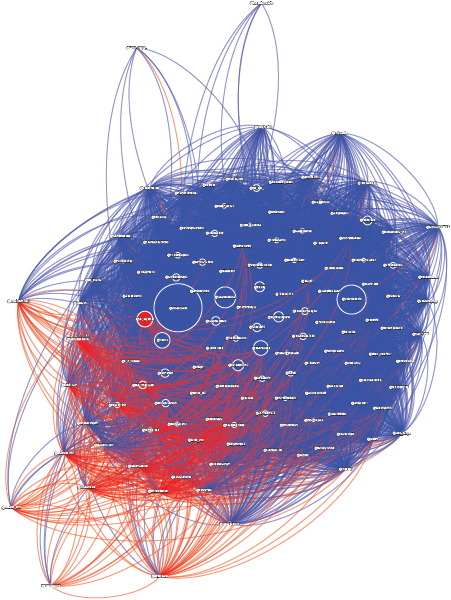
Top 0.1% of Nodes by Betweenness Centrality (January–September 2014).
In line with our research question, the objective is not to delve into markers of success. Instead, our focus of analysis is on the networks, and specifically on the ways in which different nodes interacted with each other and what this tell us about levels of centralization and autonomy of the official campaigns vis-a-vis key groups in their assemblages.
To uncover the general characteristics of the official Yes and No overall networks, we identified all the Twitter accounts that the official campaigns interacted with, that is, by retweeting them or mentioning them directly, which is known as their outbound ego-network. 6 The first striking difference is numerical, suggesting a different degree of engagement and inclusiveness: 291 versus 160 nodes (or accounts) for Yes and No, respectively. Second, there are significant variations in the prevalence of different types of actors. For Better Together, of the 10 accounts they most often retweeted or mentioned, only 3 belonged to supporter groups, while 6 were accounts of leading members of the campaigns, and 1 a media outlet. In contrast, for Yes Scotland, 7 out of the top 10 belonged to supporter groups. Furthermore, all top five accounts were supporter groups for Yes Scotland, whereas only one of the top five for Better Together was a supporter group.
To further explore these differences, in Figures 2 and 3 we specifically visualize the connection between the official campaign accounts and the accounts of key groups aligned with them.
7
Given our aims, and accepting that only a small fraction of the findings can be visualized in detail, we selected a subset of accounts from their ego-networks. The selection criteria for the visualization were as follows: the accounts had to have a reciprocal relationship in Twitter with the official campaign; they had to support the official campaigns side of the debate: they had to be organizations or websites that identified as a collective, rather than individual political actors (e.g. politicians and journalists); and they had to hold some importance in the network. We quantify importance here using three criteria: their betweenness centrality, the frequency of interactions with the official campaigns and their own level of out-bound activity. Finally, only groups that were

Better Together and Intermediate Nodes: Extracted (Subset of 6 Nodes) from Out-Bound Ego Network, Original Size: Nodes = 161, Edges = 2014.
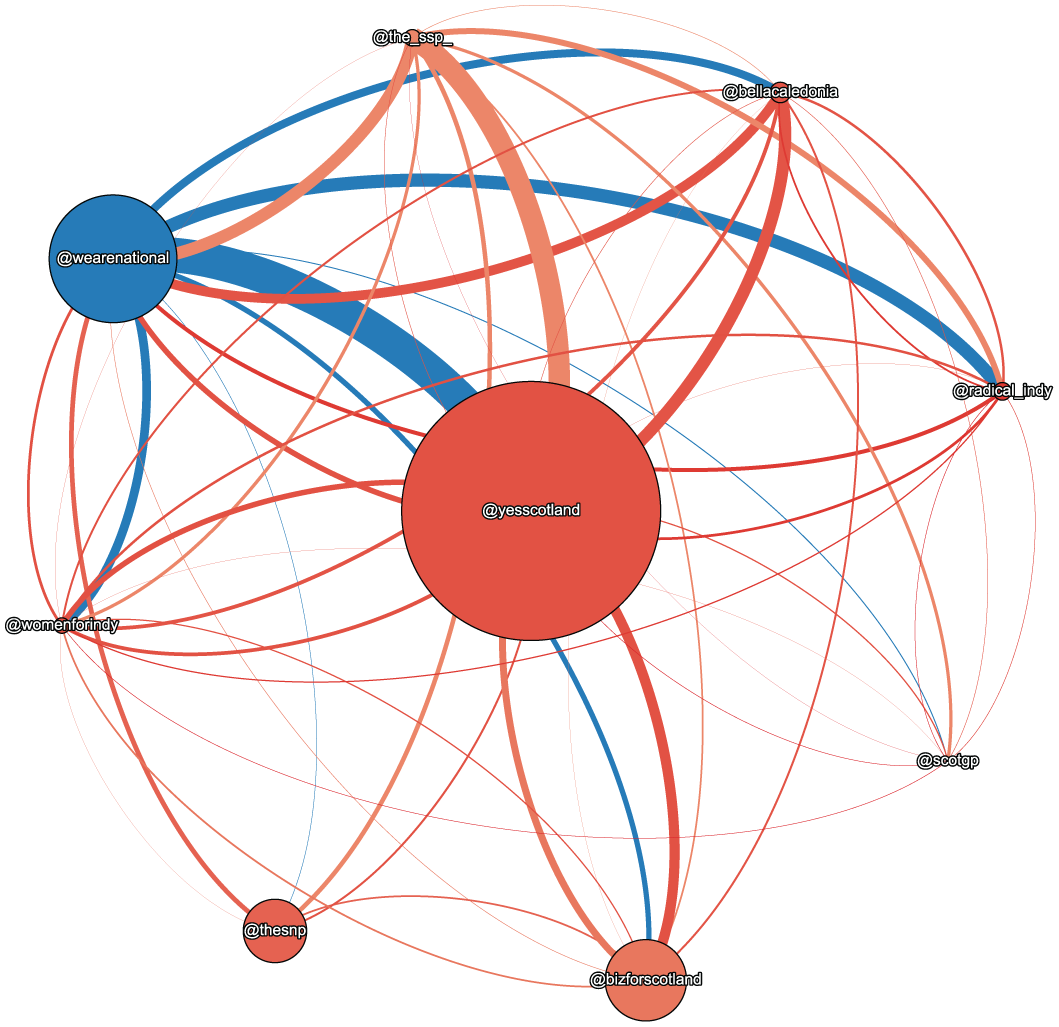
Yes Scotland and Intermediate Nodes: Extracted (Subset of 9 Nodes) from Out-Bound Ego Network; Original Size: Nodes = 288, Edges = 8192.
These visualizations consist of a circular node representing each Twitter user account, where the size of the node represents the number of connections that account has. 8 The connecting lines between the accounts are representative of the amount of activity (represented by the thickness of the line) and the source of that activity (colour of the line 9 ). For example, in Figure 3 we can see the strong connection between National Collective and Yes Scotland, represented by the thick blue line that indicates a large volume of traffic (i.e. retweets or mentions) from National Collective (@wearenational, the source) directed at Yes Scotland (the target). To the lower right of the National Collective node, a smaller red edge can be observed representing the traffic that passes from Yes Scotland to National Collective.
Overall, the analysis suggests that Yes Scotland’s twitter engagement with key groups is more hybrid, that is, less centralized, and combining autonomy and control, a blend that is essentially absent for Better Together. The key difference is that in Figure 2 there is a lack of interconnections between the No-aligned accounts, in a way that most closely resembles the hub-and-spoke or star structure associated with centrally managed hierarchical networks (Bennett and Segerberg, 2013). In contrast, although the Yes subnet in Figure 3 also has a dominant official campaign node at its centre, the breadth of interconnections and levels of activity between intermediate nodes shows a higher degree of decentralization.
Regarding differences in the degree of autonomy, Figure 3 also shows that a number of Yes-aligned accounts were at times creating more output on Twitter than the official campaign; National Collective is the most active of these accounts. There is also an indication that a different pattern of engagement is taking place. In a heavily centralized campaign, we would expect traffic to largely use the official campaign as a conduit in order to communicate with other parts of the network; however, there are multiple interactions happening between the intermediate group nodes. For example, the patterns of traffic between the Radical Independence Campaign (RIC; @radical_indy) and other nodes such as Women for Independence (@womenforindy) and Bella Caledonia (@bellacaledonia), contrast with the low traffic between RIC and Yes Scotland. On the No side, the predominant pattern is linear, corresponding to a broadcast model where information is relayed downwards. On the Yes side, the pattern of transmission is more complex with multiple interactions, and a key role for the grassroots groups. This is also supported by Figure 4, which visualizes the connections between Yes Scotland and supportive local groups: 10 Many groups active on Twitter on the Yes side developed their own organic connections, often bypassing the central campaign account. Furthermore, the interaction between the pro-independence groups is polycentric in character, and shows a much greater number of twitter-engaged local groups compared with the No side (not shown here), whose network of local groups is sparsely populated and has again a hub-and-spoke structure.
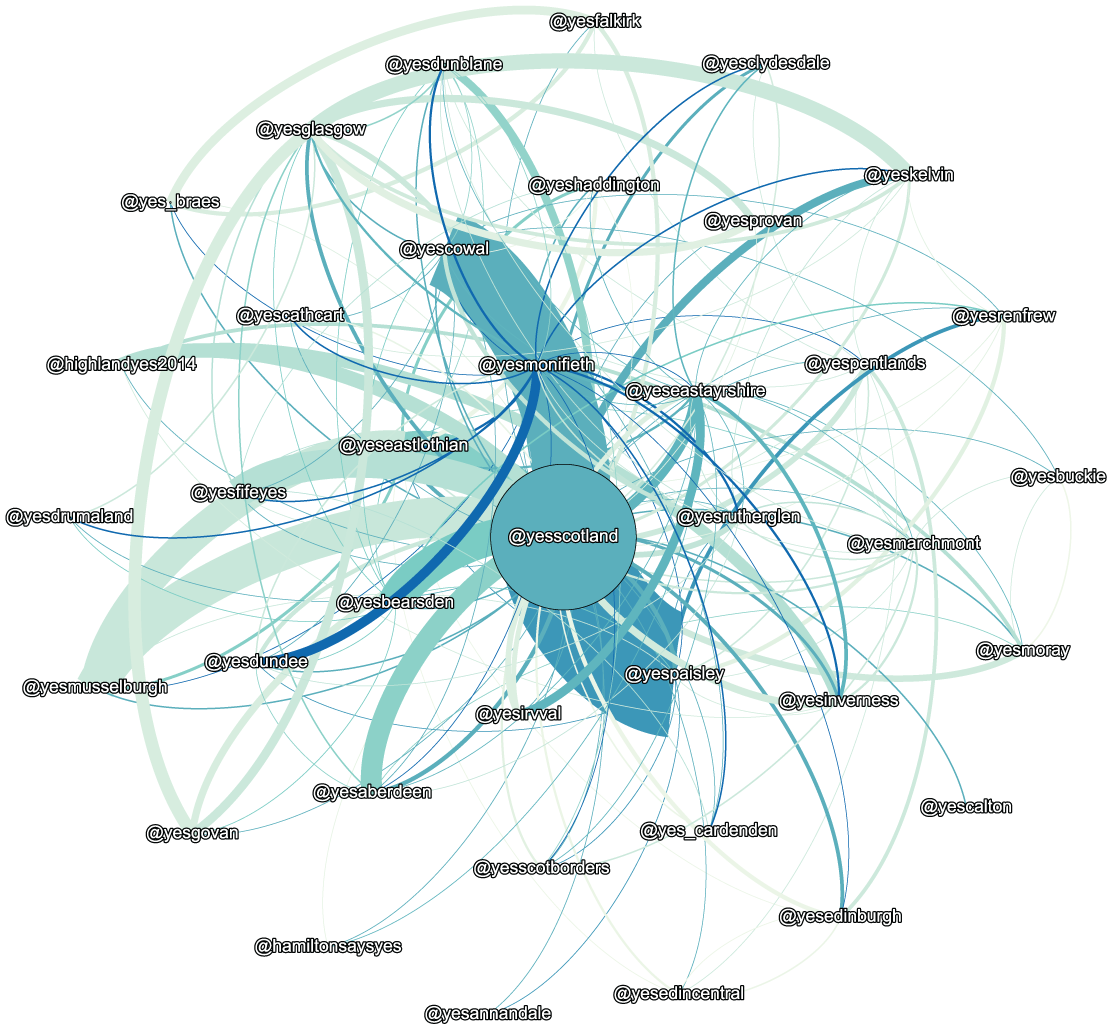
Yes Scotland and Local Yes Campaign Groups: Extracted (Subset of 35 Nodes) from Out-Bound Ego Network; Original Size: Nodes = 288, Edges = 8192.
At the same time, it is important to acknowledge and delineate the limits of the official campaign’s openness. The absence of some prominent Yes supporting accounts in Figure 3 tells us something important about the attitude of Yes Scotland towards different organizations. The most striking example is Wings Over Scotland, an influential blog, which is absent from Yes Scotland’s active connections. This was discussed in our interviews as a decision taken not to engage directly with aspects of the wider Yes campaign regarded as problematic and potentially counterproductive to the main message: ‘Wings –we never engaged with, ever’ (Interview 5, Yes campaign).
Long Live Command and Control?
The analysis of the Twitter networks, and especially the relationship between the official campaigns and key groups, shows revealing differences between the two sides. However, this analysis is for us a window into the broader characteristics of the official campaigns, their networks and how they used social media, and DCTs. The interviews with key campaign staff and associated groups are an essential complement to understand continuity and change with the control and command model, and especially the reasons for the differences and similarities between the campaigns. This is discussed in the next two sections.
The interviews reveal that digital tools enabled some innovations in their campaign practices, but their disruptive impact on the command and control model was limited; instead, there is strong continuity especially, but not only, for Better Together. Both official campaigns highlighted the usefulness of a range of DCTs for recruiting volunteers, briefing them, and coordinating and monitoring their activities, both online and offline. They also referred to their usefulness for fundraising, especially for small donations, and to the promise of crowdfunding initiatives; but these capabilities were exploited only to a limited extent, in part because of UK campaign funding regulation (Anstead and Chadwick, 2008). Social media were also regarded as having facilitated new forms of networked peer-to-peer persuasion and a degree of self-organization among groups on both the sides. Furthermore, the interviewees explained that the content, form and targets of the official campaign messages were influenced to some degree by email and social media metrics, especially Facebook’s, which were monitored regularly – although in a rather amateur fashion – to calibrate which issues were of greatest interest, by whom, and which messages, both in terms of content and presentation, got the most positive responses.
However, there is little evidence from the interviews that the capabilities of digital tools, or information obtained from them, were major influences on campaign strategy by either side. First, established techniques such as focus groups and polling were mentioned as much more important tools in this regard. Second, the emphasis from both the official campaigns was on transmitting campaign messages rather than two-way engagement. Attention focused on ensuring that there was coherence across media messages and with activities on the ground, with campaign managers playing a key role in coordination and monitoring. Moreover, social media, and Twitter in particular, were highlighted as a key tool that could be used to try to influence the mainstream media and thus ‘the agenda’. In short, many of the dimensions of the control and command model remained in evidence with DCTs bringing new, but not deeply transformative dimensions to it. Crucially, however, there were also significant differences between the two campaigns, which were a result of the interplay between contextual, strategic, organizational and cultural factors.
In terms of strategy, the most important difference lay in Better Together’s concentration on uncommitted voters as the key to winning the vote. Campaign messages were relentlessly aimed at this group, pointing out the risks associated with separation, to the extent that the campaign was dubbed (initially by Better Together staffers) as ‘Project Fear’. Yes Scotland, while also targeting uncommitted voters, gave more weight to addressing and mobilizing their own supporters. Crucially, these differences were reflected in, and in turn reinforced by, the respective campaigns’ digital strategies.
Better Together: Top down, On Message
Despite recruiting the services of Blue State Digital, famously associated with the Obama campaigns, Better Together’s digital strategy placed little emphasis on self-expression, empowering and mobilizing. Instead, the interviews revealed a remarkable accent on control and discipline; the use of ‘we’ firmly restricted to campaign professionals at the centre: We were fairly disciplined in our approach to that … our local groups had their own Facebook groups which were largely there to advertise local meetings and things like that, and to, sort of, amplify what we were doing nationally. The truth is that in a campaign as heated as this was on both sides, people freelancing was a problem, because you had deeply unhelpful things being generated … I think, luckily for us, because we were more tightly controlled, let’s … say than the other side, you know, there was … whether it was, you know, boycott campaigns or attacks on people who were … who had come out in the debate. That, sort of, thousand flowers bloom approach to it caused them trouble and actually diluted their message (Interview 2, No Campaign).
For Better Together, social media were used mostly to distribute top-down, carefully controlled messages to supporters, the public and especially ‘public opinion formers’, including media elites, in line with their overall strategy: Both Facebook and Twitter were broadcast rather than necessarily engagement. Because we didn’t want to dilute the message (…) but also we were not building something to last, you know. We always were conscious we weren’t going to exist the day after [the vote], so we could be more, I guess, mechanical and have a more, kind of, instrumental approach (Interview 2, No Campaign).
Collective action repertoires – whether digitally enabled or not – were tightly managed. Supporters recruited as volunteers via social media were treated as brand advocates, restricted to institutional modes of participation where there is ‘little initiative, creativity, or control on the part of individuals’ (Flanagin et al., 2006: 37). Systems were put in place to control any ‘over-enthusiasm’ which Better Together campaign managers felt could be wasteful if not directed: ‘they [activists] wanted to leaflet everyone’, rather than restrict themselves to the target groups identified by the centre, based on research data and Mosaic groups. 11 This control from the centre created tensions with those on the ground, many of whom were new to campaign volunteering: ‘for a lot of people that was a big struggle, they were getting frustrated’ (Interview 7, No Campaign).
Only staff could post events to the Better Together website, whereas anyone could create and advertise events on the official campaign website for Yes Scotland. There were less stringent controls over social media; many pro-Union groups were ‘given’ an account and some were allowed to create their own social media identities. But campaign managers made it clear that ‘nothing with the Better Together brand would be run without a degree of editorial control by staff members’ (Interview 2, No Campaign).
In sum, the use of social media, and DCTs generally, by Better Together was not transformative either within the official campaign organization or in its relations with supporting groups. There was little openness and decentralization or ‘blending’ of the more entrepreneurial participatory modes associated with DCTs in cutting-edge contemporary campaigns. This was not a result of lack of resources. It was a consequence of the campaign’s strategy, which in turn related to the political context, the characteristics of the coalition, and the organizational structure and culture that underpinned it. First, and crucially, it played to what the interviewees saw as the objectives and strategy of the No campaign. It was a short-term coalition with the single objective of winning the referendum vote. It avoided ‘emotional messages’ related to identity or other issues that could help mobilize but would have exposed differences between the uneasy coalition of political parties; instead, they focused on using polling combined with Mosaic data to identify undecided voters concerned about the economic risk of independence and then hammered away at this theme. Second, Better Together was the front-runner, until almost the end of the campaign comfortably ahead in the polls. Moreover, although campaign managers recognized that Yes was dominating social media, they felt they could rely on the support of the press and much of the mainstream media. In this context, from an instrumental point of view, it is not surprising that control of the message and targeting was regarded as vital, and ‘freelance’ participation as a liability that they could do without. Third, their use of DCTs was associated with a highly centralized structure, which heavily relied on the existing expertise, infrastructure and collective action repertoires from the political parties that formed the pro-Union coalition. Thus, Better Together operated essentially like a conventional political party in its media handling and attempts to canvass public support. Moreover, the campaign brought together political parties that, according to the interviewees, had not yet mastered digital for campaigns. Finally, it was underpinned by, and in turn further promoted, an organizational structure where ‘Digital’ was subsumed under ‘Broadcasting’, with staff across different sections ‘chipping in’ (Interview 2). Moreover, internal staff (not the Blue State Digital consultants) were mostly political campaign – rather than digital – specialists which meant that they had, in line with traditional party campaigns, norms, values and expertise associated with the command and control model and thus were less likely to be innovative in their use of DCTs (Baldwin-Philippi, 2015; Chadwick, 2013; Kreiss, 2016a).
Yes Scotland and the Key Role of ‘Online Allies’
Yes Scotland was more clearly a hybrid organizational type. It had elements of a more decentralized structure and some movement-like dynamics blended with traditional party campaigning characteristics, enabling – or at least not discouraging – more autonomous bottom-up participation and entrepreneurial modes of engagement. As with Better Together, this was a result of the interplay of contextual, strategic, organizational and cultural factors that affected how DCTs were used, which in turn reinforced pre-exiting dynamics.
There are two important contextual factors that shaped Yes Scotland’s overall strategy, which in turn affected their use of DCTs: their trailing position in the polls and the weak support in the mainstream media. Regarding the latter, social media was deemed particularly important as it gave Yes Scotland an alternative channel to what they regarded as a hostile press and broadcast media. But it was not the only purpose; social media communication was also seen as a means of motivating and expanding the activist base: So apart from being the counterbalance to the mainstream media, to the anti-independence media if you like, it [social media] was also one of the more obvious means through which we could communicate the kind of campaign that we wanted to run and begin to create that national movement’ (Interview 1, Yes Campaign).
Moreover, considerable emphasis was laid by the Yes campaign on training and educating, not just so that activists could relay official messages, but also with an emphasis on self-expression and peer-sharing, encouraging supporters to make their own contributions and to develop personalized networks: We trained a hard core [of volunteers/’ambassadors’] to just be online regularly and to help promote our material, but also to train other people and to encourage other people to behave in the way we behave. And also, the behaviour thing was less important for us than the getting people to understand the message and understand where we were at that point in the campaign and what to do, and how to produce their own content (Interview 3, Yes Campaign).
This mobilizing strategy was facilitated and reinforced by several factors, which might be overlooked if one focuses exclusively on Yes Scotland position as ‘challenger’. First, there is the prominence given to Digital in the official campaign organization. Unlike Better Together, it had a dedicated team, with its Director – a respected figure in digital publishing – one of the very first hires. Moreover, he reported directly to the Chief Executive – who himself came from outside the election campaigns field – and was put on an equal footing with the other Directors. Second, Yes Scotland was able to draw not only on the size and enthusiasm of the SNP’s membership, which was also much younger in average, but also on its digital expertise and culture: The SNP has actually got a good understanding of how digital works and a commitment to it. So these people were pre-prepared (…) that was very useful in terms of establishing just a culture of digital as part of what we do (Interview 3, Yes campaign).
At the same time, the interviews highlighted the importance of the fact that this was a referendum. First, that there were greater incentives and opportunities to innovate outside the party structure and routine election environment: The SNP is … even from an organisational level or other social media, it is very rigid and very … in a sense, they have to be a lot more, because they’re a membership organisation, whereas we were never a membership organisation which meant we … you can’t impute responsibility for anyone’s actions, although many people tried. Whereas with the SNP, they’re far more often responsible for the actions of councillors or anything like that. So theirs is a very controlled … our message was still very controlled. Our … what we put out in the core things we’d put out, they were always the same themes. But the SNP, you don’t know anything unless they tell you. Whereas there was so much information and research on … the independence campaign was so broad (Interview 5, Yes Scotland).
Second, and crucially, there were important differences in the degree of grassroots support each campaign could tap on and how they chose to interact with pre-exiting and new groups. In fact, it is in the relationship of each campaign vis-a-vis other groups that the differences between the Yes and No campaigns are most striking (as illustrated in the Twitter analysis above). Both campaigns created some local and sectoral groups, whereas a number of other were formed independently. But there were many more for Yes Scotland (circa 350 vs 80) and their online presence was subject to less control and interference from the official campaign. Most crucially, for Yes Scotland there was a further assemblage of highly vibrant grassroots groups and individual bloggers, which they defined as ‘online allies’, that were all but absent for Better Together. Some were SNP members and others not, but most of them worked in a decentralized and mostly autonomous manner from the official campaign: ‘They set up themselves, self-motivated, and our engagement with them on social media would mostly be to share their posts or retweet a particular, kind of, campaign message or part of their momentum as well’ (Interview 5, Yes campaign).
Moreover, within the Yes campaign hierarchy and among the key supporting actors, there was a strong emphasis on the importance of reducing dependence on the SNP and building a broader inclusive movement, the latter term being mentioned by almost every interviewee from the pro-independence side. And in doing so, autonomy and decentralization were regarded as key values: Well, it’s just an umbrella term [movement] to describe lots of disparate groups working for the same goal. It wasn’t an organization because it wasn’t organized, so what else do you call it? […] people didn’t wait for instructions or permission, they just got on with doing whatever they thought needed done (Interview 6, Yes supporter group).
For these grassroots groups, social media played an important, and often crucial, role although most of them undertook offline activity as well: So National Collective, for instance, online linked people talking on Facebook chat. It then developed into offline meetings. It then developed into organisational structures that then developed into local groups, that then developed into live public events and campaigns. Those people would never have been connected or would have been far less likely I believe to have been connected. People would have been far less confident about sharing their voice and sharing their thoughts if they hadn’t first had that platform of social media to put them together (Interview 8, Yes supporter group).
And social media were also important in developing relationships between these groups and Yes Scotland, enabling the official campaign to benefit – if not directly control – from the broader pro-independence assemblage. It meant that different groups could develop content for – and indeed by – a range of audiences, and the central campaign could choose to ‘leverage’ (Kreiss, 2009) these networks and their creative and sharable content, by amplifying these messages through their own digital channels: I would say that National Collective were a huge part of the effort in terms of producing some really, really good content. They had a lot of fun during the campaign and it showed in the material they produced, which we were then able to on-share and expose to a really enormous audience. Bella Caledonia as well. We would re-tweet Women for Independence, Business Scotland material as well, and Labour for Independence (Interview 3, Yes Campaign).
Moreover, although the regulations governing the conduct of the referendum were the same for both campaigns, they adapted to them differently. Better Together assimilated groups within their own campaign and funding structures, ensuring greater control: We took the decision that Academics, Women Together, all these groups, we would bring in house, they’d be in our funding, we could then work together, but in terms of the work they did it would be independent, it was just they were part of Better Together (Interview 7, No Campaign).
Yes Scotland’s different approach to external groups was in part pragmatic, simply because they had limited influence over a number of organizations. But greater autonomy was considered acceptable because this wider base was seen to add both energy and breadth to the campaign. It fitted with what Yes Scotland defined as their strategic objectives, which included developing into a ‘movement’.
In fact, according to one senior source, ‘we very much had to be not like a political party’ (Interview 1, Yes campaign). Being too closely identified with the SNP, or more generally with the collective action repertoires of political parties, was seen as an impediment to broadening support for independence. Hence Yes Scotland’s less hierarchical structure and encouragement – or at least tolerance – of ‘different centres of activity and creativity’ (Interview 1, Yes campaign). Moreover, as direct coordination of organizations outside the funding umbrella was not legal, it enabled, and in some ways necessitated, more entrepreneurial (Flanagin et al., 2006) modes of engagement. It is thus clear that the role of grassroots groups on the pro-independence side, in combination with contextual, strategic, organizational and cultural factors, influenced how the affordances of DCTs were enacted. In turn, this challenged traditional campaign hierarchies, dragging both Yes Scotland and the wider Yes campaign along the spectrum of hybridity, away from exclusive reliance on traditional party campaign organizational practices and hierarchies.
However, we should not exaggerate either the differences between the two campaigns nor the impact of the use of DCTs on the command and control model. Better Together did take some steps to encourage participation and develop supporter groups, even though its key priority was maintaining control over message and activity, which was reflected in its digital strategy. For its part, the Yes campaign was hardly a hybrid participatory ‘nirvana’. Although the independence movement at large had more horizontal and participatory characteristics, and these influenced the official campaign, there were tensions, especially with the SNP. Not only there was in Yes Scotland a strong continuity with the professional model, but the campaign managers remained nervous about their inability to control, and specifically about the risks associated with the way social media was used by some of its ‘online allies’ and individual supporters.
First, although DCTs facilitated greater participation, some of that activity was regarded as an inefficient use of resources, and on occasions as a distraction with potentially damaging repercussions (e.g. protests against ‘BBC bias’). Second, they feared the central campaign message was sometimes drowned out because: There was so much information [out there and the] independence campaign was so broad with Radical Independence [etc.] putting out their own ideas so we had to repeat, repeat, repeat, messages in order to make sure that they were the ones getting through’ (Interview 5, Yes Campaign).
Finally, there was great frustration with trolling by what became known as the ‘cyberNats’: ‘We distanced ourselves from that as much as possible and we issued guidelines, we got our supporters to stamp on that behaviour as much as possible. But it did hurt us’ (Interview 3, Yes Campaign).
At the same time, there was a recognition within the official Yes campaign that because of how the affordances of the technology were enacted and the values that underpinned this – it was ineffectual to try to achieve full control: ‘you are in a canoe on the rapids and you can’t stop moving but you can avoid the rocks’ (Interview 3, Yes campaign). Trying too hard to enforce control was considered potentially ‘enormously counterproductive’ and had the potential to ‘stifle initiative’ (Interview 9, Yes campaign).
The best approach in the Yes campaigners’ view was to develop ‘an ability to just try and accept’ that bottom-up autonomous participation, much of it digitally enabled, was a key element in generating and sustaining the passion of the pro-independence campaign. A number of the interviewees also highlighted the importance of self-expression, and even enjoyment and fun, something that was almost entirely absent for Better Together. The official campaign did not accept all groups – or arguably any groups – as equal partners, but they were prepared to relinquish some of their ability to command and control to try to harness the creativity, enthusiasm and effort of local and sectoral groups and the ‘online allies’ that had sprung up, even where that resulted in the official campaign being bypassed and, on occasion, eclipsed.
Implications and Conclusion
This article contributes to the literature on DCTs and electoral campaigns by providing a rich empirical analysis of two opposing campaigns, located at different points along the spectrum of hybridity, and unpacking some of the factors that help to explain the differences. Our research demonstrates first that the use of social media – and DCTs more generally – does not necessarily lead to significant change to campaign organizations and practices; in fact, overall, the challenges to the command and control model were fairly muted. Second, the pattern of use is not determined by technological affordances or resources, although both of course play a role. Use still very much varies across campaigns, even if they have access to similar digital tools. In explaining the differences between the two sides, the interplay between contextual factors and the strategic choices made by campaign managers were highly significant. But so too were the organizational structure, and culture and values of key participants within and outside the official campaigns. These are factors that have been less emphasized in previous studies on elections, although not so in social movement research. As Chadwick (2007: 285) highlights, drawing on Tilly, collective action repertories ‘are not simply neutral tools’ to be adopted at will: ‘values shape repertoires of collective action, which in turn shape the kind of adoption of organizational forms’. The same applies to DCTs; they are not ‘just technologies’ that any campaign with enough resources will adopt in similar ways. There must be an elective affinity between digital media affordances and organizational culture, which mediate how they are enacted and their impact on organizational change. The values and repertoires of Better Together, a professionally and party-run, electorally focused coalition with short-term goals, were restrictive and led to a controlled but stifling campaign and use of social media. This was in contrast to the pro-independence side, an insurgent campaign run by a mix of party and non-party experts and that – although with the SNP at its core – was situated within a vibrant independence movement, and thus could rely on a broader coalition of grassroots groups which had a more decentralized structure, and inclusive and participatory values. This was a key factor on shaping how Yes Scotland enacted the digital affordances of social media and their model of campaigning overall.
We cannot generalize from a single case study. Nonetheless, the findings reported here provide insights relevant not only to understanding of referenda campaigns but also contemporary electoral campaigns more generally, where the significance of the relation between official campaigns, the extended network of campaign actors and the use of digital tools continues to grow. Nowadays, political parties – even in hierarchical and centralized party systems such as the UK’s – need not only to deal with the challenges and opportunities of DCTs, but also increasingly must engage and coordinate with a range of grassroots groups – often digitally driven – outside their organizational structures, practices and values.
As our study shows, it is only by understanding the interplay between a number of actors and factors (i.e. financial and labour resources, strategy, organizational structures, values and repertoires of the official campaign and other groups, as well as context) and how this relates to their use of DCTs, that we can better understand to what extent, how and why campaigns are changing. Technology and specialized consultancy can be bought, but other factors are less controllable, and yet they play a crucial role in mediating how digital tools are used and how it affects campaign models. We need to continue to develop a better understanding of the interaction between these factors, especially outside the United States.
Moreover, while our study is not focused on the normative citizenship issues, it raises relevant ‘democratic health’ questions associated with different models of campaigning. In an era where exclusionary populism has gone mainstream, debates are moving beyond the anxieties of the ‘crises of participation’ in which almost any engagement was welcomed after decades of declining voter turnout and crumbling party memberships. The cultural values that underpin the differential use of technology by campaigns cannot be switched on and off at will. Moreover, how well do they work for different goals and contexts? It should not be assumed that the digital action repertoires of different kinds of groups can be automatically transferred across types of organizations or domains, nor that it would be democratically desirable if this was the case. Instead, we must consider what types of participation are being enabled and encouraged and for what ends, whether these types are equally apt for parties and government as they are for single issues and protest, and how they relate to the (often contested) norms of democratic citizenship.
Footnotes
Acknowledgements
We first want to thank our interviewees. We also want to thank Kate Dommett and Maggie Scammell; the University of Glasgow’s Comparative Politics Cluster; the participants of the workshop on Digital Media, Power and Democracy; the reviewers at ICA where this paper was presented and especially the journal’s reviewers whose comments greatly helped us to improve it.
Funding
The author(s) received no financial support for the research, authorship and/or publication of this article.
