



Abstract
There has been substantial focus on China’s influence in Africa in recent years. Some argue that China’s growing economic ties with African states have increased its political influence across the continent. This article examines whether trade with China leads African states to adopt more similar foreign policy preferences to China in the United Nations. We examine foreign policy similarity using voting patterns in the United Nations General Assembly and country statements in the United Nations General Debate. The analysis demonstrates that more trade with China has paradoxical effects on foreign policy positions of African states—it leads them to align more closely with US foreign policy positions in the United Nations, except on human rights votes. Our findings suggest that African states are engaged in balancing behavior with external powers whereby African elites seek to play off rival powers against one another in order to strengthen their own autonomy and maximize trade.
Keywords
Introduction
China’s emergence as a powerful actor in the global economy represents a fundamental shift in the global balance of power. This has led to questions about the political implications of China’s growing economic power, and the extent to which it uses this as a tool of foreign policy. This is especially so as China has increasingly sought to play a more active role in global politics in recent times—resulting in a more dynamic and expansive foreign policy (Tull, 2006). According to Lanteigne (2015: 9), the primary goal of Chinese foreign policy is “to better manage the forces of globalization for the betterment of the state while ensuring that the Communist Party maintains its paramount role in Chinese governance.” Indeed, China has sought to gain allies around the world to ward off what are seen as Western attempts to undermine Communist Party rule, and to lock in sources of natural resource supply and markets for Chinese production (Lanteigne, 2015). China’s expanding economic ties around the world are seen by some as aimed at serving these foreign policy objectives, and nowhere has China’s economic engagements come under greater scrutiny than in Africa.
China–Africa relations have a long history going back to Mao Zedong and Zhou Enlai’s prominent role in the non-aligned movement in the 1960s (Brautigam, 2009; Carmody and Owusu, 2007; Mohan and Power, 2008; Taylor, 1998). 1 These have expanded over recent decades, and China is now the single biggest trade partner with African states (Romei, 2015). Despite, or perhaps because of, China’s stated approach being based on non-interference in partner countries’ domestic affairs, many view its growing trade with Africa as enhancing its political influence on the continent (see Tull, 2006). This influence is seen to come at the expense of traditional powers in Africa, particularly the United States—with different US governments expressing concern over China’s increasing presence in Africa (Smith, 2012; Wonacott, 2011). Most notably, the Trump administration unveiled a new strategy for US engagement in Africa in late 2018, which was designed specifically to counter Beijing’s growing influence across the continent (Calamur, 2018). This has meant Africa is increasingly seen as the principal site of the United States’ and China’s struggle for global influence. 2
Some, however, question this view of the political effects of China’s economic engagement with African states. Brautigam (2009), for example, argues that China’s economic involvement in Africa is less about seeking political influence and more about developing a longer term economic partnership. Furthermore, she argues that China is open about the nature of this relationship and, therefore, African governments are in a position to shape the relationship. Others have also highlighted the agency of African governments, particular regarding relations with China (e.g. Brown and Harman, 2013; Corkin, 2016; Mohan and Lampert, 2013). In particular, some argue that African governments have, at times, sought to resist Chinese political influence and to use China’s growing economic engagement to balance against Western power (Shinn and Eisenman, 2012). This may suggest that rather than increasing Chinese political influence, growing trade with China has provided African states with greater room to maneuver regarding their external relations.
Despite these contrasting perspectives, there has been surprisingly little systematic analysis of the effect of economic ties with China on the foreign policy positions of African states. 3 This article addresses this gap by examining the impact of increased trade with China on the foreign policy positions of African states in the United Nations (UN). Our analysis considers different foreign policy dimensions. Existing analyses of the foreign policy impact of China’s emergence as a major economic power have tended to focus on individual policy issues considered important to China (e.g. Flores-Macías and Kreps, 2013; Strüver, 2016) or on specific events of particular interest to it (e.g. Kastner, 2016). Less attention has been given to the broader foreign policy consequences of trade with China, despite it long being recognized that countries’ foreign policy relations may differ across issues (Keohane and Nye, 1977). To assess the impact of China’s increased trade with Africa across multiple foreign policy dimensions, we employ two different types of measure of foreign policy position. The first is a new measure derived from the application of text analysis to countries’ annual statements in the UN General Debate (GD). As we explain, states are more freely able to signal their foreign policy positions in their GD speeches, providing us with a “softer” measure of foreign policy preference. The second measure is based on countries’ voting patterns in the UN General Assembly (UNGA). Importantly, we consider voting similarity across different dimensions, such as all UNGA resolutions, human rights resolutions, and votes on issues deemed important by the US government.
Our analysis shows that increased Chinese trade with African countries has a paradoxical impact, in that it leads African countries to move closer to the United States and away from China on different foreign policy dimensions. It is only on voting on UN resolutions linked to human rights—where the perceived need to project “hard shell sovereignty” against Western intervention is important (Barma et al., 2009)—that more trade with China is associated with closer alignment between China and African states. These findings are consistent when we address potential endogeneity between trade and foreign policy positions. We argue that these results suggest African states use trade with China to attempt to strengthen their position globally by balancing Chinese against Western power to achieve greater autonomy and “non-interference” in their internal affairs, and to maximize policy rents.
Trade, Foreign Policy, and China–Africa Relations
China’s emergence as a major economic power has led to renewed attention to the foreign policy consequences of trade (see, for example, Flores-Macías and Kreps, 2013; Ross, 2006; Rotberg, 2009). The links between economic relations and political influence have long been a subject of academic interest. More than 70 years ago, in his influential text, National Power and the Structure of Foreign Trade, Hirschman (1945) argued that trade between countries would lead to foreign policy convergence. This convergence would occur, he explained, due to concerns that foreign policy disputes could disrupt trade relations and therefore interfere with economic growth. Furthermore, he argued that because countries would differ in their relative dependence in particular trade relationships, the threat to interrupt them would be “an effective weapon in the struggle for power” for the less dependent country (Hirschman, 1945: 17). In other words, trade dependence could provide a state with political influence over another.
This argument has been applied in the context of China’s international trade in recent years (e.g. Brazys and Dukalskis, 2017; Flores-Macías and Kreps, 2013; Ross, 2006). In particular, it forms the basis for the view that increased trade has provided China with significant political influence across Africa (see Alden, 2007; Large, 2008; Lumumba-Kasongo, 2011; Sun, 2014; Tull, 2006). From this perspective, China’s emergence as the continent’s largest trade partner has increased bilateral dependence, and as such African states are thought to align their foreign policy positions with it to ensure that this trade relationship is maintained. Some, however, have argued that rather than Chinese trade with African states being a form of hard, coercive, power—trade relations are part of Chinese “soft power” in Africa. Kurlantzick (2007: 6), for example, argues that “for the Chinese, soft power means anything outside of the military and security realm”—a perspective shared by many Chinese scholars (see Fijałkowski, 2011). This notion of trade as soft power through market access runs counter to Nye’s (2004) original conceptualization, which focuses on cultural resources and public diplomacy. 4
The argument that trade is part of China’s soft power in Africa is in part because the government has influence over trade flows, given its ownership of major resource companies, such as the oil company Sinopec, for example. However, Chinese trade with African states is also part of a broader strategy of engagement without macro-level conditions, thereby offering, if not an alternative development model, at least a counterpoint to the “Washington Consensus” promoted by Western powers (Carmody and Owusu, 2007; Kurlantzick, 2007; Taylor, 1998; Thompson et al., 2005). From this perspective, trade might lead to foreign policy convergence because it would increase the appeal of China’s approach to economic engagement, and international relations more broadly, among African governments based on the promise of non-interference in the affairs of these countries. In other words, rather than alignment occurring due to Chinese pressure, foreign policy convergence with China from this perspective would represent a fundamental shift in the interests and preferences of African governments toward the “Beijing Consensus” through the mechanism of soft power (see Nye, 2005).
Both perspectives on China–Africa trade—as representing either hard or soft power—suggest that the growing trade dependence of African states on China should have a similar outcome, namely, foreign policy convergence. Others question this deterministic view of the effects of Chinese trade on African foreign policy positions, particularly as it ignores or downplays the agency of African governments (see Brautigam, 2009; Brown and Harman, 2013; Corkin, 2016; Mohan and Lampert, 2013; Shinn and Eisenman, 2012). The view that trade leads to foreign policy convergence overlooks the ways in which African states may seek to avoid political influence from China.
This is an argument that has been made more generally beyond the China–Africa context. Scholars have questioned the notion that trade dependence leads to foreign policy convergence—states that are dependent on a particular trade relationship can turn to other avenues to counter bargaining disadvantage (David, 1991; Wagner, 1988; Womack, 2006, 2015). Holsti (1978: 515) argues that dependent states can “learn how to maximize their bargaining advantages and eventually develop the intellectual, technical, and bureaucratic skills to manage their resources in such a way as to avoid exploitation.” This criticism has been supported by empirical studies that find little evidence to support the view that trade dependence leads to foreign policy convergence (see, for example, Richardson and Kegley, 1980).
There are several reasons why such criticism may be especially valid in the context of China’s trade with African states. First, scholars have argued that as China pursues a “no questions asked” foreign policy, it appears to be agnostic about the overseas engagements of “client” or partner states in Africa, except as they relate to recognition of the People’s Republic of China (PRC) over Taiwan (Adem, 2010; Sun, 2014; Wenping, 2007). Instead, China’s trade with African countries is seen as overwhelmingly driven by economic rather than political motivations (Brautigam, 2009; Eisenman, 2012; Sun, 2014). As some have pointed out, this gives African governments significant scope to shape the nature of their economic and political relations with China (Brautigam, 2009; Lee, 2018; Mohan and Lampert, 2013).
Second, the argument that trade leads to foreign policy convergence in the China–Africa context tends to overlook, or significantly downplay, the influence of Western powers, particularly the United States, in Africa. 5 Indeed, one of the main issues discussed by scholars and in the media is the implications of China’s growing role in Africa for the United States, which until recently was the dominant external economic and political power on the continent (see Campbell, 2008; Carmody, 2016; Carmody and Owusu, 2007; Smith, 2012; Tull, 2006; Wonacott, 2011). There is a broad consensus that the rise of China in Africa has weakened the hold of the US and other Western powers over African states. A number of studies have argued that China’s growing influence in Asia has also led states there to balance their engagement between it and the United States in order to maximize the benefits from relationships with both, while limiting their dependence on either (see Chung, 2001; De Castro, 2010; Ikenberry, 2016). African states may adopt a similar approach as some observers have suggested (Adegoke, 2018). Therefore, far from weakening African governments’ bargaining power, an important consequence of generally growing economic linkages between African states and China is that African governments are likely to have a stronger bargaining position in relation to the traditional Western powers (Kragelund, 2014). Indeed, as Whitaker (2010) notes, African leaders have sought to use China’s growing engagement across the continent to reduce their dependence on the United States, in particular.
Third, it is important to recognize the mixed public response in many African countries to growing commercial ties with China. Some have questioned the portrayal in the Western media of the public in African countries having an overwhelmingly negative view of Chinese involvement (see Brautigam, 2009; Sautman and Hairong, 2009). As these studies point out, there is significant variation and nuance in African views of China–Africa relations. This is supported by more empirically based studies conducted on popular perceptions of Chinese involvement in Africa. For example, an Afrobarometer study found that high Chinese import penetration correlated negatively with perceptions of China, whereas the presence of foreign direct investment was found to have a negligible impact (Gadzala and Hanusch, 2010). Other studies have found a generally positive public perception of China–Africa relations in most African countries. However, there have also been high-profile instances of strong negative public responses to Chinese involvement in African countries, sometimes leading to protests (see Brautigam, 2009; Gill and Reilly, 2007; Mohan and Lampert, 2013). Such events have been used, and in part fueled, by populist politicians seeking to use “the Chinese problem” of increased migration to gain popular support (see Carmody, 2016; Sautman and Hairong, 2009). This is especially important in the African context, where it has long been recognized that foreign policy has been a secondary concern for domestic African elites more concerned with regime maintenance and the establishment of domestic authority (Herbst, 2014). These “audience effects” are therefore likely to impact African elites’ foreign policy positions in relation to growing trade with China because these elites use their foreign policy positions to signal to domestic audiences.
Based on this discussion, the impact of the rise of China has potentially contradictory effects on African states’ foreign policy positions. On one hand, it might create incentives to draw closer to China in order to potentially receive more material benefits through increased flows of trade, investment, and aid, and to strengthen external sovereignty, at least in relation to the West. For example, closer alignment with China reflects a shift from a greater concern with ethics in foreign policy under Nelson Mandela’s presidency in South Africa to “realpolitik” subsequently, with that country abstaining in 2014 on the UN vote to refer North Korea to the International Criminal Court, for example (Allison, 2014). 6 On the other hand, the emergence of an alternative power center to the United States and Europe, it could be argued, has allowed some African elites to play off rival powers against each other in order to strengthen their own autonomy without aligning with a particular power or bloc (see Carmody and Kragelund, 2016).
This raises an important empirical question. Does greater trade lead African states to become allies of China or do African states use increased trade to merely balance Chinese against Western power to achieve greater autonomy and access to resources? 7 This article seeks to shed light on this question. In order to do this, we systematically examine the impact of trade on foreign policy alignment between China and African states, using voting patterns in the UNGA and annual statements in the UN GD. Our analysis focuses on examining the various arguments about the impact of growing China–Africa trade on foreign policy convergence discussed here.
Data and Methods
To test whether increases in trade between China and African states lead to alliance or balancing behavior in African foreign policy positions, we conduct a regression analysis to examine the effects of trade with China. Our country-year panel data include observations for 50 African countries over the years 1971–2013. 8
Outcome Variable: UN Votes and Speeches
We consider two types of measure of foreign policy position in this analysis. The first is the similarity of voting patterns in the UNGA. This is the most widely used measure of foreign policy alignment (see Voeten, 2013). The second is based on a new dataset of countries’ annual statements in the UN GD, the UN General Debate Corpus (UNGDC; Baturo et al., 2017). 9 We apply text analytic methods to these speeches to derive estimates of foreign policy position at the UN, as we explain below.
The UN GD takes place in New York every September at the start of each new session of the General Assembly. The GD provides member states with an opportunity to present their perspectives and preferences on key issues in world politics in formal statements delivered by heads of state and other high-level country representatives. In addition to discussing specific events that have occurred, such as conflicts and other crises, governments highlight broader issues in international politics that they view as important. The Chinese GD statements in recent years have emphasized a number of issues seen as key to its foreign policy. This includes the need to respect national sovereignty and countries’ right to choose their own social system and development path, promoting peaceful development, greater representation for developing countries in global governance institutions, and the importance of economic cooperation and multilateralism.
There are a number of important characteristics of the GD, and ways in which GD speeches differ from voting in the UNGA, which have important implications for measures of foreign policy position. In the UNGA, countries vote on a set of issues that have been placed on its formal agenda. As a result, voting in the UNGA can easily be compared across countries and over time, which is in large part why it has become the main measure of states’ foreign policy positions. In contrast, states can use their GD statement to discuss any issue considered to be of importance, without being restricted by the issues on the formal agenda. As Smith (2006: 122) notes, a key function of the GD is “to act as a barometer of international opinion on important issues, even those not on the agenda for that particular session.”
This distinction between UN speeches and votes relates to a broader difference between the two, which is that governments face fewer external constraints when delivering statements in the UN GD than when voting in the UNGA (see Baturo et al., 2017). The manner in which states are restricted to voting on issues that are on the formal agenda is one example of an external constraint not faced by governments when delivering speeches. A second and, arguably, more important external constraint comes from the way in which UNGA voting—unlike GD statements—is institutionally connected to decision-making and political outcomes. In other words, countries’ votes in the UNGA can lead to the adoption or rejection of a UN resolution. As a result, external factors such as trade relations and aid flows have a greater influence on how countries may vote in the UNGA, as a number of studies demonstrate (see Alesina and Dollar, 2000; Dreher et al., 2008; Kim and Russett, 1996; Voeten, 2000; Wang, 1999). For example, the United States can cut aid to countries which vote against it on issues designated as important or strategic in the UNGA. In contrast, GD statements are not institutionally connected to decision-making in the UN. This means that these statements are less likely to be subject to external pressures, and states have more freedom in the positions they take and are able to discuss more contentious issues. It also means that the GD is one of the few international arenas where smaller or less powerful nations in the international system have the opportunity to have their voices heard (see Baturo et al., 2017; Luard and Heater, 1994; Nicholas, 1959; Smith, 2006).
To examine these positions, we include a measure of foreign policy stances derived from GD statements, in addition to measures based on UNGA voting, as the former captures a different dimension of foreign policy similarity. The relative absence of external constraints and political consequences for GD speeches means that it provides us with a “softer” measure of foreign policy position than UNGA voting (Baturo et al., 2017). In other words, there are fewer implications for what governments choose to speak about in the GD. If increased trade with China leads to African governments’ expressing policy positions in their GD statements that are more aligned with China, this would provide some indication that trade with African states is a form of soft power for China. Hence, using measures of foreign policy position derived from votes and speeches should provide us with a more complete picture of the impact of trade with China on the foreign policy positions of African states.
In order to derive a measure of foreign policy similarity from countries’ GD statements, we use Wordscores, a text scaling algorithm developed by Laver et al. (2003), which is a standard and widely used procedure in political science for text classification. Wordscores classifies unseen target documents (known as the test set), based on their word frequencies, into known, a priori defined categories (“pro-China” vs “pro-USA”). This constitutes scaling the documents in the test set on a single dimension that is defined by these preselected categories. To this end, we define the training set (which is a set of documents that are known to belong to one of the categories) as speeches made by China and the United States.
Based on the word frequencies in the training set, the algorithm calculates the conditional probability that an unknown document with its word frequencies belongs to one of the two categories (“pro-China” or “pro-USA”). Wordscores calculates the latent position of each document in the test set as the arithmetic mean of the posterior probabilities. 10 Figure 1 shows a ridgeline plot with density plots of the positions of African states according to the Wordscores measure over time. The ridgeline plot enables us to observe the distribution of African states’ positions on the China–US dimension for each individual year between 1971 and 2013. A comparison of the distributions shows greater alignment with the United States early in the time series, followed by a shift toward the Chinese position since the 1980s. The maps in Figure 2 show the positions of African states based on the Wordscores measure in 1980 and 2010. The maps provide some validation of the measure. For example, Kenya was a close US ally during the Cold War as can be seen in the 1980 map; however, with the end of the Cold War, Kenya moved to the East African average as seen in the 2010 map.
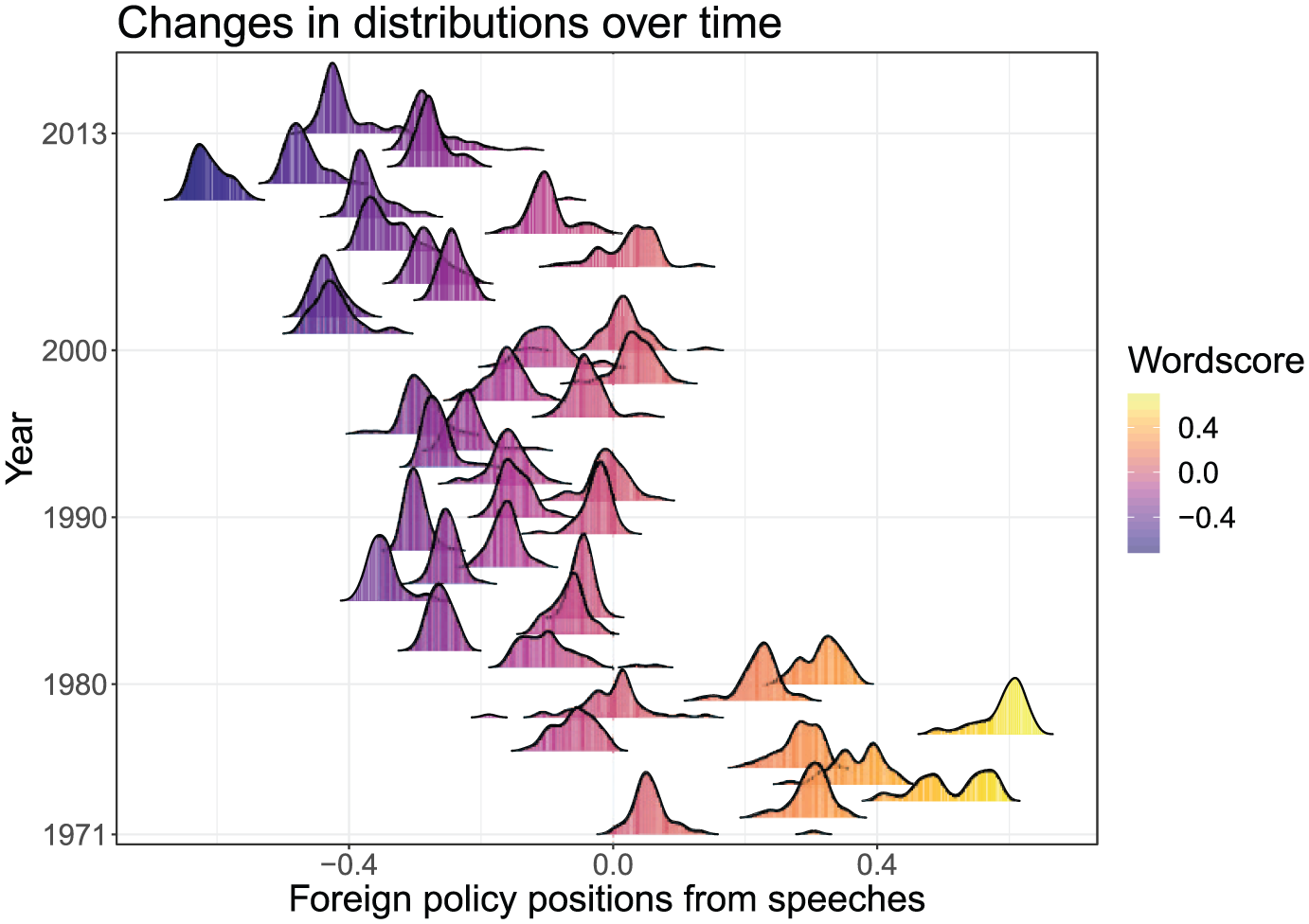
Foreign policy positions over time. Changes in the densities of positions of African states from Wordscores classification of GD statements in relation to the United States (+1) and China (–1).
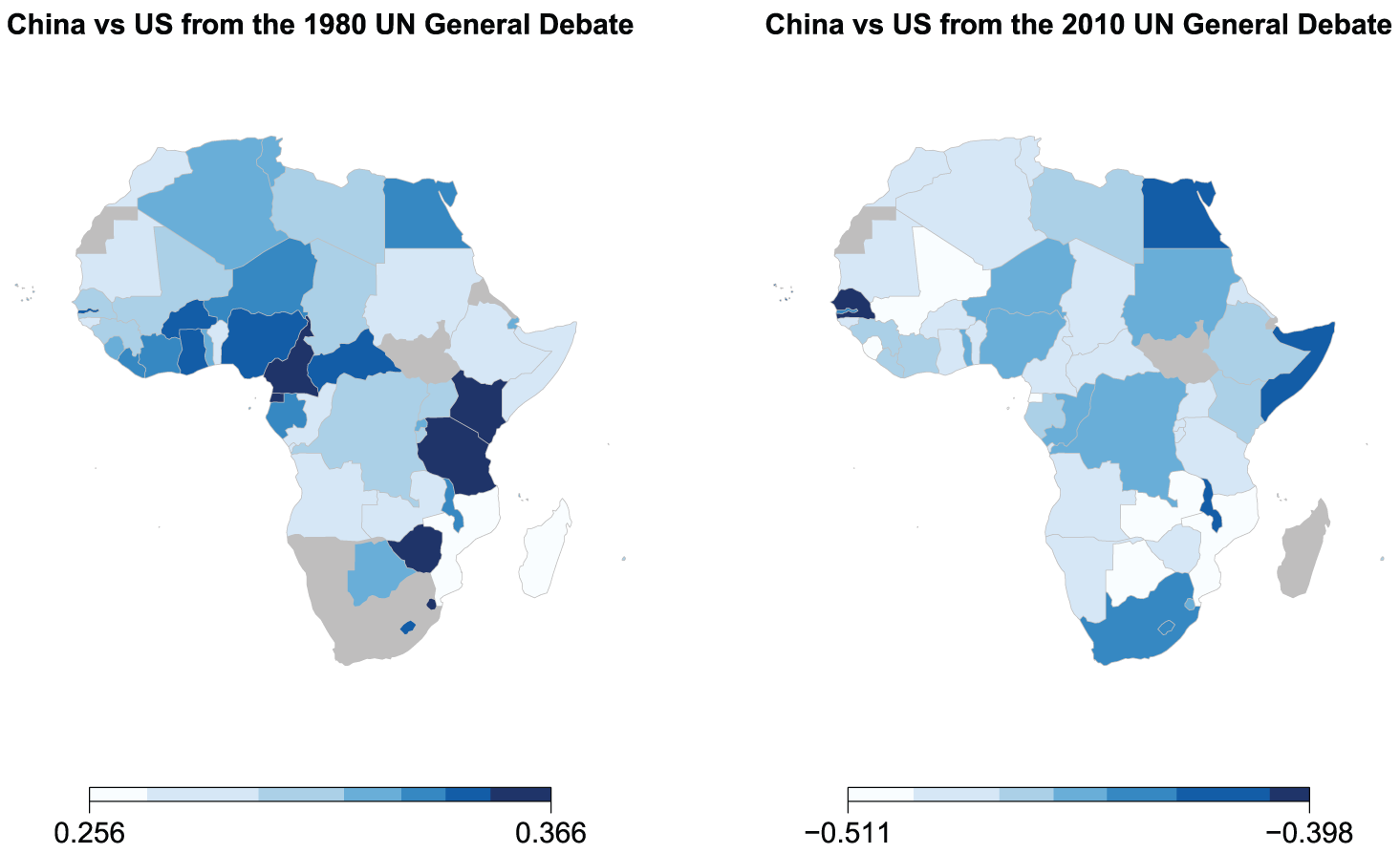
General Debate statements in 1980 and 2010. The maps show African states’ position in relation to the United States (+1) and China (–1) in 1980 and 2010, according to the Wordscores measure applied to GD statements.
In addition to a text-based measure of foreign policy position, we include measures based on countries’ voting patterns in the UNGA. As we have noted, using UNGA voting patterns is the standard approach to analyzing foreign policy proximity in international relations research. This is because UNGA voting provides information about countries’ preferences on the same set of issues over time, which can be easily compared. We use roll call voting data from Voeten (2013). We calculate voting similarity with China as the number of times in a given year that a country votes the same way as China as a proportion of the total number of votes in the year. We consider voting similarity across a number of different types of UNGA resolutions. Specifically, we look at voting similarity across all resolutions for a given year, on human rights-related resolutions, and resolutions on which China and the United States disagreed in their voting. Figure 3 presents a ridgeline plot of changing distribution of voting similarities across three areas. These figures show the distribution of African countries’ voting similarities with China for each year between 1971 and 2013.

Voting similarity with China. Changes in densities of voting similarities of African states across all votes in the UNGA, votes on human rights issues, and votes where China and the United States vote differently.
We also consider human rights–related resolutions because “China adamantly defends state sovereignty, views external interference in a state’s human rights as an unwelcome challenge … and takes visible international stands defending a state’s sovereignty relative to human rights considerations” (Flores-Macías and Kreps, 2013: 361). Furthermore, as Flores-Macías and Kreps (2013: 361) explain, China has been very consistent in its voting in opposition to human rights resolutions in the UNGA. Therefore, voting on human rights resolutions in the UNGA allows us to examine a foreign policy issue of importance to the Chinese government and an issue on which China has been consistent in its stance over time. In the additional analysis (below), we also consider voting similarity on issues considered important by the US State Department (see Wang, 1999), and look at the similarity of African states’ voting patterns with the United States.
Explanatory Variable
In considering how trade with China impacts African states’ foreign policy positions, our main explanatory variable is the share of trade entered into by an individual country with China. This is the sum of a country’s total imports and exports with China as a proportion of the country’s total trade for a given year. We use dyadic trade data from the UN COMTRADE database to calculate the given country’s trade share with China. We focus on trade share with China rather than overall trade because it better captures the level of trade dependence from one country to another (see Barbieri, 1996). We present distributions of the African states’ trade share with China for each year of the analysis using a ridgeline plot in Figure 4. We observe a general trend of higher proportion of trade with China over time, simultaneously an increasing heterogeneity among African states. In 2013, the median trade share with China was at 11%, third quartile at 18%, and maximum at 50%.
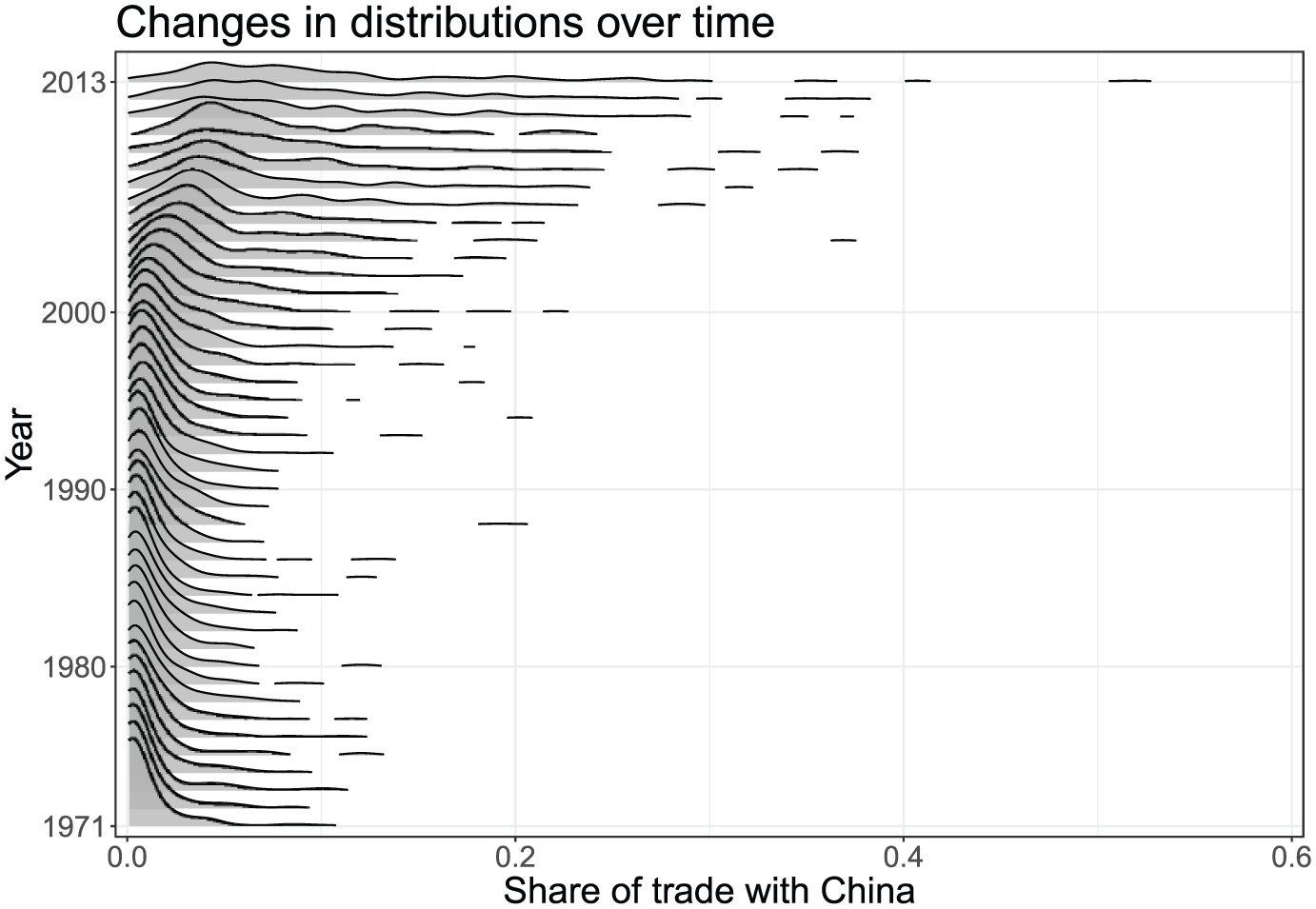
Share of trade with China over time. The plot shows changes in distributions of the proportion of total trade by African states with China over time.
Other Control Variables
We also include additional variables in our model to control for other factors that may influence countries’ trade relations or foreign policy positions. These additional control variables consist of a standard set of political and economic variables, such as countries’ Polity scores (Marshall and Jaggers, 2016); countries’ levels of wealth, which we measure by gross domestic product (GDP) per capita (logged); and the size of a country’s population (logged). The data for GDP per capita and population are taken from the World Bank’s World Development Indicators (WDI).
As changes in the amount of trade a particular country engages in with China may be related to general changes in its levels of trade, we also include trade as a proportion of GDP as a control. This is calculated using trade data from the UN COMTRADE database and GDP data from the World Bank’s WDI. We also control for how resource-rich countries are by including a variable on a country’s total natural resources as a proportion of GDP using data from the World Bank’s WDI. As the foreign policy positions of individual countries may have been influenced by the Cold War context, we include a dummy variable for post–Cold War years. We also control for the potential influence of the United States. We include a variable that captures countries’ trade share with the United States. This is calculated in the same way as trade share with China. We also include a variable that captures the amount of aid received from the United States by a particular country as a share of its GDP, also taken from the World Bank’s WDI.
Model Specification
We examine the effects of trade with China on African foreign policy preferences using a panel linear regression model that controls for country fixed effects. This allows us to account for country-specific unobserved factors that are constant over time and partly address the issue of omitted variable bias. The inclusion of country fixed effects means that our analysis focuses on how changes in a country’s share of trade with China influence their foreign policy positions. In total, the models include 50 countries and cover a 42-year time period (1971–2013). Therefore, this time period of the analysis enables us to consider the longer term engagement of China in Africa. We address potential temporal dependence in the robustness tests.
Results and Analysis
Table 1 presents the results of the impact of increased trade with China on the foreign policy positions of African states. In Model 1, the outcome variable is the measure of position derived from UN GD speeches using per year estimation with the Wordscores classifier. The GD statements of China (–1) and the United States (+1) in that year are used as reference texts. The results show that an increase in the share of trade with China leads African states to move closer to the United States and away from China in terms of the foreign policy positions expressed in their GD statements. This result is statistically significant at the 99% confidence level.
Results of effects of trade share with China on African states’ foreign policy positions.
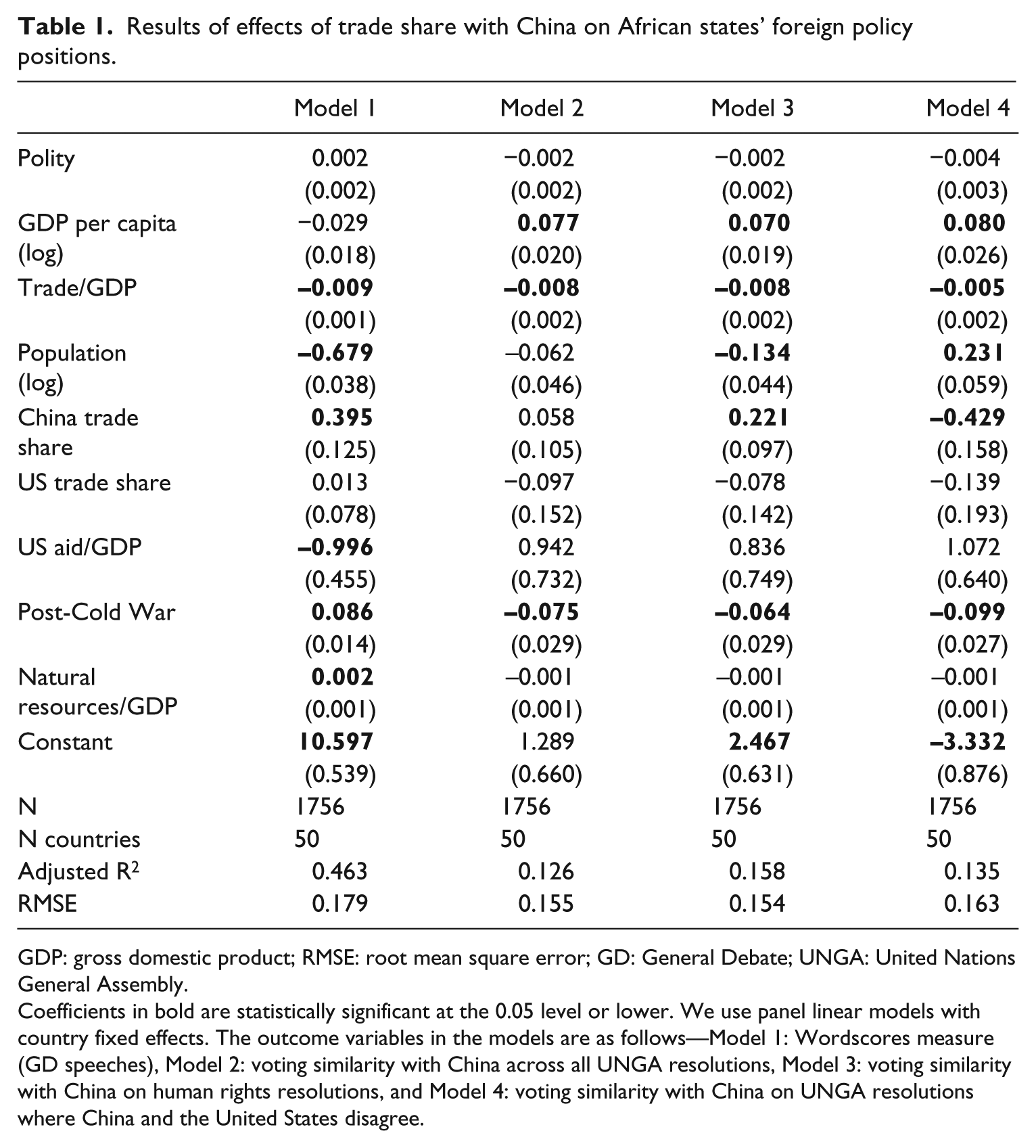
GDP: gross domestic product; RMSE: root mean square error; GD: General Debate; UNGA: United Nations General Assembly.
Coefficients in bold are statistically significant at the 0.05 level or lower. We use panel linear models with country fixed effects. The outcome variables in the models are as follows—Model 1: Wordscores measure (GD speeches), Model 2: voting similarity with China across all UNGA resolutions, Model 3: voting similarity with China on human rights resolutions, and Model 4: voting similarity with China on UNGA resolutions where China and the United States disagree.
The outcome variable in Model 2 is the similarity of voting patterns in the UNGA between African states and China across all UN resolutions during this time period. The results demonstrate that increased trade has no statistically significant effect on the similarity of Chinese and African voting patterns in the UNGA. This may reflect China’s “no questions asked foreign policy.” In Model 3, we consider voting similarity between China and African states on human rights–related resolutions in the UNGA. This, as we have explained, is based on the argument that the Chinese government has consistently opposed resolutions in the UNGA on human rights issues (see Flores-Macías and Kreps, 2013). The results in Table 1 suggest that an increase in the share of trade an African country engages in with China has a statistically significant effect on its likelihood to vote in agreement with China on human rights issues. In other words, the more trade undertaken by African countries with China, the more likely they are to align themselves with China in opposing UN resolutions on human rights.
Finally, Model 4 in Table 1 considers voting similarity between African states and China on resolutions in the UNGA where China and the United States differ in how they voted. We consider whether a greater share of trade with China makes African states more likely to vote in agreement with China or the United States on votes where there was disagreement between China and the United States. The results demonstrate a statistically significant negative relationship. Therefore, an increase in the share of trade engaged in by African countries with China makes them less likely to vote in agreement with China on resolutions where the United States and China differed in their votes.
The results provided in Table 1 would appear to suggest that greater trade between China and African states has a mixed, and somewhat paradoxical, effect on foreign policy preferences. An increase in trade share has no effect on voting similarity between African states and China when we consider all votes in the UNGA. However, when we consider only human rights votes, we find that an increase in the trade share between African states and China leads to more similar foreign policy positions. If we consider UN GD speeches and UNGA votes where China and the United States differ, we find the opposite result; an increase in trade share with China leads African states to move further away from China in terms of their preferences. In terms of GD speeches, we find that more trade with China leads African states to express foreign policy positions in their GD statements that are closer to the United States and further from China.
While these results may appear paradoxical, we argue that they provide strong support for the argument that African governments use trade with China to strengthen their position globally by balancing Chinese against Western power to achieve greater autonomy and maximize resources. African states use economic engagement with China to strengthen their domestic and international sovereignty by trying to promote non-interference in relation to domestic human rights. In other words, Chinese trade creates issue-specific allies around a hard shell sovereignty. Hence, we see that more trade with China leads to African governments voting more similarly to China in opposing human rights–related UN resolutions. However, beyond the issue of human rights, African governments seek to balance their growing trade relationship with China by moving closer to the West, specifically the United States, at least in this forum.
These results support findings from analyses of the engagement of individual African states with China and the United States. For example, there has been some discussion of how the Angolan political elite has adopted such a strategy to ensure that it maintains relations with a variety of external partners and avoids being dominated by China (see Carmody and Kragelund, 2016; Shinn and Eisenman, 2012). Therefore, rather than growing trade between China and African states leading to a growing foreign policy alliance between China and African states as might be expected, these governments appear to be using this growing trade to play off the rival powers in order to strengthen their own autonomy, and attract more trade, aid, and investment from the United States, as China’s assistance comes with “no strings attached.” Hence, we see a greater share of trade with China leading to African states moving closer to the United States and away from China in terms of foreign policy positions expressed in the UN GD and in voting on resolutions where there is disagreement between China and the United States.
Additional Tests
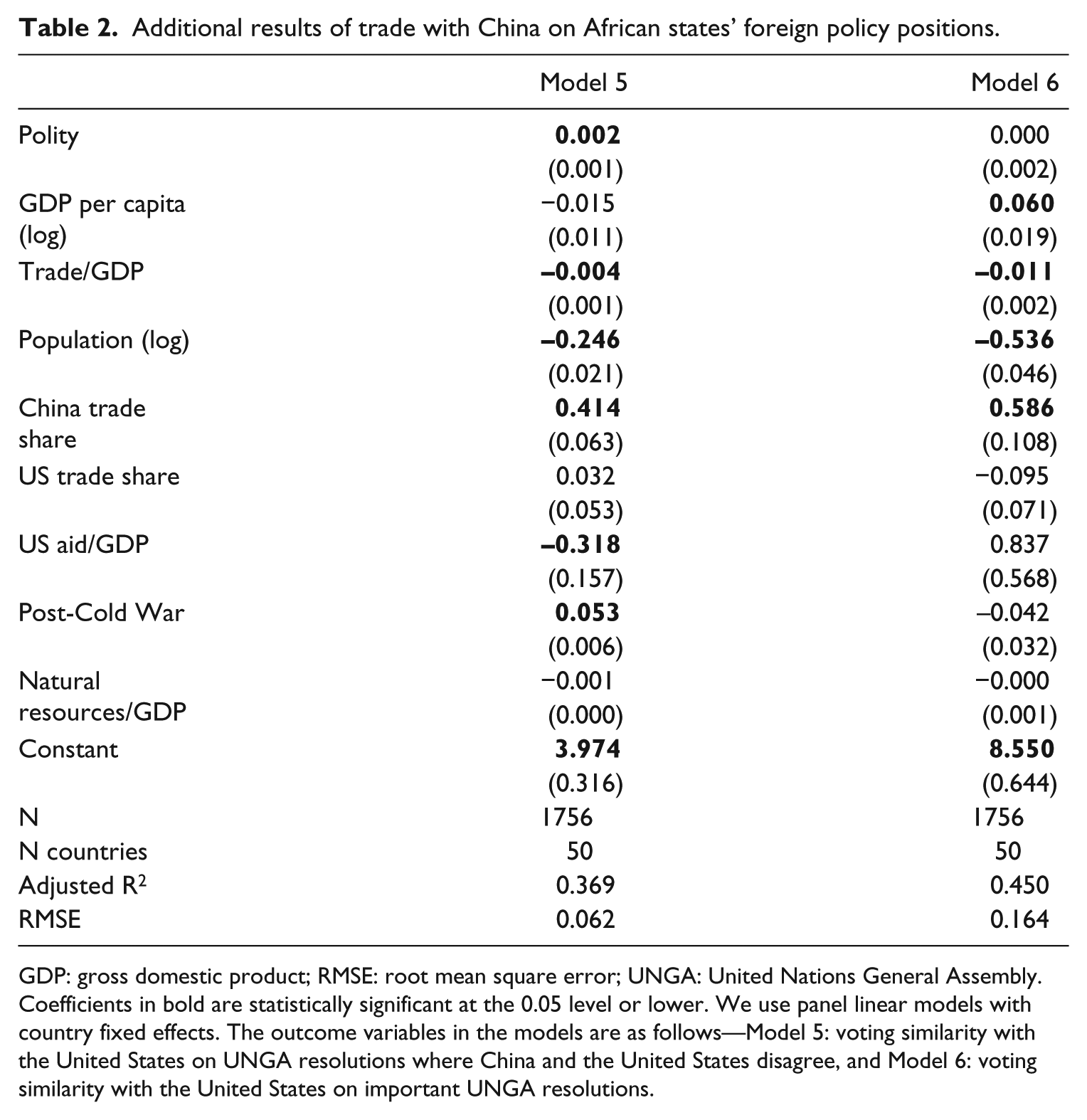
We conduct additional tests to further examine the relationship between trade with China and African foreign policy positions. We first examine further whether African governments look to balance growing trade with China by moving closer to the United States in their foreign policy positions. The first model in Table 2 once more examines votes in the UNGA where China and the United States disagree. While we previously established that a higher share of trade with China makes African states less likely to vote the same way as China on such resolutions, we now consider whether increased trade with China makes African states more likely to vote with the United States on votes where the United States and China differ.
Additional results of trade with China on African states’ foreign policy positions.
GDP: gross domestic product; RMSE: root mean square error; UNGA: United Nations General Assembly.
Coefficients in bold are statistically significant at the 0.05 level or lower. We use panel linear models with country fixed effects. The outcome variables in the models are as follows—Model 5: voting similarity with the United States on UNGA resolutions where China and the United States disagree, and Model 6: voting similarity with the United States on important UNGA resolutions.
In Model 6, in Table 2, we consider voting on resolutions that are deemed “important” by the US State Department. As the international relations literature has discussed, the US State Department provides a list of the resolutions in the UNGA that it considers to be important and on which it monitors whether countries, particularly those that receive US aid, vote in agreement with the United States (see Wang, 1999). If growing trade with China leads African governments to move closer to the United States on some foreign policy dimensions, we would expect to see this with votes the United States considers important.
Figure 5 presents a ridgeline plot of changing distribution of voting similarities with the United States on votes where the United States and China differ and votes deemed “important” by the US State Department. We observe a general trend of decreasing voting similarity with the United States, particularly on important votes, although there is a recent pickup in similarity, perhaps as the unipolar post–Cold War moment has passed.
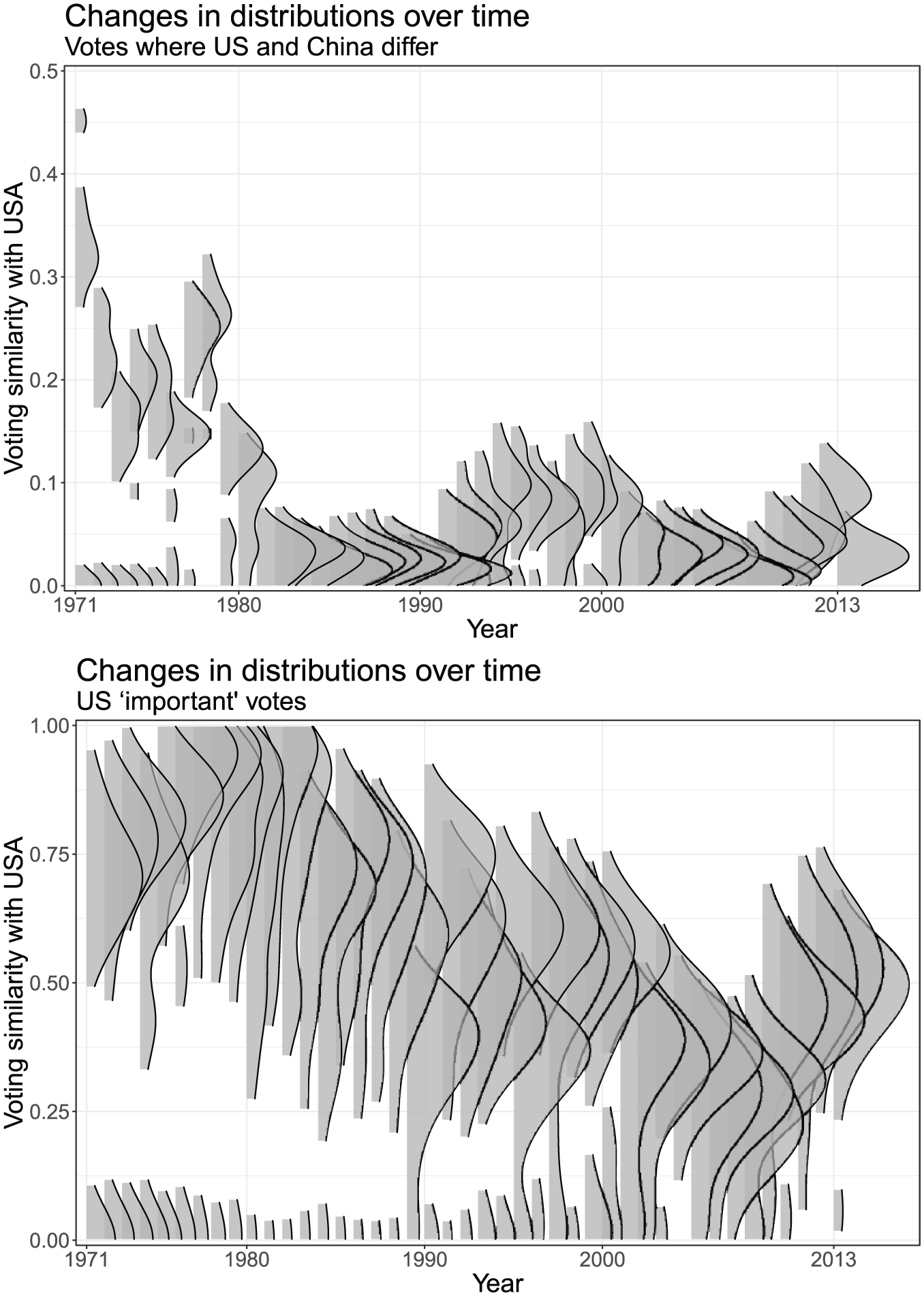
Voting similarity with the United States. Changes in densities of voting similarities of African states across votes where China and the United States vote differently and votes classified as “important” by the US State Department.
The results in Model 5 suggest that this is the case—an increased trade share with China makes African states more likely to vote in accordance with the United States where there is disagreement between China and the United States. The results of Model 6 show that an increase in trade share with China makes African states more likely to vote in agreement with the United States on these important resolutions. These additional tests, therefore, provide further support that African states seek to balance increased trade with China by moving closer to the United States in some areas of foreign policy.
We conduct several additional tests to demonstrate the robustness of our findings. These results are provided in the Supplementary Material. We show that lagging trade share with China and the United States does not alter our findings. We also separately consider imports from China as a share of trade and exports to China as a share of trade. While there are minor differences in the results, this analysis does not alter the general picture provided by the analysis. Furthermore, we address potential temporal dependence by fitting a cubic spline to the regression models. Our findings remain consistent when a cubic spline is included as we discuss in the Supplementary Material. We continue to find support for the argument that African states engage in balancing behavior. Likewise, the inclusion of extra control variables, such as countries’ human rights records and whether a country is involved in an ongoing conflict, does not significantly impact our findings.
Our argument in this article focuses on the foreign policy consequences of trade with China for African countries. Therefore, it is important to address potential endogeneity in this relationship. It may be that rather than trade leading to foreign policy positions, the relationship is the other way around. African governments may choose foreign policy positions in order to foster more trade with China. The findings of our analysis—that increased trade with China generally leads African states to move closer to the United States—would appear to counter concerns about potential endogeneity. However, it may still be argued that these governments move closer to the US foreign policy position to encourage the Chinese government to increase its economic engagement with, or assistance to, these countries. In order to address potential endogeneity, we exploit differences between African states that have diplomatic relations with the PRC and those that have diplomatic relations with the Republic of China (Taiwan).
In 1971, the UNGA passed a resolution transferring China’s seat on the UN Security Council from the Republic of China to the PRC. Over time, most states have switched diplomatic recognition from Taiwan to the PRC. 11 However, some states—including in Africa—continue to formally recognize Taiwan. Burkina Faso, for example, until recently had full diplomatic relations with Taiwan, leaving Eswatini, the only African state to recognize Taiwan. Furthermore, there are differences between countries in terms of when they switched their recognition to PRC. For example, Ghana never formally recognized Taiwan, and established diplomatic relations with the PRC in 1960, while Malawi switched from Taiwan to the PRC as recently as 2008, São Tomé and Principe in 2016, and Burkina Faso in 2018. It is also worth noting that several countries—including the Central African Republic, Chad, and Liberia—have switched back and forth, in recognizing one or the other.
We argue that countries choosing not to recognize the PRC are unlikely to use the foreign policy positions expressed in their GD speeches or their votes in the UNGA to seek to increase their trade with China. If these countries were trying to use foreign policy positions to foster trade with China, then the most obvious option would be to recognize the PRC. As such, we examine the relationship between trade with China and foreign policy positions among African states that do not have diplomatic relations with China (PRC) for a given year. This enables us to address the issue of endogeneity as changes in foreign policy positions among these states must follow from changes in trade share with China. We provide the results of the analysis in Table 3 and use the six dependent variables previously examined.
Results of trade with China on foreign policy positions of African states with no diplomatic relations with PRC.

PRC: People’s Republic of China; GDP: gross domestic product; RMSE: root mean square error; GD: General Debate; UNGA: United Nations General Assembly.
Coefficients in bold are statistically significant at the 0.05 level or lower. We use panel linear models with country fixed effects. The outcome variables in the models are as follows—Model 7: Wordscores measure (GD speeches), Model 8: voting similarity with China across all UNGA resolutions, Model 9: voting similarity with China on human rights resolutions, Model 10: voting similarity with China on UNGA resolutions where China and the United States disagree, Model 11: voting similarity with the United States on UNGA resolutions where China and the United States disagree, and Model 12: voting similarity with the United States on important UNGA resolutions.
The results provided in Table 3 are broadly consistent with our previous findings. The results show that a greater trade share with China leads to countries moving closer to the United States and away from China in terms of the GD statements (Model 7). We also find that an increase in trade share with China leads to greater voting similarity with the United States on votes where there is disagreement between China and the United States (Model 11), and votes the United States considers to be important (Model 12). We find that there is no relationship between trade with China and voting alignment across all votes (Model 8). The analysis differs to the previous results on voting on human rights resolutions (Model 9). Here, we find that increased trade with China has no effect on these African states’ voting on human rights issues. This, however, is in line with our expectations, as we would not expect countries that do not formally recognize the PRC to seek to align with it on human rights issues due to increased trade. We also find that trade with China has no effect on voting similarity with China on resolutions where China and the United States differ (Model 10). In general, however, the analysis provides support for our findings on the paradoxical impact of trade with China on African foreign policy positions and the balancing argument.
Our analysis suggests that African countries are engaged in balancing behavior in relation to their engagements with China. However, this balancing is perhaps more focused on internal politics than the threat of external military intervention (the traditional realist explanation for balancing). African governments, as a rule, are highly focused on regime maintenance, and balancing between great powers may not only yield additional resources which can be deployed to strengthen authority domestically (Peiffer and Englebert, 2012) but also allow for maximum policy latitude and autonomy by avoiding over-dependence on one or a set of donors.
Conclusion
The political implications of China’s growing economic ties with African states have been the subject of much recent attention. This article has systematically analyzed the impact of Chinese trade on African foreign policy positions by examining the effects of trade on UNGA voting patterns and annual statements in the UN GD. Our analysis demonstrates that, with the exception of voting on human rights–related resolutions in the UNGA, an increase in trade with China leads to African states aligning more with the United States in their foreign policy positions at the UN. To avoid becoming overly dependent on China and maximize resources and autonomy, African states that increase their trade dependence on China move closer to the US foreign policy position.
The attempt to seek greater autonomy by African governments is further demonstrated by the shift toward China’s position when it comes to human rights votes in the UNGA. China has long been an opponent of resolutions promoting human rights on the basis that this would infringe on national sovereignty. We argue that African states align with China on this issue based on a similar view. Indeed, the recent threat by several African governments to withdraw from the International Criminal Court—with South Africa having begun this process, and Burundi having already withdrawn—provides a further example of African states opposing the human rights agenda to prioritize domestic autonomy. 12 Therefore, the link between increased trade and voting alignment with China on this issue provides further support for the argument that African governments are seeking to leverage their growing economic ties with China to enhance their autonomy.
Therefore, while the study provides some support for recent calls for greater recognition of the agency of African governments in shaping external relations, our findings also highlight the limits of this agency. African governments have managed to secure some limited policy autonomy by engaging in this balancing behavior between China and the traditional Western powers rather than being able to reshape these relations, which are still characterized by dependence (see Carmody and Kragelund, 2016; Taylor, 2014). We would therefore argue that the analysis suggests that the balancing behavior of African governments with regard to their relations with China is more in line with what Randeria (2003) has termed “cunning states,” which read the internal and external political opportunity structures to maximize the possibilities for regime maintenance.
Supplemental Material
PSX840962_Supplemental_material – Supplemental material for Power Plays and Balancing Acts: The Paradoxical Effects of Chinese Trade on African Foreign Policy Positions
Supplemental material, PSX840962_Supplemental_material for Power Plays and Balancing Acts: The Paradoxical Effects of Chinese Trade on African Foreign Policy Positions by Pádraig Carmody, Niheer Dasandi and Slava Jankin Mikhaylov in Professional School Counseling
Footnotes
Acknowledgements
We would like to thank Lior Erez, Federico Maria Ferrara, Stephan Haggard, Jeffrey Kucik, and Henry Thomson for their incredibly helpful comments on previous drafts of this paper. Authors’ names are listed in alphabetical order. The authors have contributed equally to all work.
Funding
The author(s) received no financial support for the research, authorship, and/or publication of this article.
Supplemental material

Notes
Author Biographies
References
Supplementary Material
Please find the following supplemental material available below.
For Open Access articles published under a Creative Commons License, all supplemental material carries the same license as the article it is associated with.
For non-Open Access articles published, all supplemental material carries a non-exclusive license, and permission requests for re-use of supplemental material or any part of supplemental material shall be sent directly to the copyright owner as specified in the copyright notice associated with the article.
