



Abstract
The question, ‘which kind of democratic governance people prefer’, has moved to the forefront in current democracy research. This article uses existing hypotheses on democratic preferences as an input and employs an advanced research design to find out what citizens want if they had engaged in deliberation and reflection. We conducted an online-experiment with a deliberative treatment asking 256 German citizens in 2016. Our findings show that deliberation does not lead to more informed or differential preferences for governance models compared with getting informed or ‘thinking twice’. One reason are high levels of consistency between basic democratic values and governance choices already before the experiment, contradicting our initial assumption that preferences about democracy are generally ill-formed. Overall, our experiment shows that post-deliberative democratic preferences are mainly driven by issue salience and disenchantment with the actual shape of representative democracy. We detect a sort of a ‘populist’ impulse where disenchantment conduces to calls for a stronger voice of the ‘people’ and participatory governance models, irrespective of their concrete design.
What do citizens want from democracy and democratic governance? And which democratic procedures – representative democracy, direct democracy or citizen deliberation – do they view as legitimate when policy choices are made? The topic of democratic process preferences has moved to the forefront of democracy research in recent years. Several theses – some complementary, others competing – have emerged in the literature: the ‘political dissatisfaction hypothesis’ suggests that preferences for more citizen involvement and more participatory schemes of governance are driven by disenchantment with the actual shape of representative democracy, whereas the (potentially complementary) ‘new politics hypothesis’ claims that political sophistication breeds appetite for more participation (Dalton et al., 2001). By contrast, the ‘Stealth thesis’ proposes that many citizens prefer effective and efficient policy-making (Hibbing and Theiss-Morse, 2002) to participatory schemes, while Neblo et al. (2010) find in a prominent study that citizens have a desire to get involved in politics and to engage in deliberative activities. Other research has added nuance to these debates, by correlating preferences for stealth and direct democracy with issue type (Wojcieszak, 2014), ideological and socio-demographic variables (Bengtsson and Mattila, 2009; Coffé and Michels, 2014; Webb, 2013) or by probing for complex dimensionalities of representative, direct-democratic and technocratic schemes of governance (Font et al., 2015). Yet, findings remain ambiguous and we have surprisingly little robust knowledge on what citizens actually want from democracy. As VanderMolen (2017: 696) writes in the context of stealth attitudes, the ‘weak results suggest that although citizens may not be happy with the way democracy works, they do not necessarily have strong or detailed opinions about a procedural replacement’.
In this article, we set up an experimental design allowing us to obtain a deeper understanding of citizens’ process preferences. Our starting point is that existing studies, resting on pure survey-based research, may tap into ill-informed attitudes and preferences, especially when citizens are confronted with highly abstract issues such as democratic governance schemes. In particular, we do not know the counterfactual, what democratic preferences citizens would have if they had the possibility to deliberate about it and weigh the pros and cons of the various schemes. It is fairly possible that citizens have biased views on which democratic model works best for them. Getting informed about the various pros and cons of different governance models and deliberating about them might help citizens to structure their raw opinions and align their general preferences on democracy with existing (and novel) governance models. Therefore, we created a ‘deliberative’ treatment in order to help citizens to develop more informed preferences on governance models. As we describe in detail below, the experiment we conducted in 2016 with 256 German citizens comprised three treatment groups: an information-deliberation group, an information-only group and a pure control group getting neither information nor deliberation. But even in the pure control treatment, participants had the chance to ‘think twice’ about their preferences for governance models rather than be given only a few seconds to think about and respond to this hugely complex topic in a standard survey design. We combined our treatments with specific decision ‘scenarios’, whereby we confronted participants with pre-selected ‘governance schemes’. We think that the juxtaposition of decision ‘scenarios’ leads to more meaningful choices compared with pure (and serially asked) survey questions on governance schemes (VanderMolen, 2017). In our experiment, we presented participants three existing governance models (the traditional representative model in Germany, a Swiss direct democracy model combining representative politics and direct-democratic voting and a Baden-Württemberg model combining representative politics and citizen dialogue). In addition, we presented them a putative ‘integrative’ model combining representative, dialogical and direct-democratic instruments (as proposed by the Bertelsmann Foundation 2014 under the label ‘hybrid democracy’). In sum, the goal of our article is to introduce a more powerful methodological approach that sheds new light on the various debates in the literature and on the nature of democratic process preferences.
We proceed as follows. We first peer into the theoretical debates on democratic process preferences, showing that the results are unclear and contradictory. Next, we propose an essential amendment, namely a deliberative component to preference formation. This is followed by a description of the experimental procedures, the outcome and predictor variables as well as the statistical method. Then, we present results of our deliberative experiment with German citizens. We find that deliberation does not lead to more informed or different preferences for governance models compared with getting informed or ‘thinking twice’. But after deliberating or ‘thinking twice’, we detect a sort of a ‘populist’ impulse where disenchantment with the shape of current politics conduces to calls for a stronger voice of the ‘people’ and participatory governance models, irrespective of their concrete design. We conclude by outlining some avenues for future research on democratic process preferences.
The Complex Nature and Contested Shape of Democratic Process Preferences
In political theory and some democracy research, there is a tradition of conceptualizing the democratic process in ‘unitary’ terms. On this view, there is a specific and preferred model of democratic governance (such as representative, direct or deliberative democracy) which is expected to either please everyone (given its undeniable theoretical advantages) or at least to please many in a specific cultural context or under specific societal and political conditions. For example, some democratic innovation scholars have claimed that the current crisis of representative democracy gives rise to a general trend for preferring direct or deliberative schemes of governance (e.g. Fishkin, 2009). But such thinking tends to ignore the heterogeneity of preferences in the citizenry. Opinion researchers have long argued that different subsets of the citizenry may have very different preferences for democracy. Dalton et al. (2004) have put forward the ‘political dissatisfaction hypothesis’. According to this hypothesis, citizens who are disenchanted with the actual shape of representative democracy including parties and traditional institutions have lost trust or do not feel responded by current systems want more participation, especially direct democracy. Another hypothesis – the ‘new politics hypothesis’ (Dalton et al., 2001; Dalton and Welzel, 2014; see also Norris, 1999) – suggests that new post-materialist values make people critical of hierarchical structures and conduce to demands for more direct involvement in politics. Specifically, younger and politically sophisticated citizens with higher education, high knowledge and high levels of internal efficacy prefer more participatory schemes of governance (Bowler et al., 2007; Dalton et al., 2001). Yet existing empirical research has not been able to clearly distinguish between the two hypotheses. Dalton et al. (2001) found in Germany that the dissatisfaction hypothesis generated more empirical support than the new politics hypothesis. By contrast, focusing on six established democracies, Donovan and Karp (2006) found that especially younger and more politically interested citizens turned out to be the strongest supporters of direct democracy, providing support for the new politics hypothesis (see also Bowler et al., 2007).
Another approach to understanding democratic process preferences is provided by the ‘Stealth thesis’ (Hibbing and Theiss-Morse, 2002). According to this thesis, many citizens prefer effective and efficient policy-making to participating in and deliberating about politics. Hence, citizens only participate in politics when they perceive institutions as corrupt; if not, they will be happy-bystanders of politics. As with the dissatisfaction and the new politics hypothesis, evidence for stealth democracy is unclear. In an experimental study with American Congressmen, Neblo et al. (2010) found that citizens do have a desire to deliberate: ‘[The] willingness to deliberate is much higher than indirect evidence from political behavior research might suggest, and that those most willing to deliberate are precisely those who are turned off by standard partisan and interest group politics’. Webb (2013), in turn, shows for the UK that Stealth people and dissatisfied democrats are different types of citizens: while both have low trust in elites, dissatisfied democrats are politically interested and efficacious while Stealth people are not. Webb’s empirical analysis reveals that dissatisfied democrats favour deliberative democracy, whereas Stealth citizens favour direct democracy. In a recent study, VanderMolen (2017) finds no deep and coherent preferences for an efficient technocratic model (as implied by the Stealth approach) among American citizens either.
Recent years have added further nuance to the various hypotheses. Bengtsson and Mattila (2009) have demonstrated that people oriented towards the political left prefer direct-democratic procedures whereas people oriented towards the political right favour delegated procedures and Stealth democracy (see also Christensen and von Schoultz, 2017). Bengtsson and Mattila (2009) as well as Coffé and Michels (2014) also found some evidence for the ‘political dissatisfaction’ hypothesis. People with low external efficacy, low satisfaction and low trust favour both direct democracy and stealth democracy. Another crucial factor is education: contrary to the ‘new politics hypothesis’, both research teams found that people with lower (and not higher) levels of education favour direct democracy over representative democracy; in addition, less educated people also support stealth democracy.
Research has shown, furthermore, that democratic preferences may be conditional on issue type. Wojcieszak (2014) distinguishes between ‘hard’ and ‘easy’ issues (see Carmines and Stimson, 1980). ‘Hard’ issues concern technical issues with a focus on policy means (efficiency), thus requiring more knowledge for considered judgement. By contrast, ‘easy’ issues are symbolic issues and focus on policy ends (effectiveness). She finds that people were favourable to representative democracy in the context of ‘hard’ issues but not in the context of ‘easy’ issues. Finally, research suggests that ‘outcome favourability’ matters as well: citizens’ perceptions of legitimacy of democratic governance are not only affected by procedural but also by substantive considerations, that is, whether outcomes match their policy preferences (Arnesen, 2017; Esaiasson et al., 2012, 2016; Hibbing and Theiss-Morse, 2002).
While existing research has offered important insights into correlates of democratic preferences, it remains deficient in several regards. The critical point is that when we ask participants abstract concepts such as preferences for democratic governance schemes, we may tap into non-attitudes. Indeed, we know from psychological research that people generally have difficulties in forming coherent and stable attitudes on politics (see Bengtsson, 2012: 56; Converse, 2006; Zaller and Feldman, 1992). This problem may be enhanced in the context of more abstract concepts such as preferences for democratic governance models, undermining the validity of traditional survey research on this topic. While Bengtsson (2012) finds some coherence in citizens’ preferences in connection with representative democracy in Finland, she could not identify clear patterns for citizen involvement and expert-based decision-making. For technocratic governance, for instance, ‘it appears as if a mixture of experts and elected politicians is the answer’ (Bengtsson, 2012: 61). Hence, it may be the case that democratic preferences are both non-separable and multidimensional (Bengtsson and Christensen, 2014; Font et al., 2015; Neblo et al., 2010). Consequently, it may be deficient to ask participants whether they prefer direct democracy or more deliberation without considering the counterfactual what governance models would citizens prefer if they had engaged in deliberation and reflection. Indeed, we expect that citizens may have biased views about the pros and cons of different governance models, leading to distorted answers in traditional surveys.
Deliberating and ‘Thinking Twice’ About Democratic Preferences
Our key argument is that traditional survey–based research may tap into ill-informed attitudes and preferences, especially when citizens are confronted with highly abstract issues such as democratic governance schemes. We expect that deliberation about democratic decision-making procedures acts as a ‘filter’ on citizens’ raw and poorly reflected preferences, contributing to a more informed and deeper understanding of democratic processes (see Fishkin, 2009). First, Mercier (2016) claims that dialogue and the proper juxtaposition of different positions leads to epistemically superior outcomes, whereas ‘solitary’ reasoning (i.e. thinking about the topic individually) is generally not conducive to a correction of misguided intuitions. Even worse, ‘solitary reasoning can lead to an accumulation of arguments supporting one’s own opinion, frequently poorly examined, leading to overconfidence and polarization’ (Mercier, 2016). Undoubtedly, any discussion treatment bears the risk of undesirable group dynamics (such as groupthink). Yet research shows that well-structured deliberation forums do not contribute to undesired social pressures (see, for example, Baccaro et al., 2016), a problem that can also be mitigated by choosing appropriate discussion formats (such as asynchronous and facilitated discussion, see below). We also know from previous experimental research that a deliberative treatment contributes to more information gains compared with a mere information treatment (Esterling et al., 2011):
Hypothesis 1. Deliberation leads to more informed democratic preferences compared with mere information or ‘thinking twice’.
Second, Fishkin (2009) assumes that citizens have different preferences after deliberation: since people’s attitudes generally rest on little information and reflection, citizens are expected to change their views and attitudes when they are confronted with new information and different opinions. Yet it is a very open question in what directions citizens’ process preferences shift after deliberation. Deliberative theory is generally silent on this matter; a directional hypothesis would only be possible in (the unlikely) case where there is a ‘correct’ answer to a problem. Yet in the context of democratic preferences, it is theoretically impossible to say which governance model is the ‘correct’ or the ‘best’ one. Recent empirical research, however, suggests that participating in a deliberative event may ‘breed an appetite’ for more deliberative and participative schemes (Christensen et al., 2017). This leads to the following two hypotheses:
Hypothesis 2a. Deliberation leads to different democratic preferences compared with mere information or ‘thinking twice’, albeit the direction of preferences is open.
Hypothesis 2b. Deliberating about democratic preferences breeds an appetite for more participatory models of governance.
Finally, deliberative theory has opened itself up to a broader variety of preference transformations in recent years, taking a stronger focus on preference clarification than preference change (see Knight and Johnson, 2011: 145). Regarding preference clarification, a poignant question is whether expressed support for governance models is consistent with underlying democratic values and preferences of participants. Specifically, the question is whether general democratic preferences (such as preferences for more direct citizen involvement) align with specific governance models (such as direct democracy and citizen dialogue). A similar analysis has been conducted in the context of deliberative assemblies on electoral reforms. Fournier et al. (2011) explored whether deliberation was conducive to consistency by checking whether participants’ preferences about electoral systems became more congruent with views about system features and with general outlooks towards politics and change (such as fair representation of parties, choice for the voter, identifiable local representation or simplicity) after the deliberative process:
Hypothesis 3. Deliberation promotes the alignment of general democratic preferences with specific governance models.
Overall, our article uses existing hypotheses on democratic preferences (political dissatisfaction, sophistication, stealth attitudes, ideology, issue-type and outcome favourability) as an input and employs an advanced research design to find out what citizens want from democracy if they had engaged in deliberation and reflection. Put differently, we explore the validity of existing hypotheses (such as the ‘political dissatisfaction’ or the ‘Stealth thesis’) under the condition that citizens have deliberated, got informed or ‘thought twice’ about it. 1 While our hypotheses predict the deliberation group to have the most informed and reflected preferences on governance models, the fact that the other groups are surveyed twice provides a major improvement on existing survey where participants are surveyed only once and give answers to complex constructs within a few seconds.
Methods and Measurements
Experimental Setup
We have conducted our deliberative experiment on democratic preferences at the University of Stuttgart in April 2016. The recruiting of participants was done on the basis of the NCCR Democracy module survey in Germany. At the end of the survey, participants were asked if they are willing to take part in an online discussion, incentivized by a remuneration (€30) for taking part in the discussion and filling out additional surveys. A total of 580 persons expressed a willingness to participate; 297 eventually participated and 264 filled out all surveys. Compared with representative ALLBUS and ESS data for Germany, participants in our deliberative experiment were better educated, had a much higher political interest and were disproportionally male (see Supplemental Appendix A1). These biases are also present in comparison with the German part of the NCCR module survey, but far less pronounced. This not only confirms long-standing critiques of biased participation in citizen deliberation but also limits our ability to generalize from our analysis. However, our experimental set-up is designed to establish a causal relationship for deliberation’s effects. To date, many deliberative experiments do not qualify as true experiments since they either lack a true control group or create control groups out of those participants who are not interested in participating in the deliberative event. This, however, leads to comparisons among people with very different motivation profiles and does not allow extracting the causal effect of deliberation. At the same time, it is crucial to isolate the effect of deliberation from information effects (which play a crucial role in any deliberation event with citizen). To overcome such problems, we follow a procedure proposed by Esterling et al. (2011) where those agreeing to participate are randomly assigned to three groups (Table 1):
Experimental Design.
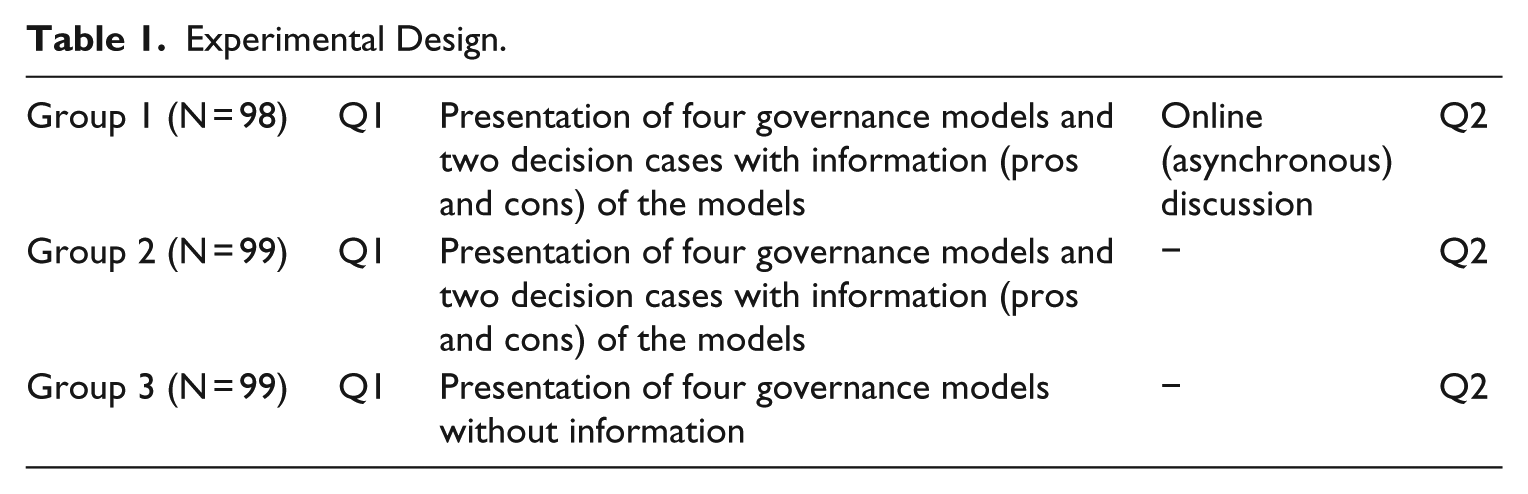
A first (treatment) group was presented with different governance schemes (see below) with information about the respective pros and cons and then having the possibility to deliberate about the various schemes.
A second (control) group was presented with different governance schemes with information about the respective pros and cons but with no possibility to deliberate about the various schemes.
A third (pure control) group was only presented with the governance schemes (with no information and no deliberation).
The randomization process worked well: there were no systematic differences with regard to socioeconomic and political variables across the three treatment conditions (see Supplemental Appendix A2). All three groups were surveyed twice (Table 1). With regard to the deliberative treatment, we have applied a fully automated discussion tool dubbed Smartopinion (see Supplemental Appendix A3; Wyss and Beste, 2017). Smartopinion provides an argument-tree forum, in which participants interactively develop a ‘representation’ of the argumentative structure of a debate (Klein, 2012). In addition, the forum features an artificial facilitator confronting participants with pro and con arguments regarding the four governance models. At first glance, asynchronous forms of deliberation do not match traditional deliberative ideals where participants engage in an intensive face-to-face encounter. Yet, the Smartopinion tool sets up conditions for the free and fair exchange of participants’ views, involving a ‘minimal’ conception of deliberation focusing on ‘mutual communication that involves weighing and reflecting on preferences’ (Mansbridge, 2015). Moreover, as Strandberg and Berg (2015) demonstrate in an experimental study, asynchronous online discussion does not decrease discussion quality compared with synchronous online discussion. Quite to the contrary, their findings even suggest that online deliberation has a higher quality when conducted in an asynchronous way.
However, as previous research has shown, it is essential in asynchronous forums to distinguish between active participants and ‘lurkers’. Put differently, not all participants engage with each other, that is, post messages and react to other participants’ contributions. As Smith et al. (2013) find, actively contributing in the form of posting has the biggest effect on opinion formation, while ‘lurking’ has only little effect. We follow Smith et al. (2013) who define ‘deliberation’ as ‘actively contributing to one or more threads by posting at least once during the experiment’.
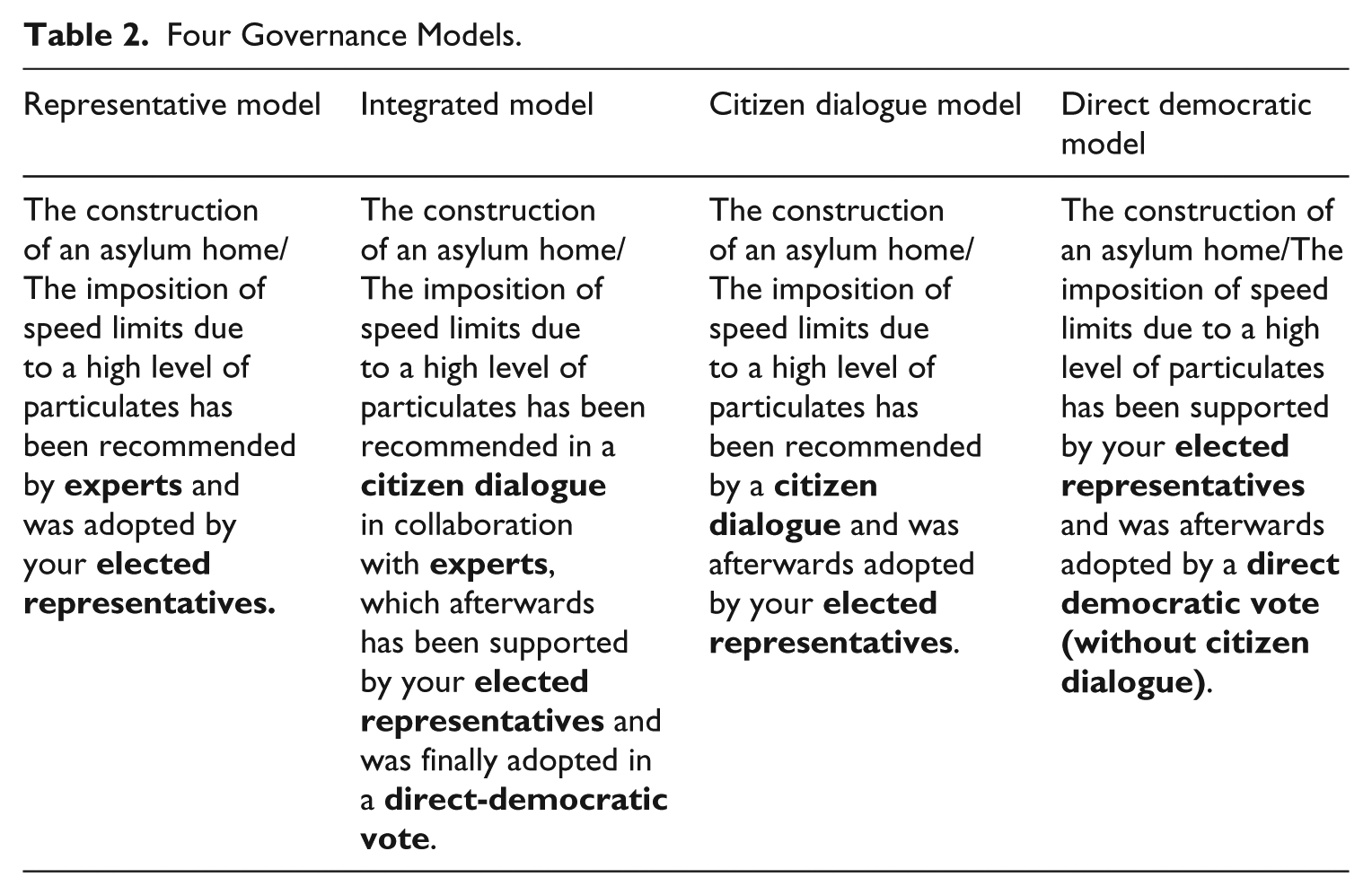
The deliberation effect may be enhanced by presenting participants with specific decision scenarios (see VanderMolen, 2017). One way to do so is conducting conjoint and vignette experiments which ask participants to evaluate hypothetical profiles with multiple, usually randomly varied attributes. These are used to measure preferences in the context of multidimensional decision-making (Hainmueller et al., 2015). We used a ‘conjoint-type’ analysis with a juxtaposition of different democratic governance schemes. We think that the juxtaposition of different governance schemes leads to more meaningful choices than presenting participants with these schemes in a serial way (as is done in most research on this topic). In this regard, we also take up the issue of potential procedural replacement of representative democracy. Very few advocates of participatory or deliberative schemes of governance have proposed to fully replace representative democracy; rather, direct-democratic and deliberative schemes are seen as ‘add-ons’, embedded in the architecture of representative democracy. Hence, we created four governance models: the actual representative model in Germany, Swiss direct democracy combining representative politics and direct-democratic voting (but no organized dialogical involvement of citizens), organized citizen dialogue embedded in a representative system (as in Baden-Württemberg) and a hypothetical integrative model combining representation, citizen dialogue and direct democracy. 2 While the latter scheme has no real-world equivalent it nonetheless found strong support among German voters in a previous survey conducted by the Bertelsmann Foundation (2014). 3 We have not applied a fully randomized conjoint design for two reasons. First, we expected the number of participants as being too low for full randomization. Second, we wanted to make sure that participants in the deliberation group could talk about the same governance models.
We combined the four governance models with two decision cases (Table 2): one involved the construction of an asylum home in one’s own neighbourhood; the other one was about speed limits in the context of particulates. While the first case represents a highly salient topic in Germany in the aftermath of the refugee crisis, the second case represents a less salient and more technical issue. While both issues turned out to be important to our participants, the asylum home issue was more salient (an average of 9.3 on a 1–11 scale) than the speed limit issue (an average of 7.5 on a 1–11 scale); this difference is statistically significant (p = 0.00). Empirically, we treat the asylum home issue as a salient topic and the speed limit issue as a less salient topic.
Four Governance Models.
Outcome Variables
We consider two outcome variables: to measure informed democratic preferences, we focus on knowledge as well as support for the four different democratic governance schemes. Knowledge on democratic governance is measured as a variable with four levels. Each correct question 4 at T1 awards one point, which results in a scale from 0 (no correct answer) to 4 (only correct answers) after aggregation by summation (for more information see Supplemental Appendix A4). On the other hand, we consider the support for the four governance models at T2. Support for the governance models is captured by the question: ‘how suitable do you find the presented governance scheme?’, measured on a 11-point scale. We asked this question eight times at T2, separately for each governance scheme (representative, direct-democratic, citizen dialogue and integrated model) and for each decision case (asylum home and speed limit).
Predictor Variables
A first set of predictor variables concerns the three treatments in our experiment, which are the deliberation group followed by the two control groups (control and the information-only).
A second set of predictor variables concerns issue-related factors. We distinguish between two issues, the construction of an asylum home (coded as 1) and speed limits in the context of particulates (coded as 0). In addition, we focus on substantive policy preferences. We integrate outcome favourability in the decision cases by stating that a specific policy (building of an asylum home or speed limits in the context particulates) was adopted. Due to the relatively low number of expected participants, we did not vary the outcome (adoption vs non-adoption) but we control for outcome favourability by asking participants on a preference scale how much they agree with the adopted measure in substantive terms We employ a scale ranging from ‘1’ (policy is rejected personally) to ‘11’ (policy is approved personally).
A third set of predictor variables concerns the various attitudinal, cognitive, and sociodemographic variables in connection with the ‘political dissatisfaction’, ‘new politics’ and ‘Stealth’ hypotheses. Regarding ‘political dissatisfaction’, we focus on satisfaction with democracy and external efficacy. First, satisfaction with democracy in Germany is measured by the item ‘On the whole, how satisfied are you with the way democracy works in Germany’. The item is measured on a 1–11 scale, whereby ‘1’ indicates extreme dissatisfaction and ‘11’ extreme satisfaction. Second, external efficacy is measured by two items, namely ‘Politicians are not really interested in what people like me think’ and ‘MPs in parliament very quickly lose touch with ordinary people’, ‘1’ indicating agreement and ‘5’ disagreement. These two items have a high reliability score (α = 0.80) and are therefore put into an index variable (based on factor analysis). Since agreement would indicate dissatisfaction, we have reversed the scale. Regarding the ‘new politics hypothesis’, we only concentrate on the sophistication aspect since post-materialist values were not measured in the survey. We capture political sophistication by internal efficacy, political interest, political knowledge and education. Internal efficacy captures one’s own perceived efficacy in dealing with political affairs. It contains two items, namely ‘I feel that I have a pretty good understanding of the important political issues facing our country’ and ‘I consider myself well-qualified to participate in politics’. Again, ‘1’ indicates complete disagreement and ‘11’ complete agreement. Both items have a high reliability (α = 0.88) and are put into an index variable (based on a factor analysis). For political interest, we employ a scale ranging from ‘1’ (not at all interested) to ‘4’ (very interested). Relevant knowledge on democratic governance also forms a predictor variable in one model and is measured as a variable with four levels (for more information see Supplemental Appendix A4). Education is measured by using information provided by the participants about their highest degree of education. The variable consists of six levels, running from primary education to tertiary education. Regarding Stealth attitudes, we use the original Stealth questions proposed by Hibbing and Theiss-Morse (2002). These comprise the following four items: ‘Elected officials would help the country more if they stopped talking and just took action on important problems’, ‘What people call compromise in politics is really just selling out one’s principles’, ‘Our government would run better if decisions were left up to successful business people’ and ‘Our government would run better if decisions were left up to non-elected, independent experts rather than politicians or the people’. All four items are measured on 1–11 scale, whereby ‘1’ indicates disagreement and ‘11’ agreement. The first two items represent necessary conditions for having stealth attitudes. We dichotomized the four stealth items by recoding values higher than ‘6’ as ‘1’ and values below ‘6’ as ‘0’. On the new scale, ‘1’ indicates agreement with the item, while ‘0’ indicates disagreement. The re-coded stealth items where then added to an index ranging from ‘0’ (no stealth traits) to ‘3’ (at least three stealth traits). Finally, we include ideology, age and gender. Ideology is measured in two ways. On the one hand, we focus on the political self-rating of participants on a left-right scale (range 1–11); on the other hand, we focus on ‘extremism’, whereby the scale is recoded as follows: those with values above 9 and below 4 are considered as ‘extreme’ (coded as ‘1’), whereas all others are seen as ‘moderate’ (coded as ‘0’). Finally, we focus on gender (‘1’ female and ‘0’ male) and age (measured in years). All variables were standardized (z-transformation), so that all models can be interpreted by reference to their means.
Regarding Hypothesis 3, we have asked four questions on participants’ basic preferences on democracy (at T1 and T2): ‘Political decisions should be taken as promptly and efficiently as possible’, ‘political decisions should be made in dialogue with all stakeholders, even if this is time-consuming’, ‘political decisions should be made directly by citizens’ and finally ‘political decisions are best made by elected representatives who have the time and resources to deal with complex political issues’. All four items are measured on 1–11 scale, whereby ‘1’ indicates disagreement and ‘11’ agreement.
Statistical Method
To explore the antecedents of democratic preferences, knowledge and consistency, the representative model forms the baseline, which is subtracted from the responses to the other three governance models. This step reduces the relevant models from four to three. As our survey recoded participants’ preferences on two topics (asylum home and speed limit), we convert the dataset into a ‘long format’ with two observations per participant. This requires the estimation of a hierarchical model with varying intercepts at level of participants. We estimate the support for the governance model in a Bayesian hierarchical regression framework using the R package ‘brms’. The Bayesian framework is particularly appropriate when it comes estimating relatively complex multi-level models on a small-to-midrange dataset (Stegmueller, 2013). For each model, we ran four different chains with 2500 iteration, discarding the first half of the iterations to facilitate convergence of estimated parameters. Regarding the priors, we use for population level effects and intercepts normal distributions (mean = 0 and standard deviation (SD) = 10) and for SDs cauchy distributions (location: 0, scale: 2).
With regard to the effects of our experimental treatments, the straightforward way is to compare the outcome of the treatment group (deliberation group) with the outcome of the two control groups (pure control group and information-only group). Yet in some experimental settings (such as ours), we cannot enforce the treatment – deliberation – on participants (Angrist et al., 1996). While some participants comply with the deliberative treatment and actively post contributions (‘activists’), others only read but do not post comments (‘lurkers’), while a third group does not even access the discussion forum or leaves it shortly after entry (‘deniers’). Non-compliance becomes particularly relevant when discussion effects are not monotonic, that is, participants participating actively in the discussion forum experience stronger opinion shifts than ‘lurkers’.
In order to properly model the effects of the deliberative treatment on compliers, we follow an approach dubbed ‘Complier Average Causal Effect approach’ (CACE; Angrist et al., 1996; Jo and Muthén, 2001). The main challenge of this approach is that the compliance status of the subjects in the two control groups is unknown. In our case, we identify the antecedents of compliance in the deliberation group via an ordered logit model differentiating among ‘activists’, ‘lurkers’ and ‘deniers’ (see Supplemental Appendix A5). Based on this ordered logit model, we then predict compliance for the information-only and the pure control group. On this basis, we complement our hierarchical model by random effects (intercepts and slopes) for each complier type, allowing us to distinguish knowledge and the support for the different governance schemes for each complier type, foremost for these participants that actually participated in the discussion.
Results
We present the result in three steps: first, we focus on how deliberation affects knowledge and support for the various governance models (Hypotheses 1 and 2). Second, we then explore existing hypotheses on democratic preferences (political dissatisfaction, sophistication, stealth attitudes, ideology, issue-type, and outcome favourability) to find out what citizens want from democracy if they had engaged in deliberation. Third, we investigate whether deliberation helped participants to align their general democratic preferences with available governance models (Hypothesis 3).
A first result is that the deliberation treatment neither affects the knowledge (Figure 1(a)) level nor conduces to differential support for the four governance models (Figure 1(b)). Figure 1(a) displays that there are no discernible differences for knowledge at T2 across the three treatment groups, disconfirming Hypothesis 1. Notice, however, that knowledge levels on the pros and cons of various governance models was surprisingly high with a score of correct answers hovering around 80%, a score already obtained at T1. We shall return to this point further below. Figure 1(b) shows that support for the four governance models at T2 does not vary much across treatments either. This disconfirms Hypothesis 2a, suggesting that deliberation conduces to different preferences, as well Hypothesis 2b, suggesting that deliberation ‘breeds an appetite’ for more participatory and deliberative governance models (see Christensen et al., 2017).
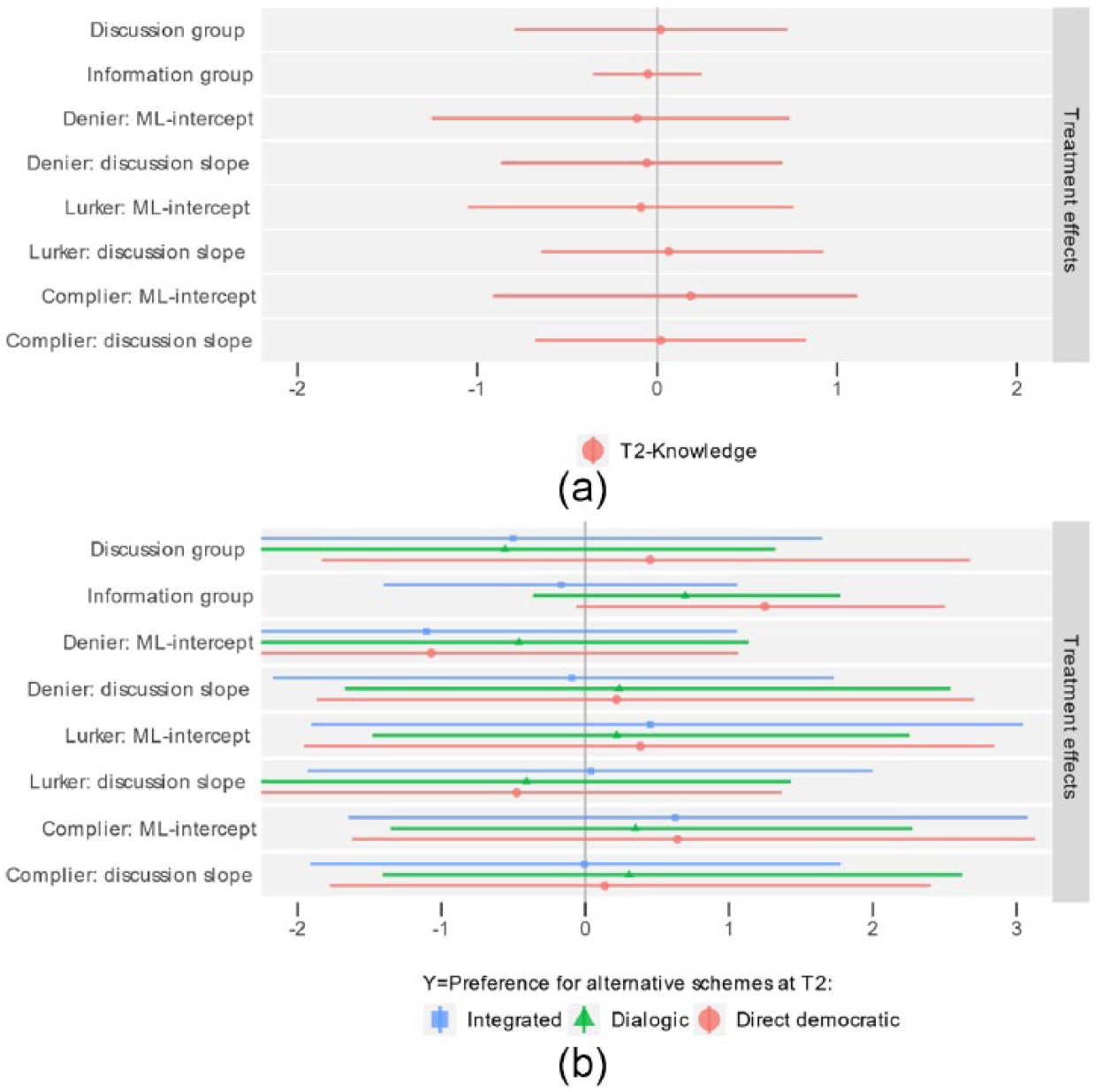
(a) Limited Knowledge-Model and (b) Limited Preference Model.
Following Smith et al. (2013), we have probed whether differences show up when we distinguish between ‘activists’, ‘lurkers’ and ‘deniers’ in the deliberation group. As mentioned before, and as Figure 1 displays, no such effects occur both for knowledge and support for the four governance schemes. 5 In sum, our deliberative treatment did not work as expected: it neither made participants more informed nor lead to different democratic preferences compared with the information and control condition.
Before we turn to Hypothesis 3 (consistency) – which will help us better understand these (non-)results – let us first explore what citizens want from democracy when they have deliberated, got informed or thought twice about it. We start with some descriptive findings. Figure 2 shows that a majority of participants prefer an integrated governance model for both issues, for all treatment groups at T2. The representative model turns in second, followed by the dialogical model; the direct-democratic model is the least preferred. Although there are no discernible differences between the treatments, participants’ democratic preferences were not fully stable between T1 and T2: about 35% of participants preferred a different governance model at T2. However, we cannot identify a systematic pattern for the preference shifts (see Supplemental Appendix A6).
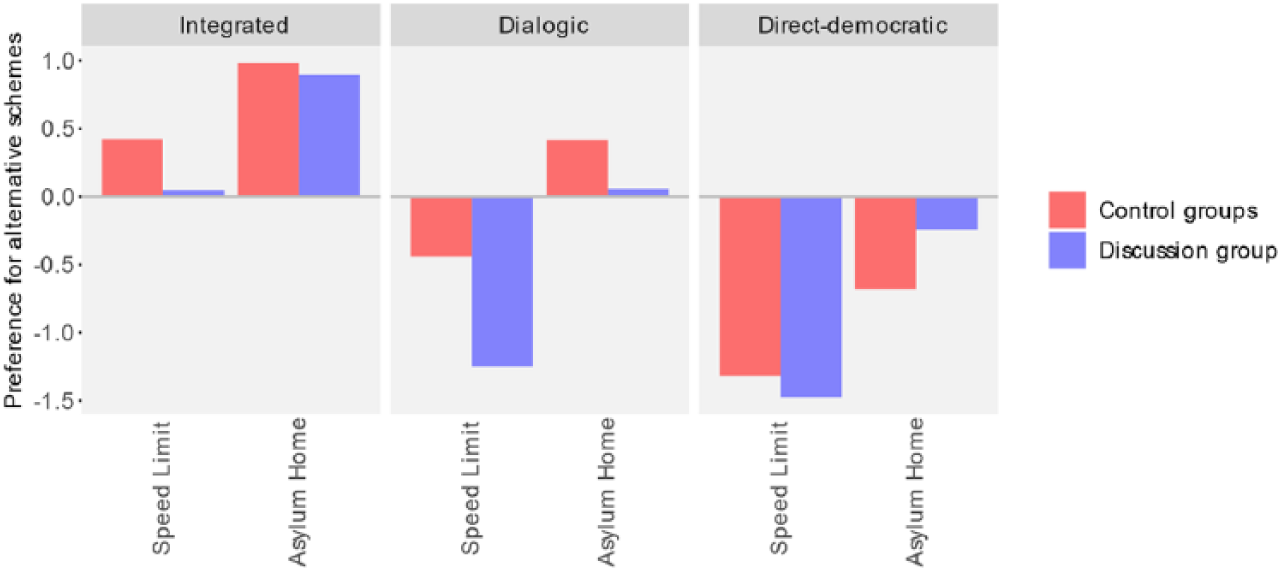
Preferences at T2.
The question now is what preferences for governance models citizens have at T2, after being exposed to the various treatments. We find, first of all, that the type of policy issue matters (see Figure 3). Participants have stronger preferences for the integrated, participatory and dialogue model in the context of the more salient asylum home issue. Conversely, for the less salient speed limit issue, participants have a stronger preference for representative democracy (even though, as shown in Figure 2, a majority of respondents prefer the integrated model). Outcome favourability, in turn, only plays a slight role: those participants whose substantive preferences in opposition with the choices presented in the decision scenarios preferred the direct-democratic model (but not the integrated or the dialogical model).
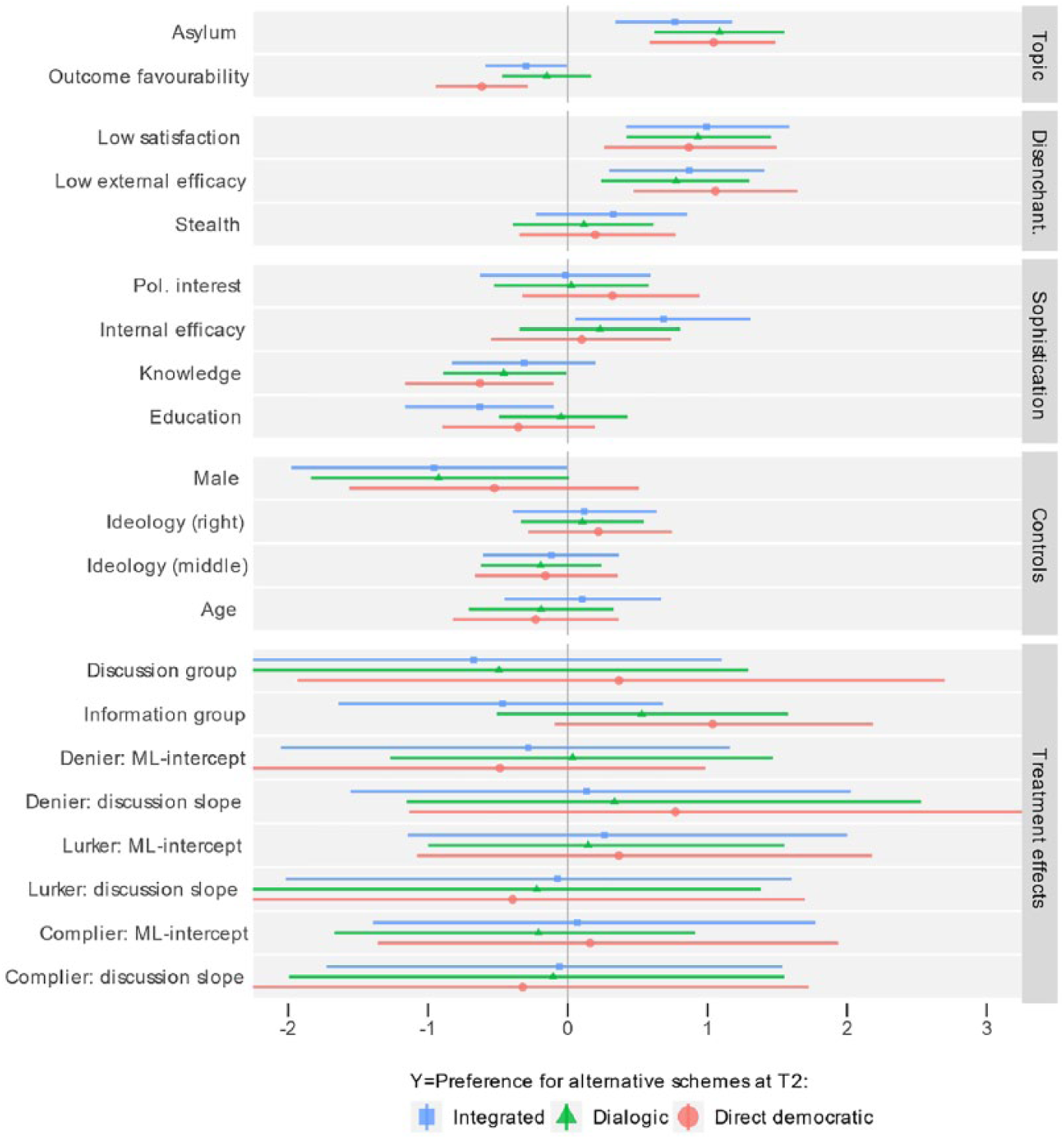
Full Preference Model.
Second, disenchantment with the current functioning of democracy strongly matters for the support of governance models. Corroborating the ‘political dissatisfaction hypothesis’ (Dalton et al., 2001), participants with low external efficacy and low satisfaction with democracy prefer any alternative to the ‘status quo’, that is, representative model. Intriguingly, there are no discernible differences in support for the dialogic, direct-democratic or integrative scheme, a point to which we return below. The effect of Stealth attitudes, in turn, is less clear. While the effects are not significant at the 95% credible interval, they still tend to contradict the original Stealth thesis claiming that Stealth citizens do not want to get more directly involved in politics (Hibbing and Theiss-Morse, 2002). Moreover, our finding does not provide support for Webb (2013) either, who found that Stealth people have distinct preferences for direct democracy. Similar to disenchanted citizens, Stealth people just seem to want ‘something else’ than representative democracy. This finding may be less surprising when we take a more in-depth look at the Stealth items. High stealth attitudes in our sample are a product of support for the items ‘Elected officials would help the country more if they stopped talking and just took action on important problems’ (60%) and ‘What people call compromise in politics is really just selling out one’s principles’ (about 45%). Only a few participants supported the items ‘Our government would run better if decisions were left up to successful business people’ (5%) and ‘Our government would run better if decisions were left up to non-elected, independent experts rather than politicians or the people’ (about 25%). A principal component analysis shows that the first two Stealth items and political dissatisfaction load on a common factor (analysis upon request). Hence, stealth attitudes seem to represent an aspect of political disenchantment (Font et al., 2015: 155ff.) and do not represent distinctive types of citizens (as in the UK; see Webb, 2013).
Third, our findings provide mixed results for sophistication. Higher levels of knowledge lead to less support for two participatory schemes (direct-democratic and dialogical ones); internal efficacy leads to more support for the (demanding) integrated model, while higher levels of education are associated with less support for the integrated model. Furthermore, as mentioned in the theoretical part, it might be possible that the dissatisfaction and the sophistication thesis complement each other and that different types of disenchanted citizens may have distinct preferences for specific governance models. The latter point is suggested by Webb’s (2013) analysis in the UK showing, for instance, that dissatisfied but politically interested and efficacious citizens favour deliberative democracy (Webb, 2013). To test for such effects, we have run interaction models for external efficacy and satisfaction with political interest, internal efficacy and knowledge and education, exploring whether dissatisfaction and sophistication lead to an even stronger preference for participatory schemes and/or for the choice of distinct governance models. Yet, interactions are mostly insignificant or ‘patchy’ with no robust pattern for distinct governance models emerging (see Supplemental Appendix A8). Hence, we conclude that the connection between disenchantment and support for participatory models document a sort of a ‘populist’ impulse: if one is dissatisfied with how politics currently work (which in the German context includes ‘Stealth citizens’ as well), one simply wants a stronger voice of the ‘people’, irrespective of the concrete design of the participatory schemes. 6
Fourth, contrary to Bengtsson and Mattila (2009) as well as Christensen and von Schoultz (2017), the procedural preferences of our participants do not have a partisan dimension: there are no discernible differences with regard to governance models between participants on the left and the right of the political spectrum. Finally, gender matters: men have lower support for participatory governance schemes than women.
With some important nuances – namely the ‘populist impulse’ for participatory models – our research largely corroborates the substantive findings of previous survey research (e.g. Bengtsson and Mattila, 2009; Goldberg and Bächtiger, 2019): issue salience and political disenchantment drive preferences for participatory governance models. But what do these findings mean in the context of deliberation or ‘thinking twice’? Remember that deliberation in itself did not lead to more informed preferences and ‘thinking twice’ led to almost identical support for the various governance models (also among ‘activists’, i.e. those who complied with the deliberative treatment). Yet, as mentioned in the theoretical section, deliberation may work in more complex ways than assumed by traditional deliberative research: it may not lead to different democratic preferences but may help participants to align their general democratic preferences with available governance models (Hypothesis 3). We now explore whether the deliberative treatment enhanced consistency patterns between general democratic values and support for the various governance models.
‘Consistency’ Between Democratic Values and Support for Governance Models
Regarding basic democratic preferences, we have asked participants how much they value dialogue among all-affected interests, direct participation, efficiency and speedy decisions and decisions delegated to representatives. The idea behind the various value questions is, on the one hand, that they align with specific governance models; for instance, if a person values direct participation in politics, then this person should also support direct-democratic governance schemes. On the other hand, the various values also involve some trade-offs: the more you value dialogue between all affected and direct participation, the less you should value efficiency (speedy decisions) and delegated decision-making. By running principal component analyses, we can check whether participants are aware of such trade-offs.
Our empirical analysis reveals some intriguing trends. First, the principal component analysis (Table 3) shows that already at T1, we obtain a factor ‘citizen involvement’, which contains both dialogue and direct participation. Moreover, as the negative and high loading on the item ‘representation’ indicates, participants view ‘citizen involvement’ in opposition to the status quo in Germany, namely representative democracy. In a way, this corroborates our previous finding of a sort of a ‘populist’ impulse when it comes to support for more participatory schemes. We also obtain, but to a lesser degree, a factor ‘efficient and delegated decision-making’, whereby the efficiency component trumps the delegation component. Indeed, efficiency (in the sense of speedy decision-making) and delegation to representatives may not fully go hand-in-hand, since policy negotiations in representative politics might require time (indeed, populist notions of policy-making claim that politicians should take action rather than talk). Nonetheless, the existence of the two factors indicates that there is some awareness among participants of the trade-off between efficiency and delegation and dialogical and direct involvement of citizens. Second, as Figure 4 documents, there is also strong consistency between our two ‘latent’ democratic values (direct and dialogic involvement and efficient delegation) and support for the four governance schemes both at T1 and T2: those who value direct and dialogic involvement prefer direct democracy, the integrated model and citizen dialogue to representative democracy. Notice that the direct-democratic scheme is more preferred than the citizen dialogue scheme. One reason for this can be found in the principal component analysis, where the item ‘direct participation’ yields higher factor loadings than the item ‘dialogue among all affected interests’. Overall, the fact that participants already had high consistency levels at T1 might help us better understand why the deliberative treatment in our experiment neither had an effect on informed preferences nor on differential support for the various government schemes. Participants’ preferences were already well-structured before they were exposed to the deliberation and information treatment, and this may have attenuated the deliberation and information effect. By the same token, this finding challenges our initial assumption that citizens in general (and regardless of political sophistication) have ill-formed attitudes about democratic process preferences. Of course, our sample is biased in terms of political interest and education. But intriguingly, information and consistency levels were almost identical among participants with less political sophistication and lower education levels (Supplemental Appendix A9). As such, we may not fully tap into ‘non-attitudes’ when we study democratic preferences.
Consistency (Factors).
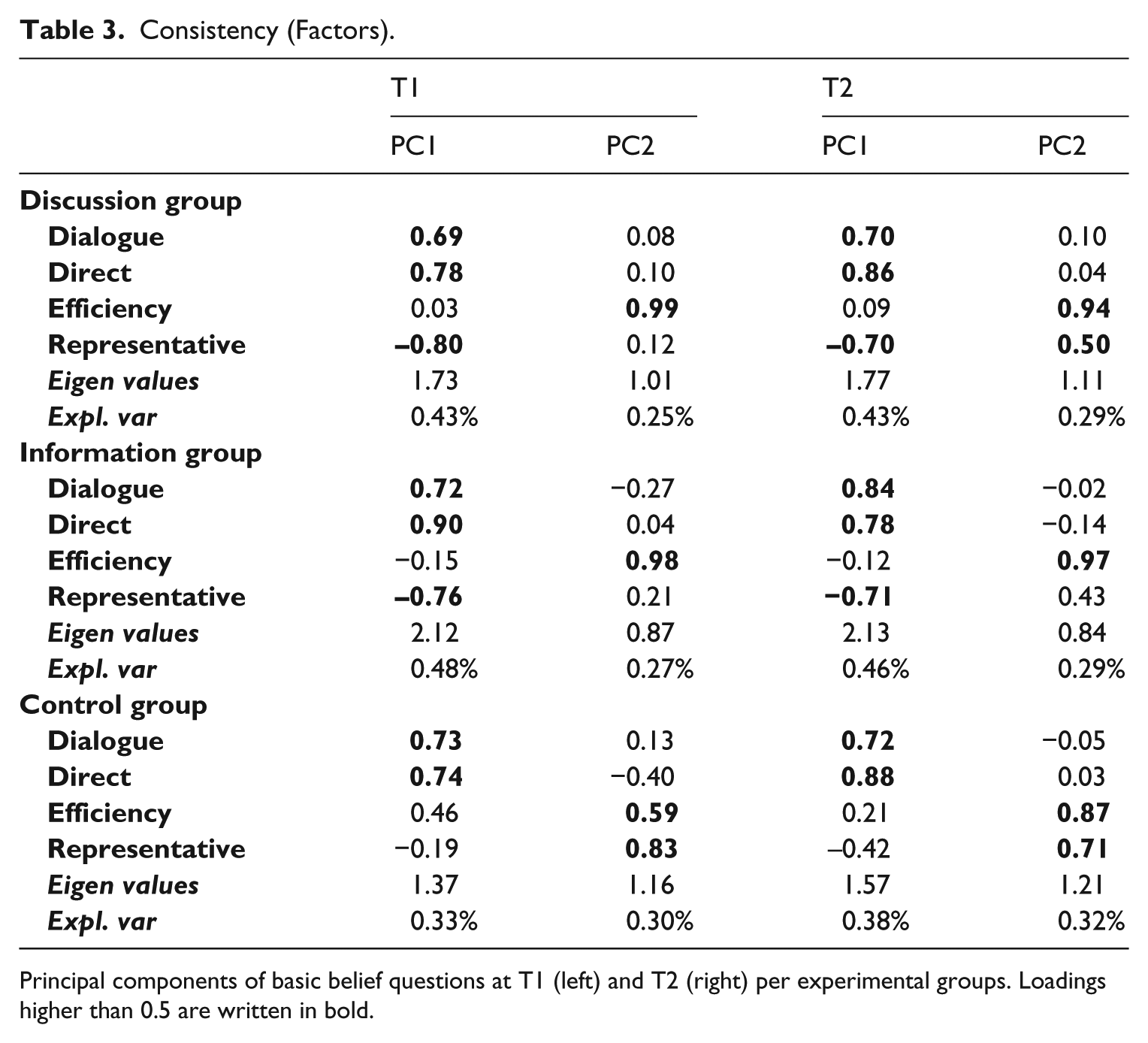
Principal components of basic belief questions at T1 (left) and T2 (right) per experimental groups. Loadings higher than 0.5 are written in bold.
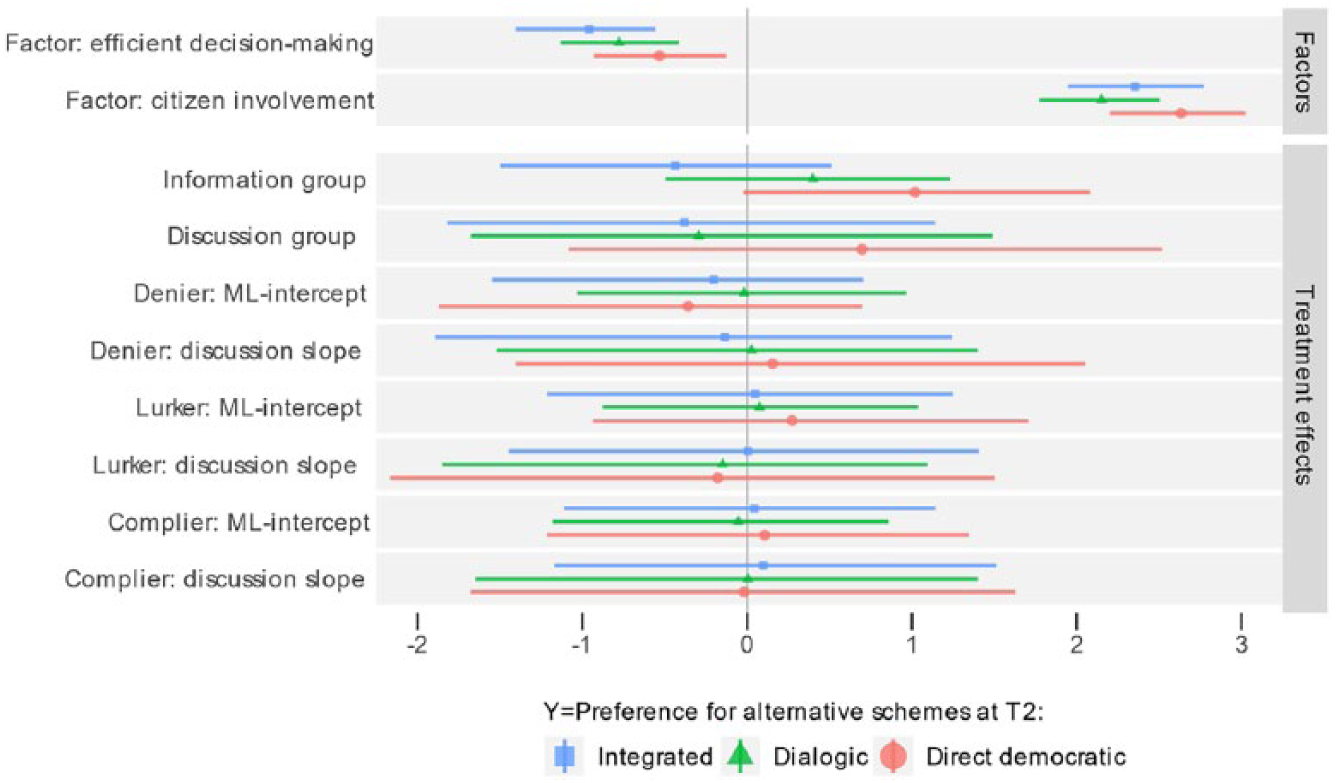
Consistency (Factor Model).
Conclusion
Based on an advanced methodological design – a deliberative experiment testing a counterfactual, namely which democratic preferences people would have if they had the possibility to deliberate, getting informed or at least ‘think twice’ – this article set out to shed new light on the various debates in the literature on democratic process preferences. Compared with previous studies where participants are only given a few seconds to think about and respond to this hugely complex topic, our design constitutes a major improvement: it not only encouraged participants to at least ‘think twice’ on the topic but also presented participants with juxtaposed governance schemes (rather than serially asked survey questions). The substantive results show, first of all, that after deliberating, getting informed or ‘thinking twice’ preferences of German citizens on democratic governance models are mainly driven by issue salience and disenchantment with the actual shape of representative democracy. On the one hand, when an issue is perceived as salient, then our participants wanted more involvement in politics. On the other hand, citizens with low external efficacy and low satisfaction with democracy just want something else – or something more – from democracy, namely more involvement of any type (dialogical, direct-democratic or integrative). Political sophistication, in turn, does not have a coherent effect on the support for democratic procedures. Furthermore, and contrary to previous studies, we do not find that dissatisfaction and support for specific participatory models is tied to distinct strata of citizens, such as dissatisfied but politically interested and efficacious citizens favouring deliberative democracy or Stealth citizens favouring direct democracy (Webb, 2013). Rather our results are indicative of a sort of a ‘populist’ impulse where disenchantment with the shape of current politics conduces to calls for a stronger voice of the ‘people’ and participatory governance models, irrespective of their concrete design. This result is even more remarkable given the fact that our participants had the possibility to deliberate, getting informed or at least ‘think twice’ about their preferences for democratic governance models.
A central finding of our study is, however, that deliberation in itself does not lead to more informed or different preferences for governance models than the information treatment or just ‘thinking twice’ about different governance models. Nor do we find a higher consistency between general democratic values and support for the various governance models in the deliberative treatment. We have carefully distinguished between ‘activists’, ‘lurkers’ and ‘deniers’, but contrary to Smith et al. (2013) we do not find any effect of the deliberative treatment. Several reasons may be listed for this non-result. First, deliberative theory does not presuppose specific directional opinion shifts. None of the democratic governance models is epistemically ‘superior’, and all models have their distinctive pros and cons. Second, one can add that asynchronous and online discussion may not produce the same effects than synchronic and face-to-face discussion. Third, part of the non-effect of deliberation might also be due to sample bias: those who were willing to participate in our deliberative experiment were better educated and much more interested in politics than participants in the overall survey. This may have been conducive to higher knowledge levels and more consistent preferences in all treatment groups already before the experiment (as documented by the consistency analysis). Intriguingly, however, we do not find any differences between more and less sophisticated participants in our experiment. In sum, our findings challenge our initial assumption that preferences about abstract and complex topics (such as democratic governance models) are generally ill-formed (including more sophisticated citizens). And our study also reminds deliberation scholars that without proper control groups, they may overestimate deliberation’s effects: as in our experiment, sometimes merely ‘thinking twice’ already does the job.
While our deliberative experiment represents an important methodological improvement compared with pure survey studies on democratic preferences, there is much work left to for the future study of this topic. First, future research will need to take the strategic aspect of democratic preferences more seriously. An experiment on preferences for direct democracy in Belgium shows that citizens may have strategic considerations when choosing democratic innovations; their hope is that their substantive policy preferences may win a majority in the context of such alternative procedures (Werner, 2017). Second, as Landwehr and Steiner (2017) report, personality traits affect the choice of governance models as well. Personality traits should be routinely built into surveys and explored in the context of advanced methodological designs. Third, we also need cross-national research on the topic of democratic process preferences. It is not only situation-specific issue contexts that shape citizens’ process preferences, the latter might also be affected by the overarching institutional and cultural context. For instance, while a majority of German citizens seem to prefer what is called ‘hybrid democracy’ (Bertelsmann Foundation, 2014), it is fairly possible that Swiss citizens with a long-standing experience with direct democracy have radically different views on how desirable democratic procedures should look like. These deficits notwithstanding, we think that our study represents a first step towards a deeper understanding of citizen process preferences.
Supplemental Material
PSX843967_Supplemental_material – Supplemental material for Deliberating or Thinking (Twice) About Democratic Preferences: What German Citizens Want From Democracy
Supplemental material, PSX843967_Supplemental_material for Deliberating or Thinking (Twice) About Democratic Preferences: What German Citizens Want From Democracy by Saskia Goldberg, Dominik Wyss and André Bächtiger in Political Studies
Footnotes
Acknowledgements
We would like to thank two anonymous reviewers for their cogent and very helpful comments. We also thank Asa von Schoultz, Hannah Werner, Achim Hildebrandt, Jonathan Kuyper and Simon Niemeyer for reading previous versions of this paper and for their useful suggestions. We would also like to thank all participants from the 2nd and 3rd Deliberative Democracy Summerschools in Canberra (2017) and Turku (2018) for their constructive discussions and contributions. Finally we thank NCCR Democracy.
Funding
The author(s) disclosed receipt of the following financial support for the research, authorship, and/or publication of this article: Research for this paper was funded by the Swiss National Science Foundation in the framework of the National Centre of Competence in Research on Democracy based at the University of Zurich.
Supplemental material
Supplemental material for this article is available online.
Notes

Author Biographies
References
Supplementary Material
Please find the following supplemental material available below.
For Open Access articles published under a Creative Commons License, all supplemental material carries the same license as the article it is associated with.
For non-Open Access articles published, all supplemental material carries a non-exclusive license, and permission requests for re-use of supplemental material or any part of supplemental material shall be sent directly to the copyright owner as specified in the copyright notice associated with the article.
