



Abstract
The Democracy in Europe Movement 2025 (DiEM25), launched by former Greek Finance Minister Yanis Varoufakis, seeks to construct a transnational left political project to ‘democratise Europe’. Its construction of a European ‘people’ against an international elite raises questions about the potentials of populism beyond the nation-state. Building on a discourse-theoretical distinction between populism and nationalism, the article asks whether DiEM25 is a truly transnational populist movement. Through an analysis of the movement’s manifestoes, speeches, press releases and published interviews with DiEM25 leaders, the article shows how DiEM25 constructs a ‘European people’ in opposition to an international ‘elite’, how DiEM25 oscillates between speaking for national ‘peoples’ and a transnational ‘people’, and how it negotiates its populism, nationalism and transnationalism. The article contributes to the theorisation of populism beyond the usually assumed nation-state level and shines a light on the potentials and limitations of transnational populism as an as-yet understudied political development.
Introduction
On 9 February 2016, former Greek Finance Minister Yanis Varoufakis assembled an Avengers-like team of luminaries of the European left – including Mayor of Barcelona Ada Colau, British Green MP Caroline Lucas, philosopher Slavoj Žižek, and musician Brian Eno – in Berlin’s Volksbühne (Theatre of the People) to launch the Democracy in Europe Movement 2025 (DiEM25). DiEM25’s mission was not a modest one: indeed, it aimed to ‘shake Europe – gently, compassionately, but firmly’ (Varoufakis, 2016e) by bringing about its democratisation and convening a constitutional assembly for Europe by 2025. Otherwise, Varoufakis claimed, the whole European project could disintegrate. In claiming to speak for ‘we, the people of Europe’ against ‘unaccountable “technocrats,” complicit politicians and shadowy institutions’ (DiEM25, 2016a: 6), and making this antagonistic divide between ‘the people’ and ‘the elite’ core to its discourse, DiEM25 set itself up as a populist movement. 1 Most importantly, DiEM25 is an explicitly transnational project, as ‘the people’ it purports to speak for are not nationally-bound, but rather ‘the people of Europe’. In the European context, such a move is novel: while populism on the continent is usually associated with ethnic nativism (on the right), national sovereignty (on the right, but increasingly also on the left (Kallis, 2018) and at the very least with nationally-bound ‘people’, here was a case of populism that – in a political conjuncture characterised by a return to the nation rather than increasing supranational cooperation – explicitly sought to throw off the shackles of the nation-state in its construction of ‘the people’.
The explicitly transnational dimension of DiEM25 almost immediately led to concerns from voices on the left that the national level was being abandoned. George Souvlis and Samuele Mazzolini (2016) worried that: DiEM has put all its bets on the European dimension, entirely bypassing the national one […] Is it really necessary to delete the state from the map as a locus of progressive democratic reforms and to consider it as outdated and old-fashioned obsession? We do not think so!
John Malamatinas (2016) argued that ‘[m]ovements are not made from the top’ and concluded that ‘[t]he initiative to create a Pan-European movement to change existing conditions is correct, but existing structures should also be associated with this’. Varoufakis (2016g) shook off such criticisms by arguing that ‘[o]ur view on the Europe-Nation juxtaposition is a dialectical one’ and that ‘prioritising the nation-state and calling for a retreat from Europe into its bosom is, indeed, a retrograde step’. Drawing on DiEM25’s Manifesto, he noted that change must come primarily from the transnational level: ‘European democrats must come together first, forge a common agenda, and then find ways of connecting it with local communities and at the regional and national level’ (DiEM25, 2016a: 5).
These discussions about the ‘proper’ place of the national and transnational levels are not new for the left. What is new, however, and worthy of analysis is how these national/transnational tensions operate in the case of populism. This article thus seeks to examine the case of DiEM25 and ask: can it truly be considered a transnational populist movement, or does it remain tethered to the national level? Combining a discourse-theoretical conceptual framework with qualitative content analysis, it examines the manifestoes, speeches, press releases and published interviews with DiEM25 leaders (especially Varoufakis himself, who has been and remains by far the most prominent figure of the movement – a fact that has attracted a fair degree of criticism) to track:
Its speaking in the name of national ‘peoples’ and/or a singular European ‘people’;
The subject position/s it offers for identification for potential followers;
Its construction of ‘the elite’ as an enemy;
How exactly these constitutive aspects of its discourse are orientated – around the in/out axis of national membership, and/or around the down/up axis of the populist distinction between ‘the people’ and ‘the elite’.
The first section of the article lays out the conceptual distinctions between populism and nationalism. Arguing that they constitute conceptually distinct discursive repertoires, it shows that although populism and nationalism are often articulated together in empirical claims to represent ‘the people’, they are not one and the same, and indeed, do not need to occur together. It offers a set of formal criteria to distinguish these phenomena from one another (at the conceptual level), based on different nodal points, subject positions, constitutive outsides, and spatial orientations of relation between these aspects. The second section builds on this distinction to discuss transnational populism, a form of populism that purports to move beyond national boundaries and that can potentially be viewed as the ideal that DiEM25 is working towards. The third section outlines our methods and materials, while the fourth section offers our analysis of the data. The conclusion reflects on what can be learned from DiEM25 for transnational populist cooperation more broadly.
Populism and Nationalism: Conceptual Distinctions
Our enquiry into the possibility of a transnational populism must start from a clear conceptual distinction between populism and nationalism. This is a condition for allowing us to identify the populist, national(ist) and transnational dimensions of DiEM25’s politics and for studying how they might strengthen its project and appeal or, alternatively, create tensions with one another.
It is understandable why conceptualisations of populism have often included references to nationalism and the nation-state, or have simply assumed it to operate on a national level. Many of the most prominent cases of populism – from Perón and Chávez to Le Pen and Trump – have also been nationalist. Indeed, the populist claim to represent the ordinary people is often combined with demands for national sovereignty and resistance against supranational interference from bodies and forces like American imperialism, the European Union or the United Nations. On the radical right, this has also been combined with a nativist rejection of ethnic-cultural diversity. Moreover, because populist actors usually operate on a national level, their populist appeal to ‘the people’ (like democratic appeals to ‘the people’ in general) tends to be an appeal to a ‘people’ defined at the level of the nation-state – even in populist politics that are not nationalist in any strict sense. More so, nationalism and populism both revolve around the claims made in the name of ‘the people’, with the same signifier often being used to refer to both the national(ist) ‘people’ and the populist ‘people’ in many languages (e.g. ‘das Volk’, ‘the people’, ‘folket’).
This has led to much slippage between the concepts of populism and nationalism and, as we will discuss below, to very little reflection about populism beyond the nation-state. For one, much of the earlier literature on populism treated exclusionary nationalism as an integral part of populist politics. This has especially been the case in Europe, where populism has long been conceptualised on the basis of experiences with the populist radical right, leading to arguments that populism is inherently exclusionary or that it speaks in the name of an ethnic-culturally defined nation (e.g. Akkerman, 2003; Jagers and Walgrave, 2007; Taguieff, 1997: 15). Significant advances in the literature – particularly building on the discourse-theoretical work of Ernesto Laclau (2005a, 2005b) and the ‘thin ideology’ approach to populism associated most prominently with Cas Mudde (2004; Mudde and Rovira Kaltwasser, 2017) – have resulted in more precise definitions that avoid the inclusion of elements of nationalism in the conceptualisation of populism and that highlight the specificity of populism more clearly. Nevertheless, the term populism continues to be used to refer to what are in fact nationalist, nativist, or radical right political stances (e.g. Aalberg et al., 2016; Inglehart and Norris, 2017).
There are several problems with these conceptual overlaps. For one, references to the exclusion of a nationally defined ‘other’ as part and parcel of populism reduce the notion of populism exclusively to its exclusionary right-wing form and render the concept incapable of covering the often more inclusionary left-wing variants of populism (see Mudde and Rovira Kaltwasser, 2012). There are normative issues with such associations of populism with exclusionary nationalism as well, as they tend to delegitimise left-wing populism as a threat to democracy through its association with radical right-wing populisms (see Stavrakakis et al., 2017).
Another problem is that references to what are in fact elements of (exclusionary) nationalism in definitions of populism stand in the way of grasping the specificity of what actually makes populist politics populist. Even if, hypothetically, all forms of populism were explicitly (rather than only banally) nationalist, there are significant analytical advantages to a clear conceptual distinction between populism and nationalism, as this allows an analysis of how the populist and nationalist dimensions of such politics interact. Finally, there is a need to move away from the methodological nationalism that exclusively locates the notion of populism on a national level because of the dominance of the nation-state as the location of democratic politics.
Populism, Nationalism and the Construction of ‘The People’
Our main task here is to thus free the concept of populism from its reductionist association with nationalism and with the nation-state in order to make it suitable for an exploration of transnational populism.
To distinguish populism from nationalism, and to study the intricate connections between the two, we build on the discourse theory originally formulated by Laclau and Mouffe (1985) and further developed by these authors and others (e.g. Glynos and Howarth, 2007; Howarth and Stavrakakis, 2000). A discourse-theoretical approach to populism and nationalism shifts attention away from ‘mainly sociological categories, which address the group, its constitutive roles and its functional determinants, to the underlying logics that make these categories possible’ (Laclau, 2000: xi). That is, rather than seeing nationalist and populist politics as representing pre-existing socio-political categories, discourse theory allows us to ask how such discourses construct the categories they claim to represent – in our case, ‘the nation’ and ‘the people’.
A number of questions can guide us in this task. First of all, as meaning comes about relationally, we need to ask which signifiers appear in populist and nationalist discourse respectively and what respective role they play in the two discourses. The concept of nodal points is introduced here to indicate the ‘privileged discursive points that partially fix meaning within signifying chains’ (Torfing, 1999: 98). Other signifiers within a discourse acquire their meaning through their relation to these nodal point(s) (Laclau and Mouffe, 1985: 112). For example, in liberalism the signifier ‘freedom’ or ‘liberty’ plays such a central role. Other signifiers, such as ‘state’, ‘individual’, and ‘society’, acquire meaning in relation to the nodal point ‘freedom’.
Second, we need to look not only at which elements are combined in populism and nationalism but also at how these elements are combined. Discourse theory draws attention to political architectonics – that is, to how signifiers are related to each other to produce particular structures of meaning. These relational structures of meaning can be captured using spatial metaphors (see Dyrberg, 2003) – the most obvious in political discourse being left/right, but others include up/down, in/out, forward/backward, front/back, centre/periphery and open/closed (see Bacot and Rémi-Giraud, 2007; Dyrberg, 2003; Lakoff and Johnson, 1980; Laponce, 1981).
Third, we need to look at the subject positions offered by populist and nationalist discourse to their addressees. Laclau and Mouffe build on Althusser and Foucault to theorise how discourses offer citizens particular subject positions with which to identify and how this process of interpellation/identification constructs individuals as subjects of discourse (Howarth and Stavrakakis, 2000: 12–13).
Fourth, as the construction of political identities and the affective investment in such identities relies on so-called ‘constitutive outsides’ – identities that are external and different to the political identity in question – we need to ask what these constitutive outsides are in populism and nationalism respectively and how the distinction between the constructed identity and its outsides can be grasped spatially.
Table 1 provides an overview of our answers to these questions, resulting in a more formal, socially constructionist and, we hope, clearer distinction between nationalism and populism. The distinctions are explained in more detail below.
Discourse-Theoretical Conceptualisation of Nationalism and Populism.
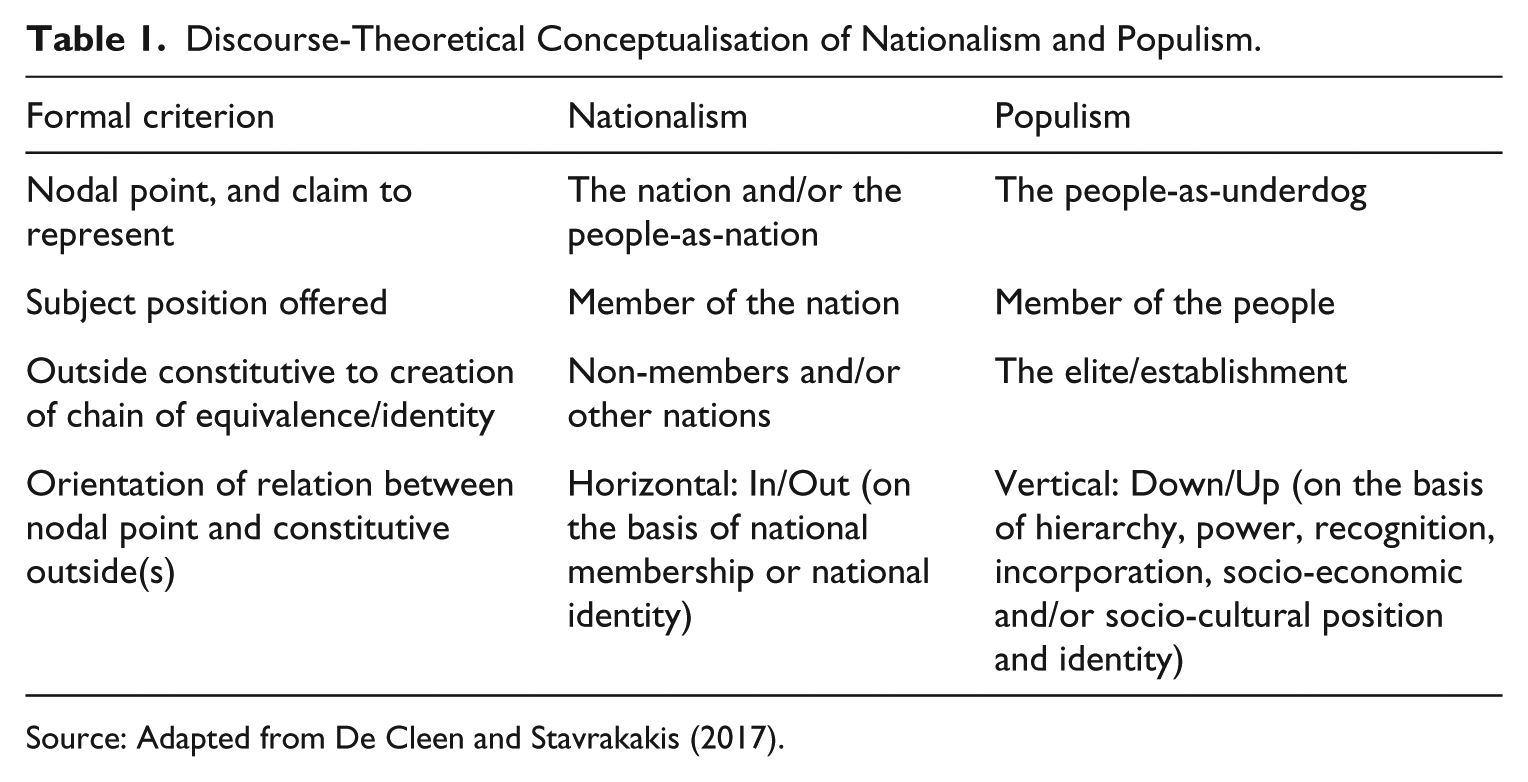
Source: Adapted from De Cleen and Stavrakakis (2017).
Crucial to our argument is that nationalism and populism are conceptualised as discourses on a level of abstraction above that of movements, parties or leaders that are commonly labelled as ‘populist’ or ‘nationalist’. We attempt to identify their basic discursive structure, the structure that makes them nationalist and populist respectively, and keep out all other dimensions. In doing this, we are not claiming that concrete nationalist actors operate only according to nationalist logics and that populist actors operate exclusively along populist logics. On the contrary, our argument is based on the assumption that each political project brings together different strands of discourse – populist, nationalist and others. We believe that a clear distinction between populism and nationalism on the conceptual level is a precondition for a thorough analysis of the intricate connections between populist and nationalist dimensions of different kinds of politics.
Nationalism
Curiously, it is in not in the literature on nationalism that we find the most theoretical confusion between populism and nationalism, but almost exclusively in the literature on populism. One reason for this is that populist politics operate in what Michael Billig (1995) has called ‘a world of nations’ and not the other way around. Theories of nationalism also have a far longer history than theories of populism. Moreover, despite not being a fully-fledged ideology, nationalism is far less ‘thin’ than populism, offering a rather more developed worldview (Freeden, 1998, 2017). We therefore start by defining nationalism and then move on to defining populism in a way that distinguishes it clearly from nationalism. We propose the following discourse-theoretical definition of nationalism: Nationalism is a discourse structured around the nodal point ‘nation’, envisaged as a limited and sovereign community that exists through time and is tied to a certain space, and that is constructed through a primarily in/out opposition between the nation and its outgroups (De Cleen and Stavrakakis, 2017, 2019; see also Sutherland, 2005).
‘Nation’ is the nodal point around which nationalist discourse is typically structured (see Sutherland, 2005: 186) and in relation to which other signifiers such as state, land, freedom, democracy, people and culture acquire meaning (see Freeden, 1998: 755). This does not mean that nationalists exclusively use the word ‘nation’, of course, but that at the core of all nationalist discourses there lies a particular collective identity constructed in a particular nationalist way.
Nationalism divides the human species in different, (more or less) exclusive groups (Balibar, 1989: 9–10). It is helpful to think about the structure of nationalist discourse in spatial terms in order to distinguish it from populism (Dyrberg, 2003). Nationalist discourse is structured around an in/out relation, with the ‘in’ consisting of the members of the nation and the ‘out’ comprising different types of non-members.
As this in/out construction of group identity is not exclusive to nationalism (in a broader sense, most identity construction depends on in/out dynamics), we need to identify the particular manner in which nationalism constructs ‘in’ and ‘out’ (see Day and Thompson, 2004: 102–103). Benedict Anderson’s ([1983] 2006) idea of the nation as an ‘imagined community’ is helpful here. First, Anderson notes that the nation is constructed as limited: nationalism is first and foremost a representation of the world as made up of distinct nations. Indeed, however open and inclusionary nationalism might become in some cases, the distinction between one nation and other nations, and between members of the nation and non-members remains primary, for without a constitutive outside – for example, between Americans and non-Americans – there can be no national identity. Second, the nation is constructed as a community that all members of the nation are organically part of. Third, the nation is constructed as sovereign: it has the right to take decisions independently and without interference. Shared time (a shared past, present and future) and space (a shared territory with borders and distinct characteristics) – as well as the shared language, customs, etc. that follow from this – serve to differentiate ingroup from outgroup, to obscure the (historical) contingency of the nation, as well as to provide legitimacy for the nation’s sovereignty over a territory (Freeden, 1998: 752; Wodak et al., 2009: 26).
The fact that the basic structure of nationalist discourse consists of the horizontal in/out distinction between members and non-members of the nation of course does not imply that there are no vertical dimensions to nationalist politics. Indeed, many nationalisms have also been characterised by discourses of (cultural, economic, political, racial, …) superiority of one’s own nation over other nations, or of a national majority over national minorities. However, such up/down hierarchies are not a necessary element of nationalism, as more ‘open’ and ‘inclusive’ forms of nationalism indicate. Moreover, such up/down hierarchies between nations always depend on a basic in/out distinction between different nations linked to shared history and territory.
Populism
While populism also revolves around the sovereignty of ‘the people’, its discursive structure is clearly different than that of nationalism. We propose to define populism as: a dichotomic discourse in which ‘the people’ are juxtaposed to ‘the elite’ primarily along the lines of a down/up antagonism in which ‘the people’ is discursively constructed as a large powerless group through opposition to ‘the elite’ conceived as a small and illegitimately powerful group. Populist politics thus claim to represent ‘the people’ against an ‘elite’ that frustrates their legitimate demands, and presents its demands as expressions of the will of ‘the people’ (From Stavrakakis and De Cleen, 2017; for similar definitions see Laclau, 2005a, 2005b; Stavrakakis and Katsambekis, 2014).
This definition shows that ‘the people’ serves as the nodal point of populism, and that ‘the people’ is characterised by its antagonistic relationship to ‘the elite’. Populists mobilise and simultaneously stimulate or reinforce dissatisfaction with ‘the elite’ for its – real and/or perceived – frustration or endangerment of a number of popular demands, interests or identities (see De Cleen and Stavrakakis, 2017: 11; Moffitt, 2016; Stanley, 2008: 98). In doing so, they can attract different groups with distinct interests, bringing together heterogeneous demands and identities in what Laclau and Mouffe (1985) call a ‘chain of equivalence’ that is symbolised by the signifier ‘the people’. What brings different demands and identities together in this populist articulatory chain – what makes them ‘equivalent’ – is the fact and/or impression that they are all frustrated and endangered by the same ‘elite’ (see Laclau, 2005a, 2005b; Stavrakakis and Katsambekis, 2014).
In spatial-orientational terms, then, populism is structured around a vertical, down/up axis that refers to power, status, and hierarchical socio-cultural and/or socio-economic positioning (Dyrberg, 2003; Laclau, 1977; Ostiguy, 2017). Populists claim to speak for ‘the people’, ‘the ordinary people’, ‘the little man’, ‘the common man’, ‘the man in the street’ as a down-group or underdog. And they reject ‘the elite’, ‘the establishment’, ‘the political caste’, ‘the ruling class’ as an up-group for not representing ‘the people’ and for endangering its interests.
This down/up structure differentiates populism from other discourses that revolve around ‘the people’, including nationalism (the people-as-nation) but also democracy (the people-as-demos). This spatial identification of populism’s structure also points towards the specificity of populism’s affective appeal. While they operate very closely together in particular political projects, the nationalist love for the nation and the nationalist animosity towards the non-national Other are very different from the populist identification as member of the people-as-underdog and the animosity towards ‘the elite’.
Transnational Populism
As can be seen, there are clear differences between nationalism and populism, with each of them drawing on distinct nodal points, subject positions and constitutive outsides, and the spatial orientations between these components being characterised by differing in/out or down/up spatial axes. Disambiguating the two allows us to move one step further for the purposes of our analysis of DiEM25 and ask the question: if populism is not automatically tied to nationalism, or indeed the national level, can we speak of transnational populism?
In order to see populism in a transnational light: all that needs to be done is to […] specify that ‘the people’ that populists appeal to and claim to speak for must go beyond the borders of the nation-state. That is, ‘the people’ under transnational populism must be spread over a number of different national contexts, or indeed may be spoken of at a level above the nation-state (Moffitt, 2017: 410).
In other words, whether populism is transnational or not hinges on the construction of ‘the people’. References to a transnational elite in themselves do not make populism transnational (as frequent nationalist-populist opposition to transnational elites on both the left and the right shows). Moreover, while ‘the elite’ targeted by transnational populists as their enemy is likely to be largely transnational, their conception of ‘the elite’ can also include nationally defined groups. As such, we can define transnational populism as: a dichotomic discourse in which ‘the
In developing the concept of transnational populism, a distinction can be made between populists who co-operate or co-ordinate on an international basis – what could be called ‘international populism’ – from more fully-fledged ‘transnational populism’ (De Cleen, 2017; Moffitt, 2017). The former refers to examples like the Europe of Freedom and Direct Democracy and the Europe of Nations and Freedom groups in the European Parliament or Latin American populist leaders’ coordination in regards to forming the Bank of the South – cases where populists relying on nation-based conceptions of ‘the people’ temporarily enter into alliances with other ‘national’ populists within an international setting. The aim here is not to construct a ‘people’ that supersedes the national settings – rather, these alliances between populists representing peoples in the plural are strategic and usually temporary. Transnational populism, on the other hand, seeks to move beyond this ‘marriage of convenience’ situation by attempting to transcend the particularities of separate national peoples and instead construct a ‘people’ that goes across national borders.
Empirical cases of transnational populism remain rare, and in many cases, partial. Potential examples include the Occupy and Indignados movements (Aslanidis, 2018; De Cleen, 2017) but also the claims on behalf of a transnational ‘people’ made by the likes of Hugo Chávez and Geert Wilders, along with the unsuccessful attempt to develop a European-wide 5 Star Movement (Moffitt, 2017). But DiEM25 is ‘perhaps [the] most clearly articulated case of transnational populism’ (Moffitt, 2017: 413) in the contemporary political landscape, given its explicit transnational mission. In the words of Varoufakis, it is ‘a cross-border pan-European movement’ that rather than building up from the nation-state level, instead ‘start[s] at the European level to try to find consensus and then mov[es] downwards’ (Varoufakis, 2016b: 33). Elsewhere, Varoufakis has noted that unlike some of the examples of what we have called ‘international populism’ above, DiEM25 is ‘not in the business of becoming a confederacy of existing nation-state parties’ (Varoufakis, 2016e). Yet as we shall see, even if DiEM25 likely represents the most fully realised transnational populist project yet attempted, it nonetheless ‘oscillate[s] between speaking for ‘the people’ and plural ‘the peoples’ of Europe, indicating some ambivalence about whether the nation-state level is to be superseded or not’ (Moffitt, 2017: 414). This also begs the question as to whether and to what extent populist discourse can be separated from nationalist discourse in empirical practice within our ‘world of nations’ (Billig, 1995).
Indeed, while Laclau noted that ‘[i]t is perfectly possible to constitute a “people” in such a way that many of the demands of a more global identity are “universal” in their content, and cut across a plurality of ethnic identities’ (Laclau, 2005: 198) – a populism above the national level, in other words – it appears that, in reality, the task is a difficult one. Although we ostensibly live in a globalised world shaped by international and transnational linkages and forces, our political imaginaries (and outlets for political representation) still tend to remain firmly rooted within the nation-state. As a result, ‘the people’ of populism is most often constructed and articulated within this setting – one that is taken-for-granted as the ‘natural’ space in which politics operates. When it comes to populism, then: while ‘the people’ constructed within national borders are obviously a construction, the artifice and hard work involved in this construction are less evident and visible than in transnational settings […] the transnational setting is far more diffuse, open and unfamiliar, thus making the constitutive process of speaking for ‘the people’ more difficult (Moffitt, 2017: 416).
DiEM25 offers a key case for analysing this difficult process.
Method and Material
With this in mind, the key research puzzle of this article is: Is DiEM25 a truly transnational populist movement or does it remain tethered to the national level? Building on the conceptual framework set out above, we can now operationalise our central question into more concrete research questions that will guide our analysis: What subject positions does DiEM25 offer for identification to its potential members and followers? What are the nodal points of its discourse? Does DiEM25 claim to speak for ‘peoples’ tied to nations, or for a transnational ‘people’ of Europe? Who or what stands as the constitutive outside of its discourse? And what is the orientation of the relation between its nodal points and constitutive outside(s) – is it a truly transnationally defined down/up populist relation, or do remnants of the nationalist in/out relation remain? And, if DiEM25 ends up somewhere in between, how do the populist, national(ist) and transnational dimensions relate to each other?
The analysis presented in this article combines the discourse-theoretical conceptual toolbox with the qualitative-interpretive coding procedures and qualitative-interpretive principles of qualitative content analysis (Coffey and Atkinson, 1996) and of constructivist grounded theory (Charmaz, 2003). This research strategy has been labelled discourse-theoretical analysis (Carpentier and De Cleen, 2007). Our analysis aims to combine theoretical rigour with analytical openness by integrating discourse theoretical concepts and our concepts of populism, nationalism and transnational populism as sensitising concepts – which point the qualitative researcher to relevant parts of and aspects of the material (Bowen, 2006; Charmaz, 2003) – in the process of gradually moving from descriptive open coding that stays close to the texts, over axial coding that identifies patterns in the texts under study, towards ever more interpretive, selective and theoretically inspired coding that allows us to answer the general research question.
Compared with other modes of discourse analysis, discourse-theoretical analyses are characterised by a more macro-approach to the study of discourse (Carpentier and De Cleen, 2007: 277). We study DiEM25’s language use because it allows us to identify the structure of its discourse and its discursive strategies. In so doing, we do take inspiration from the more micro-linguistic strategies of Critical Discourse Analysis (Fairclough, 2003; Reisigl and Wodak, 2001). We are open to all aspects of DiEM25’s use of language that are relevant to answering our questions. Next to arguments, we also need to study vocabulary – the way DiEM25 ‘‘word[s]’ or ‘lexicalise[s]’ the world in particular ways’ (Fairclough, 2003: 129). Because of our interests in the discursive construction of political identities, we pay particular attention here to DiEM25’s referential strategies: how it refers to particular people and groups of people (Reisigl and Wodak, 2001: 45–56). Vocabulary is not enough to identify a discourse’s specificity, however, because ‘discourses may use the same words […] but they may use them differently, and it is only through focusing upon semantic relations that one can identify these differences’ (Fairclough, 2003: 129). The question thus becomes how the relations between signifiers (e.g. ‘the people and ‘the elite’) are constructed in language. Specific points of attention in our analysis are how differential relations are constructed through contrastive relations (‘but’, ‘instead of’, ‘however’, etc.), how equivalence is constructed through additive and elaborative relations (e.g. by listing) (Fairclough, 2003: 88), and how relations between groups are constructed through spatial metaphors.
Our corpus covers DiEM25 press releases (44), material from its numerous campaigns (6), and its manifestoes (2), all of which were collected from its official website. We furthermore focus on speeches from five events that have been central to the building of DiEM25. We supplement these materials with a selection of extended interviews with Yanis Varoufakis (4) and a set of open letters (3) he has written explaining the decisions behind the movement. These materials cover the period from January 2016, a month before DiEM25’s launch, to September 2018. 2 As this overview shows, our corpus reflects the centrality of the figure of Varoufakis to DiEM25, Varoufakis being so prominent as to be almost to the exclusion to otherwise well-known figures associated with the movement.
Analysis
Our analysis proceeds in three main steps. We first discuss DiEM25’s explicitly transnational strategy and how this can be understood in the context of SYRIZA’s failure to oppose the austerity programme imposed by its supranational creditors. We then move on to an analysis of DiEM25’s populism, which constructs an opposition between ‘the people’ and an undemocratic transnational elite. Finally, we discuss the intricacies of DiEM25’s speaking in the name of ‘the people’. We show how DiEM25 constructs a transnational European people-as-underdog while also speaking in the name of different national European peoples, in the plural, and reflect on what this means for its transnational populist character.
From the Failure of National Populism to a Transnational Strategy
DiEM25 is very explicitly an attempt to form a transnational, European-wide movement aimed at democratising the European Union. This transnational strategy can be understood at least partly as a by-product of the failure of the SYRIZA-led Greek government to halt the austerity programme imposed on Greece by the supranational institutions that serve as its creditors – the so-called ‘Troika’ of the European Commission, the European Central Bank and the International Monetary Fund. DiEM25’s own genesis story stresses that the experience of the failure of a democratically elected party on the national level informs its transnational strategy to ‘democratise Europe’. In the words of Varoufakis, who served as Finance Minister in the SYRIZA government in 2015: DiEM25 is an attempt to harness the energy released by what we call ‘the Athens Spring’, our experiment in democracy in Greece that was crushed by the banks […] DiEM is an attempt […] to take that spirit and to make sure that it is not lost, that it regulates throughout Europe […] and becomes the foundation on which we can build a surge of democracy throughout the continent (Varoufakis, 2016a).
Following this, ‘one could perhaps make sense of this passage from the so-called “Athens Spring” to DiEM25 as a transition from a failed national populism to a […] transnational […] populism’ (Panayotu, 2017: 9). Indeed, according to DiEM25, SYRIZA’s experience, and especially the experience of the 2015 Greek bailout referendum, uncovered the anti-democratic structure of the EU and the need to go beyond the nation-state in order to ensure a democratic Europe and envisage an alternative to austerity, producing ‘a Europe for its people’ (DiEM25, 2017b).
DiEM25 was launched in February 2016 and, as its name indicates, revolves around the demand for the democratisation of European institutions, with its immediate aim, as stated in its Manifesto, being ‘full transparency in decision-making’ (DiEM25, 2016a: 5), for example through live-streaming the EU Council, Ecofin and Eurogroup meetings and the publication of the minutes of European Central Bank deliberations (DiEM25, 2016a: 5). DiEM25 argues that the reason why Europe’s crisis (which it considers to have five dimensions: public debt, banking, inadequate investment, migration and rising poverty) remains unresolved is because all of them ‘are currently left in the hands of national governments powerless to act upon them’ (DiEM25, 2016a: 5).
On 25 March 2017, 60 years after the signing of the Treaty of Rome, DiEM25 presented its European New Deal, an agenda for a different Europe, and the basis for a ‘transnational Progressive International’ (DiEM25, 2017a: 6). As this document outlines, the movement’s long-term aim in the process of democratising Europe is to establish a new Constitutional Assembly ‘consisting of representatives elected on a trans-national ticket’ (DiEM25, 2016a: 6). The creation of a single transnational list based on DiEM25’s Manifesto for the 2019 European Parliament elections is identified as the first practical step towards DiEM25’s ambitious vision. DiEM25 members met in Napoli on 10 March 2018 for this purpose, and claimed that: this list will set the frame to build, after the 2019 elections, the first successful transnational political party in EU history with the direct purpose of pushing also other political forces to follow us on that path, creating their own, finally real, transnational parties (DiEM25, 2018: 4–5, Emphasis ours).
Participants of this meeting included various left municipal, regional and national political organisations, including the Alternativet (Denmark), the Italian DeMA (Democracia a Autonomia), Benoît Hamon’s Génération.s (France), LIVRE (Portugal) and Razen (Poland). At a meeting in Lisbon a month later, participants unanimously agreed on the name of DiEM25’s transnational list: ‘European Spring’, a clear reference to the (failed) Athens Spring that Varoufakis referred to earlier.
A Populist Movement
The previous section showed that DiEM25 follows a transnational strategy. In this section, we argue that its discourse is also clearly populist (see García Agustín, 2017; Panayotu, 2017). It is structured around an antagonistic frontier between two conflicting agents: the people-as-underdog versus ‘the elite’. ‘The elite’, DiEM25 argues, is fundamentally anti-democratic in denying European citizens their sovereignty. In the DiEM25 introduction video, the following passage appears in writing: They pretend to worry about competitiveness, migration, terrorism. But only one prospect truly terrifies them: Democracy! They portray their political decision as ‘technical’ to deny European democratic sovereignty over power and money! The more they succeed… the deeper the economic crisis… and the more authoritarian they become (DiEM25, 2016b).
We can see here and in other DiEM25 material (DiEM25, 2016a: 2) that the movement’s populist opposition between ‘the people’ and ‘the elite’ revolves around an understanding of democracy as the principle of government by – not just for – ‘the people’, with ‘the elite’ illegitimately and undemocratically having too much power (and deliberately withholding power from ‘the people’). It is in this denial of democracy to ‘the people’ that the different groups constituting ‘the elite’ find their common linkage. Who are the members of this elite? In the DiEM25 Manifesto, we find a long list: Rule by Europe’s peoples, government by the demos, is the shared nightmare of: The Brussels bureaucracy (and its more than 10,000 lobbyists) Its hit-squad inspectorates and the Troika they formed together with unelected ‘technocrats’ from other international and European institutions The powerful Eurogroup that has no standing in law or treaty Bailed out bankers, fund managers and resurgent oligarchies perpetually contemptuous of the multitudes and their organised expression Political parties appealing to liberalism, democracy, freedom and solidarity to betray their most basic principles when in government Governments that fuel cruel inequality by implementing self-defeating austerity Media moguls who have turned fear-mongering into an art form, and a magnificent source of power and profit Corporations in cahoots with secretive public agencies investing in the same fear to promote secrecy and a culture of surveillance that bend public opinion to their will (DiEM25, 2016a: 1).
This passage illustrates how DiEM25 uses a rich vocabulary to construct this populist opposition between ‘the people’ and ‘the elite’ on a vertical down/up axis. On one side of this axis, we have those wielding power – ‘political parties […] that betray their most basic principles when in government’, ‘unelected technocrats’, ‘oligarchies’, ‘moguls’, and ‘corporations in cahoots with secretive public agencies’. On the other side, we have those who have been left powerless by the former group – ‘Europe’s peoples’, ‘the demos’, ‘the multitudes and their organised expression’. Different groups of powerful people are constructed and united, in this passage, as one ‘elite’ by including all of them in a single list, as well as through references to these different elites’ shared power, unaccountability and lack of concern for the people’s interests and opinions, as well as by implying that they are ‘in cahoots’ with each other.
The centrality of this populist down/up opposition is also apparent in many of DiEM25’s more concrete demands to ‘democratise Europe’. DiEM25’s calls for transparency in decision-making, for one, are aimed at increasing the democratic control of citizens on the political elites that govern them: ‘in a democratic union, it is outrageous that decisions that dramatically affect the many are being made behind closed doors by the powerful few’ (DiEM25, 2016c, emphasis ours). To address this the ‘Transparency in Europe now!’ campaign demanded that the EU be ‘transparent and accountable to the people it serves’ (DiEM25, 2016c, emphasis ours).
While clearly originating on the Left, DiEM25 explicitly aims to form a broad alliance around its demand for democracy. In a populist manner, DiEM25 attempts to form a chain of equivalence between a ‘we’ that includes many particularities which are united to fight, in the name of ‘democracy’, against an illegitimate undemocratic elite that serves as the common enemy (Panayotu, 2017: 10). DiEM25 appeals to ‘the majority suffering [from austerity] in quiet desperation’, and to ‘every genuine democrat … radical democrats, left-wing democrats, social democrats, green democrats, liberal democrats, the purpose of whom is to put the “demos” back into democracy against the European Union establishment that sees people power as a threat to its authority’ (Varoufakis, 2016e). It seeks to form a broad alliance, ‘a coalition of democrats’ (Varoufakis, 2016e) that transcends the usual ideological markers or party memberships, with Varoufakis noting that: the idea is that anyone can join independently of political party affiliation or ideology because democracy can be a unifying theme. Even my Tory friends can join, or liberals who can see that the EU is not merely insufficiently democratic but, rather, anti-democratic and, for this reason, economically incompetent (Varoufakis, 2016b: 32).
A Transnational Populism?
The previous two sections have shown that DiEM25’s strategy is explicitly transnational and that its discourse is clearly populist. The long list of groups constituting ‘the elite’ discussed above also shows a strong international dimension: DiEM25’s criticisms of ‘the elite’ is mainly aimed at a European and even global elite, consisting of supranational institutions, transnational corporations and a range of national governments that are all denying their citizens’ sovereignty and are collaborating with said institutions and corporations. Indeed, at the heart of DiEM25’s politics lies the argument that a transnational strategy for the democratisation of Europe is necessary because of the existence of a transnationally connected elite that negates the democratic rights of ‘the people’, and more so, that the failure to oppose this transnational elite through a populist politics on a national level is due to the fact that that these elite groups have powers that ultimately supersede those of national government.
However, this does not automatically make DiEM25’s politics an example of transnational populism. For DiEM25 to truly be an example of transnational populism, it is crucial that it also claims to speak in the name of a transnational people. Yet does DiEM25 truly construct a transnational people-as-underdog that supersedes the boundaries of the nation-state? Or does its discourse remain at the level of an international populism that brings together different nationally defined peoples-as-underdog? The answer is: both. Take the following passage from the DiEM25 manifesto: We, the peoples of Europe, have a duty to regain control over our Europe from unaccountable ‘technocrats’, complicit politicians and shadowy institutions. We come from every part of the continent and are united by different cultures, languages, accents, political party affiliations, ideologies, skin colours, gender identities, faiths and conceptions of the good society. We are forming DiEM25 intent on moving from a Europe of ‘We the Governments’, and ‘We the Technocrats’, to a Europe of ‘We, the peoples of Europe’ (DiEM25, 2016a: 6).
This passage, and especially the formulation ‘We, the peoples of Europe’ – with peoples in the plural – alerts our attention to the intricacies of the signifier ‘the people’ in DiEM25. While very explicitly transnational and having the democratisation of European institutions as its key aim, DiEM25’s discourse is also rife with references to the national sovereignty of nationally defined ‘peoples of Europe’. Despite being a transnational movement, DiEM25 thus also reproduces one of the key tenets of nationalism: the right of a nationally defined people to sovereignty.
In DiEM25’s discourse, references to ‘the peoples of Europe’ are far more common than the more singular ‘European people’ or simply ‘the people’, but the shifts and slips between the two happen quite rapidly. For example, their draft on the Constituent Assembly reads: ‘The Constitution, elaborated by the peoples of Europe, would become the source of legitimacy and sovereignty. It will be the beginning of a new age: the age of ‘We, the People of Europe’ (DiEM25, 2018: 4). We see a move here from peoples in plural in the first sentence to ‘we, the people of Europe’ in the last one. What we see throughout the material is the simultaneous construction of a transnational populist people-as-underdog and a speaking in the name of national peoples. Let us look at how DiEM25 deals with this in some more detail.
Articulating the National and the Transnational
In the documents, we studied there are many passages that reveal DiEM25’s attempts to navigate the tensions between the transnational and the national, and more specifically, to articulate national and transnational democratic sovereignty in a coherent project. For example, the European New Deal is presented as a transnational strategy to restore national sovereignty: DiEM25 believes that, yes, we, the peoples of Europe, must take our countries back. Indeed we need to take our regions back. We need to take our cities and towns back. But to take back our countries, our regions and our cities, we need to reclaim common purpose amongst sovereign peoples. And to do this we need an internationalist, common, transnational European project. We need a European New Deal (DiEM25, 2017a: 2).
A transnational populist chain of equivalence is constructed here around the signifier ‘democracy’. This allows DiEM25 to bring together demands for the democratisation of the EU with demands for the restoration of not only national sovereignty but also regional and local sovereignty. 3 The key strategy here is to present a transnational democracy as a condition for democracy on any of the lower levels.
DiEM25’s creation of a national political wing in 2018 brought the issue of the relation between the national and the transnational into focus even more strongly. DiEM25’s position on this issue has changed over time. In the movement’s second assembly in Rome in 2016, Varoufakis decisively stated: We are not in the business of creating another confederacy of existing political parties in different nation-states in Brussels … We are not in the business of creating national parties … to compete against other political parties which are filling the space … We are in the business of creating a political infrastructure that we don’t have in Europe (Varoufakis, 2016f).
However, 2 years later in March 2018, DiEM25 launched its first national electoral wing in Greece, MeRA25, the Greek Patriotic Front of Responsibly Disobedient Europeanists (followed, in June 2018, by German electoral wing – Demokratie in Europa DiEM25). After long consideration and debates among the movement’s members, 92% voted in favour of Varoufakis’ proposal entitled, tellingly, ‘Not just another political party’, to create national electoral wings. In responding to criticisms that this move would constitute a betrayal of DiEM25’s transnational ambitions, DiEM25 stressed the transnational dimensions of its national electoral wings as constituting ‘the first transnational party with a genuine transnational decision-making structure and culture enshrined in pan-European campaigns and election manifestos for each country, and approved by all members across Europe’ (DiEM25, 2017d).
What is evident here is DiEM25’s endeavour to construct a European ‘people’ and a European democracy that simultaneously acknowledges the layered character of political identity and action as being defined on local, regional, national and transnational levels (see García Agustín, 2017: 332–333). In one of his many interventions on the website Open Democracy, Varoufakis highlights that: we have already experienced how the blending together of Europeans across nations and political parties into one transnational organisation is producing ‘proof’ that, on top of our existing multiple identities, it is not only possible but also empowering to overlay a new one – a transnational identity of our own making: radical, anti-authoritarian, democratic Europeanism (Varoufakis et al., 2016, emphasis ours).
In a similar vein, Paola Pietrandrea, (now former) member of the Coordinating Collective of DiEM25 (2018), seems to share with the majority of DiEMers the belief that ‘… through the struggle against European institutions, we can forge the European people’ (Pietrandrea, 2018).
In short, navigating the tensions between the national and the transnational, DiEM25 argues that change in Europe can happen only through a dialectical connection between the national and transnational level. In other words, the national and transnational do not constitute a contradiction according to DiEM25 – they exist as moments of the same political hegemonic project.
National Sovereignty as Part of a Transnational and Open Populist Project
While the importance of national sovereignty permeates much of DiEM25’s discourse – and the movement thus reproduces the central principle of nationalism – its discourse is ultimately not structured around the nationalist in/out relation, but rather around the populist down/up axis, and around the signifier of ‘democracy’. Yet, national sovereignty is one of the levels one on which democracy needs to be recovered from ‘the elite’ that has taken it from ‘the people’.
The national is an important level of sovereignty that gets much attention in DiEM25’s discourse, but it is not the only one, and can never be absolute because it is mixed with the local, regional and transnational operation of democracy. Furthermore, DiEM25 speaks out consistently against the exclusionary character of much nationalist politics, against the ‘retreat into our nation-states’ (DiEM25, 2016c) that is propagated not only by the nationalist right but also by some on the left and against the reductionist ideas of national identity that DiEM25 considers to underlie such nationalist politics.
This can be seen in the fact that ‘the people’ in DiEM25 is overall not in any regard considered as an ‘ethnic nation’, but rather is seen as a ‘constituent political power’ (see Balibar, 2004: 157). Even the movement’s national electoral wings are not limited by nationality: DiEM25 has embraced transnational candidate lists for the 2019 European Parliament elections – ‘electoral legislation constraints not withstanding’ (DiEM25, 2017c) – with the Greek Varoufakis simultaneously being Secretary of MeRA25 in Greece and running as a the lead MEP candidate in Germany under the Demokratie in Europa banner. When asked why a Greek would run in Germany, Varoufakis replied that ‘[i]f you want to change the Roman Empire, you start in Rome’ (in Schulz, 2019). DiEM25’s distaste for exclusionary nationalism is also clear in what they proclaim as Europe’s ‘duty to the refugees’: a duty to ‘let them in’ (Varoufakis, 2016c). In contrast to nationalist resistance to non-nationals and outsiders, DiEM25’s ‘Let them in’ and ‘Stop the deal’ campaigns (the latter supporting legal action against the 2016 EU-Turkey deal on asylum seekers) explicitly support and welcome refugees and asylum seekers. Here DiEM25 sets itself against ‘the nationalist alternative [which] is to divide, to foster distrust leading to violence and perhaps to war’ (DiEM25, 2017a: 6). ‘A progressive international’ is presented as the only way ‘to counter the nationalist international that is gaining strength all over the world’ (Varoufakis, 2016d).
By stating its international and transnational aims, DiEM25 also positions itself against voices on the left that advocate leaving the European Union. This, DiEM25 argues, will only play into the hands of the nationalist right and will not further progressive ideals: ‘the idea that we must recoil to the nation-state in order to create a better society is to me particularly silly and implausible’ (Varoufakis, 2016b: 28). Elsewhere, Varoufakis states that: This left-wing objection to a pan-European movement defies understanding. In effect, it argues that supranational democracy cannot exist because a demos must be characterized by national and cultural homogeneity. I can just imagine Marx’s rage at hearing this! Just as I can imagine how puzzled it would leave the left-wing internationalists who dreamed of – and struggled for – a transnational republic. The Left, lest we forget, has traditionally opposed the bourgeois belief in a one-to-one relationship between a nation and a sovereign parliament […] DiEM25, therefore, by calling for a pan-European campaign of disobedience against transnational elites – in order to create the European demos that will ensure democracy – aligns with the Left’s traditional approach (Varoufakis, 2016f).
Varoufakis refers here to what he considers to be the inherently transnational character of the left, thus placing DiEM25’s transnationalism in the history of the left and criticising others for withdrawing from this transnational politics. In the process, he argues that while a ‘European people’ might not exist yet, and constructing it is clearly not an easy task, DiEM25 is in the business of constructing a transnational ‘European demos’.
Conclusion
This article has provided a conceptual and empirical exploration of the nature of transnational populism. Our focus has been on the rather under-researched case of DiEM25 and the transnational pan-European populism it puts forward to address the perceived democratic deficit currently marking European politics. Our analysis has shown that DiEM25 can indeed be seen as a form of transnational populism, but also that its move towards the transnational is not total, and that the national remains crucial to its demands for democracy. The case of DiEM25 illustrates the difficulties and ambiguities marking transnational populist initiatives, especially in this era of a pan-European strengthening of the populist radical right and of left-wing populist movements that oppose transnational decision-making and global capitalism through explicit appeals to the nation.
The first section put forward a robust conceptual distinction between populism and nationalism, without which it is impossible to capture and account for the potential transnationalism of populist movements. Building on this disentanglement of populism and nationalism (and the nation-state) at the conceptual level, the second section of the paper proceeded to discuss the concept of transnational populism, a form of populism that purports to move beyond national boundaries and that can be seen as the ideal that DiEM25 appears to be putting forward. The third section discussed our discourse-theoretical approach to discourse analysis and the development of the corpus, the analysis of which we discussed in the remainder of the article.
We have argued that DiEM25’s discourse does constitute a populist one, structured on the basis of a populist down/up relationship which establishes an antagonistic frontier between ‘the people’ and the establishment. Furthermore, it is animated by a transnational desire to ‘… go beyond borders and reimagine political community for the twenty-first century’ (Varoufakis, 2018: 222). In other words, DiEM25 constantly endeavours to construct a transnational political space and become a transnational political force able to offer democratic change in Europe. And yet DiEM25 oscillates between speaking in the name of ‘the people’ and in the plural names of ‘the peoples’ of Europe. In short, the passage from the national to the transnational level is not as easy or simple as it may seem from the outset.
This difficulty may reflect a structural limit that all inclusionary populist forces in Europe are bound to face in their attempt to energise populist mobilisation and policy application beyond the nation-state. Establishment forces already seem to be able to function at the transnational level, even through ad hoc institutions like the Eurogroup, in which the acceptable degrees of legitimacy and accountability are quite low and flexible, reflecting a pre-existing agreement on commonly accepted policies. Such a transnational coordination cannot simply be replicated by anti-establishment forces to the extent that resistance is still mostly framed at the level of national community. As we have seen, the enjoyment and the defence of rights remain largely tied to the membership of a nation-state; and the discursive and affective investment of oppositional demands and identities also seem to remain largely attached to the nation-state.
The way DiEM25 seems to be addressing these structural and historical difficulties is (a) through the oscillation between singular and plural when talking about ‘the people’ or ‘peoples’ of Europe and a dialectical approach to national and transnational democracy, and (b) through the creation of a leadership circle with scientific, technocratic, cosmopolitan and other credentials (here, as in the entire DiEM25 project, the role of Varoufakis is paramount) that is supposed to guarantee the smooth flow of ideas, policies, proposals and demands from one language to the other and from one country to the other, safeguarding transnationalism. But at what price? On both levels, DiEM25’s transnational populism seems to encounter certain limits. Whereas the former strategy raises important questions about the possibilities and limits of DiEM25’s transnational character, the latter introduces through the backdoor a rather elitist element, which may explain Varoufakis’ aversion for an explicit strategy of left populism (Varoufakis and Vion Dury, 2018). Although DiEM25 claims to have more than 69,000 members in more than 214 countries and territories, to some people it seems as if it does not speak the ‘same language’ as ordinary people, leading to the criticism that this movement is nothing more than a marginalised, elite-driven intellectual group, or even Varoufakis’ fan club (Balkan, 2017; Souvlis and Mazzolini, 2016). Whether DiEM25 will make much headway in the construction of a transnational European people that will democratise the European Union remains to be seen. What the case of DiEM25 certainly does show is that, yes, a transnational populism is possible not only in theory but also in practice, but that such a transnational populist endeavour cannot simply escape the national level – and that speaking in the name of a transnational people is one thing but actually constructing such a people is another.
Footnotes
Acknowledgements
The authors would like to thank Merve Keçeli and Alice Masoni for valuable help with collecting the empirical material.
Funding
The author(s) received no financial support for the research, authorship, and/or publication of this article.
Notes
Author Biographies
