



Abstract
The call for more direct democracy, and referenda in particular, is often heard and met with support from large numbers of citizens in many countries. This article explores the motives for supporting referenda: Do citizens support them for intrinsic reasons, because referenda allow them to exercise their democratic rights more directly? Or are preferences for referenda predominantly based on the expectation that they will produce desired policy outcomes and thus instrumentally motivated? Our survey experiment explores such instrumental preferences by assessing how substantial policy preferences affect individuals’ choice of referenda over alternative decision-making procedures. We show that congruence between a respondent’s own opinion and the expected majority opinion is associated with support for a referendum on a given matter, and thus arrive at the conclusion that calls for referenda should be reassessed in light of the partly instrumental character of procedural preferences.
Introduction
Both in political science and in political practice, democratic innovations are discussed as a means to overcoming political disinterest and to reviving representative democracy (Newton and Geissel, 2012; Bächtiger, 2014; Smith, 2009). The rise of populist parties and movements, which is often viewed as a result of frustration with existing institutions and power structures, has further propelled calls for procedural reforms. The apparently most popular types of innovations are elements of direct democracy, ranging from citizen initiatives over obligatory or facultative referenda to plebiscites. This article is a contribution to the growing literature on “process preferences,” which explores citizens’ attitudes to democratic innovations and their motives for supporting or rejecting reforms. 1 More specifically, we explore and test for two different sets of motives actors may have for supporting democratic innovations and direct democracy in particular. First, their procedural preferences may be motivated by an intrinsic value attached to the procedure. People may thus value direct democracy because it enables citizens to participate in legislation rather than merely in elections, to become authors of the laws they have to obey, or because it sparks discussions and furthers civic virtues. Second, however, procedural preferences may also be motivated by instrumental considerations. In this case, specific procedures, such as a referendum, are supported because actors believe that they will bring about their preferred policy outcomes. The first type of motive could be described as input-oriented, the second one as output-oriented. Given that public debates about democratic innovations mostly focus on their intrinsic merits and given that the literature on process preferences mostly discusses normative determinants, a central goal of this article is to draw attention to the relevance of instrumental motives behind process preferences. More precisely, we do this by assessing how support for referenda changes as a function of own substantial preferences, given a level of generalized support for referenda.
The structure of our article is as follows. We will first outline theoretical considerations behind our argument that two types of motives matter for procedural preferences and give an overview of the existing literature. Subsequently, we will explain the survey experiment we conducted to identify effects of intrinsic and instrumental motives in the choice of a referendum as decision-making procedure. We go on to present the results of our empirical analysis and discuss our findings, coming to the conclusion that instrumental procedural preferences require more attention in the debate about democratic innovations.
Theory: Explaining Preferences Over Procedures
In political science, there is a strong tradition that draws a sharp distinction between constitutional decisions, including procedural ones, and substantial policy decisions. According to contract theories, consensus on substantial policy decisions is, given the diversity of interests and values in any modern society, out of reach. By contrast, constitutional choices are viewed as allowing for at least hypothetical consensus. According to Niklas Luhmann (1983), it is precisely because modern societies cannot establish a consensus on substantial matters that procedures become the ultimate and only source of legitimacy. Research in social psychology provides empirical evidence for the claim that perceptions of procedural fairness enable cooperation even in the face of intense substantial conflict (Lind and Tyler, 1988; Tyler and Lind, 2001). Focusing mostly on trials and legal procedures, but also referring to legislative decisions, Tom Tyler and E Allan Lind (2001) provide evidence for a “procedural justice effect” that enhances the acceptance of decisions in individuals who disagree with them on a substantial level. The procedural consensus on a set of “rules of the game” that are perceived to be fair may thus be viewed as a prerequisite for the functioning of modern democracy. One of the central reasons why consensus is deemed possible on the procedural level is that the outcome effects of procedures are assumed to be either non-transparent or non-existent. 2 The contract-theoretical tradition has, in combination with the growing influence of institutional economics, led to a view of institutions and procedures as cooperation structures with beneficial effects on the community. However, this view of institutions blinds out the distributive effects of institutions themselves and ignores that the latter are the result of competition and power struggles (Knight, 1992; Moe, 2005). Moreover, it cannot explain the choice between alternative democratic decision-making procedures.
Recently, research on “democratic innovations” has highlighted forms of participation, such as direct democracy and deliberative forums, that could complement or in part even replace established representative institutions (Smith, 2009). When it comes to explaining preferences over specific democratic decision-making procedures and reforms rather than support for democratic decisions per se, the question “who wants democratic innovations, and why?” becomes more pressing. Several studies have addressed determinants of support for different types of governance and process innovations: in their seminal contributions, John R Hibbing and Elizabeth Theiss-Morse (2002) argued that a majority of American citizens prefer a “stealth democracy” over a more direct and participatory democracy and want to have as little as possible to do with politics. Russell Dalton et al. (2001) find that less educated citizens and supporters of extremist parties are more likely to support direct democracy. Asa Bengtsson and Mikko Mattila (2009) show that support for both direct and stealth democracy is higher among those with less political knowledge and low beliefs in external efficacy, although citizens leaning toward the left tend to favor direct democracy, those leaning to the right tend to favor stealth democracy. Claudia Landwehr and Nils Steiner (2017) argue that citizens’ distinct normative conceptions of democracy affect their support for democratic innovations such as referenda, expert decision making, and citizen deliberation. Similarly, Joan Font et al. (2015) find evidence for three distinct models of political decision-making processes among Spanish citizens: a representative model, a participatory model, and a non-partisan technocratic model. Which of these three models is preferred also seems to depend on the issue at stake, as another study by Magdalena Wojcieszak (2014) shows: citizens seem to prefer direct decision making for what Edward G Carmines and James A Stimson (1980) called “easy” decisions and representative decision making for “hard” ones. Oser and Hooghe (2018) draw on data from the European Social Survey 6 (2012) to show that different “citizenship concepts” correlate with the willingness to engage in conventional and non-conventional political participation, while Lisbeth Hooghe et al. (2017) find that strong democratic norms increase citizens’ dissatisfaction with democratic institutions and procedures, especially where the quality of government is low.
A smaller set of studies considers outcome-oriented or instrumental motives for procedural preferences. Ben Seyd (2013) focuses on electoral reforms within the British representative system and presents compelling arguments for complementing a “classical” political science perspective that assesses respective proposals for their effects on inclusion and representation with an economic approach that considers winners and losers of respective reforms. Daniel A Smith, Caroline Tolbert, and Amanda Keller find that in the United States, long-term losers in electoral politics are more likely to favor a national referendum, a result that is supported by Oscar Gabriel for Germany (Gabriel, 2013; Smith et al., 2010).
Fewer studies analyze the relative weight of factors that potentially determine individuals’ preferences over procedures: James P Wenzel et al. (2000) have compared explanations viewing voters as self-interested with “a more ideological and psychological approach” where constitutional choices are concerned, finding, for example, that support for the majority principle shapes constitutional preferences. In a cross-national comparison, Shaun Bowler et al. (2007) find that the demand for direct democracy can be driven both by the expectation of more opportunities to participate and by a wish to “keep watch on the government.” With similar results, Asa Bengtsson and Hanna Wass (2010) have studied voters’ preferences on the Finnish electoral system, finding effects of both different normative views of representation (delegate vs trustee model) and of sociodemographic variables. Amy Gangl (2003) shows that procedural justice considerations matter more where pragmatic (technical) policy disputes are concerned, whereas preferred outcomes are more important where ethically charged issues such as abortion are concerned. Linda Skitka and Elizabeth Mullen (2008) similarly find that where people have strong moral convictions, the evaluation and acceptance of decisions are primarily driven by the belief that the morally “correct” decision has been taken. Peter Esaiasson et al. (2019) explicitly challenge Tyler and Lind’s (2001) procedural fairness theory and provide evidence that “outcome favorability,” or the degree to which a decision coincides with one’s own policy preferences, rather than procedural fairness is the dominant determinant of decision acceptance.
However, we are not aware of any studies trying to explain preferences over specific alternative decision-making procedures within democracy. The majority of the above-mentioned studies use either generalized support for democratic innovations, especially referenda, or a trade-off between direct and representative decision making as a dependent variable. For example, survey respondents are typically asked whether they would support the introduction of instruments of direct democracy or whether they think that “there should be more referenda” in their country. By contrast, we adopt an experimental approach that confronts survey participants with a discrete choice of alternative decision-making procedures for specific policy decisions. While three of the possible procedural choices (referenda, expert decision making, stakeholder deliberation) constitute innovations compared to the fourth and “default” option of parliamentary decision making, our focus in this article is only on the preference for a referendum as a contextualized choice. We concentrate on referenda not only because they are the most frequently discussed and adopted democratic innovation but also and primarily because the outcome effects of a referendum on a specific policy issue can under certain conditions be more or less transparent to our subjects: if I am sure that a majority of voters share my policy preference, a referendum is likely to result in the desired outcome. For alternative decision-making procedures, such as deliberative stakeholder or expert forums, the outcome effects are far less transparent, making it difficult to disentangle different motives for their support.
The central question behind our study is thus whether (and to what extent) the choice of a referendum as the preferred decision-making procedure in a specific context is determined by substantial policy preferences and dependent on the belief that this procedure will help to realize them, or whether (and to what extent) the choice is determined by an intrinsic value attached to the procedure, and independent of substantial preferences and expected outcome effects. We assume that, on the individual level, two sets of motivational factors can potentially determine preferences over procedures.
Intrinsic Motives
Preferences over procedures may be motivated by considerations of procedural justice or normative conceptions of democracy as a form of collective decision making. As mentioned above, research in social psychology suggests a “procedural justice effect” that helps individuals to accept decisions against their own interest where decision-making procedures are regarded as fair. When it comes to political science and preferences over democratic procedures themselves (rather than substantial decisions), normative motives are regarded as central in the influential work of Russell Dalton (1999), Ronald Inglehart (1990), and Pippa Norris (1999). With different emphases and foci, all three argue that in advanced and affluent democracies, a transformation of values toward post-materialism leads citizens to value political participation as an end in itself. “Critical citizens” (Norris, 1999) want to exercise democratic autonomy and practice civic virtues, and they demand more opportunities for political participation than representative systems typically offer. They tend to support referenda as a more direct form of citizen legislation. While they may go hand in hand with specific, probably post-materialistic, policy preferences, the critical citizen’s procedural preferences are independent of, and unaffected by, substantial preferences. We describe such preferences as intrinsic procedural preferences, as procedures are valued for themselves and not for expected outcome effects.
A person with a strong intrinsic preference for referenda would approve of their application even if he or she expects them to bring about decisions he or she disapproves of. When survey participants are asked whether they generally agree that there should be more referenda without providing the context of a specific political conflict and decision, such intrinsic motives are likely to be an important determinant, although expected general outcome effects may also play a role. General support for direct democracy, which captures intrinsic motives for supporting referenda, should then be expected to have a positive effect on the probability of choosing a referendum as the mode of decision making in any specific case, regardless of one’s own position on the issue to be decided. We thus arrive at the following hypothesis for our first set of motives:
H1. General support for direct democracy raises the probability of choosing a referendum as the decision-making procedure for a specific policy issue.
An intrinsic preference for direct democracy does not, however, necessarily extend to all conceivable policy decisions. In particular, even the “critical citizen” may regard referenda as more suitable for policy decisions that are less complex and that can be presented to citizens as a binary choice. One should thus assume the specific topic (regardless of the own position on it) to have a moderating effect on the intrinsic preference for referenda. On the basis of Carmines and Stimson’s (1980) distinction between “easy” and “hard” decisions and Wojcieszak’s (2014) finding that citizens prefer direct forms of decision making for the former and representative decision making for the latter, we test a second hypothesis:
H2. Support for referenda is higher if the topic to be decided on is a seemingly “easy” one.
As noted by Carmines and Stimson (1980), “easy” decisions tend to have a symbolic character and focus on ends rather than means, while “hard” decisions are more technical in nature and focus on means rather than ends. Importantly, the distinction between easy and hard decisions is not based on an objective indicator but refers to the way a decision is likely to be perceived by survey participants and citizens. Our survey design captures the effect of different decision topics on procedural preferences by asking four separate groups of participants for their preferred decision-making procedure for a specific policy decision on, respectively, assisted suicide, immigration, taxation, and renewable energies. The first two issues are likely to appear “easy” to participants, whereas the last two are obviously highly complex and therefore examples of “hard” decisions. The empirical analysis uses various approaches (dummy variables, sample splits) to account for the assumed role of particular policy issues. 3
Instrumental Motives
Whereas the political science literature on democratic innovations predominantly focuses on values, or intrinsic motives, an economic perspective focuses on plain self-interest as the central determinant of procedural preferences (see, for example, Acemoglu and Robinson, 2000; Robinson and Torvik, 2016; Ticchi and Vindigni, 2010). From this perspective, the choice of institutions is interpreted as the result of a cost–benefit analysis, with individuals preferring one procedure over another if it is likely to produce outcomes that further their material interests or substantial policy preferences. Accordingly, actors are assumed to attach only instrumental value to decision-making procedures, and support for a specific procedure is conditional on the belief that it will bring about desired outcomes. However, the outcomes associated with specific decision-making procedures are neither deterministic nor fully transparent. Most importantly, results depend on the choices made by others, and aggregate decisions are thus subject to interdependence. Seeking an instrumental explanation for the choice of a referendum as a decision-making procedure, we therefore cannot expect substantial preferences to have a direct effect on the procedural choice. Instead, the effect must be viewed as moderated by expectations about the majority opinion: if and only if the “democratic instrumentalist” expects the majority to share his or her policy preference, he or she will choose the referendum. Regarding instrumental preferences over decision-making procedures, we thus arrive at the following set of hypotheses:
H3a. If a person expects majority support for his or her own substantial policy preferences on a given policy issue, he or she will, with a higher probability, choose a referendum as a decision-making procedure on that issue.
H3b. If a person expects her or his own position to be in conflict with the expected majority position, she or he is more likely to reject a referendum as a decision-making procedure on that issue.
Figure 1 displays our causal model: general support for direct democracy and the own substantial policy preference on the issue at hand constitute the central explanatory variables, with the subject matter and the expected outcome, respectively, moderating their effect on the choice of a referendum as a mode of decision making, which constitutes our explanandum.

Intrinsic and instrumental motives as determinants of individuals’ support for referenda.
The Survey Experiment
To explore intrinsic and instrumental motives for procedural preferences, we designed a survey experiment that was fielded via the GESIS panel in 2015 and 2016 (GESIS, 2017). The GESIS panel is a mixed-mode access panel started in 2013, representative of the German-speaking population between 18 and 70 in Germany (Bosnjak et al., 2017). Since 2013, panelists have been participating in bimonthly waves of surveys. Due to the experimental design of our survey, only panelists in the online-access mode could participate. 4 The GESIS data include, besides specific survey items, a wide range of sociodemographic questions as well as standard attitudinal constructs. The waves we draw on are wave 10 (“ce,” October–December 2015) and wave 15 (“dd,” August–October 2016).
The dependent variable in our analysis is the discrete choice of the procedure “referendum” over alternative procedures for a decision over a specific policy issue. The experimental treatment consists in the confrontation with different policy issues. The panel is divided into four subgroups and in each group, panelists are asked about their procedural preference for a decision on one of four policy issues: assisted suicide, immigration, renewable energies, and taxation. We thus asked participants: Currently, there is a lot of discussion about assisted suicide [immigration / transition to renewable energies / fair taxation]. How should a political decision on the matter in your opinion be taken? a) After a public debate, a referendum should be held. b) The Bundestag [German parliament] should decide on the basis of discussions within the political parties. c) An independent expert commission should develop a recommendation which is then implemented. d) Representatives of all affected groups should come together at a table and jointly find a solution.
On the subsequent screen, we asked participants about their own substantial attitudes on the matter on a 5-point scale ranging from “absolutely in favor” (1) to “absolutely against” (5), for example, “Are you for or against the legalization of assisted suicide?” On a third and final screen, we asked participants for their assessment of the majority opinion, again on a 5-point scale, ranging from “clear majority in favor” (1) to “clear majority against” (5), for example, “Do you think that the majority of Germans are in favor or against the legalization of assisted suicide?” 5
Our rationale for choosing a split-panel experimental approach with four different treatment groups is that a conventional survey design in which participants are confronted with several questions about their procedural and substantial preferences on a set of issues might lead to halo and order effects that distort results. In particular, survey participants are likely to try to be consistent across policy areas and therefore to choose the same procedure in all cases. Importantly, we also wanted participants to answer the question about their own position on the policy in question before thinking about the majority position. Asking several such sets of questions would mean that in any but the first set, responses to the question about the own position are influenced by considerations about the majority position (which participants know they will be asked about on the next screen), thus compromising the comparability of responses across the different sets.
Table A1 in Supplemental Appendix A displays the marginal distributions of responses for the four topics. 6 The share of respondents picking a referendum differs substantially across treatment groups but is quite large for most of them. The percentage of participants who do or do not expect a clear majority in favor or against a policy differs across the four treatments, too, with the range of respondents expecting a clear majority in either direction ranging from 9% (energy policy) to 27% (taxation).
To test H1, we make use of an item that asks for general support for more direct democracy (“There should be more referenda in Germany”: fully disagree (1) to fully agree (7) on a 7-point scale) as an independent variable. Note that this variable captures all—intrinsic or instrumental—motives that determine individuals’ support for direct democracy, such as their (lack of) trust in policymakers’ competence and their conceptions of democracy and the importance they accordingly assign to direct democratic participation. Moreover, since this item was part of the August/September 2015 wave, while the experiments described above took place in the June/July 2016 wave, we can be sure that the reaction to this statement reflects respondents’ general attitude toward referenda, that is, it is not affected by their view on any particular policy issue. Controlling for general support for referenda thus enables us to isolate the role of instrumental motives behind individuals’ support for referenda on specific policy issues, as it allows us to assess how support for referenda changes as a function of own substantial preferences and expectations about the majority opinion, given a level of general support for referenda.
To analyze whether respondents consider a referendum more or less appropriate for “easy” or “hard” policy decisions (on assisted suicide, immigration, taxation, support for renewable energies) and to test H2, we introduced dummies reflecting respondents’ membership in the different experimental groups. 7
To test our H3a and H3b, we constructed a variable labeled Congruence, measuring the relation between a respondent’s own substantial preference and the expected majority opinion. More specifically, this variable assumes a value of 1 if the respondent revealed to be “strongly in favor” or “rather in favor” of a particular policy decision—for example, the legalization of assisted suicide, admission of refugees, higher income taxes for high-income earners, an expansion of renewable sources of energy—and expected a clear majority of the domestic population to support that policy issue. 8 Likewise, Congruence assumes a value of 1 if the respondent was “strongly opposed” or “rather opposed” to the policy decision and expected a clear majority of the domestic population to share her or his view. Conversely, Congruence assumes a value of −1 if respondents stated that their own attitudes were in contrast with the expected view of a clear majority—either because they were absolutely/rather in favor of a certain policy position and expected the majority to oppose it, or because they were absolutely/rather against that position and expected the majority to support it. In all other cases—that is, if respondents either did not utter a definite view on a specific policy issue and/or if they did not expect a clear position of the majority—the variable Congruence assumes a value of 0. 9 By including Congruence in the subsequent regressions, we intend to identify the relevance of instrumental motives for individuals’ procedural preferences: if Congruence has a positive effect on the likelihood that a respondent selects a referendum as a procedure to decide on a specific policy issue, this indicates that—in addition to all other motives that possibly play a role—she or he supports the procedure that is most likely to further her or his own interests. Conversely, if Congruence turns out to have no effect on respondents’ procedural choices, this raises doubts about the relevance of instrumental motives.
Analyses and Results
Benchmark Results: The Role of Congruence
The first set of results presented below will be based on estimating variants of the following regression equation

In this equation, Referendumij assumes a value of 1 if respondent i picked a referendum as the appropriate procedure to decide on policy issue j and 0 if the respondent picked some other procedure. The variable Ref_Prefi reflects respondent i’s view on the general desirability of referenda as a means to take policy decisions. As mentioned in the preceding section, this variable is defined on a scale between 1 and 7, with a higher value reflecting a stronger support for referenda. Congruenceij is a variable that assumes a value of 1 if respondent i expects her or his opinion on policy issue j to be aligned with the majority’s view, a value of −1 if the respondent expects herself or himself to be in opposition to the majority, and 0 otherwise. Finally, Groupij is a dummy variable that is 1 if respondent i is part of “group j”—that is, participated in experiment j (with j = assisted suicide, immigration, or taxation)—and 0 otherwise. To avoid perfect collinearity, we omit the dummy for the energy policy group.
We started by estimating equation (1) using only the general preference for referenda (Ref_Pref) as a regressor and then subsequently added the other variables. In terms of estimator, we first used ordinary least squares (OLS)—that is, the “linear probability model”—then added logit estimates, accounting for the non-linear nature of the relationship. The numbers presented in Table 1 give estimated coefficients—for logit: average marginal effects—and t/z statistics based on a robust covariance matrix. 10
OLS and logit regressions for all respondents (dependent variable: choice of referendum as a procedure for a given policy issue).
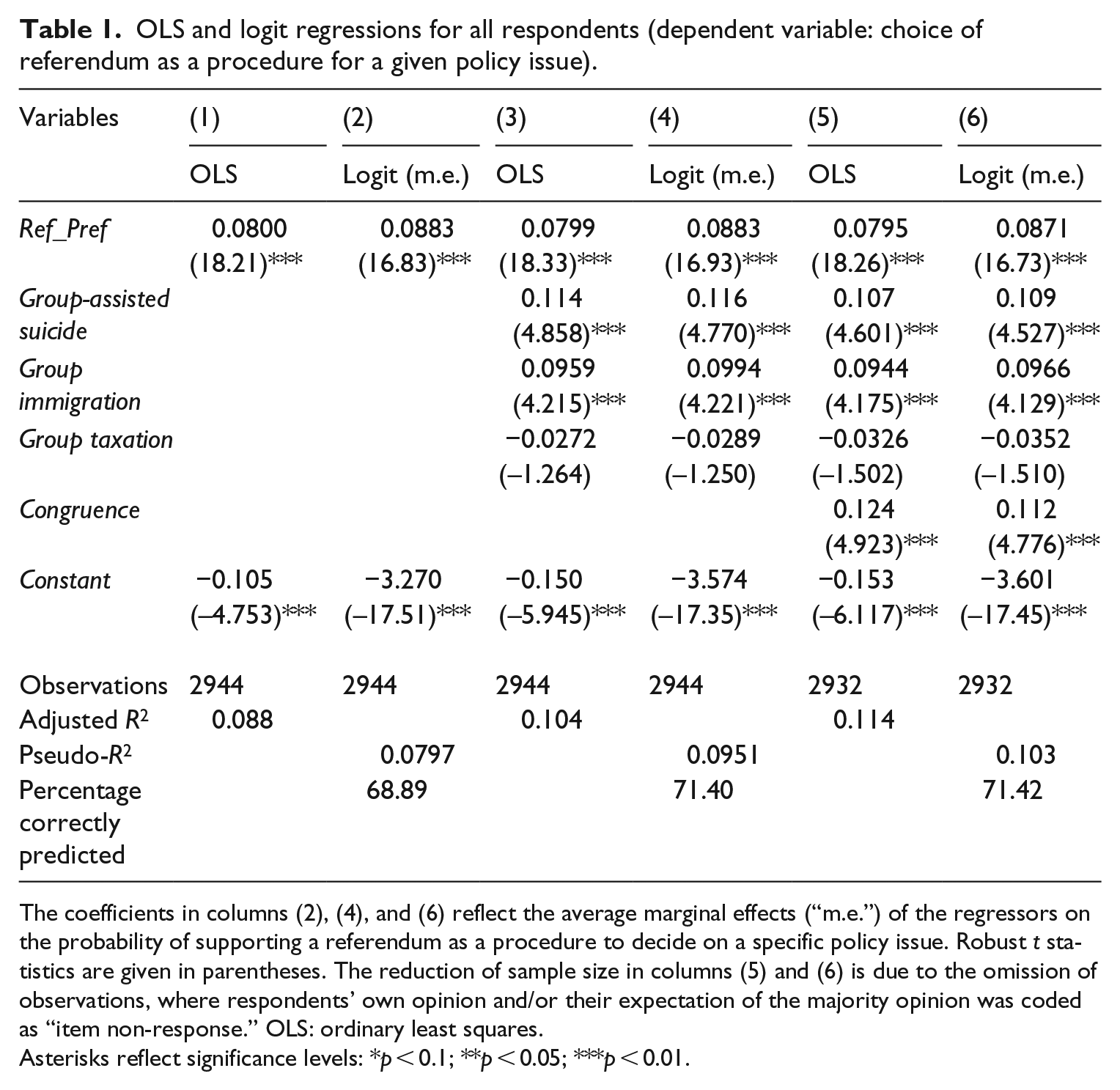
The coefficients in columns (2), (4), and (6) reflect the average marginal effects (“m.e.”) of the regressors on the probability of supporting a referendum as a procedure to decide on a specific policy issue. Robust t statistics are given in parentheses. The reduction of sample size in columns (5) and (6) is due to the omission of observations, where respondents’ own opinion and/or their expectation of the majority opinion was coded as “item non-response.” OLS: ordinary least squares.
Asterisks reflect significance levels: *p < 0.1; **p < 0.05; ***p < 0.01.
As indicated by columns (1) and (2), the results strongly support H1: if an individual has expressed her or his support for referenda as a decision-making procedure in general, she or he is more likely to choose a referendum as a procedure to decide on a specific policy issue. Apparently, the marginal effects do not differ very much between the OLS and the logit model: an individual who fully agrees with the view that there should be more referenda in Germany (i.e. for which Ref_Pref assumes a value of 7) is 48 to 53 percentage points more likely to support referenda as an appropriate procedure on a specific issue than an individual who fully disagrees with that statement (i.e. for which Ref_Pref assumes a value of 1).
Interestingly, the marginal effect of Ref_Pref hardly changes once we add dummies that reflect respondents’ confrontation with a specific policy issue in the experiment. However, columns (3) and (4) indicate that—given individuals’ general support for referenda—there are considerable differences across policy issues: relative to energy policy (as the omitted category), respondents were 11% more likely to choose referenda as a procedure to decide on assisted suicide and 9.5% more likely to advocate referenda for decisions on immigration. By contrast, no such effect could be observed for those participants who had to pick a procedure to decide on taxation. We interpret this result as supporting H2, according to which, given their general view on referenda as a decision-making procedure, individuals consider this procedure more appropriate for the seemingly “easy” decisions on assisted suicide and immigration than for “hard” decisions on taxation or energy policy, which obviously require more complex regulation and cannot be decided on by a yes-or-no question.
Columns (5) and (6) of Table 1 document the relevance of instrumental motives in guiding respondents’ choice of a referendum as a decision-making procedure for a specific policy issue: the coefficient of Congruence is positive and highly significant, indicating that, ceteris paribus, an individual who believes that her or his view on a particular issue is aligned with the majority’s view is 24 percentage points more likely to support a referendum as a procedure than an individual who sees herself or himself in opposition to the majority. We interpret this result as evidence that the attractiveness of a referendum is enhanced by the expectation that a majority vote will result in an outcome that coincides with a respondent’s preferred result.
So far, we have focused on respondents’ support for referenda, essentially ignoring the alternative decision-making procedures offered to respondents in the survey. To explore whether and how Congruence affects individuals’ choice of these alternative procedures, we estimated equation (1), replacing Ref_Choice by dummy variables that reflected individuals’ support for alternative decision-making procedures: a parliamentary decision based on discussions within parties (Parliament), a decision based on expert commissions’ recommendations (Experts), or a decision based on a discussion among representatives of all affected groups (Stakeholders). Since Table 1 demonstrated that the logit estimator delivered results very similar to OLS, we used the latter to estimate marginal effects. To facilitate comparison, column (1) of Table 2 reproduces column (5) of Table 1.
OLS regressions for all respondents (dependent variable: choice of a given procedure for a specific policy issue).
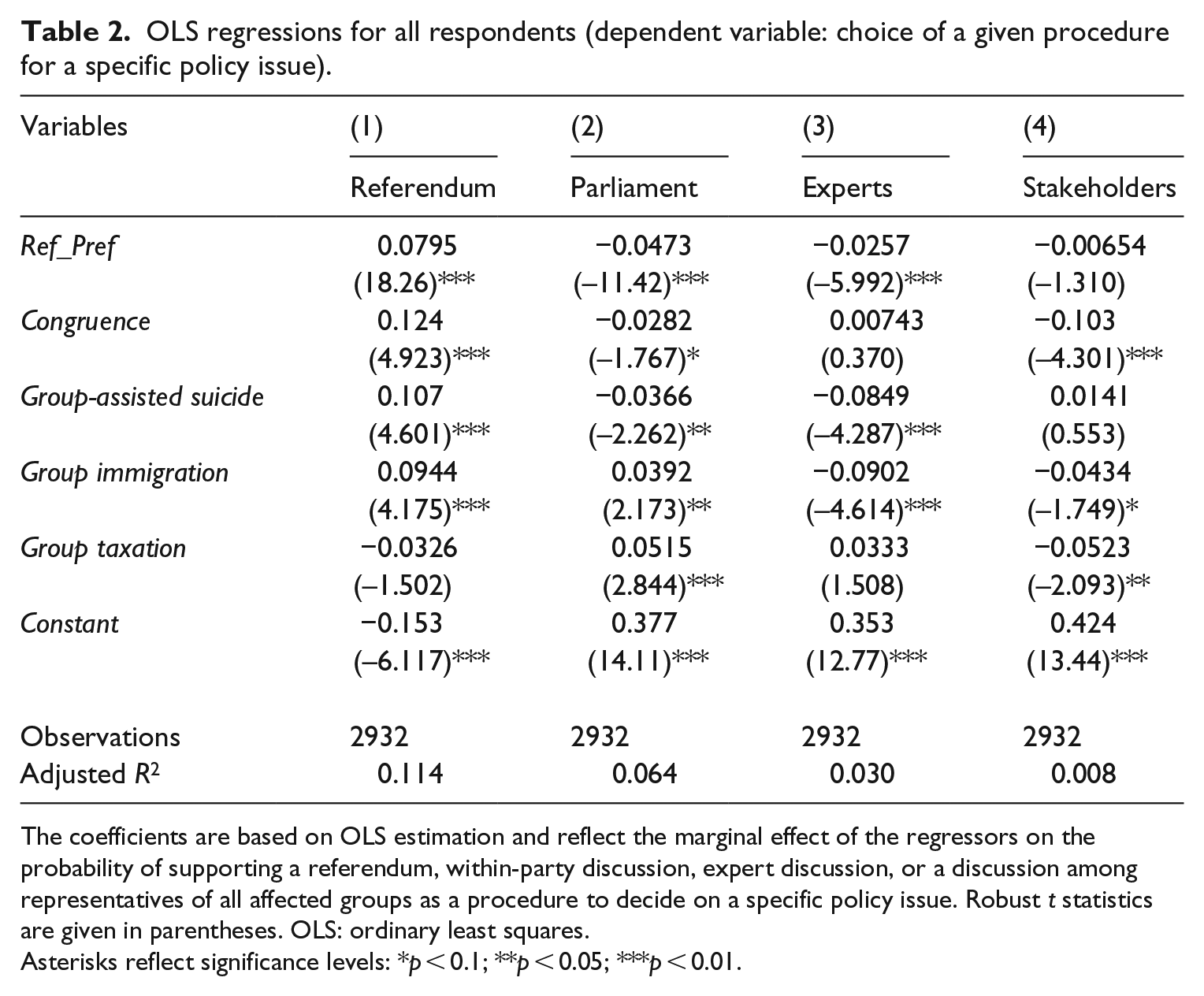
The coefficients are based on OLS estimation and reflect the marginal effect of the regressors on the probability of supporting a referendum, within-party discussion, expert discussion, or a discussion among representatives of all affected groups as a procedure to decide on a specific policy issue. Robust t statistics are given in parentheses. OLS: ordinary least squares.
Asterisks reflect significance levels: *p < 0.1; **p < 0.05; ***p < 0.01.
The results in Table 2 indicate that—not surprisingly—a general preference for referenda significantly reduces the likelihood that an individual prefers a parliamentary or expert decision on a given policy issue. Interestingly, no such significant effect can be found for the fourth possible procedure, an inclusive discussion among representatives of all affected groups. More importantly for our discussion, Congruence only has a significantly positive effect on the probability to choose referenda. For the other available procedures, the effect is either significantly negative (columns (2) and (4)) or insignificant (column (3)). This finding lends further support to the notion that individuals advocate referenda if they reckon that a majority decision results in an outcome that coincides with their own interests. Our finding thus confirms the important role of instrumental motives in shaping agents’ procedural preferences (H3a and H3b). 11
The Role of Instrumental Motives: A Binary Perspective
While the results reported so far strongly support the role of instrumental motives in guiding agents’ preference for referenda as a decision-making procedure, there are some further issues that we want to address: first, the effect of agreement and disagreement with the expected majority view may not be as linear as suggested by the effects of the Congruence variable. More specifically, being in accord with the majority may have a stronger (or weaker) effect than being in conflict—that is, the expectation that the majority shares my opinion on a specific policy issue may make me more enthusiastic about a referendum—while the expectation that the majority position contrasts with my own view may have no effect, and vice versa. We allow for this possibility by replacing the Congruence variable with two dummy variables: the variable Positions_aligned assumes a value of 1 if the respondent expects her or his view to coincide with the majority’s position—either by supporting or by rejecting the policy issue she or he is asked about—and 0 otherwise. Conversely, Positions_contrasting assumes a value of 1 if a respondent expects her or his view on a policy issue to be in conflict with the majority position. 12 To support H3a and H3b on the relevance of instrumental motives, Positions_aligned would have to have a positive influence on the likelihood that an individual chooses a referendum as a procedure to decide on a specific policy issue, while Positions_contrasting should have a negative effect.
A further possibility that we have to be aware of is that the positive effect of Congruence might reflect a more general attitude that we term “majoritarianism”: the idea that if there is a clear majority in favor of a policy, the matter can and should be decided by a referendum—regardless of whether the expected majority position coincides with my own position or not. In this case, the selection of the referendum option is, while dependent on the policy issue at hand, not instrumentally but procedurally motivated, and failing to control for this possibility may induce us to overrate the importance of instrumental motives. We therefore introduce the variable Majority_expected, which assumes a value of 1 if a respondent expects the majority to be for or against a particular policy issue and 0 otherwise. Equation (1) is thus modified by replacing Congruence with the dummy variables Positions_aligned, Positions_contrasting, and Majority_expected

In this equation, Procedureij assumes a value of 1 if individual i picks a given procedure (referenda, party discussions supporting parliamentary decisions, decisions by expert commission, decisions after discussion among representatives of all groups involved) to decide on issue j and 0 otherwise. Again, we are presenting the results based on OLS estimation. In terms of marginal effects and significance levels, logit estimation delivers similar results.
While the findings displayed in Table 3 still support the notion that instrumental motives play a role in determining agents’ preferences over procedures, they also suggest a more nuanced view: apparently, an individual’s expectation that his or her own view on a specific policy issue is aligned with the majority view raises the likelihood that he or she will advocate a referendum to decide on this issue. This effect does not emerge for the other procedures offered in the survey, that is, Positions_aligned only has a significantly positive effect in column (1). However, expecting a conflict between the personal attitude and the expected majority position does not render referenda less attractive: in column (1), the coefficient of Positions_contrasting is negative but not significantly different from 0. Finally, respondents apparently tend to support referenda regardless of their own policy attitude if they expect the majority of the population to have a strong view on an issue. No such effect can be found when we use the choice of alternative procedures as a dependent variable. 13
OLS regressions for all respondents (dependent variable: choice of alternative procedures for a given policy issue).
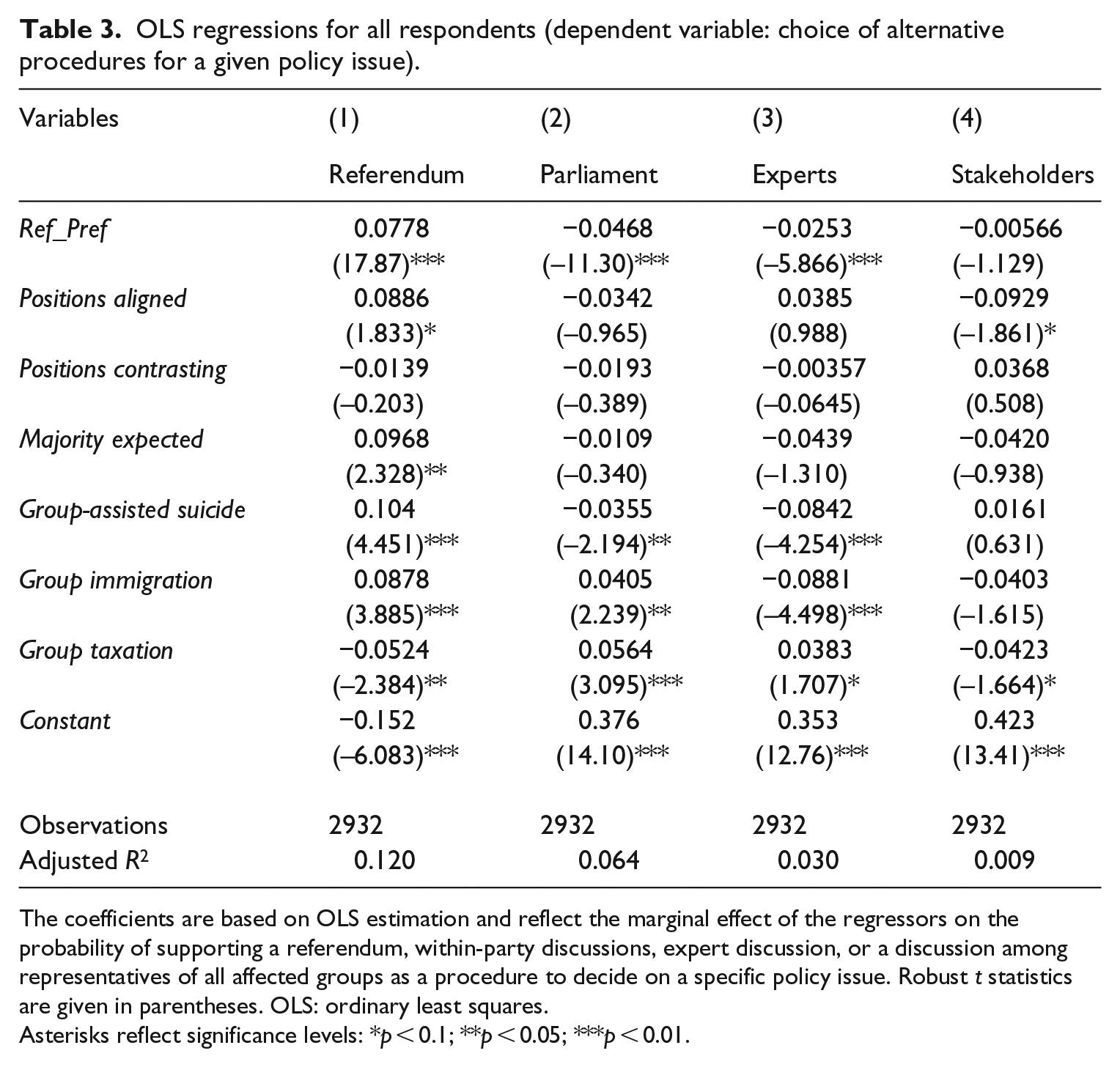
The coefficients are based on OLS estimation and reflect the marginal effect of the regressors on the probability of supporting a referendum, within-party discussions, expert discussion, or a discussion among representatives of all affected groups as a procedure to decide on a specific policy issue. Robust t statistics are given in parentheses. OLS: ordinary least squares.
Asterisks reflect significance levels: *p < 0.1; **p < 0.05; ***p < 0.01.
Considering Different Policy Issues
So far, our analysis has been based on a sample that combined the responses of participants in all four treatment groups of the experiment. We accounted for the fact that some respondents had to pick a procedure to decide on assisted suicide, while others were asked about their views on taxation by using group dummies. In this section, we explore the possibility that not only individuals’ support for referenda but also the relative importance of instrumental motives, as captured by the dummies Positions_aligned and Positions_contrasting, differ across policy issues. To explore whether such differences actually exist, we separately consider the subsamples of the individuals who participated in the four experiments. Table 4 displays the results of estimating equation (2) by OLS, using Referendumij as a dependent variable, limiting the sample to participants in experiment j and, of course, omitting the group dummies. 14
OLS regressions for participants of different experiments (dependent variable: choice of referendum as a procedure for a given policy issue).
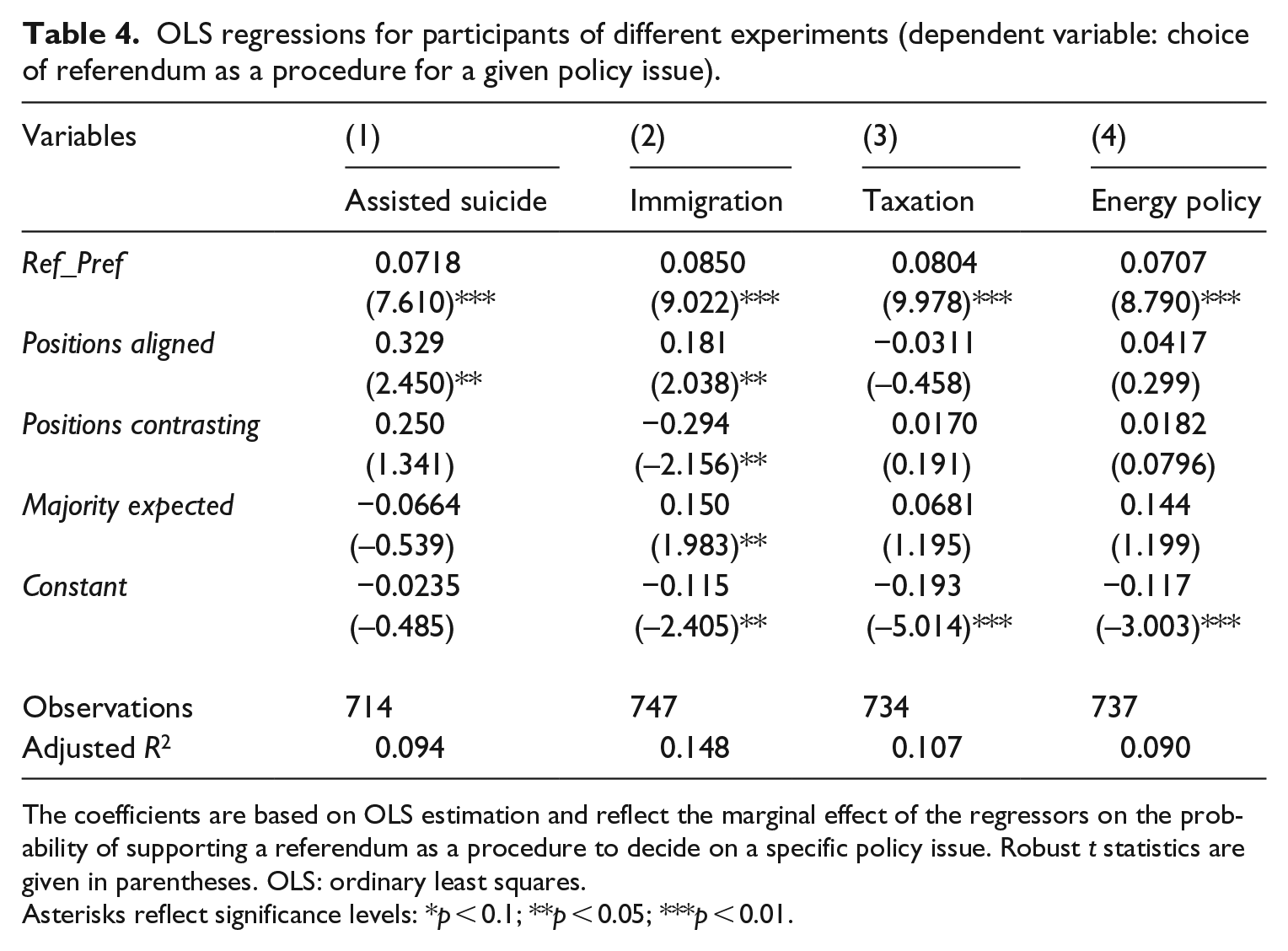
The coefficients are based on OLS estimation and reflect the marginal effect of the regressors on the probability of supporting a referendum as a procedure to decide on a specific policy issue. Robust t statistics are given in parentheses. OLS: ordinary least squares.
Asterisks reflect significance levels: *p < 0.1; **p < 0.05; ***p < 0.01.
The results in Table 4 suggest that the importance of instrumental motives indeed differs across policy issues: while Positions_aligned has a significantly positive effect on the support for referenda when it comes to deciding on the “easy” topics of assisted suicide and immigration, no such effect can be observed for the “hard” topics of taxation and energy policy. Positions_contrasting lowers the support for referenda, but only in the group that focuses on immigration. Moreover, the prominent role of majoritarianism suggested by Table 3 seems to be driven by the immigration group.
In our analyses of the previous sections, we did not consider any additional variables to control for respondents’ socioeconomic characteristics. This was for good reason: as long as the sample combined participants of all four experimental groups, there was no proper argument why respondents’ income, gender, age, and so on, should influence their procedural preferences beyond their general view on the desirability of referenda, as expressed by the variable Ref_Pref. 15 However, once we split the sample into groups of individuals who were asked about their preferred procedure to decide on assisted suicide, on immigration, and so on, such a separate effect becomes possible, if not plausible: for example, the view on using a referendum to decide on assisted suicide may depend on a respondent’s age, the view on using a referendum to decide on immigration may depend on a respondent’s citizenship, and the view on using a referendum to decide on taxation may depend on a respondent’s relative income. Since we had no clear hypothesis on the factors that may or may not matter for specific policy issues, we included all of the following control variables in our regressions: High Income is a dummy variable that assumes the value of 1 if a respondent reports his personal monthly net income to be above €4000—clearly exceeding the average monthly income in Germany. Female is a dummy variable indicating the respondent’s gender. Birth year reflects respondents’ age. Since the GESIS panel uses the value of 1943 (1995) for all respondents who were born in 1943 or earlier (1995 or later), we use the dummy variables Old (Young) for all individuals born in 1943 or earlier (1995 or later). German citizen is a dummy variable meant to control for respondents’ citizenship, and University entrance degree and University degree are dummy variables indicating respondents’ educational attainment. 16
The results displayed in Table 5 are interesting in several respects: gender, age, and citizenship seem to matter for some policy issues but not necessarily for those that we would have expected ex ante. Moreover, individuals with a higher educational attainment seem to oppose referenda—in particular as a procedure to decide on taxation. Most importantly, however, our previous results on the role of aligned and contrasting policy positions remain largely intact: when it comes to deciding on assisted suicide and immigration, respondents who see their own opinion in accord with the expected majority opinion are more likely to support referenda as a procedure. Furthermore, a perceived contrast between the own and the majority’s position on immigration reduces the support for referenda as a decision-making mechanism. Finally, the support for referenda does not depend on aligned or contrasting positions when the issue at stake is taxation or energy policy. 17 The most important difference to Table 4 is that majoritarianism—as reflected by the variable Majority expected—no longer plays a role in any of the policy experiments, once we control for socioeconomic characteristics. This change is driven by two forces: first, since not all respondents offered information on their income, educational attainment, and so on, including these variables substantially reduced the sample size and thus the precision of the estimate. In addition, however, Majority expected is correlated with socioeconomic characteristics—most importantly, the educational attainment variables (University entrance degree and University degree). Once we include these variables in the regression, Majority expected is no longer significant. The fact that this does not happen to the key regressors of interest—namely, Positions_aligned and Positions_contrasting—makes us confident that our main results are not driven by omitted-variable bias.
OLS regressions for participants of different experiments (dependent variable: choice of referendum as a procedure for a given policy issue)—including socioeconomic characteristics.

The coefficients are based on OLS estimation and reflect the marginal effect of the regressors on the probability of supporting a referendum as a procedure to decide on a specific policy issue. Robust t statistics are given in parentheses. OLS: ordinary least squares.
Asterisks reflect significance levels: *p < 0.1; **p < 0.05; ***p < 0.01.
Discussion and Conclusion
The literature on democratic innovations focuses mainly on intrinsic or ideological reasons to complement existing representative decision-making structures with more participatory elements. Many innovations, such as mini-publics (Grönlund et al., 2014) and deliberative polls (Fishkin, 1991), are justified against the background of a comprehensive normative theory (see Parkinson and Mansbridge, 2012) and appeal to respective motives in citizens. However, direct democracy is a special case among the suggested democratic innovations. We have argued that this is because in the case of direct democracy, and referenda in particular, the outcome effects of the decision-making procedure are quite transparent. Especially where decisions on specific policy issues are concerned, information about the majority position allows for a fairly accurate prediction of a referendum’s result. Our discrete choice experiment shows that the selection of a referendum as a decision-making procedure is—at least in part and for some policy issues—instrumentally motivated. While a general preference for direct democracy does increase the likelihood of supporting referenda for specific decisions (H1), and referenda are generally more popular for “easy” than for “hard” political decisions (H2), alignment between the own policy preferences and the assumed majority preference tends to increase support for referenda, while the lack of such alignment reduces support—especially for seemingly “easy” decisions (H3a/H3b). In fact, our analyses may still underestimate the effect of instrumental motives, as general support for referenda (which we use as a proxy for intrinsic motives) may itself be driven by specific outcome expectations, that is, the belief that for most, or the most important policy issues, a majority shares the own position.
We believe that our findings have important implications for democratic theory and practice. To begin with, discussions about democratic innovations that complement or replace existing representative structures should be better informed about the outcome effects of procedures. They should take more seriously the old question, “who benefits?”—not only where substantial decisions are concerned but also for procedural choices. Instrumental motives behind calls for procedural reform should be revealed and openly discussed. For example, the call for more direct democracy that is increasingly being voiced by right-wing populist parties seems to be motivated not only by a Rousseau-style identitarian understanding of democracy but also by the belief that the preference for anti-immigration policies is shared by a majority that would win respective referenda. While instrumental motives for supporting democratic innovations cast doubt on empirical claims made by authors such as Inglehart (1990) and Norris (1999) that the shift toward post-materialist values is behind “critical citizens’” demand for more participation, their prevalence also has normative implications: where procedural innovations primarily serve the interests of existing majorities or groups with a high potential for mobilization, they are likely to produce perpetual losers and will undermine trust in democracy rather cure its ills.
From a practical perspective, those who are in a position to take the procedural decision to hold a referendum must be aware of the volatility and unpredictability of public opinion, in light of which the choice of a referendum as an instrument to achieve specific policy goals seems ill-advised. The Brexit referendum is an instructive case in this regard: it was called by David Cameron under erroneous suppositions about the majority position and turns out to be anything but the “easy” decision its advocates wanted it to look like. Two important lessons for the use of referenda can be learned here. First, the full complexity of any decision put to the democratic demos should be appreciated and the implications of possible results communicated. This is only possible if, second, a referendum is preceded by adequate large-scale deliberation. In any other case, referenda constitute what Cristina Lafont (2019) calls a “procedural shortcut” that will fail to generate democratic legitimacy. How elements of direct democracy can be combined with institutionalized and mass deliberation thus remains a pressing question to be addressed by participatory and deliberative theories of democracy. In the end, however, institutional design choices and innovations require a strong democratic mandate that can only be obtained in broad and inclusive “meta-deliberative” processes (see Dryzek, 2010, ch. 5; Landwehr, 2015).
Supplemental Material
sj-pdf-1-psx-10.1177_0032321719879619 – Supplemental material for Preferences for Referenda: Intrinsic or Instrumental? Evidence from a Survey Experiment
Supplemental material, sj-pdf-1-psx-10.1177_0032321719879619 for Preferences for Referenda: Intrinsic or Instrumental? Evidence from a Survey Experiment by Claudia Landwehr and Philipp Harms in Political Studies
Footnotes
Acknowledgements
The authors thank Thorsten Faas for collaboration in the design of the survey experiments, the GESIS team for support in the implementation and fielding of the survey, and two anonymous reviewers as well as Nils Steiner for helpful comments and suggestions on earlier versions of this paper. Support by the research unit “Interdisciplinary Public Policy” at Johannes Gutenberg University Mainz is gratefully acknowledged.
Funding
The author(s) received no financial support for the research, authorship, and/or publication of this article.

Supplementary Information
Additional supplementary information may be found with the online version of this article.
Notes
Author Biographies
References
Supplementary Material
Please find the following supplemental material available below.
For Open Access articles published under a Creative Commons License, all supplemental material carries the same license as the article it is associated with.
For non-Open Access articles published, all supplemental material carries a non-exclusive license, and permission requests for re-use of supplemental material or any part of supplemental material shall be sent directly to the copyright owner as specified in the copyright notice associated with the article.
