



Abstract
How do International Monetary Fund programs and conditions affect labor rights? Recognizing the diversity of International Monetary Fund conditionality, we argue that the more stringent International Monetary Fund labor market conditionality is, the worse labor rights become. However, this negative effect can be mitigated if there exist domestic political institutions that have incentives and abilities to provide protections over workers: one such case is a closed-list proportional representation system; another case is a leftist government that relies on political supports of workers. Our empirical analysis demonstrates that the more labor conditionality a program includes, the worse labor rights the country sustains. In addition, we report that the negative effect is partially mitigated when domestic political circumstances are favorable to the political representation of workers under a proportional representation system or under a leftist government.
Introduction
In May 2010, the Greek government signed onto an International Monetary Fund (IMF) program after a long and heated negotiation with the European Union (EU) and the IMF. The deal, which secured a 3-year, 30 billion Euro financial assistance package from the IMF as part of a 110 billion Euro financing package with the IMF/EU, was touted by then IMF Managing Director Dominique Strauss-Kahn as “a historic course of action that will give this proud nation a chance of rising above its current troubles and securing a better future for the Greek people” (IMF, 2010). In order to meet such a goal, the program contained a wide range of policy reform measures, commonly known as conditionality, aimed at tackling massive fiscal imbalance and restoring long-run economic viability. At the time of the press release, Mr. Strauss-Kahn emphasized the importance of the Greek government following up with the policy conditions by empathetically stating “implementation is now the key” (IMF, 2010).
It turned out that the implementation of the policy conditions of the IMF program was anything but smooth-sailing for the Greek government. Within hours of signing the agreement, the program was met with anger from the Greek public. Union members, teachers, pensioners, and students took to the streets and squares to protest the belt-tightening austerity measures included in the IMF program. In the following months, large-scale general strikes and intense riots continued, and the politics in the Greek parliament became increasingly turbulent. The contentious politics of the IMF program implementation culminated with two rounds of a vote of confidence in 2011. The incumbent government narrowly edged to win in both, but the second one in November 2011 eventually led to the resignation of Prime Minister Papandreou. After some of the conditions included in the program were not met, the 2010 stand-by agreement was scrapped altogether and was replaced by a new 4-year program under the Extended Fund Facility. The drama had continued to unfold with frequent political crises and repeated renegotiations of the program. Over 8 years since 2010, five different prime ministers had resided over the crisis and Greece had only narrowly escaped national defaults. 1
While Greece significantly departs from a usual IMF program–participating developing country in many regards, domestic political turmoil that followed the 2010 IMF agreement exemplifies typical political dynamics of IMF program implementation: the IMF and a government negotiate an IMF program that includes domestic-politically unpopular policy reform measures, only to observe those conditions seriously challenged when the government tries to implement them. Since an IMF program is an international agreement that does not require formal ratification at the time of signing, the participating government and the IMF are able to sign a program with ambitious reform measures with a hope to “tip the balance” against anticipated domestic opposition (Vreeland, 2003). However, implementation of such reforms also requires ex ante explicit approval or at least implicit acquittal of relevant domestic stakeholders, such as legislatures and various interest groups. Few governments are immune to such domestic approval process, and without such consents from domestic stakeholders, some IMF programs abort prematurely and others remain incomplete, caught in the middle of domestic political contestation (Beazer and Woo, 2016; Ivanova et al., 2001; Vreeland, 2003).
As was the case in Greece, at the frontline of opposition in the battle against IMF program implementation are most often workers and labor unions. IMF programs often include labor market reform measures, such as wage restrictions, hiring freezes, privatization of state-owned enterprises, lay-offs, pension reforms, or labor market flexibility legislation that directly hurt workers’ rights (Kentikelenis et al., 2016; Reinsberg et al., 2019; Stubbs and Kentikelenis, 2018). There are also other measures that indirectly compromise workers’ interests. For instance, IMF programs often put ceilings on public spending and contain other public sector reform conditions, and these measures often result in reductions in public wages and social benefits that most workers rely heavily on (Nooruddin and Simmons, 2006; Rickard and Caraway, 2019). Thus, fierce opposition by workers and labor unions to IMF programs exemplified in the recent Greek case seems quite justified.
Building on the recent development in the IMF literature examining the effect of IMF conditionality (Gunaydin, 2018; Kentikelenis et al., 2016; Reinsberg et al., 2019; Rickard and Caraway, 2019; Stubbs and Kentikelenis, 2018), we theorize and empirically investigate how IMF conditionality affects the rights of workers. By examining the effect of conditionality, the recent studies in the literature depart from earlier studies that have examined the effect of IMF programs as a dichotomous indicator on labor rights (i.e. Abouharb and Cingranelli, 2007; Blanton et al., 2015; Martin and Brady, 2007; Oberdabernig, 2013), thereby discounting the possible differential effect of IMF programs depending on its varying conditionality (Dreher and Jensen, 2007; Stone, 2008; Woo, 2010, 2013). More recent studies began to address this problem by paying more attention to the varying degree of conditionality and they generally report that harsher public sector and labor-related conditions tend to hurt workers’ rights (Kentikelenis et al., 2016; Reinsberg et al., 2019; Rickard and Caraway, 2019; Stubbs and Kentikelenis, 2018). That is, what matters is not just whether a country signs an IMF program or not, but with what and how many conditions that country signs the program.
Our main theoretical contribution is that the negative effects of labor-related conditionality are filtered and mitigated through domestic political institutions. Specifically, we theorize how domestic political interests and institutions might have condition the effects of IMF conditionality. We identify a feature of electoral systems, proportional representation (PR), and a measure of political representation of labor, left government, as key factors that can mitigate the negative effects of IMF conditionality on workers’ rights. Specifically, we argue that countries that adopt a PR system and/or that have a leftist executive are better able and more willing to shield rights of their workers from the international demand by the IMF than their counterparts with a single-member district plurality or majoritarian system and/or with a rightist executive.
Our empirical findings provide strong support to the theoretical argument. We find that the more labor conditionality a program includes, the worse labor rights the country sustains, conforming to the key finding in the recent literature (Kentikelenis et al., 2016; Reinsberg et al., 2019; Rickard and Caraway, 2019; Stubbs and Kentikelenis, 2018). More importantly, we successfully demonstrate that the negative effect of labor conditionality is not uniform across different domestic political circumstances. As we theorize, the negative effect of labor conditionality is partially offset when domestic political circumstances are favorable to the political representation of workers under a PR system and under a leftist government. The results are robust to various empirical specifications and remain statistically and substantially significant after we take into account the endogenous nature of IMF conditionality and program participation. The theoretical argument and empirical evidence presented in this article contribute to the literature not only by taking the variation in IMF conditionality seriously but also by specifying conditions under which IMF conditionality leads to more or less deterioration of workers’ rights.
The article is organized as follows. In the next section, we review existing studies addressing how IMF programs affect workers and labor rights. In the theory section, we present our theoretical argument and hypotheses. In the following empirical section, we discuss our empirical strategy and report our main findings. The conclusion discusses the theoretical and policy-oriented implications.
Literature Review
Until recently, there have been relatively few scholarly studies done on the impact of IMF program participation on workers’ rights, despite the political salience of the conflict between the IMF and workers in IMF program participating countries. Pastor (1987) provides the earliest empirical assessment of the effect of the IMF on labor. Examining the effect of IMF programs in Latin America, he argues that “IMF’s desire to secure the cooperation of local elites may lead them to design programs which place the burden of adjustment on workers and other popular classes” (Pastor, 1987: 258). As IMF programs increasingly require wage restraint, devaluation, and removal of price controls and other consumer subsidies, he hypothesizes that IMF programs should have a negative effect on labor, and indeed reports that labor’s share of income is significantly reduced during the course of IMF programs for 18 Latin American countries between 1965 and 1981. Weeks (1999) similarly reviews labor market conditions in Latin American countries between 1970 and 1998, and attributes significant deterioration of workers’ rights and the rise of unemployment to policy liberalization and deregulation demanded by IMF and World Bank conditionality. Expanding the data coverage to 110 countries from 1961 to 1993, Vreeland (2002) finds that labor’s share of income in manufacturing is significantly reduced when countries participate in IMF programs, after controlling for observable and non-observable factors affecting IMF program participation in the first place. Potentially, the negative effect of IMF programs on labor’s share of income might be driven by the fall in the political power of workers, as IMF programs tend to reduce the percentage of union membership (Martin and Brady, 2007).
Oberdabernig (2013) presents more subtle findings. While the effect of IMF programs on poverty and inequality, which are often associated with quality of life of workers, is overall negative between 1982 and 2009, the effect reverses when the analysis is done for the 2000–2009 sub-period. In this sub-period, when the IMF became increasingly concerned with poverty alleviation, the contemporaneous effect of IMF program participation is statistically significant and positive, leading to a decrease in poverty indicators and inequality. This more nuanced picture is countered by the most recent study. Blanton et al. (2015) show that when a country accepts IMF and World Bank programs, the country tends to experience deterioration of labor rights protection due to significant policy reforms included in the programs.
More recent studies tend to be more methodologically sophisticated, often controlling for selection effects—that is, which countries are more likely to participate in an IMF program—before evaluating the effect of IMF program participation. However, by setting a dichotomous indicator of IMF program participation as the main explanatory variable, these studies make the implicit assumption that all IMF programs are similarly designed to each other or that IMF programs with different conditionality would have similar effects once they are signed.
Yet, IMF programs differ from one another and it is reasonable to expect that different IMF programs produce different outcomes. Existing studies of IMF conditionality report large variations in IMF program design, whether in the number of conditions included in a program (Caraway et al., 2012; Copelovitch, 2010; Dreher and Jensen, 2007; Kentikelenis et al., 2016; Woo, 2010) or in the scope of conditionality covered within a program (Stone, 2008). Moreover, the aforementioned studies show that differences in design between IMF programs are not random but stem from international and domestic political circumstances surrounding deliberate negotiations between the IMF and participating governments. The varying conditionality is likely to produce different political, social, and economic outcomes. For instance, Beazer and Woo (2016) demonstrate that different conditions lead to different policy reform outcomes in the post-Soviet transitional countries, emphasizing the importance of variations in IMF conditionality. In the same vein, Woo (2013) shows that the positive catalytic effect of an IMF program on foreign direct investment (FDI) is conditional on the variation of conditionality.
The most recent innovation in the IMF literature is that studies have begun to explicitly theorize and empirically examine the varying conditionality. Stubb and Kentikelenis (2018) provide a detailed discussion of how specific IMF conditions might erode workers’ rights. For instance, labor market deregulation, public sector wage restrictions, and privatization and reform of state-owned enterprises all directly hurt labor rights (Stubb and Kentikelenis, 2018). Similarly, Reinsberg et al. (2019) demonstrate that labor conditions significantly reduce both individual and collective labor rights, taking into account the endogenous nature of an IMF program and its conditionality.
Theoretical Argument
IMF conditionality varies significantly as recent studies of IMF conditionality empirically document (Copelovitch, 2010; Dreher and Jensen, 2007; IEO, 2006; Kentikelenis et al., 2016; Woo, 2010). Most pertinent to this study, Caraway et al. (2012) show that labor market conditionality varies widely. Of all the programs signed between 1980 and 2000, the average number of labor conditions in IMF programs is 5.26, with a standard deviation of 5.13. What is more astonishing is the gap between the minimum and the maximum number of conditions. While several programs contain zero labor conditions, certain programs contain more than 20, 30, or even 40 conditions.
Our baseline expectation with regard to labor market conditionality’s effect on workers’ rights closely match with those of the recent studies: the more labor conditions a program includes, the more adversely worker rights are affected by the program (Reinsberg et al., 2019; Stubbs and Kentikelenis, 2018). Commonly utilized labor conditions include restrictions on public sector wage levels, public sector employment levels, privatization of state-owned enterprises, private sector minimum wages, other kinds of private sector wage restraint, social security, public pension, labor market flexibility, and collective bargaining decentralization (Caraway et al., 2012). In addition to the direct negative consequences these labor conditions produce in the labor market, many of these employment and labor market flexibility measures make workers compete for fewer available jobs in the midst of an economic crisis, weakening the bargaining power of workers. In addition, IMF programs also tend to reduce labor unionization, further enfeebling workers’ political influence (Martin and Brady, 2007). Finally, IMF programs and their conditions are also likely to lead to the growth of the informal economy, of which the workforce is not likely to be unionized (Blanton et al., 2018). Examining the case of Togo, for instance, Blanton et al. (2018) find that the size of the informal economy grew by 18% during the years when the country was under IMF programs. We reason that more fierce job market competitions for workers in formal sectors and the growth of the informal economy substantially weaken the power of workers vis-à-vis employers, hence tip the balance of bargaining in favor of employers. In sum, such explicit labor market conditionality undermines the interest and political power of workers especially when they are successfully implemented, and thus we expect that as the labor conditionality becomes more stringent, holding other variables constant, workers’ rights deteriorate.
Hypothesis 1: When an IMF program contains more stringent labor market conditions, labor rights are more likely to be negatively affected by the program.
We further argue that domestic political factors intervene and mediate the impact of IMF conditionality on labor rights (Burgess, 2010; Gunaydin, 2018). Like other dimensions of integration into the global economy (Blanton and Blanton, 2012; Greenhill et al., 2009; Mosley and Uno, 2007), IMF program participation is one important external factor that shapes and changes the incentives for governments to recognize and protect workers’ rights. Governments are, however, different in their political will and ability to promote labor rights, depending on the extent to which domestic politics channels the interests of workers and unions as viable political forces (Berliner et al., 2015; Burgess, 2010).
In the context of the politics of IMF program implementation, domestic politics also plays a crucial role in translating conditionality to actual policy outcomes, because the contents of IMF programs are often quite vague (Nooruddin and Simmons, 2006). This leaves a rather large room for participating governments to make their own policy judgments even when conditionality is fully implemented. In the case of budget cuts, a common quantitative condition, where and how budget cuts are to be made are often left open. Even when structural conditions, specifying how a government should meet quantitative conditions, are attached, they are often done in vague terms (IMF, 2003; Nooruddin and Simmons, 2006). For instance, the Independent Evaluation Office of the IMF (2003) reports that while most programs under study include “social spending” as a key issue, “none of them defined what programs fall under “social spending,” leaving it to the discretion of domestic politicians to make those crucial choices (Nooruddin and Simmons, 2006). The above discussion implies that participating governments can exert some influence over how IMF programs are actually implemented.
We also emphasize that not all conditions included in IMF programs are successfully and completely implemented. Countries’ meeting IMF conditionality is not always granted, since governments’ efforts to implement it often face stiff domestic resistance. Facing stiffer domestic oppositions than anticipated, governments might try to persuade the IMF that some conditions are not to be implemented and should be waived instead. And such governments’ requests are sometimes granted by the IMF. As a consequence of domestic oppositions, some programs are scrapped altogether and renegotiated. Other programs continue, but with significant modifications. In still other instances, the IMF does not punish the non-implementation of certain conditions and grant waivers instead.
The Greek case discussed in the introduction is a good example of incomplete implementation. Greece, a parliamentary democracy with a semi-PR electoral system, has repeatedly failed to implement labor-related conditions. The Extended Arrangement under the Extended Fund Facility for Greece, signed in March 2012 and intended to last for 4 years, including a number of ambitious yet controversial labor conditions. In the letter of intent sent to the IMF managing director, the Greek government pledged to “place more emphasis on securing reductions in unit labor costs and improvements in competitiveness, through a combination of upfront nominal wage cuts and structural labor market reforms (Greece, 2012: 4). Specifically, the program included conditions that promised to reduce 150,000 public employees, reduce public sector wages, revise collective bargaining measures in favor of employers, decrease the minimum wage by 22% then to freeze it until the end of the program, relax key employment protection legislations, reform arbitration and mediation processes in favor of employers, increase working hour flexibility, close non-priority social spending, privatize a number of state-owned enterprises, and reform the public pension system (Greece, 2012; International Trade Union Confederation (ITUC), 2013; Kornelakis, 2016). By the end of the arranged program, however, not all of these labor conditions had been implemented. Both the conservative government under Antonis Samaras and the leftist government under Alexis Tsipras could not implement them in a timely fashion due to domestic oppositions and had to delay it. At the conclusion of the fifth review of the arrangement in June 2014, the IMF staff report concluded that “the [Greek] authorities were unable to deliver on most labor market reform commitments” (IMF, 2014: 19) yet the IMF decided to approve Greece’s request for a waiver of nonobservance of performance criterion (IMF, 2014). Either willingly or reluctantly, the Greek government was able to postpone politically difficult labor market reforms.
The Greek case suggests that borrowing countries often avoid full implementation of IMF labor conditions in a way that is more favorable to workers, when governments are responsive to the collective interests of organized labor, especially when conditions negotiated are vague enough to offer larger room to maneuver. The adverse effect of implementing labor market conditions on labor rights, therefore, can be mitigated when workers maintain channels of political influence and when governments understand damaging political consequences of labor-related reforms.
We consider two factors that affect levels of political representation of workers and unions. First, we highlight the importance of government partisanship. Previous studies show that the partisan control of government affects several dimensions of socioeconomic policy, including redistribution, social spending, and labor market institutions in both developed and developing countries (Garrett, 1998; Huber et al., 2008; Pribble et al., 2009). Left-wing parties that rely on workers and unions as core constituencies seek to reduce unemployment and inequality through higher levels of redistributive transfers and social spending. Right-wing parties are more committed to decrease state-intervention in markets and protect the interests of capital owners and business sectors. If parties reflect the preferences of their core constituencies with different value commitments, the position of governing parties on the left-right scale would affect the relationship between IMF labor conditionality and labor rights. Compared to their right-wing counterparts, left-leaning governments are more likely to be responsive to the demands of workers and unions in the implementation of IMF labor-related conditions.
Hypothesis 2: When a left government participates in an IMF program containing stringent labor market conditions, labor rights are less likely to be negatively affected by the program than when a right government participates in such a program.
Second, we argue that electoral systems play an important role in mediating the impact of IMF conditionality on labor rights. Government partisanship might explain types of core constituencies that governments care about in policy implementation. Nevertheless, the extent to which governing parties can offer distinct policy programs for the interests of their partisan constituencies and implement them in real terms itself is still conditioned by domestic political institutions shaping the dynamics of party politics. The vast literature on comparative political economy suggests that electoral institutions affect the realization of partisan incentives in policy outcomes, as they define the ways in which representative policymakers maximize their chances of winning and staying in office.
The importance of PR systems as an electoral institutional setting that increases the organized power of labor and generates labor-friendly policies has been emphasized in several studies. For instance, PR systems are shown to generate larger public transfers, higher redistribution, and less inequality than majoritarian systems (Birchfield and Crepaz, 1998; Milesi-Ferretti et al., 2002; Persson and Tabellini, 2004). Since its lower vote-seat proportionality makes the entry of new parties representing workers and unions much easier than otherwise, PR was historically preferred by parties carrying organized economic interests, especially the left and social-democratic parties (Alesina and Glaeser, 2004; Cusack et al., 2010).
Electoral systems affect the realization of interests of labor as they produce systematic differences in the partisan composition of governments and their coalition dynamics. Iversen and Soskice (2006) show that PR systems are more likely to have center-left governments, whereas majoritarian systems are more likely to have center-right governments. Center-left governments in PR also redistribute more than those under majoritarian systems, because a multi-party system with PR allows parties to fully commit the preference of their core constituencies. Hence, even when controlling for the effect of government partisanship, PR still has a direct and positive impact on redistribution and active labor market policy (Iversen and Soskice 2006; Iversen and Stephens, 2008). In their analysis of labor market regulations in 85 countries for the period 1975–1995, Botero et al. (2004) find that although the impact of historical origins of laws is substantial, electoral institutions still matter for the legal protection of workers: countries with PR tend to maintain higher levels of protection for individual employment relations (i.e. employment laws) and rights to unionization and collective bargaining (i.e. collective relations laws).
We therefore argue that the adverse effect of IMF labor conditionality on labor rights would be mitigated by PR systems, as they enhance both the political representation of workers and unions and the abilities of center-left governments to defend their interests.
We additionally note the differences between closed-list PR and open-list PR systems in terms of party strengths and cohesion (Hix, 2004). We expect that the extent to which governments moderate the negative effects of IMF conditionality on labor rights will be much greater in closed-list PR where a strong party leadership induces legislators to fully commit to policy platforms for core partisan constituencies at the national level. The effect of open-list PR on the link between IMF conditionality and labor rights would be less clear-cut because the lack of party control allows incumbent legislators to deviate from a party line and cultivate personal reputation. Thus, the willingness and abilities of center-left governing parties to defend the collective interests of labor in the negotiation and implementation of IMF conditionality might be weaker in open-list PR systems. The effect of electoral systems on the relationship between IMF labor conditionality and labor rights is specified in Hypothesis 3.
Hypothesis 3: When a country with a closed-list PR system participates in an IMF program containing stringent labor market conditions, labor rights are less likely to be negatively affected by the program than when a country with other types of electoral systems participates in that program.
Finally, we contend that the mitigating effect of left governments and closed-list PR systems would be the greatest when both are present. That is, electoral systems and government partisanship would interactively mediate the effects of IMF conditionality on labor rights.
Hypothesis 4: The negative effects of IMF conditionality on labor rights will be most likely mitigated in countries that have both left governments and closed-list PR systems.
Empirical Tests
Variables and Data Sources
We test our hypotheses using Mosley and Uno’s (2007) data on collective labor rights in developing countries from 1985 to 2002. Mosley and Uno’s data have been widely employed in the literature, as they offer comprehensive measures on workers’ rights to organize, collectively bargain, and strike across a great number of developing countries (Berliner et al., 2015; Blanton and Blanton, 2012; Blanton et al., 2015; Greenhill et al., 2009; Mosley and Uno, 2007). The Mosely-Uno data also allow us to examine a country’s level of respect for collective labor rights in terms of national labor legislation and practical implementation, respectively.
Mosley and Uno (2007) use Kucera’s (2002) template and assess labor rights violations in 37 categories under six areas: freedom of association and collective bargaining–related liberties, the right to unionize, other union activities, the right to collectively bargain, the right to strike, and rights in export processing zones. Relying on a content analysis of reports from three sources (i.e. the US State Department, the International Labor Organization, and the International Confederation of Free Trade Union), they assign a score of zero for no violation and one for one or more violations in each of the 37 categories. A composite measure of Labor rights is defined as the weighted sum of violations with greater weight given to more serious violations.
The Mosley-Uno data provide two other important measures that capture de jure and de facto aspects of collective labor rights (Blanton et al., 2015; Greenhill et al., 2009). The Labor laws measure represents the extent to which legal provisions are placed to protect freedom of association and collective bargaining rights of workers. The Labor practices measure indicates the extent to which such rights are observed in practice by government officials and employers. Labor laws and Labor practices equal the weighted sum of violations of law and practice dimensions in Kucera’s 37 categories, respectively. The distinction between laws and practices is important since the formal legislation of labor rights does not necessarily guarantee their actual implementation, especially when governments lack the ability to monitor and enforce labor standards in practice (Greenhill et al., 2009).
We employ Mosley and Uno’s three measures of labor rights as our dependent variables. Using Labor laws and Labor practices, we examine whether and to what extent labor conditions in IMF programs affect legal protection and practical implementation of labor rights in borrowing countries. We include Labor rights to evaluate the overall effect of IMF labor conditionality on collective labor rights. The scale of these variables is reversed such that higher values indicate greater respect for labor rights.
Our primary independent variable is Caraway et al.’s (2012) measure of the stringency of IMF labor conditions specified in letters of intent. Letters of intent describe the major economic issues in borrowing countries and policy packages that they are committed to implement. Caraway et al. (2012) evaluate the relative intrusiveness of conditions on labor issue areas, including wages, employment, labor market flexibility, and collective bargaining and compute the Letters of intent measure for a country’s IMF program as the weighted sum of the total number of labor conditions with more weight given to more stringent conditions, such as those linked to possible suspension of the IMF loan. Higher values of Letters of intent represent greater intrusiveness of IMF labor conditions. If IMF labor conditionality adversely affects collective labor rights, the coefficients for Letters of intent should be negative.
Our independent variables of interest include electoral systems and government partisanship as factors mediating the effects of IMF labor conditionality on labor rights. PR is a dummy variable that assigns 1 to closed-list PR systems in which at least for one of the electoral tiers, party leaders control the rank of candidates on ballots, and voters cast their votes for parties, not for individual candidates. Left is a dummy variable coded 1 if left or center parties hold the executive office and 0 for otherwise. Data on electoral systems and executive partisanship come from the Database of Political Institutions (World Bank, 2012a).
We consider several controls suggested by labor rights studies. Three variables capture the degree of a country’s integration into the global economy since globalization might improve labor rights through growth and investment, but generate competitive pressures on workers (Mosley and Uno, 2007). Trade that equals the sum of imports and exports as a share of gross domestic product (GDP) and FDI inflows as a share of GDP are included as natural logarithms. We employ Greenhill et al.’s (2009) Bilateral trade context measures to control for the transmission of labor standards across countries caused by trade. Greenhill et al. (2009) create Bilateral trade context for Labor laws (or Labor practices) as the average score of Labor laws (or Labor practices) across a country’s exporting partners weighted by partners’ shares of the country’s total exports in a given year. 2 If a country’s collective labor rights are affected by labor standards among its exporting destinations, the coefficients on Bilateral trade context measures will be positively signed and significant.
We control for regime types (= Democracy), using the Polity score that ranges from −10 for full autocracies to 10 for full democracies (Marshall et al., 2013). A dummy variable Conflict coded 1 for the presence of internal armed conflicts come from the UCDP/PRIO Armed Conflict Dataset (Gleditsch et al., 2002). Population size and GDP per capita drawn from the World Development Indicators (World Bank, 2012b) are included in natural logarithms. Summary statistics are available in Table A1 in the online appendix.
Estimation Methods
The issues of selection bias have been widely discussed in studies examining the effects of IMF programs. First, whether or not countries participate in IMF programs is not randomly determined, since countries having poor economic conditions are more likely to seek IMF loans during economic crises (Abouharb and Cingranelli, 2009; Dreher, 2006; Vreeland, 2002, 2003). Second, conditions included in IMF programs are not randomly assigned. Borrowing governments seeking political leverage for economic reforms might accept more stringent conditions to reduce domestic political pressures (Beazer and Woo, 2016). The interactions between regime types and labor’s strength affect labor conditions in IMF loan contracts (Caraway et al., 2012). The Fund itself adjusts conditionality depending on domestic political constraints in borrowing countries or their willingness to implement economic reforms (Stone, 2008). Geopolitical factors also matter for conditionality (Dreher et al., 2015; Oatley and Yackee, 2004; Stone, 2008).
To address these issues, many studies on the effects of IMF programs have used an instrumental variable approach with two-equation models (Abouharb and Cingranelli, 2009; Blanton et al., 2015; Dreher, 2006; Oberdabernig, 2013; Stubbs et al., 2017; Woo, 2013). One equation instruments for IMF-related variables using variables such as an alliance with the US, voting in the United Nations General Assembly (UNGA), or membership on the United Nations Security Council (UNSC), whereas the other equation estimates the effects of predicted values of IMF variables and covariates on the outcome variable. Some caveats should be noted, though. While geopolitical variables control for endogeneity of IMF variables to a certain extent, there still could be unobservable factors that are associated with IMF variables and the outcome variable of interest (Stubbs et al., 2020). Using geopolitical factors might make the Local Average Treatment Effect represent all IMF programs rather than politically motivated IMF programs, if IMF programs driven by the strategic importance of borrowing countries work differently than other programs (Dreher et al., 2018).
Thus, we address endogeneity of IMF labor conditionality using two- and three-equation models with compound instrumentation. Two-equation models simultaneously examine the determinants of collective labor rights and IMF labor conditions, controlling for endogeneity of labor conditionality. The results of two-equation models are easy to interpret, as they generate the differential effects of IMF conditionality on labor rights only across countries that have participated in IMF programs. Three-equation models address endogenous selection into both IMF labor conditionality and IMF program participation. In doing so, three-equation models allow us to distinguish the effects of IMF labor conditionality from the effects of other dimensions of IMF program participation across all relevant samples (Reinsberg et al., 2019; Stubbs et al., 2020).
The equation for collective labor rights estimates the effects of IMF labor conditionality and program participation with political and economic variables discussed above. The conditionality equation has IMF labor conditionality (= Letters of intent) as a dependent variable with a set of relevant covariates. We consider Democracy and Left, since labor reform conditions in IMF programs are less intrusive when political leaders are more responsive to demands from labor (Caraway et al., 2012). Trade, FDI, GDP, and GDP per capita in natural logarithms are included as economic covariates. A dummy variable for UNSC membership controls for countries’ importance to the IMF’s major shareholders. Similarly, the equation for IMF participation has a dichotomous dependent variable for a country’s entry into the IMF program in a given year with controls, including Left Party Power, Democracy, and the log of GDP. Left Party Power captures the strength of left across political parties by averaging the values of ideological orientations of the chief executive’s party, the largest government party, and the largest opposition party, when right, center, and left are coded as 1, 2, and 3, respectively (Berliner et al., 2015).
Following empirical strategies suggested by Stubbs et al. (2020), each equation for IMF variables includes a compound instrument that controls for endogenous selection into IMF labor conditions and programs. In the equation for IMF labor conditions, Conditionality instrument is obtained by multiplying the country-specific average of the number of IMF labor conditions with the total number of countries under IMF programs per year. The IMF participation equation includes Participation instrument as an interaction term between the country-specific average of IMF participation and the total number of countries under IMF programs per year.
Compound instruments that we generate for IMF labor conditionality and participation effectively meet the exclusion criterion, because country-specific changes in IMF variables should not affect labor rights outcomes only except through IMF programs. Any changes in IMF labor conditionality and participation that deviate from a country’s long-run averages are driven by IMF decisions, not by the country’s characteristics (Stubbs et al., 2020; Forster et al., 2019). Our instruments also fulfill the relevance criterion because the total number of countries under IMF programs can approximate the Fund’s willingness to approve IMF loans and adjust conditionality given the budget constraint. Stubbs et al. (2020) suggest that the Fund confronts the issues of resource scarcity when it provides loans to more countries. An increase in the number of countries under IMF programs thus leads the IMF to approve fewer lending arrangements and include more conditions in IMF loan contracts.
We estimate our models using Roodman’s (2011) conditional mixed-process (CMP) recursive estimator that has been widely used in studies examining the impact of IMF conditions and programs (Blanton et al., 2015; Detraz and Peksen, 2016; Forster et al., 2019; Reinsberg et al., 2019; Stubbs et al., 2020). Using a seemingly unrelated regression technique, CMP allows us to estimate multi-equation models for collective labor rights, IMF labor conditionality, and IMF participation simultaneously. The equations for labor rights and IMF labor conditionality all include country and year fixed effects. The equation for IMF participation includes region and year fixed effects since country fixed effects with a binary model may cause the incidental parameter problem (Reinsberg et al., 2019; Stubbs et al., 2020).
Results
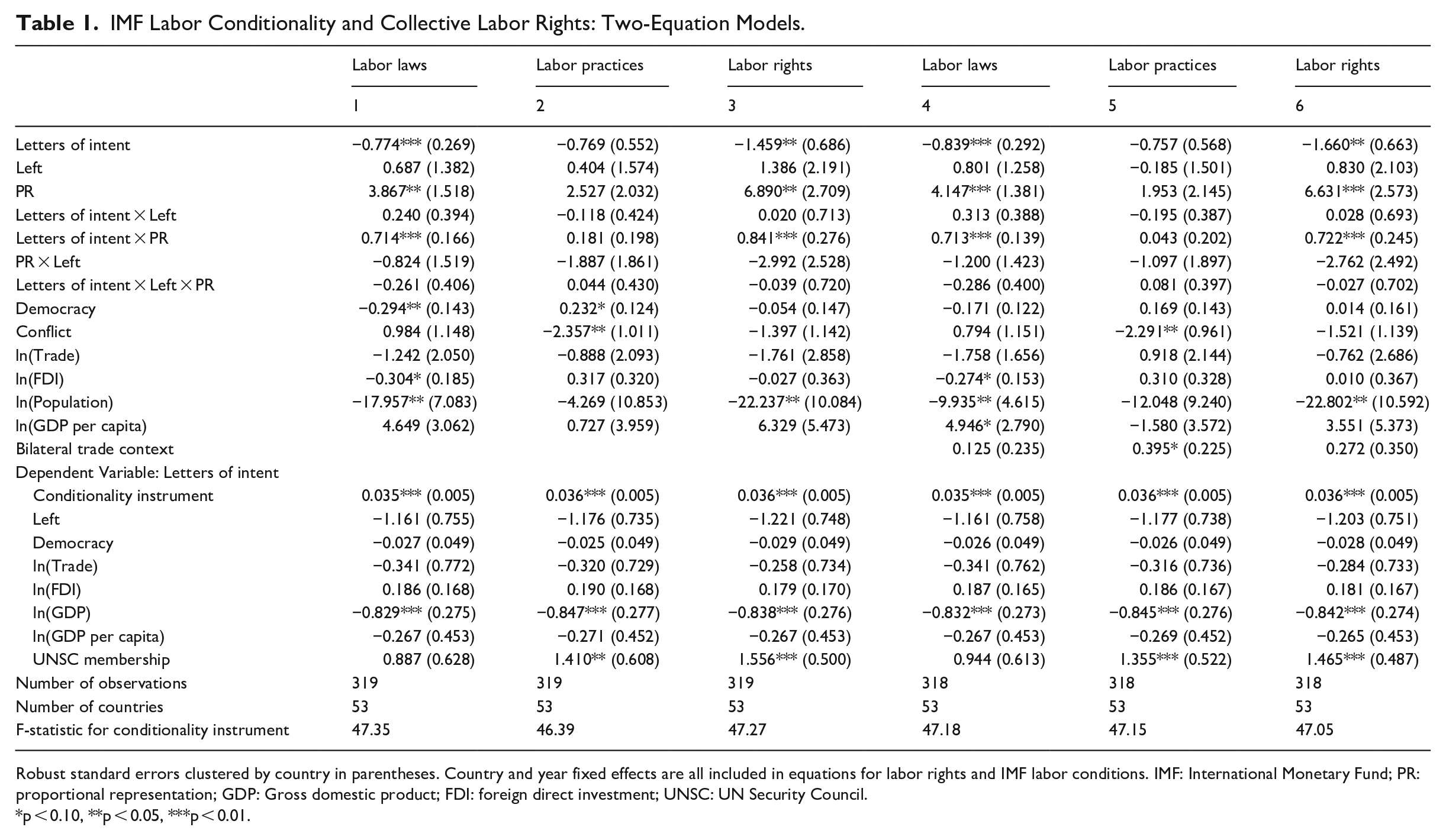
Table 1 provides baseline results from two-equation models for the relationship between IMF labor conditionality and collective labor rights. Since we do not consider endogeneity of IMF participation, models in Table 1 are restricted to countries that have participated in IMF programs.
IMF Labor Conditionality and Collective Labor Rights: Two-Equation Models.
Robust standard errors clustered by country in parentheses. Country and year fixed effects are all included in equations for labor rights and IMF labor conditions. IMF: International Monetary Fund; PR: proportional representation; GDP: Gross domestic product; FDI: foreign direct investment; UNSC: UN Security Council.
p < 0.10, **p < 0.05, ***p < 0.01.
The lower half of Table 1 reports the determinants of IMF labor conditionality. We find that our instrument is strongly correlated with the stringency of labor conditions included in IMF programs, as coefficients for Conditionality instrument are consistently positive and significant across models. The Kleibergen-Paap F-statistics range from 46.39 to 47.35, suggesting that our conditionality instruments effectively meet benchmarks for strong instruments (Staiger and Stock, 1997; Stubbs et al., 2020). Negative and significant coefficients on the log of GDP suggest that IMF labor conditions are less intrusive if a borrowing country has a large economy. Nevertheless, positive and significant coefficients for UNSC membership do not support the argument that temporary members of the UNSC receive more favorable loan conditions (Dreher et al., 2015).
The upper half of Table 1 presents the results from the labor rights equation, controlling for endogeneity of IMF labor conditionality. Models 1–3 estimate the determinants of Labor laws, Labor practices, and Labor rights, respectively. Models 4–6 add Bilateral trade context generated for each measure of collective labor rights. All models include multiplicative interaction terms between Letter of Intent, PR, and Left, as we hypothesize that the effects of IMF labor conditionality on labor rights are mediated by electoral systems and government partisanship. For instance, the marginal effect of Letters of intent on Labor laws in Model 1 can be expressed by equation (1).

As both PR and Left are dummy variables coded as 0 or 1, equation (1) suggests that a one-unit increase in Letters of intent reduces the value of Labor laws by 0.774 point, if borrowing countries have neither closed-list PR systems nor left governments. The effect of Letters of intent on Labor laws, however, changes to −0.534 in countries with left governments without closed-list PR. In countries with closed-list PR, the effect of labor conditionality becomes −0.081 and −0.06 with and without left governments, respectively. Such patterns remain consistent in Models 3–4 and 6, suggesting that the negative impact of IMF labor conditionality on labor rights is mitigated when electoral systems and/or government parties are more responsive to the interest of labor. For instance, Model 4 shows that when we control for the diffusion of labor standards across countries, the estimated coefficient for Letters of intent becomes −0.839 without both closed-list PR and left governments. The extent to which Letters of intent reduces Labor laws itself becomes −0.526 or −0.126, as Left or PR takes the value of 1, respectively. The marginal effect of Letters of intent on Labor laws becomes −0.099 when borrowing countries have left governments with closed-list PR.
The results in Table 1 warrant in-depth discussion. Traditional regression tables generated from interaction models tell us little about the significance of the findings, as they merely show the statistical significance of parameters relevant for the specific values of conditioning variables (Brambor et al., 2006). To examine whether the estimated marginal effects of explanatory variables have meaningful information, we should consider changes in their standard errors and confidence intervals across a range of conditioning variables (Franzese and Kam, 2009).
Table 2 reports how the marginal effects of IMF labor conditionality on collective labor rights vary across electoral systems and government partisanship with standard errors, t-statistics, and 95% confidence intervals. Table 2 shows that the effects of Letters of intent on Labor laws and Labor rights are all negative and statistically distinguished from zero with 95% confidence intervals, when right-wing parties hold the executive office without a closed-list PR system. All models except models 2 and 4 show that the magnitude of the reductive effects of Letters of intent becomes smaller under left-center governments and declines further with closed-list PR regardless of government partisanship. When PR is in place, the effects of Letters of intent are not distinguishable from zero, suggesting that the increase of IMF conditionality would no longer exert negative consequences on labor rights. In sum, Tables 1 and 2 suggest that the stringency of IMF labor conditionality decreases Labor laws and Labor rights most significantly if domestic political institutions in borrowing countries do not effectively represent the collective interests of workers and unions. The results also show that IMF labor conditionality has no significant association with Labor practice, suggesting the actual implementation of labor rights might depend on domestic regulatory capacity (Greenhill et al., 2009).
Marginal Effects of IMF Labor Conditionality: Two-Equation Models.

IMF: International Monetary Fund; SE: standard error; PR: proportional representation.
The results in Tables 1 and 2 remain robust when we re-estimate two-equation models with another conditionality instrument that equals an interaction between the country-specific average of IMF labor conditions and the natural log of IMF liquidity ratio as a proxy for the budget constraint in a given year (Stubbs et al., 2020). As shown in Tables A2 and A3 in the online appendix, the reductive effect of Letters of intent on Labor laws and Labor rights becomes the largest in magnitude under right-wing governments without closed-list PR. With left-center governments and/or list-PR systems, the degree to which IMF labor conditions reduce Labor laws and Labor rights itself declines and becomes indistinguishable from zero.
Table 3 presents the results from three-equation models that address the determinants for collective labor rights, IMF labor conditions, and program participation. Table A4 in the online appendix reports variation in the marginal effects of labor conditionality on three measures of labor rights with standard errors, t-statistics, and 95% confidence intervals. The results strongly support our hypotheses that the negative effects of IMF labor conditionality on labor rights are mitigated with the presence of closed-list PR systems and left governments. In Table 3, coefficient estimates for Conditionality instrument and Participation instrument with their F-statistics suggest that our models properly address endogenous selection into IMF labor conditionality and participation. In Table 3 and Table A4 of the online appendix, model 1 shows that a one-unit increase in Letters of intent decreases the Labor laws measure by 0.876 point in countries without both closed-list PR and left governments. The marginal effect of Letters of intent, however, changes to −0.556 or −0.119, if borrowing countries have only either left governments or closed-list PR, respectively. Under left governments with closed-list PR, the reductive effect of Letters of intent becomes the smallest in magnitude (= –0.086). Model 6 in Table A4 of the online appendix shows that without closed-list PR systems, the marginal effects of Letters of intent on Labor rights are −1.902 and −1.878 under right and left governments, respectively, and that they are both statistically significant with 95% confidence intervals. With the presence of closed-list PR, their magnitude declines and becomes statistically indistinguishable from zero. These findings suggest that electoral systems might play a more important role in mitigating the negative effects of IMF labor conditionality on collective labor rights than government partisanship.
IMF Labor Conditionality and Collective Labor Rights: Three-Equation Models.

Robust standard errors clustered by country in parentheses. IMF: International Monetary Fund; PR: proportional representation; GDP: gross domestic product; FDI: foreign direct investment; UNSC: UN Security Council.
p < 0.10, **p < 0.05, ***p < 0.01.
Figure 1 graphically displays the results in Table 3 and Table A4. Here we once again show that the extent to which IMF labor conditionality decreases Labor laws and Labor rights itself is the greatest under right-wing governments without closed-list PR. The adverse effects of conditionality are mitigated with left-center governments and decline further with closed-list PR. In countries with both closed-list PR and left governments, the reductive effect of Letters of intent on Labor laws and Labor rights becomes the smallest in magnitude and indistinguishable from zero with 95% confidence intervals. The results of three-equation models remain robust and consistent when country fixed effects are included in the IMF participation equation (Table A5 in the online appendix) and when we use the log of the IMF’s liquidity ratio as a proxy for the budget constraint for compound instruments for conditionality and participation (Table A6 in the online appendix). Details on the substantive interpretation of these results are available in Tables A7 and A8 of the online appendix.
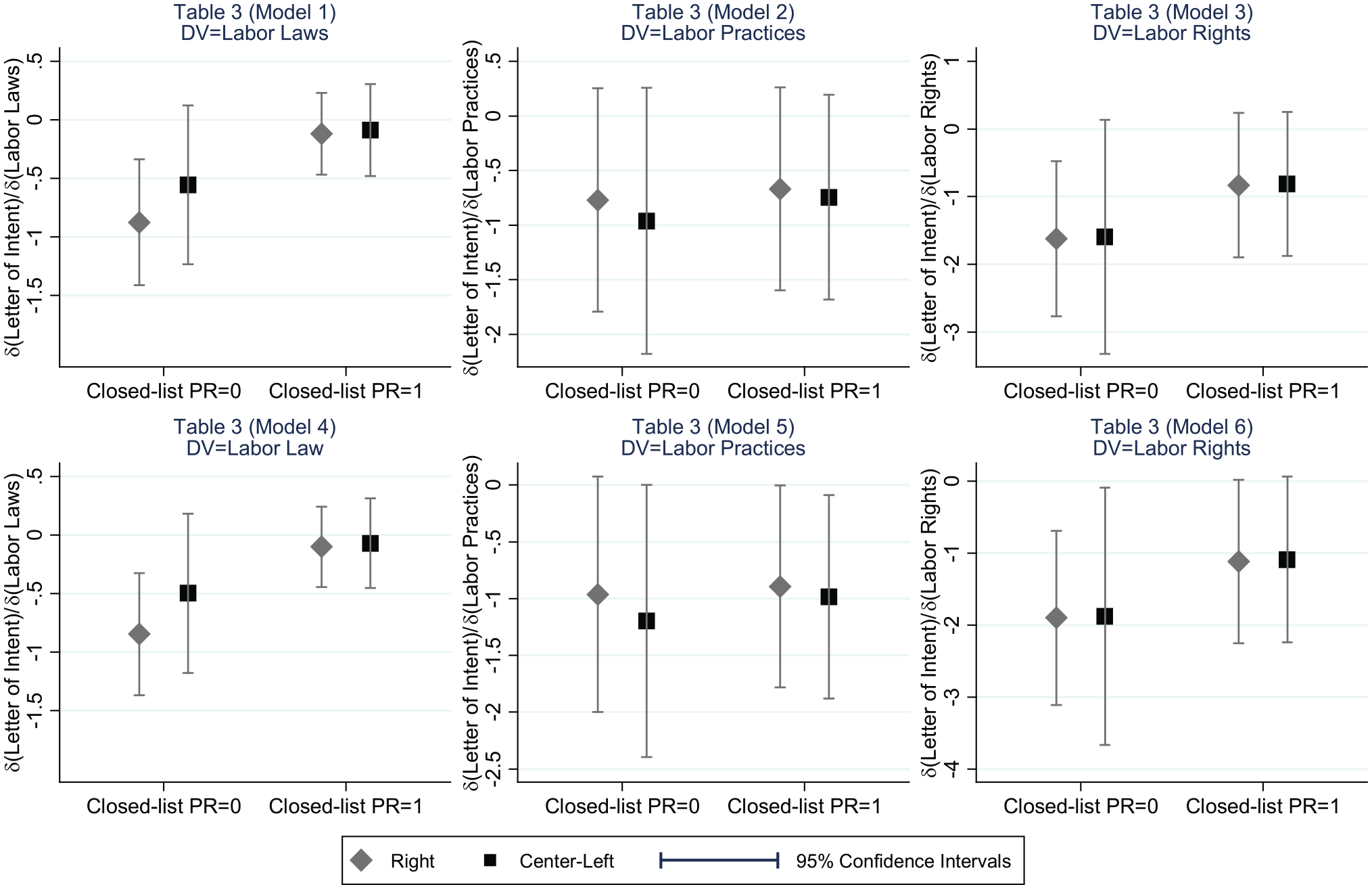
Marginal Effects of IMF Labor Conditionality: Three-Equation Models.
The Mosely-Uno data employed so far allow us to examine the effects of IMF labor conditions on de jure and de facto protection of collective labor rights but the data only cover the period of 1985–2002. Thus, we extend our findings using alternative data sources. We draw a measure of hard conditions on labor issues from the IMF conditionality data constructed by Kentikelenis et al. (2016). We employ Collective labor rights, Individual labor rights, and Aggregate labor rights from the Center for Business Research’s (CBR) Labor Regulation Index (Adams et al., 2016) and Worker rights from the Cingranelli-Richards (CIRI) Human Rights Data Project (Cingranelli et al., 2014). Instead of using dichotomous variables of closed-list PR and government partisanship, we create a continuous variable (= Labor representation) that equals an interaction between proportionality and government partisanship. 3
Due to space constraints, the results from these robustness checks are reported in Table A9 and Figure A1 in the online appendix. The results also include Labor laws as a dependent variable for comparison. Here we find that hard conditions on labor issues in IMF programs exert significant negative effects on Labor laws, Individual labor rights, Aggregate labor rights, and Worker rights, controlling for endogenous selection into IMF conditions and participation. In Figure A1 in the online appendix, however, the positive slopes of marginal effect lines with 95% confidence intervals suggest that the negative associations between IMF labor conditions and labor rights measures are mitigated, as the value of Labor representation increases. These findings suggest that the adverse impact of IMF labor conditionality declines in magnitude when domestic political systems institutionalize the political representation of labor more effectively.
Our key results support Reinsberg et al.’s (2019) findings that IMF labor conditions reduce collective and individual labor rights in borrowing countries, controlling for the endogeneity of IMF conditionality and participation. There are some important differences worth mentioning. Reinsberg et al. (2019) see the strength of organized labor as an important factor mitigating IMF programs’ downward pressures on labor rights. However, we emphasize that it is domestic political institutions that mediate the effects of IMF conditionality on various measures of labor rights, as they shape policymakers’ incentives to respond to the collective interests of workers and unions.
Conclusion
While there have been multiple calls for and emphasis on more inclusive and balanced growth by the IMF, the actual materialization of inclusive and balanced growth seems hard to obtain. 4 For instance, in early 2011, when then managing director of the IMF, Dominique Strauss-Kahn, and then World Bank president, Robert Zoellick, met a delegation of the ITUC (2013) in Washington, they repeated the rhetoric that these Bretton Woods institutions are committed to “broaden the distribution of economic growth while extending social protections.” 5 However, beyond repeated declarations of intent, it is uncertain how concrete measures would be taken to achieve such goals.
While Mr. Zoellick promised that the World Bank will consult with unions at national and global level to protect core labor standards and worker protection, one of the publications of the World Bank, “Doing Business” still punishes those countries that provide better workers’ rights protection. The Guardian article reports: Despite the crisis, the 2011 (Doing Business) report still penalises those countries that require contributions by employers for unemployment insurance, workers’ compensation, pensions, maternity leave or other social protection programmes. . . . countries that introduced social security contributions, such as, for example, Cambodia, were seen as business-unfriendly, while regimes such as Belarus were highly ranked for making it easier to eliminate jobs, even though the country had already lost its preferential trade status with the European Union for violating fundamental workers’ rights such as freedom of association and collective bargaining. . . . In the 2010 edition of Doing Business, the “top reformer” prize was won by Rwanda, because employers were no longer required to consult with the employees’ representatives or notify the labour inspector before announcing job cuts.
6
Our analysis here provides empirical support for the more popular characterization of the negative effect of the IMF on workers than the version the IMF hopes for. Two key findings have emerged. First, IMF labor conditions, not surprisingly, affect workers’ rights negatively. The stringency of labor conditions in IMF loan documents is significantly and negatively associated with a country’s level of respect for collective labor rights. This is consistent with empirical findings by earlier studies on the IMF programs’ effects on labor rights. Yet second, the negative effect of IMF labor conditions can be partially mitigated in the implementation process. Our findings consistently show that the degree to which IMF conditionality undermines collective labor rights itself becomes much smaller in closed-list PR settings and becomes minimized with the combination of list-PR systems and left-center governments.
The findings suggest that government partisanship might not be sufficient for explaining the ways in which IMF and conditionality affect levels of respect for labor rights in borrowing countries. We show that electoral systems, especially closed-list PR, serve as one important mechanism that not only enhances the political representation of labor institutionally but also allows better government responsiveness to labor’s demands, when the IMF demands the structural reforms of labor market institutions as loan conditions.
By proposing a theoretical argument of how domestic political institutions condition the effect of labor conditionality on labor rights and providing empirical support for the argument, this study makes a valuable academic contribution to the study of labor rights, political institutions, and a powerful international institution, the IMF. In doing so, this article encourages students of international institutions to think deeply about how domestic politics interacts with influences of international institutions to shape political, economic, and social outcomes of interest. It also further demonstrates merits of examining disaggregated conditionality that most recent studies of IMF programs adopt.
Supplemental Material
sj-docx-1-psx-10.1177_0032321720905318 – Supplemental material for IMF = I’M Fired! IMF Program Participation, Political Systems, and Workers’ Rights
Supplemental material, sj-docx-1-psx-10.1177_0032321720905318 for IMF = I’M Fired! IMF Program Participation, Political Systems, and Workers’ Rights by Su-Hyun Lee and Byungwon Woo in Political Studies
Footnotes
Declaration of Conflicting Interests
The author(s) declared no potential conflicts of interest with respect to the research, authorship, and/or publication of this article.
Funding
The author(s) disclosed receipt of the following financial support for the research, authorship, and/or publication of this article: Su-Hyun Lee wishes to thank S. Rajaratnam School of International Studies, Nanyang Technological University, for generous financial support. Byungwon Woo’s research was supported by the Yonsei University Research Fund of 2019-22-0017.

Supplemental Information
Additional supplementary information may be found with the online version of this article. Table A1. Summary Statistics. Table A2. Estimation of Two-Equation Models with an Alternative Conditionality Instrument. Table A3. Marginal Effects of Letters of Intent: Two-Equation Models in Table A2. Table A4. Estimating Marginal Effects of Letters of Intent: Three-Equation Models in Table 3. Table A5. Estimation of Three-Equation Models with Country-Fixed Effects in the IMF Participation Equation. Table A6. Estimation of Three-Equation Models with Alternative Compound Instruments. Table A7. Estimation of Marginal Effects of Letters of Intent in Table A5. Table A8. Estimation of Marginal Effects of Letters of Intent in Table A6. Table A9. Estimating the Effects of IMF Labor Conditions on Alternative Measures of Labor Rights. Figure A1. Marginal Effects of IMF Labor Conditions on Alternative Measures of Labor Rights.
Notes
Author Biographies
References
Supplementary Material
Please find the following supplemental material available below.
For Open Access articles published under a Creative Commons License, all supplemental material carries the same license as the article it is associated with.
For non-Open Access articles published, all supplemental material carries a non-exclusive license, and permission requests for re-use of supplemental material or any part of supplemental material shall be sent directly to the copyright owner as specified in the copyright notice associated with the article.
